
In this article
Dead hangs are the most recommended climbing training exercise you will hear about and the one most commonly done wrong. The basic movement looks simple — hang from a bar or hangboard edge, hold on, let go. But what the hang actually trains depends entirely on how you do it, what you hang from, and whether your connective tissue is ready for the load. Done well, dead hangs build the finger strength and shoulder integrity that separates climbers who plateau from climbers who keep improving. Done wrong, they put new climbers on the injured list.
This guide covers what dead hangs actually develop, the distinction between passive and active hanging that most instruction skips, the five-stage progression from first hang to weighted hangs, and how to program them into a climbing week without overtraining.
Quick Answer: Here’s how to build a dead hang progression for climbing:
- Start with a 20mm edge dead hang for 10 seconds — if that’s hard, begin with a pull-up bar
- Progress to 20mm for 3 × 10 seconds with full recovery between sets before moving smaller
- Practice active hanging (scapulae depressed and packed) rather than passive hanging from day one
- Move to an 18mm edge only after 3 × 15 seconds on 20mm feels controlled
- Add weight only after you can dead hang on a 12–14mm edge for 10 seconds with no shoulder shrug
- Schedule hang training on fresh days — not after climbing sessions — to allow connective tissue to adapt
What Dead Hangs Actually Train (And What They Don’t)
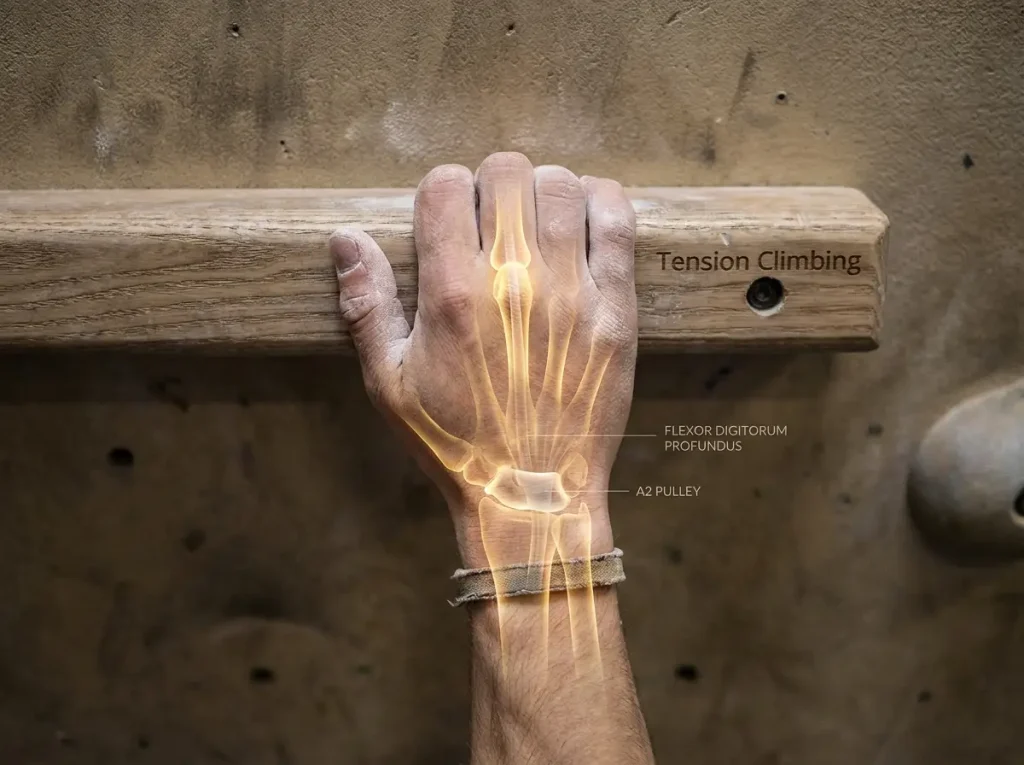
The common description of dead hangs is “grip strength training.” That’s accurate but incomplete, and the incomplete version leads to training decisions that miss most of the exercise’s value.
Finger flexor tendon adaptation
The primary target of dead hang training is the flexor digitorum profundus (FDP) and its pulley system — the A2 pulley in particular, which takes the highest load during crimp-grip climbing. Tendons adapt to load more slowly than muscle: where a muscle might show measurable adaptation to training stimulus in two to three weeks, tendon adaptation peaks at eight to twelve weeks for most climbers. This is why dead hang progression has to be slow. You will feel capable of harder hangs before your tendons have adapted to the load you’re already doing. Feeling capable and being ready are different things.
A 2021 randomized controlled trial on hangboard training — one of the most rigorous hangboard studies to date — found significant grip strength improvements across hanging protocols, but also documented that injury rates rose sharply when training load increased faster than tendon adaptation rates would support. The progression matters as much as the training.
Shoulder girdle stability
Dead hangs, when performed correctly with active scapular engagement, build significant rotator cuff and posterior shoulder stability — the kind of shoulder integrity that lets you lock off hard moves, absorb the force of an unexpected foothold pop, and train consistently without accumulating shoulder injuries. This benefit is invisible in the grip-strength framing. It’s real and it matters more than grip alone for climbers who struggle with shoulder fatigue on steep routes.
What dead hangs don’t train well
Pulling strength — the ability to generate force dynamically on climbing moves — is not the primary target of dead hang training. Pulling is trained through campus boarding, lock-offs, and pull-up variations. If you’re doing only dead hangs and expecting it to translate to pulling harder on dynos or completing hard lock-offs, you’re missing a training layer. Dead hangs build the foundation; pulling work builds the application on that foundation.
The Passive vs. Active Hang: The Distinction Nobody Explains
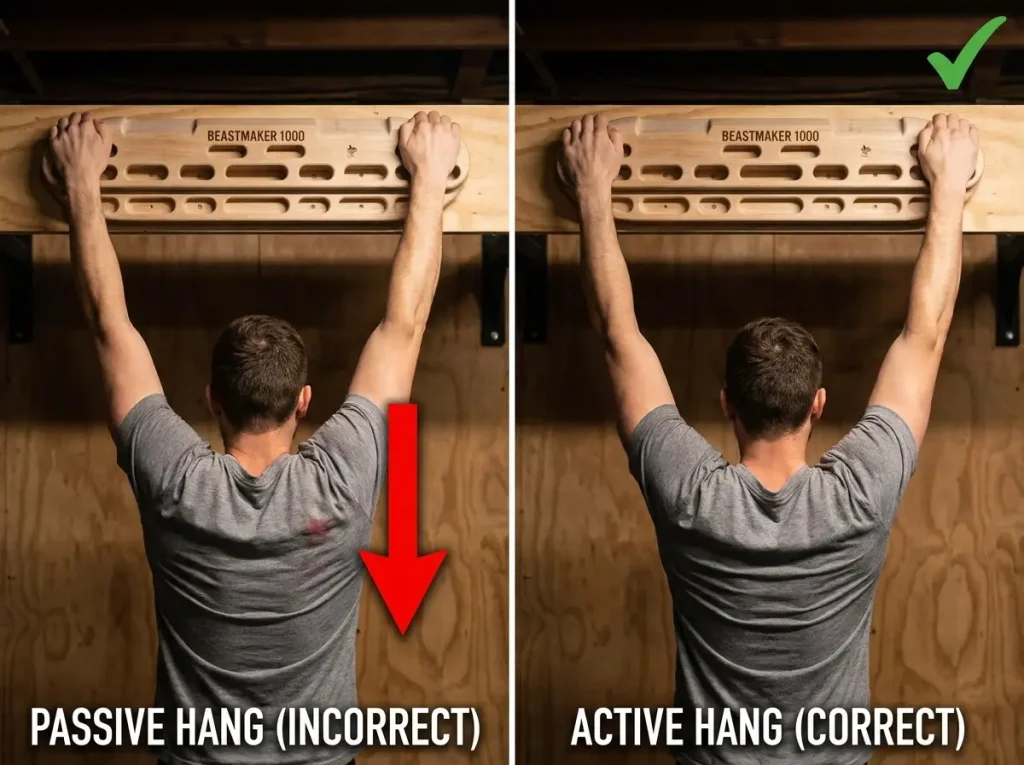
This is the part of dead hang instruction that most guides skip entirely, and it’s why a lot of climbers do years of hanging with limited shoulder benefit and accumulate shoulder discomfort in the process.
What passive hanging looks like
A passive hang occurs when you hang from a bar or edge and let your shoulders rise toward your ears — the shoulder blades wing outward and upward, the shoulder joints take the full load passively, and the muscles around the shoulder girdle contribute nothing. This is what most people do by default, especially beginners. It feels like hanging. It trains finger flexors and nothing else relevant to climbing. Done for extended periods, passive hanging also loads the shoulder joint capsule and rotator cuff in a way that causes discomfort for many climbers over time.
What active hanging looks like
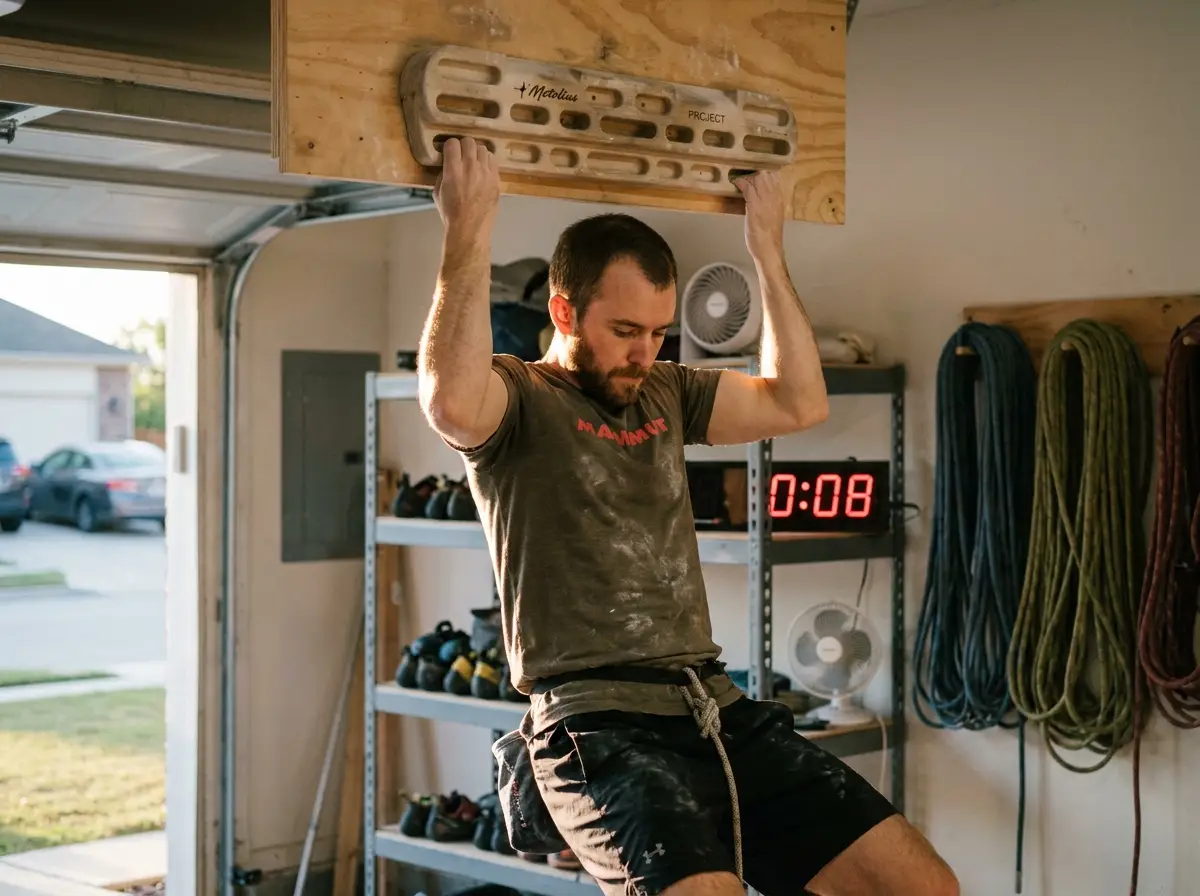
An active hang starts with the same grip position but immediately before taking the full load, you depress and retract your shoulder blades — pull them down and slightly together as if trying to put them in your back pockets. This engages the serratus anterior, lower trapezius, and rhomboids, which stabilizes the shoulder girdle and distributes the hanging load across the muscles that are supposed to be working during climbing. Your shoulders stay away from your ears. Your lats are engaged. The hang looks nearly identical from the outside; the muscular engagement is fundamentally different.
Practice active engagement on a doorframe pull-up bar before touching a hangboard. Hang passively, feel the shoulder rise. Now depress — feel the shoulder drop and stabilize. That shift is what you’re trying to maintain throughout every dead hang session.
Pro tip: If your shoulders ache after hang sessions, you’re almost certainly passive hanging. Spend two weeks focusing only on active hang engagement at comfortable depths before worrying about edge size or duration. The ache will go away and your hang quality will improve.
When You’re Ready to Start Dead Hang Training
This section matters and most training articles skip it in a rush to get to the protocol.
The connective tissue prerequisite
Dead hangs are not a beginner exercise. The loading on finger flexor tendons during a dead hang on a small edge is significant — higher, in terms of force per unit area on the pulley system, than most climbing moves. Beginners whose tendons have not adapted to the stimulus of regular climbing are not ready for concentrated hang training.
The general guideline from climbing training researchers including Eva López — whose hangboard research underpins most modern dead hang protocols — is a minimum of six months of regular climbing before beginning hangboard training. This isn’t arbitrary conservatism. Tendons develop their basic structural adaptation during those six months of climbing. Beginning hangboard training before that adaptation is in place is why new climbers who follow “beginner hangboard programs” frequently pull pulleys and strain tendons within weeks.
If you’ve been climbing regularly for less than a year, the best dead hang training is more climbing. If you’ve been climbing for more than a year and your fingers feel bulletproof on routes, you’re probably ready to start.
Starting edge depth
Begin on a 20mm edge or larger — a rung on a hangboard or a bar at a gym. Not a 15mm edge. Not a 12mm edge. Not a sloper. Twenty millimeters. The smaller the edge, the higher the force concentration on the A2 pulley. At 20mm, you can load the system with partial-crimp grip and begin building adaptation without approaching the injury threshold that smaller edges create in undertrained tendons.
The Dead Hang Progression: 5 Stages
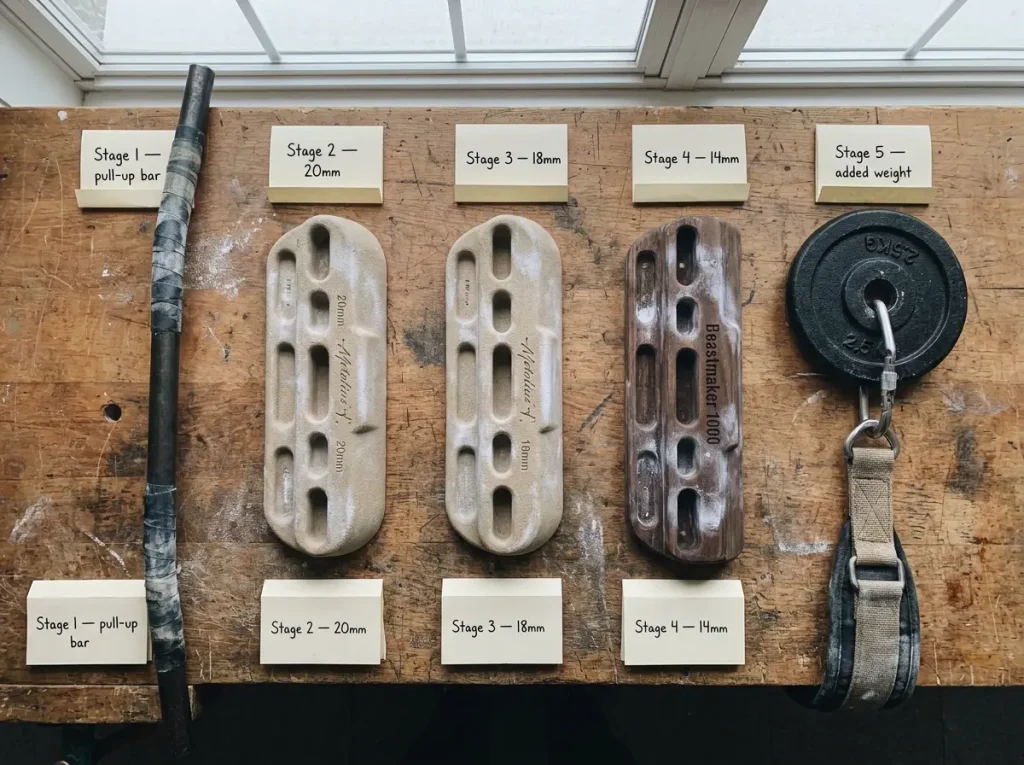
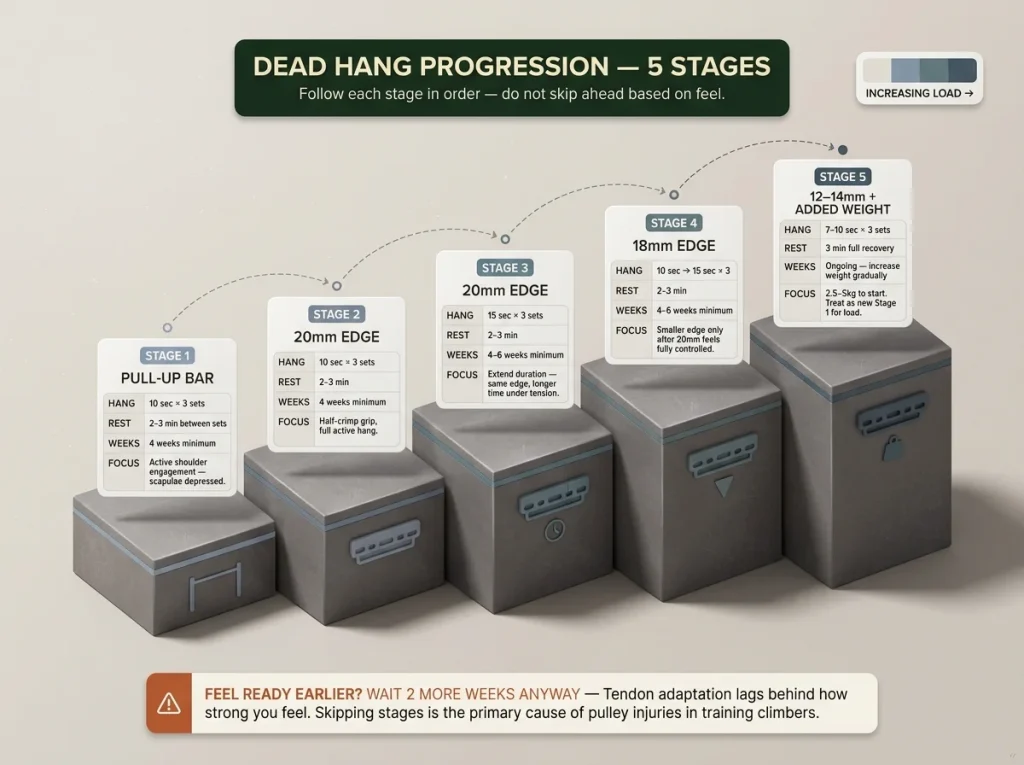
These stages are intentionally conservative. If you want to jump ahead because a stage feels easy, wait two more weeks and then reassess. The injury timeline for finger tendons is “fine for a while, then suddenly not” — the connective tissue builds up load tolerance slowly, and the threshold failure isn’t predictable from feel alone.
Stage 1 — Pull-up bar, 10 seconds × 3 sets
Hang from a standard pull-up bar with active scapular engagement. Hold 10 seconds, rest 2–3 minutes, repeat three times. Focus entirely on the active hang position. Do this twice per week for four weeks before moving to a hangboard. This builds shoulder engagement habit and begins tendon stimulus at the most forgiving load.
Stage 2 — 20mm edge, 10 seconds × 3 sets
Move to the 20mm edge on a hangboard. Same protocol: 10 seconds, 3 minutes rest, 3 sets. Half-crimp grip (proximal knuckle flexed, middle phalanx extended, no thumb wrap over fingers). Four weeks at this stage, twice per week, before extending duration.
Stage 3 — 20mm edge, 3 × 15 seconds
Extend each hang to 15 seconds at the same edge. The added duration increases time under tension and advances tendon adaptation. Do this for four weeks. If any set produces a sharp or pulling sensation in the finger tendons — not the general ache of loaded muscle, but a specific tendon sensation — pull back to 10 seconds and give two additional weeks before trying again.
Stage 4 — 18mm edge, 3 × 10 seconds
A 2mm edge reduction is a significant load increase. Move to 18mm only after Stage 3 feels completely controlled. Run the same protocol: 10 seconds, 3 minutes rest, 3 sets, twice per week. Build to 15 seconds at 18mm over four to six weeks before dropping further. For most climbers, getting to a controlled hang on a 15mm edge at bodyweight is where meaningful climbing-specific strength gains start to show up in performance.
Stage 5 — Added weight
Adding weight is appropriate only when you can hang a 12–14mm edge for 10 seconds with controlled active form and no compensating shoulder shrug. Use a weight belt, dip belt, or a small plate in a stuff sack — something that loads evenly. Start with 2.5–5kg and treat the weighted hang as a new Stage 1: same conservative duration, same rest intervals, same four-week patience before increasing load.
For how dead hang training integrates with a broader training program, the bouldering plateau guide covers training stimulus and adaptation in the context of breaking through performance ceilings — the same principles that govern hangboard periodization.
Edge Depth, Grip Position, and What to Train First
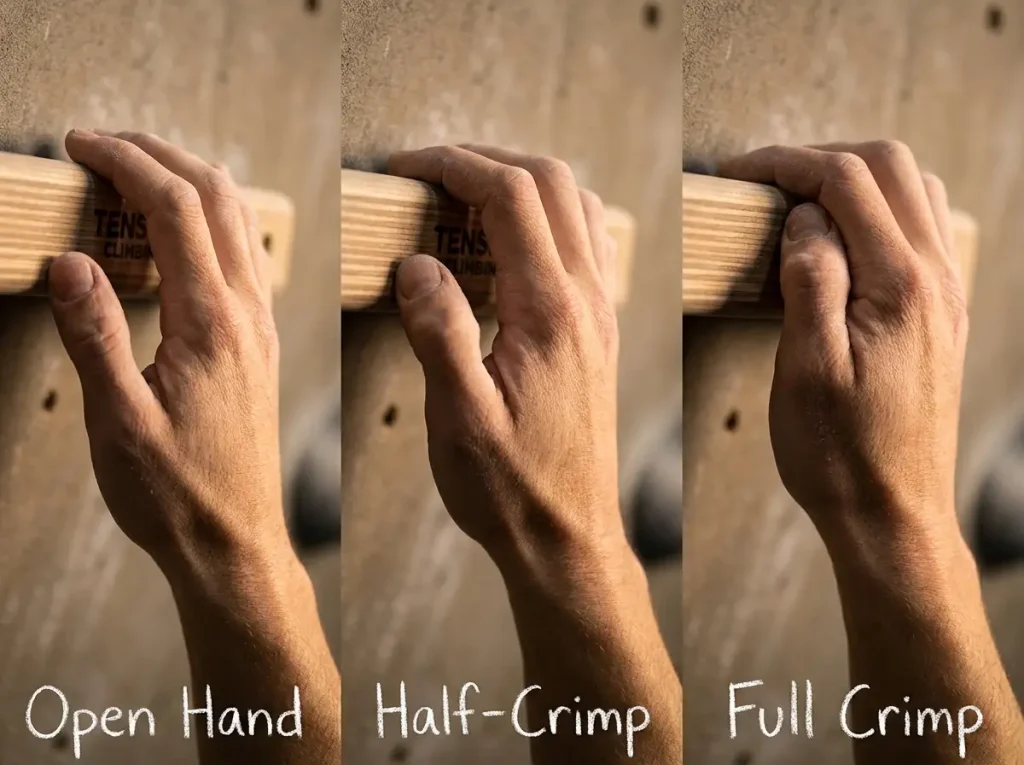
These decisions affect both training effectiveness and injury exposure.
Half-crimp vs. full crimp vs. open hand
Half-crimp (proximal knuckle bent, middle phalanx extended) is the standard training position for most dead hang work. It loads the A2 pulley moderately and corresponds to the grip most climbers use naturally on edges. Full crimp (all knuckles bent, thumb occasionally wrapping) generates higher force but also significantly higher pulley loads — not appropriate for beginners or for hang training on small edges until you’re well into Stage 4 or 5. Open hand (all fingers extended at the middle knuckle) places lower load on the A2 pulley and is the grip position recommended by most sports medicine researchers for beginners specifically because of this. Some coaches recommend training primarily open hand to build the grip that has the lowest injury profile while still developing meaningful strength.
Start wider than you think
Most new hangboard users start too small. The 20mm starting point feels embarrassingly large to climbers who’ve seen training content featuring elite climbers on 8mm edges. Use the large edge. You’re training the adaptation, not the strength ceiling, and you’ll get there faster by not skipping foundational work.
Programming Dead Hangs Into Your Climbing Week
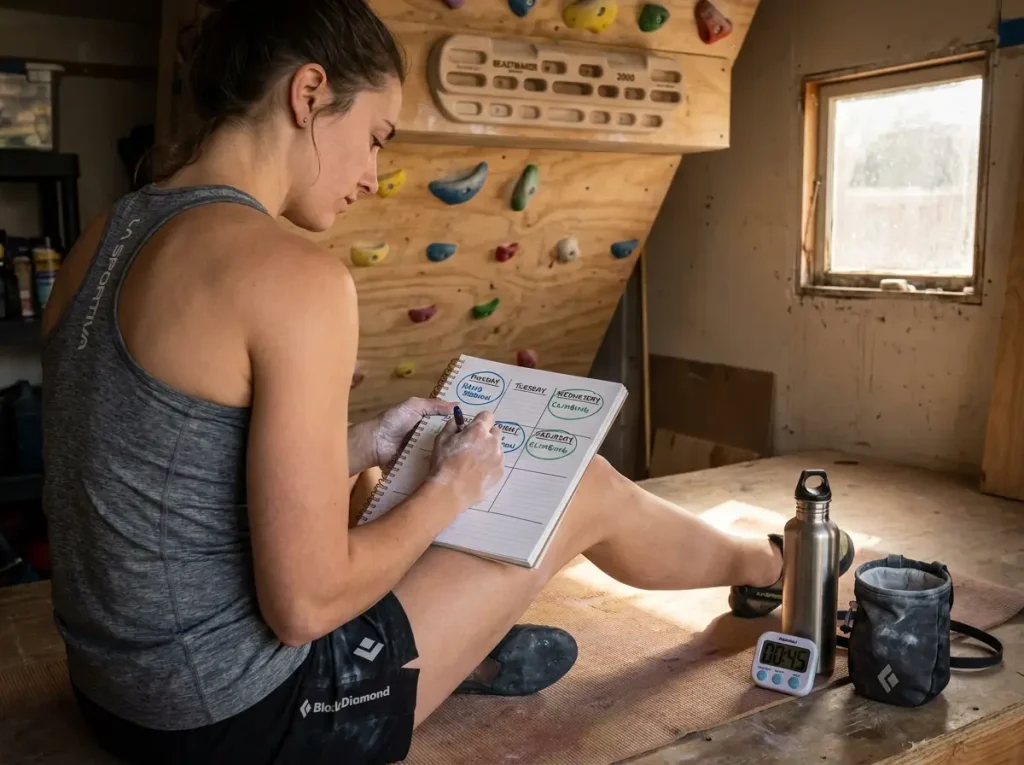
Connective tissue requires 48–72 hours to recover from concentrated loading. The practical programming rule: dead hangs go on days when you’re not climbing hard, never immediately before or after a limit climbing session.
Two-session-per-week template
For most recreational climbers doing three to four climbing days per week, two hangboard sessions per week on rest days or lighter days is the correct load. More than this creates cumulative tendon stress that outpaces adaptation, especially in the first six months of hangboard training.
A simple template that works: Monday — hangboard session. Wednesday — climbing. Friday — hangboard session. Saturday/Sunday — climbing. Adjust to your schedule, but maintain at least one full rest day between hang sessions and don’t hang the day before your hardest climbing day.
Warm-up before hanging
Hanging cold tendons are at higher injury risk. Spend ten minutes warming up: light aerobic activity to raise general temperature, then five to ten minutes of easy climbing or warm-up hangs on large edges (40mm+) before touching any training edges. The warm-up is not optional. The climbing performance plateau guide covers periodization principles that apply directly to structuring hangboard training across a training cycle.
Common Dead Hang Mistakes That Cause Finger Injuries
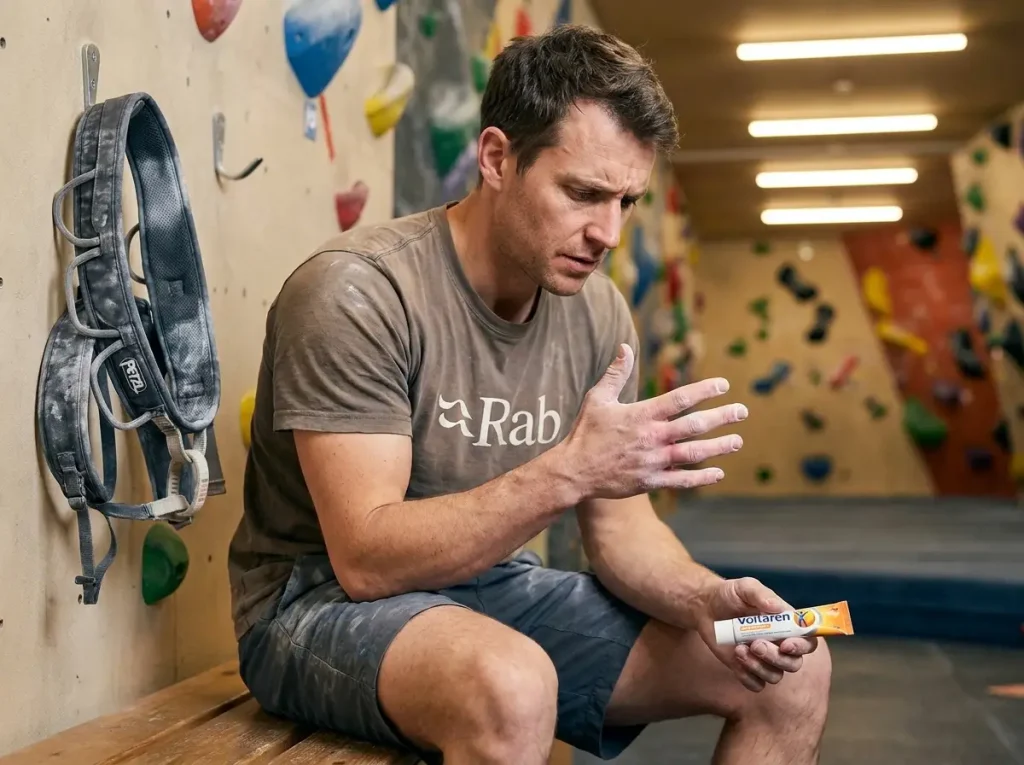
Training through a pulley strain
A pulley strain produces a specific sensation: a localized, sharp or dull ache on the palm side of a finger, usually at the base or middle segment, that worsens under load. It often comes with mild swelling and a faint snap or pop sensation at the moment of injury. If you feel this during a hang, stop immediately. The reflexive response — “it’s probably nothing, I’ll keep going” — is how a Grade 1 pulley strain becomes a Grade 2. Take two weeks complete rest from finger loading, then reassess. Use that time on open-hand hangs at very large edges or general fitness work.
Too much volume too soon
The enthusiasm error: starting a hang protocol and doing five sets instead of three because it felt easy. Tendon adaptation doesn’t care how the session felt. Do the prescribed number of sets at the prescribed intensity, rest fully between sessions, and trust the slow timeline. The climbers who add volume based on how a session felt are the climbers who get hurt at week six of a twelve-week program.
Skipping rest between sets
The 2–3 minute rest between sets in a dead hang protocol is not a guideline — it’s the recovery time the tendon needs to clear metabolic waste and approach baseline recovery before the next set. Hanging every 60 seconds because “that’s what I do for pull-ups” trains muscular endurance at the cost of tendon integrity. Set a timer. Wait the full rest.
The ice climbing fitness training plan covers periodization for full climbing training programs, including how to taper and peak hangboard training around climbing objectives and rest cycles.
Conclusion
Dead hangs work. The research is solid, the results are real, and the exercise is accessible to most climbers who are past their first year on the wall. What makes the difference between climbers who build strength through hang training and climbers who get hurt doing it is almost entirely in the details: active vs. passive, 20mm before 15mm, 10 seconds before 15, full rest between sets.
Start conservative. Stay there longer than feels necessary. Add load based on a timeline, not a feel. The finger strength that makes hard climbing possible is built in months, not weeks — and it’s built reliably when the progression is followed rather than skipped.
Q1 Are dead hangs good for beginner climbers?
Not in the conventional sense. Beginners — climbers with less than six to twelve months of regular climbing — should build finger tendon adaptation through climbing itself before beginning hangboard work. The concentrated load of dead hangs on undertrained connective tissue is a common cause of early climbing injuries. If you’re a beginner and you want to hang, use a pull-up bar with active shoulder engagement and focus on that foundation.
Q2 How long should a dead hang be?
Start with 10 seconds per set. Build to 15 seconds at the same edge depth before reducing edge size. In later stages, 7–10 second hangs with added weight are standard. Duration in dead hang training is a secondary variable to edge depth and grip position; extend duration at a given edge before moving to a harder one.
Q3 What edge size should I start dead hangs on?
Twenty millimeters (20mm) is the standard starting point. This feels large, and that’s appropriate. The smaller the edge, the higher the force concentration on your A2 pulley system. Move to 18mm only after 3 × 15 seconds on 20mm feels completely controlled and your finger tendons have had at least four to six weeks to adapt.
Q4 Can I do dead hangs after a climbing session?
It’s not recommended, especially for climbers newer to hang training. Your finger tendons have already taken significant load during climbing. Stacking concentrated hang training on top of that load increases cumulative stress past what adaptation can absorb. Schedule hang sessions on lighter climbing days or rest days.
Q5 How do I know if I have a pulley injury from dead hangs?
Localized pain on the palm side of a finger — usually at the first or second finger segment — that increases under load and may come with mild swelling is the typical pulley strain presentation. A Grade 1 strain often feels like a vague ache; Grade 2 involves more specific pain and reduced range of motion; Grade 3 is severe pain and significant strength loss. When in doubt, stop training and see a sports medicine physician or physical therapist familiar with climbers. Don’t train through it.
Safety Notice: Rock climbing and mountaineering are inherently high-risk
activities that can involve physical trauma or fatal incidents. The information on Rock Climbing Realms is for
educational and informational purposes only. Techniques and advice presented here are not a substitute
for professional, hands-on instruction. Conditions and risks vary by location. Always seek guidance
from a qualified instructor before attempting new techniques. By using this website, you agree that you
are solely responsible for your own safety. Any reliance you place on this information is strictly
at your own risk, and you assume all liability for your actions. Rock Climbing Realms and its authors
will not be held liable for any harm, damage, or loss sustained in connection with the use of this information.
Affiliate Disclosure: We are a participant in the Amazon Services LLC Associates Program, an
affiliate advertising program designed to provide a means for us to earn advertising fees by advertising and linking
to Amazon.com. As an Amazon Associate, we earn from qualifying purchases. We are also an official affiliate partner
of Black Diamond Equipment via the AvantLink network. If you click on a Black Diamond affiliate link and make a
purchase, we may earn a commission at no additional cost to you. We also participate in other affiliate programs.
Additional terms are found in the terms of service.