
In this article
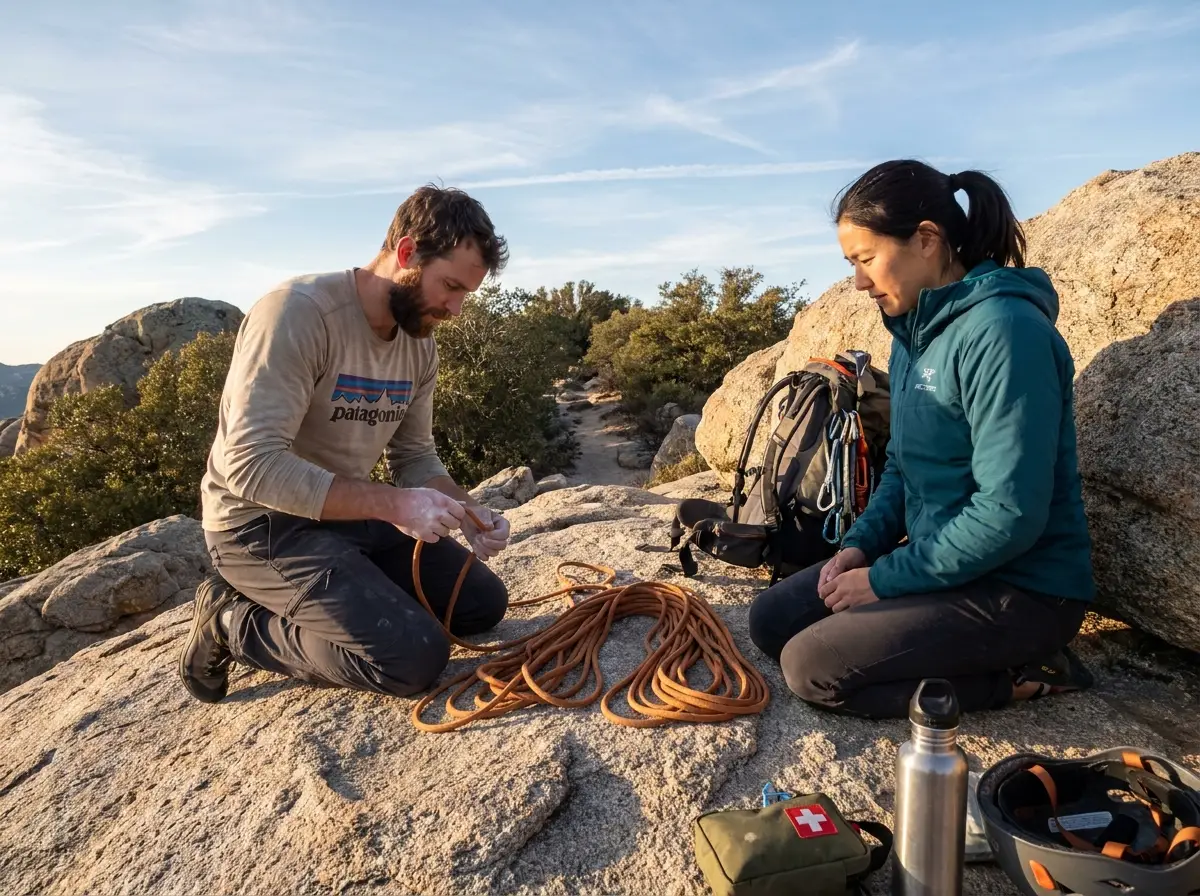
Your partner just hit the ledge on the way down. You got to her in under a minute, and she’s conscious, but her left ankle is sitting wrong and she can’t put weight on it. You’re four miles from the trailhead on an approach with no cell service. You have a rope, some slings, a sleeping pad, and three other people. That’s actually enough — if you know what you’re doing before panic takes over.
I’ve been involved in three crag evacuations over the years, and the thing that separates a clean extraction from a chaotic one is almost never gear. It’s whether someone steps up in the first two minutes and runs a real assessment before anyone touches the patient. After that, building a stretcher is just rope work.
Here’s exactly how to handle it, from the moment your partner hits the ground to the moment you hand them off to SAR.
Quick Answer: Here’s how to build and use an improvised stretcher at the crag:
- Assess the scene for hazards before approaching the patient
- Run a quick ABCDE check and decide whether moving is safe
- Choose your stretcher type based on available gear
- Build a rope litter using clove hitches woven across two rigid poles
- Integrate slings and runners from your rack to reinforce the frame
- Load and secure the patient with webbing before carrying
- Coordinate a 4-person carry with a designated team leader calling the steps
Before You Build Anything: Assess the Scene First
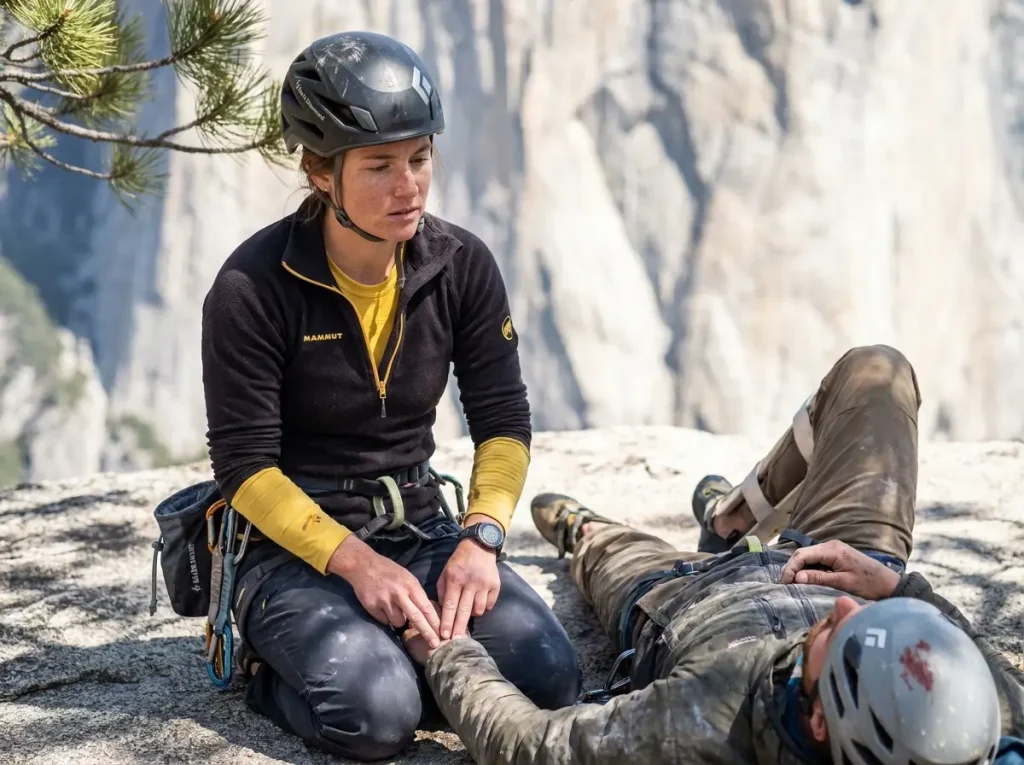
The fastest way to make a bad situation worse is to rush the patient before you’ve checked the area. Rock below an active climbing route is not automatically safe. Look up before you run in. A second rockfall, a loose rope end, an unstable boulder — these are real hazards at an accident scene.
Check the immediate area for hazards
Walk a ten-second perimeter before you touch anyone. Are you under the fall zone? Is the rope still running through protection that could shift? Is there anything overhead that moved during the fall? If the area is actively hazardous, your first job is getting yourself and the patient out of that zone — which changes the spinal calculus immediately, but we’ll get to that.
Run a quick ABCDE check on the patient
Airway — Is it open? If the patient is face-down and unconscious, that matters more than anything else right now. Breathing — Are they breathing normally? Circulation — Any visible severe wounds? Disability — Can they tell you their name and what happened? Are they moving all limbs? Exposure — Hypothermia risk, especially if they’re on cold rock in wet clothes.
This takes ninety seconds. Do it every time.
The move-vs.-stay decision
Here’s the real question you’re answering in that first two minutes: is this person safer staying where they are, or safer being moved? The answer isn’t always “don’t move them.” A patient with a suspected spinal injury sitting in a rain-pooled ledge in dropping temperatures faces a genuine hypothermia risk. According to the Wilderness Medical Society’s 2024 spine management guidelines, prolonged exposure to environmental hazards can pose a greater threat than movement performed with reasonable spinal precautions.
If the patient is alert and oriented, can describe their symptoms clearly, and has no neurological signs — weakness, numbness, tingling in the extremities — you have more options than traditional first aid courses taught.
Pro tip: Ask the patient to wiggle their fingers and toes before you decide anything. Intact sensation and movement below the injury site tells you a lot about what you’re dealing with. Write it down on your phone so you have a baseline to compare at the trailhead.
The Modern Take on Spinal Protection at the Crag
This is the section most climbing first aid content skips entirely, and it’s the one that matters most when you’re standing over someone who just grounder-out on trad.
Why cervical collars are no longer the standard
The Wilderness Medical Society and NCOAE — two of the most rigorous wilderness medicine organizations in the country — updated their spine management guidelines for remote and wilderness settings after reviewing a substantial base of evidence that found no demonstrated benefit from rigid cervical collars in wilderness settings. In some cases, improvised cervical collars caused harm by restricting airway management and masking progressive neurological symptoms.
That doesn’t mean spine injuries don’t happen at the crag — the AAC’s 2024 accident data logged 16 head and traumatic brain injury incidents in a single year, out of 190 total reported accidents. What it means is that the goal is spinal protection, not spinal immobilization. Two very different things.
What spinal protection means for climbers
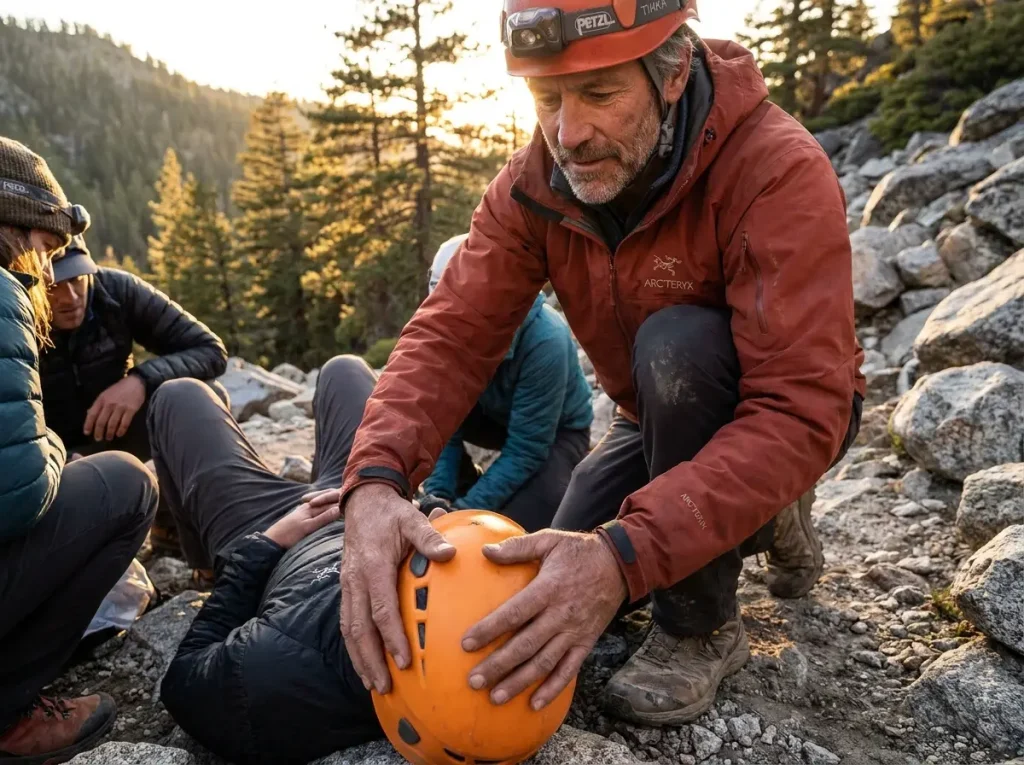
Spinal protection means moving the patient in a way that keeps the head, neck, and spine in neutral alignment throughout — not necessarily zero movement, but controlled movement. Manual in-line immobilization, where someone holds the patient’s head steady during log roll and stretcher loading, is the key technique. You don’t need a collar for this. You need calm hands and a designated person whose only job is holding the head.
When to prioritize moving over spinal precautions
If the patient is unconscious and not breathing normally — airway takes priority. Period. If they’re in an actively hazardous location. If hypothermia is setting in and you have shelter but need to move first. These are the situations where a wilderness first responder makes a judgment call about environmental risk versus movement risk. The modern standard supports that call.
Pro tip: Designate one person as “head holder” the moment you decide to move the patient. That person does not help build the stretcher. They do not carry gear. Their entire job is hands-on the patient’s head from first movement to final handoff.
Choosing the Right Stretcher for Your Situation
Three options, in order of stability and speed.
Rope litter: your best option when you have the gear
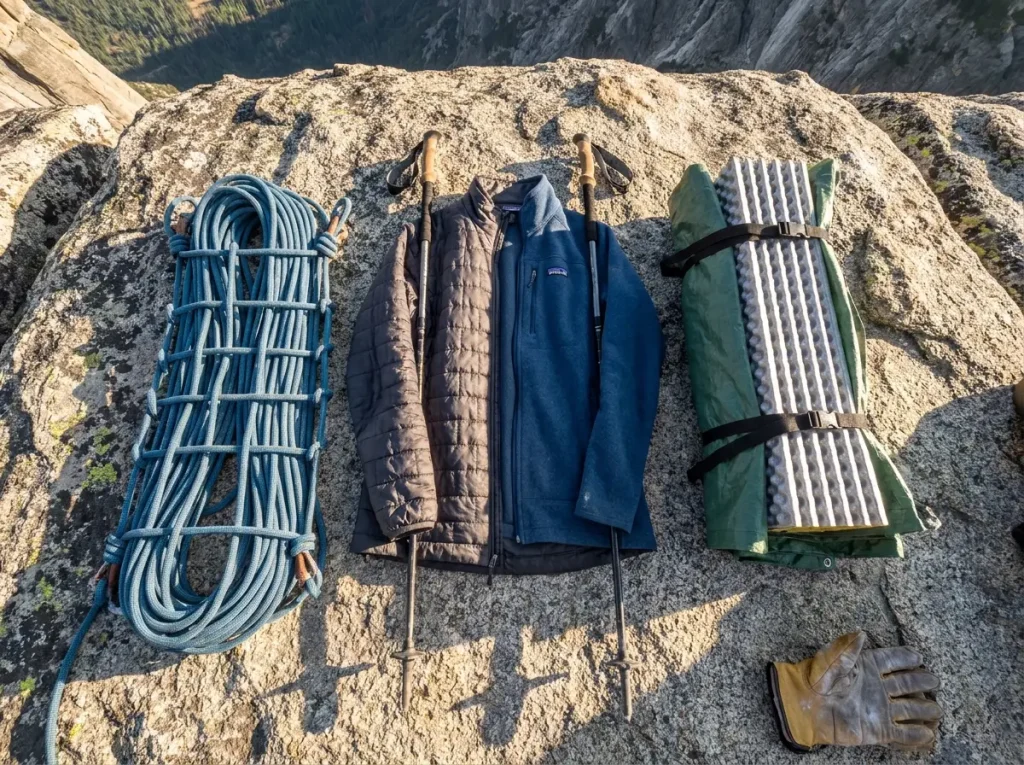
A rope litter built from a 50- to 60-meter climbing rope and two rigid poles — trekking poles, tree branches, ice axes — is the most stable improvised option. It supports the patient from head to toe, distributes weight well, and uses gear you already have. It takes ten to fifteen minutes to build if you know the steps. Worth it for any evacuation over a quarter mile.
Jacket stretcher: when you only have what’s on your back
Two to four jackets — zipped or buttoned shut — with poles or branches threaded through the sleeves. Fast to build, adequate for short carries on flat terrain, less stable on descent. The padding is acceptable; the rigidity is not. Use this when time is critical or the distance is short.
Sleeping pad and tarp system: the most comfortable option
A closed-cell foam pad (Z-Lite style) or inflatable pad under a tarp, with poles along the edges and webbing ties holding everything together, gives the patient the most comfortable surface. If the patient has a pelvic or lower-extremity injury, the padding difference matters over a long carry. Combine this with the rope litter approach when possible — pad first, rope frame over the top.
How to Build a Rope Litter Step by Step
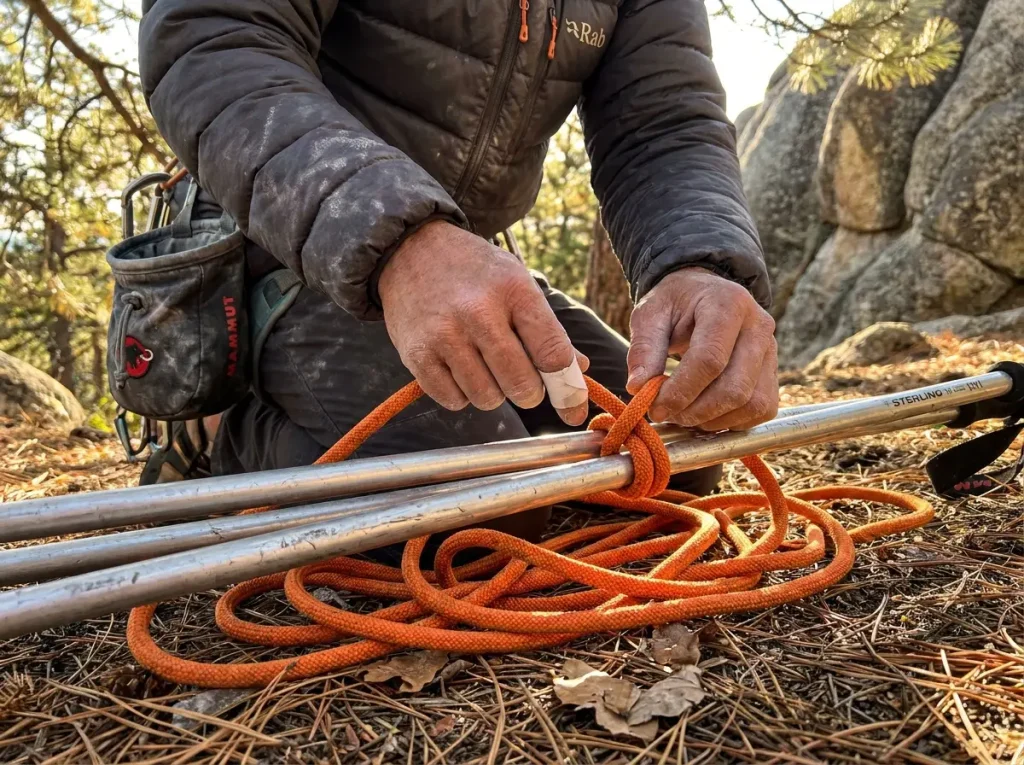
What you need: a 50-60m climbing rope, two poles (trekking poles, ice axes, sturdy branches at least 6 feet long), webbing or runners for handles.
What to pull from your rack
Two trekking poles or ice axe shafts for the frame. Your climbing rope — coiled and uncoiled. Six to eight locking carabiners. Four to six shoulder-length or double-length slings. Any extra webbing from your pack. A sleeping pad if available. You’re not leaving any of this behind anyway — it all goes.
Laying the foundation and building the frame
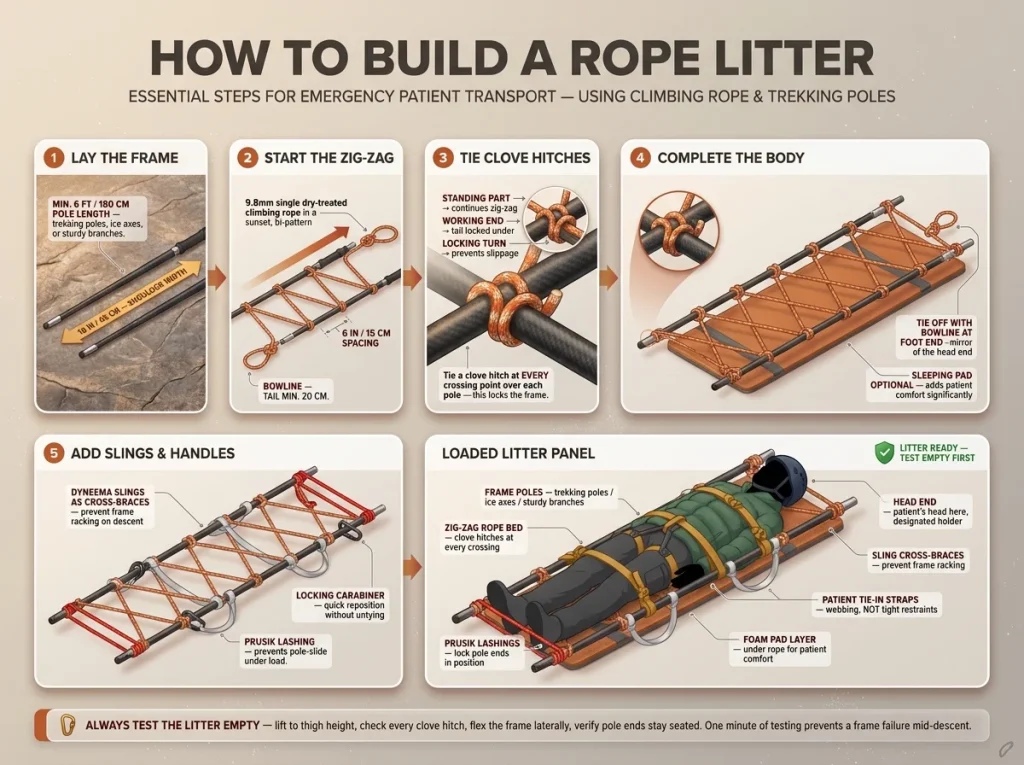
Lay your two poles parallel on flat ground, spaced about 18 inches apart — shoulder width. Tie a bowline at one end of the rope, then begin a zig-zag pattern, passing the rope over and under each pole alternately, spaced about six inches apart down the length. At each crossing point over a pole, tie a clove hitch to lock the rope in place and prevent the frame from shifting under load.
You’re building a rope bed. The tighter and more evenly spaced your loops, the more weight the litter distributes without any single point taking excess load. Work from head to foot, and stop when you’ve covered about six feet of frame length. Tie off the tail end with another bowline.
Loading and securing the patient
Log roll the patient onto their side — with your designated head-holder maintaining neutral alignment throughout — then lower the litter behind them and roll them back down onto it. The patient’s head should be at the wider end. Use your webbing or extra slings to create two cross-ties across the patient’s torso and one across their thighs. These are not restraints — they’re lifelines that keep the patient from shifting sideways on descent. Thread each tie under the frame poles and back over the patient; tie off with a figure-eight follow-through. Snug, not tight.
Pro tip: Before you load the patient, test the litter with an uninjured team member lying in it. One quick lift to knee height tells you immediately if any clove hitches are slipping or if the frame is too narrow. Fix it now, not when the patient is in it.
Using Your Full Rack to Build a Better Stretcher
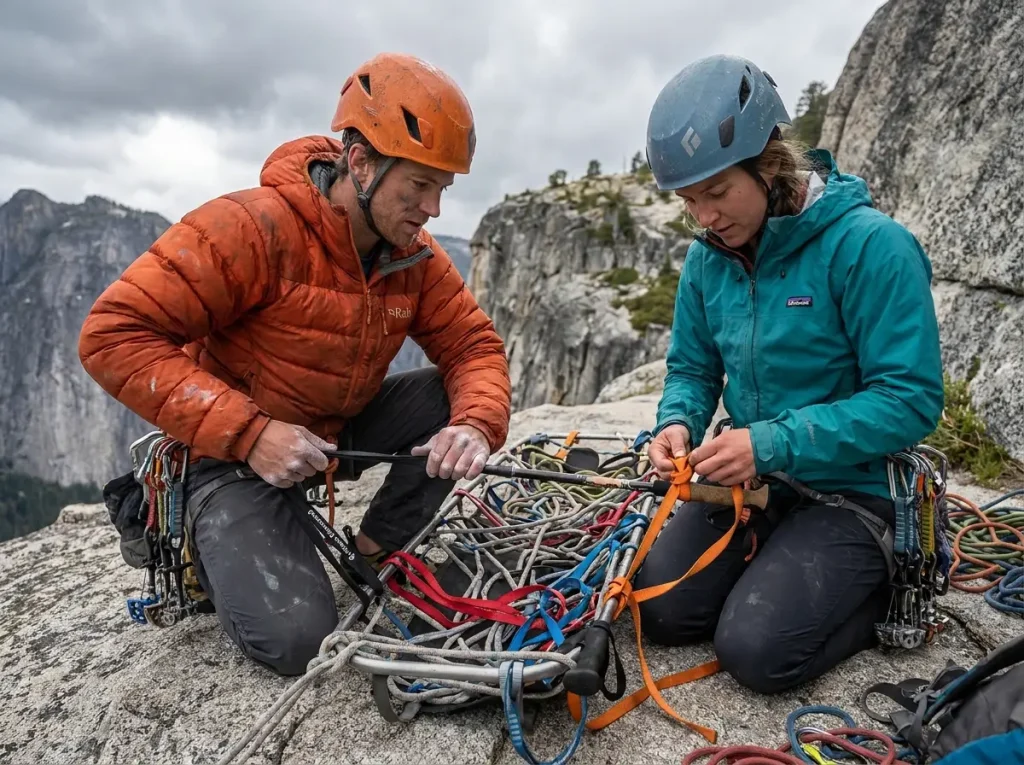
Every climber at the crag has more rescue hardware than they think. The standard rope litter guide tells you to use the rope. Here’s what else works.
Integrating slings and runners into the structure
Double-length (120cm) dyneema slings are excellent cross-braces for the litter frame. Once your rope zig-zag is complete, thread a double-length sling under the frame from one pole to the other at the midpoint and the quarter point. Pull them tight and tie off with a water knot or overhand. These cross-braces prevent the frame from racking (twisting sideways) on uneven terrain — a problem that gets worse the longer your carry.
If you have a Prusik cord in your pack, use it to lash the frame at each pole-end to prevent the poles from sliding out of the rope loops. This is the failure mode nobody talks about until the litter is loaded and one pole telescopes three inches on a downhill step.
Building handles and anchor points
Shoulder-length slings girth-hitched around the poles at the carry positions give your team proper grips without having to grab the frame poles bare-handed. Four carry positions — two on each long side — gives a four-person team a stable grip. If you have locking carabiners, clip the sling handles to the pole rather than girth-hitching directly; it lets you quickly reposition without untying anything.
If the terrain requires a guided lower — rope anchored above, litter descending a steep slope with guide ropes — your existing gear already handles this. Build a simple Z-rig or a redirected lowering system off a two-bolt anchor if one exists, attach guide ropes to the head and foot of the litter to control rotation, and lower the patient in a controlled descent. This is covered in more depth in our mechanical advantage hauling systems guide.
Testing the litter before you load the patient
Lift it empty to thigh height. Check every clove hitch — are any slipping? Flex the frame laterally — does it rack more than two or three inches? Check the pole ends — are they seated inside the rope loops or starting to slide? One minute of testing prevents a stretcher failure mid-carry on a descent trail. No exceptions.
Carrying Technique and Terrain Navigation
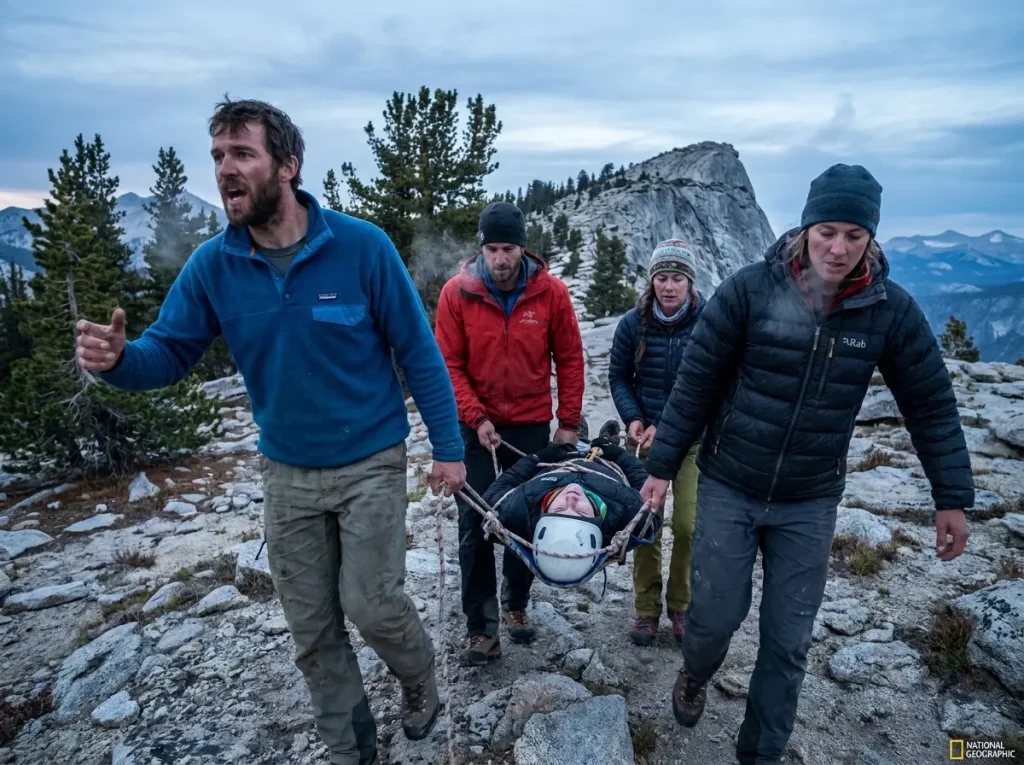
A rope litter requires a minimum of four people to carry safely. Six is better on descent. Eight is ideal for technical terrain but rarely realistic.
Minimum team size and role assignments
Four people: one at each corner. The person at the head of the litter leads the team, calls the pace, and watches the patient. Everyone else watches the terrain and follows the head caller’s verbal cues. The head carrier also maintains verbal contact with the patient throughout the carry — every thirty seconds, a check-in. Patient response tells you if anything is deteriorating.
Assign a scout if you have a fifth person. Their job is to walk ten meters ahead, identify foot placement hazards, and signal the team before they reach obstacles. In boulder fields or root-covered approach trails, this prevents the entire team from stopping and reassessing at every step.
If you only have two people, the options narrow significantly: a fireman’s carry (for a short-distance move to a safer location only), a drag across smooth terrain (acceptable in emergencies, uncomfortable for the patient), or staying put and summoning help — which requires a communication device. Make sure someone in your party knows about calling for rescue while climbing before you need it.
Coordinating movement over uneven terrain
The head caller announces every step change: “Stepping down, ready, step.” The team moves on the verbal cue, not simultaneously on instinct. On descent, the carrier at the foot of the litter bears more weight and needs the most rest. Rotate positions every ten minutes on a long carry — fresh arms make a real difference after the first half mile.
Keep the litter as level as possible. A fifteen-degree head-down tilt on descent increases intracranial pressure in a head injury patient. Compensate by having the uphill carriers raise their side. It looks awkward. It’s the right call.
Internal link opportunity: If the evacuation route requires a rappel or descending a short technical section with the patient in the litter, the process for a tandem lower is covered in our guide on tandem rappel rescue with an injured partner.
When to stop and reassess during the carry
Every ten minutes, or at every terrain change. Check the patient’s level of consciousness (still responding? coherent?), check the litter integrity (clove hitches still set?), and check your team (someone’s hands going numb? Grip failing?). A deteriorating patient en route needs SAR contact immediately — make noise, activate your Garmin inReach or SPOT device, or send your fastest runner ahead to the trailhead.
Check your ankle injury article reference: if the patient has a lower extremity fracture, verify the improvised splint is still in place before each carry segment — movement jostles splints more than you’d expect. See our guide on ankle injury climbing first aid for splinting technique before you load the patient.
Pro tip: Designate a timekeeper. When everyone is focused on the terrain and the patient, nobody tracks time. Set a phone timer for ten minutes before each carry segment begins. The beep triggers an automatic assessment stop. Simple, and it works.
Conclusion
Three things matter most when your partner can’t walk out. First: assess before you act. Two minutes of real evaluation before anyone touches the patient saves you from decisions you can’t take back. Second: use everything on your rack, not just the rope. Slings, runners, and carabiners turn a basic rope litter into something that won’t rack apart on the descent. Third: designate roles and communicate continuously. The carries that go wrong do so because nobody was leading the team.
The gear makes it possible. The preparation makes it work. Take a Wilderness First Aid course before you need this — building a rope litter in a parking lot is a very different experience from building one on granite with your hands shaking. Practice the knots. Know who in your regular climbing crew has first aid training. And always carry a communication device on approaches longer than two miles.
Q1 How do you make an improvised stretcher with a climbing rope?
Lay two rigid poles parallel at shoulder width. Zig-zag your climbing rope between them with clove hitches at each crossing point, spacing the loops about six inches apart. Continue for six feet of frame length and tie off both ends. The litter takes ten to fifteen minutes to build and supports the full weight of an adult.
Q2 How many people do you need to carry a climbing accident victim?
A minimum of four people to carry a loaded litter safely, with one person assigned solely to head and neck stabilization if spinal injury is possible. Six to eight people is better for technical terrain or descents. With only two people, limit movement to a short-distance emergency drag or fireman’s carry to reach a safer position.
Q3 Should you move someone after a climbing fall?
Not automatically. Assess airway, breathing, consciousness, and neurology first. If the patient is alert, has no numbness or tingling in extremities, and the scene is safe, you can plan a careful evacuation. If the scene is actively hazardous — rockfall, hypothermia risk, flooding — the Wilderness Medical Society guidelines support moving the patient with spinal protection even when injury is suspected.
Q4 What is the fastest improvised stretcher to build at a crag?
The jacket stretcher — thread two poles through the sleeves of two to four zipped jackets — takes two to three minutes. It is adequate for short carries on flat terrain. For anything over a quarter mile or on descent terrain, build a rope litter even if it takes fifteen minutes. The added stability is worth the time investment.
Q5 What climbing gear doubles as rescue equipment in an emergency?
Your rope (litter frame), slings and runners (cross-braces and carry handles), trekking poles or ice axes (frame poles), carabiners (connection points), webbing (patient tie-in straps), and Prusik cord (lashing). A Garmin inReach or similar satellite communicator is the single most important non-climbing piece of gear for remote crag days — more important than a first aid kit in most scenarios. See our guide on climbing travel insurance and rescue coverage for what SAR costs when you need it.
Safety Notice: Rock climbing and mountaineering are inherently high-risk
activities that can involve physical trauma or fatal incidents. The information on Rock Climbing Realms is for
educational and informational purposes only. Techniques and advice presented here are not a substitute
for professional, hands-on instruction. Conditions and risks vary by location. Always seek guidance
from a qualified instructor before attempting new techniques. By using this website, you agree that you
are solely responsible for your own safety. Any reliance you place on this information is strictly
at your own risk, and you assume all liability for your actions. Rock Climbing Realms and its authors
will not be held liable for any harm, damage, or loss sustained in connection with the use of this information.
Affiliate Disclosure: We are a participant in the Amazon Services LLC Associates Program, an
affiliate advertising program designed to provide a means for us to earn advertising fees by advertising and linking
to Amazon.com. As an Amazon Associate, we earn from qualifying purchases. We are also an official affiliate partner
of Black Diamond Equipment via the AvantLink network. If you click on a Black Diamond affiliate link and make a
purchase, we may earn a commission at no additional cost to you. We also participate in other affiliate programs.
Additional terms are found in the terms of service.