
In this article
Most climbers roll into Devil’s Lake with a shiny new rack and confidence from their 5.10 gym sends, only to get spit off a 5.6 and realize their 20-foot anchor webbing is completely useless. I’ve spent enough time hauling gear up the East Rampart and building anchors deep in the woods to know that climbing here is an entirely different puzzle. This guide breaks down exactly how to survive the slippery quartzite, decipher the old-school grades, and rig the extended top-rope anchors you need to climb safely at the Midwest’s premier crag.
⚡ Quick Answer: Safely climbing Devil’s Lake requires 60-foot static ropes for extended top-rope anchors, master point angles under 60 degrees, and flawless edging technique on the slick Baraboo Quartzite. Most beginners bring short webbing and try smearing their shoes instead. That’s a great way to slide right off a 5.5 warm-up.
| Devil’s Lake Climbing Information | |
|---|---|
| Category | Details |
| Rock Type | Baraboo Quartzite (Metamorphosed Sandstone, 1.7 Billion Years Old) |
| Climbing Style | Traditional (Trad) and Top-Rope (TR) only |
| Bolting Policy | Strictly prohibited (Bolt-less area by DNR enforcement) |
| Peak Season | May through October (Weekends reach maximum capacity early) |
| Park Entry Fees | $13/day (Wisconsin plates) | $16/day (Out-of-state plates) |
The Quartzite Reality Check: Why You’re Slipping

The 1.7-Billion-Year-Old Friction Problem
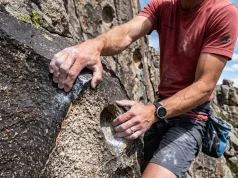
You can’t climb the Baraboo Range like sandstone down in Kentucky. The rock here is Baraboo Quartzite, essentially ancient beach sand cooked and crushed under the earth for 1.7 billion years. What popped back up to the surface is a chunk of fused glass that feels like a wet bar of soap on your fingertips. It possesses zero texture to bail you out when you lose your balance.
The composition of Baraboo Quartzite lacks the softer minerals like feldspar that give granite its raw grip. It’s pure quartz. Slap your open palm against a wall in the Red River Gorge, and the rock bites back, holding you in place. Slap a flat face at the Lake, and your hand slides straight down until it catches a distinct ledge or crack. Your skin gets no help from the stone.
That zero-friction reality dictates every move you make. You trust the quartzite to hold metal gear because it never snaps, but un-chalked skin and dirty shoe rubber slide off instantly without warning. You rely purely on mechanical interlocking—burying the literal tip of your climbing shoe on a tiny crust of rock and staying completely rigid through your core.

Smearing vs. Edging on “Glass”
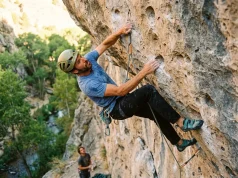
Every gym-to-crag transition falls apart right here. Indoors, you mash the ball of your foot against a giant plastic volume, drop your heels low, and trust the friction to hold your weight. That lazy smearing technique gets you absolutely nowhere on this rock. You need to switch your brain over to technical footwork and precise geometry.
Instead of smearing the sole, find a micro-edge maybe a quarter-inch deep. Place the firm inside point of your shoe directly on that crystal, and weight it completely. Once you place that foot, do not pivot your ankle. The second you wiggle your heel, the rubber slips, and your knee slams into the rock face. I’ve watched countless beginners shred their pants exactly this way.
I watch beginners hesitate all day long. They place a foot, don’t trust the hold, leave half their weight hanging on cramped forearms, and blow the foot out because they didn’t press down hard enough. Learning how to transition from smearing to precise edging solves half your problems at the Lake. Stand up straight, commit your weight through your toes, and let your skeletal structure take the load off your tired arms.
Pro-Tip: Don’t look away from your foot until you physically stand up. The biggest mistake you can make is placing your toe on an edge, then looking up to scan for a handhold before shifting your weight. Watch the rubber engage the rock, commit the weight downward, and only then reach up.
Even when your edging technique is flawless, the rock still has ways to trick you. Figuring out foot placements is only the first part of the puzzle; reading the rock’s hidden geology is the second. Keep your eyes open for the slickest sections hiding in plain sight.
The Hidden Phyllite Danger
Sometimes you do everything right. You put your weight on a massive flat ledge, maintain tension, and your foot still blows out like you stepped on a banana peel. That’s the phyllite talking. Phyllite is a dark strip of metamorphic rock sandwiched directly in the middle of the quartzite. It forms exactly where the rock naturally broke apart millions of years ago, which means it sits right inside the cracks we all love to climb.
That rock layer is pure slime. It looks like a bomber foothold until you weight it, feeling almost greasy under your rubber. Most locals spot the dark purple or black streaks from the ground before tying in. If you have to step onto a phyllite band, treat it like an icy driveway. Keep your center of gravity squarely over your hips and don’t pull outward on the holds.
The whole quartzite learning curve involves getting surprised by these greasy spots until you finally recognize the color change. If you’re buying shoes for the trip, pick something with stiff, specific rubber designed for edging, like Vibram XS Edge. Soft, sensitive shoes meant for steep overhangs just fold over and roll right off these microscopic holds, leaving you hanging on the rope.
Decoding the Sandbagged Grades

Getting Spanked by a 5.5
Climbing difficulty ratings here were set decades ago by guys tying nylon ropes around their waists and wearing terrible leather boots. The result is the most famous set of sandbagged grades in midwest trad climbing. A route officially rated 5.5 at the Lake often demands the physical effort and scary commitment of a 5.8 at a modern sport crag. Expect to fight for every single inch.
I watch strong gym climbers—people who cruise 5.11 plastic routes indoors—flail and fall on a 5.6 classic because they can’t figure out how to stand up on glass. Drop your ego in the parking lot immediately. Those old-school numbers reflect the sheer effort of placing your own gear on slick rock without chalk or sticky rubber back in the 1960s and 70s. When pioneers like Pete Cleveland called a route a 5.6, you’re measuring yourself against athletes who simply didn’t complain about bad friction.
If you come in expecting a casual romp up a 5.7, you’re setting yourself up for a rude awakening and a potentially bad fall. If you want to understand how these old-school trad numbers translate, assume everything at the Lake is two full number grades harder than what the guidebook says.
The “Headpointing” Culture
Because the grades crush egos and protection requires exact, tedious placements, the local culture defaults entirely to headpointing. You hike up top, set a solid toprope anchor, practice the route until you have every single move wired into muscle memory, and only then pull the rope to lead it from the bottom. Some purists call this cheating. Locals call it staying alive.
There’s zero shame in taking a toproping lap on a 5.8 before you tie in on the sharp end. The rock forces awkward, pumping stances, and searching for the right size nut while your calves shake violently is exactly how people take huge ground falls. Practice the tricky sequences on top-rope. Find where the rest stances hide. Figure out which piece of your trad rack fits the crux crack perfectly, and memorize which hand you need to place it.
Pro-Tip: Rack your gear in the exact order of the placements you figured out on your top-rope run. Clip the specific nut you need for the crux on a dedicated carabiner right at the front of your harness gear loop. You won’t have the stamina to sort through a messy harness when the pump clock starts ticking on a slippery face.
Once you understand how the grades really work and embrace top-roping to practice the moves, your confidence naturally climbs. The key trick is picking the right introductory objectives early on so you don’t get completely shut down your very first weekend out here.
The “Actually” Moderate Classics to Start On
You have over 1,600 routes to choose from across the park, but hunting for the best easy routes requires local beta. The guidebooks list tons of 5.3s and 5.4s, but half of them run right up loose, dirty chimneys filled with spiderwebs that nobody actually wants to climb. If you want the top 5 actually moderate classics to save your self-esteem on day one, you need to know exactly where to walk.
Start with Queen’s Throne (5.4) over in Cleopatra’s Amphitheater. It gives you a clean corner line, massive ledges for resting, and bomb-proof gear placements to help you calm down and trust the rock beneath you. Next, walk over to the Balanced Rock Wall and tie into Sunken Pillar (5.5). The moves feel blocky and secure, forcing you to place your feet flat and stand up tall with confidence.
When you feel ready for some air under your heels, hike up to Brinton’s Crack (5.6). It’s the quintessential Lake climb, featuring a bold eight-foot traverse right over empty space. Pull smoothly through these sandbagged 5.6 grades, and you might just be ready for the rest of the park—assuming you know how to build the massive anchors required to actually climb them.
The Top-Rope Anchor Dilemma

The 60-Foot Setback Problem
Most climbers learn how to build solid anchors on two giant steel bolts drilled ten inches from the cliff lip. At the Lake, there are obviously no bolts. If you want to ride a top-rope, you hike the trail up top, walk deep into the woods, and find heavy living trees or deep rock fissures to tie into. The major catch? The best, safest trees grow twenty to fifty feet back from the actual drop-off.
If you bring a standard twenty-foot loop of tubular webbing, you’ll spend the day watching everyone else climb. You simply can’t reach the edge with standard gear. A proper toprope anchor setup out here requires massive 30ft extensions just to bridge that massive gap between the trees and the cliff edge safely.
You must get your master point—the redundant locking carabiners where your climbing rope runs through—hanging completely free over the sharp edge of the rock. If your master point sits flat on the dirt clifftop, your dynamic climbing rope saws back and forth across the abrasive quartzite lip under bodyweight tension. The rock devours modern rope sheaths in hours.

Static Rope vs. Tubular Webbing
Forget packing massive spools of flat nylon webbing to solve the setback problem. Webbing is incredibly cheap, but it belongs on smooth, rounded rocks. When you drag a flat piece of nylon over a 90-degree jagged ledge, all the heavy load hits just a few individual strands of the exposed material, and it cuts fast. You need real thickness to survive the brutal conditions up top.
A chunky 10-millimeter static rope handles edge abrasion significantly better because of its round profile and thick outer sheath. A round rope rolls slightly over an edge, while flat webbing grinds and frays to death. If you plan your trips around top-roping, a dedicated section of 60ft static ropes is the baseline standard requirement. Pair it with heavy-duty edge protection—like split fire hose or a heavy canvas pad—and place it exactly where the loaded rope bends over the harsh lip.
Dragging enough static rope to reach the lip is only part of the equation. Setting the anchor up wrong up there can multiply the forces pulling on those distant trees, creating perfectly hidden dangers that can fail catastrophically.
The 60-Degree Rule for Anchor Vectors
When you build an anchor using two trees spaced far apart in the woods, your ropes form a giant “V” shape. The wider that “V” becomes at the point, the more force you place on each individual tree and knot. This is why mastering the fundamentals of anchor geometry is a non-negotiable survival skill out here.
If your ropes hang perfectly parallel pulling straight down, each leg shares half your weight. Widen that angle out to 60 degrees, and each leg takes roughly 58% of the load. That’s standard practice and incredibly safe. But the naturally wide tree spacing at the tops of these cliffs pushes naive climbers into terrible geometric decisions.
Spread the anchor legs out to 120 degrees, and you put 100% of the force on each leg simultaneously. Push it wider to 150 degrees, and you put nearly double your body weight onto the system. This explains the second critical reason you pack long static ropes. Long lines let you push that master point far out into space, creating a long, narrow “V” that keeps the angle well under 60 degrees. Short ropes force terribly wide angles, and wide angles snap gear.
With your anchor fundamentals completely dialed, you’re ready to tackle the sharp end of the rope—which introduces an entirely new set of ethical rules and gear challenges.

Leading at the Lake: Gear Limits and Ethics

The Strict “No-Bolt” Rule
Let’s clear this up plainly before you pack the car: there are absolutely no bolted routes anywhere in the park. The trad-only ethics form the absolute rock-solid foundation of the local climbing community. Decades ago, traditionalists fought hard to prove that the natural crack systems provided enough protection for anyone brave enough to lead the routes. The state park backed their stance entirely.
Today, strict Wisconsin DNR policy heavily restricts any fixed hardware, preserving the area as a pure bolt-less haven. Bring a hammer drill here, and you violate the law—and the locals will gladly run you out of the parking lot before you drill an inch.
This bolt-less mandate preserves the historical integrity of the rock face. You climb the route exactly as the pioneers did. You never clip shiny metal rings; you study the fissures, slot your own nuts and hexes, and fully accept the consequences of a bad placement. If a blank section requires a 20-foot runout, you either commit to the sparse moves without falling, or you back down. It’s a pure, uncompromising style that builds real character.
Passive Pro: Why Nuts and Hexes Shine
Because the cracks formed natively along straight fault lines, they stay incredibly parallel as they drop down the wall. Modern spring-loaded cams rely heavily on rock friction to hold a fall. Like we established, quartzite completely lacks friction. Cams hold fine in perfect placements, but they stubbornly love to “walk” deep into slick cracks as the rope jiggles them from below.
This is where your passive gear violently earns its paycheck. Passive protection—your standard set of wired nuts and large aluminum hexes—doesn’t rely on springs or friction. It wedges deep into natural constrictions like a mechanical cork in a wine bottle. The parallel cracks conceal small pods and pinches that swallow aluminum nuts perfectly snug.
The physical movement of locking in solid nut placements with a sharp downward tug creates a hold you trust your life to. Bring a full set of stoppers and some medium-to-large hexes. They seat beautifully in the horizontal breaks and ring loud like cowbells on your harness.
Having the right traditional gear is crucial, but environmental factors will constantly mess with your placements. Even when the gear fits perfectly, the weather can ruin the friction inside the crack entirely.
Coping with the “Lake Effect” Moisture
The Baraboo Range generates its own intensely frustrating microclimate. Locals call it the Lake Effect, and it ruins perfect climbing days fast. Quartzite doesn’t absorb water at all. However, the deep vertical cracks pack in centuries of dirt, pine needles, and moss that act like giant wet sponges.
You walk up to a cliff 48 hours after a heavy rain storm. The sun shines bright, the face is bone dry, and the sky stays clear blue. But the moment you jam your hand securely into the crux crack, it comes out dripping with icy dark mud. The cracks weep water for days on end.
On top of that, hot summer days pull brutal humidity directly off the water, creating a miserable sheen of condensation right on the rock surface. If you see dark streaks running down the wall, assume that section offers zero friction. Give the crack systems ample time to dry after a big storm, and stick exclusively to the sunny, exposed faces when the humidity spikes.
Dealing with wet cracks is incredibly annoying, but navigating the crowds and the brutal terrain outside the climbs can exhaust you before you even tie in your knots.
Logistics: Crowds, Talus, and Ticks

Escaping the East Rampart Mobs
Show up at the east rampart at 10:00 AM on a brisk October Saturday, and you’ll fail to find parking, let alone an open climb. It turns into an utter zoo. The main wall packs in loud college outing clubs, massive scout troops, and guided parties hanging top ropes on every single line. The dense crowds at east rampart mean you literally spend hours waiting in line just to touch a classic 5.7 route.
When you get tired of fighting for breathing space among the hammocks and bluetooth speakers, quickly pack your bag and hike over to the solitude of the west bluff. Most people stay far too lazy to make the longer hike, leaving the western walls completely quiet. You lose the dense concentration of easy top-ropes, but you gain real peace on the rock. Exploring the west bluff also gives you a completely beautiful new perspective looking down over the water.
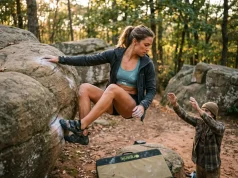
If you sweat easily, the best time of day for shade on the East Bluff hits hard in the late afternoon, while the West Bluff stays cool all morning. Plan your approach hike around the sun to beat the heat. And if you safely prefer low climbing without ropes, the bouldering scene here is massive, hiding thousands of hard problems from V2 to V13 deep in the woods.
Navigating the Ankle-Breaking Talus Approach
Getting to the very base of the cliffs requires paying a toll in sweat and twisted joints. Massive fields of broken, jagged boulders called talus carefully guard the base of every major wall. The talus approach never feels like a casual hike. You physically rock-hop on uneven, wobbly blocks the size of refrigerators.
Doing this in flip-flops with a thirty-pound pack full of steel hardware heavily begs for a snapped ankle. Wear stiff approach shoes with actual sticky rubber tread. The boulders unexpectedly shift under your weight, and the dark gaps drop deep enough to swallow a leg whole. The key to sticking to established climber impacts and navigating responsibly is strictly following the worn, chalk-marked paths through the rocks. The designated paths properly settled over decades of traffic and rarely ever roll over on you.
Surviving the talus gets you to the dry base, but the woods hide another persistent, invisible threat waiting for you the exact moment you drop your pack in the dead leaves.

The Bug Defense Strategy
You unknowingly share the Wisconsin woods with an absolute army of hungry ticks. Sauk County holds a nasty, earned reputation for tick-borne illness, particularly Lyme disease. Every single time you drop your gear in the dirt or violently bushwhack to set an anchor, you roll the dice.
Don’t rely on completely weak organic bug sprays or hopeful wishful thinking. The only genuinely reliable defense involves treating your tough approach pants and shoes heavily with Permethrin before you leave home. Spray it all over your clothes in the garage, let it completely dry overnight, and it knocks ticks dead on contact for weeks. Once you finally get back to the car parked at the south shore parking lot, do a thorough, careful tick check before you even touch the driver’s seat.
Now that you know exactly how nasty the rocks and bugs are out here, let’s look at what critical gear you need to throw in your car.
Your First Trip Action Plan

What to Pack Before You Drive
Use this checklist before you pull out of the driveway. Forget even one of these items, and your climbing trip tragically dies before it heavily begins.
- A 60-meter dynamic climbing rope. Don’t blatantly bring a skinny 9.2mm performance cord; the abrasive lip shreds thin modern sheathing extremely fast.
- A 60-foot static rigging rope exclusively for tying your anchors back to distant, sturdy trees.
- A full set of reliable stoppers and big locking aluminum hexes.
- At least three long sections of heavy canvas or split fire hose to confidently pad the sharp cliff edge.
- Six to eight heavy-duty, screw-gate locking carabiners.
Bringing the right combination of static and dynamic ropes does you absolutely no good if you lack the lockers to build the required master point safely. Setting up a reliable, completely independent kit easily costs around $450 to $700. Whether you successfully enter through the north shore parking or the south lot, remember the strict park entry fees are mandatory at the gates.
Essential Skills to Master First
Don’t ignorantly try to figure this stuff out entirely on the fly. Before you touch the sharp rock, you fiercely need to know how to tie a figure-eight follow-through blindfolded in the dark. You crucially need to know how to intelligently construct a redundant master point with your static line. Most importantly, you need to deeply master tying a clove hitch.
Adjusting the exact length of a tight anchor leg by slowly tying and untying clunky figure-eights wastes an entire hour of precious daylight. A smart clove hitch lets you carefully dial in the exact rope length on a locking carabiner in three quick seconds. If you stare blindly at a sharp granite lip and can’t confidently identify exactly where the rope chafes the absolute worst, you strictly need more practice before you rig complex anchors alone.
If all this technical rigging naturally sounds completely overwhelming for a quick weekend trip, there is absolutely no shame at all in paying someone else to handle the logistics while you focus entirely on the stunning views.
When to Hire a Local Guide Instead
If closely reading about giant 60-foot static extensions, sharp master point angles, and slick phyllite interbeds visibly makes your head spin, nicely stop stressing. That’s a completely normal, rational reaction for any casual weekend warrior. You don’t have to bravely learn it all in one chaotic afternoon.
Booking a highly trained, certified professional from Apex Adventure Alliance or trusted Devil’s Lake Climbing Guides is easily the smartest money you spend on your first visit. These experienced Devil’s Lake guide services professionally handle the terrifying clifftop rigging so you happily focus entirely on your footwork. You comfortably spend the long day climbing instead of hopelessly untangling dirty webbing in the bugs.
If you eagerly want to do some homework before your guided trip, simply browse Mountain Project or the Kaya app for run-through beta videos. You can also proudly dive into the classic, endless guidebook showdown and buy acclaimed Jay Knower‘s modern book over Sven Olof Swartling‘s older legacy edition. The modern book has superior, clean photos and a wildly helpful route database mapping perfectly to get you started faster.
Conclusion
To successfully survive Devil’s Lake, you practically have to abandon your shiny gym ego immediately upon arrival. Smartly start two full number grades lower than you actually think you regularly climb. Master the exact, strict geometry of a 60-foot static anchor to safely stay alive on the steep cliff edge. Finally, firmly trade your sloppy smearing habits for aggressive, stiff-soled edging on the classic Baraboo Quartzite. The rock feels unbelievably stubborn and the old-school grades hit incredibly hard, but cleanly mastering this crag makes every single send legendary. Try proudly leading Queen’s Throne on your exact next trip to deeply feel the history for yourself.
FAQ
Is there sport climbing at Devils Lake?
No, Devils Lake completely remains strictly a trad and designated top-rope climbing area without any bolted sport routes. The sprawling state park strictly prohibits aggressively drilling or quietly placing new bolts to properly preserve the historical ethic and natural integrity of the ancient Baraboo Quartzite formations.
What is the best guidebook to use for Devils Lake?
Jay Knowers acclaimed Devils Lake: A Climbing Guide is the undisputed top choice for its excellent color photos and modern route mapping details. Sven Olof Swartlings older generation guide delightfully still provides unmatched historical context and deep details on totally obscure, forgotten climbing lines.
Are the climbing routes at Devils Lake beginner-friendly?
Technically yes, simply because there correctly are hundreds of low-grade climbs available, but they require precise technical edging and extreme emotional patience. The unusually slick, glassy quartzite and severely sandbagged historical grading easily make an introductory 5.5 feel far more desperately difficult than a beginner happily expects.
Can I use tubular webbing for anchors instead of static rope?
Experienced locals strongly discourage tubular webbing mainly because it typically isn’t safely long enough to properly reach the distant, sturdy trees. A thick 60-foot static rope easily bridges the massive gap, incredibly fights off sharp edge abrasion much better, and efficiently allows for rapid master point knot adjustment.
Safety Notice: Rock climbing and mountaineering are inherently high-risk
activities that can involve physical trauma or fatal incidents. The information on Rock Climbing Realms is for
educational and informational purposes only. Techniques and advice presented here are not a substitute
for professional, hands-on instruction. Conditions and risks vary by location. Always seek guidance
from a qualified instructor before attempting new techniques. By using this website, you agree that you
are solely responsible for your own safety. Any reliance you place on this information is strictly
at your own risk, and you assume all liability for your actions. Rock Climbing Realms and its authors
will not be held liable for any harm, damage, or loss sustained in connection with the use of this information.
Affiliate Disclosure: We are a participant in the Amazon Services LLC Associates Program, an
affiliate advertising program designed to provide a means for us to earn advertising fees by advertising and linking
to Amazon.com. As an Amazon Associate, we earn from qualifying purchases. We are also an official affiliate partner
of Black Diamond Equipment via the AvantLink network. If you click on a Black Diamond affiliate link and make a
purchase, we may earn a commission at no additional cost to you. We also participate in other affiliate programs.
Additional terms are found in the terms of service.