
In this article
Day two on the wall. 1,800 feet above the deck, portaledge swaying in a Yosemite thermal. I reached into the bag labeled “Dinner / Day 2” and pulled out mush. The freeze-dried Pad Thai had absorbed condensation overnight, dissolved its pouch seam, and turned into 500 calories of paste I couldn’t get a spoon into without untying my belay line. Below me: three more days of climbing. My partner looked over. Neither of us said anything.
That moment cost me nothing catastrophic. But it taught me something most climbing articles skip entirely — food on a multi-day objective isn’t a convenience problem. It’s a systems problem. Get it wrong and you’re not just hungry. You’re weaker at the crux, slower at the bivy, and making worse decisions when the gap between getting down clean and not is razor-thin.
This guide engineers a complete nutritional system for multi-day climbing objectives — from caloric physics and substrate timing to haul bag packing and waste protocols — so your fuel system is as reliable as your rope system.
⚡ Quick Answer: For most multi-day climbing objectives, target 3,000–6,000 kcal per person per day with a minimum caloric density of 100 kcal/oz (≥4.5 kcal/g). Strip all commercial packaging before the approach, label every bag by day and meal, and use a 2:1 glucose-to-fructose ratio for mid-pitch fueling. Pack water at the bottom, snacks at the top, and never eat a heavy meal before a technical pitch — your gut literally can’t process food and climb at maximum intensity at the same time.
The Caloric Physics Audit — Engineering Your Energy Budget
Here’s where everyone starts wrong. They calculate distance and elevation gain, estimate “I’ll bring a few extra bars,” and show up underfueled by Day 3. The problem isn’t appetite — it’s that they never ran the actual numbers.
Energy expenditure on multi-day alpine and big wall hauling objectives ranges from 3,000 to 6,000 kcal per day. That range is driven by temperature, pitch difficulty, and the sheer metabolic cost of hauling loads that often exceed 100 kg. Cold adds heat generation. Technical terrain adds isometric loading. Altitude adds breathing effort. The numbers compound fast.
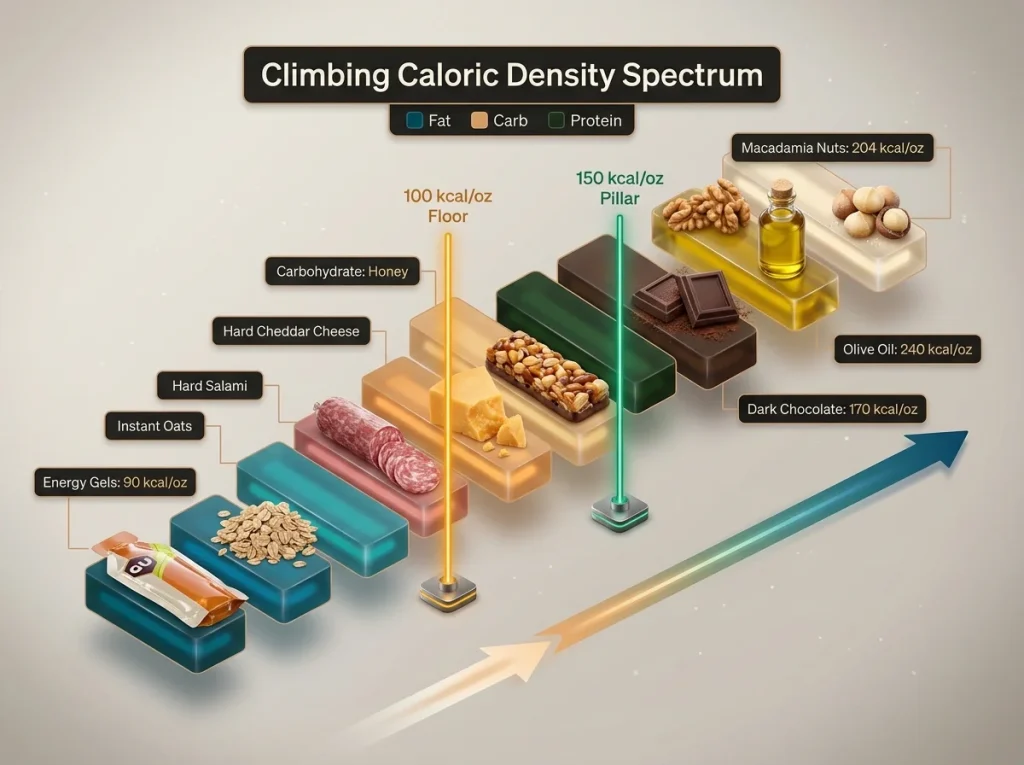
The caloric-physics audit starts with one metric: calories per ounce. Your baseline target is ≥100 kcal/oz. Foods above 150 kcal/oz are your load-bearing pillars. Everything below 100 kcal/oz is dead weight — and on a wall, dead weight has a direct performance cost.
For a 75 kg climber carrying a standard three-day food supply (roughly 3.4 kg / 7.5 lbs), that mass represents a measurable increase in total system load. According to research on finger strength as the primary predictor of sport climbing performance, Max Isometric Finger Strength (MIFS) is the #1 performance variable across all grades — and the force required to latch a hold scales linearly with your total system mass. On 5.13+ or V9+ terrain, that 3.4 kg of food can functionally knock you down half a grade or more. That’s the physics. The send you missed might have been breakfast.
Before you leave the ground, use a physics-based calorie calculator for expedition objectives to personalize your daily target based on your objective’s terrain and elevation.
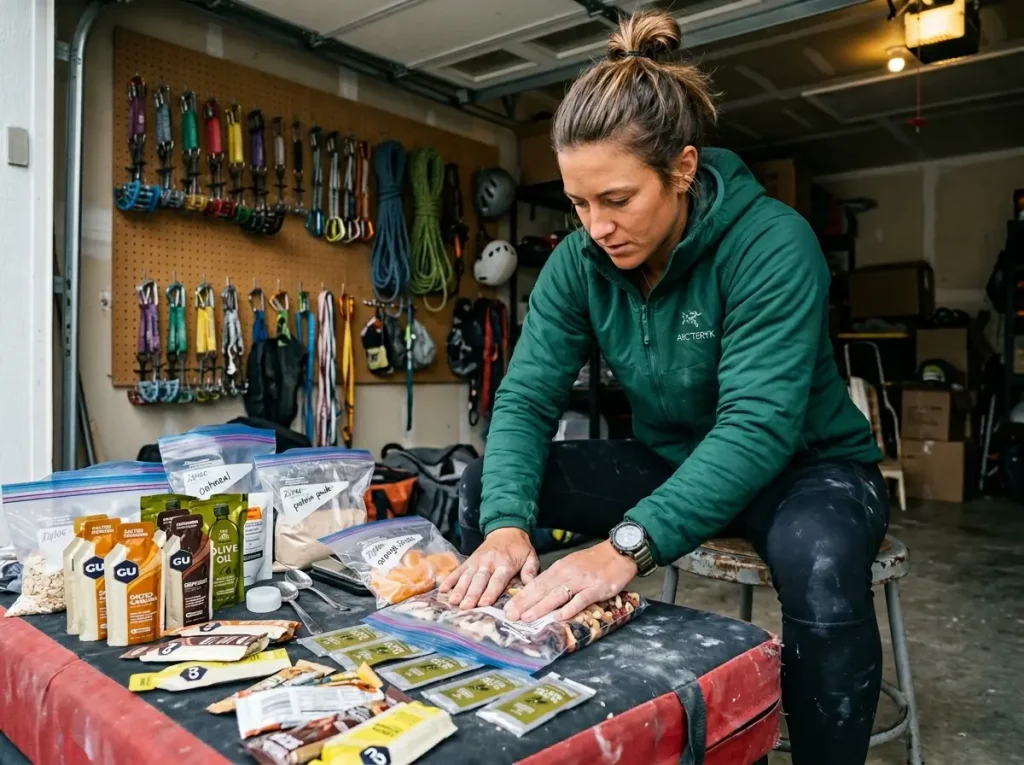
Pro Tip: Strip all commercial packaging before the approach. Original wraps are bulky, add dead weight, and create waste you must haul down. Repackaging into heavy-duty Ziplocs reduces food volume by up to 30% and cuts waste with zero impact on calories.
Calories Per Ounce — The Only Metric That Matters
The fat content of a food almost entirely determines its caloric density. Fat provides 9 kcal/g; carbohydrates and protein provide 4 kcal/g. That’s the whole picture.
Macadamia nuts sit at roughly 204 kcal/oz — the highest available trail food. Pecans and walnuts are close behind. Olive oil and coconut oil hit 240–250 kcal/oz, which makes them the single most calorie-dense substance you can carry. Dark chocolate lands at 155–170 kcal/oz and brings cognitive benefits from caffeine and theobromine.
Plain oatmeal checks in at about 104 kcal/oz — just above the floor, but borderline. Add one tablespoon of olive oil and it jumps to roughly 155 kcal/oz. That one tablespoon costs you nothing in pack weight and gains you 50 additional calories. This is not a trick. It’s arithmetic.
Energy gels — Gu, Liquid IV types — come in at 80–100 kcal/oz. Lower density, but optimized for rapid gut absorption mid-pitch. That’s a different use case. Density is for your haul bag. Gels are for your harness pocket.
Pro Tip: Before loading the haul bag, run every food item through the “100/150 Rule.” Below 100 kcal/oz is dead weight. 100–150 is acceptable. Above 150 is your core food system. If an item doesn’t hit 100, justify its presence by weight — or leave it at the trailhead.
The Weight-to-Force Penalty on Hard Moves
On a vertical face, you feel 100% of your system weight — no mechanical advantage, no partial load transfer. Every extra kilogram of food mass increases the force requirement on your finger pulleys, linearly. At elite grades (5.13+/V9+), this is the difference between a send and a fall.
Even when everything is hauled, the approach still costs you. A 3.4 kg food supply during a 4-hour approach compromises ankle stability, increases fatigue before the first pitch, and raises injury risk on technical terrain. On big wall objectives where the weight shifts to anchor forces, every extra kg of food increases peak load on your haul anchor. Engineer accordingly.
Building Your Caloric-Physics Spreadsheet
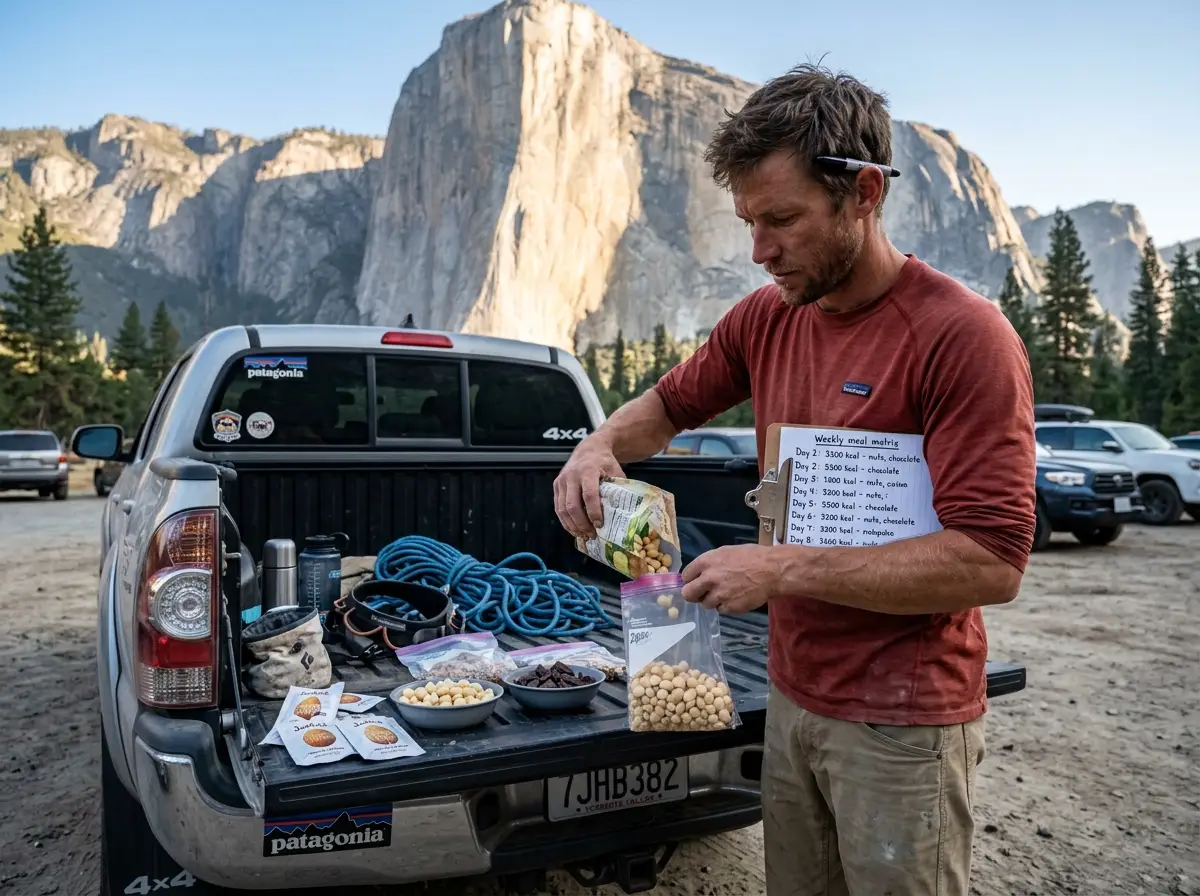
Create a Day-by-Day Caloric Matrix: Day, Activity Type, Caloric Target, Food Items, Total Weight. Target ≤1.5 lbs (680g) of food per person per day when selecting for density.
Assign caloric intensity tiers to each day. Approach days run moderate demand — 3,000–3,500 kcal. Technical crux days run high — 4,500–5,500 kcal. Rest or bivy days drop back toward 2,500–3,000 kcal. These are not estimates. They’re architecture decisions that determine how your body performs when it counts.
Plan for 10% caloric spillage: dropped food, spills, appetite suppression at altitude. Build that cushion into your math before you pack, not after you’re short on Day 3.
Label every bag by day AND meal — not just by content. “Day 3 / Dinner” is the only format that functions at 2 AM on a portaledge, in the dark, with frozen fingers, and a headlamp that’s lost half its charge.
Substrate Timing — Engineering the Right Fuel for Each Phase
Most climbing nutrition advice from hiking blogs tells you to “eat well before a hard pitch.” That advice actively hurts climbing performance. Here’s what’s actually happening in your gut.
During strenuous climbing, blood flow to the gastrointestinal tract drops by as much as 80%. This is called splanchnic hypoperfusion — your blood gets redirected to your working muscles, and your GI tract essentially shuts down. Research on exercise-induced splanchnic hypoperfusion and gut dysfunction confirms the mechanism: heavy meals consumed before or during technical pitches cause nausea, GI distress, and measurable power output reduction. The body literally cannot digest and climb at maximum intensity simultaneously.
The fix is not eating more. The fix is timing and format.
Your body operates in two distinct metabolic phases on a multi-day objective. During low-intensity hauling and approach — aerobic, fat-oxidizing — your gut can handle complex food. During high-intensity technical climbing — anaerobic, glycolytic — it cannot. These phases need completely different fueling strategies.
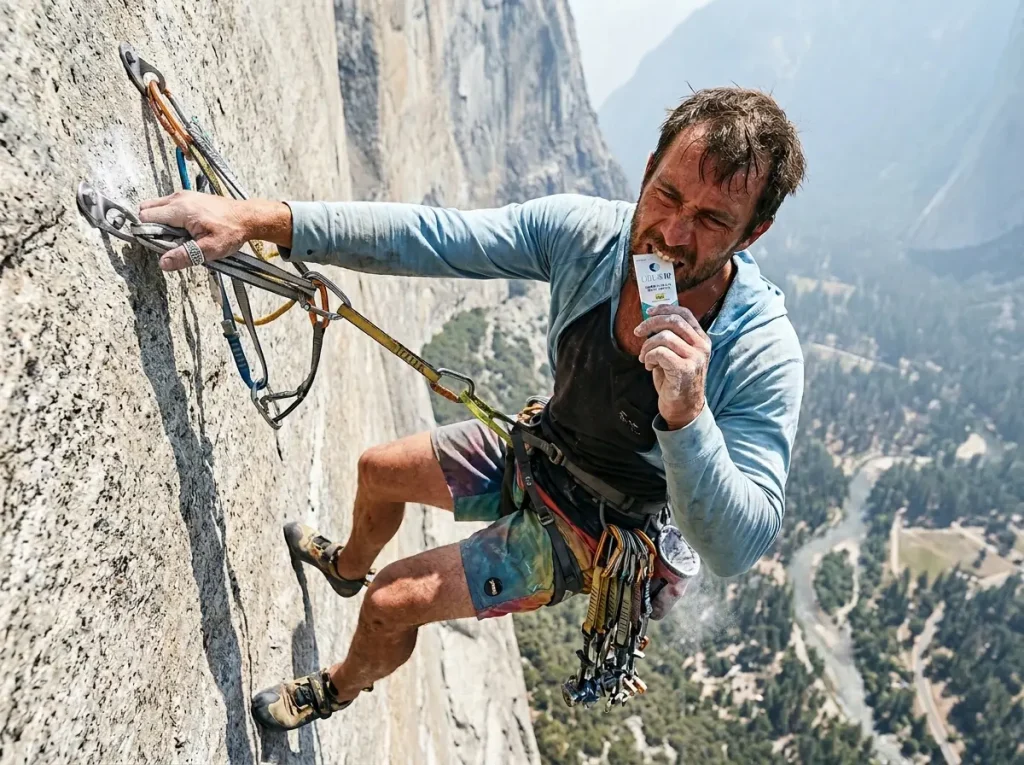
For mid-pitch fuel, use the drip-feed protocol: 100–200 kcal of simple carbohydrates every 60–90 minutes during technical segments. Energy gels, honey packets, Gu Chomps, liquid calories in a softflask. One-handed food only. Anything requiring teeth-and-two-hands to open is a liability you will discover at the worst possible moment.
For efforts over 2.5 hours, use a 2:1 glucose-to-fructose ratio. Glucose absorption alone is capped at roughly 60g/hour through the SGLT1 transporter. Adding fructose — which uses the GLUT5 transporter — allows 90–120g/hour of total carbohydrate throughput. The 2:1 ratio is the field-confirmed standard for gut comfort and absorption efficiency on multi-day efforts.
For nutrient timing windows for climbing performance, the anabolic window matters most at the bivy: target 25–40g of protein plus high-GI carbs within 45–60 minutes of finishing a technical sequence.
On Day 2 of a multi-day wall, climbers routinely undereat during technical sequences because they don’t feel hungry. That’s the splanchnic effect suppressing hunger signals — not your body telling you it’s fine. Schedule eating by clock. Not by appetite.
The Drip-Feed Protocol — Fueling Mid-Pitch
Pre-stage each day’s mid-pitch snacks in the haul bag’s top pocket or a chest harness pocket the night before. Zero fumbling mid-route. Zero decisions at the crux anchor. The food is already staged. You just eat it by schedule.
Crag-portability is a real selection criterion — test every food format on a training climb before the objective. The gel that seemed fine at the gym becomes a two-handed fumble in gloves on a cold, vertical face. If you can’t eat it one-handed without looking, it doesn’t go in the harness pocket.
The Recovery Window — Post-Pitch Rebuild
The anabolic window runs 45–60 minutes post-climb. Hit it with high-GI carbohydrates for rapid glycogen resynthesis and 25–40g of protein for muscle tissue repair. On the wall, that means instant oats plus full-fat powdered milk plus a nut butter packet — carb, fat, and protein in one pot, no dishes.
Research also points to consuming hydrolyzed collagen with Vitamin C 30–60 minutes before climbing to support tendon synthesis — relevant for finger pulley protection across consecutive hard days. That means the window before your first pitch of the day matters just as much as the window after the last one.
At altitude, mountain anorexia makes hitting this window feel optional. It isn’t. Set a timer and eat by protocol.
Pro Tip: Pre-stage each day’s mid-pitch snacks the night before. At a crux anchor with pumped arms and cold fingers, you are not making good packaging decisions. Stage it from the comfort of the portaledge.
GI Racing the Freeze Line — Cold-Soaking vs. Hot Cooking
Cold-soaking — rehydrating meals in cold water over 20–30 minutes — eliminates stove dependency, fuel weight, and carbon monoxide risk in enclosed spaces. Effective cold-soak foods include instant oats, couscous, ramen, and certain freeze-dried brands (check the label; not all rehydrate cold).
The downside: palatability drops hard in sub-zero conditions. Food may freeze before it finishes rehydrating in alpine environments. At -10°C and below, cold-soaking is off the table.
For enclosed portaledge cooking: pour boiling water directly into the freeze-dried bag, zip it, insulate it immediately inside a sleeping bag or pack body. Eliminates dishwashing. Saves water. The meal cooks itself while you dig out your headlamp.
Nuts and dark chocolate can become tooth-cracking hazards at -15°C. Keep them inside your jacket against body heat on cold bivy nights. This is a thing you only learn after biting down on a frozen macadamia at 14,000 feet and wondering if you just cracked a molar.
The Vertical Kitchen — Stove Systems and Equipment Physics
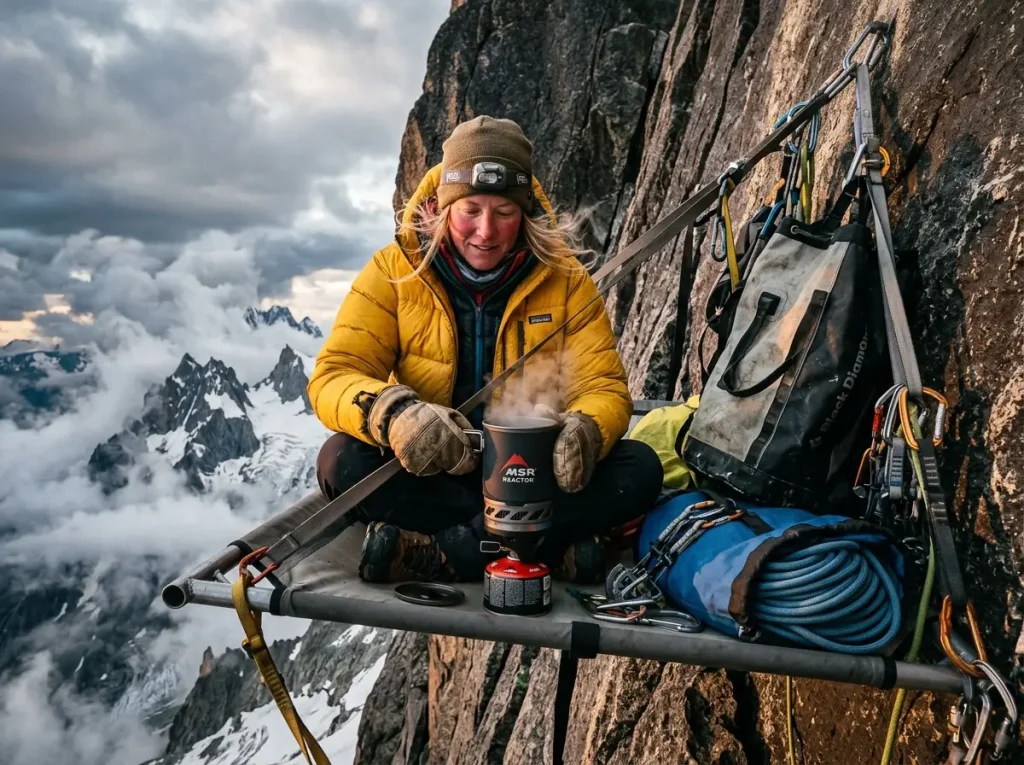 MSR Reactor stove in a suspended vertical kitchen” class=”wp-image-15395″/>
On a big wall or alpine objective, your stove is not a convenience item. It is safety equipment. The decision between the Jetboil Flash and the MSR Reactor is not preference — it is an objective-specific engineering decision with real consequences.
Jetboil Flash: 13.1 oz without fuel, flux ring convection burner, approximately 1 min 56 sec boil time per liter in calm conditions, low carbon monoxide output. MSR Reactor: 16.0 oz without fuel, radiant infrared burner, approximately 1 min 34 sec boil time per liter, total wind immunity, notably higher CO output.
That CO difference is the deciding factor in enclosed environments. MSR Reactor produces enough CO to be hazardous inside a portaledge fly without deliberate ventilation. Jetboil’s lower CO output makes it the defensible choice for any objective with enclosed bivy use. One case of CO poisoning at 4,000m ends the objective. The boil-time advantage of the Reactor means nothing if you lose consciousness using it.
For big wall systems that work across multi-day objectives, stove selection is part of the full kit decision, not an afterthought.
Jetboil vs. MSR Reactor — The Decision Matrix
Use the Jetboil Flash when: solo big walls, summer objectives, low-wind environments, or any situation with enclosed bivy or portaledge fly use where CO is a real concern.
Use the MSR Reactor when: alpine expedition, high-wind environments (Patagonia, Alaska, Himalaya), or any objective requiring significant snow melting to generate drinking water.
On a 5-day alpine objective, calculate fuel at 110g of canister fuel per person per day — boiling water for meals and hydration — and carry one spare 110g canister as insurance. Running out of fuel at elevation is a life-safety event. Budget it before you leave.
At altitude, fuel canisters lose efficiency as propane-isobutane ratios shift in the cold. Warm the canister inside a sleeping bag before use to maintain pressure. This is the kind of thing that’s not in the stove manual.
Hanging Kit Engineering on Portaledges
On portaledges, stoves must be suspended safely. Commercial hanging kits exist, but many experienced big wall climbers use swaged wire modifications to reduce weight and increase stability. The critical point: the pot must be mechanically secured so it cannot be displaced by a gust of wind or rope movement while cooking.
If the pot falls on a big wall, you lose your cooking system and potentially your only means of melting snow for water. Carry one backup pot regardless of system weight cost. And crack the portaledge fly entrance a minimum of 6 inches whenever you cook — CO saturation in an enclosed portaledge is faster than most climbers expect.
Hydration Engineering — The Gallon Rule and the Dehydration Paradox
Standard allocation: 1 gallon (≈3.8L) of water per person per day. In arid environments — Zion, Yosemite in July — that number goes up. At altitude, hyperventilation and low humidity increase fluid loss significantly beyond what the thirst reflex registers.
The dehydration paradox at altitude: mild hemoconcentration (blood thickening) can slightly benefit oxygen transport. Excessive dehydration exacerbates AMS and crushes technical performance. The line between those two states is found by watching urine color, not by listening to thirst. Target “copious and clear.” Electrolyte osmolarity matters too — single-serve packets like LMNT prevent the mess of measuring loose powder in wind and vertical environments.
Pro Tip: On big walls, freeze 2-liter water bottles before departure. Pack them around Day 1 perishables — steak, sausage, pre-cooked chicken. They act as a refrigerator for the first 48–72 hours, then convert to drinking water as they melt. Real protein on Day 1 at the approach pace fuels the first technical pitches when performance demands are highest.
Big Wall Haul Bag Packing — Applied Physics
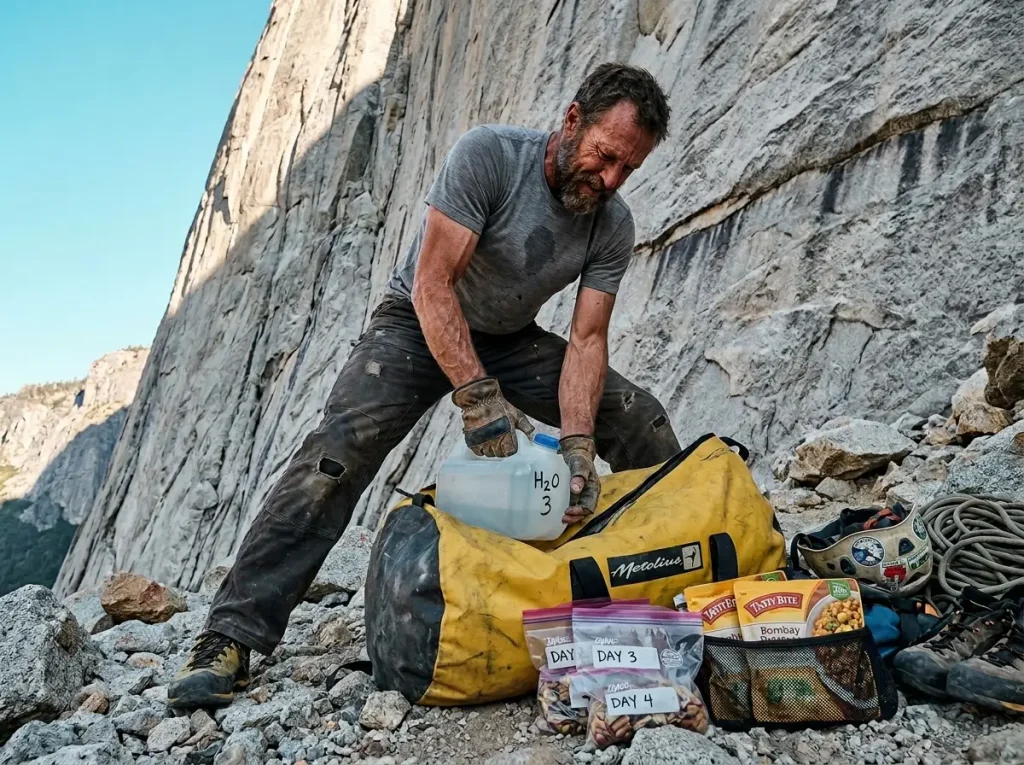
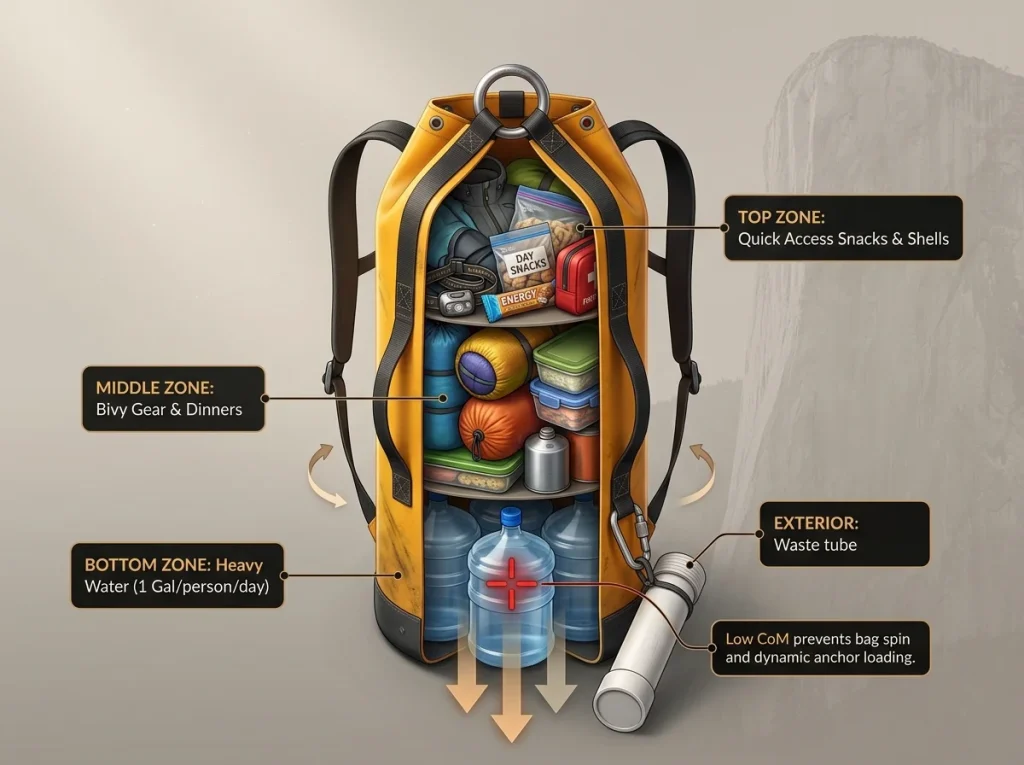
The haul bag is not a duffel bag. It has physics. Get the center of mass wrong and the bag spins during ascent, generating dynamic loads on the anchor and damaging gear through oscillation. The fix is simple: heavy at the bottom, light at the top.
Strategic packing zones: Bottom (heaviest) = water jugs, 1 gallon per person per day. Middle = dinners, spare fuel, sleeping bags. Top (lightest, most accessed) = day snacks, rain gear, headlamps. Outer pockets = poop tube, trash, Liquid IV. This is not organizational preference. The low center-of-mass prevents bag spin and reduces peak anchor load on every haul pitch.
The haul bag factor is an almost universally ignored selection criterion: crush-resistance of food packaging. Hard-sided containers survive. Soft pouches turn to paste under 80 kg of gear compression. Test every package under compression before the objective. Press it under a loaded pack at home. If the seam gives, repackage into a rigid container or rethink the food choice.
Repackaging in Ziplocs reduces volume by up to 30% and removes the need to haul commercial packaging weight down. Label each bag by day and meal in Sharpie. Pre-stage tomorrow’s top-pocket snacks every night before sleep. Never dig into the haul bag mid-route for that day’s fuel. The top-pocket stash is the system.
For a complete hydration dosage guide for vertical athletes, especially the electrolyte protocols for hot, arid wall environments, budget the water weight and haul it accordingly.
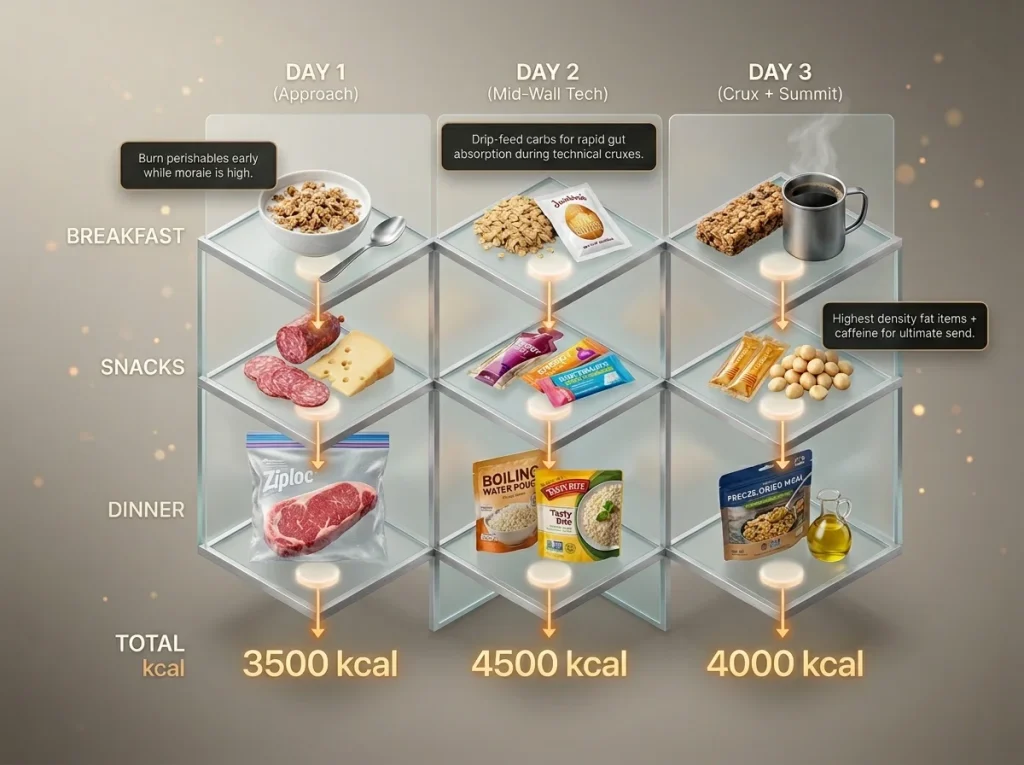
The 3-Day Vertical Menu Matrix
Day 1 (Approach + Pitch 1–4): Granola + Whole Milk Powder for breakfast — high fat, caloric, hydrating. Salami, hard cheese, and tortilla for snacks — crush-resistant, no refrigeration required. Fresh steak via the Wall Fridge method for dinner. Day 1 is when morale is highest and performance demands are significant. Spend your perishable calories there.
Day 2 (Mid-Wall Technical): Instant Oats + Nut Butter for breakfast — low GI base with fat for sustained release. Pure high caloric density drip-feed for snacks — gels, chews, electrolytes. Tasty Bite entrees + bag rice for dinner — boil-in-bag, no dish cleanup, high palatability under fatigue.
Day 3 (Crux + Summit): Breakfast Bar + Coffee — caffeine for CNS recruitment when it matters most. Honey packets, gels, and macadamia nuts for snacks — highest available density, one-handed consumption. Freeze-dried meal + olive oil drizzle for dinner.
The olive oil drizzle on freeze-dried is the single highest-value caloric hack available on a multi-day climb. One 1-oz packet of olive oil adds roughly 250 kcal to any freeze-dried meal for essentially no additional weight. This is not a tip. It’s a core system decision that adds 1,000+ calories across a 4-day objective at minimal cost.
Dirtbag Hacks and Repackaging for Zero Waste
Pre-mix oatmeal, powdered milk, chia seeds, and brown sugar in individual Ziploc bags at home. At the bivy, add boiling water, eat from the bag. Zero dishes. Zero decisions at 5 AM with cold hands.
Pre-portioned Ziploc bags for every meal also enforce the planning discipline — if the bag is pre-staged, you already made the decision at a warm table at home. You do not make that decision on a cold wall at 6 AM when hunger and fatigue have degraded your judgment.
Cold-soak while climbing: place the next meal in a softflask or Ziploc with cold water at the start of a pitch sequence. By the time you reach the belay anchor, it’s rehydrated and ready. Zero cooking time at the bivy.
Justin’s nut butter single-serve packets: 200 kcal each, crush-resistant, no refrigeration, one-handed. These belong in every climbing kit regardless of objective length.
The Weight of Waste — LNT Protocols for Multi-Day Objectives
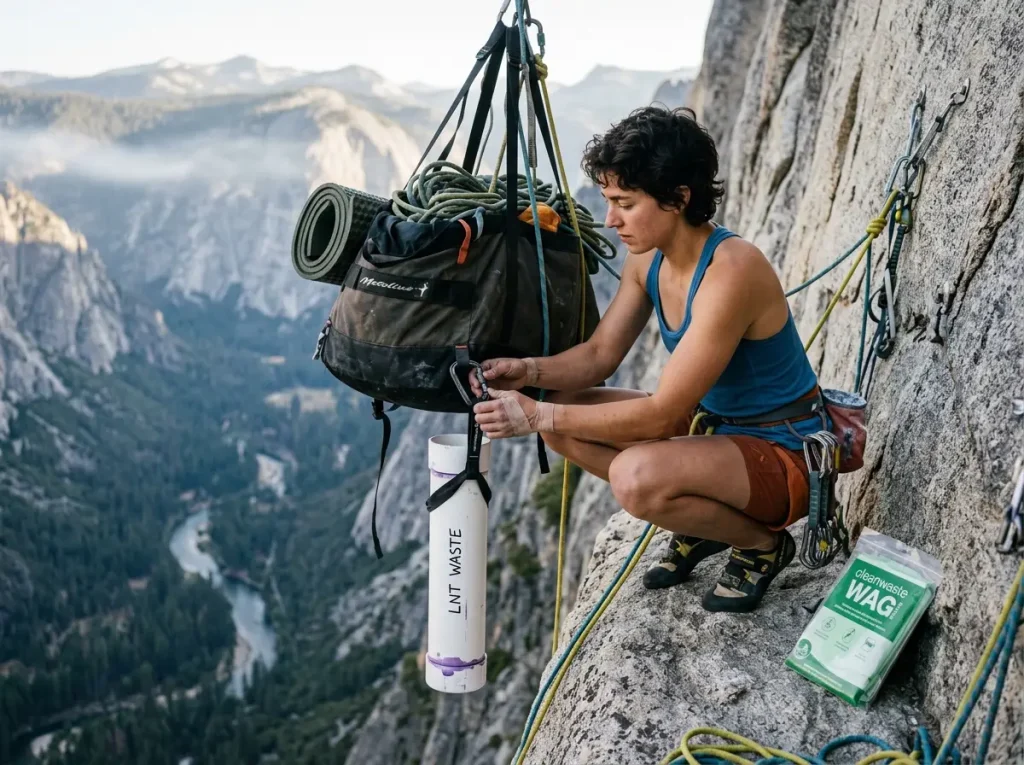
On El Capitan and most NPS-managed big walls, soil is absent. Catholes are physically impossible and legally prohibited. Waste management is not an ethical suggestion — it is a legal mandate enforced at permit checkpoints. National Park Service human waste management requirements are unambiguous on this.
On a 5-day big wall, human waste adds approximately 1–1.5 lbs per person to the haul bag on descent. Budget this into trip planning. The weight of waste is a real calculation, not an afterthought.
The poop tube is the standard system. Four-inch Schedule 40 PVC pipe (not 3-inch — too narrow for safe use), glued cap on one end, threaded clean-out plug on the other. One 12-inch section handles two people for a 5-day objective. Deposits go into individual Ziploc bags, optionally treated with odor-neutralizing powder, stored inside the tube.
The tube attaches to the exterior bottom of the haul bag using a short sling and locking carabiner. Not the interior. Not the middle. The exterior bottom. This is not an aesthetic choice — it is a hygiene decision and a compliance decision that the National Park Service actively enforces at permit checkpoints.
For a complete protocol for waste management from crag to big wall, covering WAG bags, catholes, and permit compliance across climbing environments, read the dedicated guide.
Commercial WAG bags — Cleanwaste, Restop — contain gelling agents and enzymes that solidify waste and neutralize odors. They’re the alternative for alpine or lower-angle objectives where a tube isn’t practical.
Grey Water, Microtrash, and the “Drink It” Protocol
Microtrash is anything smaller than your thumbnail: foil packets, tape scraps, pistachio shells, tea bag strings. Every piece exits with you. A banana peel decomposes in 3–5 weeks in optimal conditions. In alpine environments, it takes years. Pack it out.
Grey water: strain all wash water through mesh, pack the food particles with trash, broadcast any liquid at least 200 feet from water sources. On technical walls where broadcast is impossible — vertical faces, no soil — the “Drink It” protocol is the only compliant option. Add just enough water to deglaze the pot after eating. Drink it. Eliminates grey water entirely.
Pro Tip: On Day 3 onward, “pot soup” — whatever’s left in the pot from the previous meal plus boiling water — becomes a legitimate caloric hit, reduces waste, and requires no additional food. Dirtbag efficiency at its finest.
High-Altitude Climbing — Nutrition Adaptations Above 3,600m
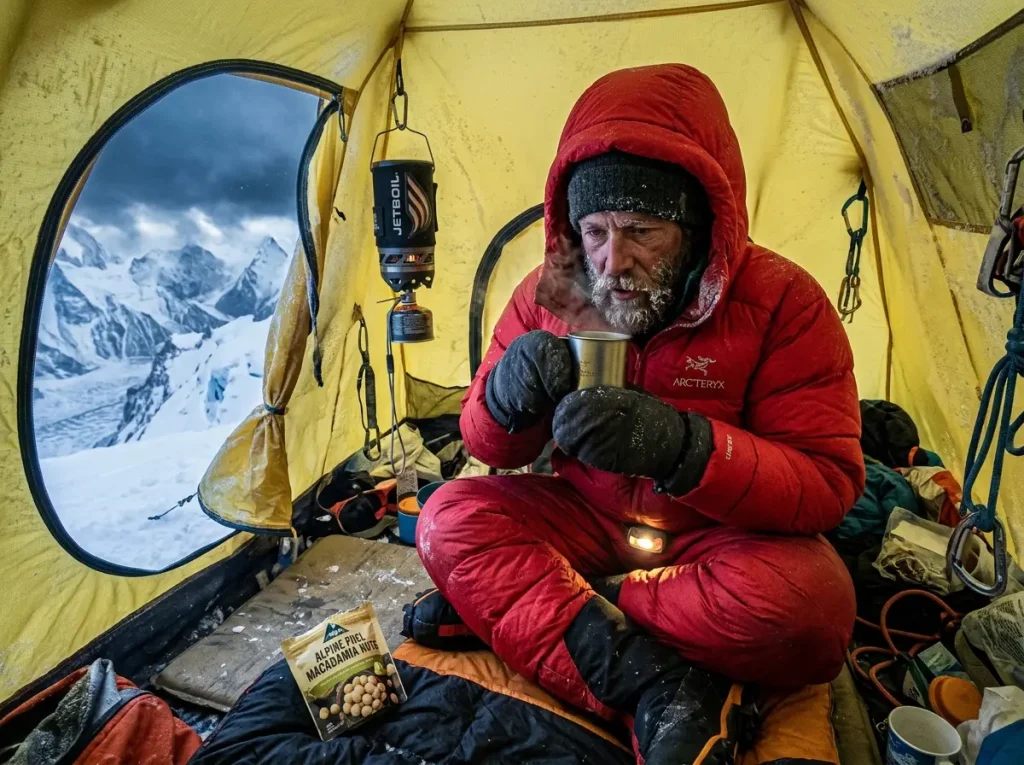
Above 3,600m (≈11,800 feet), feeding yourself becomes a full-time mental task on top of the physical one. The hormonal environment changes. Appetite suppression sets in — not as a minor inconvenience, but as a systemic reduction in hunger driven by elevated leptin. You will not feel hungry when you are severely caloric-deficient. This is mountain anorexia, and it catches experienced climbers off-guard on every expedition they don’t prepare for it.
At altitude, the body shifts substrate preference toward carbohydrates. Carbs yield more energy per unit of oxygen consumed compared to fat — a real advantage when oxygen is scarce. UIAA Medical Commission guidelines recommend 60–70% of caloric intake from carbohydrates above high altitude. This directly conflicts with the high-fat, high-density selection strategy that works at sea level and on walls below 3,600m. The tradeoffs are real. Research on nutritional requirements and altitude performance in high-mountain climbing documents these metabolic shifts in detail.
Shivering thermogenesis depletes muscle glycogen rapidly at altitude. Even at rest, in a cold bivy, your body is burning glycogen to generate heat. High-carbohydrate snacking doesn’t stop at night — it continues through the bivy. And before sleep, a high-fat snack provides the sustained fuel for overnight heat generation. Nuts or dark chocolate before sleeping. Not because it feels good — because it helps your body maintain core temperature through a cold night.
For altitude physiology and acclimatization protocols for climbers, the acclimatization schedule interacts directly with nutritional strategy.
The Anti-Palate Fatigue Protocol
Palate fatigue usually hits on Day 3 or 4, targeting high-fat foods — the exact foods you need most for caloric density. Your brain starts associating those foods with the discomfort of altitude and effort, and appetite for them collapses.
Rotate macronutrient profiles daily. Day 1 nut-butter dominated. Day 2 carb-forward. Day 3 fat and salt emphasis — cheese, olives, salami. Salt cravings resist altitude suppression better than sweet cravings. Sodium demand driven by osmoreceptors persists at altitude even when general appetite fails. Engineer salty snacks into every day of the menu, not as an afterthought.
Include 1–2 “palate reset” items with high salt and umami content: instant miso packets, soy sauce single-serves. These cut through the flavor fatigue when everything else has lost appeal.
Test every food item on a training climb or at elevation before the primary objective. Palate fatigue is individual. Customize each person’s supply by preference — what your partner rejects on Day 4, you might still want.
Small, Frequent, High-Density Snacking vs. Meal Structure
Three full meals a day at altitude is physiologically unrealistic. Large meals cause GI distress through the splanchnic mechanism, increase drowsiness, and can worsen AMS. The altitude-adapted feeding model is 6–8 small snack events per day at 200–400 kcal each.
Warm liquid calories have a specific efficiency advantage at altitude: bouillon, hot cocoa, instant soup. A 200 kcal cup of hot cocoa made with full-fat powdered milk and an olive oil drizzle addresses nutrition, hydration, and warming simultaneously. Sodium-to-water balance is managed passively through the liquid itself. This is the most altitude-efficient feeding technique available, and it works when solid food does not.
UIAA guidelines explicitly recommend small, frequent, highly palatable snacks as the altitude nutritional model. Three-meal structure is a sea-level habit that altitude punishes.
Pro Tip: At altitude, schedule eating by timer — not by hunger. Set a 60-minute alarm on your watch. When it goes off, eat 200–300 kcal regardless of appetite. Mountain anorexia will suppress hunger signals while your body is deep in caloric deficit. The clock is more reliable than your gut.
Putting the System Together
Three things, if you take nothing else from this.
Engineer your fuel — don’t just pack food. Every gram entering the haul bag must earn its place through caloric density ≥100 kcal/oz. Below that threshold is dead weight that costs you performance on every crux move. The weight-to-caloric ratio is not a nice-to-know. It is the design constraint that shapes the entire food system.
Eat by clock, not by hunger. Splanchnic hypoperfusion kills appetite mid-route. Mountain anorexia kills it at rest. The 2:1 glucose-to-fructose drip-feed runs by timer. The anabolic window runs by timer. The altitude snack schedule runs by timer. Your hunger signal is one of the first things the mountain disables. Don’t trust it.
The waste is part of the system. The poop tube, the WAG bags, the grey water protocol, and the microtrash policy aren’t afterthoughts — they’re the difference between an ethical climb and a permit revocation. Budget the weight on the way down. Pack out everything you packed in.
Before your next multi-day objective, run every food item through the 100/150 Rule and map your packing layout against the haul bag physics in this guide. The caloric math takes 30 minutes to do right. It has a measurable impact on your performance at the crux pitch.
FAQ
How much food do I need for a 3-day climbing trip?
Plan for 3,000–4,500 kcal per person per day on a technical 3-day objective, targeting ≥100 kcal/oz of food density. In practice, that means 1.0–1.5 lbs (450–680g) of packed food per person per day. With high-density selections — nuts, nut butters, olive oil, freeze-dried with added fat — a 3-day supply can stay under 4 lbs total before water.
What is the best food for high altitude climbing?
At altitude above 3,600m, carbohydrates become the priority fuel because they yield more energy per unit of oxygen than fat. UIAA guidelines recommend 60–70% of calories from carbohydrates. In practice: energy gels, oats, rice, and honey during active climbing; supplemented with fat-rich foods before sleep for overnight thermogenesis.
How do I meal prep for a multi-day climb without a stove?
Cold-soaking is the most viable no-cook strategy. Oats, couscous, certain freeze-dried brands, and ramen-style noodles rehydrate adequately in cold water over 20–30 minutes. Pre-stage each meal in a Ziploc or softflask before the pitch — by the time you arrive at the belay anchor, the meal is ready. In sub-zero alpine conditions, cold-soaking becomes unreliable; a lightweight stove becomes mandatory safety equipment.
What foods help with muscle recovery while climbing?
Within the 45–60 minute anabolic window post-effort, target 25–40g of protein combined with high-GI carbohydrates for glycogen resynthesis. Practical choices for the wall: instant oats + full-fat powdered milk + protein powder, or Tasty Bite entrees combined with a nut butter packet. Research also supports hydrolyzed collagen + Vitamin C 30–60 minutes before climbing to support tendon synthesis — relevant for finger pulley protection on consecutive hard days.
How do you deal with human waste on a multi-day big wall?
On El Capitan and most NPS-managed big walls, soil is absent and waste management is legally mandated. Build or purchase a poop tube — 4-inch Schedule 40 PVC, glued cap, threaded clean-out plug — and deposit into individual Ziploc bags stored inside. The tube attaches to the exterior bottom of the haul bag. Commercial WAG bags (Cleanwaste, Restop) are the alternative for alpine or lower-angle multi-day objectives where a tube is not practical.
Safety Notice: Rock climbing and mountaineering are inherently high-risk
activities that can involve physical trauma or fatal incidents. The information on Rock Climbing Realms is for
educational and informational purposes only. Techniques and advice presented here are not a substitute
for professional, hands-on instruction. Conditions and risks vary by location. Always seek guidance
from a qualified instructor before attempting new techniques. By using this website, you agree that you
are solely responsible for your own safety. Any reliance you place on this information is strictly
at your own risk, and you assume all liability for your actions. Rock Climbing Realms and its authors
will not be held liable for any harm, damage, or loss sustained in connection with the use of this information.
Affiliate Disclosure: We are a participant in the Amazon Services LLC Associates Program, an
affiliate advertising program designed to provide a means for us to earn advertising fees by advertising and linking
to Amazon.com. As an Amazon Associate, we earn from qualifying purchases. We are also an official affiliate partner
of Black Diamond Equipment via the AvantLink network. If you click on a Black Diamond affiliate link and make a
purchase, we may earn a commission at no additional cost to you. We also participate in other affiliate programs.
Additional terms are found in the terms of service.