
In this article
You’re brushing the last grain of chalk off your fingers after a solid day at the crag — shoes off, rope coiled, pack loaded. What you don’t feel are the 47 seeds lodged in your Velcro straps, the mud in your approach shoe lugs harboring Phytophthora spores, and the alkaline residue in your chalk bag quietly altering the chemistry of the limestone pocket you just sent. You drove three hours to a pristine subalpine crag. You also drove those hitchhikers straight past every natural barrier that had kept them out for millennia.
This is the conversation the climbing community has been slow to have. Most climbers think of their ecological impact in terms of what they remove — chipped holds, trampled vegetation, anchored rock. The research points somewhere else entirely. What we introduce matters more. Rock outcrops host between 35% and 66% of endemic plant species in many countries — island ecosystems protected, until recently, by sheer inaccessibility. Once climbing traffic begins, that protection ends.
This article breaks down the four primary ways climbers function as inadvertent biological vectors: technical textile entrapment, footwear rubber translocation, chalk as a pathogen reservoir, and the bypassing of elevational climatic barriers. And it gives you the technical protocols to stop all four without compromising your life-safety gear.
⚡ Quick Answer: Climbers spread invasive species through four primary mechanisms — ropes and Velcro trap seeds in their fibers, approach shoe rubber translocates soil and pathogens between crags, chalk alters pH and creates fungal spore reservoirs on cliff faces, and driving between elevations bypasses the natural climatic filters that historically kept lowland invasives out of alpine zones. To stop the spread: brush shoes and tape Velcro before leaving any crag, hand-wash ropes in pH-neutral soap at under 30°C, switch to liquid chalk at sensitive sites, and treat every zone transition on a multi-elevation climb as a decontamination checkpoint.
The Physics of the Hitchhiker — How Your Gear Collects Biological Material
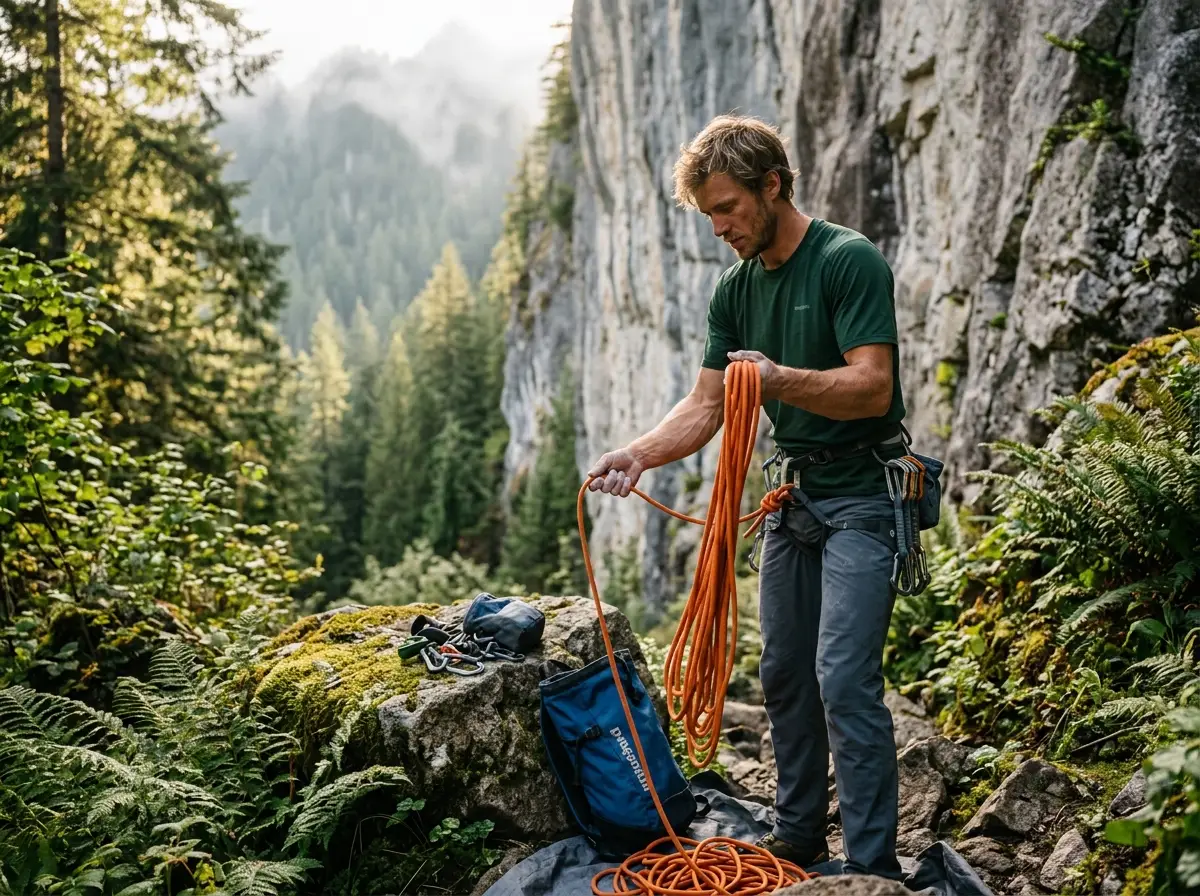
Here’s what nobody tells you at the gear shop: the same engineering properties that make your rope safe to fall on also make it one of the most efficient seed-collection systems in your pack.
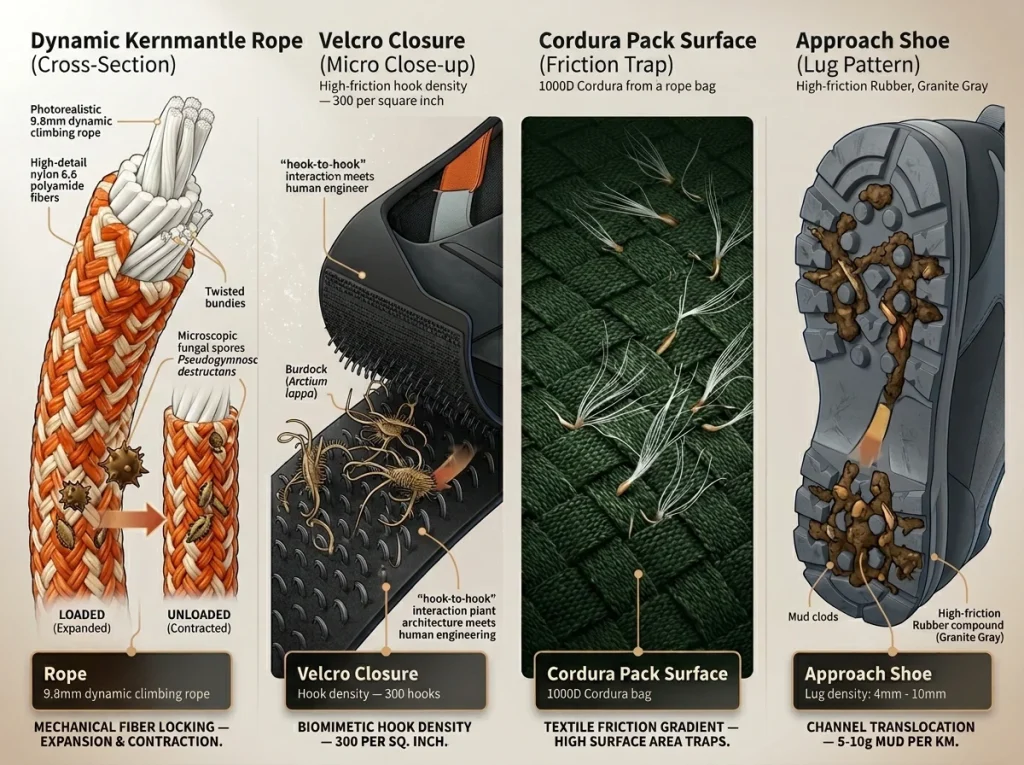
Dynamic kernmantle ropes are built from nylon 6,6 polyamide — a braided sheath over a load-bearing core. When you take a fall, the sheath expands under load. When the load releases, the fibers contract. If you were flaking out your rope at the base of an infested crag, microscopic seeds and fungal spores — including Pseudogymnoascus destructans spores linked to White-nose syndrome in bats — penetrate the weave on the way in and get locked inside on the way out. Standard coiling and shaking doesn’t produce enough mechanical force to dislodge material locked into fiber junctions. You need an actual wash.
Ropes stored in rope bags after a session may carry higher propagule pressure than those stored loosely, because compression drives seeds and spores deeper into the sheath matrix. That’s the counterintuitive one.
Pro tip: Inspect your sheath under bright light after any session at a crag known for invasive infestations. Look for burr fragments near the core strand junctions. A soft stiff-bristled brush run along the rope dislodges surface material before washing — and it takes two minutes.
Then there’s the Velcro problem. This one still gets me. The hook-and-loop fastener was invented by George de Mestral after he studied how Burdock (Arctium lappa) seeds latched onto the loops of his fabric trousers — thousands of tiny hooks, biomimetically perfected by the plant over millennia. Standard climbing shoe Velcro runs approximately 300 hooks per square inch, engineered to grab loops with the same efficiency it grabs seeds. Dog-strangling vine (Vincetoxicum rossicum) seeds travel up to 79.63 meters by wind. Their primary long-distance dispersal? Human vectors carrying seeds stuck to Velcro. Walk one infested approach trail and your closures are loaded.
Cordura bags and braided laces compound the problem. Cordura’s high surface area and textured friction trap wind-dispersed seeds like Black swallow-wort (Vincetoxicum nigrum). Braided laces and webbing create channels that capture soil-borne pathogens and vegetative bulbils — small reproductive plant fragments that can establish a new population from a single node. For a deeper look at the practical tradeoffs between lace and closure systems, the climbing shoe laces vs. Velcro — the technical decision matrix breaks it down by rock type and use case.
The mechanics of plant fruit hooks — the same system encoded in Burdock seeds — have been studied extensively in peer-reviewed literature. The physics are unambiguous: your gear is better at collecting seeds than most dedicated seed-collection apparatus.
Footwear Tribology — Why Climbing Rubber Is a Seed Transport System
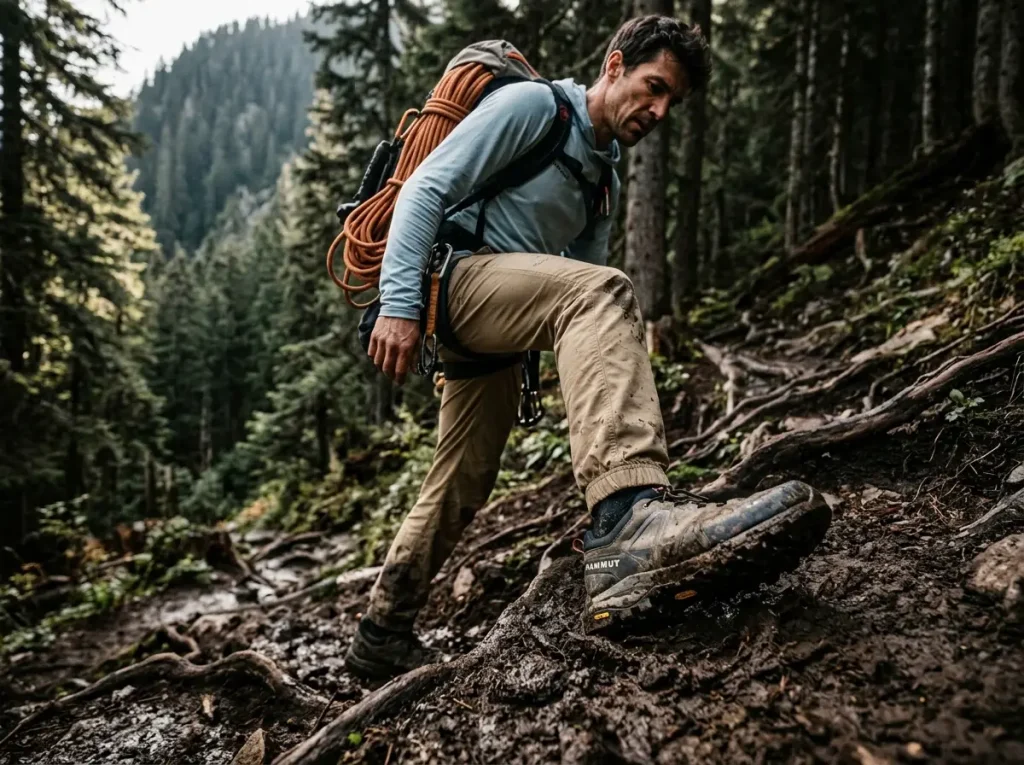
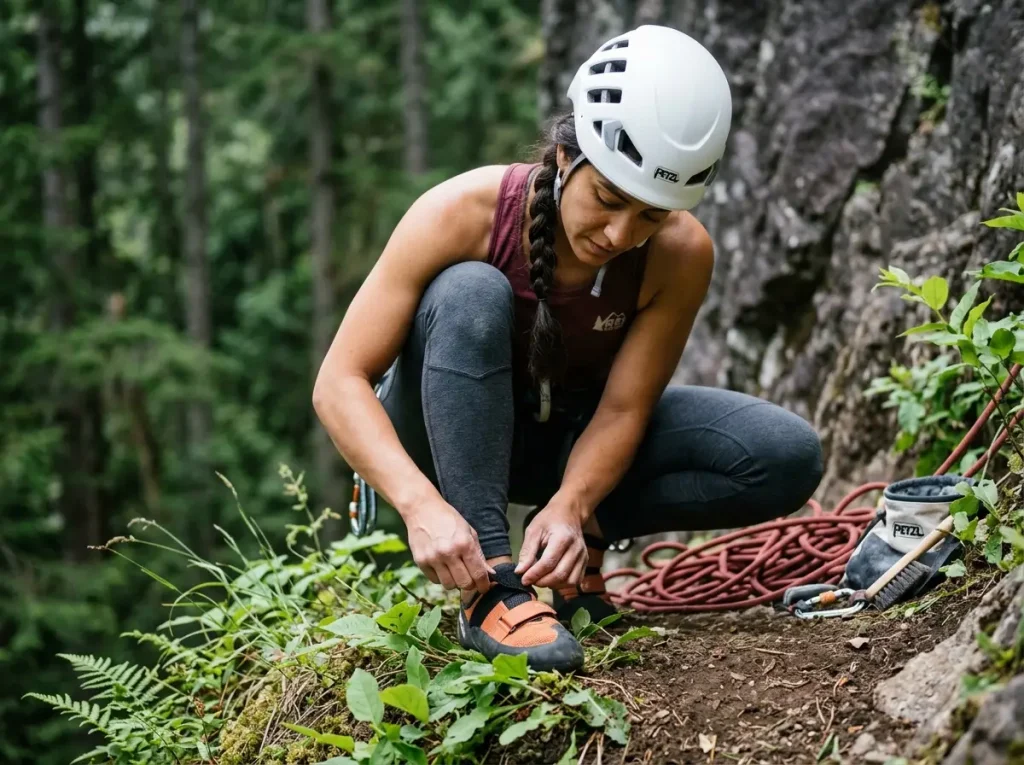
Climbers spend a lot of time thinking about what their rubber does on rock. Almost no time thinking about what it picks up between the car and the rock.
Climbing rubber generates grip through three mechanisms: deformation, molecular adhesion, and wear. Harder rubber compounds — the ones typically recommended for outdoor climbing on sharp-edged limestone and granite — resist plastic deformation on features but trap large mud clods in their lug channels. A standard worn approach shoe lug (3–5mm depth) can carry 5–10 grams of mud per shoe per kilometer of trail. Each muddy clod can harbor millions of fungal spores.
Phytophthora ramorum, the pathogen behind sudden oak fatality events, spreads primarily through mud translocation. Your shoe lugs are the vector. And the research in the Niagara Escarpment is blunt about the outcome: the proportion of non-native plants was three times higher in climbed areas compared to unclimbed cliff faces — 81% versus 27%. Footwear translocation from staging area to rock face is the primary mechanism. The systematic role of recreational tourism in non-native species spread is documented in peer-reviewed meta-analysis; this isn’t speculation, it’s a measured pattern.
For the mechanics behind different rubber compounds and why hardness affects both grip and biological pickup, the tribological science behind different rubber compounds covers the physics in detail.
The smearing technique — pressing rubber into micro-textured rock — simultaneously presses soil particles and organic matter into the rubber matrix. On wet approaches, the pickup rate increases by roughly an order of magnitude compared to dry conditions. Early spring climbing, which coincides with peak seed dispersal for many invasive plants, carries disproportionately higher seed loads than late-summer climbing after seed shed has passed. The timing matters.
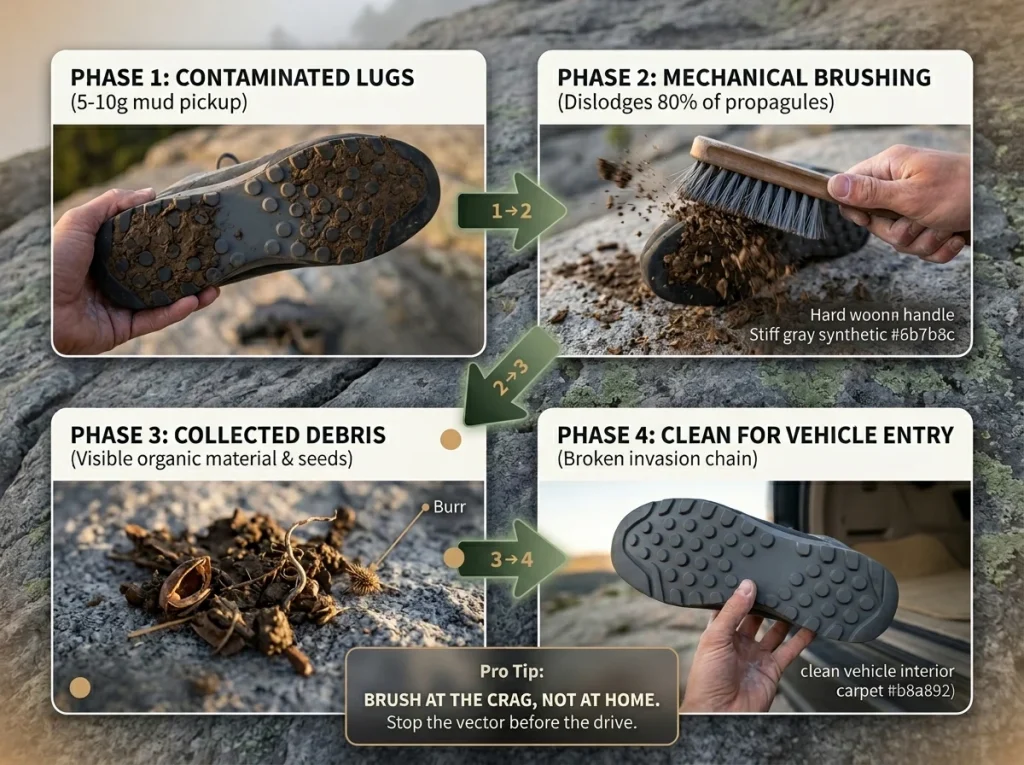
Pro tip: A stiff-bristled brush — not a soft toothbrush, which misses the deep lug channels — on shoe soles before you get in the vehicle dislodges 60–80% of trapped mud. Do it at the crag, not at home. The vector is the drive to the next destination, not the route itself.
Staging areas at crag bases are the highest-density invasion hotspots at any climbing venue. They sit at the intersection of maximum human activity, disturbed soil, and the entry point for every propagule climbers carry from the parking lot. Trampling drops native plant cover and opens bare soil niches that invasive generalists are evolutionarily adapted to colonize faster than the native cliff specialists they’re replacing.
Garlic Mustard (Alliaria petiolata) starts in the disturbed roadside soil of parking lots and travels up approach trails in shoe lugs. Once it’s at the crag base, climbers move it further up the face while stemming and high-stepping. The staging area isn’t just a place you set your pack. It’s the entry wound.
When you’re setting up at a crag, choose rock or established duff to set gear down — bare mineral soil is an open invitation for invasive generalists. A rope bag thrown on bare soil at the base picks up the seed load from that staging area and carries it to every crag you visit next.
The Chalk Problem — Biochemistry, pH Alteration, and Fungal Pathogen Transport
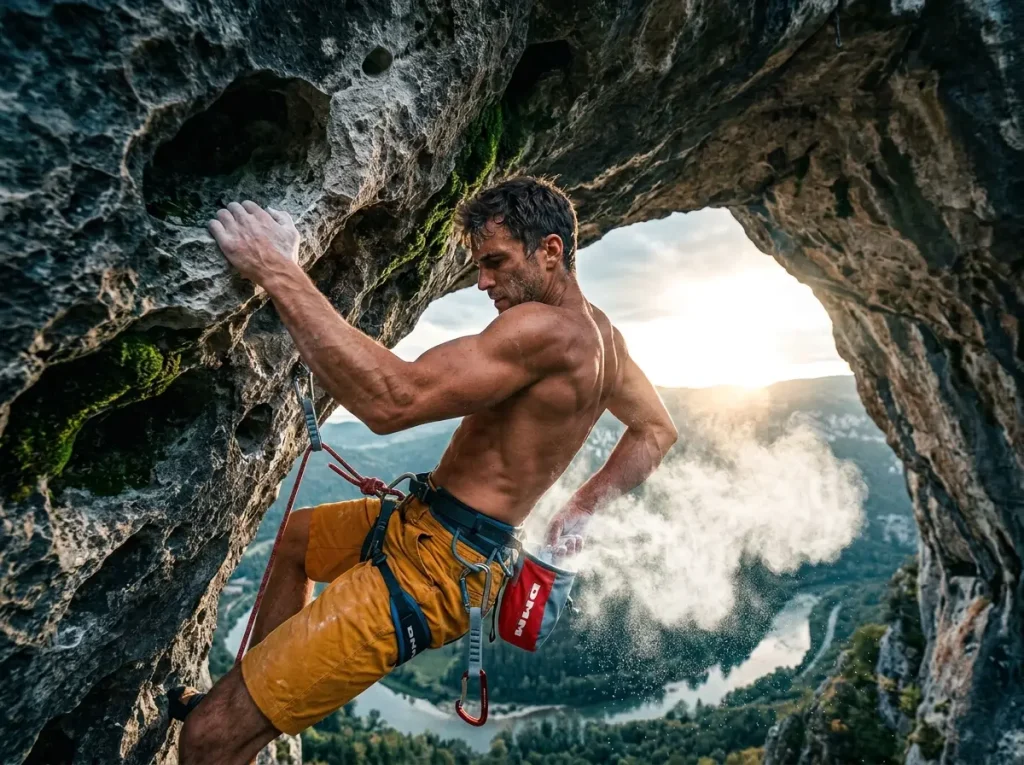
This is the section you won’t find anywhere else. Not one competitor article on climbers and invasive species mentions chalk at all. Which is remarkable, because chalk is the one vector every climber uses on every route.
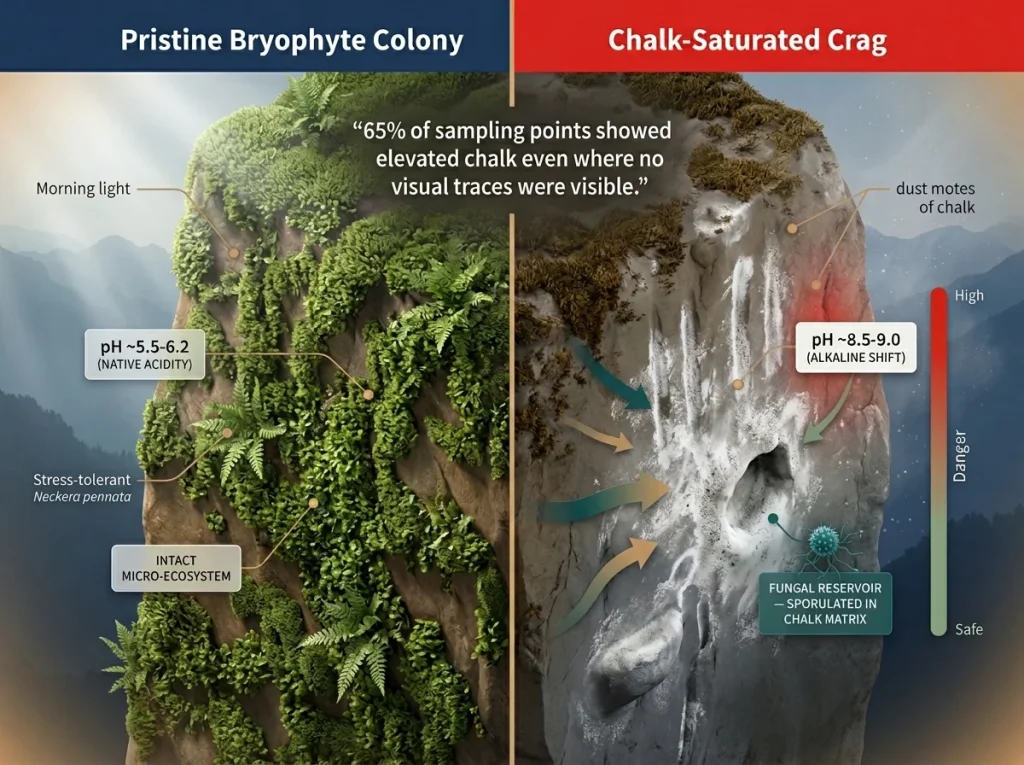
Climbing chalk is magnesium carbonate hydroxide. It’s alkaline. And it measurably alters the pH of cliff rock surfaces in ways that harm species that took millions of years to adapt to native acidity.
Native cliff flora — the bryophytes, mosses, liverworts, and stress-tolerant ferns that cover the rock around and below your holds — lack the hormonal regulatory systems of vascular plants. They absorb water directly through their surfaces, which means pH shifts hit them fast and hard. Experiments recorded in a peer-reviewed study on chalk distribution and its impact on cliff-dwelling bryophytes found significant negative effects on germination and survival of Neckera pennata and Buxbaumia viridis at elevated chalk concentrations. The same study measured elevated chalk levels at 65% of sampling points where no visual chalk traces were visible. The impact zone of a single route extends far past the tick marks you can see.
A dead moss patch leaves bare rock — no competition from native cliff specialists, and the exact substrate some invasive generalists can colonize. Learn how to clean chalk from rock safely — without damaging the surface or accelerating pH shifts before your next session at a sensitive crag.
Pro tip: Liquid chalk reduces total chalk dispersal by approximately 90% compared to loose chalk bags. At high-traffic routes on limestone with known botanical interest, switching to liquid chalk is the single highest-impact behavioral change you can make with zero effect on your climbing.
Then there’s the fungal angle — and this one is subtle enough that most people miss it.
Chalk is a porous, fine particulate. In the rain-shadow zones of overhanging sections — where UV exposure is minimal and humidity remains stable — chalk deposits create microenvironments where fungal spores remain viable long after they would have expired on exposed rock. Chalk inactivates SARS-CoV-2 with 99%+ efficiency within a minute. Fungal spores behave differently. The porous matrix protects them instead of neutralizing them. Fungal endophytes that can increase the invasiveness of Phragmites australis — the invasive common reed that has restructured wetlands across North America — are transmitted via seeds and persist in organic material. The chalk-organic debris matrix accumulating in the back of limestone pockets and overhangs is a potential reservoir.
Here’s the common mistake: climbers who wash tick marks with a water bottle squirt inadvertently activate dormant spores in chalk accumulations. Dry brush first, water only for final rinse, and never on sensitive limestone at ecologically significant crags.
Pro tip: After a high-chalk session at a sensitive site, use a soft natural-bristle brush (not synthetic — it can scrape) to spread remaining chalk over a wider area, reducing concentration at critical holds. This distributes rather than deposits.
The Elevational Bypass — How Climbers Move Species Across Natural Barriers
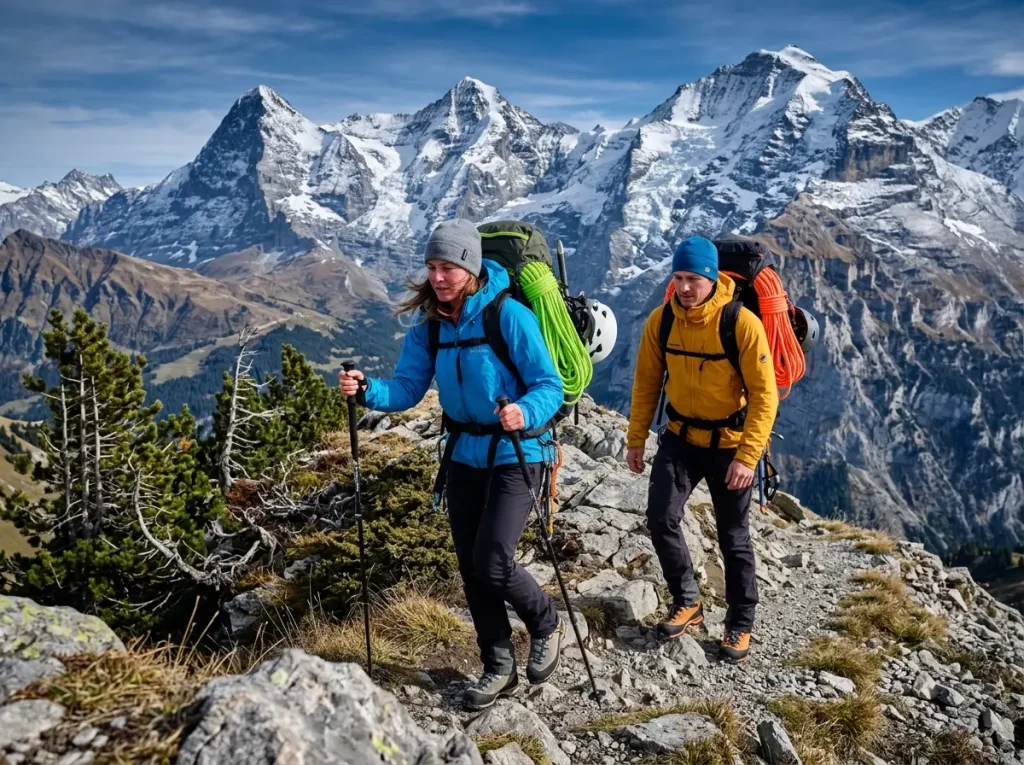
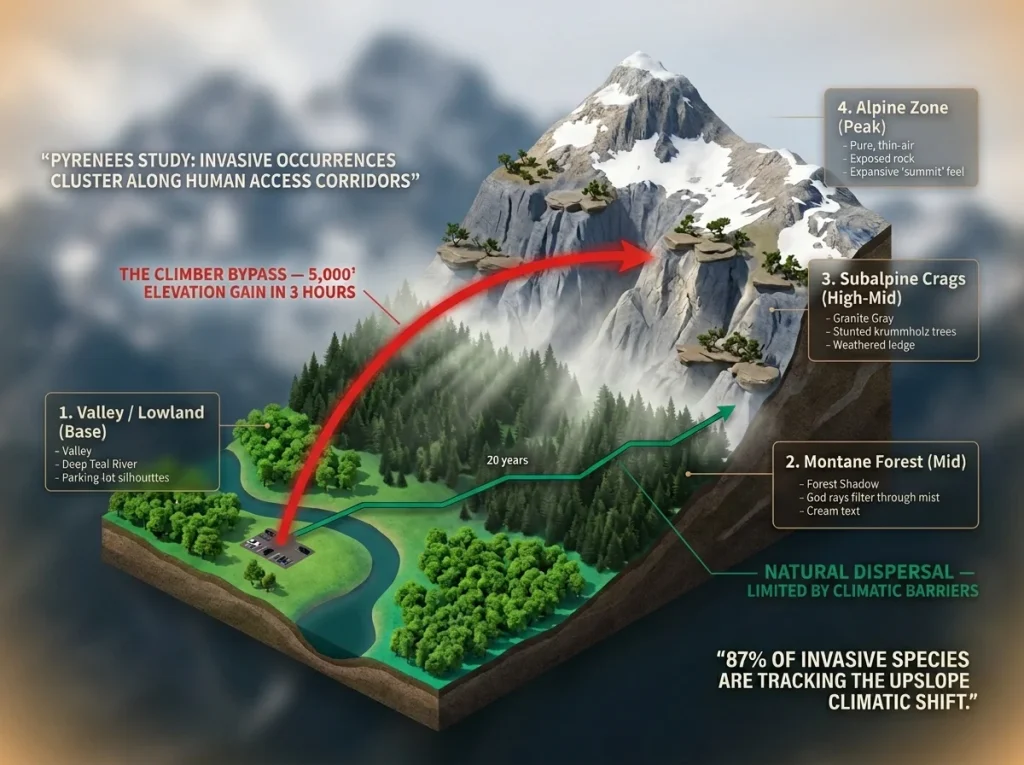
Trad and alpine climbers are the highest-risk vectors in the sport. Not because they’re careless, but because of what they physically do: they move between distinct ecological zones — valley, montane, subalpine, alpine — in a single morning. Each zone transition can involve new seed pickup and deposition at a higher elevation. They’re crossing the climatic filters that historically kept lowland invasive species below the treeline.
Climate change is already weakening those filters. The climatic “centroid” of suitable habitat for 87% of invasive species is shifting upslope. But most invasive plants can’t disperse fast enough on their own to track their shifting niche. They need a fast vector. Climbers drive from valley parking lots to subalpine crags in one morning, effectively teleporting propagules across temperature, precipitation, and phenological gradients that were the historic barriers to invasion.
The Pyrenees study on climbing invasions and non-native plant species under climate change documents it directly: invasive occurrences cluster along valleys and low-elevation corridors — the exact routes climbers use to access remote crags. Expanding infrastructure amplifies the problem. Roads, ropeway corridors, and approach trails built to access remote terrain are inadvertent invasion highways, increasing propagule pressure — the frequency and magnitude of introduction events at each site.
Pro tip: When doing multi-zone climbs — lowland start, alpine objective — treat each zone transition as a decontamination checkpoint. Brush shoes and tape Velcro before crossing the treeline. It costs three minutes and interrupts the propagule chain before it reaches the most sensitive terrain.
Above roughly 2,000 meters, a “mountain squeeze” occurs. Suitable habitat for invasive species contracts into specific high-elevation hot spots, where they compete directly with endemic cliff specialists that have no evolutionary defense against rapid-growth, warm-adapted competitors.
The Eastern White Cedar trees on the Niagara Escarpment’s cliff faces include specimens over 1,000 years old — some of the oldest living organisms in North America — and they’re being displaced by invasive vines correlated with climbing traffic. Rock outcrop ecosystems harbor 35–66% of endemic plant taxa in many countries. This is where that biodiversity concentrates. It’s also where we spend our time.
The Niagara Escarpment data makes the scale of this plain: 81% non-native plant proportion in climbed areas versus 27% in unclimbed areas. That gap is directly tied to climbing access patterns. The approach trail is the invasion corridor. For a deeper look at why these ecosystems are worth protecting, the fragile ecology of cliff ecosystems climbers depend on puts the Niagara Escarpment data in broader context.
When you’re doing early spring climbing — April and May, especially at lower elevations — you’re moving through peak seed dispersal season for most invasive plants. That session in late March when you’re psyched on the first warm temps? That’s the highest-risk run of the year for seed transport. Late summer climbing, after seed shed has passed, carries a fraction of the propagule load.
The Biosecurity-Safety Conflict — Decontamination Without Destroying Your Gear
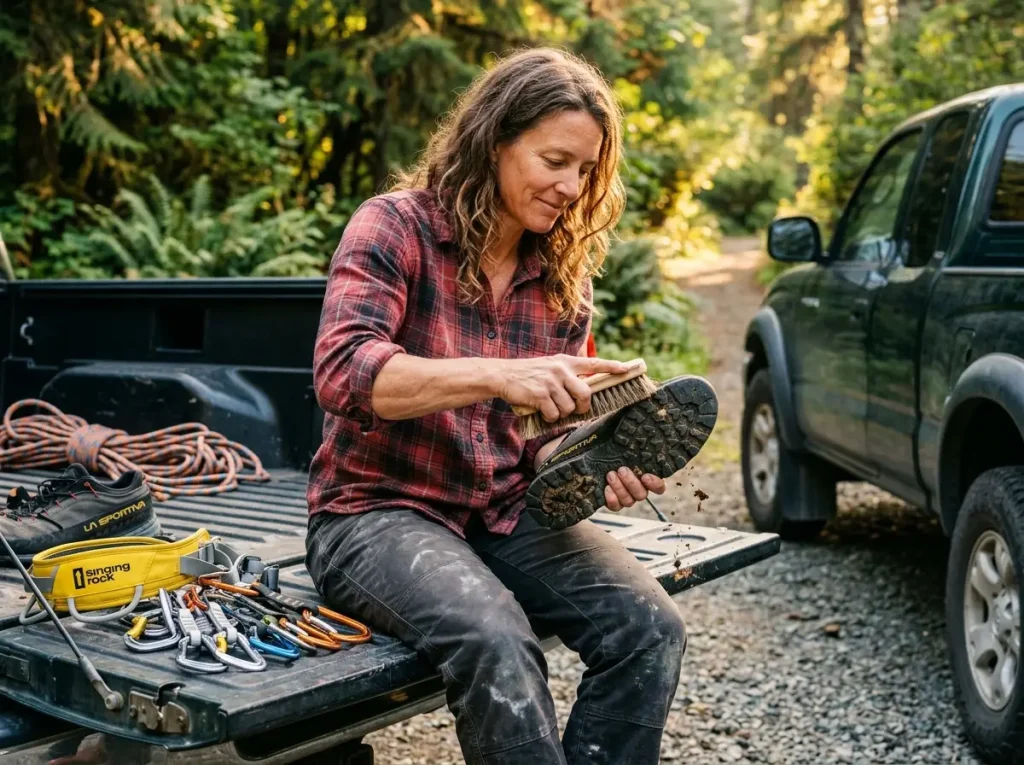
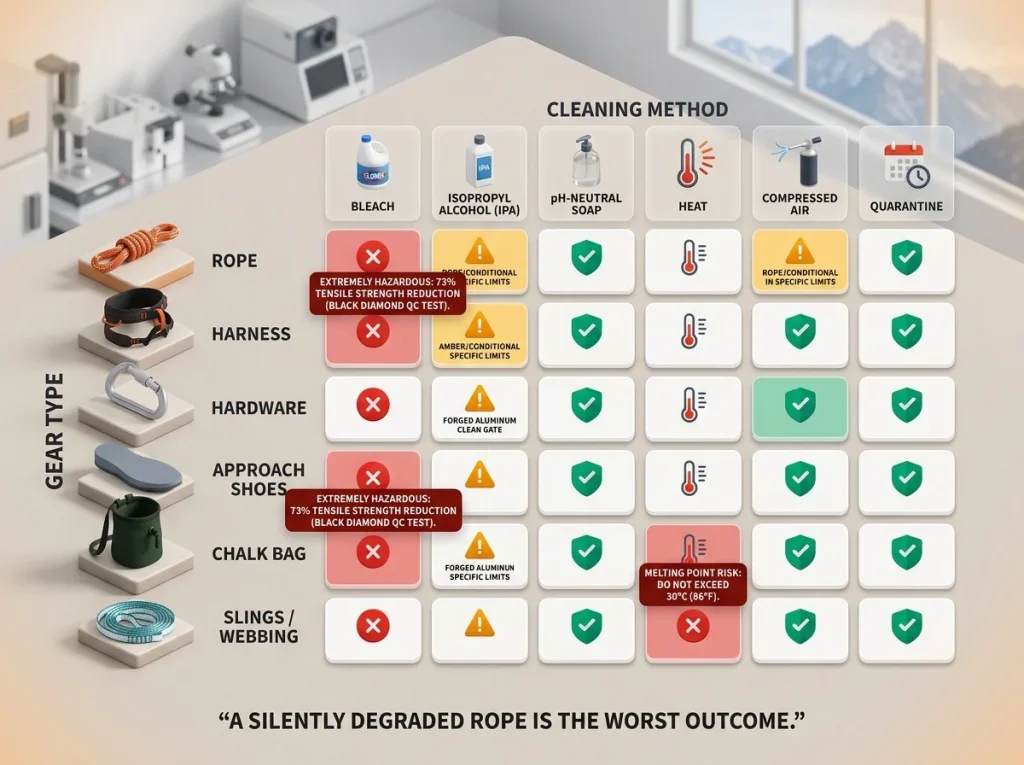
Here’s where it gets complicated. The most effective biosecurity agents — heat, bleach, harsh chemicals — are also the things most likely to ruin your rope.
Black Diamond’s QC Lab testing confirmed what most climbers don’t know: Clorox bleach causes 73% tensile strength reduction in nylon 6,6 after 72 hours of exposure. Vinegar causes 13% in just 30 minutes. Woolite detergent causes 9% in the same window. These degrade the load-bearing fiber invisibly. The sheath looks fine. The rope cannot dissipate fall energy the way it was rated to. A silently degraded rope is the worst outcome: passes visual inspection, fails mechanically.
The UIAA SAFECOM guidance on disinfecting climbing equipment safely covers this conflict directly. UIAA safety standards and what they actually test explains why spin cycles cause up to 37% faster performance loss even when the sheath looks undamaged.
Dyneema/HMPE gear has a thermal limit of 30°C. Standard fungal spore elimination requires 55°C. That’s a direct conflict for any HMPE gear. Polyamide is thermally tolerant but chemically fragile; HMPE is the reverse. Different gear, different vulnerabilities — and you can’t treat them the same way.
The verified approach is two phases: quarantine (72 hours for most pathogens, 7 days for resilient fungal spores), then pH-neutral manual washing at under 30°C. A pH strip in the wash water isn’t overkill — target 6.5–7.5. Manufacturer protocols differ: Beal, Petzl, DMM, Singing Rock, and Mammut each specify different parameters. Using another brand’s protocol on your rope isn’t safe. For the complete process, the complete science-backed climbing rope washing guide covers temperatures, drying, and UV exposure in detail.
Pro tip: Isopropyl alcohol is the controversial middle ground. Beal allows brief submersion — a maximum of 10 times over the rope’s lifetime. Most other manufacturers warn it degrades fiber finishes and reduces flexibility. Reserve it for emergency decontamination scenarios on hardware, not routine cleaning of textile gear.
Hardware — carabiners, cams — is far more tolerant of decontamination. Compressed air clears dry biological material from crevices. A damp cloth removes soil. Silicone or Teflon lubricant on moving parts after drying prevents the grinding-in of abrasive rock dust. Do not use household acid-based cleaners on metal hardware.
For approach shoes, the stiff-bristled brush at the crag handles the majority of the mud vector. For high-risk aquatic biosecurity — any scenario where you’re crossing watershed boundaries — freeze shoes overnight or allow 48 hours of drying between visits. Chalk bags should be emptied and washed with pH-neutral soap after each session at an infested site. Their interior fabric accumulates fungal spores just as efficiently as rope sheaths. Rope bags are almost never washed, and they carry the full seed load from every staging area they’ve been set down in.
The crag-side sequence is: brush shoes → tape Velcro and pack pockets → compressed air on hardware → load vehicle. Total time: five to seven minutes. That five minutes is the entire intervention. Everything downstream of that — the washing, the quarantine — is slower and less effective than simply not loading the seeds into the car in the first place.
The Climber’s Active Role — From Vector to Steward
The “Arrive Clean, Leave Clean” philosophy isn’t a suggestion from a land manager’s pamphlet. It’s the operating condition for crag access on private land, where landowner tolerance runs out in years, not decades.
Access Fund’s Climbers for Conservation stewardship framework draws a direct line between climber behavior and crag access. Crags where communities demonstrate active land management stay open. Crags where they don’t get closed — progressively, sometimes permanently. The Access Fund’s role in protecting the crags we climb details how that translates to land access agreements.
The practical action: push for a biosecurity zone at busy trailheads — a marked brush station where every climber brushes shoes and tapes Velcro before entering the approach. The hardware is a brush and duct tape. The impact is front-loaded, where it matters most. Propose it at your next Adopt-a-Crag event.
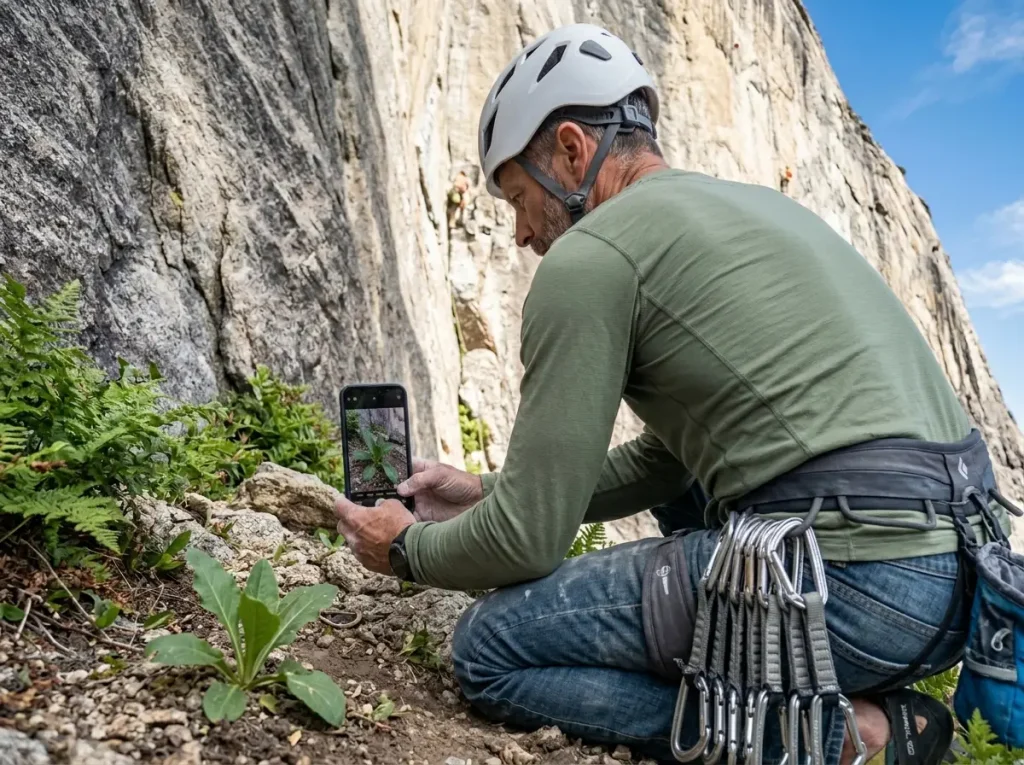
Citizen science is where climbers have a genuine detection advantage. Cliff bases, talus zones, remote subalpine crags — rangers rarely reach these on regular monitoring schedules. iNaturalist photo reports feed directly into databases land managers use to prioritize intervention. EDDMapS geotagged sightings trigger automatic institutional notification. Wild Spotter reports are reviewed by USDA Forest Service botanists. Five minutes before you tie in can start an intervention that prevents a decade of undetected spread.
Route development is the single highest-impact event in the whole lifecycle of a crag. “Route gardening” — clearing vegetation from a new line — opens an immediate invasion window in disturbed soil. Work plant-free faces, remove only loose rock, and let native vegetation re-establish before opening the route. One poorly gardened crag can contribute to a localized plant extinction. The Access Fund’s Conservation Grants program funds crag-specific invasive species removal. For the full stewardship picture, mastering the full art of climbing stewardship — beyond Leave No Trace lays out the framework.
The parallel between anchor systems and biosecurity isn’t an analogy. It’s the same discipline. Both are non-negotiable. Both protect something that cannot be rebuilt once it fails. Apply the same technical rigor to what your shoes pick up on the approach.
According to the Leave No Trace Center for Outdoor Ethics guidelines on invasive species, the simplest intervention — a thorough gear inspection before leaving any trailhead — is among the most effective tools outdoor practitioners have for reducing propagule pressure across the recreation landscape.
Conclusion
Three things to take away from this.
Your gear is an engineered collection system. The rope sheath, the Velcro, the Cordura, the rubber soles — every one of these materials was optimized for a performance property that also happens to trap and transport seeds, spores, and soil across every mountain ecosystem you pass through. This isn’t carelessness on your part. It’s physics.
Chalk is not a cosmetic issue. It alters cliff surface chemistry, harms native bryophytes, and creates fungal spore reservoirs in the rain-shadow zones of overhanging routes. No competitor article has addressed this. Now you know what they don’t.
The biosecurity-safety conflict is real, but it’s solved. Quarantine plus pH-neutral manual washing at the right temperature keeps your gear safe, maintains UIAA-rated mechanical performance, and breaks the invasion chain at the source. The protocol is five to seven minutes at the crag before you load the vehicle.
Before your next session: brush the shoes, tape the Velcro, check the chalk bag. And if something looks wrong on the approach — a plant you don’t recognize aggressively colonizing the crag base — photograph it and upload it to iNaturalist before you tie in. That’s the protocol. Now go send something — responsibly.
FAQ
Can invasive species really travel on climbing ropes?
Yes — and the mechanism is specific to how kernmantle ropes are built. When the rope loads during a fall, the braided polyamide sheath expands, allowing micro-seeds and fungal spores to penetrate between fiber junctions. When the load releases, the sheath contracts and locks the propagules inside the textile matrix. Standard coiling and shaking fails to dislodge them. Hand-wash your rope in pH-neutral soap after sessions at known infested crags.
How do you clean climbing boots for invasive species without ruining them?
Use a stiff-bristled brush on shoe soles and lug channels before leaving the crag — this is more effective than post-session washing because you’re stopping the vector at the source, before it enters your vehicle. A damp cloth (no detergents or acids) handles surface soil on climbing rubber. For high-risk aquatic biosecurity scenarios crossing watershed boundaries, freeze approach shoes overnight or allow 48 hours of drying between visits.
Does climbing chalk spread invasive species?
Not by transporting seeds directly, but by creating the conditions that allow invasive species to establish. Chalk significantly alters surface pH, harming native acid-adapted bryophytes and creating bare cliff surface that invasive generalist plants can colonize. Chalk also functions as a porous reservoir for fungal spores in rain-shadow zones under overhangs, extending their viability past natural die-off rates. Liquid chalk reduces total chalk dispersal by approximately 90% compared to loose chalk bags.
Why are alpine climbers at higher risk for spreading invasive species than gym climbers?
Alpine and trad climbing practitioners cross multiple distinct ecological zones — lowland valley, montane forest, subalpine crag, alpine zone — in a single day. Each zone transition involves new seed pickup with potential deposition at higher elevation. Climate change is already weakening the natural climatic filters that historically kept lowland invasives below the treeline. Climbers provide the high-speed anthropogenic corridor that allows these species to reach subalpine and alpine environments before natural dispersal could get them there. A gym climber’s invasive species dispersal risk is essentially zero. A trad climber doing a 5,000-foot approach to an alpine crag is a significant biological vector.
Is it okay to use bleach to disinfect climbing gear for biosecurity?
No. Black Diamond’s QC Lab documented 73% tensile strength degradation in nylon after 72 hours of bleach exposure — and the degradation is invisible from outside the sheath. A bleached rope can pass visual inspection but have lost most of its energy-dissipation capacity, which is the critical safety function in a fall. Use pH-neutral soap (pH 6.5–7.5) in lukewarm water instead, or follow manufacturer-specific protocols for biosecurity quarantine.
Safety Notice: Rock climbing and mountaineering are inherently high-risk
activities that can involve physical trauma or fatal incidents. The information on Rock Climbing Realms is for
educational and informational purposes only. Techniques and advice presented here are not a substitute
for professional, hands-on instruction. Conditions and risks vary by location. Always seek guidance
from a qualified instructor before attempting new techniques. By using this website, you agree that you
are solely responsible for your own safety. Any reliance you place on this information is strictly
at your own risk, and you assume all liability for your actions. Rock Climbing Realms and its authors
will not be held liable for any harm, damage, or loss sustained in connection with the use of this information.
Affiliate Disclosure: We are a participant in the Amazon Services LLC Associates Program, an
affiliate advertising program designed to provide a means for us to earn advertising fees by advertising and linking
to Amazon.com. As an Amazon Associate, we earn from qualifying purchases. We are also an official affiliate partner
of Black Diamond Equipment via the AvantLink network. If you click on a Black Diamond affiliate link and make a
purchase, we may earn a commission at no additional cost to you. We also participate in other affiliate programs.
Additional terms are found in the terms of service.