
In this article
You’re on the fourth set. Arms like concrete. The V5 you’ve been flashing all season suddenly feels like a 5.12 crux, and your fingers are peeling off holds they’d hold all day fresh. You drop. Again. You’ve been running 4×4 circuits every training cycle for six months, and you’re not getting better at climbing hard when pumped. You’re getting better at suffering through bad training.
That’s the thing nobody tells you at the gym: a 4×4 done wrong isn’t just ineffective. It’s expensive junk volume that generates fatigue, damages your max strength, and keeps you one fatigued slip away from an A2 injury. After enough cycles watching this play out on the wall, the pattern becomes obvious. The problem isn’t the protocol — it’s the execution.
This article deconstructs exactly why most 4×4 endurance training fails. You’ll understand the metabolic system you’re trying to hit, the variables that decide whether a session is a genuine anaerobic power endurance stimulus or wasted effort, and the biomechanical line you cannot cross when fatigue degrades your movement.
⚡ Quick Answer: Most 4×4 circuits fail because climbers pick problems that are too easy (staying aerobic), rest too long (full recovery eliminates the stimulus), or run too much volume (the 4x4x4 trap shifts everything aerobic). The correct protocol is 16 problems — four problems, four sets — at 2–3 grades below flash grade, with 4-minute partial-recovery rest intervals. The goal is to redline during sets 3 and 4 while keeping technique barely intact. The moment technique breaks, the session is over.
The Bioenergetic Foundation — What the 4×4 Is Actually Training
Here’s where everyone gets it wrong before they even step on the wall. They call 4x4s an “endurance workout” and pick problems accordingly — stuff they can lap all day fresh. Then they wonder why six months of sessions left them exactly where they started.
The glycolytic system is your second gear. The alactic system (creatine phosphate) fires for 1–15 seconds — think a single hard crux move. The aerobic system sustains you for anything over two minutes of continuous effort. Between those two lives the anaerobic lactic system: the thing powering you through 30 seconds to two minutes of max-effort climbing. A correctly calibrated 4×4 targets this window, and nothing else.
The old story about the pump was that lactic acid caused it. Modern exercise physiology has moved past that. Lactate isn’t the toxin here — it’s actually shuttled out of your working fast-twitch fibers and oxidized elsewhere, a process known as the lactate shuttle. The real culprit is hydrogen ion accumulation lowering intracellular pH, which disrupts the calcium-binding mechanisms that let your muscles contract. That’s what shuts your forearms down. Research on energy system contributions in climbing-specific exercise confirms that the glycolytic system drives the majority of high-intensity climbing efforts — and training it requires hitting the right threshold, not just generating fatigue.
For a deeper cut on what’s actually happening in your forearms, the science behind the climbing pump connects the H⁺ mechanism to forearm fluid dynamics and gives you a cleaner physiological picture than most training resources.
The Metabolic Mechanism of Failure — H⁺ Ions, Not Lactic Acid
Shaking out mid-route isn’t just psychological. Light active movement promotes local lactate clearing — you’re briefly restoring grip because your slow-twitch fibers and your heart are literally burning the lactate produced by your forearms. This is also why passive rest between sets is less effective than staying on your feet and moving. The shuttle only runs when circulation stays active.
The adaptation signal here is cumulative. If you recover fully between sets, the glycolytic stress is blunted. The mechanism requires incomplete recovery — sustained acidity is what drives the enzyme upregulation and metabolic recovery capacity you’re trying to build.
Glycolytic Power vs. Glycolytic Capacity — Two Different Goals
Most recreational climbers train capacity when they need power. They increase volume rather than managing intensity, and they end up with more fatigue and no performance gain.
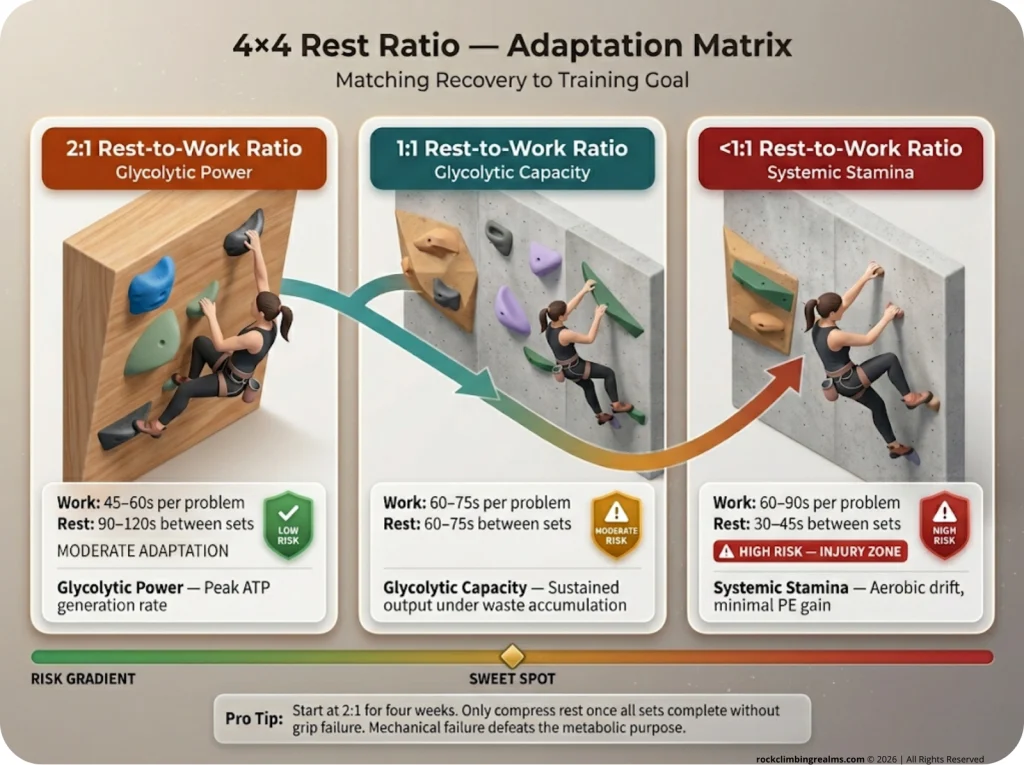
Glycolytic power is how fast your system generates ATP during a bout. You build it with shorter, harder sets and longer rest — a 2:1 rest-to-work ratio. Glycolytic capacity is how long you can sustain output under accumulating metabolic waste. You build that by compressing rest toward a 1:1 ratio. The classic 4×4 with four-minute rest targets a useful middle ground for intermediate climbers building a power-endurance base before a sport-specific block.
Run the 2:1 ratio for four weeks first. Only compress rest once you can complete all four sets without a single grip failure. Mechanical failure defeats the metabolic purpose entirely.
The Aerobic Trap — When Your 4×4 Becomes an ARC Session
If your problems are 4+ grades below flash grade, the session slides into the aerobic system. That’s useful for capillarity — ARC training territory — but it won’t build power endurance. The test is blunt: if you can hold a conversation between problems in a set, the problems are too easy.
The interference effect is real. Attempting to train both aerobic capacity and power-endurance in the same session can suppress glycolytic adaptations through conflicting molecular signaling. ARC and 4x4s serve different systems. Structure your sessions to serve one per training day.
The 4×4 Protocol — Technical Execution Variables That Decide Everything
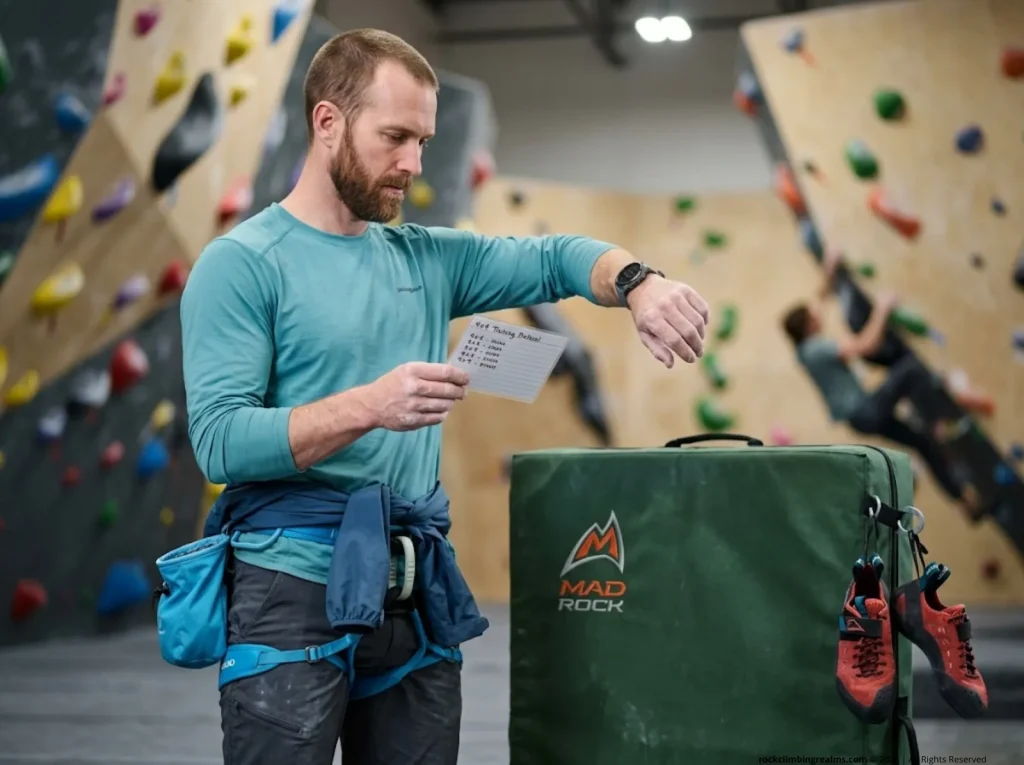
The standard protocol is 16 problems — four problems, four sets, roughly four minutes of rest between sets. This isn’t arbitrary. It’s calibrated to the glycolytic system’s time-to-fatigue and partial-clearance window. Every variable matters, and the rest interval is the one most climbers get wrong.
For a V8 climber, that means V5–V6 problems. The “intensity gap” cuts both ways. Too hard and you hit grip failure before metabolic failure — mechanical collapse isn’t a glycolytic stimulus. Too easy and you drift aerobic. The target zone is where you’re fighting by set three and your technique is barely holding together by set four. That friction is where adaptation lives.
Research on lactate shuttle research and the role of rest in metabolic clearance from the American Physiological Society makes the rest-interval case clearly: the partial-clearance window, not full recovery, is the stimulus. Understanding how to structure a complete climbing training week gives you the broader architecture for placing 4×4 sessions correctly within your week.
Grade Selection — Finding the Redline Without Hitting the Wall
Flash grade is the reference point, not your climbing ceiling. A climber who onsights V7 should use V5 problems. Avoid anything with a single hard crux move — crux failure stops the glycolytic stimulus mid-set. You want sustained effort across the problem: 10–18 moves, completable in 45–75 seconds, varied grip types.
Adjust based on how set two feels. Finishing it strong means the problems are too easy. Failing by move three of problem two in set two means they’re too hard. The climb-to-rest ratio and grade should move together — compress rest or bump grade, but not both at once.
Pro tip: Pick problems you could link easily when fresh, but know you’ll be fighting by set three. The friction between capability and fatigue is exactly where progressive overload lives in power-endurance training.
Rest Interval Architecture — Active vs. Passive Recovery
Active recovery between sets outperforms sitting down. Light walking, gentle footwork traversing, or easy downclimbing keeps systemic circulation moving — which drives lactate from your forearms to the leg muscles and heart where it can be burned off. Climbers who sit passively report feeling heavier and more acidic at the start of subsequent sets. That’s not perception error. It’s chemistry.
Heart rates during 4x4s regularly hit 85–95% of max. Don’t start the next set until yours drops to about 65–70% — somewhere between 2:30 and 4:00 minutes depending on your fitness level.
Pro tip: Use a timer. Don’t use feel. Perception of recovery when you’re pumped is notoriously unreliable — you’ll always think you need more rest than you do, or rush back on before you’re ready.
Volume Management — The 16-Problem Ceiling
The 4x4x4 protocol — 64 boulder problems — is antithetical to the glycolytic purpose. No climber maintains the intensity needed for a true systemic glycolytic stress test over that volume. The grade drops, the session goes aerobic, and you’ve built fatigue without building fitness.
Optimal total moves for a high-end power-endurance stimulus: 60–90. The 16-problem standard hits this range cleanly. For climbers new to 4×4 training, start with three sets over two or three weeks, then build to four as recovery capacity increases.
The Physics of the Pump — Ischemia, Fluid Dynamics, and Forearm Mechanics

During intense isometric grip work, your contracting forearm muscles generate internal pressure that exceeds systemic blood pressure — somewhere around 200 mmHg. Blood flow to the forearm stops. This is temporary ischemia, and the 4×4 is specifically engineered to induce it repeatedly.
In that ischemic state, oxygen delivery stops and metabolic byproducts trap locally, accelerating the pH drop. The adaptation to repeated ischemic stress includes upregulation of glycolytic enzymes and angiogenesis — new capillary growth in the forearm flexors. This is why the pump isn’t an obstacle. It’s the signal. Every time you feel it, the system that matters is working.
The data from studies on effects of active recovery on lactate concentration in climbing is unambiguous: post-session cool-down matters. Heart rate stays elevated and oxygen consumption remains high long after the last set. Fifteen to twenty minutes of easy climbing or movement after the session facilitates lactate clearance and prevents abrupt metabolic shutdown. And for the gains to actually express themselves, your rest days need to be structured — the supercompensation happens between sessions, not during them. Science-backed climbing rest day protocols covers that side of the equation.

Ischemic Stress and the Adaptation Signal
The ARC protocol works through a different mechanism: sustained blood flow promoting capillarity without ischemic stress. Both adaptations are valid — but they’re not interchangeable. ARC builds the plumbing. 4x4s stress the system these vessels serve.
The pump’s peak during a 4×4 is the peak adaptation signal. Stopping sets prematurely — before technical failure, not before discomfort — reduces the stimulus. There’s a difference between “this is uncomfortable” and “my fingers are mechanically failing.” Learn to read that gap, because it’s everything.
Lactate Shuttling During Active Recovery
Lactate produced in your fast-twitch forearm fibers gets transported via the monocarboxylate transporter system to slow-twitch fibers and oxidized. This shuttling works most efficiently during light movement — not sitting on the floor staring at your phone. That’s the physiology behind active recovery, not a coaching preference.
Practical implementation during rest intervals: gentle footwork traversing, light bouldering well below your limit, or walking. Blunts the heaviness and acidity you’d feel sitting still.
Biomechanical Resilience — The Physics of Finger Failure Under Fatigue
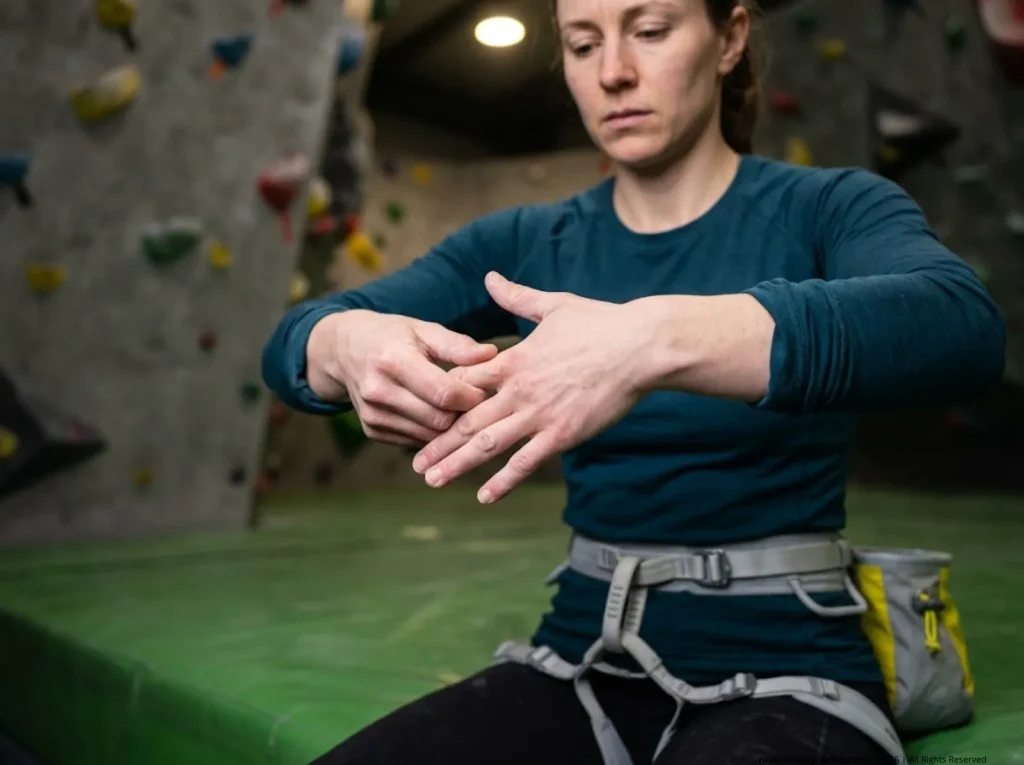
The 4×4 is the highest-risk protocol in a recreational climber’s toolkit. Not because it’s inherently hazardous — because it demands near-maximal effort in a state of cumulative fatigue, precisely when technique degrades.
The A2 pulley is a fibro-osseous band binding the flexor tendons to the proximal phalanx. In the crimp position, the moment arm is maximized. A recreational climber generates roughly 380N on the A2 during a controlled move. A fatigued slip — “shock loading” a hold as fingers peel — can push past 450N, which is the threshold for complete pulley rupture. The Schöffl grading system covers Grade I (strain, no rupture) through Grade IV (multiple ruptures requiring surgical reconstruction). Every grade in that spectrum is preventable with clean session termination criteria.
Research on biomechanics of the flexor tendon pulley system in rock climbing documents the force loads and positional mechanics precisely. If you’re already dealing with a finger injury from past overreach, the week-by-week pulley injury recovery protocol gives a structured rehab framework.
Pro tip: As Eric Hörst puts it — your body doesn’t know effort, it knows load. The pump in your forearms is metabolic. The click in your A2 is structural. Train yourself to tell the difference before you’re forced to.
The Crimp Grip Biomechanics and Pulley Load
Full crimp (PIP flexed ~90°, DIP hyperextended) maximizes the moment arm. Half-crimp (PIP flexed 45–60°, DIP neutral) distributes load more evenly, cutting peak A2 stress by an estimated 20–30%. Open hand spreads load further still.
Under redline fatigue, climbers default to full crimp on small holds. It’s a behavioral pattern that needs to be actively resisted. Training on a Kilter Board or Tension Board over a MoonBoard during 4×4 sessions reduces pulley injury risk while preserving the metabolic stimulus — ergonomic holds let you stay in better grip positions when you’re fighting.
The half-crimp isn’t a weaker position. It’s a safer and more transferable grip for sport climbing holds that demand an open-hand orientation. Train it like you’d train anything else.
The Redline Safety Protocol — Session Termination Criteria
Three objective termination signals. First: technique scratches — footwork slips on problems you wouldn’t miss fresh. Second: grip failure mid-problem on a route two grades below flash grade. Third: pain in any finger joint, distinct from diffuse forearm pump.
Pushing through metabolic discomfort is appropriate and the point. Pushing through biomechanical degradation is how you end your season. Post-session, apply moderate pressure along each finger pulley. Focal tenderness means modified protocol next time. Pain at rest means a medical evaluation.
Antagonist Training as Structural Insurance
After a 4×4 block, your forearm flexors have taken serious stress. Antagonist work on the following rest day — not the same session — protects joint integrity and prevents the imbalance-driven overuse injuries that accumulate across PE blocks.
Minimum protocol: reverse wrist curls (3×15), push-ups or dips (3×15), external rotation band work (3×20 each arm). The rotator cuff is chronically neglected in climbing training, but shoulder external rotation strength correlates directly with reduced elbow tendinopathy risk. An antagonist strength program for injury-free climbing covers this in full.
Why Your Gains Stalled — Failure Modes and the Junk Volume Trap
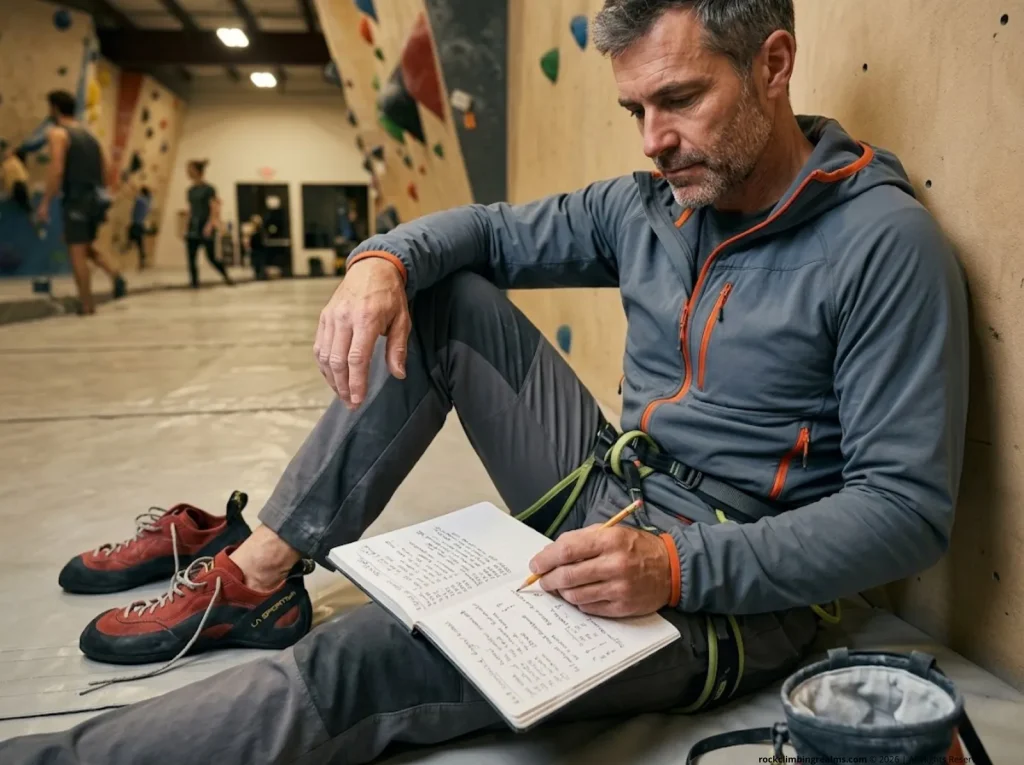
The anaerobic lactic system is the least trainable of the three energy systems. Peak adaptation arrives in 2–4 weeks. After that, you’re not building fitness — you’re building fatigue, suppressing max strength, and increasing your illness risk. Climbers who run continuous 4×4 circuits for months straight and wonder why their endurance isn’t improving have already exhausted the adaptive window by week three.
Junk volume is training that generates fatigue without stimulating adaptation. The three causes: problems too easy (aerobic drift), rest too long (full recovery = no cumulative stress), or excessive session volume (the 4x4x4 trap). The 4x4x4 controversy in training communities misses the point — any protocol requiring 64 problems will force a grade drop that shifts the workout aerobic. Volume isn’t the stimulus. Intensity under accumulating metabolic stress is.
For the structural solution, a periodization framework for climbing training blocks shows where the 4×4 block slots into an annual training plan and how to sequence it correctly.
Junk Volume Diagnosis — The Three Warning Signs
Sign one: your pump feels the same or lighter by session six compared to session two. That means problems are too easy or rest is too long — not that you’re getting fitter. Sign two: you feel systemically tired the day after a 4×4 but didn’t notice a profound pump during the session. That’s fatigue accumulation without targeted metabolic stimulus. Sign three: you’re completing all four sets without a real fight. A correctly calibrated 4×4 should be genuinely hard by set three and nearly impossible by set four.
Correction: increase problem difficulty by half a grade to one grade, or reduce rest by 30 seconds. Not both simultaneously.
The Interference Effect — How to Structure the Training Week
The bimodal distribution principle: training days should be either very high intensity (95–100%, limit bouldering) or low intensity (30–50%, ARC/easy climbing). Middle-intensity days serve neither adaptation well. 4x4s sit at 80–90% — a distinct zone, not a middle-ground compromise.
Recommended split: Day 1 — limit bouldering, 95–100% intensity, 5–10 minute rest between problems. Day 2 — ARC or active recovery, 30–50%. Day 3 — 4×4 sessions, 80–90%, four to five minute rest intervals. Avoid placing 4x4s the day before or after limit bouldering. CNS fatigue from limit work degrades the motor quality you need to safely redline on 4x4s.
Periodization — The 2-to-4-Week Rule
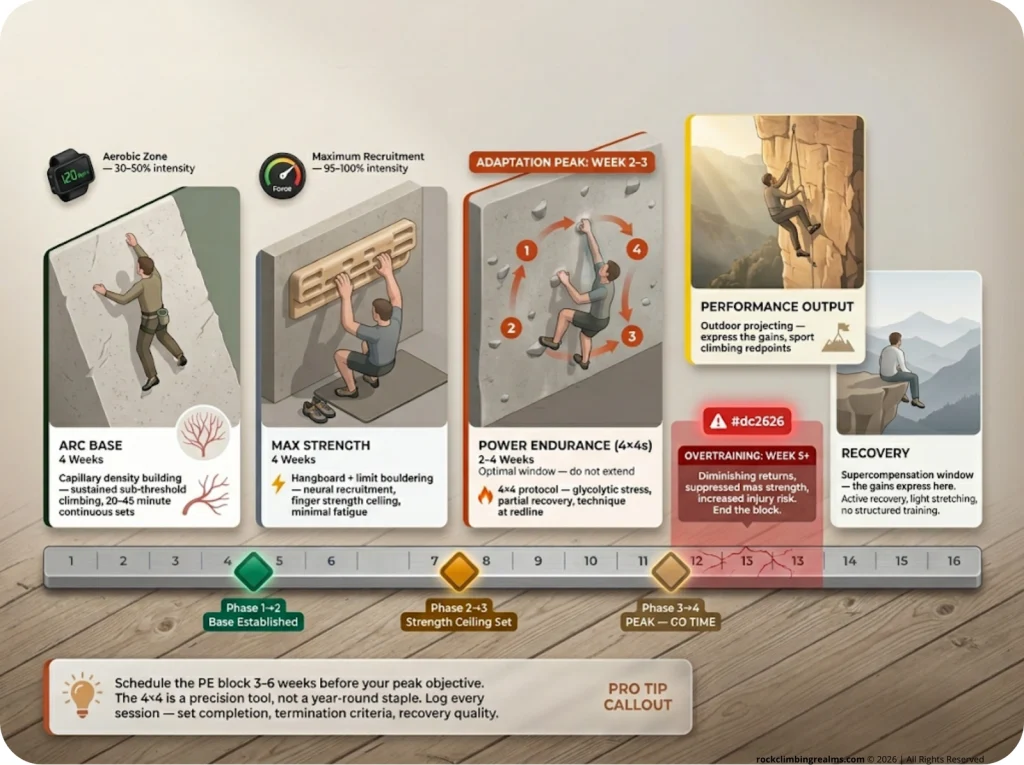
Use the 4×4 training block as a 2–4 week peaking tool before a performance season, not as a year-round staple. Schedule the block three to six weeks before your peak objective — a route trip, local competition, or project season. Annual structure: 2–4 weeks of PE (4x4s, 2–3x/week) → 4–6 weeks of skill and max strength → outdoor performance season → ARC base block → repeat.
Signs of power-endurance overtraining: reduced max grip strength, inability to complete problems two grades below previous flash grade, persistent low-grade finger soreness, disrupted sleep. If you’re seeing these, the block is already too long.
For climbers timing a PE block around competitions, a 12-week bouldering competition peaking plan gives the full framework.
System Board Integration — Moon, Kilter, and Tension Board Programming
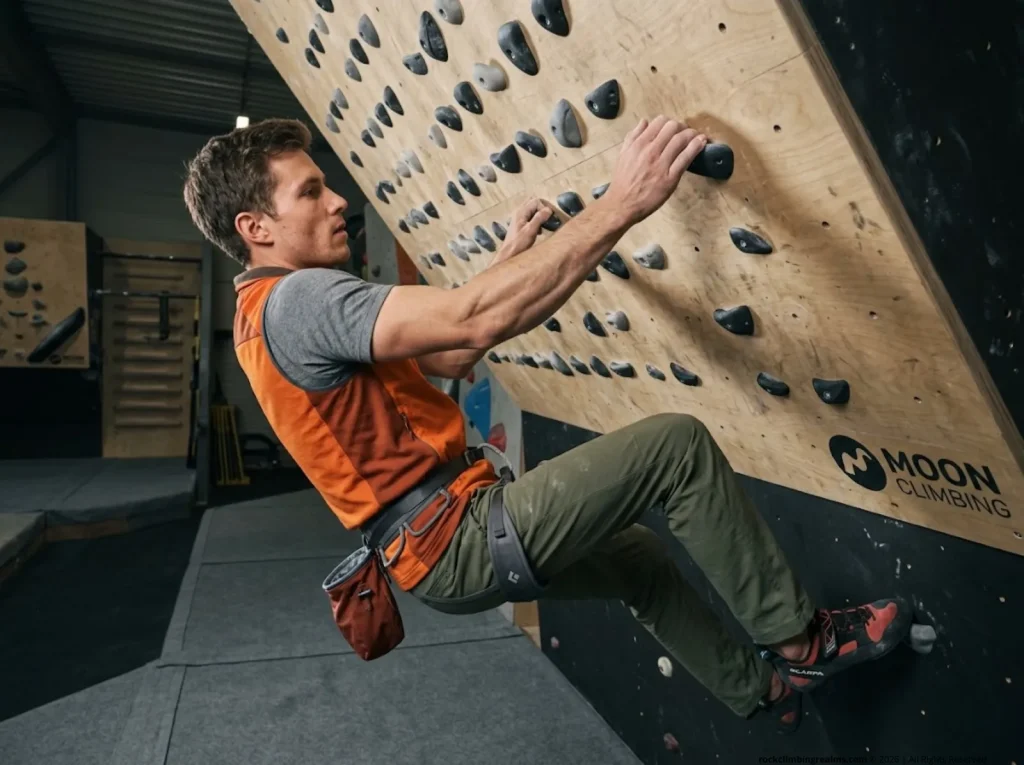
Each board changes how a 4×4 stimulus lands in your body. Choosing based on gym availability is fine. Choosing without understanding the injury-risk gradient is how people end A2 pulley strains early in a PE block.
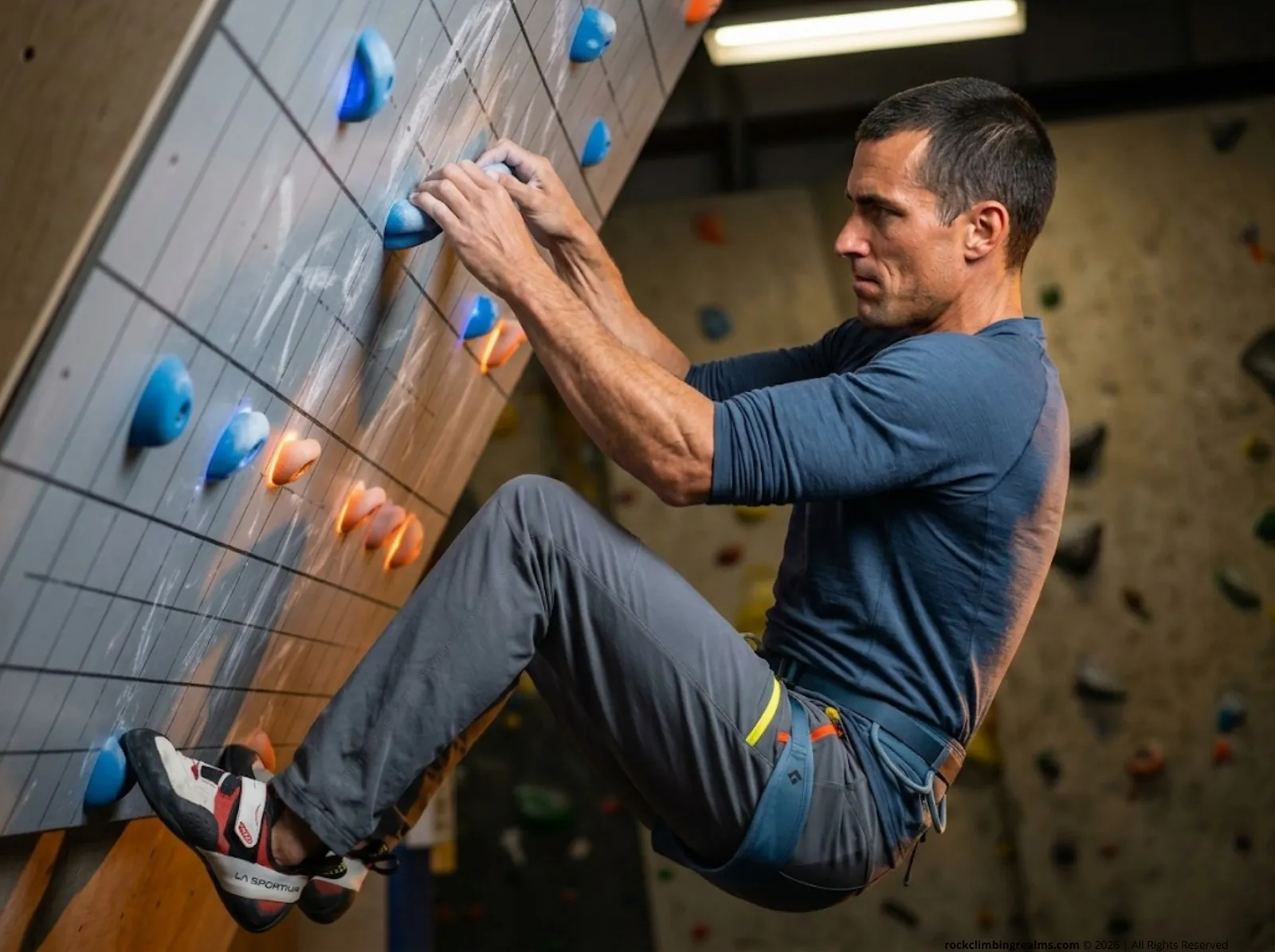
The MoonBoard at 40° uses small, ergonomic-hostile PU holds demanding high finger power and core tension. Every set here feels like limit moves. The A2 injury risk is highest due to mandatory crimp grip on narrow edges. Best for climbers with established crimp form under fatigue, no active tendon issues, and prior 4×4 experience on lower-risk surfaces. Start with three sets per session on a MoonBoard. Never choose dynos during a 4×4 — shock-loading fatigued pulleys is a direct injury mechanism.
The Kilter Board offers adjustable angle and ergonomic hold variety — jugs, slopers, crimps, pinches. At 25–35°, it creates strong glycolytic stimulus without the finger-failure risk of steeper settings. The hold diversity lets you alternate grip types across the four problems in a set, distributing forearm stress more evenly. The app integration enables standardized problem selection and progression tracking, which matters more than most climbers realize for detecting intensity drift.
The Tension Board wooden holds remove skin friction, forcing mechanical grip without skin performance variability. This is useful for high-volume sessions during a PE block when skin is the limiting factor — not the metabolic system.
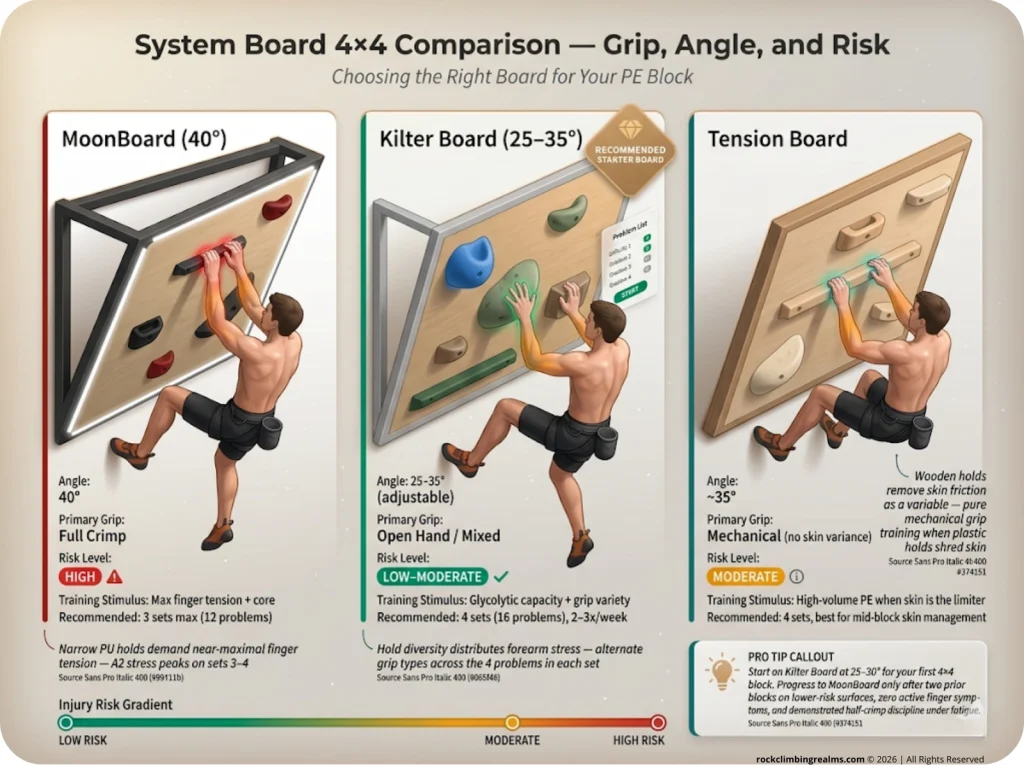
For a full comparison including cost, cost and training test: Kilter vs. MoonBoard vs. Tension Board walks through the details.
MoonBoard 4×4 Programming — High Risk, High Reward
At 40°, problems demand near-maximal finger tension on sets three and four. You’re approaching the physiological boundary between metabolic and mechanical failure every time. Reduce to three sets (12 problems) in the first week. The intensity cost is higher than Kilter or Tension equivalents at comparable grades.
If you haven’t specifically built crimp-grip discipline under fatigue on a lower-risk surface, don’t start here. The MoonBoard ends 4×4 blocks earlier — with pulley strains — more consistently than any other factor.
Kilter Board 4×4 Programming — The Capacity Builder
The Kilter Board’s skin advantage matters for board-specific programming and higher training frequency. Larger, more ergonomic holds produce less micro-trauma per session, allowing 2–3x/week training during a PE block compared to 1–2x on a MoonBoard.
Flash pump prevention on any board: progressive warm-up, culminating in “primes” — 20-second bursts of high intensity climbing 10–15 minutes before the first 4×4 set. Pre-activate the glycolytic system before demanding it performs. If capillaries haven’t dilated fully, waste products accumulate faster than they clear and the session is ruined in the first set.
Skin Management and the Flash Pump Risk
Skin failure ends sessions prematurely before the metabolic stimulus is reached. A standard skin management protocol — filing, light moisture — maintained throughout the PE block keeps skin from becoming the limiter when the forearm system is what you’re training.
Don’t tape damaged skin and continue. Compensation in grip position from altered contact points increases pulley risk. Call the session and recover. A climbing skin care protocol for high-volume training covers the maintenance side of this.
Conclusion
Three things to take away and actually apply.
One: the 4×4 is a precision systemic glycolytic stress test, not an endurance treadmill. Problems too easy, rest too long, or volume above 16 problems — any of these and you’re training the wrong system. The stimulus lives at the redline: technique barely intact, forearms screaming, fighting through sets three and four.
Two: fatigue degrades technique, and technique failure is the injury mechanism. The A2 pulley doesn’t distinguish effort from overload. You have to make that call, every set, every session. The moment you’re scratching holds you’d palm fresh, the session is done.
Three: the 4×4 is a 2–4 week peaking tool. If you’ve run continuous blocks for months and your power endurance isn’t moving, you exhausted the adaptive window weeks ago. Back off, rebuild max strength, and return to PE training when you have something to peak.
Design the next block deliberately: 2–3 weeks, twice weekly, calibrated grade, timed rest. Log every session — set completion, termination criteria, recovery quality. Give the protocol the precision it demands.
Now go send something.
FAQ
How often should I do 4x4s?
Two to three times per week during a dedicated 2–4 week power-endurance block. The anaerobic lactic system reaches peak adaptation in that window — extending beyond four weeks produces diminishing returns, increases injury risk, and suppresses max strength. After the block, shift to a max strength or skill phase before returning to PE training.
Are 4x4s good for bouldering, or are they mainly for sport climbing?
Most directly applicable to sport climbing’s power-endurance demands — executing hard moves while significantly pumped. For pure bouldering, limit bouldering and campus board work typically deliver more specific adaptation since efforts are shorter and more alactic. That said, boulderers who compete in multi-attempt comp formats or project long V-grade problems can benefit meaningfully from a 4×4 block.
What is the difference between 4x4s and intervals (on-the-minute bouldering)?
Both target the glycolytic system but with different profiles. 4x4s vs intervals comes down to stimulus type: 4x4s use consecutive problem-chaining to create sustained ischemic stress within a set, followed by extended partial recovery. On-the-minute bouldering provides shorter work intervals with compressed rest, replicating the rhythm of sport climbing redpoints more closely. 4x4s build raw glycolytic capacity; OTMs sharpen the specific work-to-rest pattern of route climbing. Both have value within a PE block.
Why am I not seeing gains from 4x4s despite training consistently?
Three most common causes. First: grade miscalibration — problems too easy (aerobic drift) or too hard (mechanical failure before metabolic stimulus). Second: excessive volume — more than 16 problems degrades intensity and shifts the workout aerobic. Third: overextended block — running 4x4s beyond 4–5 consecutive weeks exhausts the adaptive window. Diagnosis: completing all four sets without fighting in sets three and four means harder problems or compressed rest. Failing early in sets two and three means drop a V-grade.
Is it okay to do 4x4s on a MoonBoard as a beginner to the protocol?
No — and that’s the most common setup for an A2 injury. The MoonBoard’s hold geometry demands near-full crimp under high fatigue, maximizing pulley stress precisely when you’re least able to maintain controlled joint mechanics. Start on a Kilter Board at 25–30° or a spray wall with ergonomic holds. Progress to MoonBoard-based 4x4s only after two prior blocks on lower-risk surfaces, zero active finger tendon symptoms, and demonstrated half-crimp discipline under fatigue.
Safety Notice: Rock climbing and mountaineering are inherently high-risk
activities that can involve physical trauma or fatal incidents. The information on Rock Climbing Realms is for
educational and informational purposes only. Techniques and advice presented here are not a substitute
for professional, hands-on instruction. Conditions and risks vary by location. Always seek guidance
from a qualified instructor before attempting new techniques. By using this website, you agree that you
are solely responsible for your own safety. Any reliance you place on this information is strictly
at your own risk, and you assume all liability for your actions. Rock Climbing Realms and its authors
will not be held liable for any harm, damage, or loss sustained in connection with the use of this information.
Affiliate Disclosure: We are a participant in the Amazon Services LLC Associates Program, an
affiliate advertising program designed to provide a means for us to earn advertising fees by advertising and linking
to Amazon.com. As an Amazon Associate, we earn from qualifying purchases. We are also an official affiliate partner
of Black Diamond Equipment via the AvantLink network. If you click on a Black Diamond affiliate link and make a
purchase, we may earn a commission at no additional cost to you. We also participate in other affiliate programs.
Additional terms are found in the terms of service.