
In this article
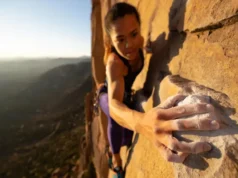
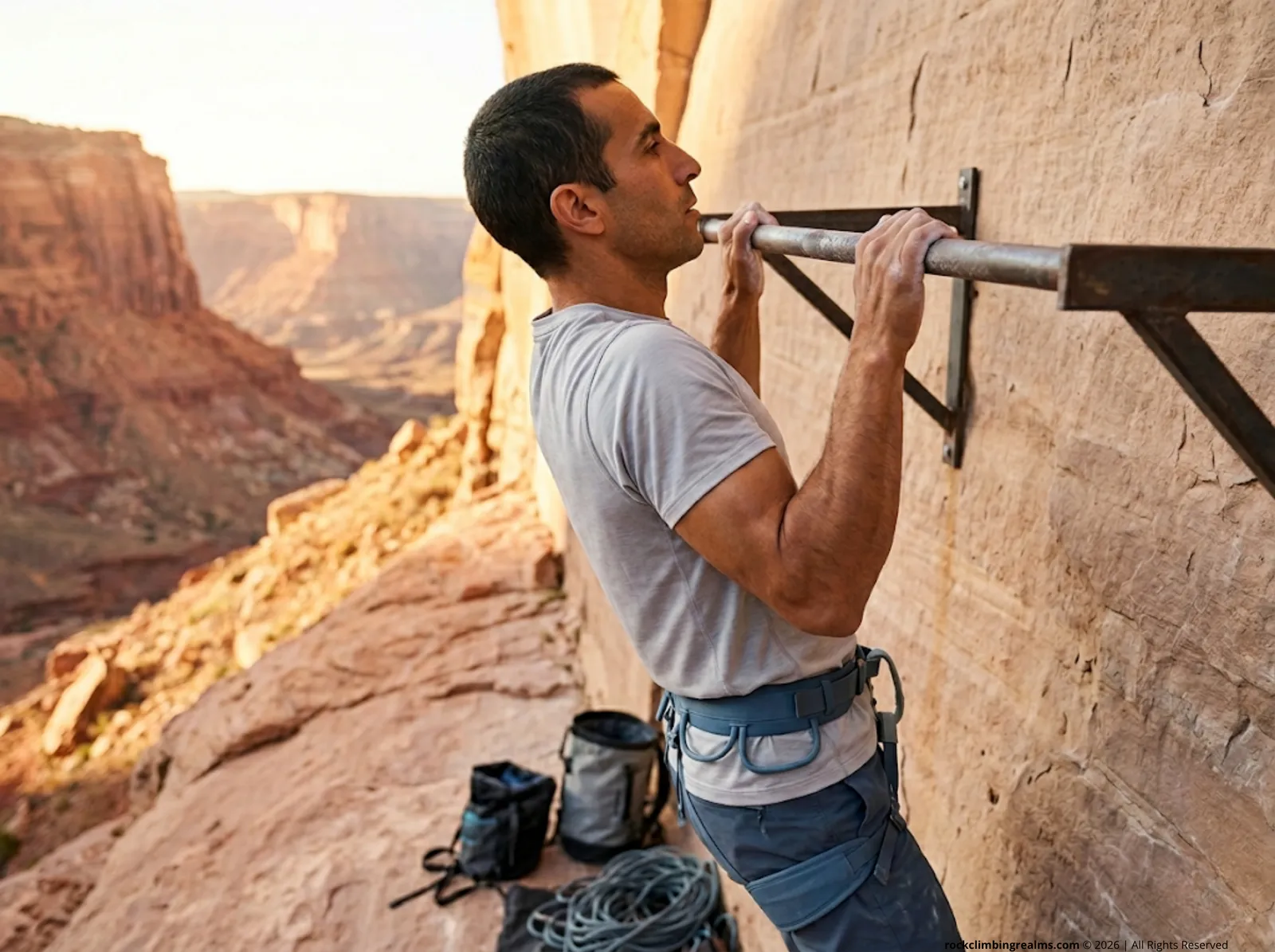
You’re 30 feet above your last draw, locked off on a greasy sloper, and your left shoulder sends a hot flash straight down into your biceps tendon. You shake it out and keep climbing — because that’s what serious climbers do. Three weeks later you’re off the wall entirely, icing your shoulder over a heating pad, staring at your training log and trying to figure out exactly where it went wrong.
I’ve watched this play out dozens of times, at crags and in gyms, with climbers who trained hard and still got hurt. The injury wasn’t bad luck. It was an unpaid debt — months or years of loading a system that nobody taught them how to maintain. This masterclass breaks down the physics of the climbing shoulder: why it fails, how the tissues actually work, and the phase-based physics-based prehab protocol that targets root causes instead of chasing symptoms.
⚡ Quick Answer: The climbing shoulder fails because of a broken scapulohumeral rhythm, not a single traumatic event. Fix the movement pattern first (Phase 1), then build rotator cuff stability under load (Phase 2), then add velocity and power (Phase 3). Add mid-session resets every 90 minutes to prevent tendon creep, and fix your belay posture — belayer’s shoulder is a real clinical injury. The full protocol takes 20–30 minutes, three times a week, forever.
| Climbing Conditioning & Injury Prevention | |||
|---|---|---|---|
| Exercise | Muscle / System | Climbing Move It Protects | Weekly Frequency |
| Thoracic Foam Roller Extension | Thoracic spine / scapular tilt | All overhead moves | Daily |
| Scapular Pull-Up | Serratus anterior | Overhangs, high reaches | 3x/week + mid-session |
| Bent Over T/Y/L | Mid/lower trapezius, external rotators | Gastons, slopers, steep routes | 3x/week |
| Sharapova (band box drill) | Infraspinatus / teres minor | Gastons, full-range lock-offs | 3x/week |
| Bottoms-Up Kettlebell Press | Full rotator cuff co-contraction | Dyno catches, dynamic movement | 2x/week (Phase 3 only) |
The Climbing Shoulder as a Mechanical System
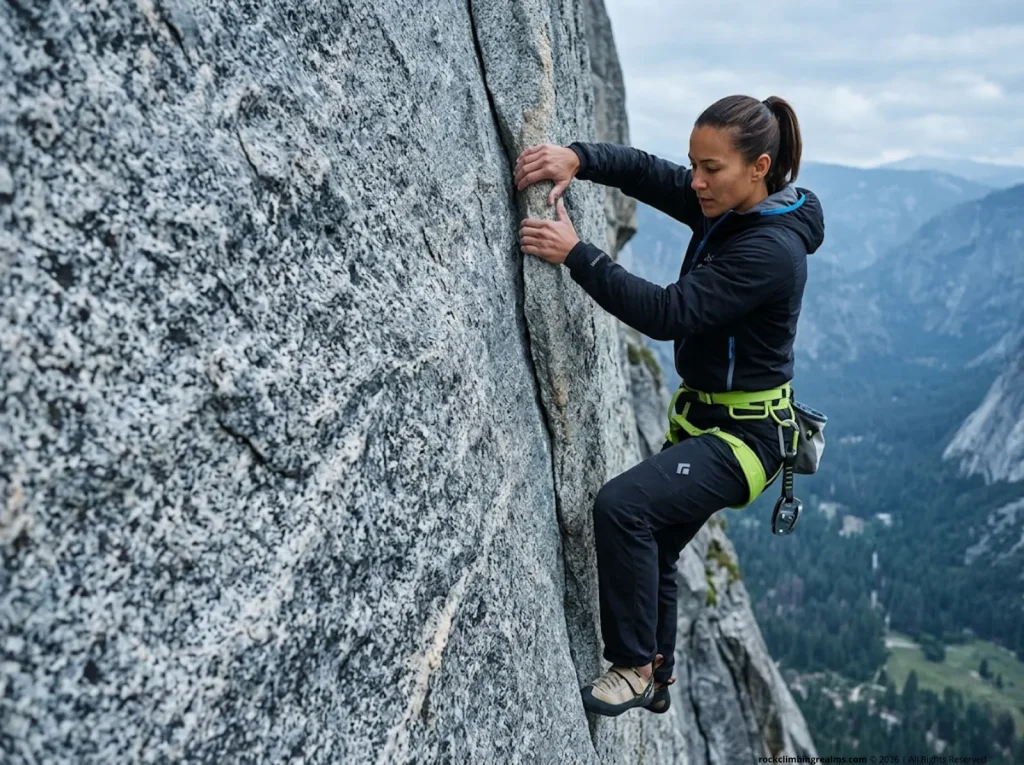
Here’s where most climbers get it wrong: the shoulder is not one joint. It’s four — the glenohumeral (ball and socket), the sternoclavicular, the acromioclavicular, and the scapulothoracic. Failure at any one of them cascades through the whole chain. Understanding the broader science of overuse injuries in climbing starts with understanding this system.
The numbers are not subtle. Upper extremity injuries account for roughly 27% of clinical climbing presentations — and that figure likely undercounts the true burden because most shoulder impingement and tendon problems never reach an emergency department. Overuse pathology represents 39–68% of all climbing injuries. This is not a falling sport. It’s a grinding-your-joints-into-dust sport.
Climbers operating at 7b+ face an odds ratio of 6.05 for shoulder injury. Adolescents between 15 and 19 carry an 11.3x higher risk. The threshold doesn’t appear gradually — it spikes once movement difficulty outpaces the adaptive capacity of the joint’s stabilizing tissue. We spend hundreds of hours dialing footwork and zero hours teaching our scapulae to move. The shoulder failing in year three isn’t bad luck. It’s an unpaid debt.
Pro tip: Before your next session, put two fingers on your scapular spine and perform a few scapular pull-ups. Feel whether your shoulder blade moves smoothly down and back, or wings out and tips forward. Most climbers feel nothing because the motor pattern doesn’t exist yet. That’s your starting point.
The Scapulohumeral Rhythm Breakdown
In a healthy shoulder, humeral movement and scapular movement follow a roughly 2:1 ratio. Research on experienced rock climbers shows the ratio frequently hits 3.7:1 — the humerus migrates while the scapula stalls. The clinical term is scapular dyskinesis, and it’s the precursor to subacromial impingement in overhead athletes.
The muscle responsible for fixing this is the serratus anterior — the primary driver of scapular upward rotation. Weakness here is the single most predictive factor for impingement onset in climbers. The serratus is also stubbornly difficult to train because most people can’t feel it working.
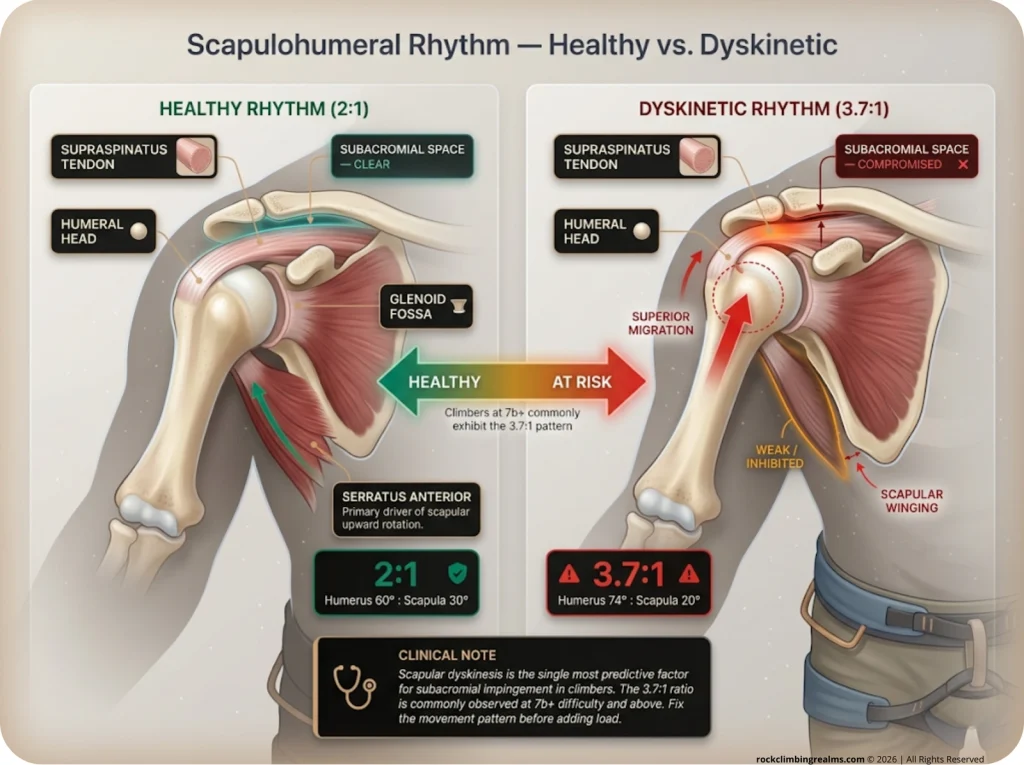
You can test yourself: stand with your back flat against a wall and slide your arms overhead while maintaining contact. If the scapular elevation happens before your arms reach 120°, or your shoulder blade wings away from the wall, your serratus anterior is not doing its job during scapular upward rotation. This is not a minor form flaw — it’s the mechanism behind most chronic shoulder problems in sport climbing.
The Class III Lever — Why Your Rotator Cuff Is Always Outnumbered
The glenohumeral joint works as a Class III lever. The muscle sits between the joint and the load at your hand — which means the rotator cuff has to produce forces several times greater than body weight just to keep the humeral head centered during a pull.
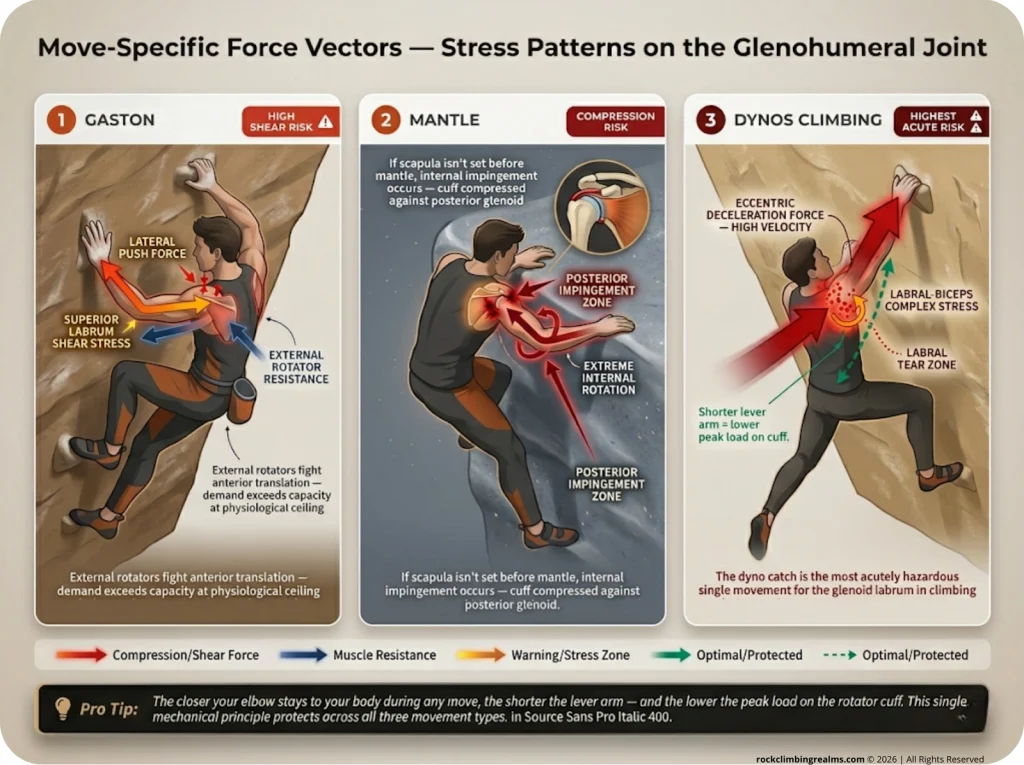
When you reach for a distant hold, the distance from joint to hand is maximized. The rotator cuff demand spikes hard. A load that feels modest at the hand translates into joint forces that can exceed total body weight. This is why the mechanics of an efficient lock-off position matter — the closer your elbow stays to your body, the shorter the lever arm, the lower the peak load on the cuff.
Move-Specific Force Vectors — Gastons, Mantles, and Dyno Catches
Gastons climbing puts the palms out and elbows flared. The external rotators — infraspinatus and teres minor — must fight anterior humeral translation while the arm pushes laterally. Result: high shear on the superior labrum. Novice climbers fail Gastons because they lack the strength. Experienced climbers hurt themselves on Gastons because they execute them at their physiological ceiling — the external rotators simply can’t keep up with the demand.
Mantles climbing drives the shoulder into extreme internal rotation during the press-out phase. If the scapula isn’t already set, internal impingement happens — compression of the cuff against the posterior glenoid. Dynos climbing create high-velocity eccentric deceleration stress on the labral-biceps complex. The dyno catch is the most acutely hazardous single movement for the glenoid labrum.
Tendon Physiology and the Clock You’re Racing Against
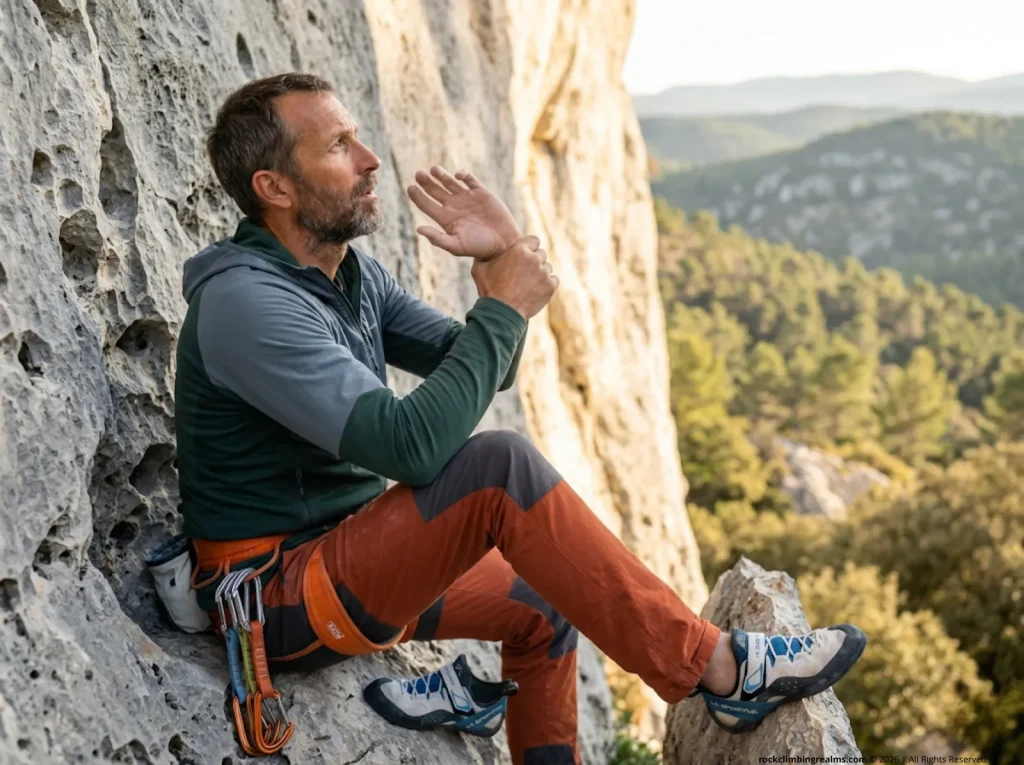
Nobody blows their shoulder on their tenth route. They blow it on their twenty-third, when the tendon has been creeping for six hours and still feels completely fine.
Tendons are tissues that behave differently depending on how fast and how long you load them — they stiffen under rapid loading and slowly elongate under sustained load, a process called tendon creep. During an isometric hold, muscle fibers shorten while tendon fibers slowly lengthen. Over a four-hour session, the stiffness loss accumulates to a point where risk factors and injury patterns in climbing physiology make the final dynamic moves genuinely hazardous.
Here’s what no other shoulder article tells you: tendons adapt ten times more slowly than muscle. The vascular supply is poor. Tenocytes synthesize new collagen in response to mechanical loading, but the metabolic window is narrow. This is why heavy, slow loads — not three sets of theraband flyes — are the most potent stimulus for tendon resilience and collagen remodeling. Eccentric loading and heavy isometric holds drive adaptation where generic band exercises don’t reach.
There is also a nutritional timing window: hydrolyzed collagen plus vitamin C, consumed 30–60 minutes before training, measurably increases collagen production in frequently loaded tissues like the rotator cuff. This isn’t marketing. This is Keith Baar-level tendon physiology applied to a climbing context.
Pro tip: Every 90 minutes of climbing, perform 4–5 slow, heavy scapular pull-ups. Not as a workout — as a mid-session reset. This mechanically re-stiffens the rotator cuff tendons before you continue loading them. It takes forty-five seconds and it actually works.
The 69% Paradox — What Asymptomatic MRI Findings Actually Mean
Here’s a statistic that reframes everything: roughly 69% of asymptomatic elite climbers show some form of labral pathology on MRI. Another 57% show humeral head cartilage changes. Full strength. Zero symptoms.
These findings mean that structural changes visible on imaging may represent normal adaptation to the traction-dominant force environment of climbing — not injury. Pain is not a reliable proxy for structural damage. Treat a positive MRI finding the same way you’d treat a tweaked crimp hold: with respect, not panic. The question isn’t what’s on the image. It’s whether the dynamic stabilizing system is still holding.
The science of supercompensation and strategic rest days connects directly here — the collagen remodeling window requires adequate recovery to close properly. You can’t out-train a tendon that never gets a chance to rebuild.
Phase 1 — Mobility and Scapular Calibration
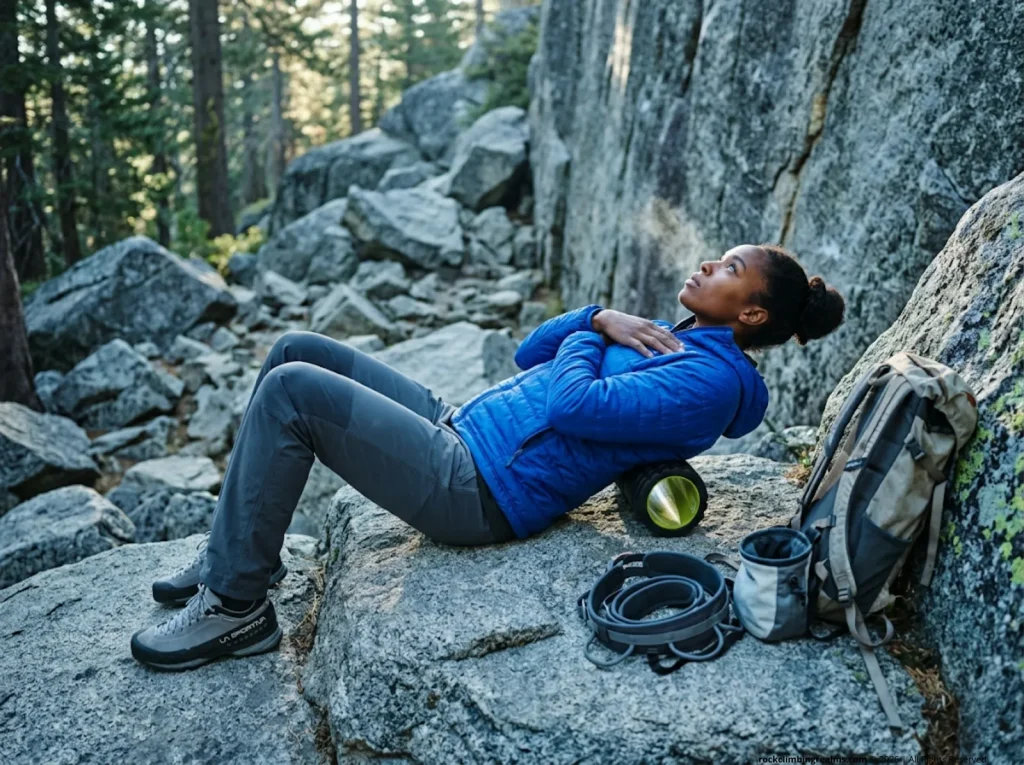
Before you add load to a broken movement pattern, restore the rails. Thoracic mobility and scapular stability are the foundation. Loading a dyskinetic scapula is pouring concrete into a cracked foundation — you’re just building failure on top of failure.
The first intervention is thoracic mobility extension: a foam roller or medicine ball between your shoulder blades at T4–T8. Extend over it, hold 30–60 seconds per segment. This reverses the climber’s hunch — the thoracic kyphosis that anteriorly tilts the scapula and collapses the subacromial space with every overhead reach. Do this daily. It sounds boring. It’s also the cheapest physical therapy you’ll ever do.
The second intervention is scapular retraction work in a closed kinetic chain — inverted shoulder blade squeezes on rings or a wall. Arms straight, squeeze the shoulder blades together to lift the chest. The most common error is substituting shoulder elevation for true retraction. If your traps are burning before your rhomboids, you’re doing it wrong. The shoulder blades should move down and in, not up. Building active range of motion through FRC principles is the framework that makes this phase systematic rather than random.
Run Phase 1 daily for 2–4 weeks. Three sets of 12–15 reps, slow and controlled. Do not skip to Phase 2.
Diagnosing Your Own Scapular Dyskinesis
Try the scapular wall-slide test: back to a wall, slide arms overhead while maintaining contact. If the shoulder blade wings or tilts before your arms reach 120°, scapular dyskinesis is present. Most climbers find out mid-slide that their scapula leaves the wall around 90°. That’s the problem.
The inverted shrug test is equally revealing. Hang from a pull-up bar and depress your scapulae without bending your elbows. Can you feel a distinct up and down? Most climbers cannot isolate this on the first attempt. The motor pattern simply doesn’t exist. That’s what Phase 1 builds.
The Thoracic Spine — The Shoulder’s Hidden Foundation
Thoracic kyphosis directly limits glenohumeral elevation by restricting scapular upward rotation. You cannot properly reach overhead on a rounded upper back — the architecture doesn’t allow it. The T-spine rotation drill (seated on heels, one hand behind head, rotate toward the ceiling) addresses this: 10 reps each side, three times a week.
Pro tip: If you sleep on your side with your arms overhead — common in athletes — you’re passively driving your thoracic spine into kyphosis every night. A cervical pillow supporting the shoulder eliminates this. It’s the kind of injury that accumulates while you’re unconscious, which is both preventable and deeply annoying.
Phase 2 — Targeted Rotator Cuff Stability
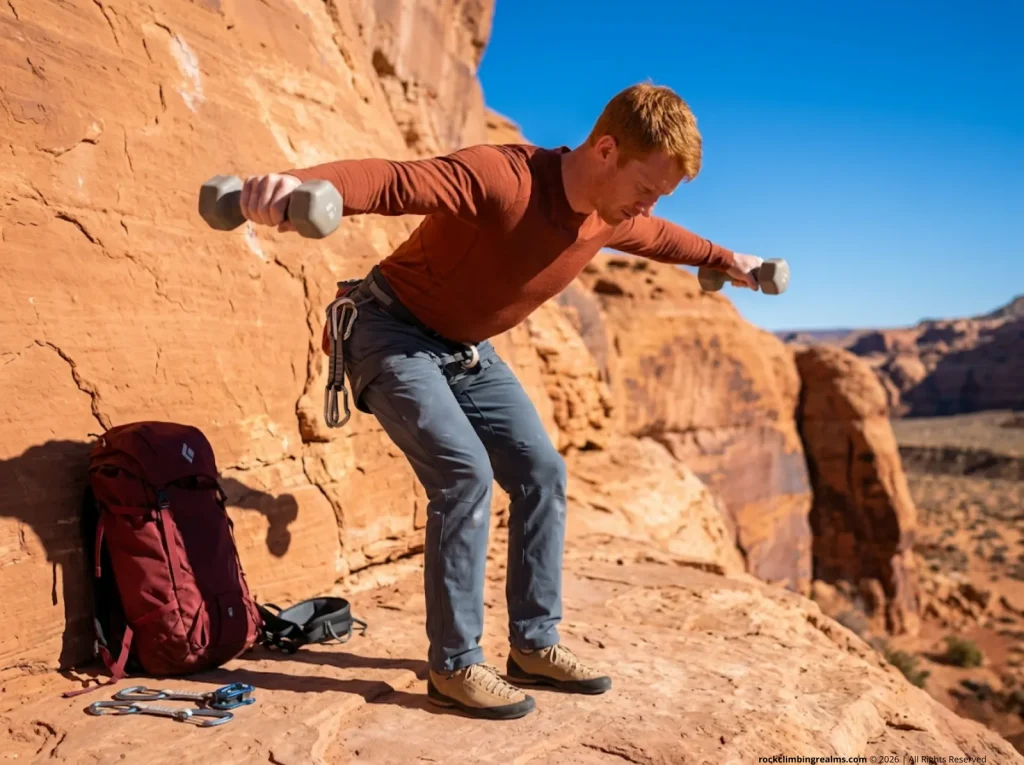
Once Phase 1 establishes proper movement quality, Phase 2 introduces climbing-specific loading. The goal here is endurance and neuromuscular precision across the full range of motion — not raw strength.
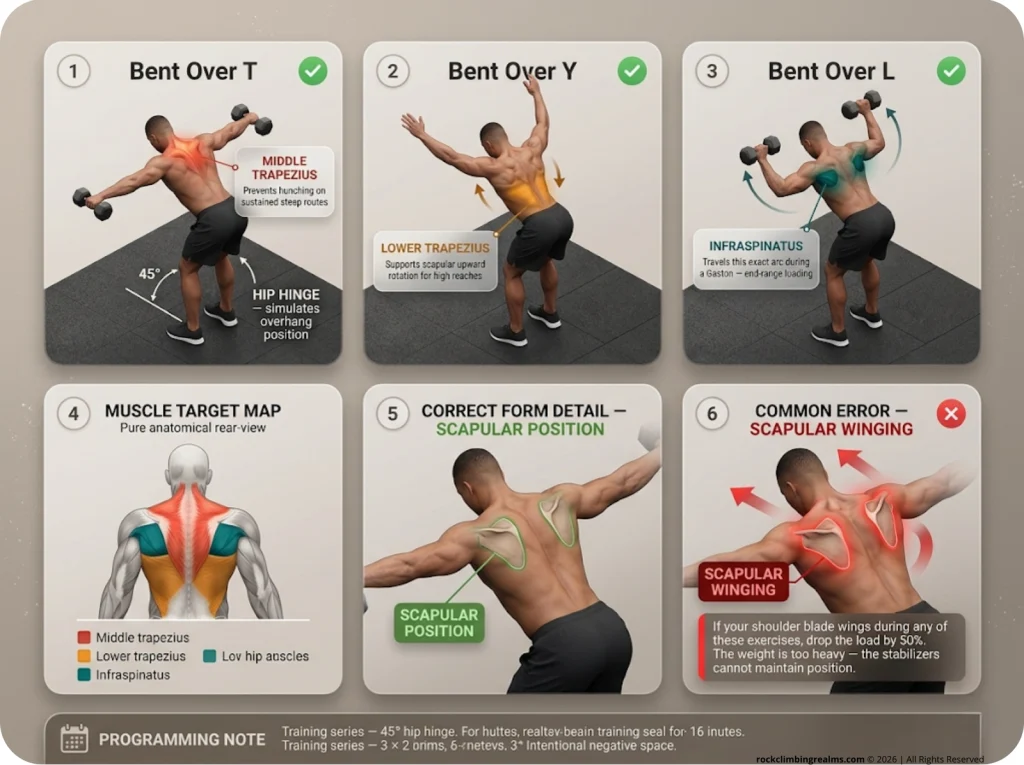
The Bent Over Letter series — T, Y, L — is performed at a 45° hip hinge to simulate an overhanging route body position. The bent-over position is not optional ergonomics. It’s a specificity principle: your rotator cuff needs to learn to fire while your spine is horizontal, not vertical. That’s the position it’s actually in when you’re climbing steep terrain.
The Bent Over T targets the middle trapezius and prevents the hunching that accumulates on sustained steep routes. The Bent Over Y hits the lower trapezius and supports scapular upward rotation for high reaches to slopers and jugs above the head. The Bent Over L — upper arm at 90°, forearm rotating from down to up — is literally the arc your infraspinatus travels during a Gaston. These exercises were field-validated by Sasha DiGiulian and Josh Levin; they use light dumbbells or resistance bands, 2–5 lbs max.
Most athletes use too much weight and lose scapular position. If your shoulder blade wings during any of these, drop the load by 50%. Perform these facing a mirror — not to admire your form, but to catch winging in real time. Building the push-muscle foundation that injury prevention requires explains why this antagonist work is non-negotiable.
The Sharapova Exercise — A Physics-Specific Intervention
The Sharapova exercise is a resistance bands drill where a band is looped around both wrists. Arms in front at shoulder height, maintaining external rotation throughout. The box pattern: hands apart, up, together, down — while keeping neutral spine and full external rotation.
The key difference from standard external rotation exercises is range coverage. The Sharapova loads the infraspinatus across its entire arc, including the end-range position where Gastons place maximum demand. This is a neuromuscular precision exercise. The load is light; the intention is high-quality motor recruitment exactly where the tissue gets isolated during the hardest moves. Rotator cuff stability protocols for the unstable shoulder from the University of Washington validates the clinical framework this exercise sits within.
The Scapular Pull-Up — Serratus Anterior Activation
Hang from a pull-up bar, arms fully extended. Without bending your elbows, depress your scapulae. You should feel your chest lift. This motion directly targets serratus anterior and lower trapezius — the two muscles most responsible for lifting the roof of the subacromial space and keeping it there during overhangs climbing.
Three sets of 10–12 slow, controlled reps. Two-second concentric, three-to-four second eccentric. If you can’t isolate this without bending your elbows, you have a significant serratus deficit. Start with banded assistance until the motor pattern is established. This is also a climbing-specific mid-session reset — add 4–5 reps between burns.
Phase 3 — Power, Resilience, and High-Velocity Loading
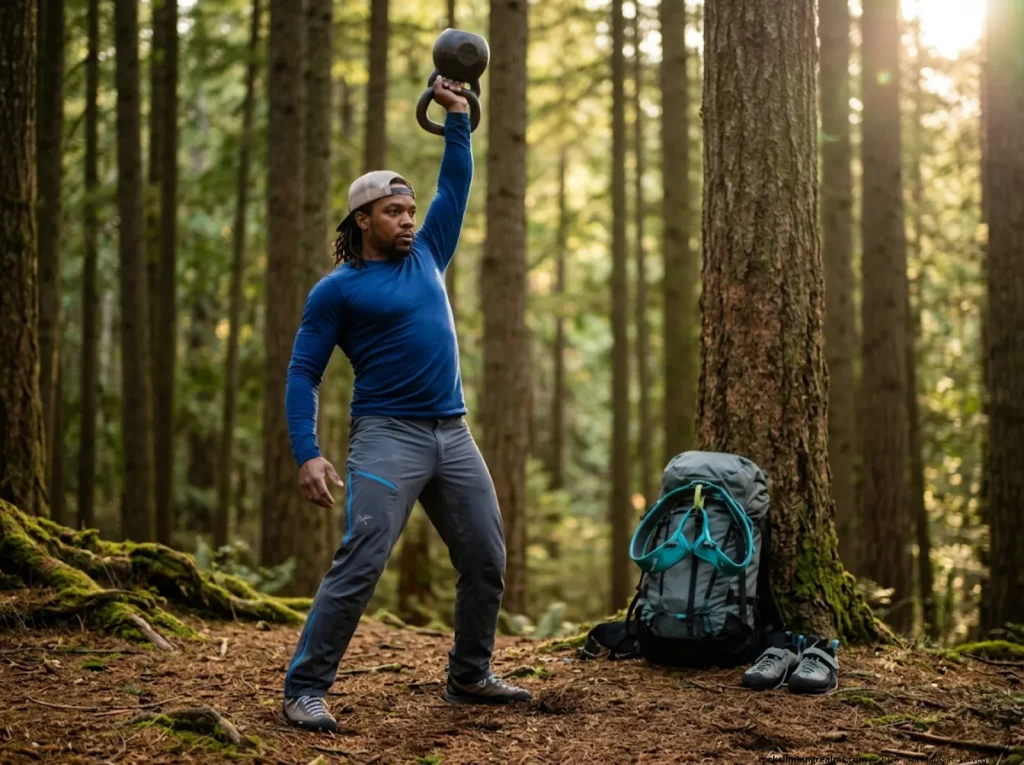
Phases 1 and 2 build the movement quality and baseline stability. Phase 3 introduces the velocity and asymmetry that real climbing actually demands. Do not enter Phase 3 without four-plus weeks of Phase 2 training with zero shoulder symptoms during or after climbing sessions.
The Landmine Press is the shoulder-safe overhead alternative for climbers with impingement history or limited shoulder flexion. The angled, arcing trajectory reduces glenohumeral compression compared to a standard overhead press. The physics advantage: the arc of the landmine means load increases at the bottom and decreases at the top — the opposite of where the shoulder is most vulnerable. Start at 40% of your standard overhead press. The movement feels easier than it is. Humility required.
Overhead carries with a kettlebell in a locked-out position demand maximum serratus anterior and lower trapezius activation under dynamic load. Unilateral carries expose side-to-side deficits invisible in bilateral exercises. The weaker scapular stabilizer side shows up within the first ten meters. Progress from unilateral to contralateral to bilateral over 4–6 weeks.
The Bottoms-Up Kettlebell Press looks ridiculous. Your climbing partners will stare. It’s also the most honest test of whether your shoulder stabilizers are actually online — the bell doesn’t lie. Grip the handle inverted. The instability demands simultaneous co-contraction of all four rotator cuff muscles. Start with a bell 30–40% lighter than usual. Three planes of instability — anterior-posterior, medial-lateral, and rotational — all present at once. Exactly mirroring a dynamic dyno catch.
One more thing: equipment quality matters here. Cheap TPE bands exhibit exponentially increasing resistance at end range — they spike at the exact moment your tendon is most vulnerable. High-quality latex bands maintain a more predictable resistance profile throughout the full arc. For Phase 3, use latex bands with at least 50% elongation rating, or a pulley systems cable setup with consistent resistance. This is not marketing preference. It’s physics. Matching your training tools to the actual physics of the movement covers this in detail.
The Belayer’s Shoulder — The Injury Nobody Plans For
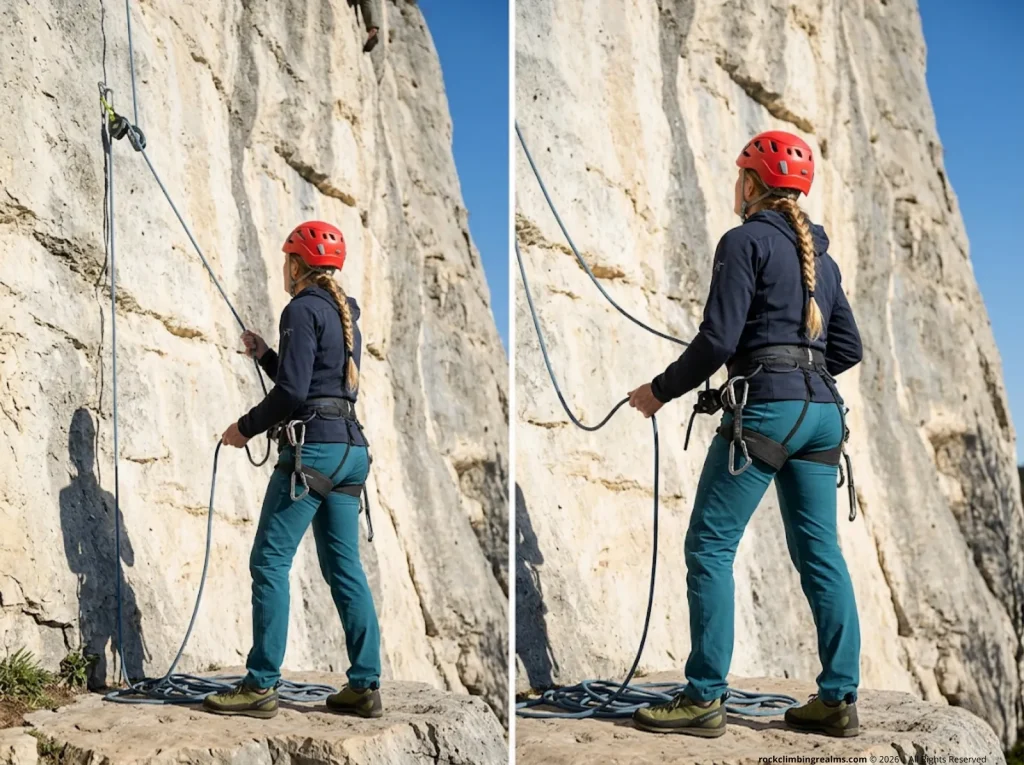
Most shoulder prehab content ignores this entirely. That’s a mistake. Belayer’s shoulder is a legitimate clinical injury driven by repetitive rope management with poor ergonomics — and it’s completely preventable.
The problem is the brake-hand elbow. Flaring it away from the body during rope management places the rotator cuff in a position of mechanical disadvantage with every catch-and-lower cycle. A dedicated belayer at a sport crag can run 20–40 of these per day. At high elbow, that’s 20–40 repetitive subacromial pressure events. Over a season, this is how rotator cuff tendinopathy develops in people who never thought of themselves as injured.
The weight disparity physics compound this. The DAV (German Alpine Club) recommends a maximum 10 kg weight difference between climber and belayer. Beyond that, a falling climber can create uncontrolled upward force on the belayer’s shoulder — unexpected, high-velocity, upward pull on an unprepared joint. That is the single worst loading pattern for the rotator cuff according to rotator cuff impingement under repetitive overhead loading.
The Ohm device solves the weight disparity problem mechanically. It attaches to the first bolt, introduces friction only during falls and lowering, and effectively makes the climber feel 25 kg lighter to the belayer’s braking system. Anchor loads stay within UIAA-rated limits. The trade-off strongly favors belayer shoulder protection. The full physics breakdown of how the Ohm counters rocket-belayer effect is worth reading if you or your partner is on either end of a significant weight difference.
The correct belay stance: elbow pressed against the body at 90° flexion, brake hand at hip level, body weight over the dominant leg. This keeps the rotator cuff in its protected range throughout rope management. I spent two years diagnosing my shoulder as a climbing problem before a PT asked how I belayed. The answer was: elbow pointing at the sky, brake hand at my ear. Managing the weight-disparity problem with a ground anchor system offers the gym-specific version of this fix.
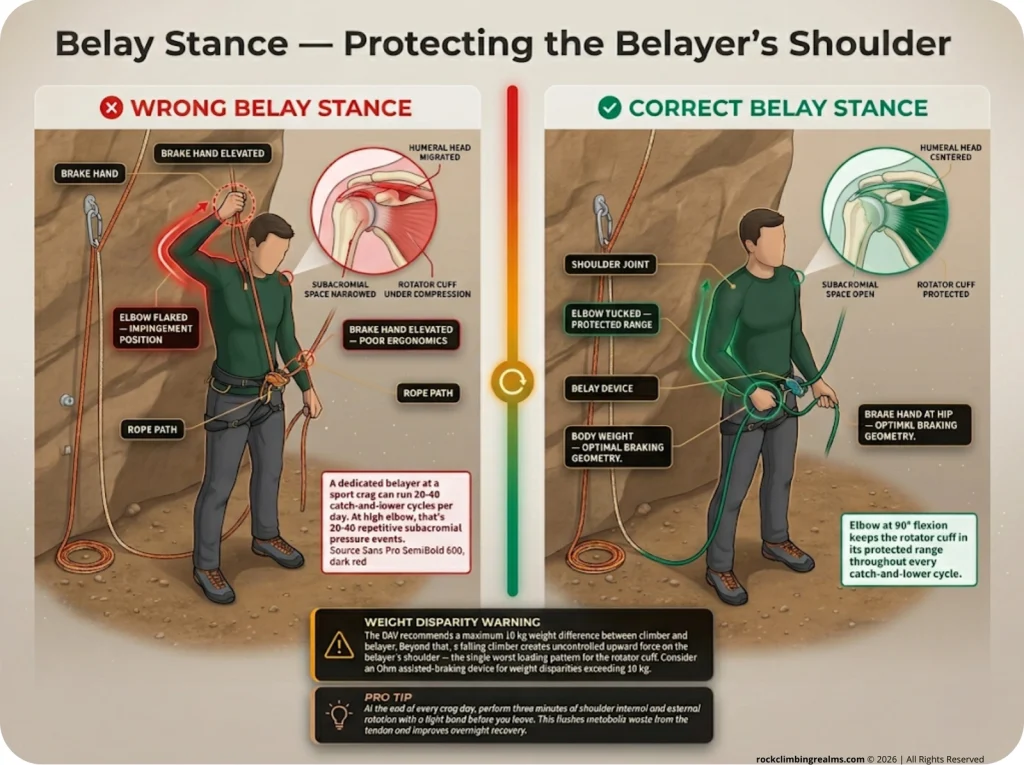
Pro tip: At the end of every crag day, perform three minutes of shoulder internal and external rotation with a light band before you leave the crag. This flushes metabolic waste from the tendon and improves overnight recovery. It takes less time than coiling your rope.
Conclusion
Three things to take away from this.
First, your shoulder is a system, not a joint. Impingement, labral tears, rotator cuff damage — they all trace back to a scapulohumeral rhythm problem. Fix the rhythm before adding load. Every time.
Second, tendons lie to you. The tendon creep mechanism makes tendons feel functional right up until the moment they aren’t. Mid-session resets and evidence-based loading protocols are not optional supplements to your training. They are the training.
Third, belay ergonomics are prehab. Belayer’s shoulder is preventable — and it happens to serious climbers who’ve never thought of their brake hand as a clinical risk factor.
Run Phase 1 for two consecutive weeks before your next training cycle. Time it, log it, and video your scapular wall-slide test. The data will be uncomfortable. It will also be necessary. Then go send something.
ng the tissue. For a shoulder prehab protocol to work, the resistance tool needs to be as precise as the clinical intention.
FAQ
How do I know if my shoulder injury is serious enough to stop climbing?
Sharp pain at end-range elevation, pain that wakes you at night, or pain that doesn’t ease within 72 hours of rest means stop climbing and get evaluated. A persistent ache that improves with warm-up but returns afterward is a load-management signal — reduce volume, don’t deny it. Climbing through a Grade 2 rotator cuff strain is how Grade 3 tears happen.
Can I climb with a rotator cuff strain?
A Grade 1 strain — inflammatory response only, no structural tear — can often be managed through load modification, volume reduction, and Phase 1–2 exercises. A Grade 2 or 3 requires imaging and clinical management before you return to the wall. Rotator cuff strain risk assessment is not something you do by feel alone.
What exercises strengthen shoulders specifically for climbing?
The Bent Over T or Y or L series, the Sharapova, and scapular pull-ups target the specific muscles and movement patterns that climbing demands: scapular upward rotation for high reaches, external rotation stability for Gastons climbing, and serratus anterior activation to maintain subacromial space on overhangs climbing. General shoulder days build deltoids. These exercises build joint integrity. Those are different things.
How often should I do shoulder prehab as a climber?
Phase 1 (mobility and scapular calibration): daily, 10–15 minutes. Phase 2 (rotator cuff stability): 3 sessions per week, separate from climbing when possible. Phase 3 (power and resilience): 2 sessions per week as a climbing-day warm-up or standalone. Maintenance dose once you’re injury-free: 20–30 minutes, three times a week, permanently. That last word is the hard part.
Why do cheap resistance bands make shoulder prehab less effective?
Cheap TPE bands exhibit non-linear, exponentially increasing resistance as they stretch — they spike at end range, exactly when the tendon is most vulnerable. High-quality latex bands maintain a more predictable resistance profile throughout the arc, letting you train the rotator cuff at end range without shocki
Safety Notice: Rock climbing and mountaineering are inherently high-risk
activities that can involve physical trauma or fatal incidents. The information on Rock Climbing Realms is for
educational and informational purposes only. Techniques and advice presented here are not a substitute
for professional, hands-on instruction. Conditions and risks vary by location. Always seek guidance
from a qualified instructor before attempting new techniques. By using this website, you agree that you
are solely responsible for your own safety. Any reliance you place on this information is strictly
at your own risk, and you assume all liability for your actions. Rock Climbing Realms and its authors
will not be held liable for any harm, damage, or loss sustained in connection with the use of this information.
Affiliate Disclosure: We are a participant in the Amazon Services LLC Associates Program, an
affiliate advertising program designed to provide a means for us to earn advertising fees by advertising and linking
to Amazon.com. As an Amazon Associate, we earn from qualifying purchases. We are also an official affiliate partner
of Black Diamond Equipment via the AvantLink network. If you click on a Black Diamond affiliate link and make a
purchase, we may earn a commission at no additional cost to you. We also participate in other affiliate programs.
Additional terms are found in the terms of service.