
In this article
The water looked deep enough from the ledge. Eight meters up, shoes tacky, forearms humming — I committed to the fall and hit the surface like a bag of cement. My ribs burned for a week. That belly-flop taught me more about deep water soloing safety than every article I’d read beforehand, and it all came down to one thing I’d skipped: practicing pencil entries from low height before climbing anything serious.
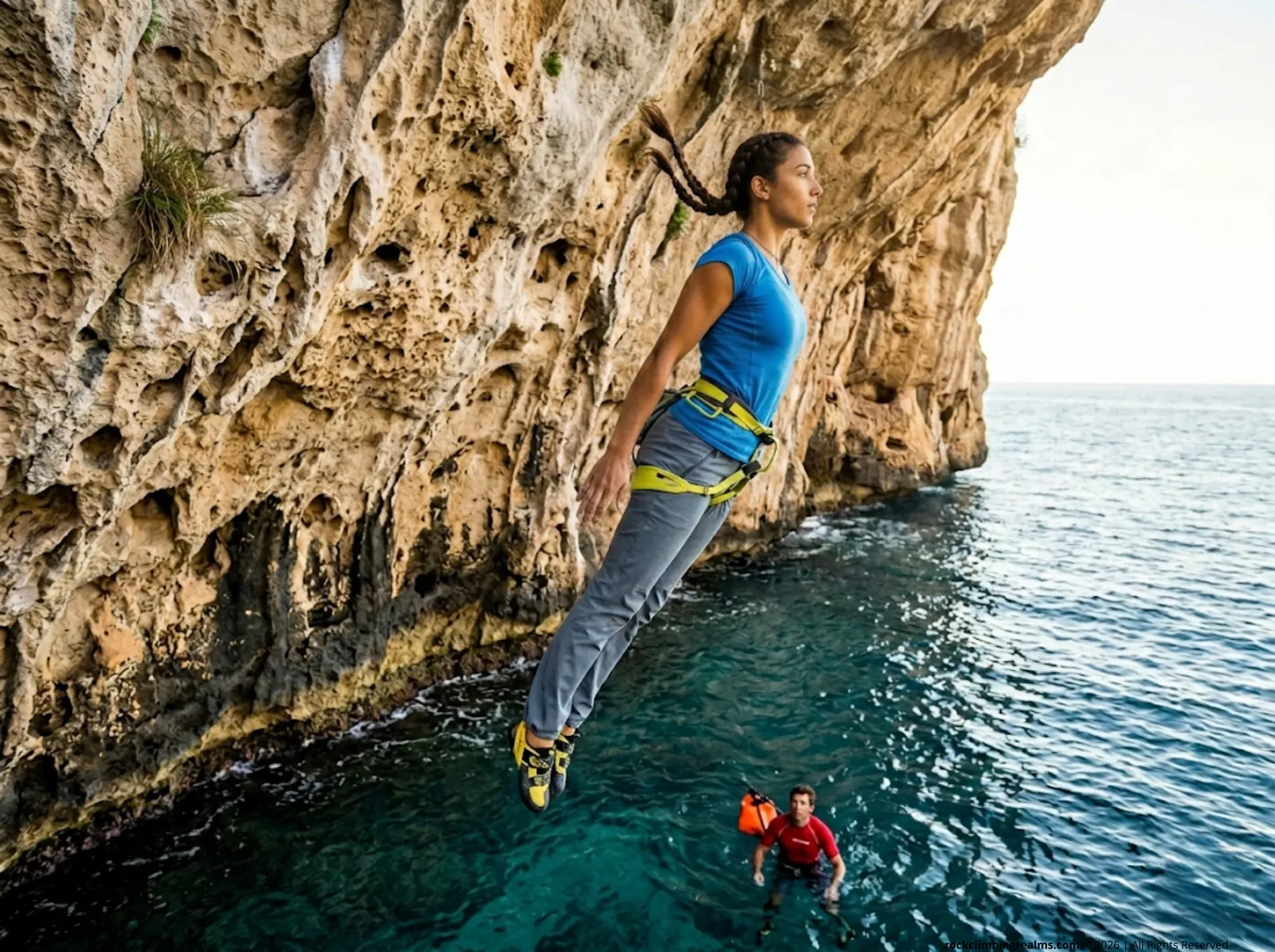
After years of trad and sport climbing across sea cliffs in Mallorca, the UK coastline, and freshwater quarries in the American Southeast, I’ve watched dozens of first-timers make that same mistake. DWS — also called psicobloc — strips climbing down to shoes, chalk, and commitment. No rope, no harness, no protection. Just you and the rock above deep water. It’s the purest, lowest-gear form of climbing humans have invented, and it will punish you fast if you skip the fundamentals.
This guide covers everything you need to safely attempt your first deep water solo session — from mastering two falling techniques and building a minimal gear kit, to scouting your landing zone and choosing a beginner-friendly venue that won’t get you killed.
⚡ Quick Answer: Deep water soloing is rope-free climbing over deep water where falls end in water landings. Start safe by practicing pencil entry technique from low height (3-5m) before climbing, always check tide and water depth, never climb alone, and use liquid chalk with 2-3 pairs of rotated climbing shoes. Beginners should stay under 10m and climb 2-3 grades below their limit.
The Science of Falling Into Water (And Why Technique Matters)
Pencil Entry — The Default for Most Falls
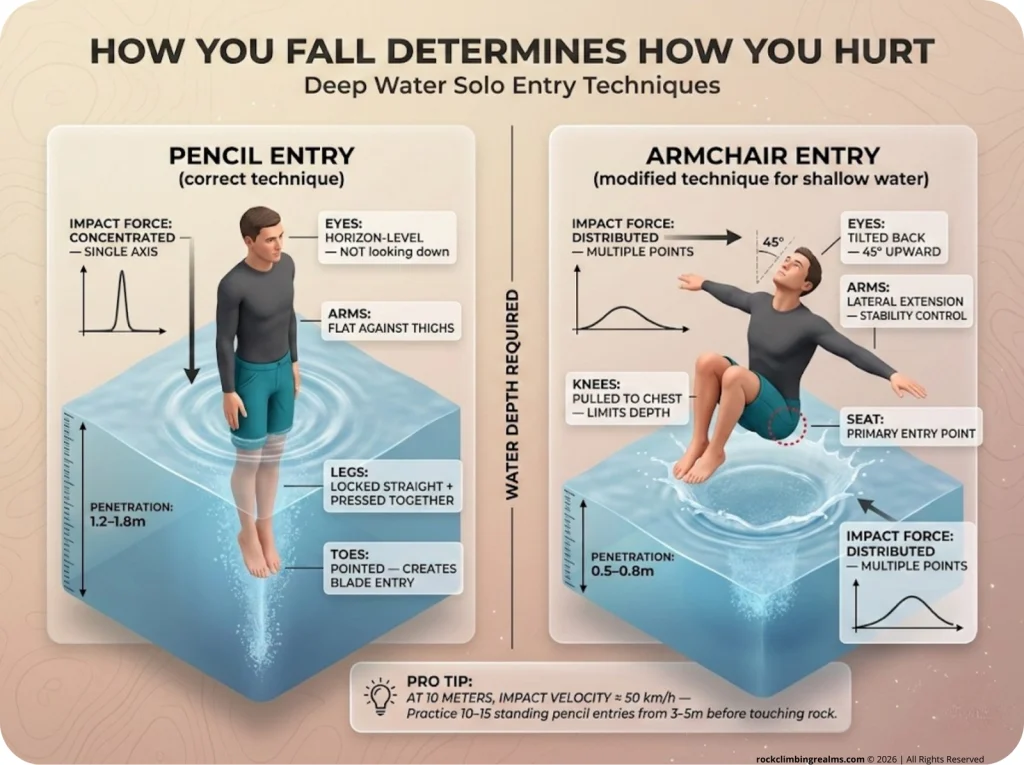
Here’s something nobody explains properly: at ten meters up, you hit the water at roughly 50 km/h. If your body is anything but arrow-straight, that surface tension turns the water into something closer to concrete. Every bruised rib, every winded landing, every panicked gasp I’ve seen on sea cliffs comes down to bad entry form.
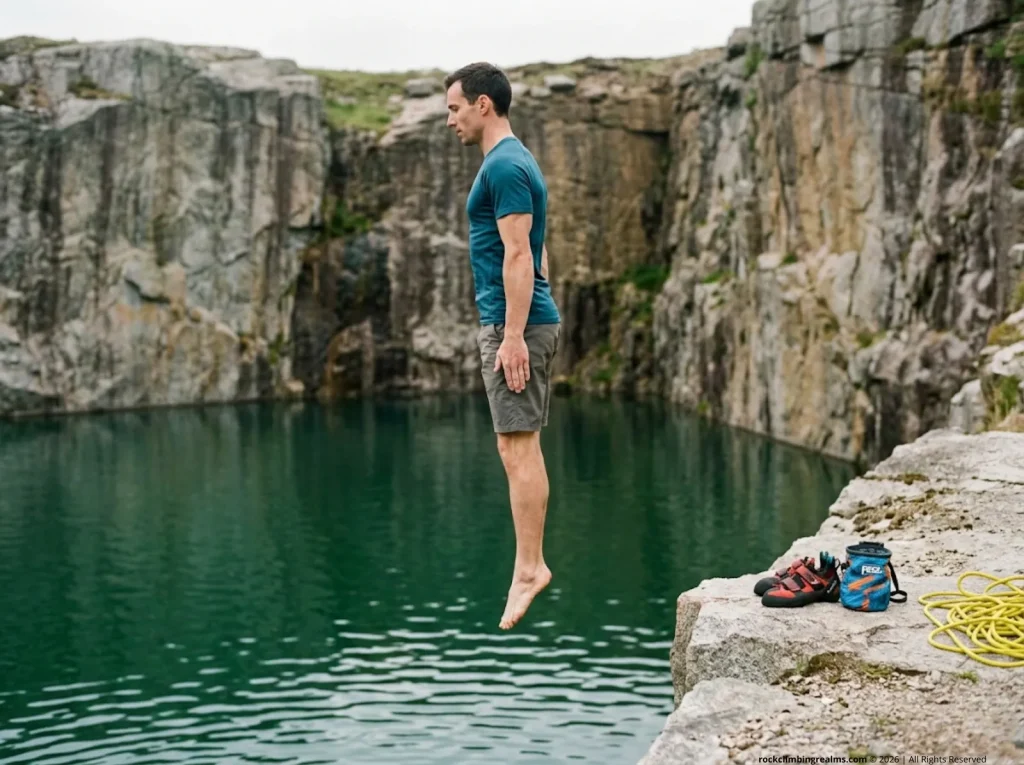
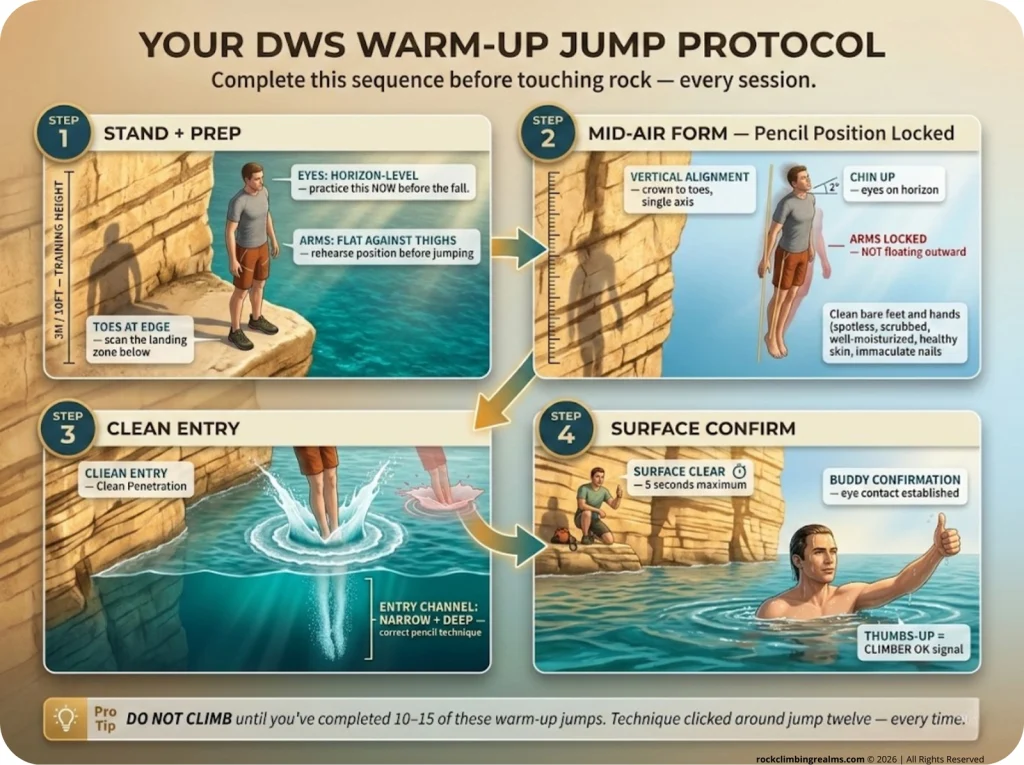
The pencil entry is your default for any fall over three meters. Legs locked straight and pressed together, arms flat against your sides, chin slightly lifted with eyes locked on the horizon — not looking down. That last part matters more than you’d think. Looking down tilts your head forward, which rotates your body, which turns a clean pencil into a chest-slapping disaster.
Pro tip: Start every session with 10-15 standing jumps from 3-5m into the water — no climbing involved. This calibrates your body and builds muscle memory for clean entries before you touch rock.
Most first-timers spread their arms outward during the fall. It’s instinct. It’s also exactly wrong. Arms out creates rotation and drags your torso forward, which is how you get the belly-flop that bruised my ribs for a week. Train yourself to press your palms flat against your thighs and keep them there.
Armchair Entry — Low-Depth Insurance
When water depth is uncertain or shallow, switch to the armchair entry. Pull your knees to your chest, lean back slightly, and extend your arms sideways for stability. This position limits how deep you penetrate — as outlined in American Alpine Club Essentials on Deep Water Soloing, the armchair technique can absorb a 30-foot fall in as little as 5 feet of water when executed correctly.
The catch: lean too far back and your head hits first. Lean too far forward and you flip to a belly-flop. It takes practice to find the sweet spot, which is why you drill both techniques from low height before climbing.
Calm Water vs. Choppy Water — The Surface Tension Factor
Glassy, calm water is actually harder on your body than light chop. Flat water has higher surface tension, which increases impact force on entry. Slightly choppy water softens the landing because the aerated surface gives way more easily — but it complicates the swim back.
Ideal conditions are light chop with no significant waves and good visibility of the bottom. If the surface is dead flat, have your buddy toss a rock nearby to break the tension before your fall. That refreshing splash also helps mark depth visually.
Cold-Water Shock and Immersion Risk — The Dangers Nobody Glamorizes
What Cold-Water Shock Does to Your Body
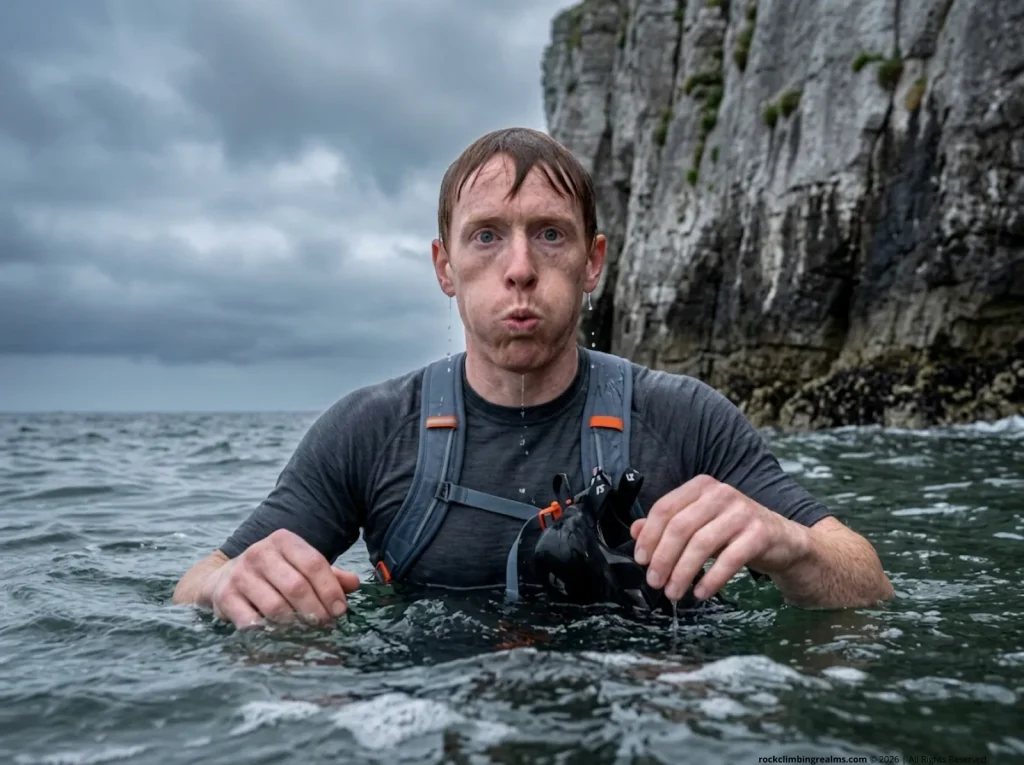
This is the part most guides skip with a single “be careful” line. Cold-water shock hits the moment you plunge into water below 70°F (21°C). Your body triggers uncontrolled gasping, rapid breathing, and panic. If your head goes under during that gasp reflex, you inhale water. It can incapacitate a strong swimmer in under a minute.
R. Bryan Simon and Seth C. Hawkins, wilderness medicine specialists who’ve provided medical coverage at DWS events, put it plainly: “Controlling your breath and keeping your airway out of the water is critical during initial exposure… consciously slow your breathing and assert mental control over panic.”
This isn’t abstract. At least three DWS fatalities have been documented in Europe, including two American climbers in Mallorca in 2021, primarily from drowning and impact trauma. If you can’t swim confidently in open water while fatigued, deep water soloing is not safe for you — full stop. The rescue window after losing consciousness in water is measured in minutes, and if you don’t have solid wilderness first aid skills every climber should have, those minutes are even shorter.
The Acclimatization Swim Protocol
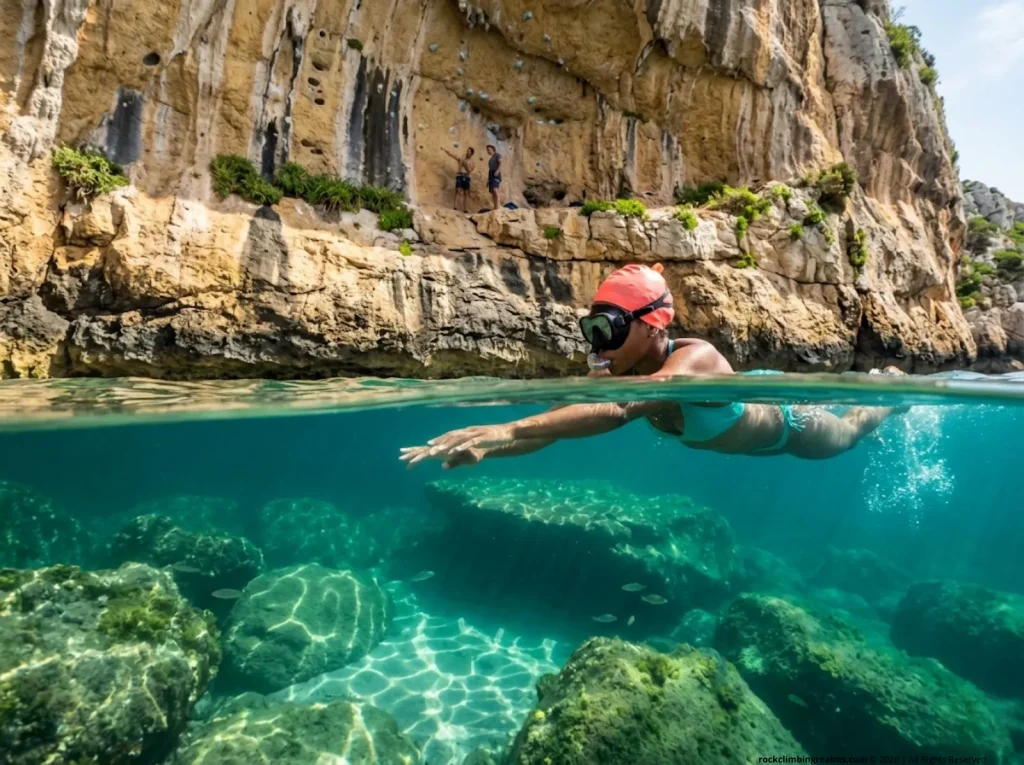
Before touching rock, swim the landing zone for 5-10 minutes. This serves two purposes: it reduces cold-water shock severity by letting your body adjust gradually, and it reveals submerged hazards — hidden rocks, depth changes, sharp ledges, and marine debris — that you cannot see from the cliff above.
If you’re gasping or panicking during this acclimatization swim, the water temperature is too cold for DWS that day. No shame in it. Pack up, come back when conditions improve.
Buddy System and Rescue Readiness
Never solo DWS. One person must stay in or near the water with a throw bag at all times, ready to assist. Before the session starts, discuss a rescue plan: who jumps in, who calls for help, where’s the nearest road access, how do you get an unconscious person out of the water and onto land.
Pro tip: Have one person in the water wearing a bright rash guard and carrying a throw bag at all times. If the climber hits the water and doesn’t surface within five seconds, the buddy goes in immediately.
According to peer-reviewed research on cold-water shock responses, the combination of cold water and physical exhaustion from climbing compounds the risk. Solo DWS is genuinely reckless.
Gear for Deep Water Soloing — Less Than You Think
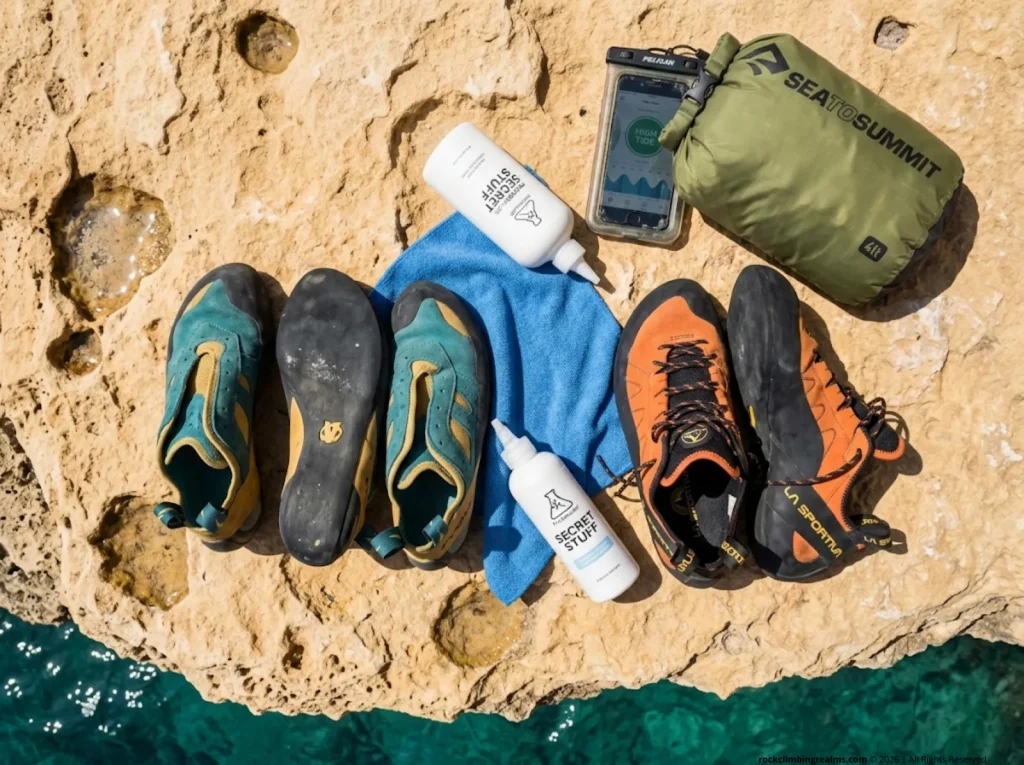
Climbing Shoes — Wet-Tolerant Selection
DWS is the lowest-gear climbing discipline. No rope, no ropes, no harness, no helmet, no quickdraws. Your kit fits in a small bag, and most of it involves managing one problem: wet shoes.
Climbing shoes lose grip dramatically when wet. Salt water accelerates this. Aggressive, downturned shoes lose performance fastest, so choose a moderate-profile shoe for DWS. Rotate your shoes — 2-3 pairs per session, towel-dry the rubber between attempts (the shoe-drying towel protocol matters), and rinse them in fresh water afterwards to preserve the rubber compound. One Reddit climber summed it up: “Brought only one pair of shoes; they stayed soaked and I slipped off easy moves.” Understanding how rubber compound hardness affects wet-rock friction makes a real difference for sea-cliff sessions.
Chalk Solutions for Sea Cliffs
Traditional chalk washes off on contact with water. Liquid chalk is the standard for DWS — apply it to your hands and forearms before climbing. The forearm application is a trick most beginners miss: coat your forearms so that when your hands sweat, the chalk transfers to holds through friction contact. Liquid chalk is key to maintaining grip through multiple attempts.
Keep a dry bag on the ledge or in a small boat for spare chalk, a towel, and your phone. Some climbers use a waterproof chalkbag clipped to their shorts, but results are mixed — wet chalk is still wet chalk.
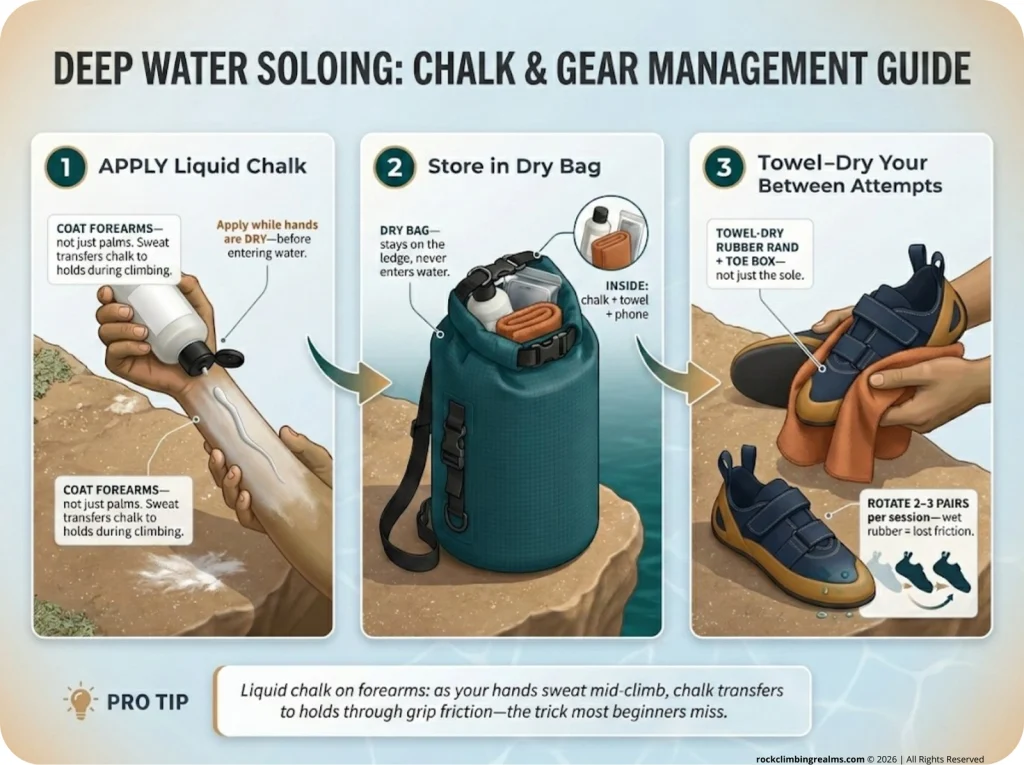
The Minimalist Kit Checklist
Here’s your entire DWS rig:
- Climbing shoes (2-3 pairs for rotation)
- Liquid chalk
- Microfiber towel
- Dry bag
- Throw bag (for buddy rescue)
- Water shoes for approach
- First aid kit
- Tide chart or app
- Snorkel/mask (for scouting submerged hazards)
That’s it. No rack, no rope, no protection. The simplicity is part of what makes DWS addictive.
Scouting Your Venue — Tide, Depth, and Exit Routes
Tide Charts and Water Depth Verification
High tide is mandatory for sea cliff venues. It covers hazards and maximizes water depth beneath the climbing. Ignoring this causes serious accidents. One forum post I’ll never forget: “Ignored the tide chart and the water level dropped while we were climbing.” That’s how you fall into three feet of water where six feet existed an hour earlier.
Scout the landing zone at high tide by swimming or diving. Check the tide before every session — this is non-negotiable. Check for submerged rocks, ledges, water depth changes, and debris. The S-grading system (S0 through S3) rates DWS routes specifically for tidal safety and fall risk beyond standard climbing grades — S0 is safest, S3 is the most committing. The Rockfax guidebook “Deep Water” remains the definitive reference for venue topos and S-grade routes, and National Park Service guidelines on water safety hazards provide additional context for open-water risk assessment.
Exit Route Planning
Before climbing, identify at minimum two exit routes from the water — a ladder, low rock shelf, boat, or swimming path to shore. Miquel Riera, the Mallorcan climber who pioneered psicobloc at Cova del Dimoni in 1978, warned it well: “When you throw yourself off the walls, look carefully at the exit points from the sea, because sometimes they’ll prick you up badly.”
If the only exit requires a long swim through waves or current, the venue is too advanced for your first session. Save it for later.
Thailand’s Railay peninsula and DWS-friendly coastline offers some of the most accessible exit routes for beginners, with warm water and well-documented venue access.
Five Beginner-Friendly Venues Compared
The best venues for a first deep water solo session balance low height, clear water, and easy access. Mallorca (Cala Sa Nau) is the birthplace of the sport with warm Mediterranean water and limestone pockets everywhere. Railay in Thailand offers tropical warmth and dozens of low lines above deep water. Dorset and Swanage in the UK give you reliable S0-rated routes with established access. Summersville Lake in West Virginia provides warm fresh water without salt corrosion on your gear. And Ha Long Bay in Vietnam delivers dramatic limestone over deep, sheltered water.
Freshwater venues eliminate salt water damage to shoes and gear. Saltwater venues offer more buoyancy but require immediate fresh-water rinsing of everything after the session.
Your First Session Protocol — From Ledge to Water
Warm-Up Jump Sequence (Non-Climbing)
Do not climb on your first attempts. Start with standing jumps from 2-3 meters into the water, focusing exclusively on pencil entry form. Legs together, arms in, eyes on the horizon. Do 10-15 jumps before touching rock.
Progress height gradually: 2m, then 4m, then 6m, and only then consider actual climbing. That first clean 8m pencil entry — the one where you slice into the water and barely feel a thing — rewires everything. Technique clicked for me around jump number twelve after a morning of feeling like I was hitting pavement.
First Climb — Low and Easy
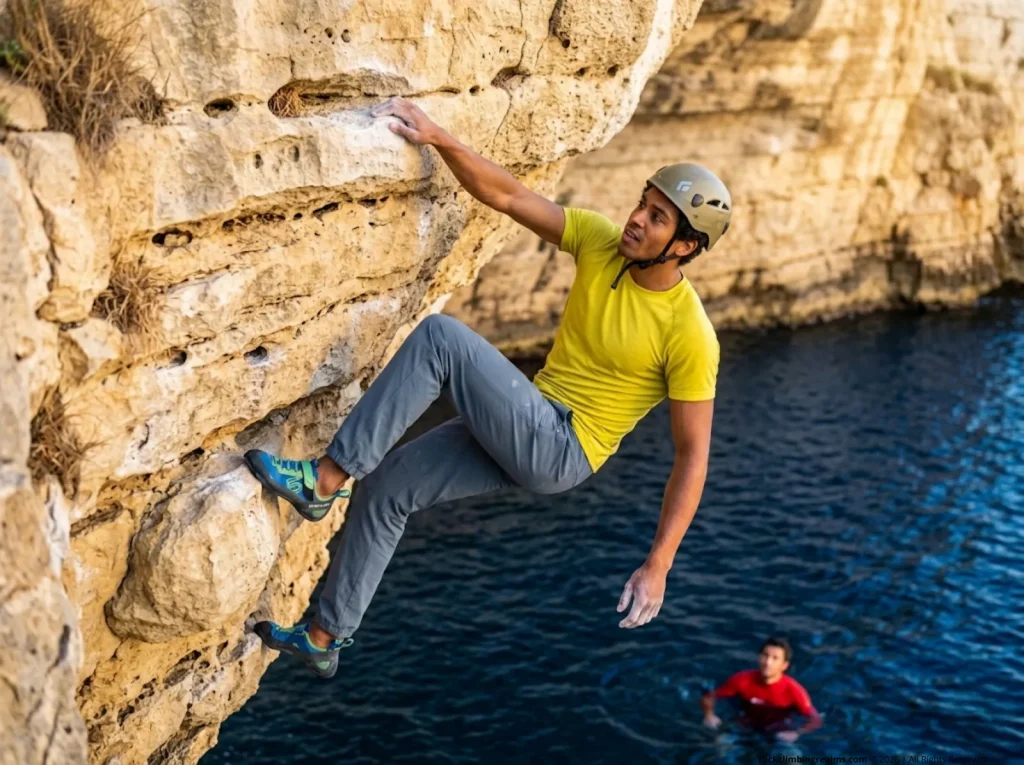
Choose a line no higher than 5-6 meters with clear, deep water directly below. Climb at 2-3 grades below your gym or outdoor limit. This session is about practice falls, not sending.
Plan where you’ll fall before you start. Pick a jug, climb to it, and let go deliberately. Deliberate falls at low height build confidence faster than accidentally falling at high height. The mental trick that works: don’t think “fall” — think “jump from a hold.” That’s easy practice for building your commitment mindset.
Pro tip: If you’re transferring your fear management skills from DWS to your regular climbing, look into the four-week mental training protocol — the principles behind controlled fear of falling exposure are identical.
Reading the Route Without Rope Beta
No bolts. No chalk marks from previous climbers — the water washed them away. No fixed gear. You read rock features raw in DWS, and that’s part of the skill transfer.
Look for jugs, rails, and ledges rather than committing to crimps. If your fingers blow on a small hold, you need to fall in control, not peel off unexpectedly. Overhung terrain is ideal because falls arc outward over deeper water rather than dragging along the wall face. Watch experienced climbers at the venue first — their line choices reveal safe and unsafe fall zones better than any guidebook.
Mental Game and Skill Transfer — Why DWS Makes You a Stronger Climber
Commitment Training Without the Consequence
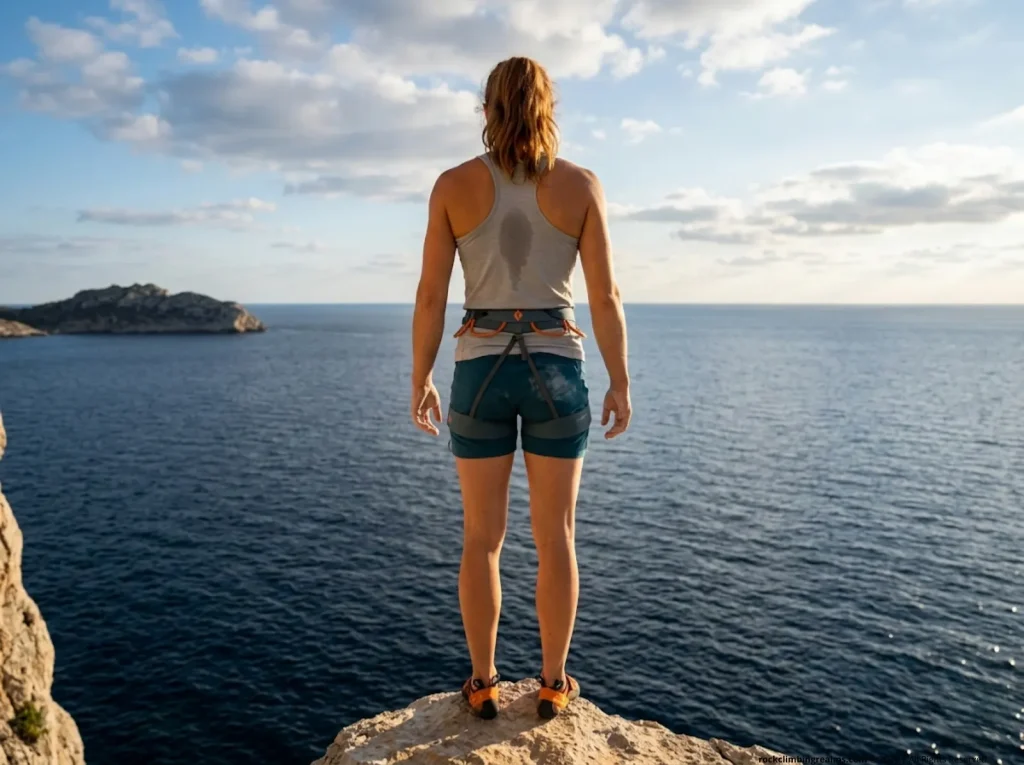
DWS is the only climbing discipline where falling is both expected and — when done correctly — safe. That makes it the single best training ground for commitment mindset. After dropping 10 meters into water repeatedly, clipping the third bolt on a sport climbing route feels calm by comparison.
This is the same kind of gradual, controlled exposure that rewires your fear response. DWS gives you hundreds of controlled falls in a single session. No other discipline offers that volume of commitment training with so little actual risk. Understanding the critical distinction between free soloing and free climbing puts DWS in proper context — it’s technically free soloing, but with a water buffer that changes the risk equation entirely.
Physical Crossover Benefits
Short, intense climbing sequences with maximum rest between attempts — swim back, hike up, go again — mirrors natural power training without you planning it. DWS builds desperate squeeze strength from holds you’d normally trust but now feel greasy and temporary. Flexibility and hip mobility improve from the wide feet placements common on overhanging sea cliff terrain.
And here’s something nobody talks about: cold-water immersion between climbs is accidental recovery training. The same protocol athletes pay for in ice baths, you’re getting free between burns. DWS doesn’t just build climbing training capacity — it builds the whole climber.
Pro tip: Keep track of your progress across sessions. Most climbers notice a measurable difference in their onsight climbing confidence after 3-4 DWS days, especially on routes where they’d normally hesitate at committing moves.
Protecting the Cliffs — Sustainability for DWS Venues
Rock Erosion and Approach Trail Impact
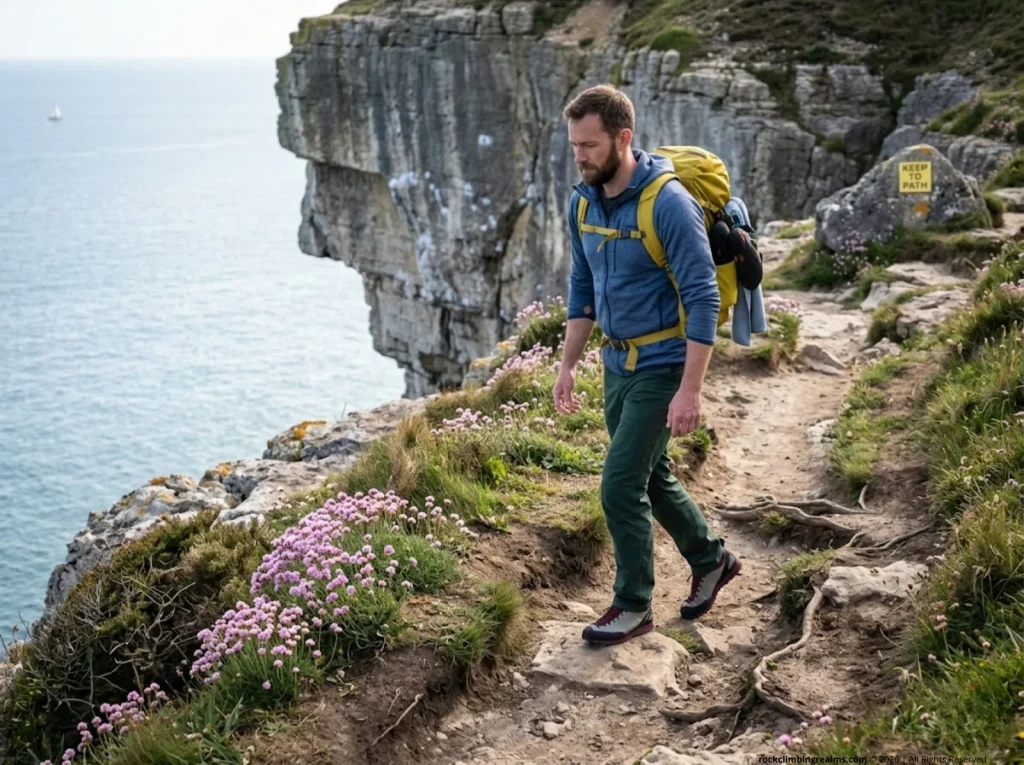
Repeated foot traffic on soft coastal rock — limestone, sandstone — accelerates coastal erosion at launch points and approach scrambles. Stick to established paths and launch ledges. Don’t pioneer new exits or scramble routes just because the rock looks climbable.
Some venues have seasonal closures for nesting seabirds — peregrine falcons, cormorants, guillemots. Check before you go. The same principles of proper chalk cleanup to minimize visual and chemical impact on rock apply on sea cliffs, and liquid chalk runoff into water is another reason to apply sparingly and intentionally.
Marine Habitat Awareness
Landing zones may overlap with protected marine areas, tide pools, or fragile formations. Check local regulations — some coastlines prohibit rock disturbance or swimmers in certain zones during specific seasons. Carry out all trash, chalk wrappers, tape, and food scraps. Leave the venue cleaner than you found it.
DWS venues survive by access staying open. One bad actor who trashes a launch ledge or disturbs protected wildlife risks closure for everyone. Be the climber who makes land managers glad they kept the crag open.
Conclusion
Three things separate a safe first DWS session from a painful one. First, practice pencil entries from low height before you climb anything — the entry technique is the single biggest safety variable. Second, treat every session like a trad lead: scout the landing zone, check the tide, plan your exit, and never climb alone. Third, respect what the water gives you and what the cliffs can’t afford to lose — this sport survives on access, and access depends on climbers who leave no trace.
Find a warm-water, low-height venue near you this summer. Do ten practice jumps before you touch rock. Build the habit of falling correctly, and you’ll discover one of the purest, most stripped-down forms of climbing that exists. Now go send something.
FAQ
Is deep water soloing dangerous?
DWS carries real risk — at least three fatalities have been documented in Europe, primarily from water immersion and impact trauma on entry. With proper technique, venue scouting, a buddy system, and cold-water awareness, the risk drops to levels comparable to highball bouldering. But manageable risk is not no risk. Respect the water.
What gear do I need for deep water soloing?
Climbing shoes (2-3 pairs for rotation), liquid chalk, a towel, and a dry bag. That’s the core kit. DWS is the lowest-gear climbing discipline — no rope, harness, or helmet. A snorkel and mask for scouting submerged hazards is a smart add, and a throw bag for your buddy is non-negotiable.
How deep does the water need to be for deep water soloing?
A minimum of 3-5 meters (10-16 feet) directly below the climbing line, verified by swimming or diving at high tide. The armchair entry can safely absorb falls in as little as 5 feet of water, but beginners should stick to deeper zones until entry technique is dialed. Deeper water means more margin for error.
Where can beginners try deep water soloing for the first time?
Mallorca (Cala Sa Nau), Thailand (Railay), Summersville Lake in West Virginia (freshwater, warm), and UK coastal venues rated S0 on the Rockfax guide are all proven beginner-friendly options. Each has established access, documented water depth, and communities that can point you to the right routes.
Can I deep water solo if I’m not a strong swimmer?
No. Strong swimming ability and confident self-rescue in open water are non-negotiable. If you cannot swim 200 meters in open water while fatigued, DWS is not safe for you. The CDC water-safety competencies for confident swimming offer a reliable baseline for self-assessment.
Safety Notice: Rock climbing and mountaineering are inherently high-risk
activities that can involve physical trauma or fatal incidents. The information on Rock Climbing Realms is for
educational and informational purposes only. Techniques and advice presented here are not a substitute
for professional, hands-on instruction. Conditions and risks vary by location. Always seek guidance
from a qualified instructor before attempting new techniques. By using this website, you agree that you
are solely responsible for your own safety. Any reliance you place on this information is strictly
at your own risk, and you assume all liability for your actions. Rock Climbing Realms and its authors
will not be held liable for any harm, damage, or loss sustained in connection with the use of this information.
Affiliate Disclosure: We are a participant in the Amazon Services LLC Associates Program, an
affiliate advertising program designed to provide a means for us to earn advertising fees by advertising and linking
to Amazon.com. As an Amazon Associate, we earn from qualifying purchases. We are also an official affiliate partner
of Black Diamond Equipment via the AvantLink network. If you click on a Black Diamond affiliate link and make a
purchase, we may earn a commission at no additional cost to you. We also participate in other affiliate programs.
Additional terms are found in the terms of service.