
In this article
Your partner peels off the crux fifteen feet above the last clip. The rope snaps taut. You hear a dull crack — kneecap meets limestone at full speed. She hangs there, screaming. You held the fall perfectly. Brake hand locked. Not an inch of slack. And that’s exactly the problem.
After a decade of catching lead falls on sport routes from the Red River Gorge to the limestone walls of southern France, I’ve watched the same scene play out dozens of times. Great belayers — attentive, responsible, locked in — giving catches that beat their partners to pieces. Not because they did something wrong, but because they didn’t do enough of something right.
Here’s the thing most climbers never hear until someone gets hurt: catching a lead fall isn’t about holding the rope tight. It’s about moving your body at exactly the right moment to turn a violent stop into a controlled one. This is the soft catch, and most belayers are botching it without knowing it.
⚡ Quick Answer: A soft catch is a dynamic belay technique where the belayer crouches and then rises or jumps as the rope comes taut on the last quickdraw, slightly lengthening the arrest to reduce impact forces by over 25%. This prevents the “steel cable” stop that slams climbers into the wall and causes ankle, knee, and shoulder injuries. It’s essential above the 4th clip with clear air below — and absolutely wrong near the ground.
What a Soft Catch Actually Does to Your Climber’s Body
The Physics of Hard vs. Soft Impact
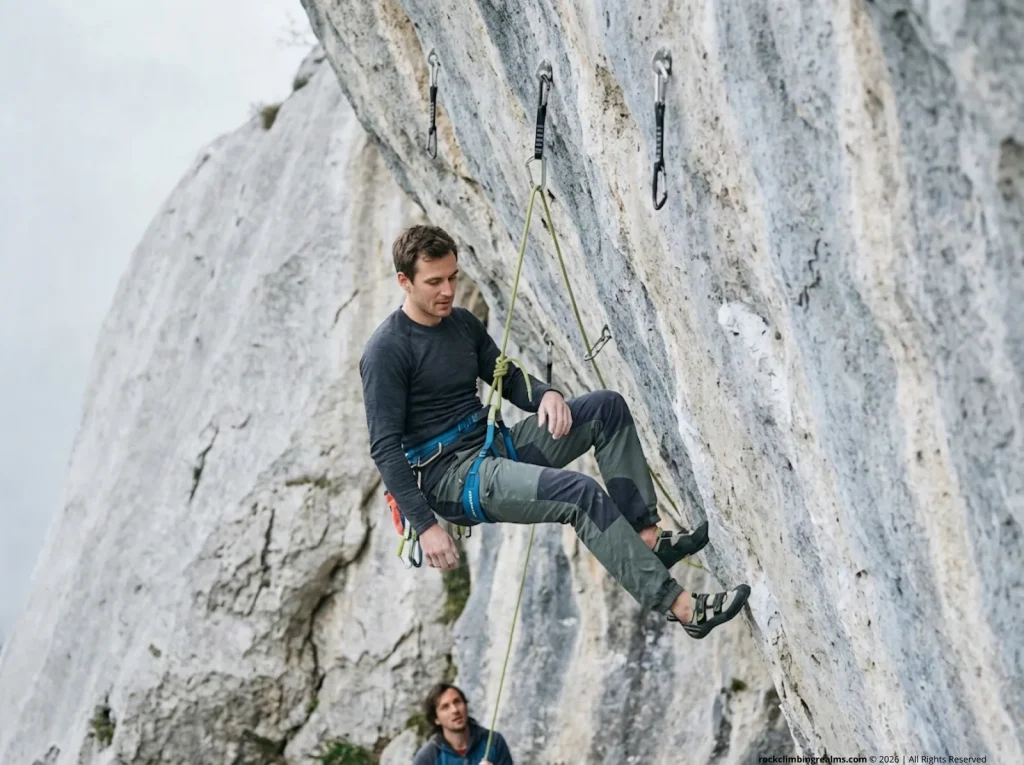
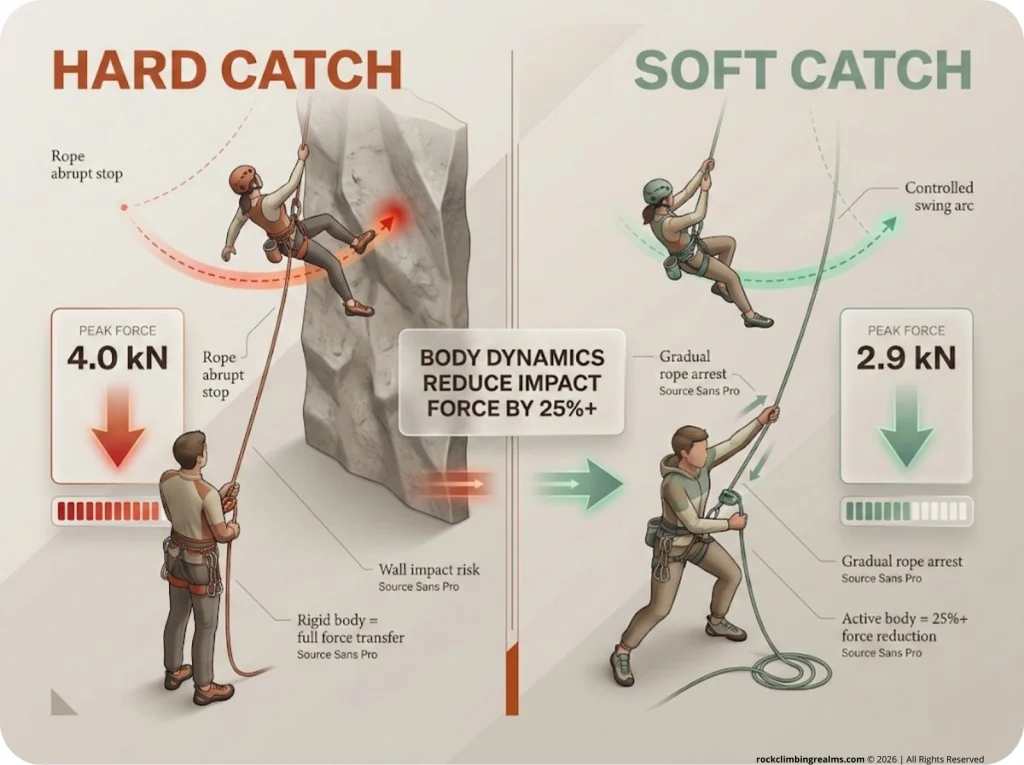
A hard catch works like a tow chain snapping taut. Your climber goes from freefall to dead stop in a fraction of a second, and all that energy dumps straight into their body. The result is an uncontrolled pendulum — a forceful wall swing that crushes ankles, hyperextends wrists, and torques hips.
Petzl’s real-fall force analysis shows what happens in actual fall tests with an 80 kg climber, a GriGri 2, and a VOLTA 9.2 mm rope at fall factor 0.3. A neutral belay generated roughly 2.5 kN of impact force on the climber and 4 kN at the anchor. That’s enough to leave bruises. Enough to shatter trust.
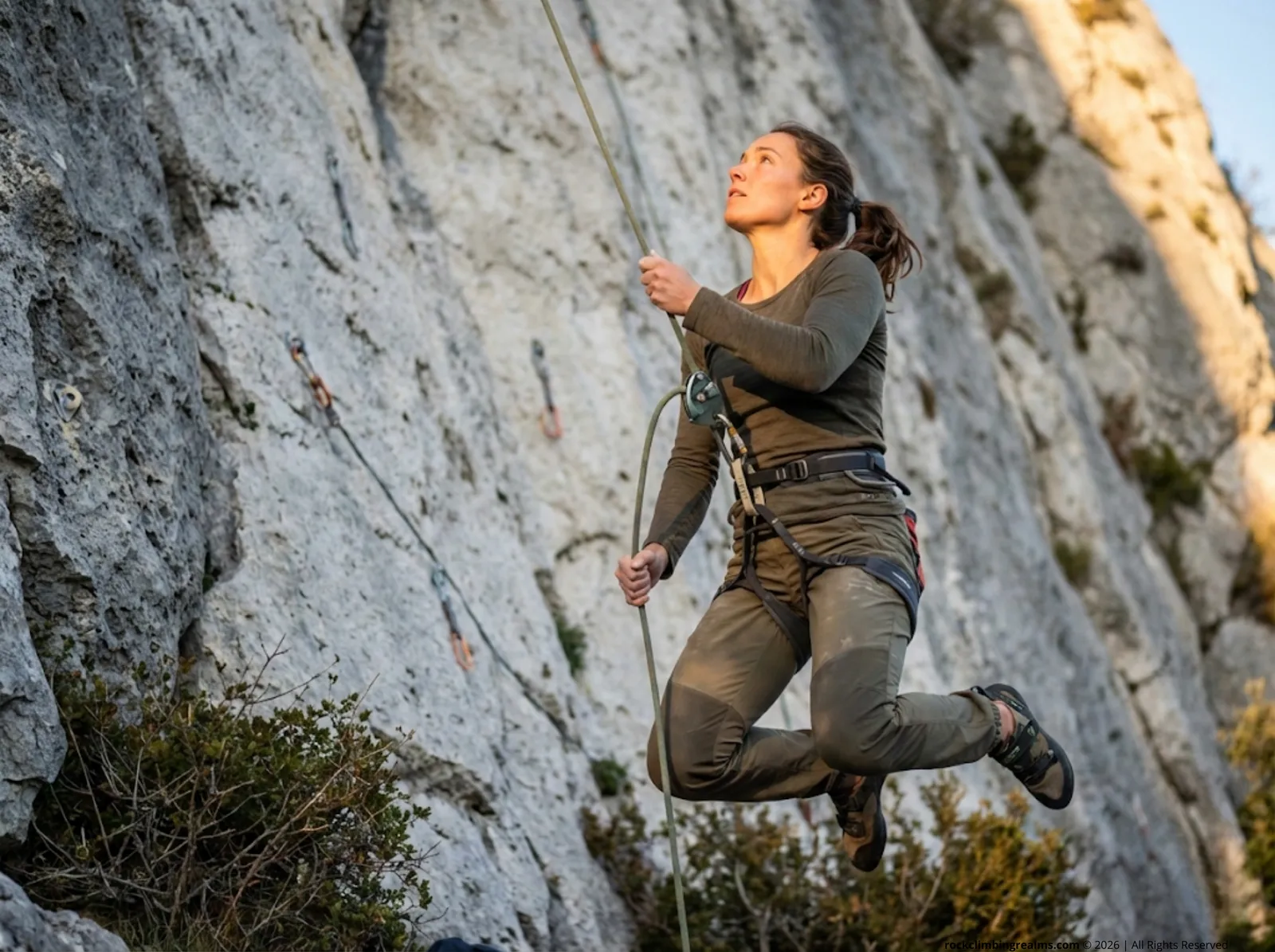
A soft catch changes the picture. By adding a few inches of controlled belayer movement — a crouch-and-rise or a small jump — you stretch the arrest window just enough to let your climber spot their landing and prepare their legs. Instead of a steel cable stop, they get a bungee. Same fall, completely different outcome.
Pro tip: The difference feels like hitting pavement versus landing on a trampoline. Once you feel a good soft catch, you’ll never trust a belayer who gives hard catches again.
How Body Dynamics Cut Impact Force by 25%
Here’s the part that makes this concrete. Edelrid’s research on passive versus active belaying forces tested the difference between standing still and actively moving during a catch. Body dynamics alone cut impact force by more than 25% — from 4.0 kN down to 2.9 kN in low-friction setups. With a high-friction system plus active movement, forces dropped to 2.6 kN.
That 1+ kN difference is real. It’s the gap between walking away sore and dealing with a shattered patella. And almost no one talks about these numbers because no competitor actually cites the data.
Fresh ropes amplify the effect. New dynamic ropes operate closer to their rated dynamic elongation (capped at ≤40% by UIAA standards), soaking up far more energy than old ropes with dozens of falls on them. If your catches suddenly feel harder and your technique hasn’t changed, the rope might be past its prime. Understanding how dynamic rope elongation affects fall forces matters more than most climbers realize.
The Exact Timing That Makes or Breaks Your Catch
Reading the Fall Before It Happens
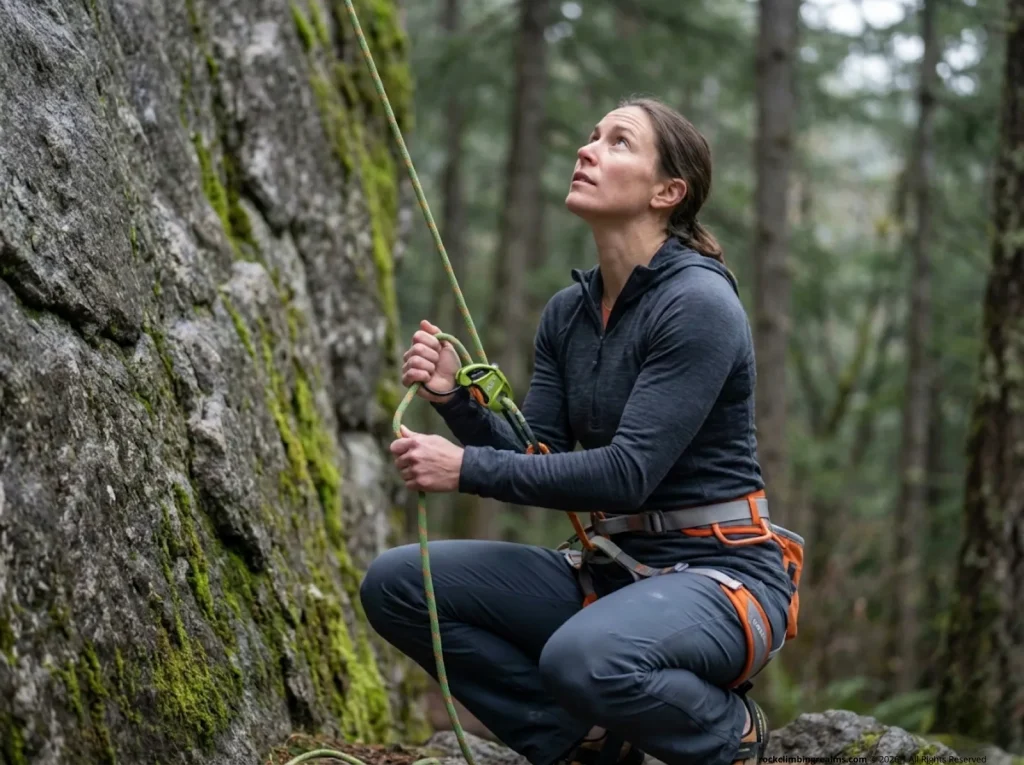
Soft catch timing starts before the fall, not during it. Watch your climber. Feet cutting? Arms shaking? Missed clip? That’s your signal to get ready.
Stand close to the wall — directly under or slightly to the rope-side of the first quickdraw. Keep a gentle smile in the rope — not tight enough to short-rope your climber and not so loose that you’re adding freefall distance. Slack management is the foundation. Get it wrong and nothing else matters.
And before the climber leaves the ground: talk. “I’m lighter, so I’ll jump big.” “First three clips are tight because there’s a ledge.” Pre-climb communication on weight and terrain isn’t optional — it’s how you coordinate the catch before there’s a catch to coordinate.
The Crouch-and-Jump Sequence
Here’s the actual movement. Start in a ready position: knees slightly bent, weight on the balls of your feet, brake hand locked. Watch your partner climb.
The moment the fall happens and the rope begins pulling taut on the last clipped draw, rise into the pull. Stand up, hop, or let the rope pull you upward. Adrian Berry nailed it: “You must be in the act of standing up as the force is applied — standing after the impact is felt is too late.”
You’re absorbing maybe 6-12 inches of additional arrest distance. Not launching yourself at the wall. Just enough belayer movement to turn the stop from abrupt to gradual, giving your climber a controlled arc instead of a face-first wall slam.
Three Timing Mistakes That Turn Soft Catches Hard
Too early. Jumping before the rope loads means both the rope stretches AND you move — creating extra rope and a longer fall. Your climber drops further than they should.
Too late. Moving after the peak force hits does nothing. The damage is already done. The hard catch already happened.
Too much. Massive jumps add freefall distance instead of cushioning the arrest. Six to twelve inches of belayer movement is all you need. Any more and you’re making the fall worse, not better.
Pro tip: Crouch ready, then stand exactly as the climber levels with the last draw. If you’re jumping BEFORE you feel the rope load, you’re too early. If you’re jumping AFTER the jolt, you’re too late. The timing window is about half a second.
The biggest mistake people share on forums? “Jumping too early or late ruins the timing and makes it a hard catch.” They’re right. Learning the 15ft rule for preventing ground falls helps you understand how slack interacts with fall distance when those first few clips are in play.
When You Should NOT Give a Soft Catch
The First Three Clips and Ground-Level Falls
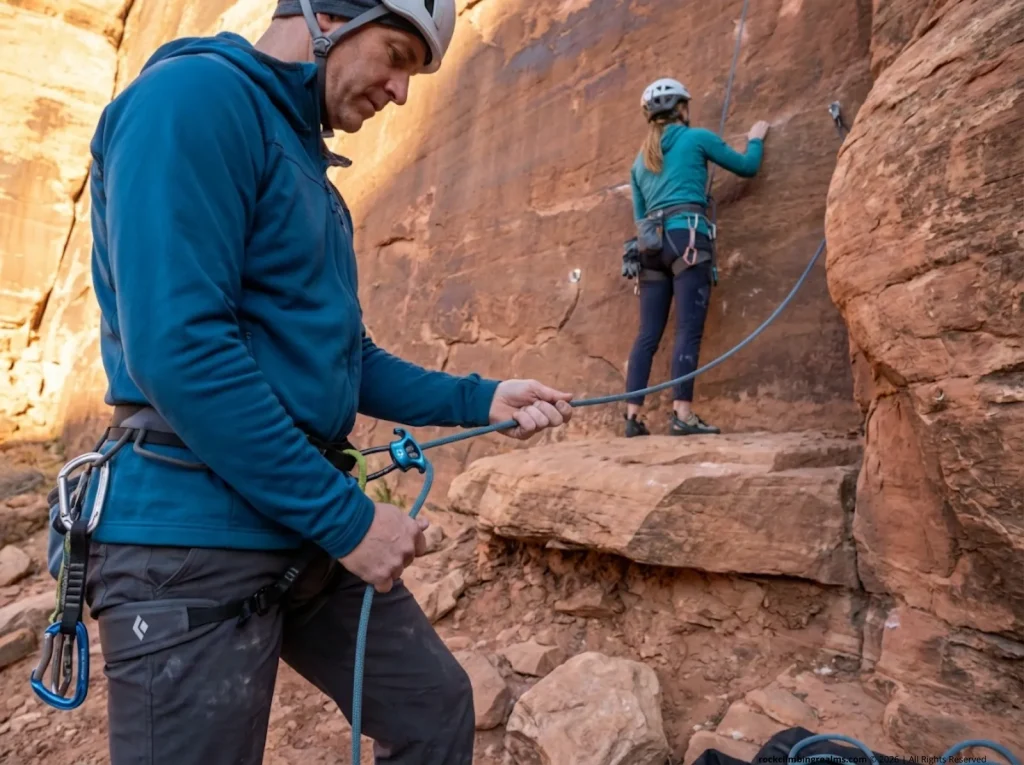
Not every fall deserves a soft catch. Below the third or fourth clip, your climber is close enough to the ground that any extra fall distance — even the 6-12 inches from a dynamic belay — creates decking risk.
Cornell University’s sport-lead belaying guidelines are clear on this: keep the belay tight for the first bolt and clips. Transition to dynamic catches only once the climber has enough height above hazards. Lindsay Auble from the American Alpine Club put it well: “Though every fall is different, in general, softening the catch provides more benefits than adding slack” — but that general rule has real exceptions near the ground.
Ledges change the equation even higher on the route. If there’s a flat shelf ten feet below your climber’s last clip, a soft catch could send them into it. Read the terrain, not just the height.
Suspect Gear, Runout, and Sketchy Terrain
If the last clip is a dodgy quickdraw, a loose bolt, or questionable fixed gear, adding dynamic force to the system is the wrong call. A static belay protects suspect protection from the extra loading.
High-runout sections where the fall distance already pushes limits don’t need a soft catch adding more travel. And overhung routes near roofs where the climber could swing into sharp edges require tighter control. Before practicing soft catches at all, make sure your lead climbing safety fundamentals are solid.
Weight Disparity and Terrain Adjustments
Lighter Belayer, Heavier Climber
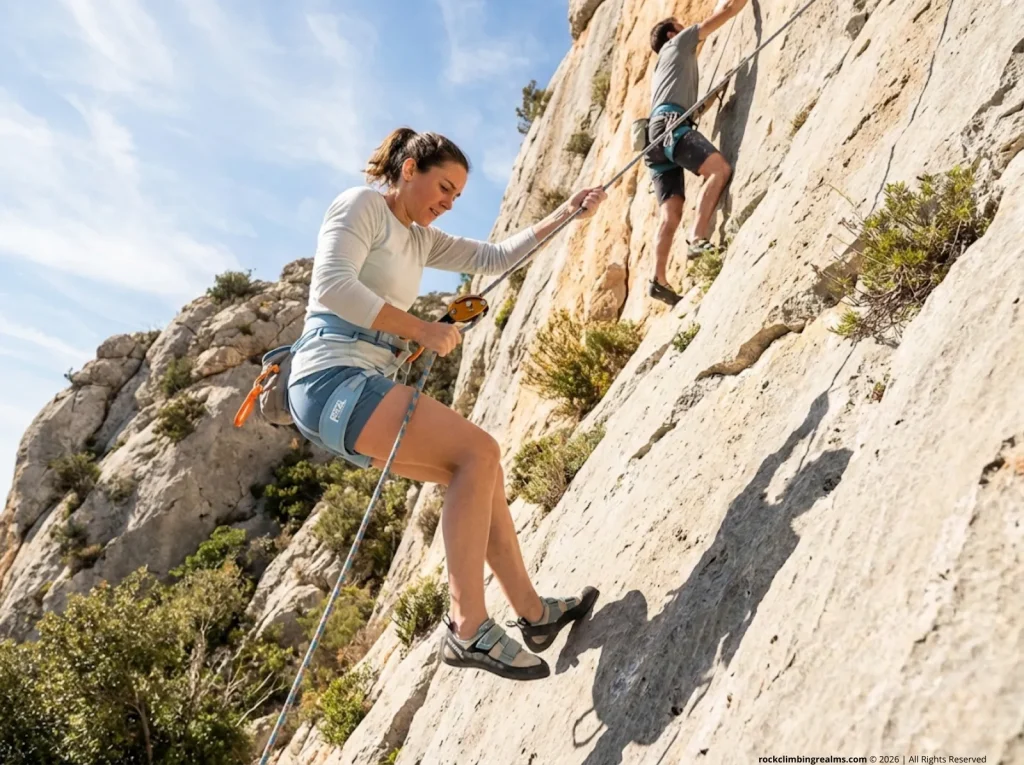
This is where most belayers fail without realizing it. When you weigh significantly less than your climber, the upward pull during a catch can yank you off the ground and slam you into the first bolt. That’s not a soft catch — that’s a rocket belayer situation.
Two solutions work. First, jump more aggressively. Use the weight disparity to your advantage by committing fully to the upward motion — you’ll travel further, but the intent is the same controlled rise. Second, set up a mobile anchor: tie a sling from a floor anchor to your belay loop below the device, leaving slight slack. This lets you travel upward in a controlled way without becoming a projectile.
Cornell’s guidelines specifically recommend mobile anchors for significant weight differences. An Edelrid Ohm can also add friction to compensate for the weight gap. Understanding ground anchor solutions for lighter belayers is worth the homework if you regularly climb with heavier partners.
Pro tip: Discuss it before the climb: “I’m 40 pounds lighter, so I’ll jump big and I’ve set a mobile anchor.” Don’t let your partner discover the weight problem during the first whip.
Slab, Vertical, and Overhung Terrain
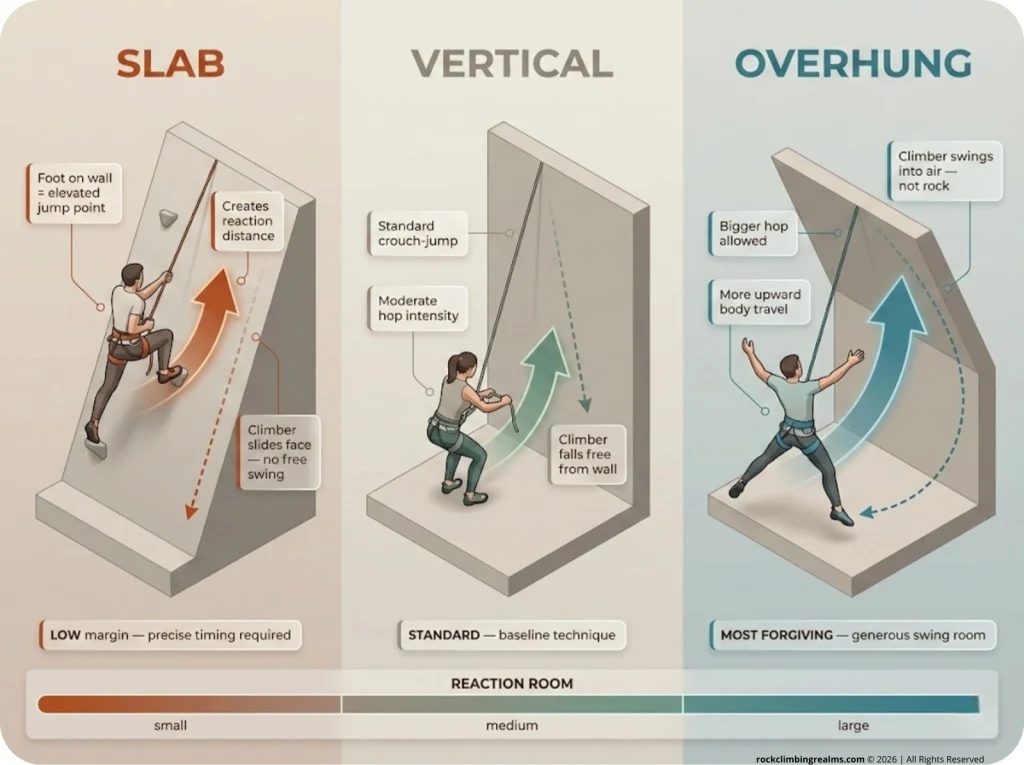
Wall angle changes everything about your soft catch strategy.
Overhung terrain is the most forgiving. Your climber swings into air, not rock. You can give more dynamic belay movement — a bigger hop, more upward travel — because there’s swing room and the wall curves away from the fall arc.
Vertical terrain is standard. The basic crouch-and-jump works with moderate intensity.
Slab climbing is the hardest. Your climber slides down the face instead of falling free, and you have almost no reaction time. The trick? Plant one foot on the wall to create a higher jump point. This rare technique — documented by Movement Gyms — creates the reaction distance needed for a controlled catch on low-angle rock where there’s nowhere to swing.
Your Belay Device Changes Everything
Assisted-Braking Devices Demand More Movement
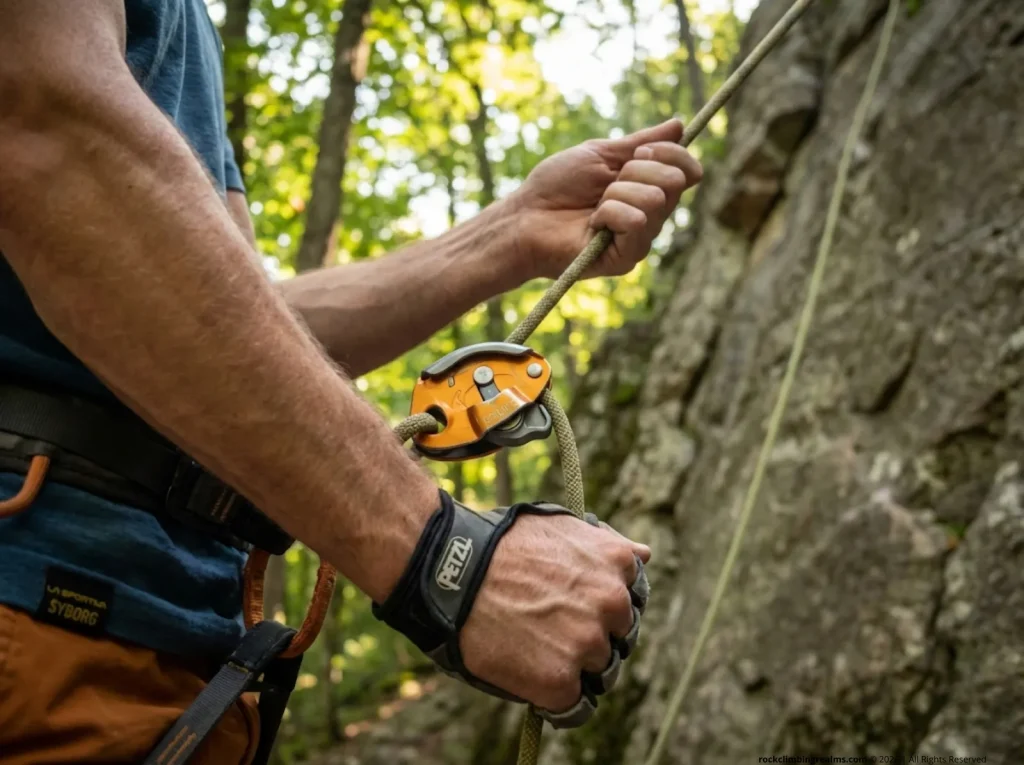
Here’s what catches people off guard. Assisted-braking devices like the Petzl GriGri and Click-Up engage the cam almost instantly during a fall. That fast lock-up naturally creates a harder catch than a tube device would.
Edelrid’s data confirms it: in high-friction belay systems, active belayer movement becomes even more critical to compensate for the device’s rapid arrest. The flip side is real — assisted braking prevents lazy-brake-hand disasters, but it demands more deliberate physical effort to achieve a soft catch.
ATC-style devices allow more inherent slippage, creating a slightly more dynamic catch by default. But the brake hand control risk is higher. Every device is a trade-off, and knowing how ATC, GriGri, and passive devices differ helps you calibrate your body movement to your specific setup.
Rope Age and Elongation Matter More Than You Think
New ropes stretch more. Old ropes don’t. It’s that simple, and it matters more than most climbers think.
After dozens of falls and UV exposure, rope cores compress and sheath fibers stiffen. Dynamic elongation drops and catches harden — even if your technique stays exactly the same. If every catch suddenly feels like a steel cable stop and you haven’t changed anything else, the rope is the culprit.
Pro tip: If your rope feels like a steel cable on catches, it’s probably past its prime. Swap it before your climber’s ankles pay the price. A fresh rope can drop impact force by nearly a full kN compared to a worn one.
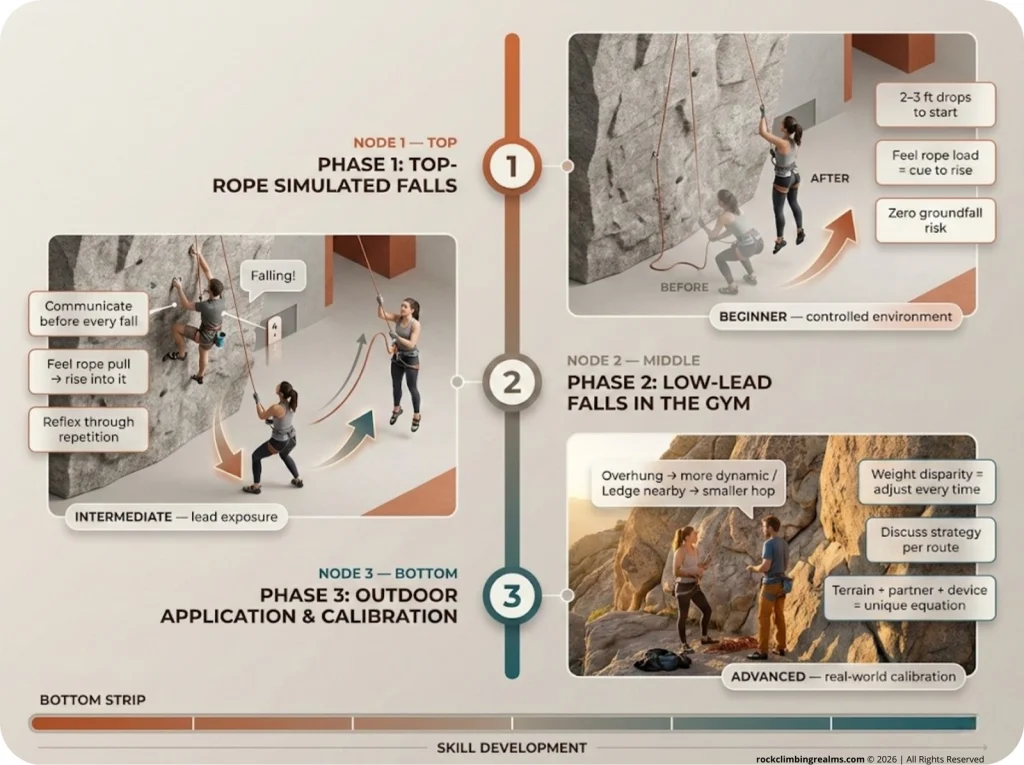
A Progressive Practice Plan That Actually Works
Phase 1: Top-Rope Simulated Falls
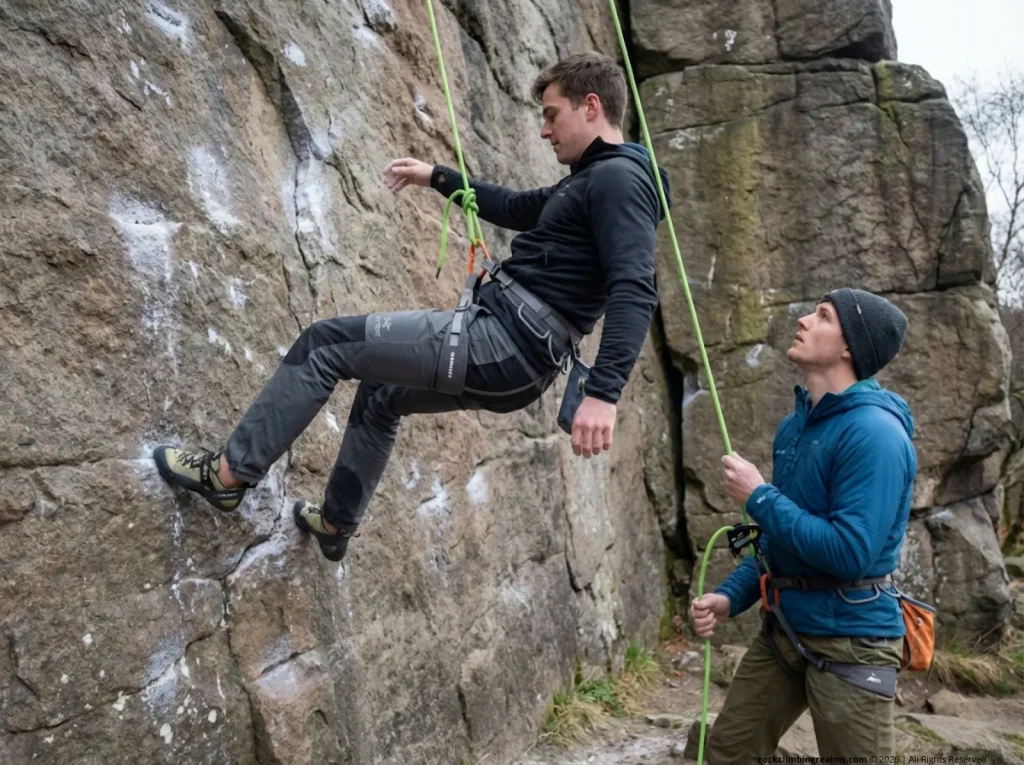
Start on top-rope. Have the climber take small, deliberate falls while the belayer practices the crouch-and-jump timing with zero groundfall risk. Start with 2-3 foot drops, then gradually increase to full body-weight whippers. Focus entirely on the feel — the moment the rope loads into your harness, that’s your cue to rise.
Phase 2: Low-Lead Falls in the Gym
Move to lead, but only practice with the climber well above the 4th clip in the gym. Communicate before each fall: “Falling!” gives the belayer time to set the ready position. Focus on the tactile feedback — feel the rope pull, then rise into it. This is where practicing catches becomes reflex instead of theory.
Phase 3: Outdoor Application and Partner Calibration
Every climbing partner pair needs calibration. Weight disparity, belay device familiarity, and terrain all change the equation. Discuss catch strategy for every route: “This one’s overhung, I’ll give you more dynamic” or “First three clips are tight because the ledge is right there.”
Andrew Bisharat said it best: “Aside from knowing how to safely operate the belay devices, giving a soft catch is the most important, and least understood, aspect of great belaying.” If you’re still looking for partners to practice with, finding a climbing partner you can trust starts at the gym before it moves to the crag.
Conclusion
Three things to lock in.
First: move INTO the fall as the rope loads — not before, not after. That half-second timing window is the entire skill.
Second: first three clips stay tight. Soft catches earn their place above the 4th clip with clear air below. Near the ground or near a ledge, a harder catch keeps your climber off the deck.
Third: communicate weight, terrain, and catch preference BEFORE the climber leaves the ground. Every route is a new equation.
Next time you tie in with your partner, spend two minutes talking about catch preferences. Then take five intentional practice falls. The difference isn’t subtle — it’s the gap between a climber who trusts you with their body and one who’s quietly shopping for a new competent belayer.
Now go send something.
FAQ
What is a soft catch in climbing?
A soft catch is a dynamic belay technique where the belayer moves — crouches, then jumps or rises — as the rope comes taut on the last quickdraw. This slightly lengthens the fall to soften the impact and prevents the sudden stop that slams climbers into the wall, causing ankle, knee, and shoulder strain.
How do you give a soft catch if you are lighter than the climber?
Jump more aggressively into the upward pull, or use a mobile anchor — a sling from a floor anchor to your belay loop below the device with slight slack. This lets you travel upward without being launched into the first bolt. An Edelrid Ohm adds friction to compensate for the weight disparity.
What is the difference between a soft catch and a hard catch?
A hard catch is a static belay arrest where the belayer doesn’t move, generating peak forces above 4 kN and slamming the climber into the wall. A soft catch uses belayer movement to reduce impact forces by over 25%, creating a gradual stop that lets the climber control their swing and prepare their legs for wall contact.
When should you NOT give a soft catch?
Never give a soft catch on the first 3-4 clips where groundfall risk exists, near ledges or obstacles, when using suspect gear, or on high-runout sections where additional fall distance adds danger. In these scenarios, a tighter catch prevents decking even though it’s harder on the body.
Is jumping as a belayer safe?
Yes, when done correctly. The jump is a controlled rise of 6-12 inches timed exactly as the rope loads — not a massive leap. You never release your brake hand, and you should practice on top-rope first. Mistimed or exaggerated jumps create more danger than they prevent.
Safety Notice: Rock climbing and mountaineering are inherently high-risk
activities that can involve physical trauma or fatal incidents. The information on Rock Climbing Realms is for
educational and informational purposes only. Techniques and advice presented here are not a substitute
for professional, hands-on instruction. Conditions and risks vary by location. Always seek guidance
from a qualified instructor before attempting new techniques. By using this website, you agree that you
are solely responsible for your own safety. Any reliance you place on this information is strictly
at your own risk, and you assume all liability for your actions. Rock Climbing Realms and its authors
will not be held liable for any harm, damage, or loss sustained in connection with the use of this information.
Affiliate Disclosure: We are a participant in the Amazon Services LLC Associates Program, an
affiliate advertising program designed to provide a means for us to earn advertising fees by advertising and linking
to Amazon.com. As an Amazon Associate, we earn from qualifying purchases. We are also an official affiliate partner
of Black Diamond Equipment via the AvantLink network. If you click on a Black Diamond affiliate link and make a
purchase, we may earn a commission at no additional cost to you. We also participate in other affiliate programs.
Additional terms are found in the terms of service.