
In this article
The pack weighed fifty-five pounds. I knew because the bathroom scale told me so the night before, and I chose to ignore it. My partner showed up to the trailhead with a twenty-eight-pound bag containing the same gear—rope, rack, shoes, water, snacks—and cruised past me on the approach while I ground my knees into dust on a switchback that should have taken ten minutes, not twenty. By the time I reached the base, my back was wrecked before I ever touched rock.
That trip taught me something I should have learned years earlier: overpacking is its own kind of danger. The extra weight blows out your knees, saps your energy on the approach, and leaves you too fatigued to climb well or make good decisions. After fifteen years of hauling too much to crags from Red River Gorge to Indian Creek, I’ve stripped my packing system down to the things that keep me alive, the things that keep me climbing, and nothing else.
This is that system. Whether you’re clipping bolts, placing gear, or hiking to a boulder field, you’ll find the exact climbing trip packing list you need here—organized by discipline, built for real conditions, and tested across hundreds of days on rock.
⚡ Quick Answer: Your climbing trip packing list starts with three non-negotiables: helmet, harness, and rope (or crash pads for bouldering). Build outward from there based on your discipline—sport climbing needs 12-15 quickdraws, trad climbing adds cams and nuts, bouldering strips down to pads and brushes. The “no cotton” layering rule applies to every trip. For flying, carry your shoes and harness on the plane; check your rope and sharp tools. A shared gear spreadsheet with your partner prevents duplicate items and forgotten essentials.
The Non-Negotiables: Life-Safety Gear That Stays on Every List
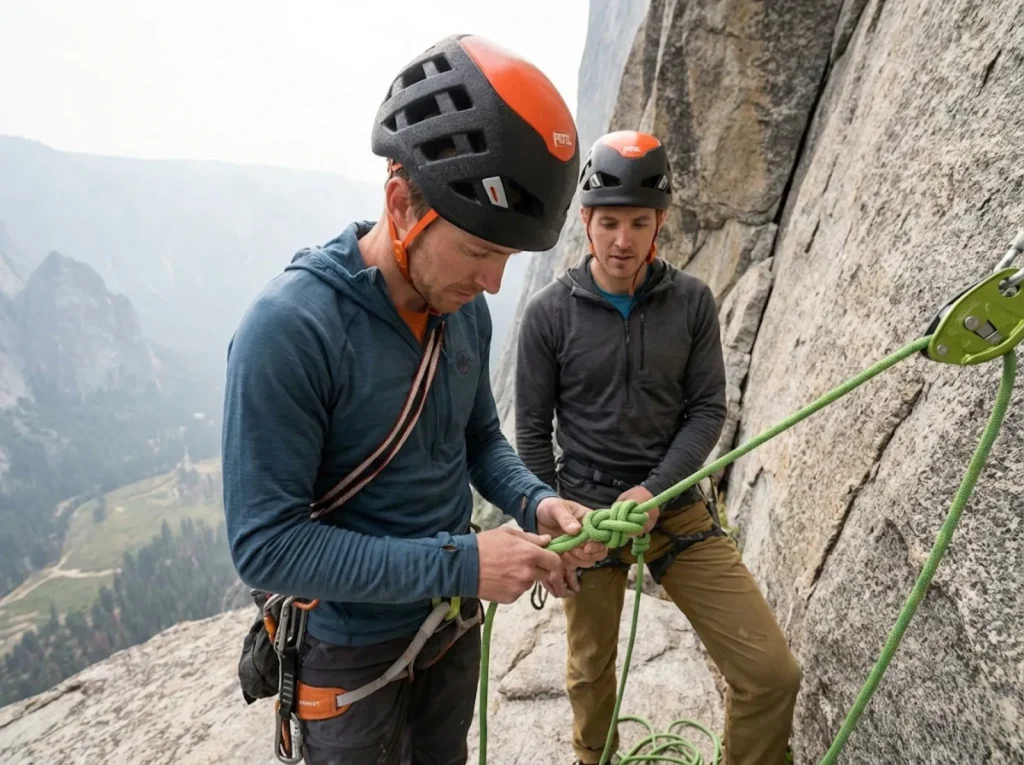
Three pieces of equipment sit at the core of every climbing trip regardless of discipline, weather, or location. These are the items rated to catch your falls, protect your skull, and connect you to the rock. Everything else is secondary.
Helmet: The One Item Nobody Argues About Anymore
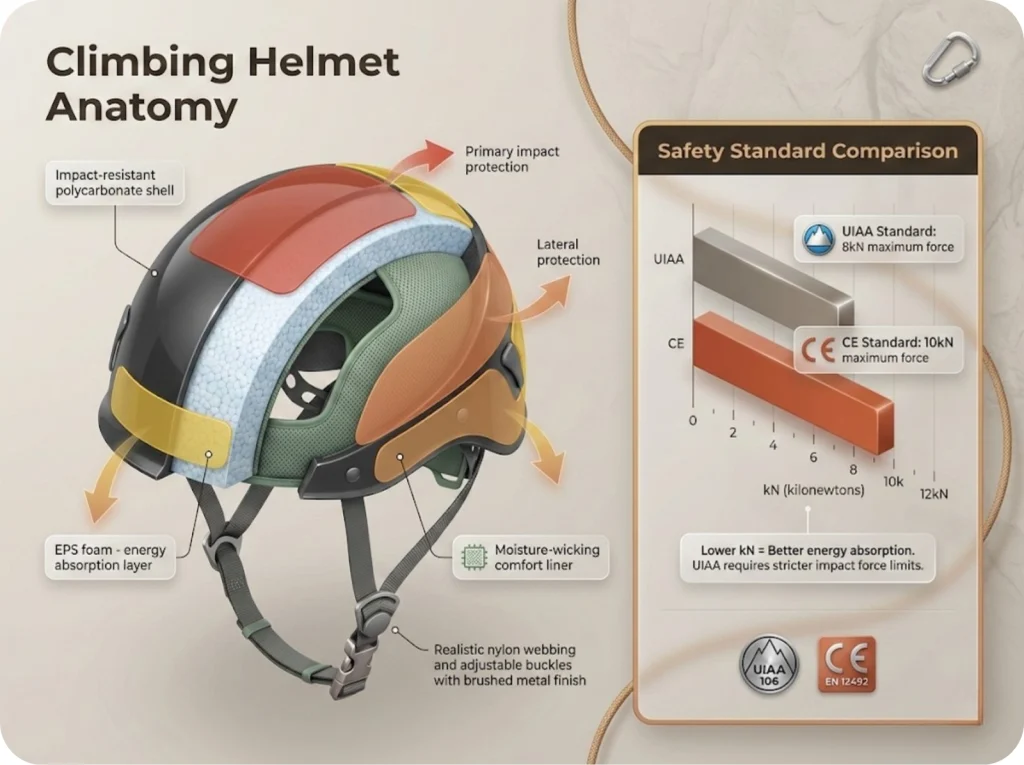
A climbing helmet is no longer optional, and this isn’t a matter of opinion. About 45% of climbing head injuries are concussions, and most happen from leader falls into rock, not from rockfall above. The UIAA Standard 106 caps transmitted force at 8kN, while the CE standard (EN 12492) allows up to 10kN. That gap matters when your head hits granite at speed. Look for the UIAA label—it’s the stricter certification, and UIAA and CE certification differences determine what level of testing your helmet actually passed.
Hybrid construction—EPS foam bonded to a hard shell—gives you the best weight-to-protection ratio for multi-day climbing trips. The real danger most people overlook is borrowing an old helmet. UV-degraded EPS foam doesn’t compress on impact. It shatters. If the liner looks yellowed, that helmet is done.
Harness: Fit It or Forget It
Your climbing harness needs UIAA 105 or EN 12277 certification. Check the tag before every season. The waist belt sits above the iliac crest—that bony ridge on your hips—so the harness locks against your skeleton, not your stomach. A belay loop rated to 15kN minimum handles the forces of a normal lead fall without issue.
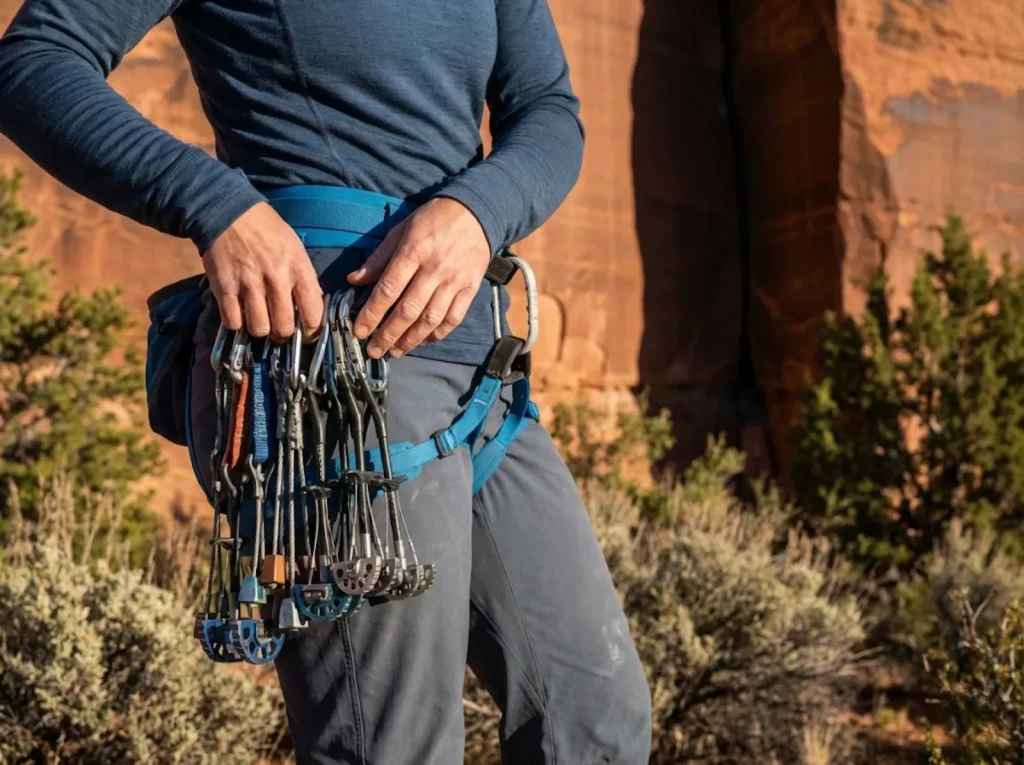
The sport vs. trad debate matters for packing. A sport climbing harness saves 100-200 grams but sacrifices gear loop space. If you’re heading out to place cams and nuts, you need those loops. Make this decision before you pack, not at the trailhead.
Rope: Match Length to Your Objective
A standard climbing rope runs 9.0mm to 10.2mm in diameter, and you need either 60m or 70m depending on the tallest route at your crag. Check the guidebook or Mountain Project before buying. A 60m rope won’t lower you off a 35-meter pitch, and that math is non-negotiable.
Dry treatment is a must for alpine or ice conditions. Wet nylon loses meaningful strength, and frozen nylon won’t run through your belay device properly. For cragging, a rope bag with tarp is your rope’s best friend—quartz grit works its way into the weave and chews through fibers from the inside out. Internal abrasion is the Silent Hazard of ropes most climbers never think about. The UIAA provides detailed safety standards for climbing equipment covering everything from rope testing to helmet impact ratings.
Pro tip: Before every trip, run the full length of your rope through your hands. Feel for flat spots, stiffness, or core shots. A five-minute inspection catches the damage you can’t see by looking.
Discipline-Specific Rack: Sport, Trad, and Bouldering
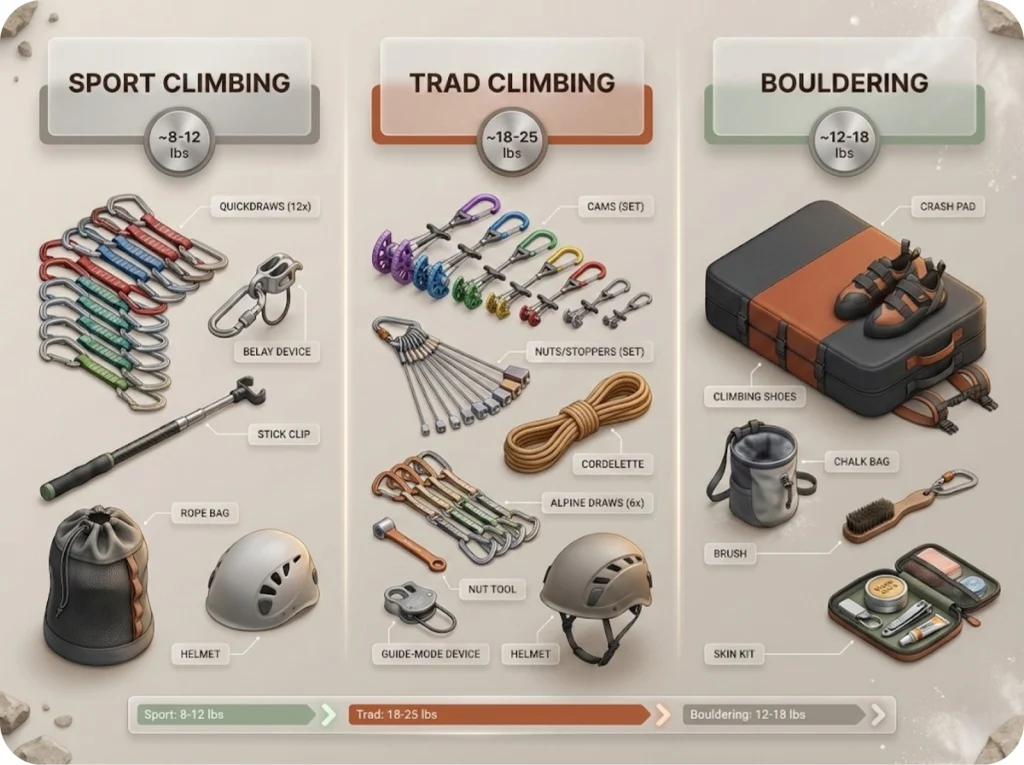
The biggest packing mistake I see is treating every trip the same. A sport climbing day at a single-pitch crag requires a fundamentally different pack than a trad climbing day on splitter cracks or a bouldering trip in a talus field. Here’s where the lists diverge.
Sport Climbing: The Lean Build
Your core sport climbing rack: 12-15 quickdraws (grab a few 60cm slings for wandering routes), a belay device with assisted braking like a Petzl GriGri, two locking carabiners, and a personal anchor system for cleaning anchors. Add a stick clip if your crag has highball first clips—most ground falls happen below the third bolt.
All of this fits in a 40L crag bag with room for your climbing shoes, chalk bag, water, and trail mix. That’s the beauty of sport: the rack is light, the decisions are few, and the packing is fast.
Trad Climbing: The Modular Rack
Trad is where the backpack gets heavy. A base trad rack includes cams from 0.4 to #3 (Black Diamond sizing), a set of nuts, a nut tool, alpine draws, and a cordelette for anchor building. Double up on the sizes your crag demands—check the guidebook before packing blind.
The weight tax is real. A full trad rack adds 8-12 pounds over a sport rack. Racking strategy helps: keep passive pro on your harness gear loops and cams on a gear sling. This distributes weight across your body and builds muscle memory for placements. If you’re new to building a skill-based trad rack, start with a single set of cams and add doubles as you learn which sizes your local rock eats.
Bouldering: Stripped to the Essentials
A bouldering trip is the minimalist’s dream: crash pad, climbing shoes, chalk bag, brush. That’s the gear list. What matters more than any equipment is a spotter who understands fall zone geometry—where the climber will land, not just where they are now.
Bring Thera-Bands for finger and shoulder warm-ups before hard sends. Pack a skin management kit: hand salve (Rhino Skin or Climb On), nail clippers, and brush-on superglue for split tips. Your skin is your most critical tool, and a flapper on day one of a five-day trip changes everything.
Pro tip: Put your crash pad straps down first, pad on top. When you fold it at the end of the day, the straps are already underneath and you don’t waste time fishing them out of the dirt.
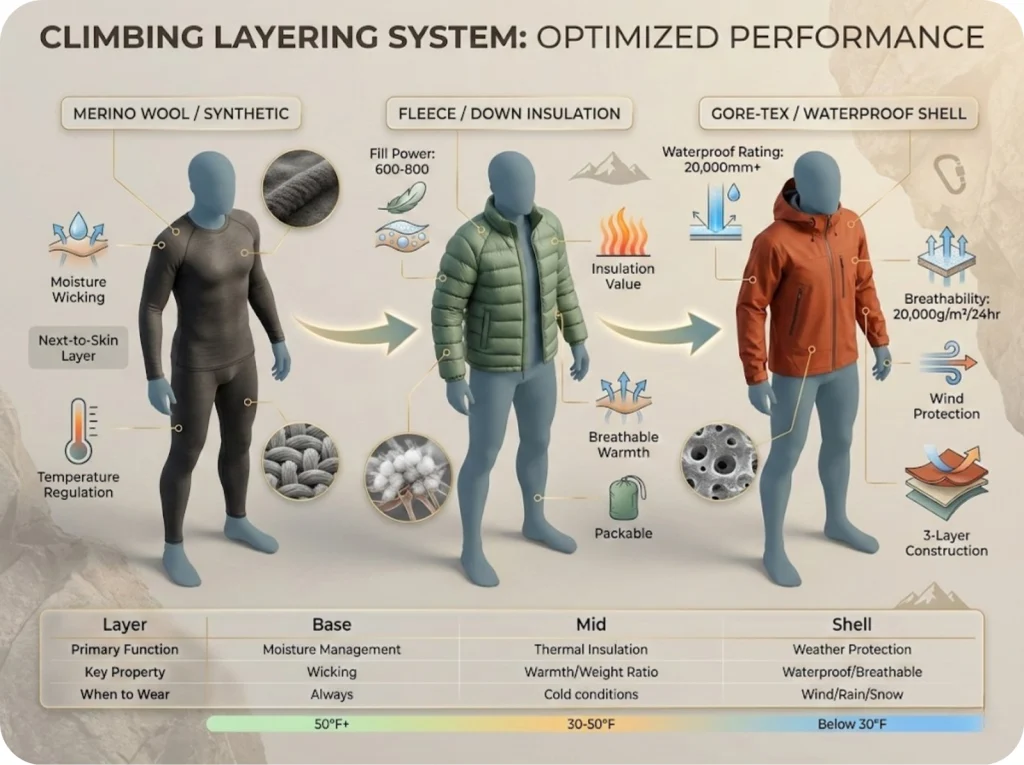
Clothing Systems: The Anti-Cotton Rule and Layering Logic
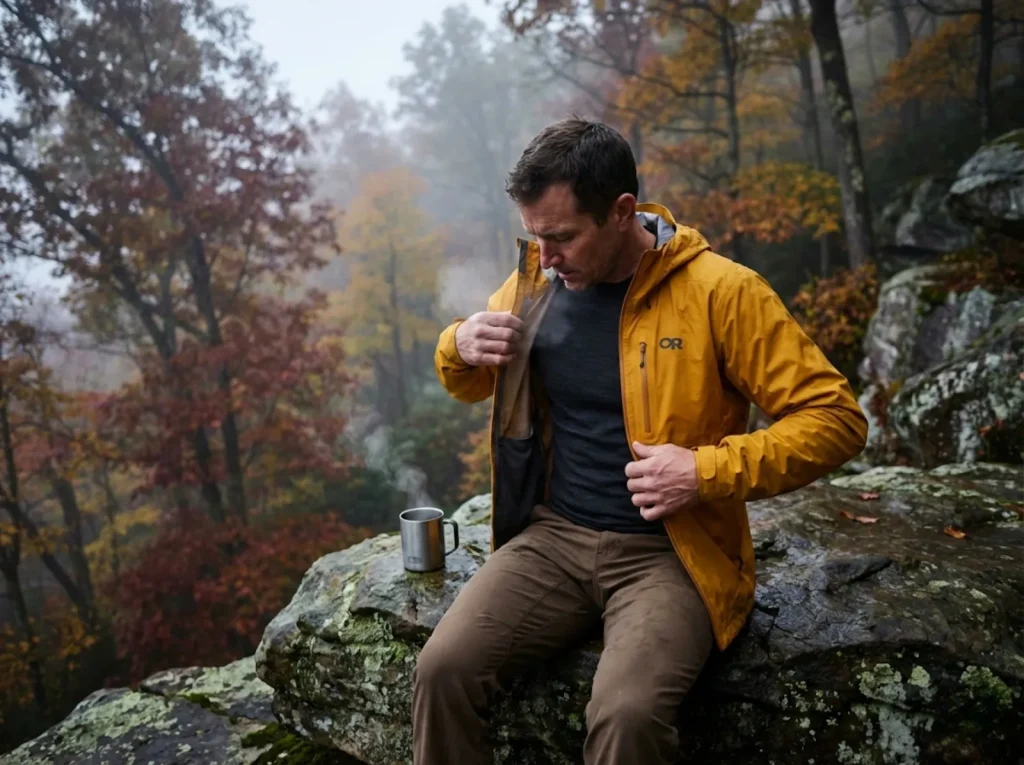
Pack your closet wrong and you’ll end up freezing at a belay stance in October or hauling ten pounds of fabric you never wore. The clothing system is simple once you commit to one rule.
Base Layer: Why cotton is dangerous Climbers
Cotton holds moisture against your skin and conducts heat away from your body. In a climbing context, that means hypothermia risk on any day that turns cold, wet, or windy—which describes most days in the mountains. Merino wool wicks moisture, resists bacterial odor for days, and regulates temperature in both heat and cold. Synthetic base layers dry faster but develop stink after one hard session.
Climbers heading to Red River Gorge in October will tell you: pack merino even when the forecast says 70°F. Appalachian evenings can drop twenty degrees in an hour, and you do not want to be belaying in a damp cotton shirt when that happens.
Mid and Shell Layers: The Weight-to-Warmth Equation
Your puffy jacket choice comes down to conditions. Fleece provides consistent warmth even when damp. Down (800+ fill power) gives you the best warmth-to-weight ratio when dry. A rain shell with a waterproof-breathable membrane blocks wind and precipitation without trapping sweat.
Pay attention to denier rating on your shell. Lighter fabrics (20D) save weight but snag on rock during chimney and crack climbing. Heavier fabrics (40D+) survive the abuse. For warm weather, a lightweight sun hoodie with UPF protection weighs almost nothing and prevents the kind of sun exhaustion that sneaks up on you during long days on exposed multi-pitch routes.
Hands and Feet: The Gear People Forget
Approach shoes with sticky rubber handle the technical scrambles on walk-ins that trail runners can’t. Bring camp shoes—flip flops or sandals—to let your feet breathe after hours in climbing shoes. Belay gloves save your hands for actual climbing during cold-weather sessions or long rappels.
If you’re flying with climbing gear, clip your climbing shoes to your carry-on. If checked luggage gets lost, shoes are the hardest item to rent in the right size at a destination crag. Everything else can be improvised. Shoes can’t.
Pro tip: Before a multi-day trip, break in new approach shoes on a few local hikes. Blisters on the approach turn every step into a negotiation with your feet—and they always win.
Flying with Climbing Gear: The TSA Playbook
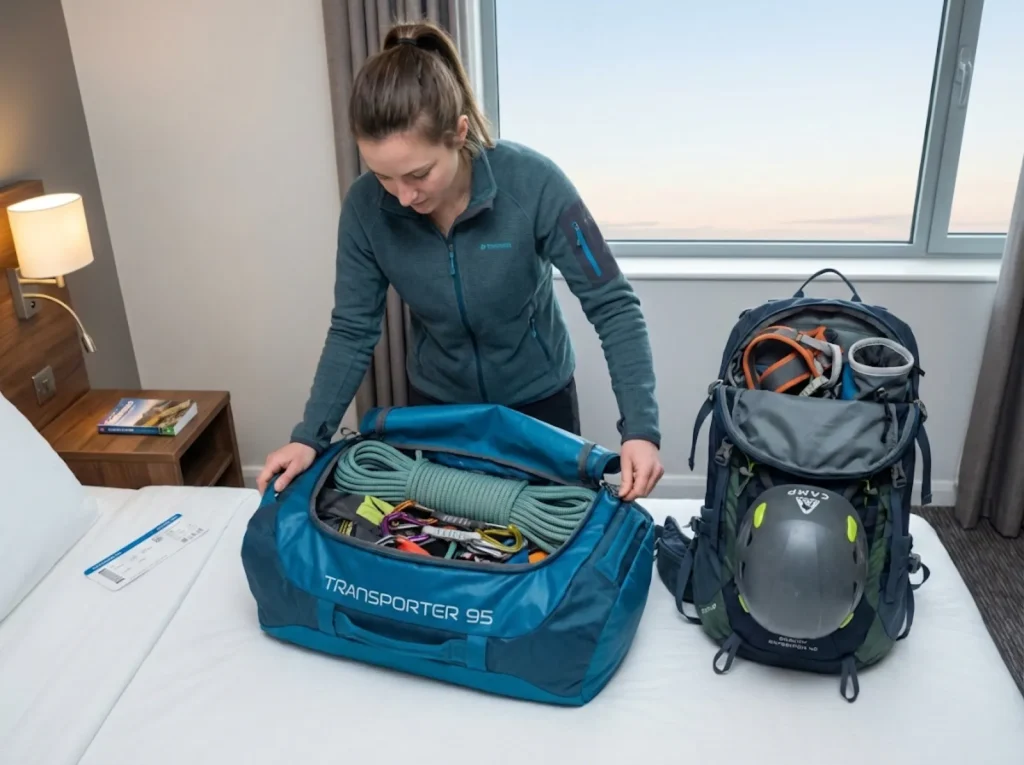
The anxiety of showing up to airport security with a bag full of metal hardware is real. Here’s the breakdown so you don’t lose your ice axe to a TSA bin.
What Goes in Checked Luggage (No Exceptions)
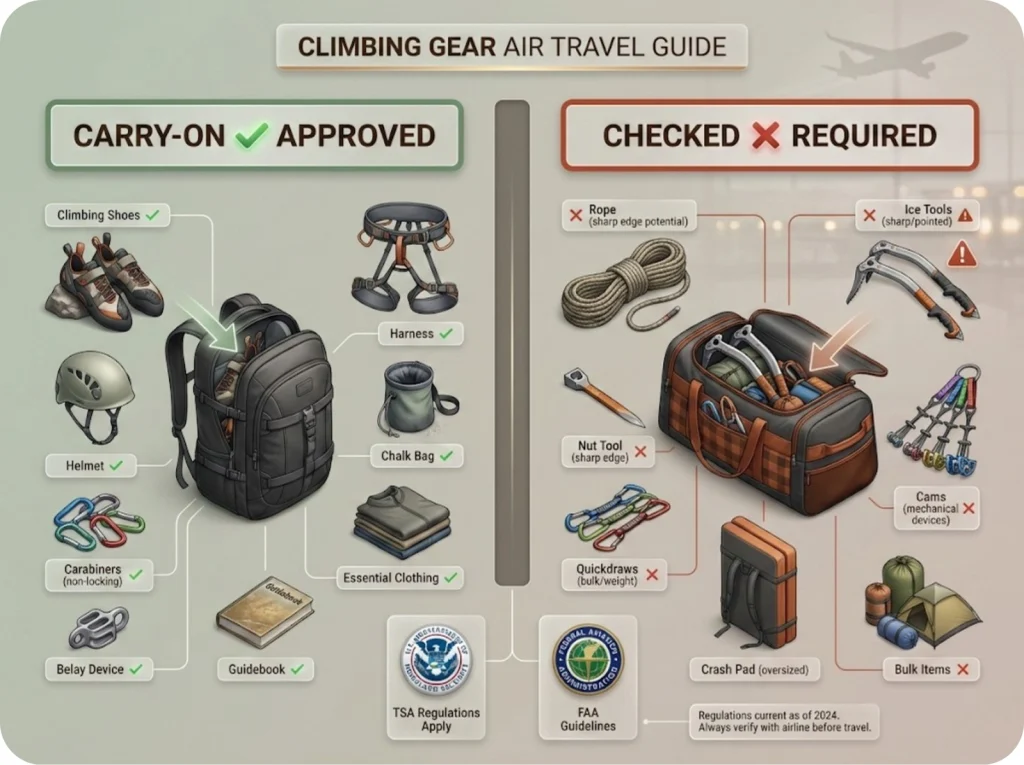
Sharp tools go in checked bags. Period. Ice axes, crampons, and nut tools longer than seven inches are classified as prohibited carry-on items under TSA protocols. Pack hardware—cams, nuts, carabiners—in a stuff sack inside your checked bag to prevent damage and avoid triggering a secondary screening. Ropes travel best in checked bags inside a rope bag or dry sack. Loose ropes look suspicious on an X-ray.
While you’re packing checked gear, run a quick pre-trip gear inspection. Trip prep is the natural moment to audit when to retire aging climbing gear and pull anything that’s seen too many seasons.
What You Can Carry On
Carabiners and quickdraws are permitted in carry-on bags, but pack them organized. A tangled pile of metal triggers manual bag checks. Climbing chalk—magnesium carbonate in powder form—is allowed, but liquid chalk with alcohol content may get flagged. Check the label.
Carry your harness and helmet on the plane. The helmet protects itself, and the harness is too critical to risk with lost luggage.
The Two-Bag Strategy for Climbing Travel
Bag one (carry-on, 40L): shoes, harness, helmet, chalk, essential clothing items, guidebook. Bag two (checked, 60-80L): rope, rack, crash pad if bouldering, camping gear, extra clothing. For international destinations, many climbers ship hardware ahead via UPS or FedEx to clear customs issues and fly with a lighter bag.
Coordinate with your partner using a shared spreadsheet. One rope is enough for single-pitch days. Nobody needs to carry two because nobody bothered to talk about it.
Survival Layer: First Aid, Water, and Food
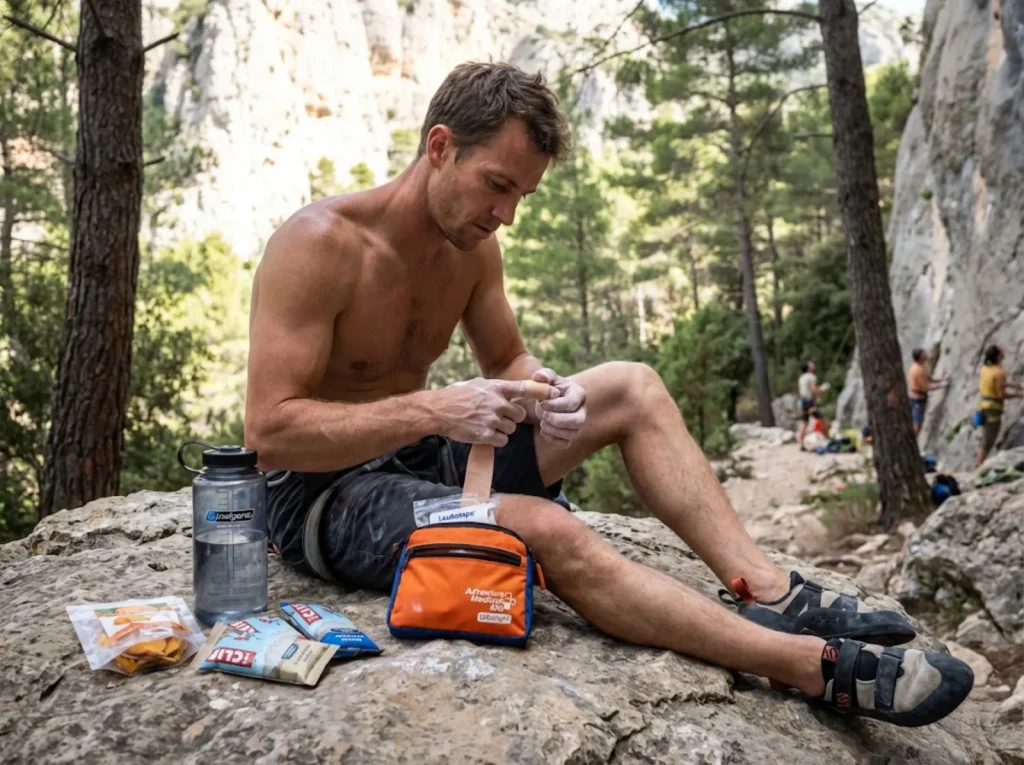
The gear that doesn’t clip to your harness still keeps you climbing. Ignore this section and you’ll bonk by 2 PM, run dry on water by 3, and wish you had tape by 4.
The Crag First Aid Kit (Customized, Not Generic)
Forget the default drugstore kit. A climber’s first aid kit needs athletic tape (Leukotape for skin closures), liquid bandage or brush-on superglue, ibuprofen, antihistamine, and your personal prescriptions. If your crag is more than thirty minutes from a trailhead, add a SAM splint and triangular bandage.
Gear matters less than knowledge here. Wilderness First Responder training multiplies the value of any kit. A bandage without training is just fabric. Guides recommend keeping personal meds—epinephrine, inhalers—on your harness, not buried in the pack at the base. For a full breakdown of what goes into a complete climber’s first aid kit, we’ve covered the specifics elsewhere.
Fueling the Day: Water and Calories
Minimum two liters per person per day. Dehydration impairs grip strength and decision-making before you notice symptoms—and both of those deficits can send you off the wall. Bring a hydration system or Nalgene that clips to the outside of your pack, plus electrolyte packets for hot days.
Crag snacks should be high-calorie and low-bulk: breakfast burritos wrapped in foil, trail mix, energy bars, dried fruit. You’re burning through fuel faster than you think, especially on multi-day trips where cumulative calorie deficit compounds by day three.
Pro tip: Freeze your water bottles the night before. They’ll thaw on the approach and stay cold through the afternoon. On desert crags where shade doesn’t exist, cold water is performance gear.
Navigation and Communication Gear
Don’t rely on cell signal at most crags. Bring a printed or digital guidebook (Rockfax, Mountain Project offline maps) for route finding. For backcountry objectives with no cell coverage, a satellite messenger like the Garmin inReach Mini 2 is worth the weight. And always bring a headlamp with fresh batteries. Rappelling in the dark because you misjudged the day happens more often than anyone admits.
The Packing Method: How to Actually Fit It All
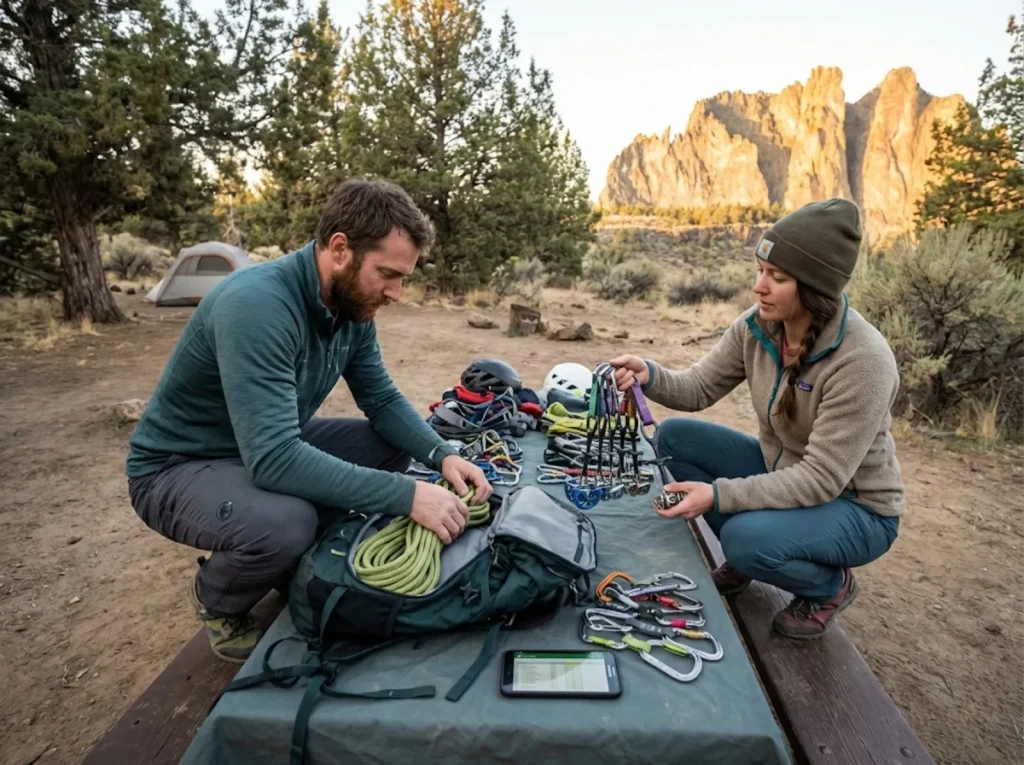
Owning the right gear is half the problem. Knowing how to pack a climbing backpack so it doesn’t destroy your back on the approach is the other half.
Weight Distribution and Pack Loading
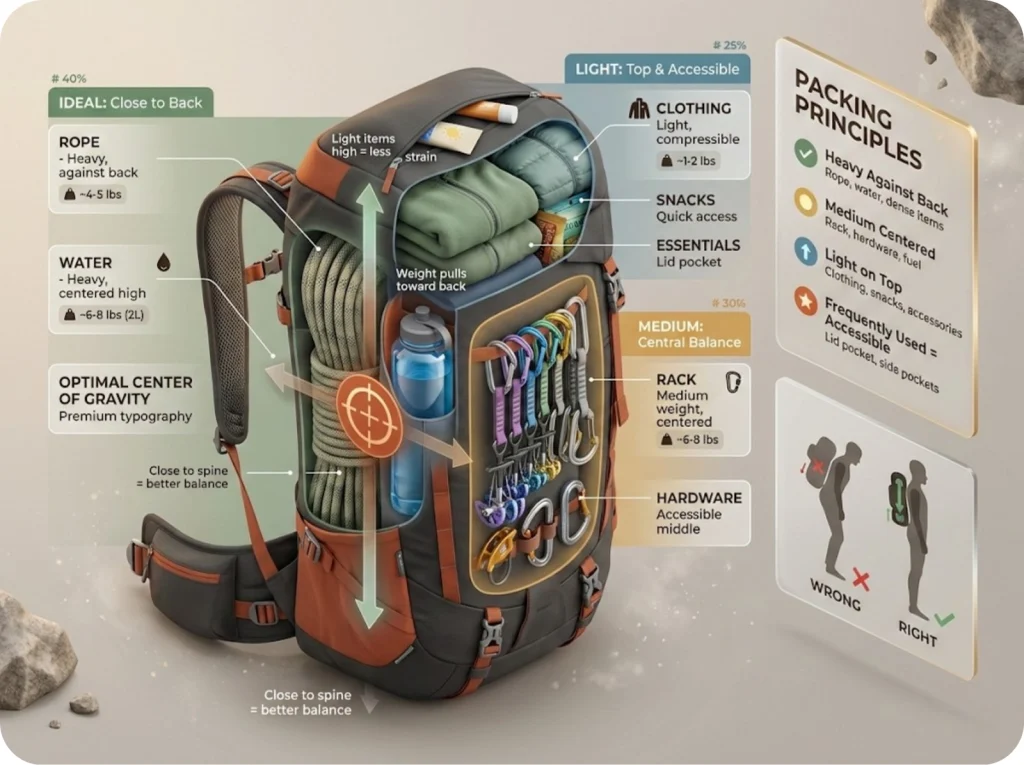
Heavy items—rope, rack, water—go in the center of the pack, close to your spine. Shifting weight outward multiplies the perceived load and throws off your balance on uneven terrain. Never clip water bottles to the exterior. They swing. Compression straps lock the load tight, and a well-compressed 40L bag feels lighter than a loose 50L.
Use a rope tarp as a packing separator: rope on the bottom, rack and clothing layered above, snacks and sunscreen in the lid pocket for quick access. This isn’t fussy organization. It’s the difference between a comfortable half-hour approach and a miserable one.
Partner Coordination: The Shared Gear Spreadsheet
Create a shared Google Sheet or checklist dividing communal gear (rope, rack, first aid) and personal gear (shoes, harness, clothing). Decide in advance who carries the rope on the approach and who carries the rack. For group gear coordination on larger trips, assign one person as the gear quartermaster who cross-references the list forty-eight hours before departure.
One rope is enough for single-pitch days. Carrying two because nobody communicated is the most common weight waste in climbing partnerships. Good partners coordinate. Great partners never skip the double-check.
The “Luxury” vs. “Necessity” Filter
A camp chair, a good pillow, and nail clippers dramatically improve multi-day climbing trip quality without breaking a weight budget. Baby wipes are essential for cleaning feet and maintaining climbing shoe hygiene when showers don’t exist. These aren’t luxuries. They’re the difference between sending on day four and hobbling through it.
For everything else, apply a simple rule: bring it once, track whether you used it. If an item comes home untouched twice, it never goes again. Conrad Anker said it best: “Mountains have a way of dealing with overconfidence.” Pack for the mountain, not for comfort. Practice Leave No Trace ethics for climbers and your light-packing philosophy doubles as environmental stewardship.
Conclusion
Your climbing trip packing list comes down to three principles. Start with the non-negotiables—helmet, harness, and rope—and build outward based on your discipline. Sport, trad, and bouldering each demand a different rack, and packing generically guarantees you’ll carry weight you never use. The “no cotton” rule is real. A proper layering system handles any weather without doubling your pack weight. And talk to your partner before you pack. A shared spreadsheet prevents the two-rope disaster and the forgotten-rack catastrophe.
Pull up the photos from your last trip. Count the items in the background that never left the pack. That’s your cut list. “When preparing to climb a mountain, pack a light heart”—and nothing more.
FAQ
Can I bring climbing chalk on a plane?
Yes. Powdered climbing chalk (magnesium carbonate) is allowed in carry-on bags by the TSA. Liquid chalk containing alcohol may get flagged during screening, so check the label for alcohol content or put it in your checked bag to keep things simple.
How heavy should my climbing pack be for a day at the crag?
For a single-pitch sport climbing day, aim for under thirty pounds total including rope, rack, water, and snacks. Trad racks add eight to twelve pounds of hardware. If your pack exceeds forty pounds for a day trip, you’re likely doubling items or carrying gear you won’t use.
What size backpack do I need for a climbing trip?
A 40L crag bag handles most single-pitch days comfortably—rope, fifteen draws, shoes, snacks. For multi-day trips involving camping, pair a 40L carry-on with a 60-80L checked bag. Bouldering trips need dedicated crash pad hauling with a pad that has built-in shoulder straps.
Do I need different gear for sport climbing vs. trad climbing?
Yes. Sport climbing requires quickdraws (twelve to fifteen), a belay device, and a few locking carabiners. Trad climbing adds cams, nuts, a nut tool, slings, and cordelette for anchor building. The core life-safety climbing gear—helmet, harness, rope, shoes—stays the same for both.
How do I split gear with a climbing partner for a trip?
Use a shared spreadsheet. Divide communal gear (rope, rack, first aid kit) and personal gear (shoes, harness, clothing items) into separate columns. Assign who carries what on the approach. One person brings the rope, the other carries the rack. Confirm the list forty-eight hours before departure so nobody shows up assuming somebody else handled it.
Safety Notice: Rock climbing and mountaineering are inherently high-risk
activities that can involve physical trauma or fatal incidents. The information on Rock Climbing Realms is for
educational and informational purposes only. Techniques and advice presented here are not a substitute
for professional, hands-on instruction. Conditions and risks vary by location. Always seek guidance
from a qualified instructor before attempting new techniques. By using this website, you agree that you
are solely responsible for your own safety. Any reliance you place on this information is strictly
at your own risk, and you assume all liability for your actions. Rock Climbing Realms and its authors
will not be held liable for any harm, damage, or loss sustained in connection with the use of this information.
Affiliate Disclosure: We are a participant in the Amazon Services LLC Associates Program, an
affiliate advertising program designed to provide a means for us to earn advertising fees by advertising and linking
to Amazon.com. As an Amazon Associate, we earn from qualifying purchases. We are also an official affiliate partner
of Black Diamond Equipment via the AvantLink network. If you click on a Black Diamond affiliate link and make a
purchase, we may earn a commission at no additional cost to you. We also participate in other affiliate programs.
Additional terms are found in the terms of service.