
In this article
You’ve read Into Thin Air. You’ve read Touching the Void. Every climber has. But the mountain books that actually change how you see a ridge or read a granite face? Those aren’t about climbing at all. They’re about geology, grief, prayer flags, and the sound of wind through heather — written by people who went into the mountains to pay attention, not to send.
I’ve spent years working through mountain literature across every genre, from expedition memoirs to Japanese haiku, and the pattern is always the same: the books that stick aren’t the ones about summits. They’re the ones about everything else the mountain is doing while you’re focused on the next hold.
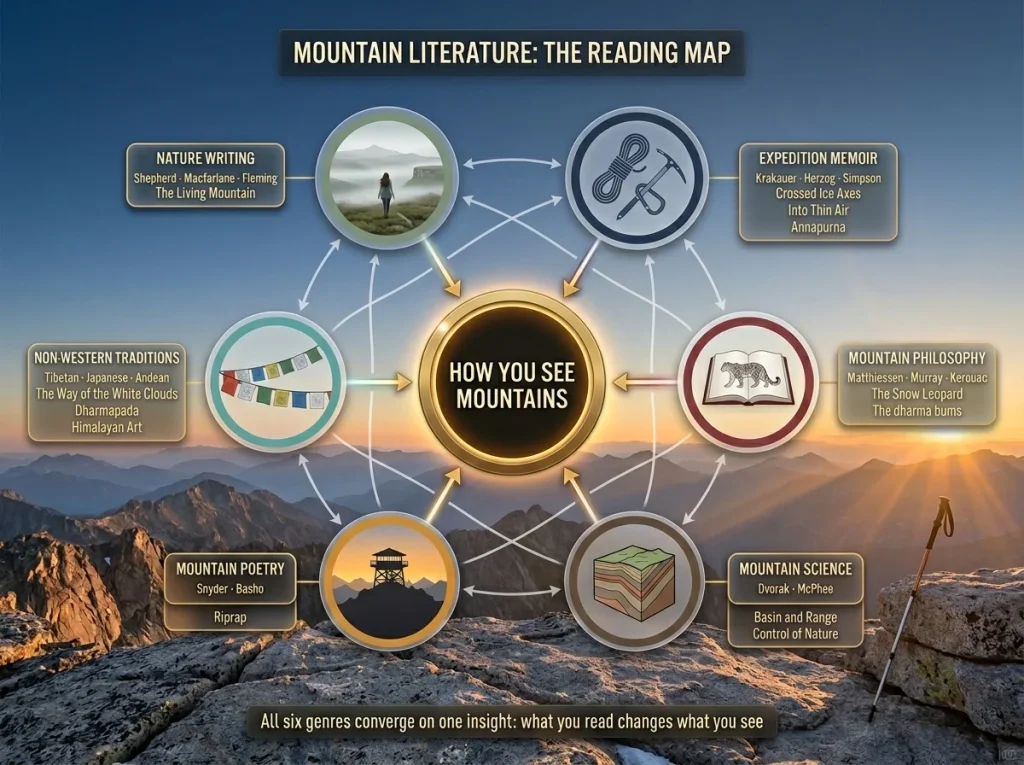
Quick Answer: Mountain literature extends far beyond climbing narratives. The genres that change how climbers see terrain include:
- Nature writing — Nan Shepherd, Robert Macfarlane (terrain as experience, not obstacle)
- Philosophy and memoir — Peter Matthiessen’s The Snow Leopard (grief and mountains)
- Mountain science — geology, ecology, plate tectonics (mountains as 4-billion-year stories)
- Poetry — Gary Snyder, Matsuo Basho (articulating what climbers feel but can’t say)
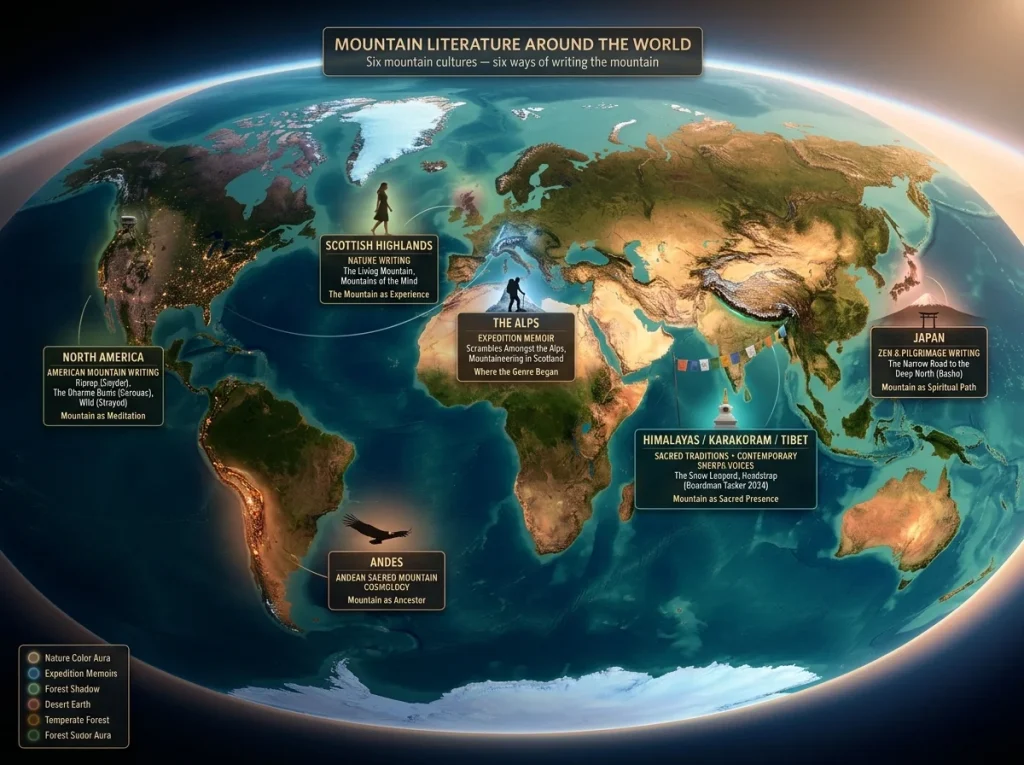
- Non-Western traditions — Tibetan, Japanese, Andean sacred mountain writing
The Four Genres of Mountain Literature (And Why You Only Know One)
The Summit Narrative — Where Most Climbers Stop
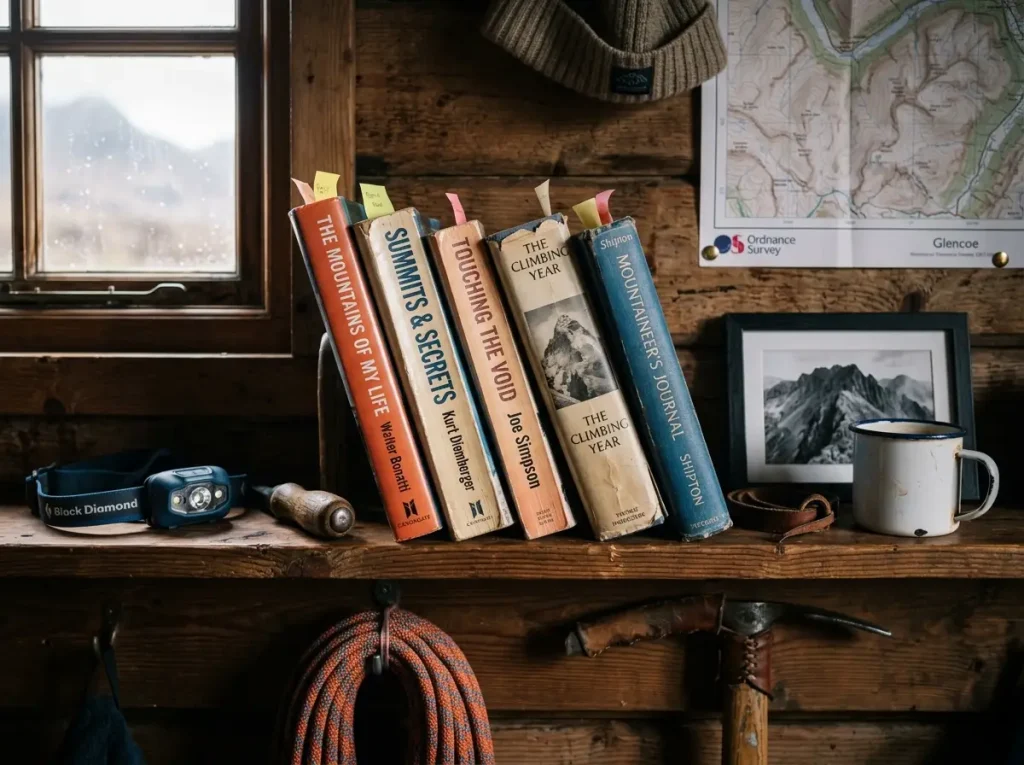
Ask a climber for a mountain book recommendation and you’ll get the same five titles: Into Thin Air, Touching the Void, Annapurna, The White Spider, K2: The Savage Mountain. All expedition narratives. All structured the same way — approach, ascent, disaster, survival. They’re gripping. They’re also a single lane on a four-lane highway.
The summit narrative dominates climbing culture because it mirrors what climbers do: go up, come down, tell the story. If you’ve never ventured beyond this genre, you’re reading mountains the way a tourist reads a city — through the highlights, not the streets. For a broader starting point, check out our full climbing book list.
Nature Writing — The Genre That Changes How You See Terrain
Nature writing treats the mountain as the subject, not the setting. Instead of a human conquering a peak, the peak exists on its own terms — the weather, the rock, the light, the life growing in the cracks. This genre asks you to stop looking for the next hold and start looking at the mountain.
For climbers, this shift is practical. You can’t read Nan Shepherd and then walk through an approach the same way.
The Journey of Self-Discovery
Some mountain books use the physical world as a mirror for internal terrain. The walk is the point, not the summit. Cheryl Strayed’s Wild belongs here, but so do older works like W.H. Murray’s Mountaineering in Scotland — books where the mountain serves as the context for understanding something about yourself you couldn’t see at sea level.
The Guidebook Tradition
The oldest genre and the most overlooked as literature. Early guidebooks read like field journals — observational, precise, opinionated. The best modern guidebooks (think Fred Beckey’s Cascade Alpine Guide series) carry a voice as distinct as any memoir. They’re literature hiding in plain sight.
Nature Writing — Where Mountains Stop Being Scenery
Nan Shepherd and The Living Mountain
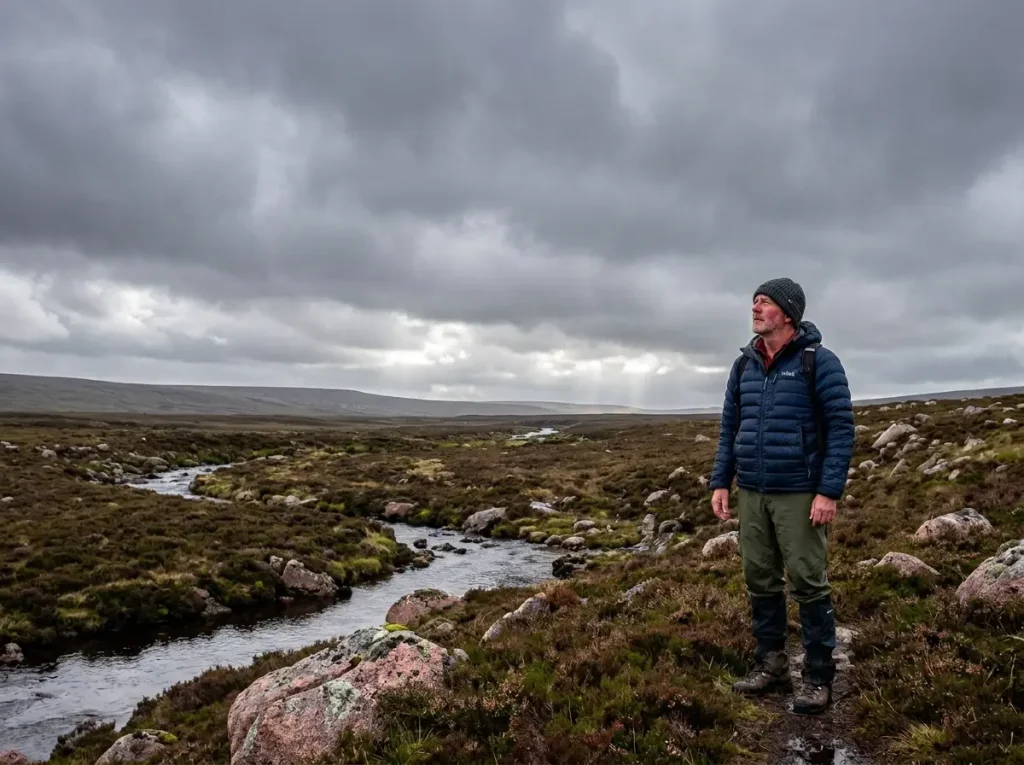
Nan Shepherd wrote The Living Mountain in the 1940s about the Cairngorms in Scotland. Then she put the manuscript in a drawer for thirty years. It wasn’t published until 1977. The Guardian later called it the finest book ever written on nature and landscape in Britain.
The book is 80 pages. You can carry it in a chalk bag. And it will restructure how you experience a mountain more than any training manual. Shepherd doesn’t climb the Cairngorms — she walks into them, through them, around them. She writes about water, frost, light, and the feeling of bare feet on granite. She’s paying attention to what the mountain is doing, not what she’s doing on it.
In 2016, Shepherd’s face was added to the Scottish £5 note. The only nature writer on British currency.
Pro tip: Read The Living Mountain before your next trip to any granite landscape. Take it to the crag. You’ll start noticing feldspar crystals, lichen patterns, and how water moves through cracks — things you walked past a hundred times.
Robert Macfarlane and Mountains of the Mind
Where Shepherd looks at mountains from the inside, Robert Macfarlane looks at them through history. Mountains of the Mind traces how Western culture went from fearing mountains to worshipping them — a shift that started roughly 300 years ago with Romantic poets and explorers. Before that, mountains were wastelands. After, they were cathedrals.
For climbers, Macfarlane’s book explains why you feel what you feel on a summit. That sense of transcendence isn’t natural — it was culturally constructed, and he shows you the blueprints. It’s a Mountain Heritage Trust-recognized work that reshaped how scholars and practitioners think about mountain culture.
Anna Fleming’s Time on Rock
Fleming’s 2022 book was shortlisted for both the Wainwright Nature Prize and the Boardman Tasker Award. Each chapter centers on a different rock type — sandstone, gneiss, limestone — exploring how geology shapes the climber’s experience. It’s nature writing specifically for people who touch rock.
The Disaster Narratives Everyone Reads (And What They Miss)
Into Thin Air, Touching the Void, Annapurna
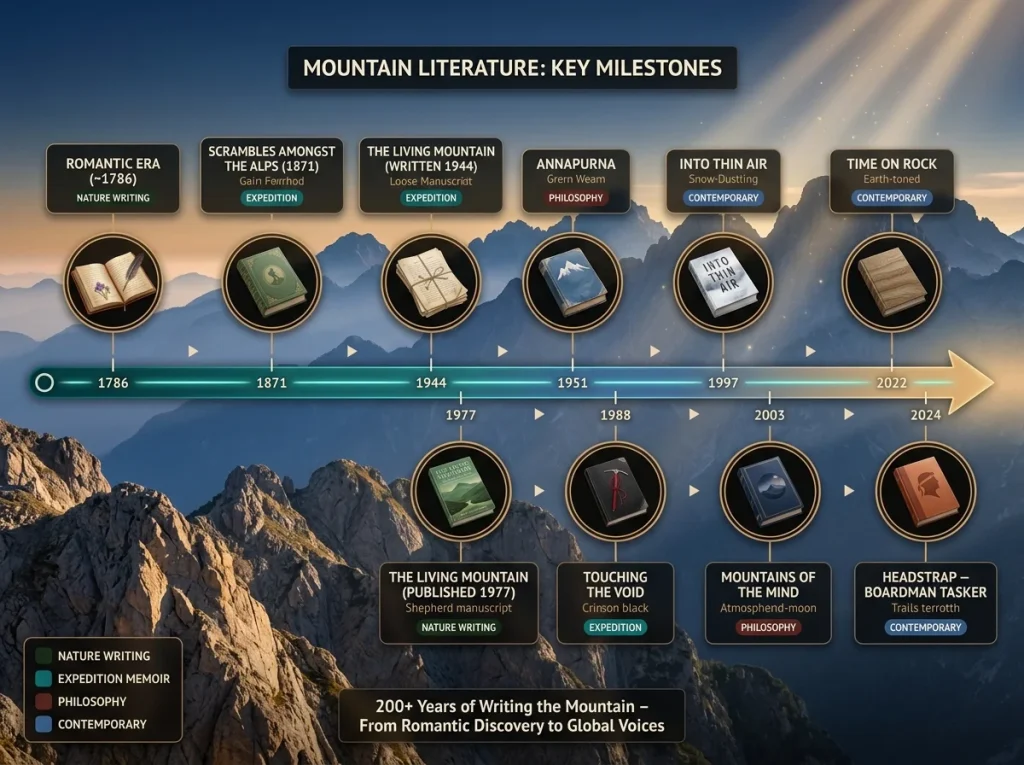
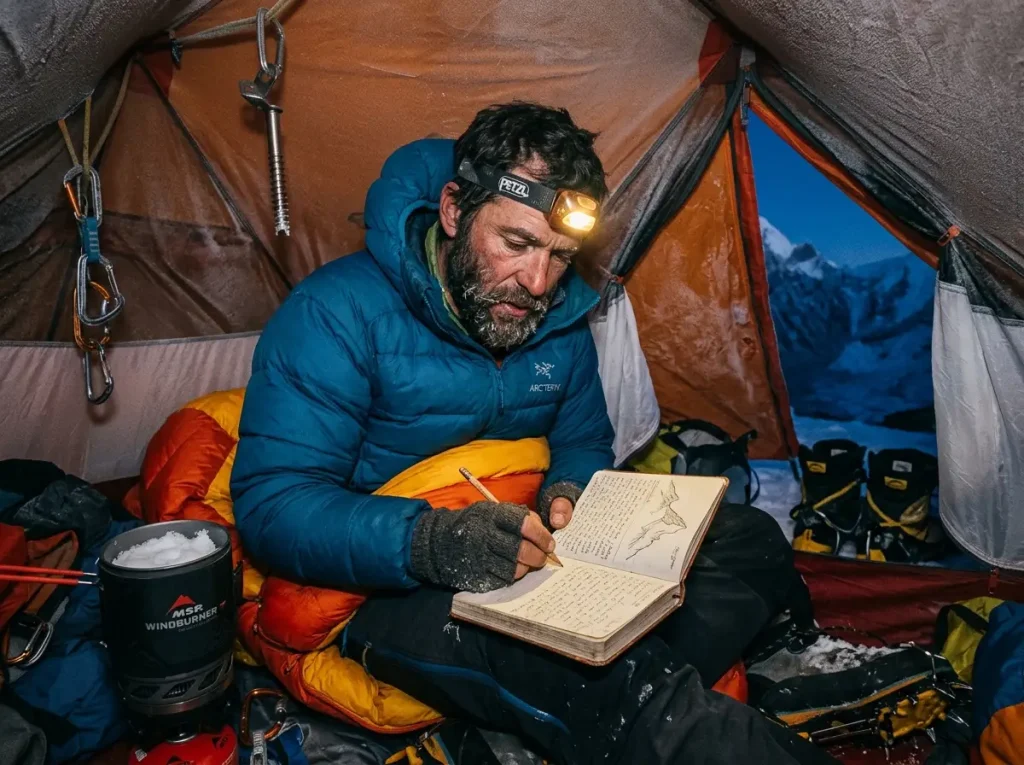
Jon Krakauer’s Into Thin Air (1997) remains the most-read mountaineering book in English. Joe Simpson’s Touching the Void (1988) is arguably the most famous survival story in the genre. Maurice Herzog’s Annapurna (1951) was the first — the original expedition narrative that established the template every book after it follows.
These three deserve their reputations. They’re gateway reads. The problem isn’t the books — it’s stopping at them and thinking you’ve read mountain literature.
The Survival Bias in Mountain Reading Lists
Every “best mountain books” list skews toward disaster. Avalanche, frostbite, amputation, near-miss. The algorithm rewards trauma. But mountain literature built on survival stories alone creates a narrow understanding of what mountains are and what they offer.
The antidote isn’t avoiding disaster narratives. It’s reading them alongside books that present mountains as something other than adversaries. When you toggle between Krakauer’s Everest and Shepherd’s Cairngorms, you start holding both realities at once — mountains as hazard and mountains as home. That dual vision is closer to the truth than either book alone.
What W.H. Murray Wrote on Toilet Paper in a POW Camp
W.H. Murray wrote Mountaineering in Scotland while imprisoned in a German POW camp during World War II. He wrote on the only paper available — toilet paper and the margins of books. The Gestapo found the manuscript during a search and destroyed it. Murray rewrote the entire thing from memory.
The book that survived is lyrical, meditative, and nothing like a disaster narrative. Murray writes about ice climbing in the Scottish Highlands the way a painter describes light. His chapter on a winter traverse of the Cuillin Ridge reads like poetry. If you’ve ever struggled with the mental game of trad climbing, Murray articulates the internal experience better than any modern sports psychology book.
The Philosophical Mountain — Books That Make You Think Differently
Peter Matthiessen’s The Snow Leopard
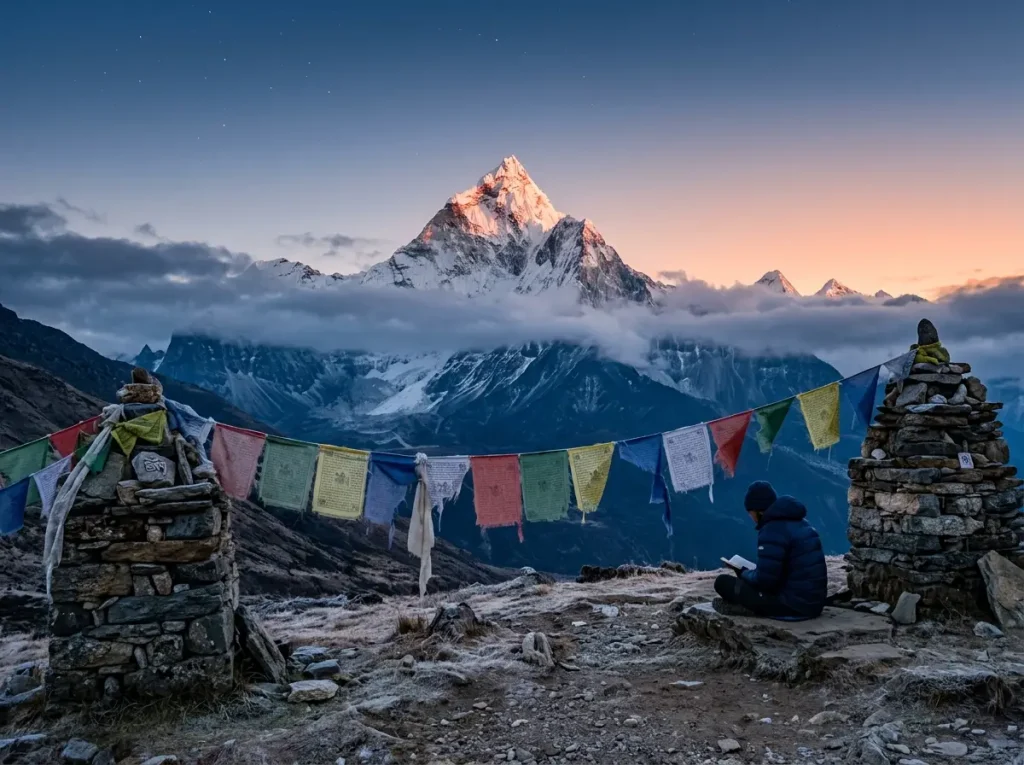
Peter Matthiessen went to the Himalayas in 1973 to study blue sheep and search for the snow leopard. He was also grieving the recent passing of his wife. The Snow Leopard is technically a travel journal. In reality, it’s a meditation on loss, impermanence, and what happens when you stop trying to reach the destination.
The snow leopard barely appears. That’s the point. Matthiessen walks through the Dolpo region of Nepal, encounters Tibetan Buddhist monks, crosses passes above 17,000 feet, and gradually stops looking for the animal. What he finds instead is a way to carry grief without being crushed by it. The book won the National Book Award in 1979.
Pro tip: Don’t read The Snow Leopard as adventure literature. Read it after a loss — a relationship, a project, a season. It lands harder when you bring your own weight to it.
Jack Kerouac’s The Dharma Bums
Not a climbing book. Not a mountain book in the traditional sense. But The Dharma Bums (1958) threads Zen Buddhist philosophy through a story that includes a significant climb of Mount Matterhorn in California’s Sierra Nevada. Kerouac’s character Japhy Ryder (based on poet Gary Snyder) approaches mountains as spiritual practice, not athletic achievement.
The book is sloppy, energetic, and sincere — the opposite of polished expedition prose. For climbers tired of performance-focused writing, it offers a radically different lens: climbing as one element of a larger practice of attention and presence.
Why Grief and Mountains Keep Showing Up Together
This isn’t accidental. Mountains strip context. At altitude, your job title, your inbox, your commute — none of it registers. What remains is whatever you’ve been avoiding. That’s why so many of the strongest mountain books orbit around loss. The mountain doesn’t fix anything. It just creates the conditions where you can finally look at it.
If you’ve noticed that managing fear and anxiety while climbing has less to do with technique and more to do with what you’re carrying emotionally, mountain philosophy literature will make that connection explicit.
Mountain Poetry and Fiction Nobody Recommends
The Poets Who Wrote Mountains Best
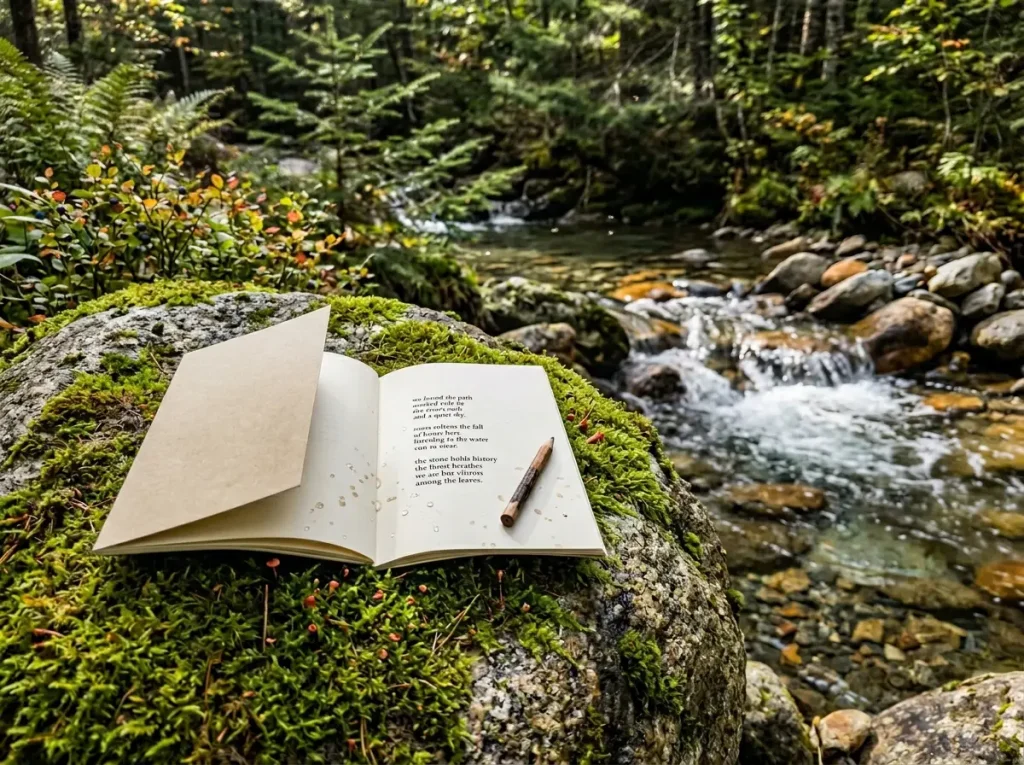
Gary Snyder spent years in a fire lookout in the North Cascades, meditating and writing poems about ridges, snow, and silence. His collection Riprap (1959) reads like a field journal set to meter — short, precise, and unmistakably written by someone who lived in the mountains rather than visited them.
Centuries earlier, Matsuo Basho walked through the mountains of northern Japan writing haiku that compressed entire landscapes into seventeen syllables. His travel narrative The Narrow Road to the Deep North (1689) blends hiking, poetry, and spiritual practice in ways that feel eerily modern. If you’re curious about climbing culture in Japan, Basho is the literary ancestor of everything that tradition values about mountains.
Most climbers never touch poetry. That’s a loss. Poetry articulates what climbers feel on rock but can’t express in prose — the compression of time during a hard sequence, the quality of silence on a summit, the specific blue of alpenglow.
Mountain Fiction Beyond the Thriller
Mountain fiction tends toward the thriller — espionage set on the Eiger, survival drama on K2. But quieter fiction exists. James Ramsey Ullman’s Banner in the Sky (1954) is a young adult novel based on the first ascent of the Matterhorn, written with more emotional honesty about ambition and loss than most adult expedition memoirs.
Michelle Paver’s Thin Air (2016) is a ghost story set on a 1935 Kanchenjunga expedition. It’s historically meticulous, atmospherically suffocating, and says more about the mountain’s indifference to human ambition than most nonfiction.
The Ascent of Rum Doodle — Satire as Mountain Literature
W.E. Bowman’s The Ascent of Rum Doodle (1956) is the funniest mountain book ever written. A pitch-perfect parody of expedition narratives, it follows a hopelessly incompetent team up a fictional 40,000-foot peak. The humor works because it comes from genuine knowledge — Bowman clearly read every earnest expedition account published before 1956 and identified exactly what made them ridiculous.
Pro tip: Read Rum Doodle after finishing any serious expedition memoir. The contrast is the best literary palate cleanser in the genre.
Mountains Through Science and Other Cultures
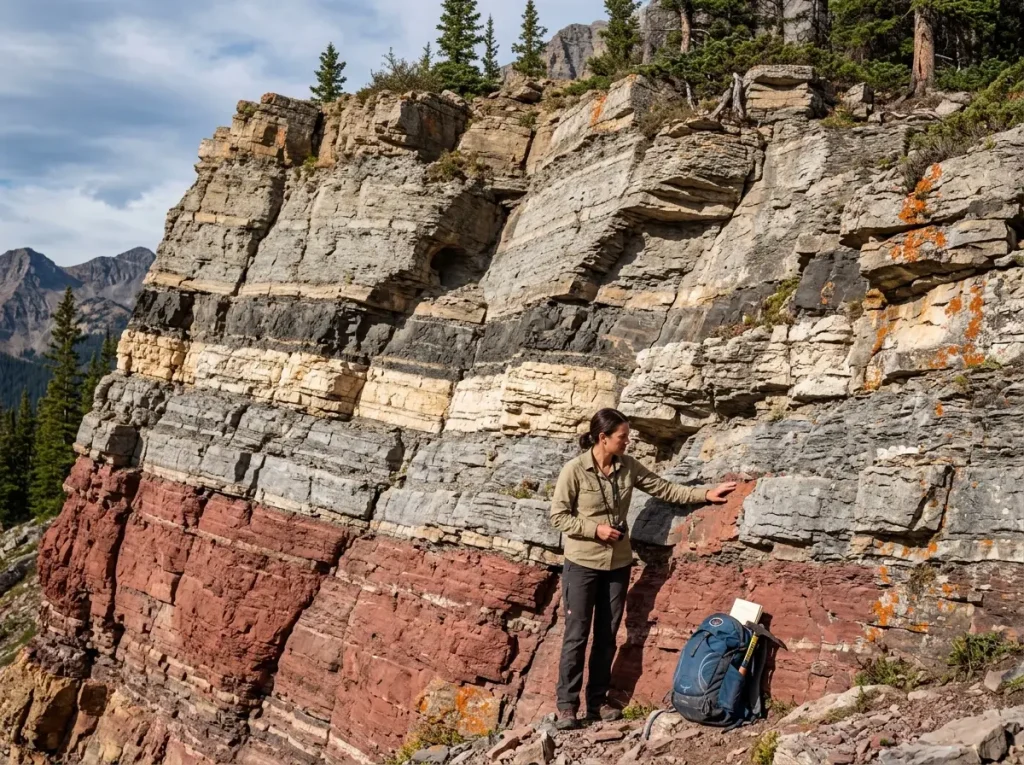
Mountains as a 4-Billion-Year Story
Most mountain books treat peaks as fixed objects — things to climb, photograph, write about. John Dvorak’s How the Mountains Grew (2021) treats North American mountains as a geological narrative stretching back billions of years. The Appalachians were once taller than the Himalayas. The Rockies rose, eroded, and rose again. Mountains move. They’re just slow.
John McPhee’s Basin and Range (1981) does something similar for the geology of the American West. McPhee makes plate tectonics read like a thriller — the collision of continents, the folding of ocean floors into mountain ranges. After reading either book, you’ll look at a cliff band and see time instead of rock.
Sacred Mountains — Tibetan, Japanese, Andean Traditions
Western mountain literature centers the human experience: we go to the mountain. In Tibetan, Japanese, and Andean traditions, the relationship is reversed. The mountain is a presence. You approach it with permission, not a summit plan.
Mount Kailash in Tibet remains unclimbed — not because it’s technically hard, but because climbing it would be an act of disrespect. In Japan, mountains like Fuji and Haguro carry Shinto and Buddhist significance that predates recreational climbing by centuries. Basho’s travel narratives move through these sacred landscapes with a reverence that Western expedition writing rarely achieves.
The Sherpa Perspective — Headstrap and Beyond
The 2024 Boardman Tasker Prize for Mountain Literature went to Headstrap by Nandini Purandare and Deepa Balsavar — a book about Sherpa porters in the Himalayas. The title refers to the headstrap used to carry massive loads. It’s a perspective almost entirely absent from Western mountain literature, where Sherpas appear as supporting characters in someone else’s summit story.
This win signals a shift in what counts as mountain literature. The genre is expanding beyond Western expedition narratives to include the people who live in mountains year-round — not as guides for visiting climbers, but as the primary subjects of their own stories.
How Reading Changes How You Climb
Seeing Rock Differently After Nan Shepherd
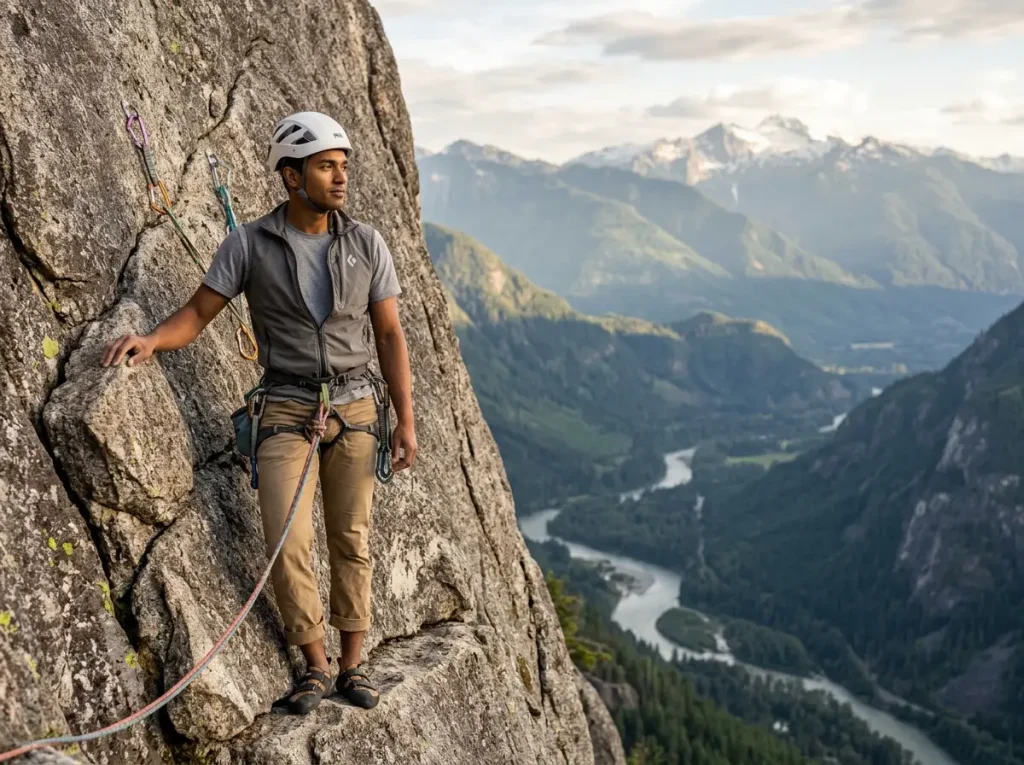
Here’s the practical payoff. Climbers who read nature writing develop what Shepherd calls “knowing” — a heightened attention to the physical world that operates below conscious analysis. You start reading the mountain instead of just reading the route.
On approach hikes, you notice how water shaped the cliff band you’re about to climb. On the wall, you register rock type — the difference between granite friction and limestone pockets — not just as a technique problem but as a geological story. That expanded attention doesn’t make you climb harder grades. It makes you understand what you’re climbing on.
Why Disaster Narratives Make You a Better Decision-Maker
The disaster genre’s other benefit is risk literacy. Krakauer’s Into Thin Air isn’t just a gripping read — it’s a case study in summit fever, sunk cost fallacy, and how experienced people make lethal decisions under pressure. Read enough expedition accounts and you start recognizing the decision patterns before they become catastrophic.
The best disaster narratives teach climbers to think in probabilities rather than certainties. That’s a productive rainy day activity that pays off when the weather gets real on a multi-pitch.
Building Your Mountain Library Beyond the Usual Lists
Start with what you haven’t tried. If you’ve only read memoirs, pick up Nan Shepherd. If you’ve never read mountain science, try Dvorak or McPhee. If poetry intimidates you, start with Gary Snyder — his poems are short, concrete, and written by someone who smelled like campfire smoke.
The rotation matters. Reading only disaster narratives creates a skewed relationship with mountains. Reading only nature writing creates a passive one. The full range — memoir, philosophy, science, poetry, fiction — builds a layered understanding that makes you both a safer and more present climber.
Conclusion
Mountain literature is broader, stranger, and more useful than the five expedition memoirs that fill every climber’s bookshelf. Nature writing changes how you see terrain. Philosophy changes how you carry risk and loss. Science reveals the timescale your routes exist on. Poetry gives you language for the things climbing makes you feel but can’t articulate.
The gap between Jon Krakauer and Nan Shepherd is the gap between watching a mountain and being in one. Both perspectives belong in your pack. If you only carry one kind, you’re missing the mountain for the summit.
Pick one book from a genre you’ve never tried — nature writing if you only read memoirs, poetry if you only read prose. Take it to the crag. Read it on a ledge between burns. The mountain you’re climbing will look different by the time you close the cover.
Q1 What is the best book about mountain climbing?
Into Thin Air by Jon Krakauer remains the most widely read climbing book, but best depends on what you want. For survival narrative, read Touching the Void. For nature writing, The Living Mountain. For philosophy, The Snow Leopard. The genre is far broader than expedition memoirs.
Q2 What is mountain literature?
Mountain literature encompasses four main genres: mountaineering memoir, nature writing, the journey of self-discovery, and the guidebook tradition. All trace back roughly 200 years to Romanticism. The field includes fiction, poetry, science writing, and philosophy alongside climbing narratives.
Q3 What is the most famous mountaineering book ever written?
Annapurna by Maurice Herzog (1951) is widely considered the original expedition narrative — the template every mountaineering book after it follows. Into Thin Air (1997) is the most commercially successful. Both are starting points, not endpoints.
Q4 Are there good fiction books set in the mountains?
Banner in the Sky by James Ramsey Ullman, Thin Air by Michelle Paver, and The Ascent of Rum Doodle by W.E. Bowman cover young adult adventure, supernatural horror, and satire respectively. Mountain fiction extends well beyond expedition thrillers.
Q5 What should I read if I like Into Thin Air?
Start with Touching the Void (survival), then move to The Snow Leopard (philosophy), then The Living Mountain (nature writing). That three-book path takes you from disaster narrative through spiritual quest to pure landscape observation — each step expanding what mountain book means.
Safety Notice: Rock climbing and mountaineering are inherently high-risk
activities that can involve physical trauma or fatal incidents. The information on Rock Climbing Realms is for
educational and informational purposes only. Techniques and advice presented here are not a substitute
for professional, hands-on instruction. Conditions and risks vary by location. Always seek guidance
from a qualified instructor before attempting new techniques. By using this website, you agree that you
are solely responsible for your own safety. Any reliance you place on this information is strictly
at your own risk, and you assume all liability for your actions. Rock Climbing Realms and its authors
will not be held liable for any harm, damage, or loss sustained in connection with the use of this information.
Affiliate Disclosure: We are a participant in the Amazon Services LLC Associates Program, an
affiliate advertising program designed to provide a means for us to earn advertising fees by advertising and linking
to Amazon.com. As an Amazon Associate, we earn from qualifying purchases. We are also an official affiliate partner
of Black Diamond Equipment via the AvantLink network. If you click on a Black Diamond affiliate link and make a
purchase, we may earn a commission at no additional cost to you. We also participate in other affiliate programs.
Additional terms are found in the terms of service.