
In this article
If you climb four days a week, hangboard twice, and spend Sunday projecting, you’re probably also sleeping six hours a night and calling that fine. It isn’t fine. The training you’re doing is building the capacity for improvement; the sleep you’re skipping is where the improvement actually happens. Those are different things, and you can’t separate them.
Most climbers treat sleep as what happens when training ends. The research says it’s part of training — arguably the part with the highest return on investment of anything you’re doing. Finger strength, movement pattern storage, route reading recall, grip endurance, and decision-making under fatigue all degrade measurably with sleep loss. They all improve with deliberate sleep optimization. This isn’t motivational framing. It’s physiology.
This guide explains what happens to your climbing during sleep, which habits actually move the needle, and how to build a sleep approach that fits around real climbing schedules — including crag camping, multi-pitch trips, and the perpetual problem of the 5 a.m. alpine start.
Quick Answer: Here’s how to optimize sleep for climbing performance:
- Target 8–9 hours on training nights; never sacrifice sleep for more training volume
- Keep a consistent wake time even on rest days — it anchors your sleep cycle
- Drop room temperature to 65–68°F (18–20°C) before bed
- Eliminate screens for 60 minutes before sleep or use blue-light filters
- Time your hard training sessions to end at least 4 hours before bed
- On climbing trip nights, protect sleep duration even at the cost of campsite logistics
- Use 20-minute naps strategically after multi-day trips, not as a substitute for nights
What Sleep Deprivation Does to Your Climbing
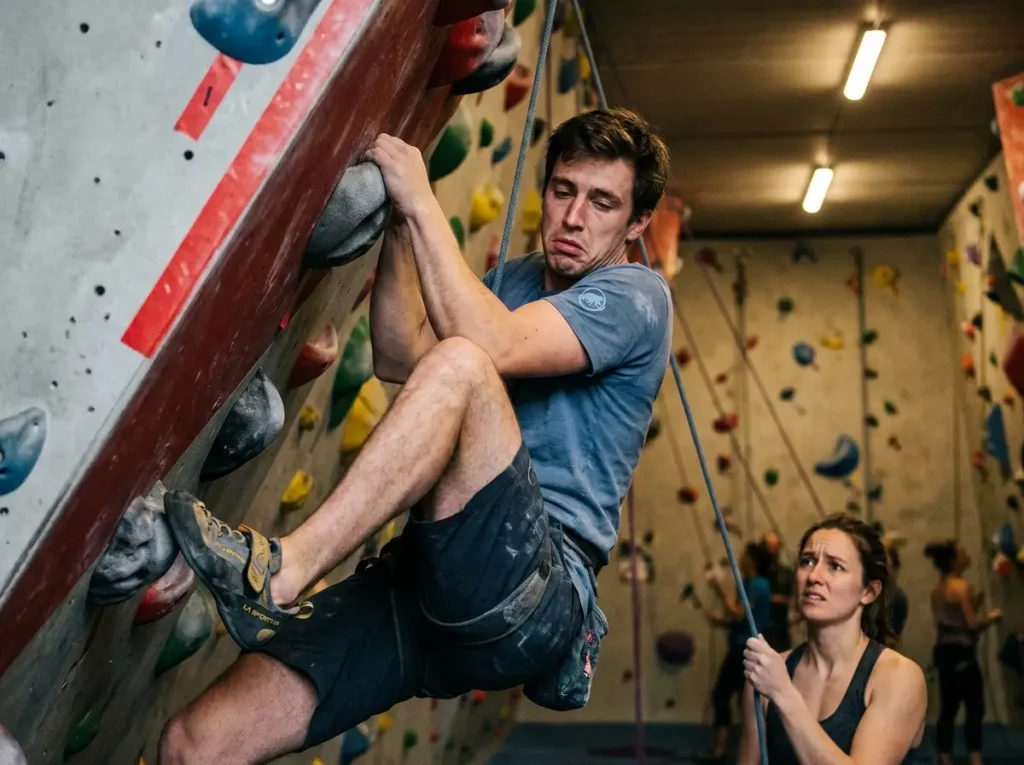
The effects of poor sleep show up in climbing before most climbers notice them, because the first things to go are the higher-order functions — decision-making, pattern recognition, and precise motor control — exactly the things that separate climbers who read routes well from climbers who fight their way up.
Grip strength, finger endurance, and reaction time
A 2019 review published in the British Journal of Sports Medicine — and supported by NIH research on sleep hygiene for athletes — found that just one night of partial sleep restriction (below 6 hours) reduced grip endurance by an average of 8% in trained athletes. For climbing, grip endurance is everything — it’s the buffer between sending a route and falling off three moves from the anchor. An 8% reduction in endurance is the difference between sending your project and not getting close.
Reaction time matters in lead climbing in ways that don’t get discussed enough. The difference between catching a clip in flow and fumbling it — between reading a foot smear as stable and missing the shift — is measured in hundreds of milliseconds. Sleep-restricted athletes show reaction time degradation comparable to mild intoxication. That’s the state many gym climbers are in for their after-work sessions.
Motor learning and route reading
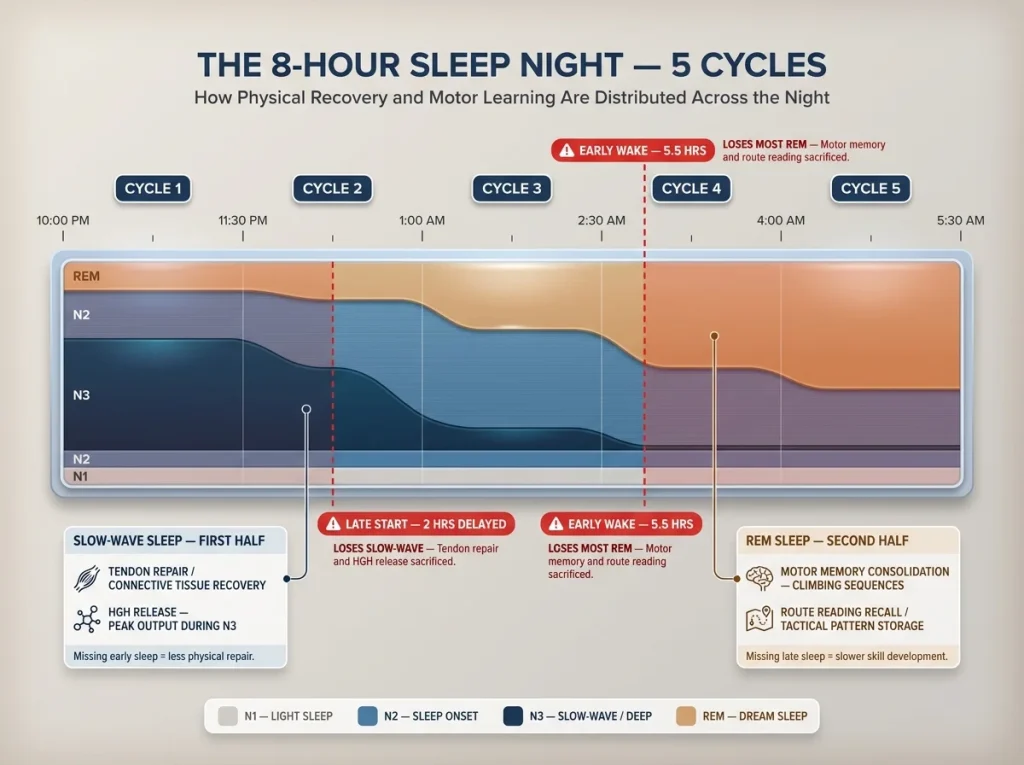
This is where sleep science intersects with climbing training in the most specific way. Motor sequences practiced during a climbing session are consolidated into long-term motor memory during sleep — specifically during the slow-wave and REM stages that dominate the second half of a full night. When you fall off a crux move repeatedly and then rest, the rest period is where your nervous system files the motor pattern correctly. Without adequate sleep following a training session, that consolidation is incomplete.
The practical implication: the session where you nearly figured out a crux sequence, climbed six reps of it, and then went home and slept five hours delivered less than half the motor learning benefit it could have. You felt like you trained. Your nervous system filed the work as incomplete.
The Sleep Stages That Matter Most for Climbers
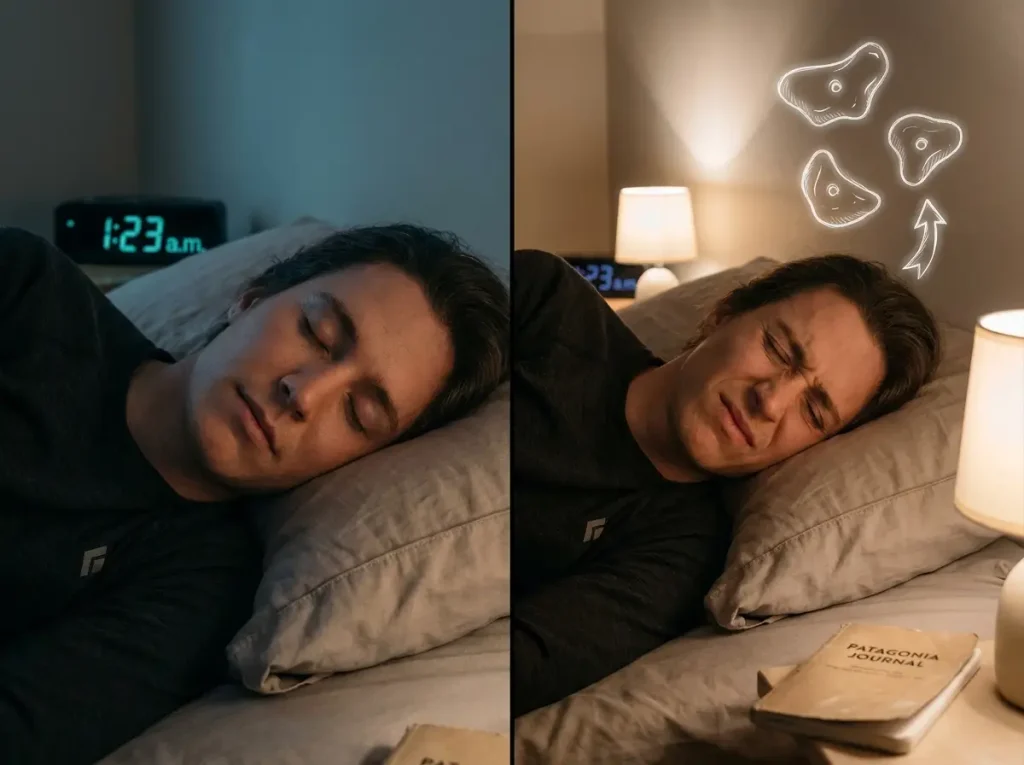
Not all sleep is equal. Understanding the structure of a sleep cycle helps you make better decisions about sleep timing, napping, and the real cost of a short night.
Slow-wave sleep: physical recovery
Deep slow-wave sleep (stages N2 and N3) dominates the first half of the night and is where most physical recovery happens. Human growth hormone is primarily released during slow-wave sleep. Muscle tissue repairs and rebuilds. Connective tissue — including the tendons and pulleys that take the most abuse in climbing training — undergoes the repair processes that reduce injury accumulation. A night that ends early (say, 5.5 hours instead of 8) cuts disproportionately into the REM-rich second half, but a night that starts 2 hours late cuts into slow-wave time first. Both are costly, in different ways.
REM sleep: the motor and cognitive upgrade
REM sleep dominates the second half of a full night and is where motor pattern consolidation and cognitive restoration happen. Climbers who spend significant time on REM-rich sleep show faster skill acquisition on new movement problems and better route reading — the ability to look at a sequence and accurately predict where the move will feel hard — because REM sleep strengthens the neural patterns that underlie spatial and tactical problem-solving.
This is why the climber who sleeps 5 hours and trains the same volume as the climber who sleeps 8 hours will develop more slowly even when their on-wall time is identical. The training stimulus is similar; the processing and consolidation are not.
Pro tip: If you wake up groggy no matter how long you sleep, you may be waking in the middle of a sleep cycle. Sleep cycles run approximately 90 minutes. Targeting total sleep time in 90-minute increments — 7.5 hours or 9 hours rather than 8 or 8.5 — sometimes reduces morning grogginess by aligning your wake time with a natural cycle transition rather than the middle of deep sleep.
How Much Sleep Do Climbers Actually Need
The answer is more than most climbers get and slightly more than the general adult recommendation.
The 8-hour floor, and why 9 is better on training days
The baseline for most adults is 7–8 hours. For training athletes — people who are actively stressing their musculoskeletal system and demanding motor learning — the research consistently shows performance benefits at 8–9 hours compared to 7. Elite climbers like Adam Ondra have been public about treating sleep as a training variable with the same seriousness as hangboard sessions. That’s not hyperbole. It’s an evidence-based training approach.
On days following hard training — a projecting session, a hangboard workout, or a long multi-pitch — sleep needs often increase. Your system has more repair work to complete. Allowing an extra 30–45 minutes of sleep on post-training nights, rather than forcing a fixed wake time, captures a meaningful amount of that additional recovery.
The debt problem
Sleep debt is real and partially non-recoverable in the short term. Two consecutive nights of 6-hour sleep leave a deficit that one 9-hour night doesn’t fully repay. The practical implication for climbing trips: a week of crag camping with 6-hour nights doesn’t get erased by a long Sunday sleep. It shows up as degraded performance during the trip itself, and as a recovery lag in the weeks after. For our deep dive on how to build the training base that makes trips like these more productive, the climbing performance plateau guide covers the interaction between training stimulus and recovery capacity.
Building a Sleep Schedule Around Climbing Days
Most training advice treats sleep as a fixed background variable and optimizes everything else around it. That’s backwards. Build the sleep schedule first, then fit training into it.
The anchor: consistent wake time
The single most effective sleep habit for athletes, according to sleep researchers, is a consistent wake time — the same time every day, regardless of whether it’s a rest day, a gym day, or a day after a late crag session. The consistent wake time anchors your circadian rhythm, which regulates sleep onset, sleep quality, and hormonal patterns that affect recovery. Once the wake time is fixed, bedtime adjusts around it based on how much sleep you need.
For a climber targeting 8.5 hours, a 5:30 a.m. wake time means a 9:00 p.m. bedtime. That sounds early, and for evening gym climbers it creates a real tension. If you’re climbing from 7 to 9 p.m. and trying to be asleep by 9:30, you’re not going to get there — the physiological arousal from training takes two to three hours to dissipate. Either shift the session earlier or accept a later bedtime and plan for a later wake time on those days.
Training session timing and sleep
Hard training elevates core temperature, raises cortisol, and activates the sympathetic nervous system — all of which work against sleep onset. Ending intense sessions more than three hours before your target bedtime is the practical guideline. For climbers with early morning jobs and evening gym access, this is genuinely difficult. What typically works better than willpower: shift to lower-intensity technique work for evening sessions and save high-intensity training (hangboard, limit bouldering, max endurance circuits) for mornings or early afternoons.
Pro tip: If you can’t move your training session timing, a 10-minute cool-down walk after the session and a cold shower lower core temperature faster than passive cooling and can reduce the sleep-latency impact of late training by 20–30 minutes. Not a complete fix, but meaningful.
The Pre-Sleep Habits That Actually Move the Needle
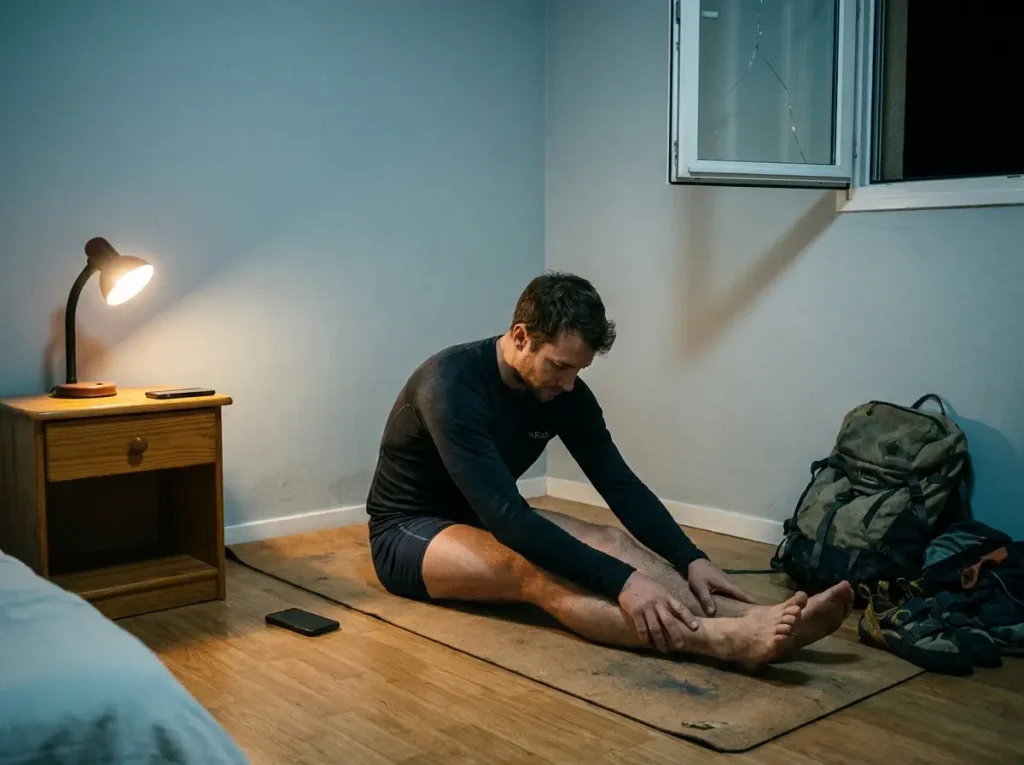
There’s a lot of sleep advice. Most of it is directionally correct but unevenly impactful. These are the ones with the strongest evidence and the most specific relevance to athletic recovery.
Room temperature
Core temperature drops during sleep onset and through the night — the drop is actually part of the mechanism that initiates sleep. A cool room (65–68°F / 18–20°C) accelerates that drop. Athletes who sleep in warm rooms consistently show worse slow-wave sleep quality than those in cool environments, independent of total sleep duration. If you’re crag camping and it’s 85°F in the tent, this matters.
Blue light and screen exposure
Blue-light wavelengths suppress melatonin production, which delays sleep onset. The effect is real but often overstated in application — the issue isn’t the amount of blue light so much as the alerting nature of screen content itself (news, social media, training videos) in the hour before sleep. The practical guideline is either no screens 60 minutes before bed, or blue-light filters plus deliberately low-stimulus content. Staring at a training video breakdown until midnight is a bad idea regardless of whether you have a filter on your phone.
Alcohol and performance
Alcohol is a common part of climbing culture, particularly at the crag. It’s also a reliable sleep disruptor — it reduces REM sleep in the second half of the night and fragments sleep architecture even in moderate amounts. One or two drinks will not eliminate the benefits of sleep, but regular evening drinking — the crag-every-weekend-with-beers pattern — meaningfully degrades the recovery quality of the nights that most matter. This isn’t a prohibition argument; it’s a trade-off worth understanding.
For the same reason that sleep underpins training adaptation, the bouldering plateau guide addresses how recovery quality interacts with the training protocol choices that determine whether you actually break through a training ceiling.
Napping for Climbing: The Rules That Work
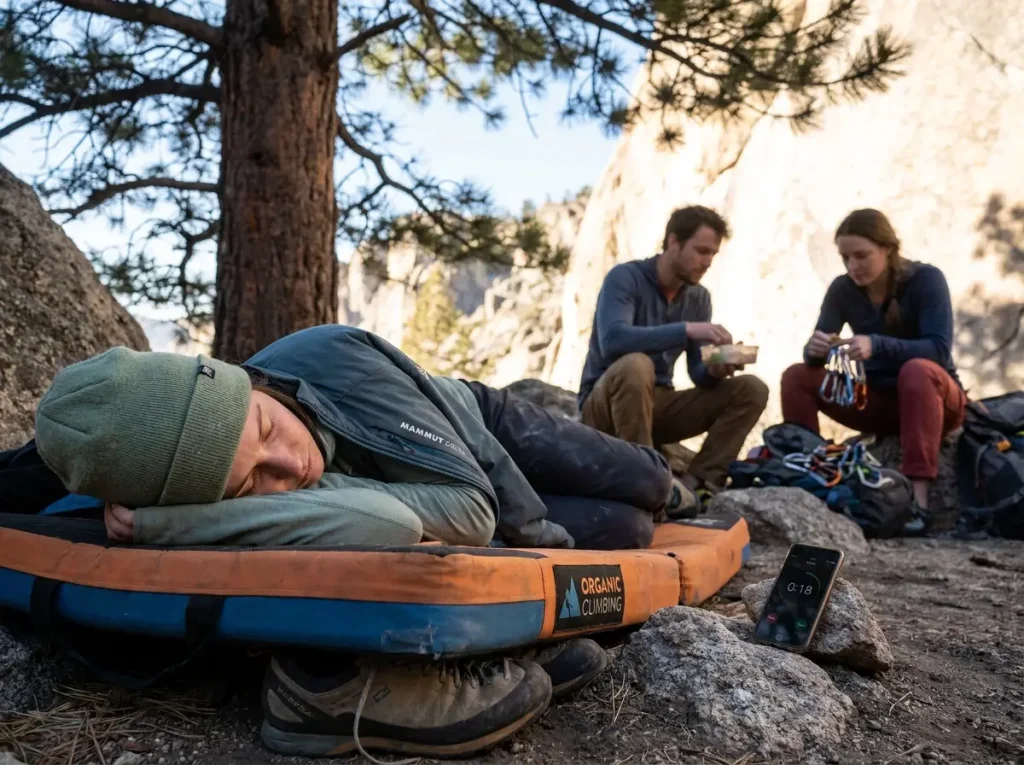
Strategic napping is a legitimate performance tool. Unstrategic napping is a way to feel slightly better in the afternoon and significantly worse at night.
The 20-minute nap
A 20-minute nap (set your alarm before you fall fully asleep) captures stage N1 and early N2 sleep — enough for cortisol reduction and alertness restoration without entering slow-wave sleep, which produces sleep inertia (the grogginess that follows a long mid-day sleep). For climbers on multi-day trips, a 20-minute post-lunch nap consistently improves afternoon session quality more than caffeine alone.
The 90-minute nap
If you’re genuinely sleep-deprived from a previous night, a full 90-minute nap completes one sleep cycle and delivers meaningful slow-wave and REM benefit. The constraint: it needs to end at least 4 hours before your target bedtime, or it reduces nighttime sleep pressure enough to delay onset and fragment the following night.
What doesn’t work
30–60 minute naps are in no-man’s-land — long enough to enter slow-wave sleep, short enough that waking mid-cycle leaves you groggy and cognitively blunted for 30–45 minutes afterward. The classic post-lunch “just a quick nap” that turns into an hour and leaves you wrecked is this phenomenon. Set an alarm at 20 minutes or commit to 90. Don’t let yourself drift.
Sleeping at the Crag: Altitude, Cold, and Night-Before Performance
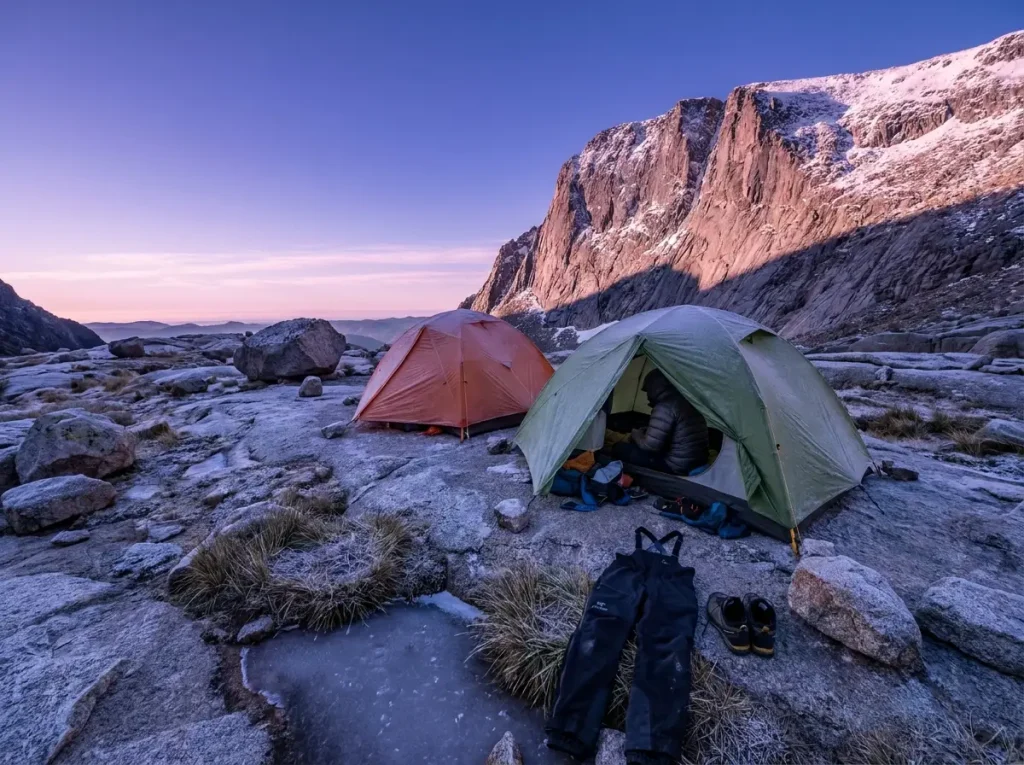
Crag camping introduces variables that don’t apply to home sleep optimization, and they matter more than most climbers acknowledge.
Altitude effects on sleep
Above 8,000 feet (2,400m), sleep quality degrades significantly. Periodic breathing — a pattern where breathing depth cycles and occasionally pauses — disrupts slow-wave and REM sleep even in acclimatized individuals. The effect is worse in the first two to four nights at altitude and improves as acclimatization progresses. At popular high-altitude crags — Rocky Mountain National Park, certain Sierra Nevada areas — it’s common for climbers to feel well-rested after a night at altitude when their sleep was actually significantly fragmented. Performance degradation from altitude sleep disruption is real and typically underestimated.
The practical response: if you’re spending a night at altitude before a key route, budget an extra night of sleep at elevation before your send day to allow partial acclimatization. Arriving at altitude the night before and projecting the next morning is close to worst-case timing for sleep quality.
Cold and sleep quality
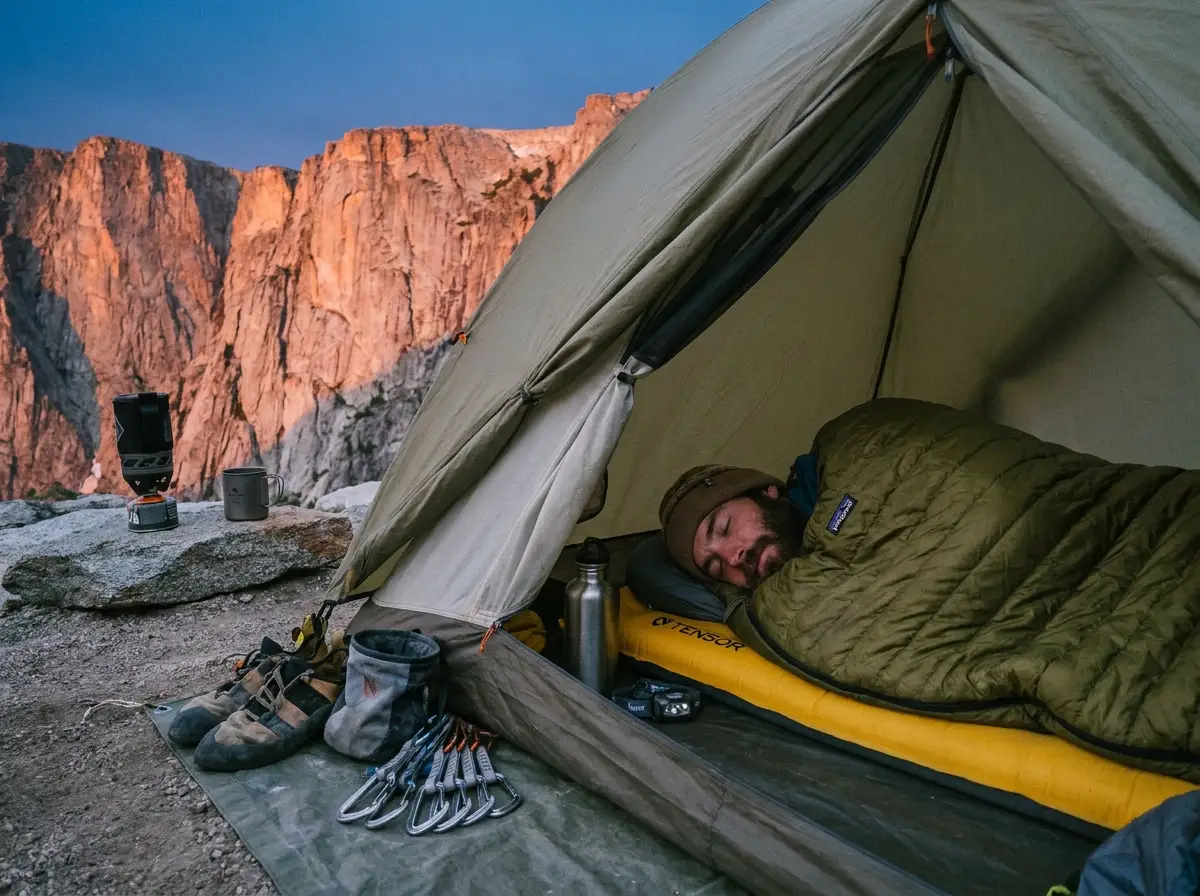
Cold tent sleeping — below 50°F (10°C) — also fragments sleep. Paradoxically, your system needs to drop core temperature to initiate sleep but cannot do so if the environment forces thermal regulation work. Sleeping cold means your metabolism burns resources staying warm that should go to repair. Quality insulation (appropriate sleeping bag rating for the conditions, an insulating pad rather than just air) matters for recovery quality as much as for comfort.
The ice climbing fitness training plan covers periodization for cold-environment climbing, including how to structure training and recovery across multi-day alpine objectives where crag sleep conditions are a real variable.
Conclusion
Sleep is where your climbing training pays off. Every hangboard session, every technique rep, every limit boulder problem you worked — the adaptation from all of it happens during sleep, not during the training itself. Treating sleep as optional is treating adaptation as optional.
Start with the anchor: pick a consistent wake time and hold it. Build backward from there to a bedtime that gives you 8–9 hours on training days. Cool the room. Cut the screens before bed. And on the crag, protect sleep duration even at the cost of logistics — the climber who slept well on the approach is a different climber than the one who didn’t.
Q1 How many hours of sleep do climbers need?
Most training climbers perform best with 8–9 hours on nights following hard sessions, and a minimum of 7.5 hours on rest days. The general adult recommendation of 7–8 hours is a floor, not a target, for athletes who are actively training their physical systems and demanding motor learning.
Q2 Does napping help climbing performance?
Yes, strategically. A 20-minute nap improves afternoon alertness and reduces cortisol without disrupting nighttime sleep if taken before 3 p.m. A 90-minute nap can partially offset a previous poor night. Naps between 30–60 minutes tend to leave you groggy from mid-cycle waking and should be avoided.
Q3 Does alcohol affect climbing recovery?
Yes, measurably. Alcohol reduces REM sleep in the second half of the night, which is where motor consolidation and cognitive recovery happen. Even two drinks close to bedtime fragment sleep architecture enough to reduce the training adaptation benefit of the following night’s sleep.
Q4 What is the best bedtime for climbers who train in the evenings?
For evening gym climbers, this is genuinely hard. Intense training within 2–3 hours of sleep significantly delays sleep onset. Either shift hard sessions earlier when possible, or use a post-session cooldown (cool shower, walk, light stretching) to accelerate physiological wind-down. Accept that a 9 p.m. training finish and a 10 p.m. bedtime is ambitious — 11 p.m. is more realistic, and sleep time should be budgeted accordingly.
Q5 Why does sleep at altitude feel poor even when I think I slept well?
Periodic breathing at altitude fragments slow-wave and REM sleep in ways that are not always consciously felt. You may complete a full night at altitude feeling rested but having experienced significantly more micro-arousals and less restorative sleep depth than at sea level. The first two to four nights at elevation are worst; performance degradation from altitude sleep disruption improves with acclimatization.
Safety Notice: Rock climbing and mountaineering are inherently high-risk
activities that can involve physical trauma or fatal incidents. The information on Rock Climbing Realms is for
educational and informational purposes only. Techniques and advice presented here are not a substitute
for professional, hands-on instruction. Conditions and risks vary by location. Always seek guidance
from a qualified instructor before attempting new techniques. By using this website, you agree that you
are solely responsible for your own safety. Any reliance you place on this information is strictly
at your own risk, and you assume all liability for your actions. Rock Climbing Realms and its authors
will not be held liable for any harm, damage, or loss sustained in connection with the use of this information.
Affiliate Disclosure: We are a participant in the Amazon Services LLC Associates Program, an
affiliate advertising program designed to provide a means for us to earn advertising fees by advertising and linking
to Amazon.com. As an Amazon Associate, we earn from qualifying purchases. We are also an official affiliate partner
of Black Diamond Equipment via the AvantLink network. If you click on a Black Diamond affiliate link and make a
purchase, we may earn a commission at no additional cost to you. We also participate in other affiliate programs.
Additional terms are found in the terms of service.