
In this article
Your pad looks fine from ten feet away. The shell isn’t torn. There’s no visible mold. But the last time you stuck a bad fall, you heard that sound — not the satisfying thud of energy absorbed, but a slap. A flat, dead slap. The kind that travels up through your heels and into your spine. That sound is the foam telling you something is very wrong — something that started months ago, probably in a damp garage, possibly accelerated by a bottle of DEET you sprayed on your ankles before that tick-infested approach trail.
I’ve seen this pattern enough times to stop being surprised by it. Climbers who obsess over their cams and ropes will casually toss a crash pad into a wet trunk and forget about it for six months. Then they wonder why their knees hurt after a moderate landing. The pad isn’t protecting them the way it used to — and cleaning it wrong would only speed up the damage that’s already underway.
Here’s exactly what’s happening inside your pad, how to reverse surface damage before it reaches the core, and how to know when the foam has crossed a line that no amount of cleaning can fix.
⚡ Quick Answer: To clean a crash pad without damaging the foam, always remove the foam blocks through the side zipper before washing the shell. Machine wash the shell on cold/delicate only — hot water causes nylon shrinkage and delaminates the internal waterproof coating. Air dry in shade. For routine maintenance, use a HEPA vacuum with a tamping motion (not scrubbing) to pull chalk and trail dust out before particles work into the foam cells. Never use DEET near your pad — it permanently destroys the polyurethane shell coating that keeps moisture away from the open-cell core.
How Your Crash Pad Actually Absorbs a Fall
 Asana crash pad demonstrating foam impact absorption at sandstone crag ” class=”wp-image-15707″/>
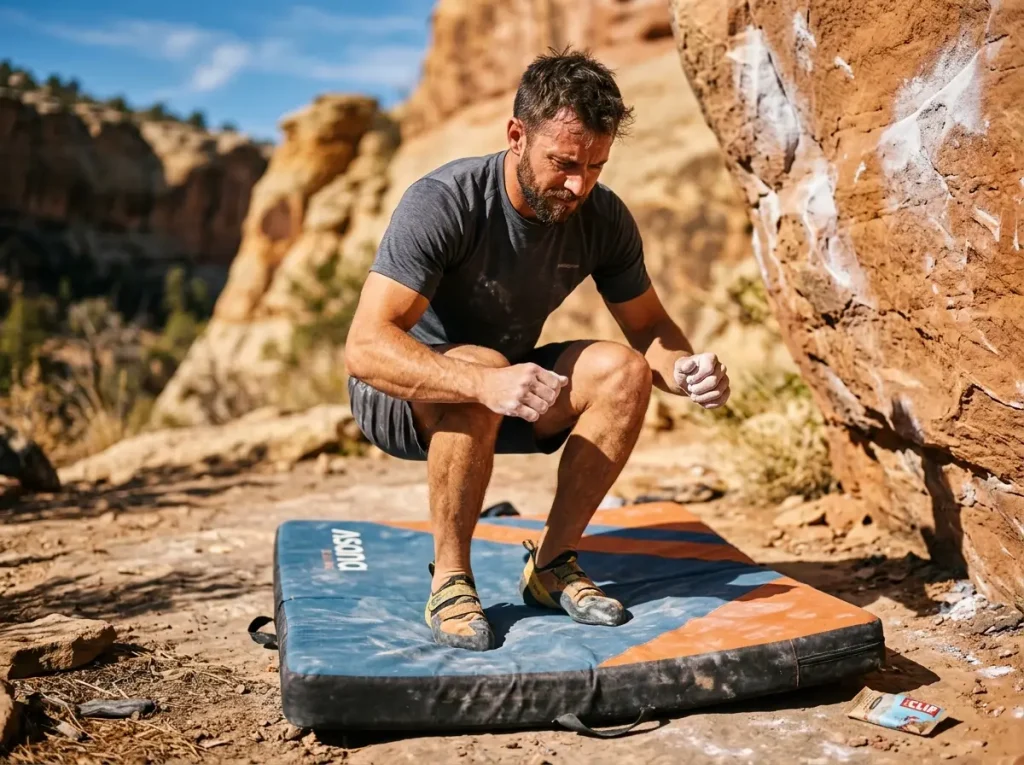
Most boulderers think of a crash pad as a thick piece of foam. It’s not. It’s a three-layer system where each component does a specific job — and where foam bottoming out is almost always a failure of the inner layer, not the outer one.
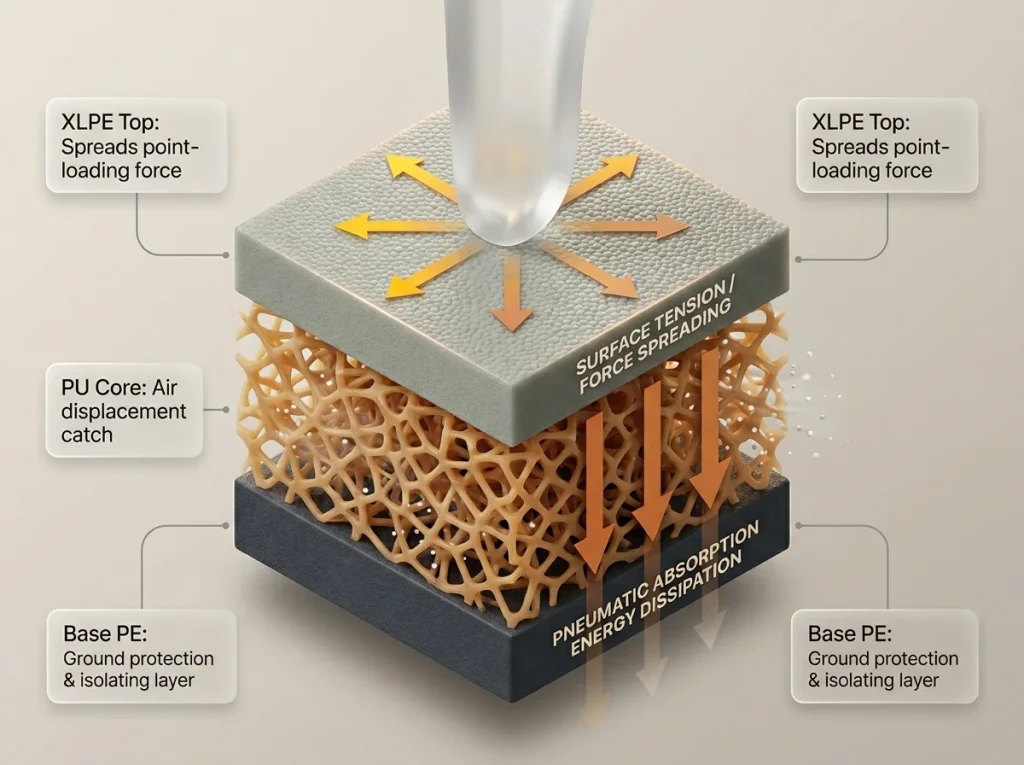
Here’s how it works: the top layer is closed-cell cross-linked polyethylene (XLPE) — dense, discrete air bubbles that won’t compress suddenly under a sharp impact. When you land, this layer resists point-loading and spreads force laterally across the surface. It’s what prevents your heel from punching straight through to the ground on a bad landing.
Below that sits the absorption core — reticulated open-cell polyurethane (PU) foam. The reticulation is a heat treatment that removes the cell walls, leaving only a net-like frame. When you hit it, air squeezes out of that network over a fraction of a second, and that pneumatic resistance is where the energy actually goes. It’s a slow catch, not a hard stop.
A base layer of high-density closed-cell foam underneath isolates the core from ground abrasion.
Standards like those in ASTM F1292 impact attenuation guidelines set G-max below 200 and Head Injury Criterion below 1000 for impact surfaces. Your pad is built to stay under those numbers when new. Dirt and moisture grinding away at the cellular walls pushes the metrics toward hazardous territory. You won’t feel it in daily use until the landing that makes your ankles ring.
For a deeper breakdown of how each layer fails over time, see the difference between open-cell and closed-cell foam in crash pads.
The difference between a pad that catches you and one that just slows you down is invisible to the eye. You only find out during the fall.
The Molecular Enemies: UV, Water, and Chemistry
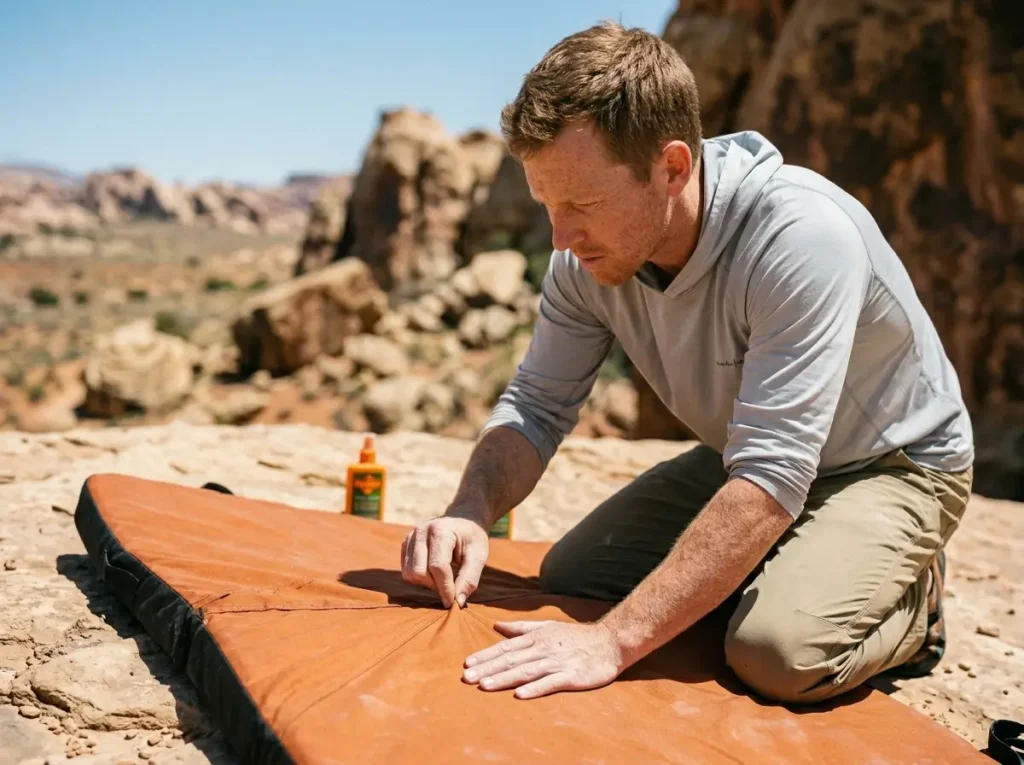
This is the section no manufacturer’s care guide wants to include, because the truth is uncomfortable: your pad is degrading even when you’re not using it.
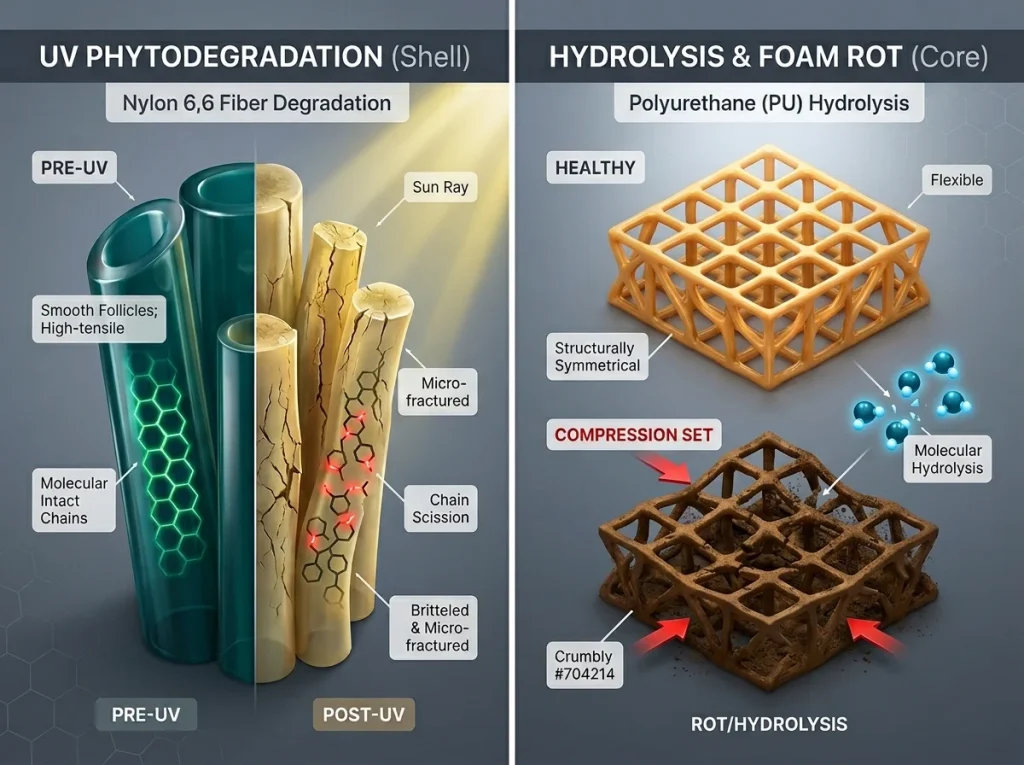
UV radiation attacks the nylon shell at the molecular level. The outer shell — usually high-denier Cordura or ballistic nylon, specifically Nylon 6,6 — loses 20% of its breaking strength in just 15 days of continuous intense sun exposure. That’s equivalent to roughly 107 days in a high-UV environment like a southwest desert crag. After three years of moderate sun, the shell may retain only 40–50% of its original breaking strength. The failure happens through photo-oxidation and chain scission — the polymer backbone breaks internally. Electron microscopy confirms this happens long before visible fraying or fuzziness appears on the surface.
You can’t see UV photodegradation of high-tensile Nylon 6,6 webbing happening. That’s the problem.
Moisture goes after the core through hydrolysis — water molecules permanently cleave the polymer chains in the open-cell polyurethane matrix. A stored damp pad doesn’t just get musty. The reticulated structure acts as a sponge, trapping moisture in a microenvironment where those chemical reactions run continuously. The result is foam rot: loss of elasticity, failure to rebound, and eventually the crumbly, dust-like texture of completely degraded foam. Compression set — the foam failing to return to original thickness after compression — is an earlier warning sign of the same process.
Anaerobic bacteria make it worse. Stored in a sealed damp environment, microorganisms consume the organic stabilizers in cheaper foams, accelerating structural breakdown.
Then there’s the one that gets climbers more than anything else: DEET. N,N-Diethyl-meta-toluamide is a plasticizer — it melts things. Specifically, it dissolves the polyurethane waterproof coating on the inside of your pad’s shell. That coating is the barrier preventing moisture from reaching the open-cell core. Once DEET destroys it, the damage is permanent and invisible. The shell looks intact. The protection is gone.
For a full breakdown of repellent options that won’t destroy your gear, including why Picaridin is the only safe repellent choice for climbers, see the tick removal and prevention guide for climbers.
Pro tip: Any pad that’s been stored against a wall in direct afternoon light is already compromised at the shell level, even if it looks fine. Rotate your storage position seasonally if your garage or shed has windows.
The Three-Tier Cleaning Protocol
The goal of cleaning a crash pad is removal of micro-abrasives and biological contaminants without introducing excessive moisture or heat — the two triggers that accelerate everything described above. Here’s the protocol, broken into three tiers based on contamination level.
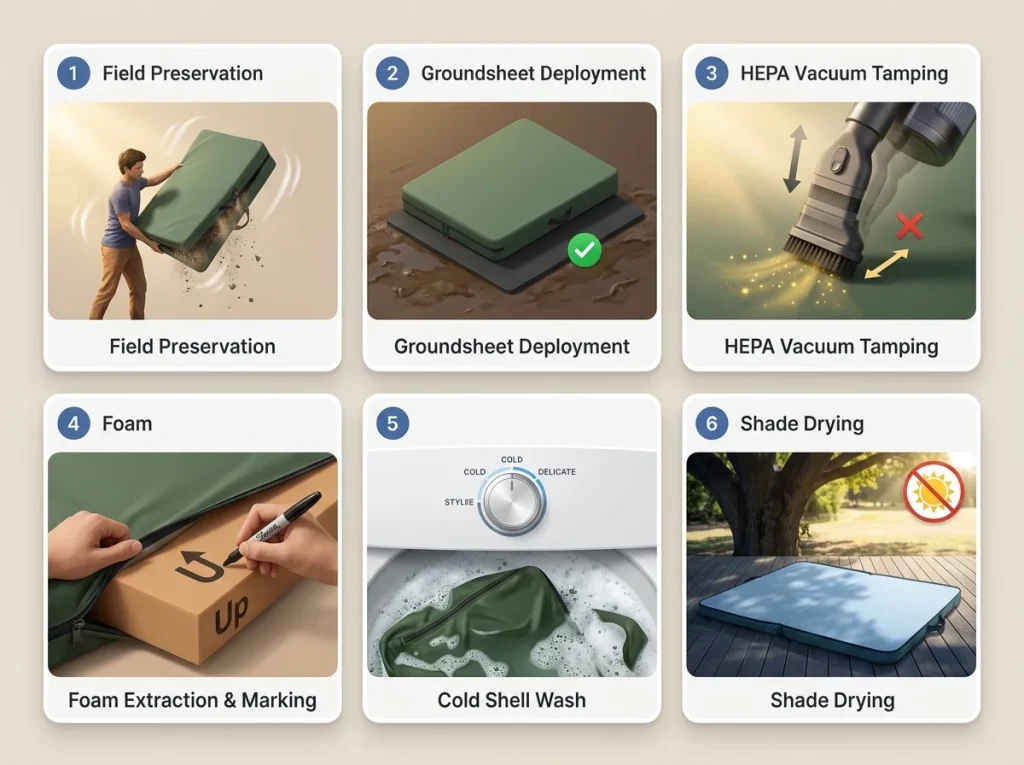
Tier 1 — Field Preservation happens at the crag, after every session, and it’s the most important maintenance you’ll do. Shake the pad vigorously. Twigs and stones trapped in the hinge of a folding pad create localized pressure points that puncture foam during transport — that kind of damage isn’t fixable. Use a groundsheet or sacrificial blubber pad as a moisture barrier between your primary pad and wet ground. Stop putting your pad face-down on mud.
The integrated carpet on many pads — Organic Climbing, Metolius, Black Diamond models all include it — is a technical safety feature, not decoration. It strips grit from climbing shoes before that grit gets driven into the fabric weave under your body weight during a fall. Use it.
Tier 2 — Routine Surface is what you do when you get home from a full session. The logic here is identical to the same pH-neutral wash protocol used for climbing ropes: abrasive particles destroy polymer structure from inside the fiber. Magnesium carbonate (chalk) and trail dust are small enough to migrate through the nylon weave and into foam cells. Get them out before they migrate.
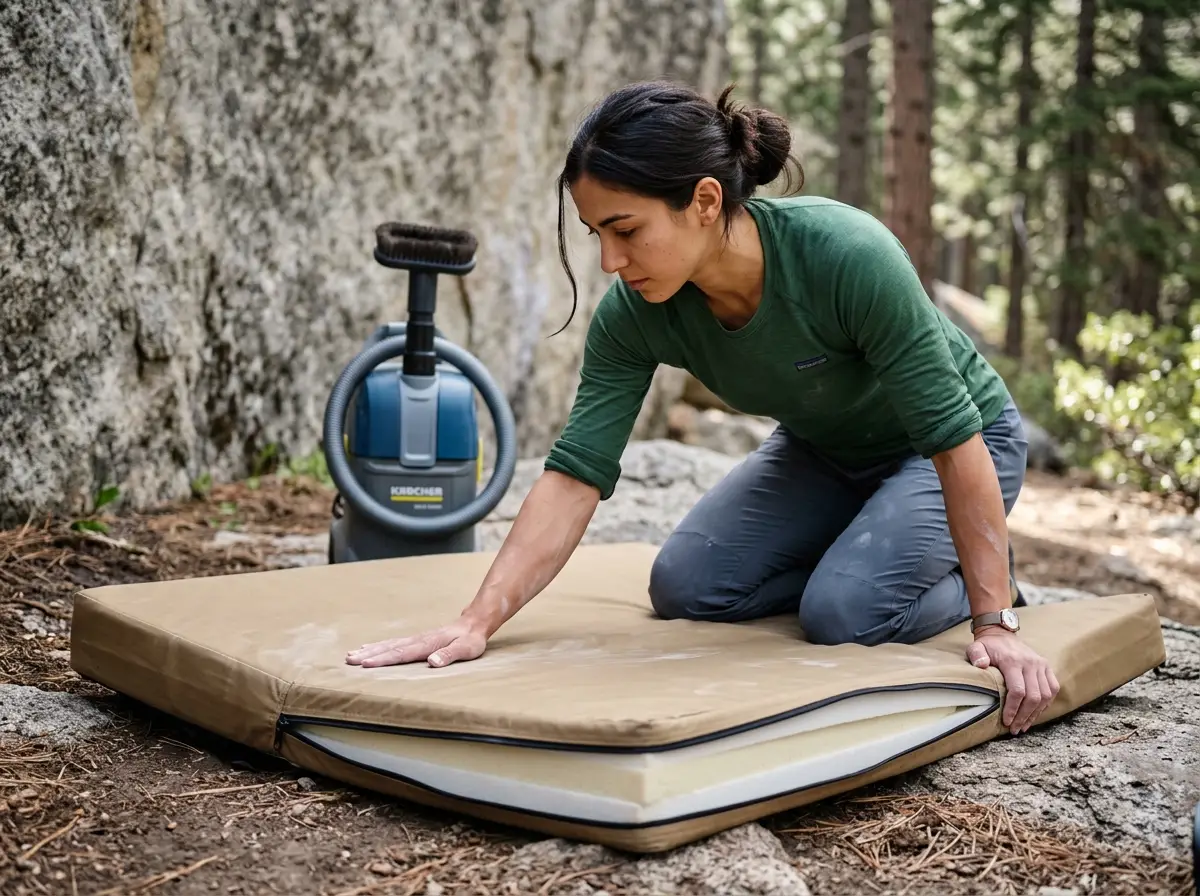
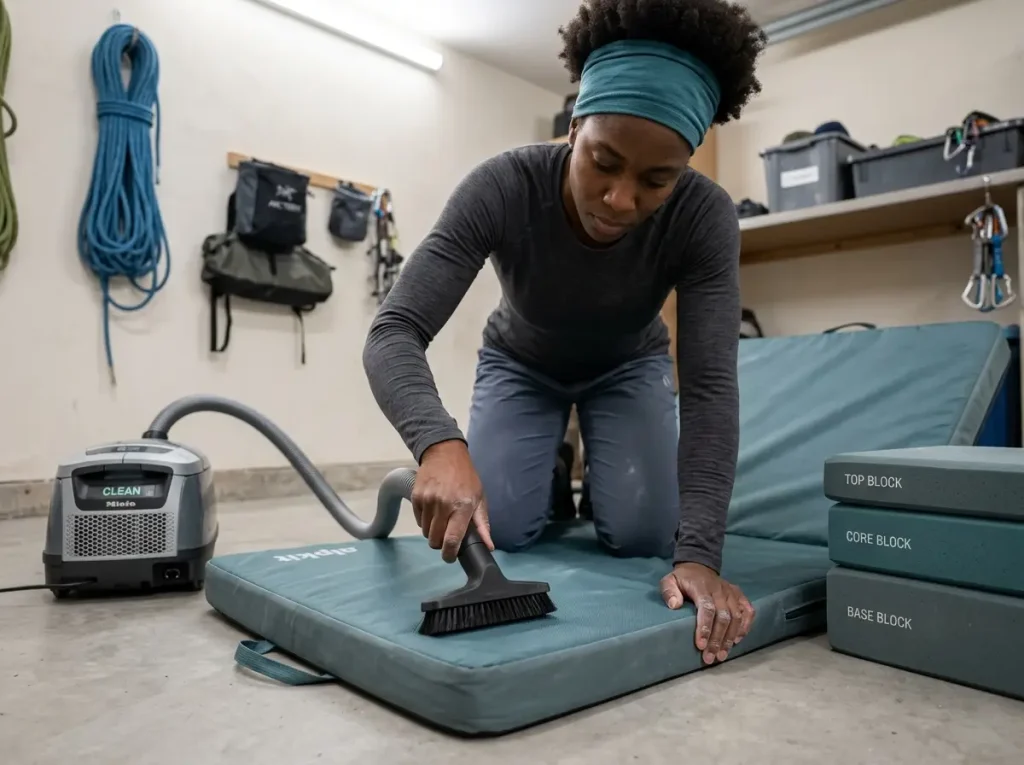
Pull out a HEPA vacuum with a soft brush attachment. Use a tamping motion — a rhythmic pounding contact rather than dragging the nozzle across the surface. Mechanical friction releases the particles; aggressive scrubbing frays the fibers. Vacuuming with a tamping motion instead of dragging the attachment is the single technique most climbers get wrong.
For spot stains, use cold water only plus a pH-neutral, non-bleach detergent. Rinse completely — residue left in fabric attracts further contamination. And it strips the DWR (durable water repellent) coating on the shell.
Tier 3 — Deep Clean is for pads that are heavily soiled or smell musty. This is an invasive process with real consequences if you get it wrong.
Unzip the side access panels — high-quality pads from Organic, Asana, and Metolius all have them. Mark the orientation of every foam block before it comes out. This step is non-negotiable: the blocks are engineered to sit in a specific order and direction. Re-inserting them backward or inverted negates the force-distribution design. Mark them with a Sharpie on the edge that faces the hinge. You’ll thank yourself later.
The orientation marking step sounds obvious right up until you’re standing over five foam blocks that all look nearly identical and none of them fit back in the way they came out.
Wash the shell only — machine cold/delicate, or hand wash. Hot water is strictly prohibited. It causes nylon shrinkage that can prevent foam re-insertion, and it delaminates the internal PU coating. Same reason you don’t put a rope in a hot dryer.
Dry in shade, well-ventilated, completely flat. Machine drying exceeds the thermal stability threshold of PU coatings. Take the extra day.
If you need to visualize the foam extraction and re-insertion sequence before doing it yourself, Asana’s team put together a useful walkthrough:
For mechanical textile cleaning protocols for high-denier nylon, the principle is the same: mechanical force releases contaminants, but abrasion destroys the fiber structure you’re trying to preserve.
Pro tip: If your pad smells like a wet basement after air drying, the anaerobic bacteria problem is already inside the foam. You can’t wash that out. It means moisture has been cycling through the open-cell core repeatedly. Start thinking about foam replacement, not another cleaning session.
Storage Physics: The Silent Killer Between Sessions
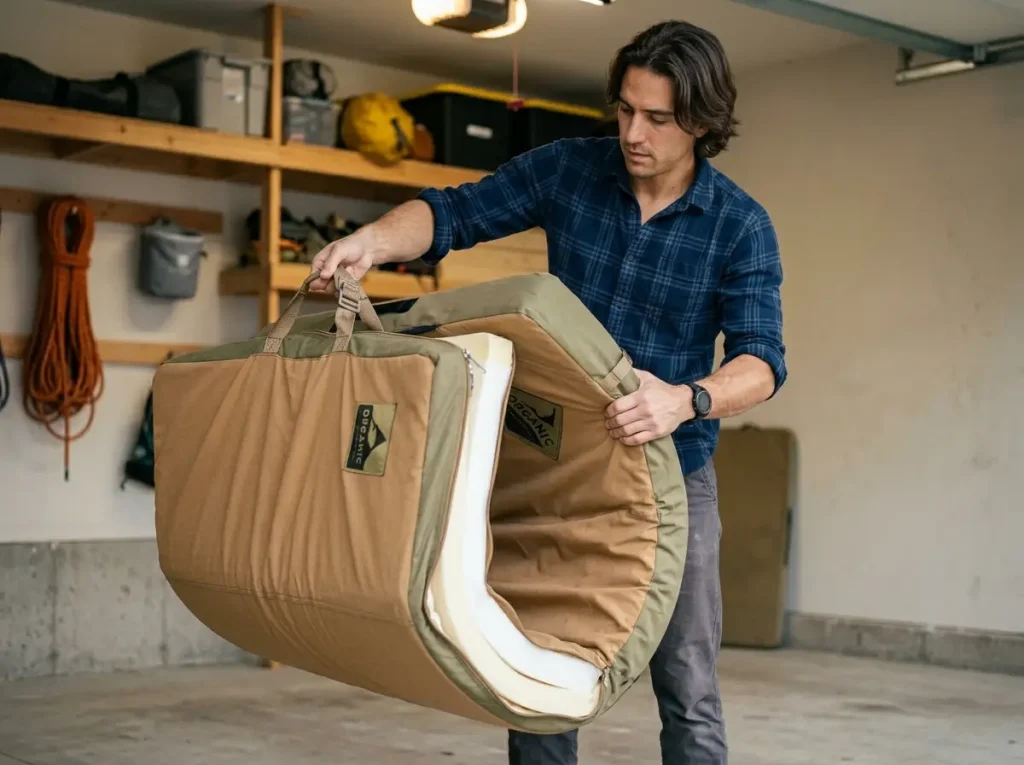
A pad that lives through ten years of active climbing can be destroyed in six months of storage. This is the thing most care guides skip entirely.
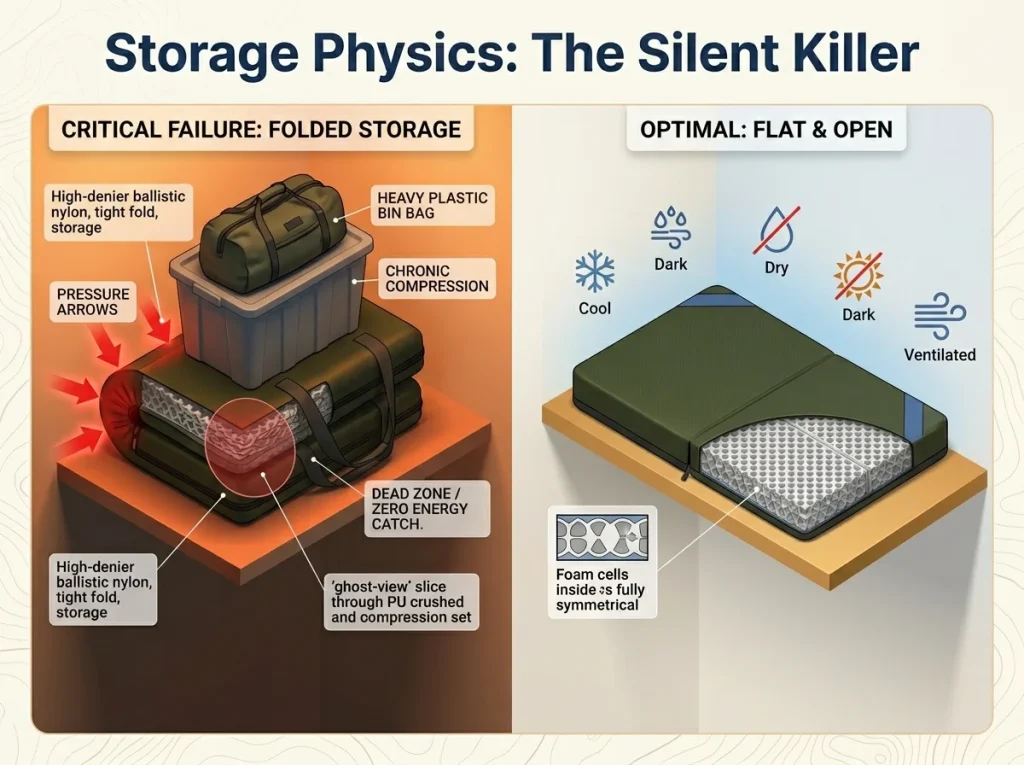
Compression set is the enemy. When foam cells are held compressed without recovery time, the cell walls fatigue permanently. They stop rebounding. And when a taco-style (hingeless) pad is stored folded, the foam at the fold apex is under extreme, continuous pressure — the cells in exactly that spot fatigue first, creating a dead, soft spot in the center of your landing zone. That’s precisely where you land on bad falls.
All pads must be stored open and flat. For taco pads, this is not optional.
Stacking heavy objects on top of a stored pad — other pads, plastic bins, gear bags — induces chronic compression across the entire surface simultaneously. The pad looks fine. The foam is slowly losing its pneumatic resistance anyway.
Climate control is the other half. The ideal storage environment is dry, cool, and dark. Car trunks in summer can reach temperatures that accelerate thermal degradation of polyurethane — simultaneously, the sealed, humid environment promotes hydrolysis and bacterial growth. A pad stored in a damp basement may look intact but have lost 30–50% of its energy absorption capacity through silent molecular failure. You won’t know until the landing that matters.
One technique that almost no one does: foam rotation. If your pad allows foam removal (most quality pads do), flip the blocks periodically to distribute creep fatigue evenly. It’s the same logic as rotating a mattress. The cells on the fall side get compressed far more than the cells on the ground side. Rotating slows the asymmetric degradation.
If you’re not already tracking your pad’s condition systematically, start with the full system for tracking gear degradation before it becomes a safety issue.
Pro tip: If you’re storing a pad through winter, slip it under a bed or on a high shelf in a temperature-stable room. A foam block that stays between 55–75°F and below 60% humidity will outlast the same block stored in a shed by years, not months.
Good storage habits slow the clock. They don’t tell you where the clock actually stands. For that, you need to test the pad directly.
Forensic Inspection: The Ground-Fall Threshold Test
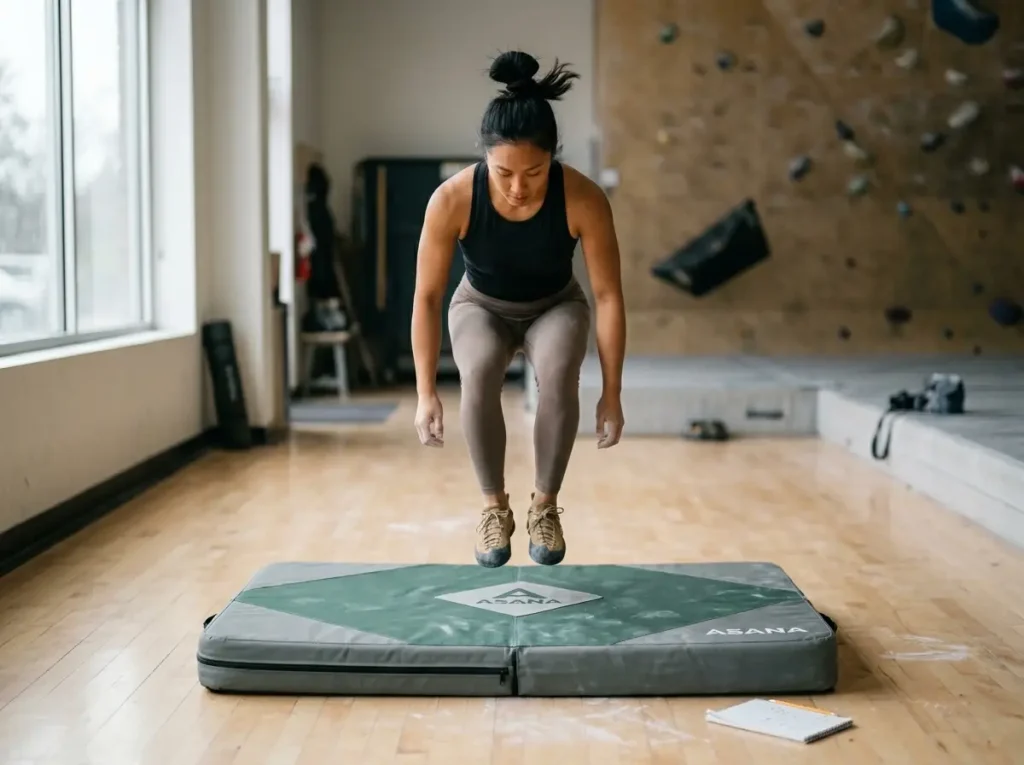
The most hazardous crash pad is the one that looks new but performs like a rug. Here’s how to know where yours actually stands.
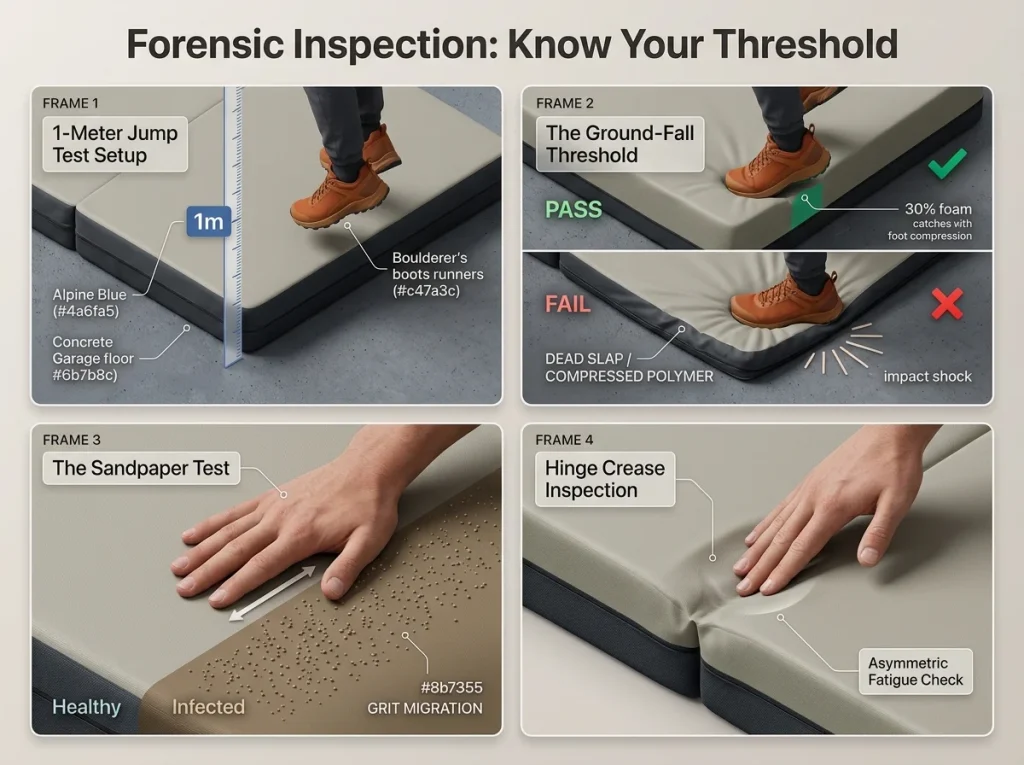
The 1-Meter Jump Test is the definitive field assessment. Put the pad on a hard, flat surface — concrete floor in your garage works. Jump from exactly one meter. You’re listening and feeling for two things.
Pass: smooth deceleration, noticeable rebound, no sense of substrate contact through the foam.
Fail: a dead thud or flat slap sound, or you feel the rigid floor through the foam. That sound — the same one from the introduction — is the open-cell core communicating that it has lost its pneumatic resistance. The cell matrix has collapsed. You’re landing on compressed polymer, not an energy-absorption system. CWA guidance on bouldering padding system retirement is clear on this point: once a pad crosses the ground-fall threshold, cleaning and storage won’t recover it.
For a clear picture of what happens to your body when a pad fails mid-fall, and why the pad’s performance at that moment determines everything, see the bouldering fall guide.
Also check the shell visibly. UV discoloration past surface fuzziness into brittleness of seam webbing means the containment system is compromised, independent of foam condition. Check the hinge area specifically — the foam adjacent to the hinge crease receives different compression stress than the main landing surface and often fails first.
The sandpaper test: place your palm flat on the pad and drag it slowly. A clean pad surface should feel smooth under the shell. Grit migration through the fabric indicates your vacuuming schedule isn’t keeping up.
Most climbers who run the palm-drag test for the first time are caught off guard — not because the pad feels gritty, but because it never once occurred to them to check.
One more thing worth knowing: budget pads often use chemical hardeners to make low-density foam feel firm at the point of sale. Those hardeners deteriorate after a season, leaving a pad that’s no longer safe to fall on. Minimum safe density thresholds are 2.2 lb/ft³ for the XLPE distribution layer and equivalent or higher for the PU core. If you bought a budget pad under $150, look up the foam density spec before trusting your spine to it.
I would never clip a carabiner with a cracked spine. The same logic applies to foam that’s lost 40% of its capacity. And once you’ve confirmed the pad has crossed that threshold, the question shifts from whether to act to which kind of action makes sense.
Repair vs. Retire: The Anti-Sell Decision Framework
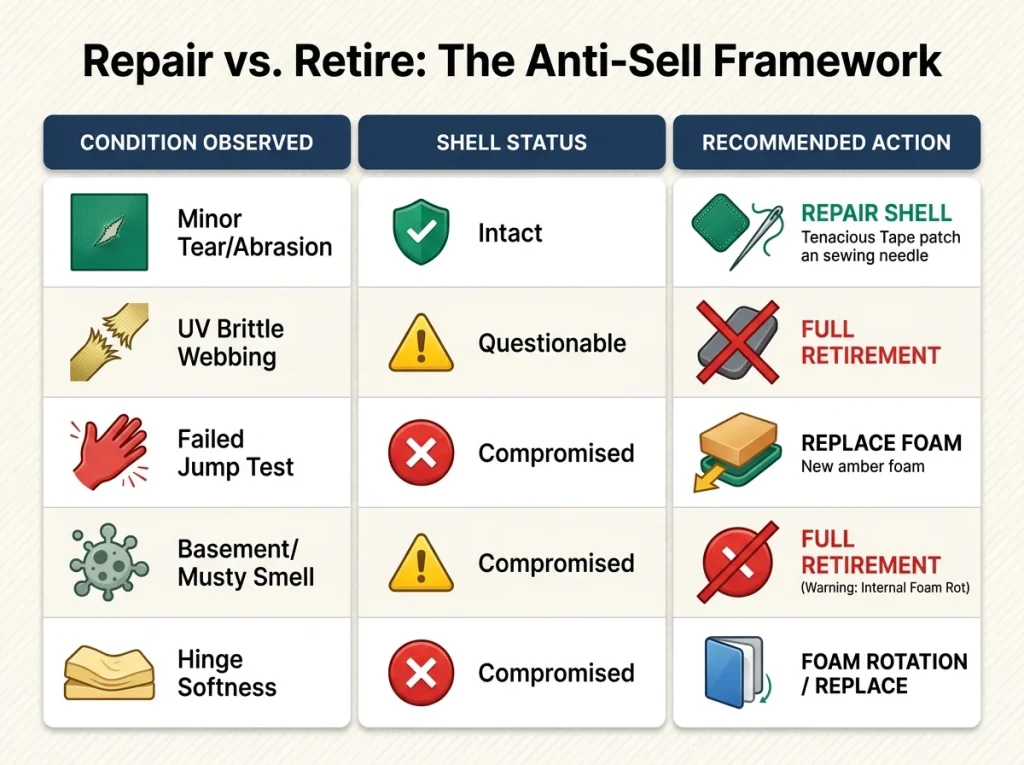
The shell and foam degrade at different rates. This is what manufacturer care guides will never tell you: a well-maintained shell can outlive multiple foam sets. That means replacement doesn’t always mean buying a new pad — sometimes it just means sourcing new foam.
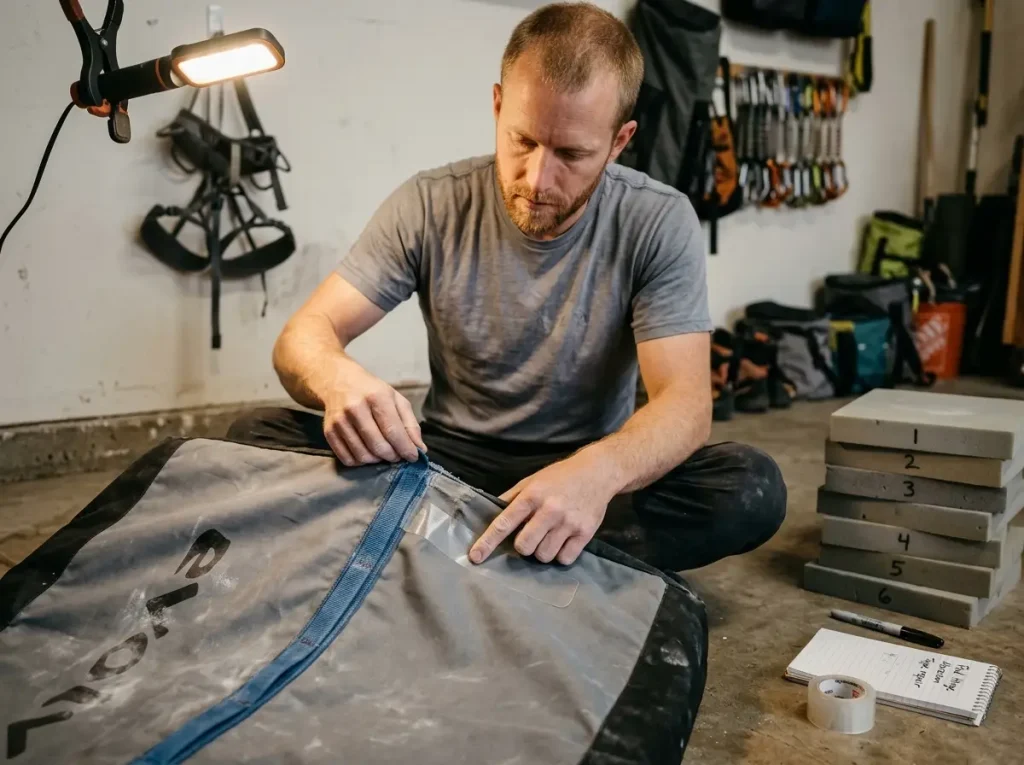
Shell repair makes sense when you have minor nylon tears or abrasions without UV brittleness or seam delamination. Tenacious Tape (Gear Aid) is a legitimate field repair for nylon shell damage. A stitched seam reinforcement handles structural webbing that’s fraying before it’s failed. These extend the shell’s useful life by years if the damage is caught early.
Shell retirement becomes necessary when you see brittleness or crumbling of seam webbing — not just fuzziness, but actual structural compromise. When the shell can no longer contain the foam during compression. When UV discoloration has gone past surface aesthetics into actual fiber degradation along stress points.
Foam replacement is the right move when the jump test fails but the shell passes inspection. Use foam density requirements for safe bouldering crash pads as your minimum specification: at least 2.2 lb/ft³ for the closed-cell distribution layer, equivalent or higher for the PU absorption core. Re-insert in the correct orientation — mark the blocks before you remove the old foam, then match the orientation exactly. Inverted or reversed blocks negate the force-distribution engineering.
Full retirement — shell and foam both done — is typically warranted after five to seven years of active use in UV-heavy environments, or three to five years with documented moisture exposure events. The logic mirrors the same inspection-and-retirement logic applied to harnesses and hardware: the safety system is only as reliable as its least-maintained component.
One thing worth noting: the bouldering pad exists in a regulatory vacuum. No UIAA or CE certification exists for crash pads. You are the final line of quality control. There’s no stamp of approval to defer to. The retirement decision is yours.
Pro tip: When sourcing replacement foam, ask the supplier for density ratings in lb/ft³ in writing. “High density” means nothing without the number. A foam block sold as “high density crash pad replacement” at 1.8 lb/ft³ is not adequate. Don’t accept marketing language in place of specifications.
Conclusion
Pull your crash pad out of wherever it’s stored. Run the jump test. Then check the hinge crease for compression set.
Three things to take from this:
Your pad is degrading chemically, not just physically. UV breaks nylon bonds internally before surface damage appears. Moisture triggers hydrolysis that turns foam crumbly from the inside out. By the time you see it, the damage is already structural.
Cleaning tiers prevent the cascade. Field shakeout, then routine HEPA vacuuming with a tamping motion, then cold-water shell wash with foam extracted: each tier stops micro-abrasives and moisture from reaching the next layer. Violate the temperature rules — hot wash, dryer, sun exposure during drying — and you accelerate the very damage you’re trying to prevent.
Perform the 1-meter jump test now. If your pad gives a dead slap, it has crossed the ground-fall threshold. No cleaning protocol rescues foam that has lost its pneumatic resistance. Replace the foam or retire the system.
If it passes, vacuum it, store it flat, and switch your bug spray to Picaridin.
FAQ
Can you wash a crash pad in the washing machine?
You can machine-wash the shell, but only on cold or delicate with the foam fully removed first. Hot water causes the nylon to shrink and delaminates the internal PU waterproof coating, permanently destroying the shell’s moisture barrier. Never put foam in a washing machine — the agitation tears the reticulated cell structure that makes the open-cell core work.
How long do crash pads last?
A well-maintained pad with a quality shell can last seven to ten years, but the foam typically needs replacement every three to five years depending on use frequency and storage conditions. Pads stored damp or in hot car trunks can fail in 18–24 months regardless of how little they’ve been used.
How do you know when crash pad foam is dead?
Perform the 1-meter jump test on a hard, flat surface. If the pad produces a flat slap or you can feel the substrate through the foam, the open-cell core has collapsed and crossed the ground-fall threshold. Replace the foam immediately — this isn’t a maybe.
Is DEET safe to use around crash pads?
No. DEET is a plasticizer that irreversibly dissolves the PU waterproof coating inside the crash pad shell. Once that coating is gone, the shell can no longer block moisture from reaching the open-cell foam core, triggering hydrolysis. Use Picaridin-based repellents exclusively around your gear.
Can you replace the foam in a crash pad instead of buying a new one?
Yes, and for pads with a structurally sound shell, foam replacement is the correct move. Source high-density replacement foam at minimum 2.2 lb/ft³ for the closed-cell XLPE distribution layer. Mark the orientation before removing old foam — re-inserting blocks in the wrong order negates the pad’s force-distribution engineering. Know the density specs before you buy replacement stock.
Safety Notice: Rock climbing and mountaineering are inherently high-risk
activities that can involve physical trauma or fatal incidents. The information on Rock Climbing Realms is for
educational and informational purposes only. Techniques and advice presented here are not a substitute
for professional, hands-on instruction. Conditions and risks vary by location. Always seek guidance
from a qualified instructor before attempting new techniques. By using this website, you agree that you
are solely responsible for your own safety. Any reliance you place on this information is strictly
at your own risk, and you assume all liability for your actions. Rock Climbing Realms and its authors
will not be held liable for any harm, damage, or loss sustained in connection with the use of this information.
Affiliate Disclosure: We are a participant in the Amazon Services LLC Associates Program, an
affiliate advertising program designed to provide a means for us to earn advertising fees by advertising and linking
to Amazon.com. As an Amazon Associate, we earn from qualifying purchases. We are also an official affiliate partner
of Black Diamond Equipment via the AvantLink network. If you click on a Black Diamond affiliate link and make a
purchase, we may earn a commission at no additional cost to you. We also participate in other affiliate programs.
Additional terms are found in the terms of service.