
In this article
Somewhere on Mountain Project there is a thread where a climber with two decades on rock asks, plainly, whether the downturned shoe advantage is real or whether it is mostly in our heads, and nobody in the thread can fully answer him. The most honest sentence anyone offered was three words long: necessary, no. That is not an argument against aggressive climbing shoes, and the eight shoes below are all current-generation picks worth owning, but they are sorted by the two things that actually decide the outcome, which are the angle you climb on and the shape of your foot, not by a ranking.
Research on climbing footwear found that more than nine in ten climbers report foot pain in their shoes, so pain was never a useful test of whether you bought the right pair. What follows is who this category is genuinely for, the eight shoes worth the money, and what they cost to own long after the box is in the recycling.
What Actually Makes a Climbing Shoe “Aggressive”
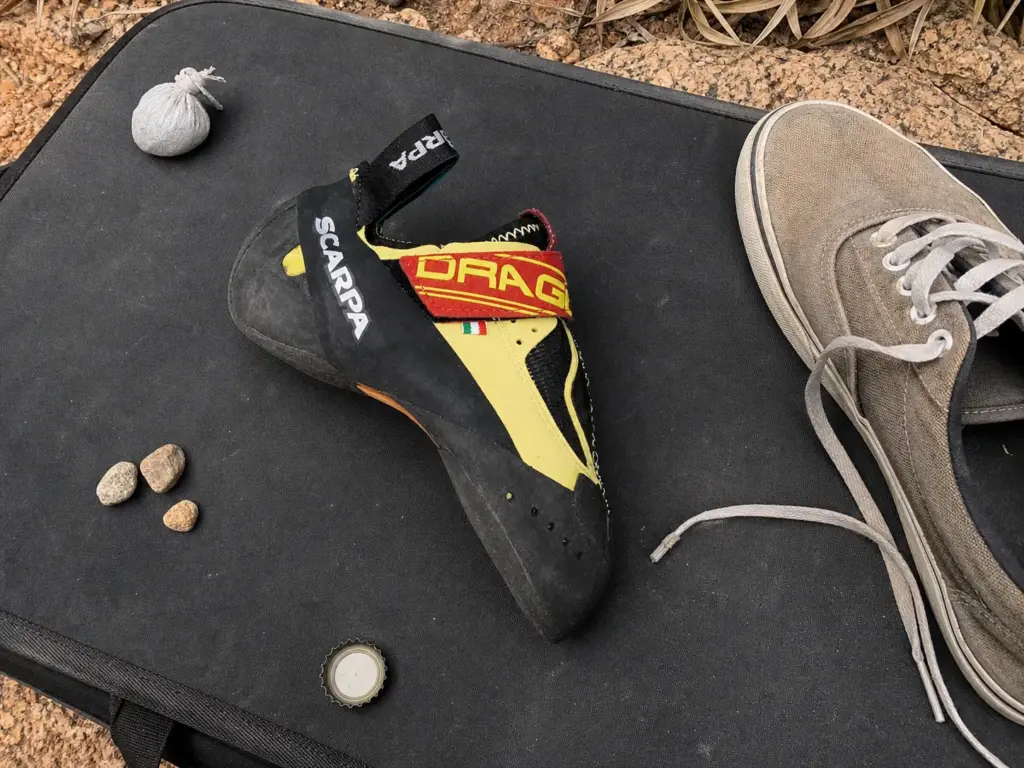
Ask in a gym shop and the answer you get is that it is the curvy one. That describes the shape, not the mechanism, and it is why so many climbers end up with a shoe that looks right on the wall and feels wrong on their project. What a veteran actually explains at the crag is that three separate design decisions stack on top of each other, and you can have any one of them without the other two.
That is the reason two shoes can both be labeled aggressive and feel nothing alike. One can be a soft, boneless slipper that reads every crystal on the rock. The other can be a stiff platform that happens to be curved.
Both are correctly labeled. Neither is a substitute for the other.
Downturn: the banana curve and what it’s for
Downturn is the visible curve that drops the toe below the heel when the shoe sits flat on a table. Climbers call it being toe-down, and it exists so that the shoe holds your foot in a pulling shape before you ever step on anything. On overhanging rock your foot is not pressing down onto a hold, it is hooking and pulling toward you, and a flat shoe asks your toe flexors to generate that curl on their own for the entire length of a boulder problem.
The downturn does that work for you and keeps doing it when you are pumped. Brands quietly segment their aggressive lines by how much of it they build in, which is why a catalog can list four shoes in the same performance tier that behave like four different tools. The amount of curve is a spec, even when nobody prints a number for it.
It also has a cost that shows up immediately. A downturned last is a shoe that has been pre-tensioned, and everything about it, the rand, the rubber, the upper, is under load even while it sits in your bag. That tension is the source of both the performance and the wear. Because aggressive shoes are one branch of a much larger family, it helps to see how climbing shoes break down by shape and job before deciding this is the branch you belong on.
Asymmetry: why the toe box points at your big toe
Asymmetry is the second axis, and it is the one nobody labels on the box. Look down at an aggressive shoe from above and the point of the toe box is not centered, it sits over the big toe, angled inward. The design rotates all of the shoe’s power onto that single strongest digit so you can stand on a hold the size of a credit card edge.
It works. It is also the design choice that does the anatomical damage later, which is the subject of an entire section further down. For now the useful part is the diagnostic: the more the toe box points inward, the more the shoe assumes your big toe is your longest toe and your forefoot is narrow enough to be funneled there.
If your foot does not match that assumption, no amount of sizing fixes it. You are not fighting the shoe’s size. You are fighting its geometry.
Softness, midsole and closure: the part people forget
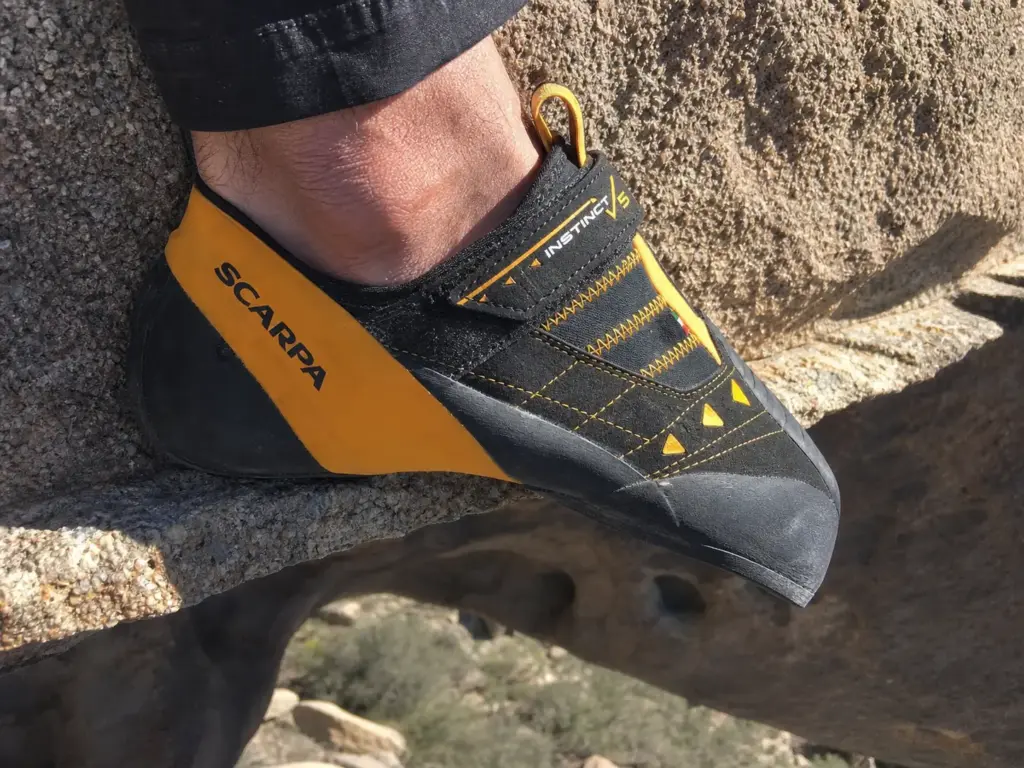
Softness is a third and completely independent axis, and this is where most confusion in the category lives. The Scarpa Drago has no midsole at all, just 3.5 mm of Vibram XS Grip2 over a slipper-soft construction, and it transmits the texture of the rock straight into your foot. The Scarpa Instinct VS keeps a half-length midsole you can genuinely stand on a small edge with.
Both are aggressive shoes. They are not interchangeable, and swapping one for the other mid-project is how people conclude that a perfectly good shoe is broken.
Closure follows construction. Aggressive lasts are almost universally a single Velcro strap or a slip-on slipper, because a lace-up shoe fights the tension rand, distributes pressure differently than the last was designed for, and adds fifteen seconds you do not want between boulder attempts when your skin is running out.
One vocabulary note that will save you in every forum thread you read next. In this category, soft is both a compliment and an insult, and which one depends entirely on the terrain being discussed. Soft on a steep boulder means sensitive and grabby. Soft on vertical granite means the shoe folds under your toe and you fall off.
The spec sheets never make that distinction, and the arguments online almost always come from two people using the same word about two different walls.
Who Aggressive Shoes Are For, and Who They Quietly Punish
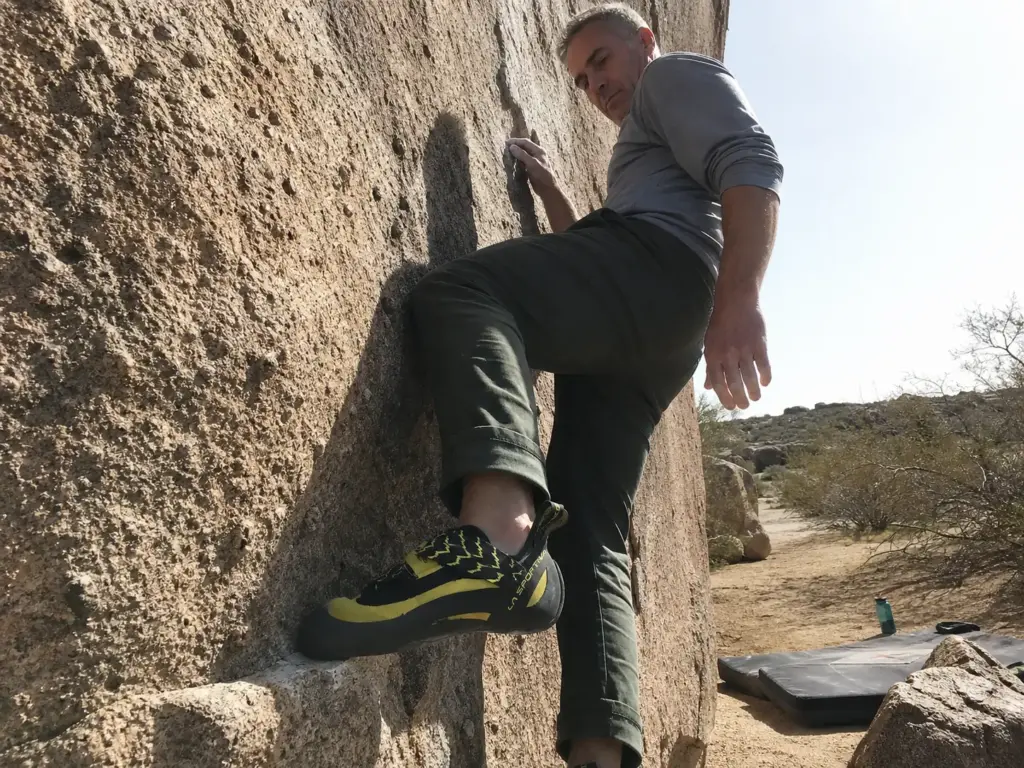
Every roundup on this topic says beginners beware and then moves on to the products. None of them says where the line actually is, which leaves the reader to guess, and the guess is almost always flattering. So here is the line, stated as three gates you either pass or you do not.
Gate one: you are projecting overhanging terrain, not vertical. Downturn pays on overhang, on toe hooks, on steep pockets and on anything where your foot is pulling rather than pressing. It actively works against you on slabs, on smears, and inside crack jams where a curled toe is the last thing you want. A climber whose home crag is vertical granite or splitter cracks is not upgrading when they buy an aggressive shoe, they are buying a worse tool for their rock at premium money.
It helps to name the terrain instead of the grade, because terrain is what the shoe actually responds to. Pocket climbing on steep limestone is close to the ideal case. Your toe goes into a hole, the downturn holds the curl for you, and the shoe does work your foot would otherwise do unassisted for the whole sequence.
Crack climbing is the opposite case, and not by a small margin. A jam wants a foot that can twist flat and wide inside a constriction, and a pre-tensioned toe will not flatten no matter how you weight it. Slab is the third case, where you want the largest possible patch of rubber touching nothing in particular, and a curved sole hands you the smallest patch you own.
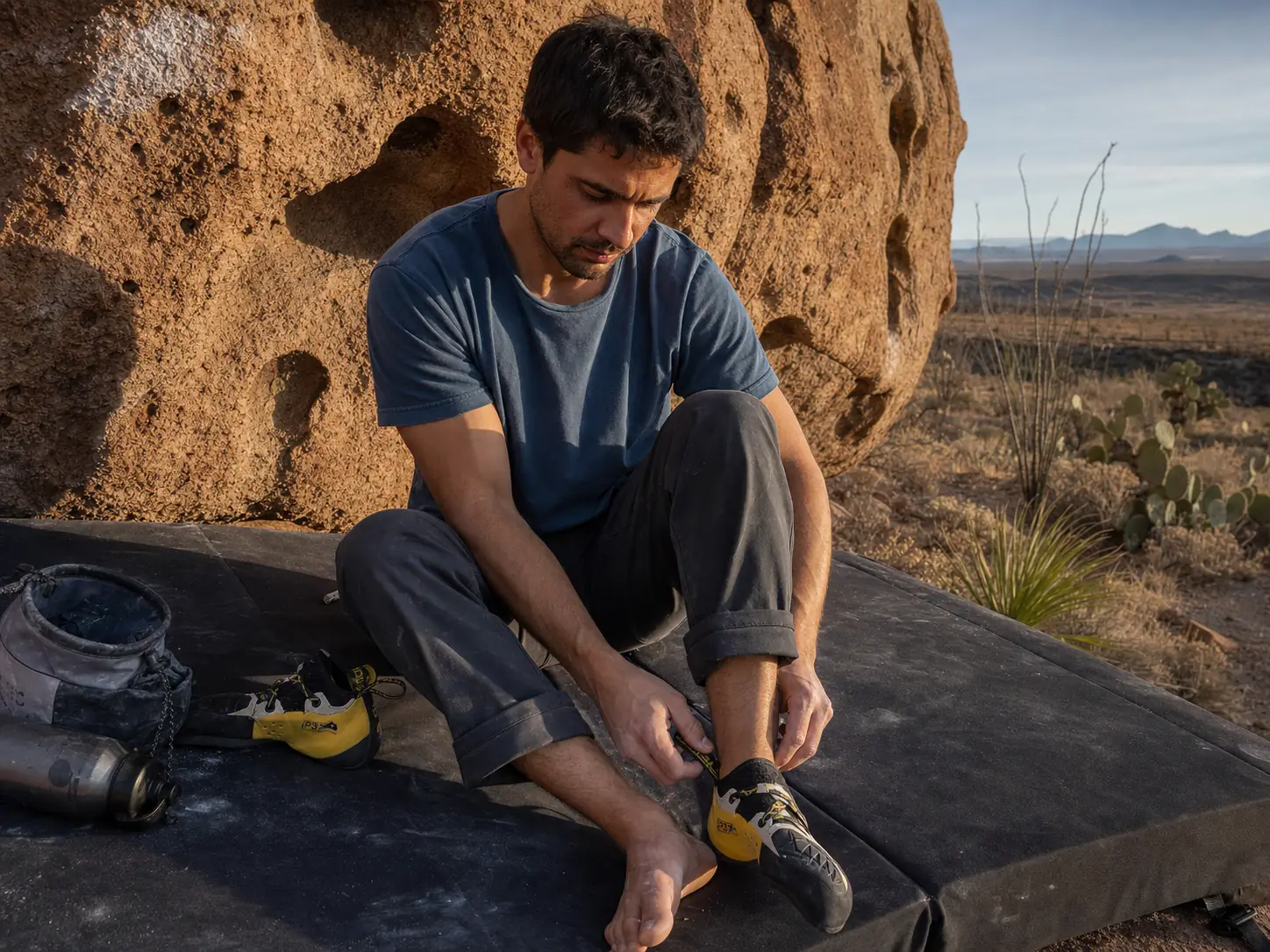
Gate two: you already own a broken-in moderate shoe you can climb a full session in. Aggressive shoes are not session shoes. They come off between attempts, and if they are the only pair you own, you either wear them for four hours (which is how feet get damaged) or you buy them too big (which is how shoes get ruined). If you do not have that second pair yet, the honest move is to get a broken-in moderate pair you can climb a full session in first and come back to this article in a year.
The reason that second pair is a prerequisite rather than a nice-to-have is that an aggressive shoe you own alone stops being an aggressive shoe inside a season. You will size it for survival instead of for performance, wear it through warm-ups it was never meant to see, and end up with a stretched, flattened pair that does none of the three jobs well.
Gate three: you are willing to run a two-shoe quiver permanently. Not as a temporary phase. This is the operating model for the category, and if the idea of owning and carrying two pairs sounds like too much, the aggressive shoe will end up doing a job it was never built for.
The phrase for what most people are actually shopping for is a quiver of one, the single pair you would keep if you were forced to choose. An aggressive shoe is almost never that pair. It is a specialist that assumes a generalist already lives in your bag, and the category only makes sense once you treat it as the second pair rather than the upgrade to your first.
In practice that quiver splits along a line most climbers already recognize once it is named. Warm-ups, mileage laps and anything you expect to onsight happen in the older, flatter pair, where climbing a full session matters more than the last five percent of performance. The aggressive shoe comes out for the redpoint burn, the attempt that actually counts, and goes straight back in the bag afterward.
This is the single most repeated durability tip in the climbing forums, and it is not really a durability tip. It is the recognition that a shoe held at maximum tension for four hours of warming up and belaying is a shoe you spent on nothing.
Fail any one of the three and the aggressive shoe is a downgrade. That is not gatekeeping, it is arithmetic, and the arithmetic does not care how motivated you are.
There is a fourth failure mode that none of the three gates catches, and it is the one worth reading a forum thread about before you buy. A climber posting under the handle Mountainhick described working through multiple downturned models and finding every one of them incompatible with the actual anatomy of their foot, in language about ripping tearing pain that was plainly not describing normal break-in discomfort.
Some feet do not fit this category at any size, in any brand, at any price. That is a shape problem rather than a toughness problem, and no amount of patience or sizing strategy converts one into the other. Finding out which situation you are in is the entire job of the next section, and it costs nothing to check before the money leaves your account.
Gate one is the one worth measuring rather than estimating, because it is the one everybody gets wrong in their own favor. Spend one session counting: of everything you got on, how much was genuinely overhanging, and how much was vertical or slabby with a steep crux in the middle? The count usually comes in lower than the self-image does. Buy for the majority of your climbing rather than for the minority of it you enjoy talking about.
The forum answer to whether downturned shoes are necessary is the flat one already quoted, and it holds up. There is one caveat worth keeping, though, phrased by a climber who has clearly been there: at your absolute physical limit, that letter grade difference starts to become a big deal. Read that carefully. At your limit.
It is worth being literal about that unit, because it is smaller than it sounds. A letter grade is the increment from 5.12a to 5.12b, one notch, the kind of gap two honest climbers can argue about on the same route. That is the size of the prize. It is real, and at the absolute ceiling of what you can physically do it decides whether a move goes at all, which is why elite climbers care about footwear with an intensity that looks unhinged from the outside.
Below your limit, on the other ninety-five percent of what you climb, the shoe is not the variable and pretending otherwise is expensive.
Session structure is the gate people underestimate. Aggressive shoes are single-pitch and boulder-lap tools, and there is universal agreement across every source in this category that they are unsuitable for multipitch and long days. Nobody argues that point. If your climbing is mostly long routes, the entire category is the wrong aisle.
The reason is mechanical rather than a question of toughness. A downturned last holds your foot in a shape it cannot leave, so there is no neutral position to rest in between pitches, no standing flat on a belay ledge for twenty minutes, and no relief on a long walk-off. On a boulder problem that lasts forty seconds, none of that matters. On a six-pitch route it is the entire day.
Then there is the part that no spec sheet can measure. There is a well-known field report from a climber who came back from a foot injury climbing in flat La Sportiva Mythos, felt strong, and then switched back to their aggressive Miuras and discovered they had less trust in them. Objectively better grip. Subjectively worse climbing.
The shoe was never the limiter, and confidence turns out to be a real variable that upgrading too early can quietly cost you.
Match the Shoe to Your Foot Shape, Not Your Grade
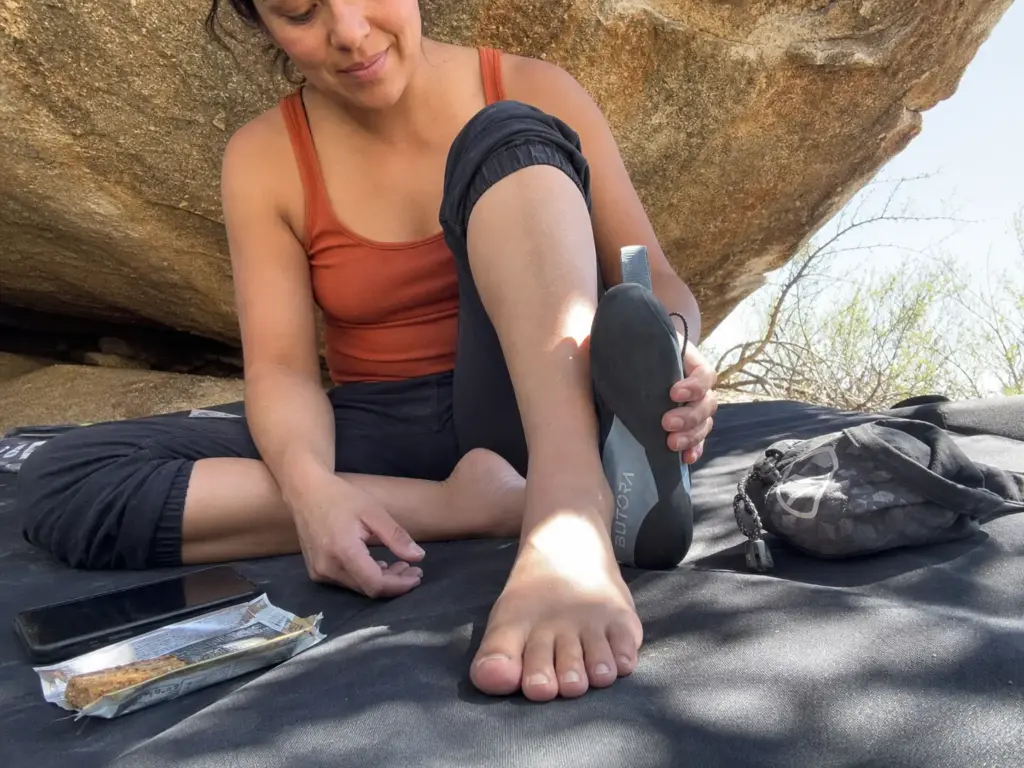
Nobody in a gym shop asks what shape your toes are. They ask what size you wear and hand you the shoe from the poster on the wall. But the failure mode in this category is almost never buying the wrong brand. It is a wide forefoot or a Morton’s toe crammed into a pointy asymmetric last, which is the moment a shoe stops being uncomfortable and starts being an injury in slow motion.
GearJunkie’s own testers put the warning in print: extended time in aggressively asymmetric shoes could even cause you to develop bone spurs or hammer toe, and the risk runs highest for climbers with Morton’s toe and wide forefeet. That is the most useful sentence anyone has written about this category, and it is buried three-quarters of the way down every roundup that bothers to include it at all.
Toe shape: Egyptian, Greek (Morton’s toe), and Roman feet in an asymmetric last
There are three common toe profiles and they behave very differently inside an asymmetric shoe. An Egyptian foot has the big toe longest, with the rest tapering down in a clean diagonal. This is the shape the entire category was designed around. The asymmetric point sits over the toe that is already furthest forward, power transfers where the designer intended, and the shoe works with you.
A Greek foot, more commonly called Morton’s toe, has a second toe longer than the big toe. Put that foot into a pointy asymmetric last and the shoe loads the wrong digit on every move. Your second toe takes force it was not built to take, curls under to fit a space shaped for a different toe, and stays curled for the length of your session. This is the profile the bone spur and hammer toe warning is aimed at directly.
A Roman foot has the first three toes at roughly even length, usually with more forefoot width. It is not incompatible with the category, but it is incompatible with the pointiest lasts in it, and it belongs in the wide-fit and higher-volume options rather than the comp-shaped ones.
None of this is a preference ranking. It is a compatibility check you run once, before you spend the money.
Width and volume: why LV and HV exist, and which one you are
Width and volume are two different measurements and confusing them is why so many people buy twice. Width is how broad your forefoot is across the ball. Volume is how much three-dimensional space your foot occupies, driven mostly by instep height and heel size. You can absolutely have a narrow foot with a high instep, or a wide forefoot sitting under a low, small heel.
This is exactly why brands ship LV (low volume) and HV (high volume) versions of the same model. Mad Rock builds the Drone 2.0 in both. Scarpa makes an LV version of the Drago for narrow feet, though it is currently on backorder rather than available. Those SKUs exist because the two axes genuinely diverge, and because the standard advice to just size down cannot solve a volume mismatch.
Sizing down a shoe that is too voluminous for your instep gives you a shoe that is too short and still loose. Sizing up a shoe that is too narrow gives you a longer shoe that still crushes your forefoot.
The folklore around downsizing is not imaginary, to be fair. Researchers measuring climbing footwear practice found that climbers downsize by nearly four UK sizes on average, which is a genuinely extreme number and confirms this is a real, measured behavior rather than gym mythology. But measured behavior is not the same as correct behavior, and none of that downsizing changes the shape of the last.
A shoe that is the wrong shape at size 42 is the wrong shape at size 40. If you want the full version of that argument, this is the shortest route to how a climbing shoe is actually supposed to fit.
The heel, the arch, and the part you can’t stretch out
Heel shape decides heel hooks far more than rubber compound does. The La Sportiva Solution’s 3D molded heel cup is the entire reason it has been the heel-hooking benchmark for something like a decade, and the Scarpa Instinct VS’s known weakness is heel slip on very aggressive hooks. Same category, same performance tier, opposite outcomes, decided almost entirely by whether the shape of their heel matches the shape of yours.
The arch platform works the same way. An aggressive shoe holds tension through the midfoot, and if your arch does not sit where the shoe expects it, that tension lands somewhere you did not agree to.
Here is the part that matters most for a purchase decision: neither of these changes with wear. Uppers stretch, rubber wears, straps loosen. Heel shape and arch structure do not. Whatever they feel like in the shop is what they will feel like in eighteen months, so those are the two things you have to get right on day one.
The Best Aggressive Climbing Shoes for Steep Rock
These are the four current-generation shoes worth buying for steep sport, bouldering and overhanging projects. Each one gets its honest weakness attached, because the best-for label is a job description rather than a ranking. Nobody wins this section. The terrain picks.
Current-generation aggressive shoes cluster at roughly $220 to $240 across the major brands, which is worth stating once so the budget argument in the next section has something to push against.
La Sportiva Skwama: Best Overall Aggressive Shoe
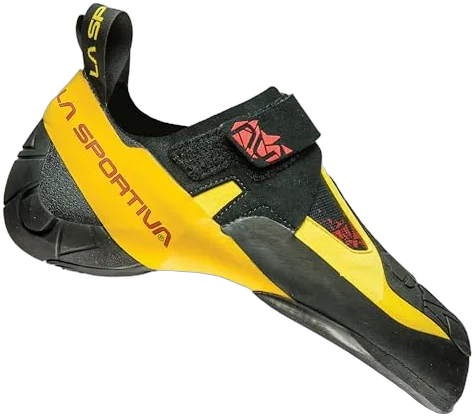
The La Sportiva Skwama (men’s · women’s) earns its position by being the only shoe here that does not force a hard trade. The split sole is the mechanism: separating the forefoot and heel rubber lets the shoe fold around a foothold and toe hook well, without the full-length stiffness that makes a shoe feel like a plank on overhang. GearJunkie’s testers landed on it as the most versatile shoe in the category, and it shows up in three or more independent roundups, which is unusual agreement for a market this opinionated.
The honest weakness is the leather upper. Leather stretches, and the Skwama’s stretches noticeably, which means the fit you buy is not the fit you keep. Size it genuinely snug, not just close, and expect it to settle into your foot over the first several sessions. If you size it comfortable in the shop, you will own a loose shoe by the time it is broken in, and a loose aggressive shoe has no reason to exist.
Scarpa Drago: Most Aggressive Pick for Steep Bouldering
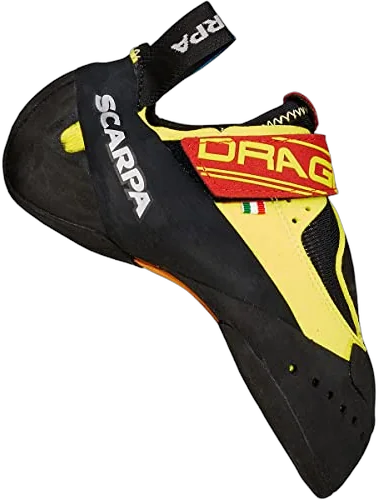
The Scarpa Drago is what people are picturing when they say aggressive. It is the most downturned shoe in this set and it removes the midsole entirely, which is a genuine design commitment rather than a cost saving. The result is a shoe that wraps volumes, grabs slopers, and toe hooks with an authority nothing stiffer can match, and one that is oddly pleasant to wear for something this extreme. It is also the shoe you want for toe scumming, where you press the rubber on top of your toes flat against the wall for pressure instead of hooking an edge with it, because a soft upper conforms to the rock and a stiff one skates off it.
The weaknesses are the direct consequence of that commitment. Ask it to stand on a small edge on vertical rock and it folds, because there is nothing in there to fold against. And 3.5 mm of soft, sticky rubber over no midsole wears through faster than anything else in this lineup, which pushes the resole clock forward. Narrow-footed climbers should know a Drago LV exists on a lower-volume last, though it is currently on backorder rather than in stock, so it is a thing to watch for rather than a thing to buy today.
Scarpa Instinct VS: Best for Steep Sport Climbing
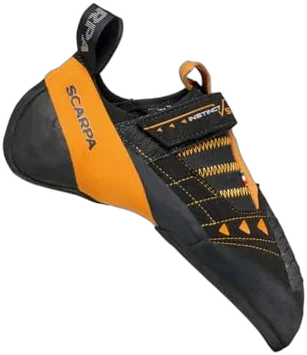
Steep sport climbing asks for something the pure boulder slippers cannot give you, which is the ability to stand on a small foothold for long enough to clip, shake out and read the next section. The Scarpa Instinct VS (men’s · women’s) solves that with a half-length midsole under an aggressive last, which is a harder engineering problem than it sounds and the reason this shoe has stayed relevant for so long.
Its documented weakness is heel slip on very aggressive heel hooks, which is a real limitation on modern bouldering terrain and a non-issue on most sport routes. With two Scarpa models sitting back to back here, it is worth understanding how the rest of Scarpa’s line compares, particularly the lower-volume lasts, before you commit to either one.
La Sportiva Solution: Best for Heel Hooking and Outdoor Bouldering
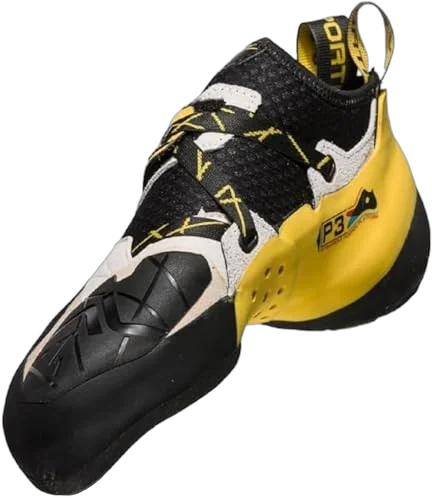
Outdoor bouldering punishes a bad heel. Modern problems are full of hooks where your entire weight hangs off the back of the shoe, and most of the failures people blame on technique are actually a heel cup rotating off the hold. The La Sportiva Solution (men’s · women’s) has held its position because the 3D molded heel cup keeps its shape under that load instead of deforming.
Its weaknesses are the standard specialist tax. It is not comfortable for all-day use, and on a narrow foot the Velcro strap runs long enough to be genuinely annoying. It is also a shoe whose heel either fits you or does not, with very little middle ground, which is the reason the heel discussion earlier in this article matters more here than on any other pick.
Run a two-shoe quiver and none of these shoes has to be perfect. Warm up and lap easy problems in an older, flatter pair, then put the aggressive shoe on only for the redpoint or onsight burn that actually matters. It is the single most repeated durability habit in the sport, and it quietly reframes every card above: not one of these is a quiver of one, and buying it as though it were is how climbers end up disappointed in a shoe that was working exactly as designed.
Aggressive Shoes for Wide Feet, Tight Budgets, and the Step Up
Every roundup on this topic has a budget pick, and almost every one of them is a lie of omission. The La Sportiva Tarantulace, the Butora Endeavor, the Mythos Eco: those are all flat beginner lasts. They are cheap shoes. They are not cheap aggressive shoes, and a reader who wants downturn without the premium price is being handed a completely different product with a reassuring price tag on it.
The same structural gap swallows wide-footed climbers. The wide-fit picks the field still names are frequently the ones that have quietly gone unavailable, which leaves the exact profile most at risk from a pointy asymmetric last with no live recommendation at all. These four shoes close both gaps, plus the one for climbers who are one honest step away from ready.
Mad Rock Drone 2.0: Best Budget Aggressive Shoe
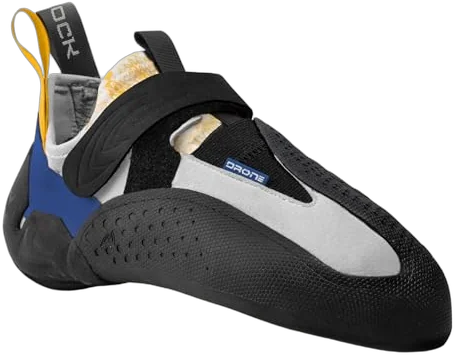
The Mad Rock Drone 2.0 matters because of what it proves rather than what it costs. A downturned last, a compression toe box and a 3D expandable molded heel are not budget features, and finding them together at roughly half the price of the premium tier is the closest thing this category has to an argument. The XF Xtreme Friction rubber is not going to be mistaken for XS Grip2 by anyone with a trained foot, but it is sticky enough that the shoe’s geometry is doing the work it was designed to do.
The two-volume split is the part worth pausing on. LV is built for a narrow foot with a low heel; HV is built for a wide foot with a high instep. That maps directly onto the volume axis from earlier, and it means this is one of the few shoes here where you can actually act on knowing your own volume rather than just being aware of it. If you are not sure which one you are, that uncertainty is itself the answer to whether you should be buying your first aggressive shoe at the premium tier.
Butora Gomi: Best Aggressive Shoe for Wide Feet
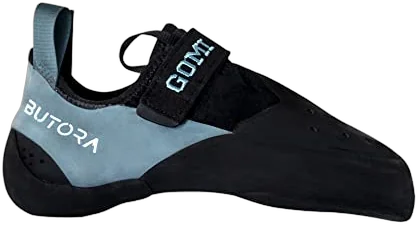
This is the most important row in the entire article, and it is the one the rest of the field structurally cannot fill. Wide forefeet are precisely the profile that gets warned about bone spurs and hammer toe in an aggressive asymmetric last, which means the climbers with the most to lose from a bad fit are the ones with the fewest live options. The Butora Gomi is a genuinely downturned bouldering shoe built on a last that accommodates that width instead of compressing it into a point.
The NEO Fuse rubber is soft and grabby in the way a bouldering shoe should be. What makes this pick load-bearing is not the compound, though, it is that a wide-footed climber can enter this category at all without accepting damage as the entry fee. If you have spent years being told to just size up and deal with it, this is the shoe that makes that advice unnecessary.
Worth being clear about what a wide-fit aggressive shoe does and does not solve, because the two get conflated constantly. A broad last gives your forefoot somewhere to sit, which removes the crushing across the ball of the foot. It does not shorten the shoe and it does not blunt the asymmetry, so a Morton’s toe still has to deal with a toe box that tapers toward the wrong toe.
Width and toe shape are separate problems. Buying wide only fixes one of them.
La Sportiva Miura VS: Best Stepping Stone From Moderate to Aggressive
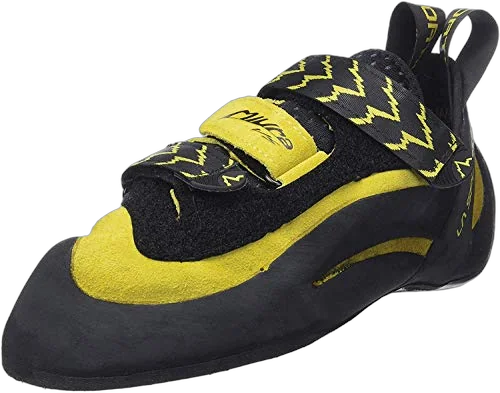
If you failed one of the three gates earlier but still want to move in this direction, the La Sportiva Miura VS (men’s · women’s) is the shoe that gets you there without the damage. The XS Edge compound is harder and holds an edge instead of smearing into it, the P3 midsole keeps the shape from collapsing, and the downturn is present without being punishing. You can climb a full session in these, which means they can be the second half of your quiver later rather than a shoe you outgrow.
The honest weakness is one climbers raise repeatedly: the Miura’s downturn does not hold up over time as well as some rivals do, so it can go flat before the rubber is finished. Given that four of this article’s eight picks come from the same brand, it is worth seeing where the Miura VS sits in La Sportiva’s range before deciding whether it is your step up or your ceiling.
La Sportiva Ondra Comp: Best for Gym and Comp-Style Climbing
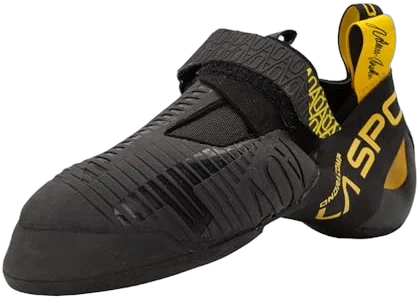
Modern gym setting is its own discipline now. Large volumes, dual-tex slopers and coordination moves reward a shoe that can wrap around a shape and hold friction across a broad contact patch, and that is what the La Sportiva Ondra Comp is tuned for. The SenseGrip treatment on 3.5 mm of XS Grip2 keeps the sensitivity high without the shoe going completely boneless, so it still edges when a route setter puts a small foot chip on a wall.
Two clear warnings on this one. It is the most expensive pick in this article and it is a specialty tool, so it should not be anybody’s first aggressive shoe. And a comp-oriented shoe is the wrong purchase for a climber who spends most of their time on real rock, where the foot holds are smaller, sharper and less forgiving than anything a setter bolts on. Buy it because your climbing is indoors and modern, not because it is the newest thing on the shelf.
One more piece of honesty before moving on, because it changes the math on every card above. A shoe you resole twice a year is not a one-time purchase, and that is exactly what makes the budget pick a real argument rather than a compromise. The section on cost of ownership at the end of this article is where that gets quantified.
Rubber, Midsole and the Edging-Versus-Sensitivity Tradeoff
Spec sheets in this category read like trivia until somebody points out that 3.5 mm versus 4 mm is the entire argument. Half a millimetre of rubber and the presence or absence of a strip of plastic under your forefoot change how a shoe behaves more than the logo on the heel does. Once you can read those two numbers, you can predict how a shoe you have never worn will feel.
Here is the current aggressive set laid out by the specs that actually matter. Scarpa Drago LV runs 3.5 mm of XS Grip2 with no midsole. La Sportiva Solution runs 4 mm of XS Grip.
La Sportiva Skwama runs 4 mm of XS Grip2. La Sportiva Ondra Comp runs 3.5 mm of XS Grip2 with SenseGrip. Those numbers are not marketing. They are the specification that predicts feel.
XS Grip 2 versus XS Edge: grip compound or edging compound
Vibram makes both compounds and they are built for opposite jobs. XS Grip 2 is the softer, stickier friction play, designed to deform around texture and hold on slopers and volumes. XS Edge is the harder compound, designed to resist deformation so that a thin sliver of rubber under your big toe stays a thin sliver of rubber instead of rolling off the hold. Worth knowing that a third path exists: La Sportiva’s No-Edge technology deletes the defined edge entirely on some of its other lasts, which is a different answer to the same question and is not represented anywhere in this set.
That fork explains a lot of otherwise confusing shoe behavior. The Miura VS runs XS Edge, which is exactly why it can be a genuine all-day shoe. The Drago cannot be, and no amount of break-in will make it one, because its compound and its construction are both committed the other direction.
The instinct that stickier is always better is the most common mistake here, and it is worth understanding why stickier rubber isn’t automatically better before you use compound as a tiebreaker between two shoes.
Sole thickness, 3.5 mm to 4 mm, and what that half-millimetre buys
Aggressive shoes run 3.5 to 4 mm of outsole rubber. All-round and moderate shoes run 4 to 5 mm. That deficit is the whole reason aggressive shoes wear out first, and it is a design decision rather than a defect: every fraction of a millimetre you remove is sensitivity you gain.
What the thinner sole actually buys is information. You can feel the difference between a crystal and a divot through 3.5 mm in a way you simply cannot through 5 mm, and on steep rock where your foot placement is often blind, that feedback is worth more than the support you gave up. It also means your rubber has fewer sessions in it before the resole conversation starts, which is a real cost that belongs in the purchase decision rather than as a surprise three months later.
Midsole presence: full, half-length, or none at all
The midsole is the hidden variable that most buyers never check, and it does more to define a shoe than the downturn does. No midsole, as in the Drago, gives maximum sensitivity and effectively zero edging support. A half-length midsole, as in the Instinct VS, means you can stand your full weight on a real edge and the shoe holds its shape underneath you. Full-length midsoles belong to a different category entirely.
Then there are the structural systems that sit alongside the midsole. La Sportiva’s P3 platform in the Solution and Miura VS exists specifically to stop the downturn from collapsing over the life of the shoe, because a downturned last is under permanent tension and tension relaxes. That is what climbers mean when they call a pair blown out: not that the rubber is gone, but that the rand and the downturn have given up and the shoe has quietly become a moderate.
When you are stuck between two shoes, ignore the downturn photos and compare three lines on the spec sheet instead: compound, sole thickness, and midsole. Grip compound plus thin rubber plus no midsole is a steep bouldering shoe no matter what the marketing says. Edge compound plus thicker rubber plus a midsole is a vertical and sport shoe. Those three lines will tell you what a shoe is for faster than any review will.
Sizing and Break-In on a Downturned Last
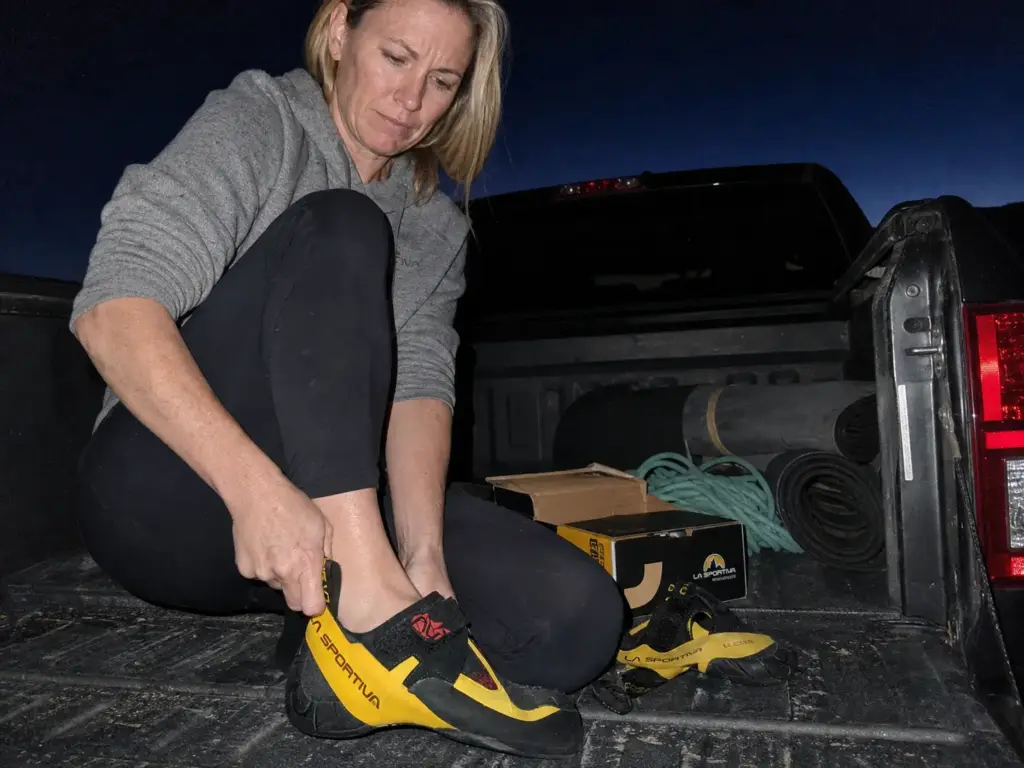
Most of the damage done in this category happens here, and it happens because the advice everybody repeats was written for a previous generation of shoe. The friend-at-the-crag version is short: the downturn already curls your toes for you, so you do not have to pay for that curl a second time in sizing.
Why “size down hard” is the wrong instruction on an aggressive last
Tester guidance on the Skwama, the Solution and the Drago LV converges on the same recommendation, which is to start at your street shoe size or size down slightly. That directly contradicts the folklore of dropping one or two full sizes, and it is not softness creeping into the sport. It is a consequence of how modern aggressive lasts are built.
The geometry of the shoe is already holding your toe in a curled, powered position. Adding aggressive downsizing on top of that does not add performance, it just adds compression to a foot that is already in a compressed shape.
The second reason the folklore persists is worse. Pain is not the fit test. Imaging research on climbing footwear found foot pain reported by more than 90% of climbers, which means discomfort is the baseline condition of the entire category, not a signal that you sized correctly. If nine out of ten people in a room are in pain regardless, your pain tells you nothing about your shoe.
Fit has to be judged on the things that vary instead: whether the heel locks without a pocket of slack behind it, whether there are localized hot spots rather than general tightness, and whether your toes are curled or crumpled.
Buying them too big is the other failure mode
The overcorrection is just as common and considerably more expensive. Climbers who have heard how much aggressive shoes hurt buy them roomy so they can survive a long session, and in doing so they destroy the mechanism they paid for.
An aggressive shoe works because the tension rand pulls against your foot. Remove your foot from that equation by leaving space, and the rand has nothing to pull against, so it starts pulling the shoe itself out of shape. This is the single most common reason a pair goes flat months before the rubber is worn out. The shoe did not break in — it gave up.
Break-in, stretch, and what will never change
Leather uppers stretch, and the Skwama’s is notable for it. Synthetic uppers in microsuede and microfiber barely move at all, which is why a Scarpa Instinct VS fits about the same in month six as it did in week one. That much is common knowledge.
What is less commonly said, and what should change how you shop, is this: much of what makes an aggressive shoe feel aggressive is the construction and fit of the heel and the structure in the arch area, and that will not change much over time. You cannot break in a heel shape. You cannot break in an arch platform. Those two things are permanent from the moment you hand over the money, so they are the two things you have to get right in the shop while everything else is still negotiable.
If you have already made the downsizing mistake and are looking at a pair you cannot wear for more than a few minutes, there are safe ways to stretch a pair you already sized too small that will not wreck the rand in the process.
Store them with the straps fastened and let them air-dry flat, never crumpled in the bottom of a pack. Climbers describe pulling a pair of Dragos out at the end of a summer of being stuffed in a bag and finding they had set into the shape of a slipper, downturn gone. Break-in is something you manage on purpose, not something that just happens to a shoe while it lives in your car.
What Aggressive Shoes Actually Do to Your Feet Over Time
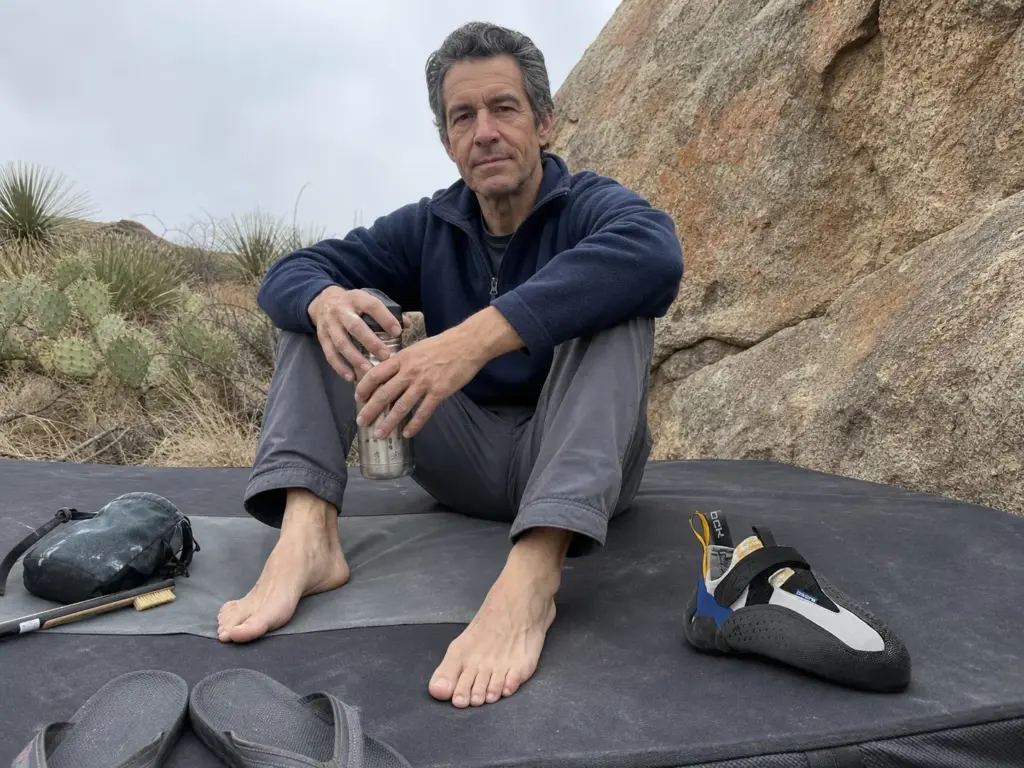
Nobody wants to be the person who ruins a shoe article by talking about bunions. But this is the part every roundup leaves out, and leaving it out means readers make a multi-year commitment with only half the information. What follows is not an argument against the category. It is the reason to dial in the fit, run the quiver, and take the shoes off between attempts, all of which cost you nothing.
The bunion numbers nobody prints
Here is the finding that should be in every article about this category and is in almost none of them. Hallux valgus, the joint deviation most people know as a bunion, was present in 53% of long-time high-level climbers, with 20% of that group affected bilaterally. The comparison figure matters just as much: a systematic review of hallux valgus prevalence puts the general-population rate near 23% for adults aged 18 to 65.
Read those two numbers together rather than separately. Bunions are common in the general population, so climbing did not invent the condition. But the rate among long-term high-level climbers is more than double the background rate, and that gap is the actual cost of the category, expressed in the only currency that counts.
It is worth being precise about who that 53% describes. These are climbers with years of high-level volume, not people who bought a pair of Solutions last spring. The number is a long-run trajectory, not a prediction about your next season, and the entire reason to publish it is that a trajectory is something you can change while you are still early on it.
It is worth being equally precise about what the numbers do not say. Nobody has demonstrated that a particular pair of shoes produced a particular bunion, and joint deviation has genetic and structural contributors that have nothing at all to do with climbing. What the comparison establishes is an association strong enough to plan around, which is a different and considerably more useful thing than a verdict on your own foot. The practical read is that this is a risk multiplier you control, not a diagnosis you have already received.
What the shoe is doing to your toe while you’re wearing it
The mechanism has been measured directly, and it is more concrete than most people expect. A hallux valgus angle of 14 degrees measured barefoot rises to 21 degrees inside a climbing shoe. Putting the shoe on physically shoves the big toe seven degrees off its natural axis, before you have touched any rock.
The observation that actually matters to you is whether that deviation goes home with you. A toe that sits at 21 degrees inside the shoe and returns to 14 the moment the shoe comes off is behaving exactly as the measurements describe, which is to say it is a loaded position and nothing more. A toe that stays pushed over after the shoe is off has moved from a loaded position to a resting one. That is the point at which the habit has started writing itself into the joint, and it is the only self-check in this section that costs you nothing to run.
Now add repetition. Four sessions a week, several hours a week held at that angle, year after year, and the soft tissue that would normally spring back stops springing back. That is not a dramatic injury with a date attached. It is a slow remodeling, which is exactly why it is so easy to publish shoe roundups that never mention it.
Loading makes it worse, not just wearing. Imaging research found that climbing shoes induce excessive angulation of the joints, more so when engaged in climbing, meaning the forces you generate on the wall compound the deformation the shoe is already imposing. And the compounding factor on top of that is downsizing: with climbers dropping close to four UK sizes on average, and aggressive asymmetric lasts being where that habit does the most harm, the combination of hard downsizing plus a pointy asymmetric last is what raises the risk of bone spurs and hammer toe. As established earlier, that risk lands hardest on Morton’s toe and wide forefeet, which ties this section straight back to the fit chapter.
There is a design detail that makes the whole pattern click into place, and it comes straight out of the asymmetry section near the top of this article. An asymmetric last exists specifically to rotate the shoe’s power onto the big toe, because that is the strongest digit you own. Hallux valgus is a deviation of the joint at the base of that same big toe.
The category’s central performance feature and the category’s documented long-term cost are aimed at exactly the same joint. That is not a coincidence to be explained away, and it is not a reason to climb in flat shoes either. It is the reason the habits below are not optional fussiness.
How to keep climbing hard without paying the full price
None of this argues for giving up performance. It argues for the operating habits that veterans already run, which look fussy from the outside and are actually the difference between a shoe you wear for ninety minutes a session and one you wear for five hours.
Take them off between burns. Not at the end of the session, between attempts, every time.
The reason that one habit carries so much weight is that the deformation tracks time under tension rather than difficulty. Your foot is held at 21 degrees whether you are pulling on a project or sitting on a pad watching someone else pull on theirs. Grade does not enter the equation, and neither does brand. Total minutes worn is the single variable in this section you fully control.
Walk the approach in flip-flops or approach shoes rather than the aggressive pair, which sounds obvious and is violated constantly at every crag with a short walk-in. Warm up and lap easy terrain in your moderate pair and save the aggressive shoe for the attempts that matter. Size for shape rather than for maximum tightness, using the criteria from the sizing section rather than pain tolerance.
The honest position is not that aggressive shoes are hazardous and you should avoid them. It is this: wear them, wear them correctly, and wear them considerably less than you think you need to. If the bulk of your volume is bouldering, the same fit-first logic applies to the whole discipline, and it is worth settling before you scale your sessions up rather than after.
How Long They Last and What a Resole Really Costs
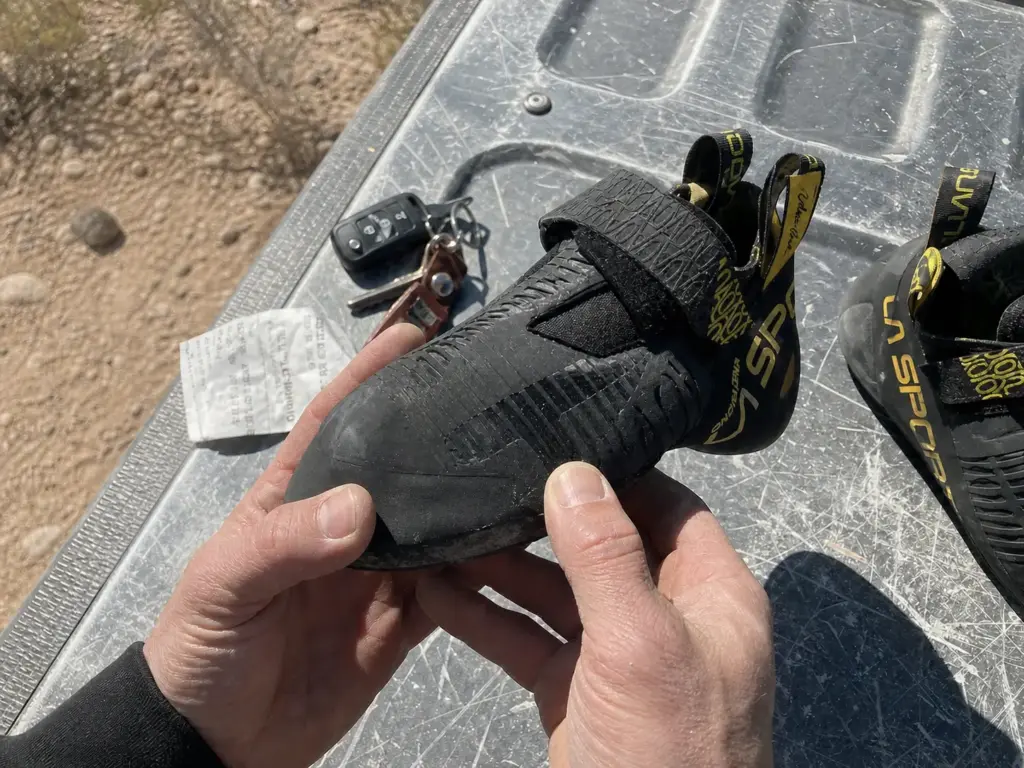
The number on the shoebox is not the price of the shoe. The climber at the crag with the twice-resoled Solutions knows the real math, and it is that math, not the sticker, that decides whether the budget pick or the premium pick is actually cheaper for the way you climb.
The three-month rule and why aggressive shoes hit it first
The working rule of thumb across the sport is roughly three months to the first resole at three to four sessions a week on a soft, thin-soled aggressive shoe. That number surprises people who are used to hiking boots lasting years, and it is not a quality problem.
It follows directly from the design. Aggressive shoes carry 3.5 to 4 mm of rubber where an all-rounder carries 4 to 5 mm, so there is measurably less material to consume before you reach the rand. On top of that, the compounds used are the softer, stickier ones, and softness and wear rate are the same property viewed from two directions. Then the use case concentrates all of that wear onto the front inch of the shoe, because toe-down climbing puts your entire weight through a contact patch the size of a coin.
Three months is the aggressive figure. A stiffer edging shoe on vertical rock at the same session frequency will run considerably longer, which is another quiet argument for the two-shoe quiver: every warm-up lap you climb in the old pair is rubber you did not spend on the expensive one.
What a resole costs and what it brings back
The numbers are more reasonable than most climbers assume.
A half sole typically runs $30 to $80. A full sole runs $60 to $110. A toe cap, for shoes where the wear has reached the rand area, runs around $15 per shoe. And a standard resole extends the shoe’s usable life by roughly 4 to 10 months.
Do that arithmetic once and the picture changes. Two resoles cost less than one new pair for very nearly every shoe in this article, and they return the shoe to a working state rather than a compromised one. A good resoler can bring the aggression back, as long as the rand and the heel structure are still sound underneath.
Run the category as an annual number instead of a sticker price and the budget argument sharpens considerably. A shoe at the top of that $220 to $240 range, resoled twice in a year, is really a three-hundred-dollar-a-year shoe. That is the figure worth comparing against the budget pick, not the number printed on the box. It is also why a genuinely downturned shoe at roughly half the category price is a structural argument rather than a compromise: the same resole bill lands on both of them, so the gap between the two stays the gap in purchase price, year after year, for as long as you keep resoling.
That last condition is the whole game. Catch it before the rand blows through. The rand is the rubber band wrapping the sides and toe of the shoe, and once you have worn through it into the upper, you are no longer resoling, you are replacing.
The signal to watch for is the outsole thinning to the point where the rand starts contacting rock on toe-downs, which happens earlier than most people check for it. If your pair is anywhere near that, the signs that say resole now rather than next month are worth reading before your next session, not after it.
One caveat on what a resole can and cannot fix. It restores rubber. It does not restore a collapsed downturn, and a shoe that went flat early almost certainly went flat because it was bought too big rather than because it wore out.
Climbers specifically name the Scarpa Vapor V and the La Sportiva Miura Lace as models that do not hold their aggression as well over time, while the Scarpa Mago comes up repeatedly as a shoe that does hold its shape. That is a durability characteristic worth knowing before you buy rather than after, and it does not appear on any spec sheet because there is no unit to print it in.
The resole arithmetic also lands differently depending on which end of the category you bought into. On a premium pair, two resoles against one replacement is not a close decision. On a genuinely inexpensive aggressive shoe, a full resole is a real fraction of simply buying the pair again, so the sensible move is often a cheap toe cap early and a replacement later rather than a full resole in the middle.
Either way, the thing that ruins the math is delamination, where the rubber separates from the midsole or the rand lifts away from the upper instead of wearing evenly. Wear is a bill you can pay. Delamination is a shoe your resoler will hand back to you.
The habits that buy you months for free
Four habits, none of which cost money, and together they are worth more rubber life than any spec on the box.
Warm up in the old pair, walk to the boulder in flip-flops, air-dry with the straps fastened, and never leave them crumpled in a pack or a hot car. Each one is measurable rubber life. A climber running all four can reasonably expect to push a first resole well past the three-month mark, while the person who wears their Solutions from the parking lot to the pad and back will be looking at the rand before the season ends.
The reason these work is that most of the wear on an aggressive shoe is not accumulated on the wall. It is accumulated walking on grit, scuffing on approach trails, and sitting between attempts with the rubber warm and soft. Heat in particular is worth taking seriously, because a hot car does more to the tension rand in one afternoon than a session of climbing does, and heat is also what starts delamination, where the rand and the outsole peel away from the upper and a straightforward resole turns into a repair job.
The Honest Verdict on Aggressive Climbing Shoes
So back to the forum veteran who asked whether the aggressive shoe advantage is real or in our heads. The honest answer is that it is real, small, and conditional. At your absolute limit, on genuinely overhanging rock, in a shoe that matches the shape of your actual foot, the difference shows up. Everywhere else it is a tax you pay in toe pain and rubber.
Three things to take away from all of this. Terrain decides before anything else does, so if your climbing is vertical or crack-heavy, the entire category is the wrong purchase no matter what grade you climb. Foot shape is a hard gate, not a preference, and a wide forefoot or a Morton’s toe in a pointy asymmetric last is a problem that no sizing strategy solves. The shoe is a tool for the burn that matters, not for the session, which is why the two-shoe quiver keeps showing up in every honest conversation about this gear.
Make the decision in that order: terrain first, foot shape second, budget third, and the specific model last. If you failed the readiness gates earlier, go get a moderate pair you can climb all day in and come back when your projects go horizontal. There is nothing embarrassing about that, and it will make you a better climber than buying the shoe you saw on a poster.
Frequently Asked Questions
01Are aggressive climbing shoes bad for beginners?
Usually yes, because an aggressive shoe assumes you already own a broken-in moderate pair and are willing to carry both to the crag. Run three gates: you project overhanging terrain, you own that moderate pair, and you accept a two-shoe quiver. Fail one and it is a downgrade. Start with a beginner-appropriate pair instead.
02Are downturned climbing shoes actually necessary?
No, not for the vast majority of climbing, because the field consensus treats downturn as a specialist advantage rather than a requirement at any normal grade. The one caveat: at your absolute physical limit on overhanging rock, that letter grade difference starts to become a big deal.
03Do aggressive climbing shoes hurt your feet?
Short-term discomfort is the category baseline, with over 90% of climbers reporting foot pain in their shoes regardless of which model they chose. Long-term structural change is separate and real: hallux valgus appears in 53% of long-time high-level climbers versus roughly 23% of adults generally.
04Should I size down in aggressive climbing shoes?
Start at your street shoe size or size down slightly, because a downturned last already curls your toe before you add any downsizing of your own. The old advice to drop a full size or two was written for flatter lasts, and on an aggressive shoe it buys pain rather than performance.
05How long do aggressive climbing shoes last before they need a resole?
Roughly three months of hard use at three to four sessions a week before the first resole is worth booking. A half sole runs $30 to $80 and adds 4 to 10 months. Catch it before the rand wears through, or you are replacing rather than resoling.
Safety Notice: Rock climbing and mountaineering are inherently high-risk
activities that can involve physical trauma or fatal incidents. The information on Rock Climbing Realms is for
educational and informational purposes only. Techniques and advice presented here are not a substitute
for professional, hands-on instruction. Conditions and risks vary by location. Always seek guidance
from a qualified instructor before attempting new techniques. By using this website, you agree that you
are solely responsible for your own safety. Any reliance you place on this information is strictly
at your own risk, and you assume all liability for your actions. Rock Climbing Realms and its authors
will not be held liable for any harm, damage, or loss sustained in connection with the use of this information.
Affiliate Disclosure: We are a participant in the Amazon Services LLC Associates Program, an
affiliate advertising program designed to provide a means for us to earn advertising fees by advertising and linking
to Amazon.com. As an Amazon Associate, we earn from qualifying purchases. We are also an official affiliate partner
of Black Diamond Equipment via the AvantLink network. If you click on a Black Diamond affiliate link and make a
purchase, we may earn a commission at no additional cost to you. We also participate in other affiliate programs.
Additional terms are found in the terms of service.