
In this article
The first time I stepped onto the slick Ogawayama granite, my boots skated off what looked like an easy smear. The rubber slipped completely. I immediately realized my standard tactics from Western crags were useless here. Climbing in Japan isn’t just about bagging new routes on a trip. After spending years dialing in high-performance climbing across the Chichibu-Tama-Kai National Park and evaluating the coastal cliffs, I learned that Japan is a ruthless, unforgiving ecosystem. It punishes sloppy footwork and demands a deep understanding of friction physics, advanced mixed-protection, and the local social contract. Here is an informational masterclass guide detailing exactly how to adjust your rubber, audit local anchors, and navigate the cultural rules so you send your projects safely and come home in one piece.
⚡ Quick Answer: Sending in Japan requires adapting to ultra-slick micro-grain granite with soft, high-viscosity rubber and maintaining a localized safety net through strict crag etiquette. You must account for intense marine corrosion on coastal bolts, utilize a specific technical-cultural interface, and adhere to rigid national park registration laws. Master these granite technical systems and cultural rules, and you avoid catastrophic gear failure while respecting the local climbing community.
The Physics of Japanese Granite: Ogawayama and Mizugaki
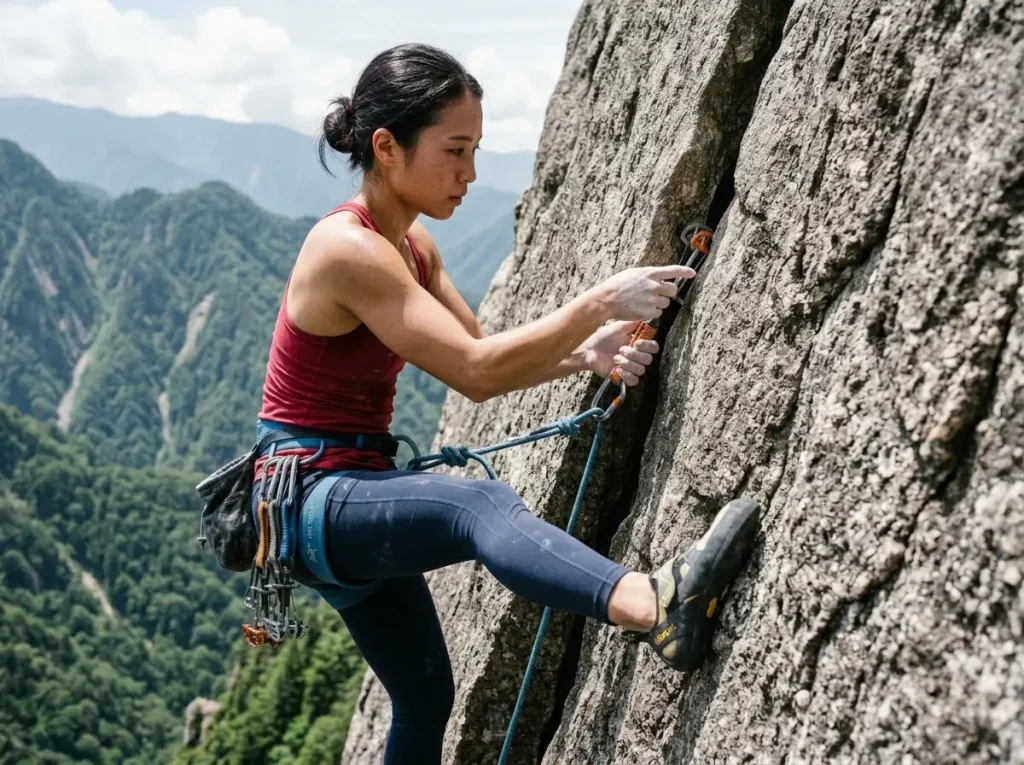
Ogawayama is the definitive destination for the hard-sending trad climber. Sitting at an altitude of 2,418 meters, the rock features coarse-grained biotite granite slabs laced with quartz and feldspar. Climbing here means you must optimize how much weight you push straight into the wall. Because positive edges are exceptionally rare, you have to maintain an extremely low center of gravity. You drive your weight vertically down through your feet, trusting razor-thin crystals on steep smears. If you pull outward or rely on finger strength to save you, your feet blow and you take the fall.
You cannot ignore your rubber. The specific rubber compounds you bring directly dictate whether you stick or slide. At the Mawarimedaira camp, temperatures swing from below freezing at night to 25°C in the afternoon sun. When the ambient temperature drops beneath 10°C, typical stiff edging rubber loses its flexibility. It turns hard and glazes over, stripping away your adhesion. Conversely, during the heavy rains of the Tsuyu season, the high-humidity environment turns the rock into a slip-and-slide.
Pro-Tip: Swap your climbing shoes based on the time of day. Use a soft, high-viscosity compound like Stealth C4 for crisp morning sessions, then deliberately switch to a stiffer edging shoe like Vibram XS Edge under the hot afternoon sun when the rock heats up.
While Ogawayama tests your precise footwork, nearby Mizugaki tests your entire trad rack. The volcanic-influenced rock is heavily fractured, shaped by weathering patterns that form deep, flared seams. These placements actively spit out standard passive nuts. Relying solely on the rare 1980s-era expansion bolts you find on the wall is an amateur mistake. You need a specialized mixed route protection setup.
Protecting these flared, weird seams requires carrying high-expansion-range active gear like Totem Cams alongside offset nuts for a true mixed-pro safety net. Every detail-oriented gear nerd knows that protecting non-parallel placements requires precision and a massive rack. Never trust an older bolt implicitly if a solid trad placement is available directly next to it. Bring your doubles of 0.4-2 and micro nuts. You might be busy adjusting your climbing shoe rubber compound, but you have to calibrate your protection mindset just as carefully.
The Micro-Texture of Ogawayama
High concentrations of quartz and feldspar make these slabs absolutely glassy. The region’s uplift means you have to master horizontal crack systems and friction smearing at the exact same time. Keep your heels incredibly low and push straight down into the crystals. Trusting this micro-texture demands psychological commitment. Your force-vector considerations must be flawless on every single pitch, because hesitation kills the friction immediately.
Mixed-Pro Mechanics at Mt. Mizugaki
The deep weathering here creates flared seams that reject standard pieces. Normal cams walk out of these placements or fail under load. You need small nuts for flared granite seams to back up the aging hardware scattered around the cliffs. A thorough bolt-safety audit should be part of every single lead. Always carry supplemental trad gear to protect yourself when the rusted bolts run out.
Adapting Rubber to the Tsuyu Climate
The softness of your climbing shoes must match the season perfectly. Avoid stiff rubber when temperatures drop near freezing. The best month to climb in japan is generally autumn or early spring, deliberately avoiding the heavy summer rains. Even so, adapting to the rock requires knowing how extreme temperature shifts change how your rubber grips the wall.
The Grading Philosophy: Decrypting the Kyū/Dan System
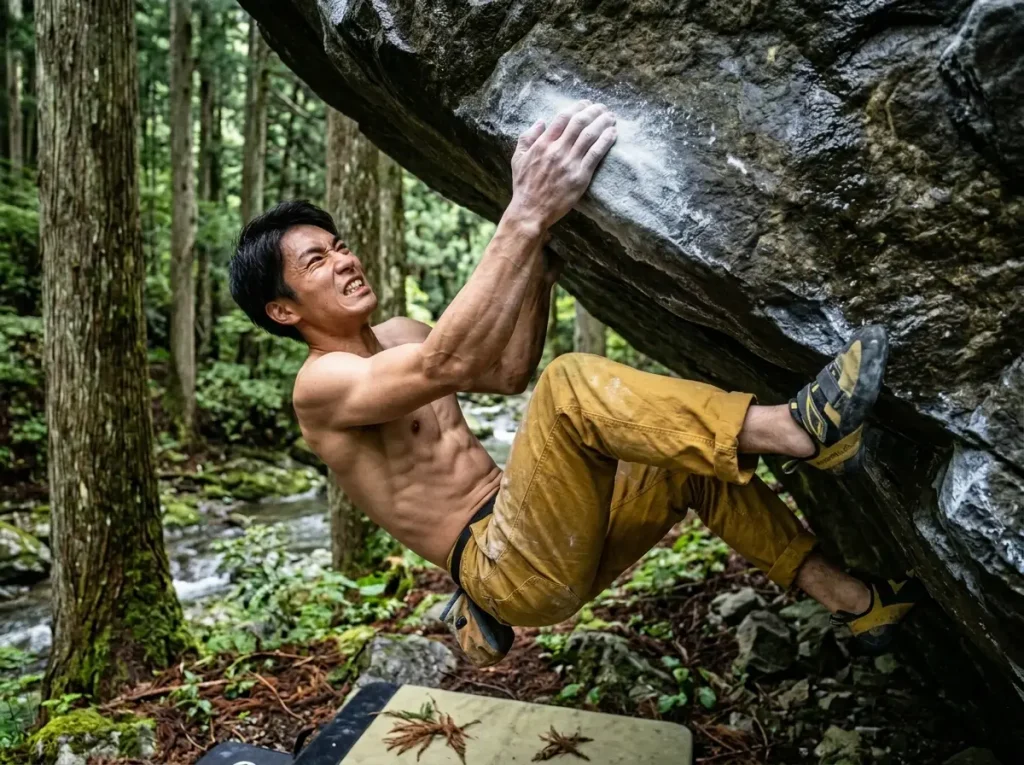
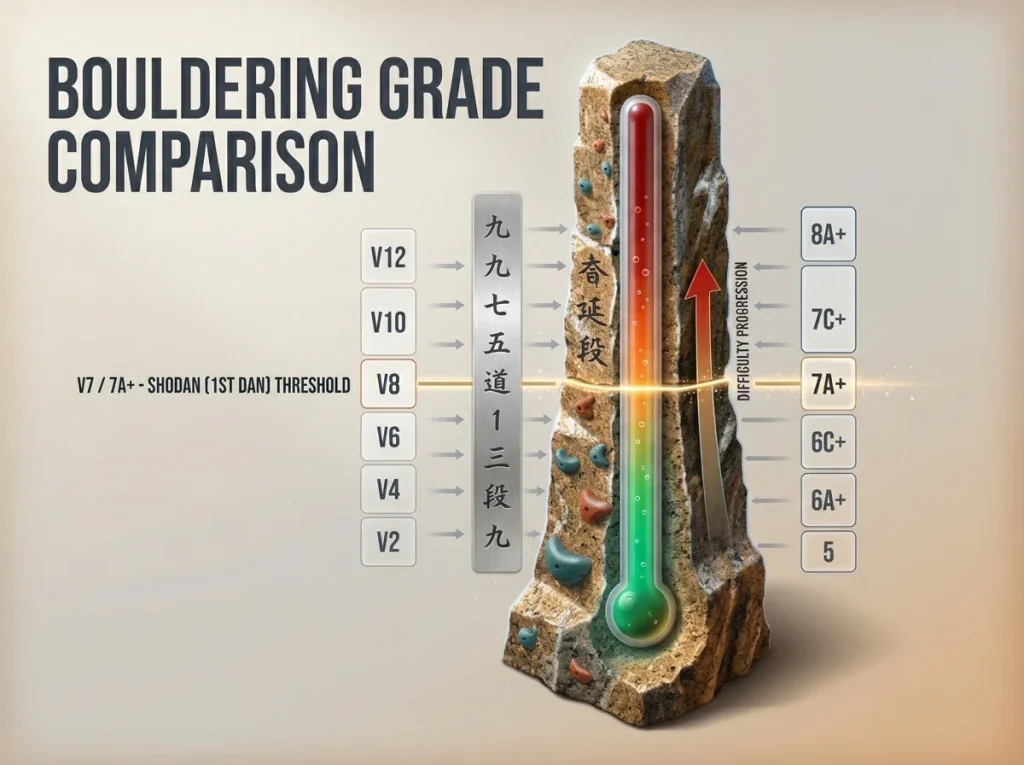
The Dankyū grading system translates directly from martial arts philosophy. It ignores the Western obsession with pure numbers, establishing a strict progression from student to expert. You start in the “Kyu” levels, which decrease in number as the difficulty rises. Reaching Shodan (1st Dan) means you earned your black belt in climbing movement. Looking closely at japanese bouldering grades, Shodan typically sits around the V7–V8 mark on the Hueco scale. You can find detailed comparisons in our breakdown of the V-Scale grading system, but know that the jump to Shodan is massive.
The transition to Shodan severely filters out climbers who rely on raw power and campusing. You literally cannot dyno your way through the kyu/dan ranks. The setters and the rock itself demand extreme hip mobility, core control, and physical tension. The holds require high-precision movement tailored to the high-friction granite. If your hips sag even a fraction of an inch away from the wall, the friction dies and the rock spits you off onto the crash pads.
At historical bouldering areas in japan like Mt. Mitake, the older grades are brutally sandbagged. The intensely polished schist and limestone surfaces will crush your ego instantly. A local 1-kyu problem will frequently humble a solid indoor climber from the West.
The underlying grading mindset fully embraces continuous self-improvement over time. The progression-focused climber uses the assigned grade as strict physical feedback rather than a cheap medal for their ego.
Pro-Tip: Train your core and hamstring tension specifically for months before your trip. Strong crimping fingers matter, but precise core tension strictly dictates whether you stick to the slick, nearly invisible footholds.
The Origins in Martial Arts
The framework represents long-term dedication to physical form. It punishes sloppy aggression and heavily rewards deep respect for biomechanics. You genuinely earn the higher grade by demonstrating absolute physical control, not just by thrutching your way to the top of the block.
Crossing the Shodan Threshold
Passing from the Kyu ranks requires mastering subtle hip tension. You have to dial in the absolute limits of your center of gravity under immense physical stress. Shodan-level climbs ruthlessly expose microscopic weaknesses in your footwork, breathing patterns, and core engagement.
Grade Variations and Sandbagging
Do not let the incredibly harsh legacy numbers frustrate you. Standard grade conversion charts only tell part of the story. Treat the established grade as technical feedback. Focus entirely on executing the beta perfectly, not on what numerical value the guidebook arbitrarily assigned to the line.
Coastal Anchor Crisis: The Hidden Danger of SCC
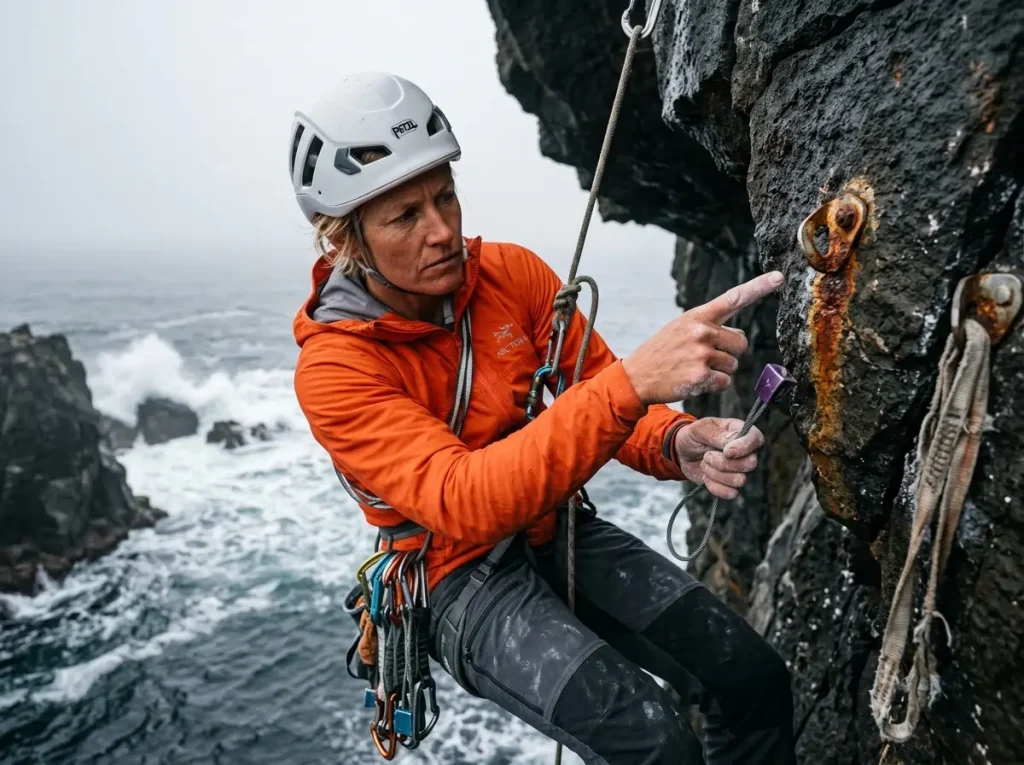
You might feel entirely comfortable clipping shiny bolts at a prominent crag back home, but the aggressive Japanese coastal environment destroys metal. Climbing at steep sea cliffs like Jo-ga-shima exposes you directly to Chloride-induced Stress Corrosion Cracking (SCC). This silent, invisible hazard methodically destroys standard stainless steel anchors from the inside out.
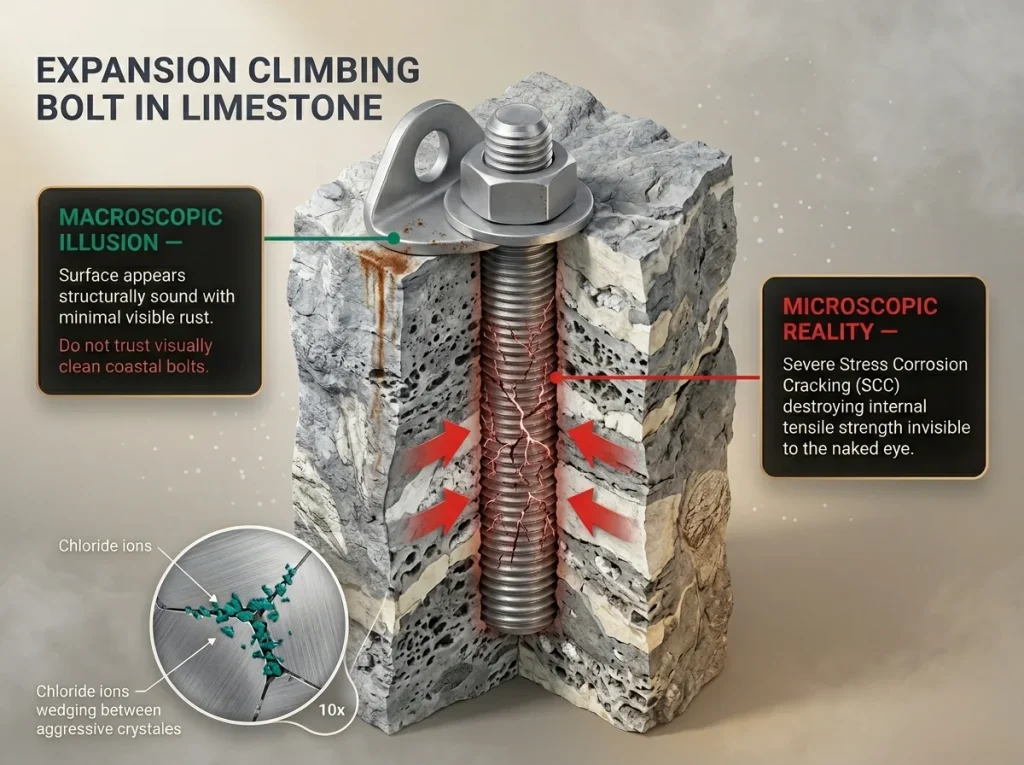
SCC occurs when high humidity fluctuations concentrate corrosive chlorides directly onto the hardware’s surface. Microscopic internal cracks form deeply within the metal without producing any visible surface rust. The bolt looks completely pristine from the outside. Then, during a routine lower-off or a minor slip, the entire piece shears off and fails under minimal forces (as low as 1 kN to 5 kN). When analyzing previous climbing anchor failures, the cause on sea cliffs is almost always silent internal fracture.
The Japanese coastline accelerates this catastrophic process brutally. Local humidity fluctuates rapidly between 20% and 70%, repeatedly hitting the specific deliquescence point of salt. Add summer temperatures exceeding 30°C, and the internal cracking chemical reaction speeds up exponentially. Severely overhanging routes and deep sea caves present the worst-case scenarios. They never get washed properly by the rain, allowing heavy chlorides to accumulate forever on the very bolts protecting your life.
The international safety consensus on this issue is absolute. Reviewing the UIAA Safety Commission’s findings on marine environments, the core data explicitly identifies Titanium Grade 2 as the only reliable, long-term material for permanent coastal anchors. The JMGA strictly agrees.
At Jo-ga-shima, I treat every piece of fixed gear as highly suspect. You have to adopt a paranoid trad climber’s risk management mindset even while on designated sport routes. The best climbing in japan isn’t worth a massive ground fall caused by a rotten, compromised bolt.
The Chemistry of Stress Corrosion Cracking
High humidity and extreme heat create the ultimate metallurgical nightmare. The chloride ions penetrate the steel’s grain boundaries relentlessly. Over a few short months, severe spiderweb cracks absolutely destroy the bolt’s tensile strength. You won’t see any of this damage until the hanger snaps off in your hands.
Why Jo-ga-shima Requires Extreme Caution
Unwashed, steep rock faces positioned near the ocean wreck AISI 304 and 316L stainless steel incredibly fast. Any stray rust weeping down from a bolt hole represents a massive, immediate red flag. A visually intact bolt head genuinely means nothing if the internal threaded shaft is completely compromised.
Safe Anchoring Practices on Sea Cliffs
Strictly verify if the local climbing developers have updated the specific physical route with Titanium Grade 2 glue-ins before you commit to the lead. Check the current technical safety data online. If you lack verification, build your anchors using traditional gear to fully back up the fixed bolts. Always leave redundant bailout carabiners if you are forced to retreat mid-route.
The Regulatory Layer: Mastering the Tozan-Todoke System
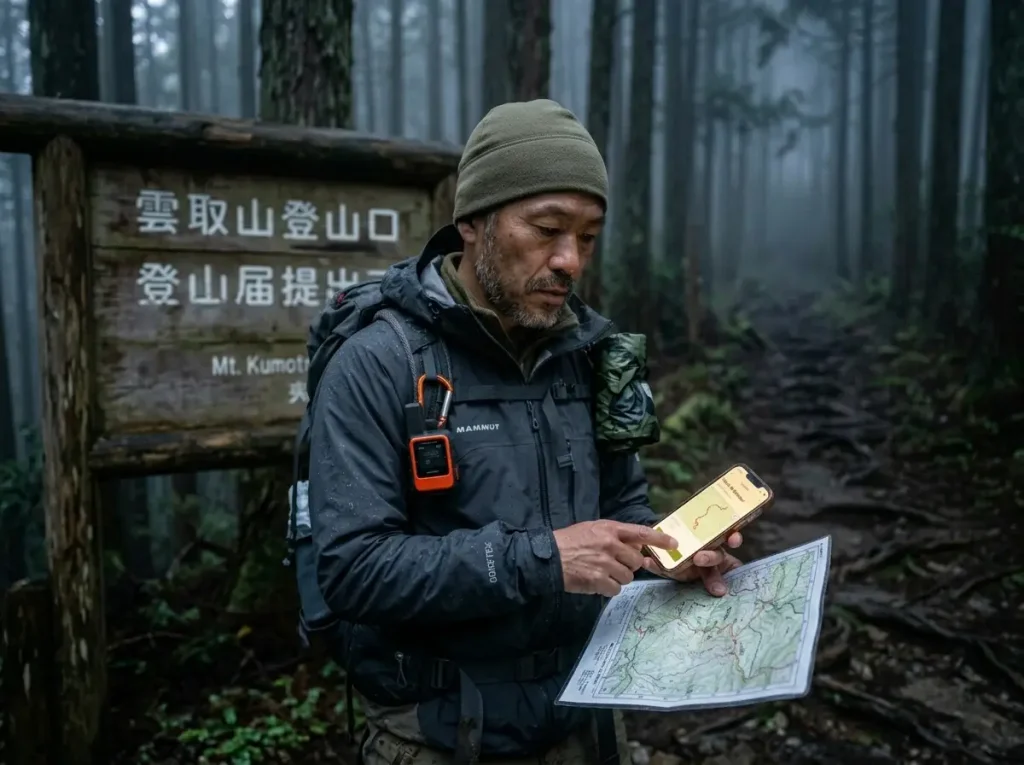
Japan’s pristine national parks operate under strict bureaucratic and ethical guidelines. You cannot casually hike into the deep backcountry. You are required to submit a highly detailed Tozan-Todoke, a mandatory mountain climbing itinerary report. This specific document acts as your formal safety contract with the state prefectural government.
The comprehensive report forces you to provide your intended route plan, your complete party roster, and an incredibly thorough gear manifest. You must strictly list your emergency food supplies, survival tools, and even the exact fabric color of your tent. Submitting this crucial document via the digital Compass app or direct police email thoroughly ensures that advanced Search and Rescue (SAR) teams acquire a highly restricted, narrowed search radius if an emergency occurs.
Do not brush off the climbing registration as annoying paperwork. Japan runs elite, world-class SAR operations. They utilize specialized police helicopters and JMGA-certified alpine mountain guides, but their effectiveness relies entirely on the precise data you provide. Any legitimate guide to climbing in national parks will aggressively reinforce that entering without registering is an irresponsible liability.
Beyond registration, the park networks enforce a seriously rigid leave no trace ethic. You must properly use Portable Toilet kits—dual-layer polymer bags containing physical absorbents—for completely carrying out human waste. Digging standard cat-holes at prominent crags or high alpine zones is a massive ethical violation. It severely contaminates the local watershed and directly leads to widespread crag access closures. When understanding how to poop outdoors efficiently, packing it out is the standard practice. According to Leave No Trace Principles, packing out solid waste using verified WAG bags is non-negotiable in fragile or heavily trafficked alpine ecosystems.
Pro-Tip: Never hang your filled waste bags swinging on the outside of your climbing pack. Store them internally inside a dedicated, durable dry bag. Prominently displaying your waste is deeply offensive to the locals and destroys our community’s reputation.
The Essential Submission Framework
Use the robust Compass app for automated GPS logging and rapid sharing with the Prefectural Police. Detail your entire trad rack and medical supplies so responders know exactly what capabilities you possess. Cellular density within the rugged Chichibu-Tama-Kai range drops rapidly to zero in the deep valleys.
Navigating National Park Ethics
The environmental preservation mandates established inside Japanese Nature Parks are thoroughly unambiguous. Pack out absolutely everything. Leave the climbing area visibly cleaner than you found it. The organized community holds zero tolerance for international climbers treating the forest like a dump.
Modern Regulations and Mt. Fuji Updates
High-traffic alpine zones like Mt. Fuji now heavily require mandatory entry fees and maintain strict daily climber limits. Actively use designated management apps like Shizuoka Fuji Navi if you expand your trip to include alpine objectives. Ensure your precise technical and cultural preparation thoroughly matches the unforgiving environment.
Sociology of the Crag: Etiquette as a Safety Protocol
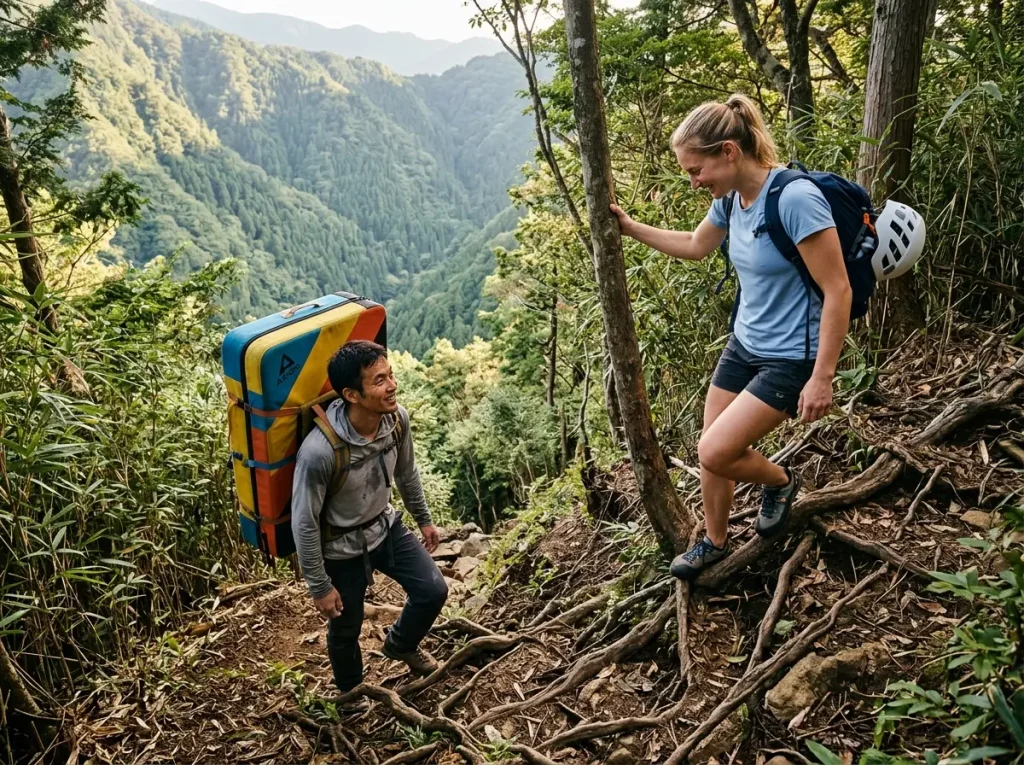
Crag etiquette in Japan actively operates as an applied, life-saving safety mechanism, not just as polite conversation. It starts immediately upon arrival with the strict greeting requirement. The mandatory, deliberate Konnichiwa fully initiates critical communication, successfully verifies intended rope lines, and formally establishes your physical presence at the crag.
This specific interaction functions as a robust safety protocol. It proactively prevents dangerous spatial conflict at highly crowded crags. It also opens the vital door for crucial beta exchange concerning hazardous loose rock, wet crystal pockets, or deeply degraded old japanese pitons. Most importantly, it creates a mental witness log. If a serious accident occurs, the climbers you specifically greeted become your primary SAR witnesses. If you spend time understanding global climbing etiquette, you quickly realize your verbal greeting serves directly as the foundation of your localized safety net.
On the punishingly steep mountain approaches, the ascending climber strictly possesses the right of way. Stepping aside is physically and culturally mandatory. The climber hiking forcefully uphill is burning significantly more energy and fiercely fighting gravity. You yield immediately without question.
Also, Japanese crags strictly enforce a harsh ethic of silence. You absolutely will not hear portable speakers blasting music. You will not hear obnoxious shouting or dramatic post-fall screaming. The japanese crag etiquette firmly demands a remarkably quiet environment. This practice effectively prevents localized noise pollution, heavily respects mountain wildlife, and solidly maintains the intense meditative focus required to confidently place micro traditional gear. Protecting the vital auditory link firmly established between the lead climber and belayer is an absolute non-negotiable standard.
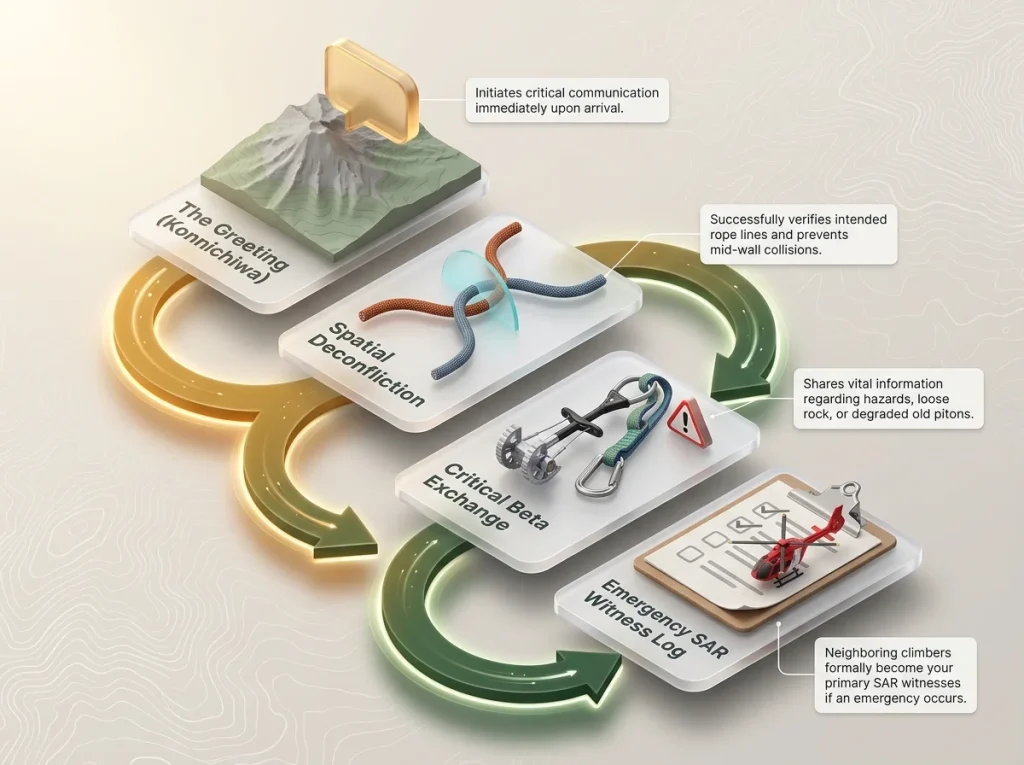
The “Konnichiwa” Safety Check
Make deliberate eye contact. Audibly greet the neighboring party long before you pull onto the starting holds. This completely breaks the ice and allows you to clearly ask about the rusted metal hardware scattered up high. It integrates you smoothly into the vital shared awareness of the cliff.
Respecting Right-of-Way on the Approach
Do not force the working, ascending climber off balance. Step decisively to the downhill side. Rapidly yielding ensures a thoroughly smooth traffic flow on exceptionally narrow mountain paths and prevents catastrophic slips downward on the steep, loose scree.
The Ethic of Silence in the Mountains
Keep your voice down. The intense psychological focus required for hard, runout trad lines shatters instantly when someone starts loudly yelling across the deep canyon. The profound quiet allows you to clearly hear hazardous rockfall, clearly hear rope commands, and carefully listen to what the stone is doing under your shoes.
The Technical Climber’s Logistics and Travel Kit
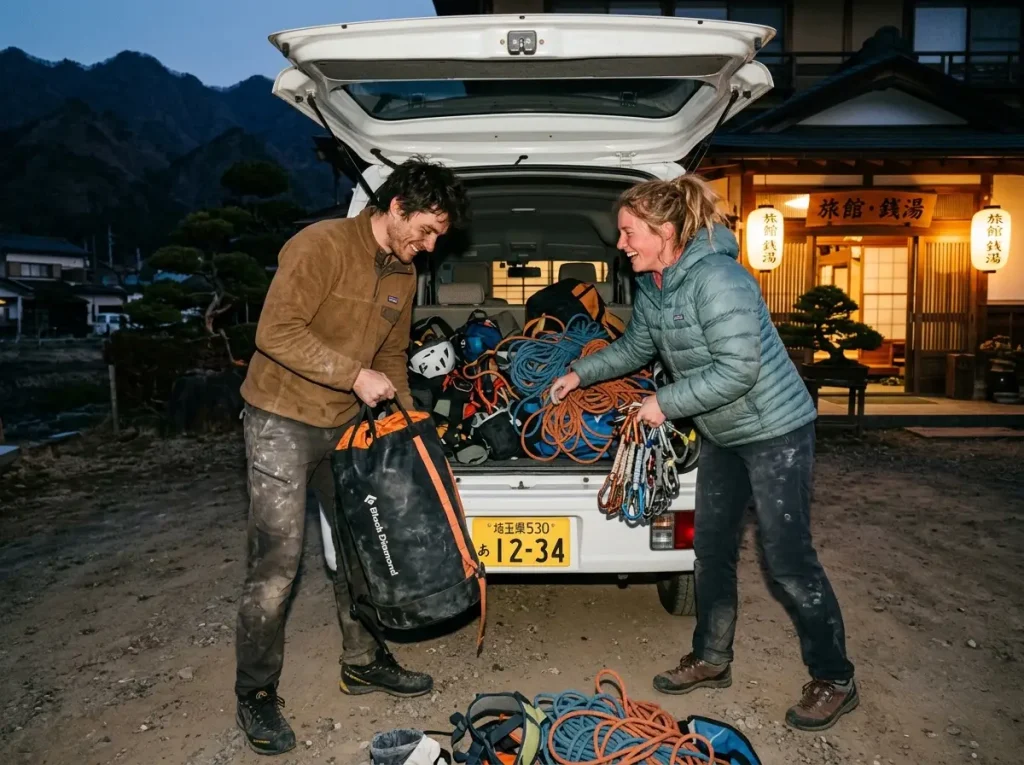
Reaching the absolute best granite blocks requires immense strategic planning. Accessing Ogawayama involves aggressively driving up extremely tight, winding mountain logging roads. Standard, heavy Western SUVs struggle miserably to pass oncoming traffic on these treacherous single-lane approaches. Your decisively best move is heavily utilizing kei car rentals.
A Kei car acts as a highly specialized light vehicle carefully restricted to a tiny engine capacity. It handles the sharp, incredibly steep switchbacks perfectly. Before you ever arrive in Tokyo, you must strictly secure an International Driving Permit formally formatted to the exact 1949 Geneva Convention standard. Exhaustively consulting our matrix of international climbing logistics verifies strongly that without this exact permitted format, Japanese rental agencies will bluntly refuse you service.
Your fundamental dirtbag instinct might strongly push you to rough it and sleep poorly every night on a crinkly pad, but deep muscle recovery remains strictly crucial. The extremely friction-heavy granite will absolutely shred your skin and brutally drain your endurance over several days. Intentionally integrating local Lodges and specific ryokan style accommodations deeply into your rest days is utterly essential.
Rigorously utilizing traditional thermal mountain baths acts as a profound physical requirement, not merely a casual luxury. The 40°C mineral-rich water thoroughly flushes built-up fatigue out of muscle tissue, drastically reduces extreme soreness, and completely resets your battered frame remarkably well for another focused day of heavy projecting. Highball bouldering safety requires fresh physical responses; ignoring recovery guarantees injury.
Pro-Tip: You must wash yourself completely thoroughly before ever entering the thermal bath waters. Vigorously scrub your chalk-stained hands, taped fingers, and dirt-covered legs sitting down in the designated shower area. Entering the shared bath unwashed severely violates the most sacred core rules of Japanese bathing etiquette.
Selecting the Right Vehicle Options
Firmly secure a reliable 4WD Kei car perfectly fitted with dedicated winter tires if you arrive anytime before June. Always explicitly pay for an Electronic Toll Collection (ETC) card. The manual cash toll booths massively waste precious time and create incredibly unnecessary stress. Never unlawfully park your rental vehicle outside explicitly designated zones.
Recovery Strategies: The Lodge and Ryokan
Systematically balancing cheap tent camping with brief, strategic stays at a prominent Ryokan dramatically speeds up deep soft-tissue repair. Do not stubbornly let sleep deprivation and massive inflammation secretly ruin your costly trip. Strictly use the incredible local infrastructure to consistently bounce back.
Navigating Remote Areas Digitally
Deep, shadowed mountain valleys block cellular communication signals completely. Extensively bring deeply detailed topo-reading guides in raw paper format. Continually carry a reliable offline GPS unit or a Garmin inReach satellite messenger. Relying entirely on your smartphone’s weak network connection practically guarantees you will get dangerously lost desperately looking for the hidden approach trail.
Conclusion
Climbing in Japan aggressively forces you heavily into an intricate, highly technical dance. You explicitly have to adapt your hard-won technical skills to hyper-slick slabs while rapidly adjusting your stubborn mindset to totally respect incredibly deep-rooted cultural safety protocols. You simply cannot carelessly brute-force your way straight up demanding Japanese rock surfaces. Absolute success requires endlessly optimizing your rubber compound choices, heavily scrutinizing every single coastal anchor you encounter, and executing your incredibly detailed registration submission absolutely flawlessly.
Deliberately dial in your physical redpoint tactics and specific friction smearing intensely at your local granite slabs starting today. Promptly replace those blown-out climbing shoes immediately with remarkably fresh rubber. Extensively hunt down your most vital local knowledge sources, strategically pack your specialized human waste bags, and absolutely respect the profound silence of the mountain crag. Now go send something.
FAQ
Do you need a car to rock climb at Ogawayama?
Yes, securing a resilient Kei car is overwhelmingly recommended. While generalized public transit networks successfully drop you off in the broad regional area, a small, heavily specialized rental vehicle definitely serves as the only truly efficient way to confidently navigate the final incredibly narrow mountain logging roads. It successfully hauls a massive full trad rack or numerous heavy crash pads deep out to the mountain camp.
Are the climbing grades in Japan harder than in the US?
Yes, Japanese established climbs remain notoriously and brutally sandbagged, especially when visiting heavily historic testing zones exactly like Mt. Mitake. You should firmly expect a local Japanese 1-kyu boulder problem to consistently feel much stiffer and harsher than a highly typical, modern indoor gym V5-V6. The intricate setting strictly demands maximum baseline tension and absolute unwavering trust in horrible friction smears.
What type of climbing rubber is best for Japanese granite?
A mid-stiffness, decidedly soft rubber exactly like Stealth C4 aggressively performs exceptionally well across the massive, rapid daily temperature swings frequently characterizing the central highlands. Firmly avoid utilizing extremely stiff edging rubber actively in cold weather conditions. It abruptly freezes, drastically loses its vital flexibility, and utterly refuses to heavily bite deep into the specific granite micro-crystals.
Is it safe to climb on the anchors at Japanese sea cliffs?
No, you should strictly never blindly trust any aging hardware located at humid crags like Jo-ga-shima. The intensely aggressive marine environment rapidly causes highly invisible, destructive Stress Corrosion Cracking (SCC) that ruthlessly destroys traditional stainless steel bolts completely from the inside out. Treat every single piece of fixed metal gear as highly suspect and compromised unless you can conclusively verify it completely as modern Titanium Grade 2 hardware.
What is a Tozan-Todoke and why do I need one?
The specific registration functions as a formally mandatory mountain climbing itinerary report legally required definitively by the Japanese prefectural police forces. It meticulously details exactly your intended route trace, rigid timeline, and crucial survival gear manifest. It strictly serves explicitly as your binding legal safety contract, guaranteeing fully that advanced search and rescue teams can precisely and efficiently locate you during a sudden severe emergency.
Safety Notice: Rock climbing and mountaineering are inherently high-risk
activities that can involve physical trauma or fatal incidents. The information on Rock Climbing Realms is for
educational and informational purposes only. Techniques and advice presented here are not a substitute
for professional, hands-on instruction. Conditions and risks vary by location. Always seek guidance
from a qualified instructor before attempting new techniques. By using this website, you agree that you
are solely responsible for your own safety. Any reliance you place on this information is strictly
at your own risk, and you assume all liability for your actions. Rock Climbing Realms and its authors
will not be held liable for any harm, damage, or loss sustained in connection with the use of this information.
Affiliate Disclosure: We are a participant in the Amazon Services LLC Associates Program, an
affiliate advertising program designed to provide a means for us to earn advertising fees by advertising and linking
to Amazon.com. As an Amazon Associate, we earn from qualifying purchases. We are also an official affiliate partner
of Black Diamond Equipment via the AvantLink network. If you click on a Black Diamond affiliate link and make a
purchase, we may earn a commission at no additional cost to you. We also participate in other affiliate programs.
Additional terms are found in the terms of service.