


In this article
You’re sixty feet up on a sport route, weighting your anchor to lower off, when you notice the nose of the carabiner isn’t sitting flush against the gate. You don’t know if it happened on this climb or on the last fifty. The thing rattles just a little when you shake it. You lower anyway — because you don’t actually know what that rattle means, and the grade-obsessed part of your brain tells you it’s probably fine.
That rattle has a name: gate play. And it has a metric. Once you know the metric, you’ll never lower off a ragged biner again — or at least not without making a conscious, informed decision about the risk.
I’ve been climbing for a long time. The inspection protocol I’m about to walk you through is not theory. It’s what I run through every season on every piece in my rack, and it’s what I use to make the retire-or-continue call that every climber eventually has to make.
⚡ Quick Answer: Inspect your carabiner in three stages. First, run the Three-Stage Gate Test — open fully, at 5mm, and at mid-range — and confirm the gate snaps shut completely at every position. Second, measure any groove in the basket: if it’s deeper than 1mm or has consumed more than 10% of the cross-section, the biner is retired, full stop. Third, check for pitting, white powder residue, or anodization discoloration that didn’t come from abrasion. Any single failure in any of those three categories means the piece comes off your rack and gets cut in half. The inspection takes five minutes. The fall it prevents is permanent.
The Standard You’re Actually Being Measured Against
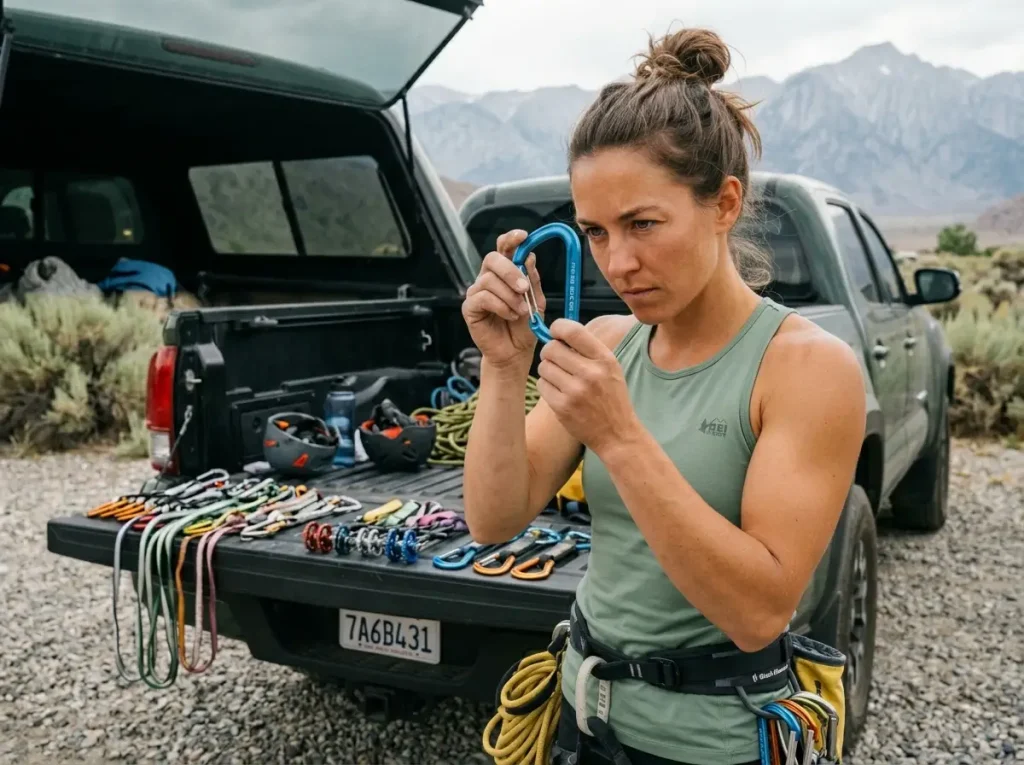
Most climbers know their biners are stamped with a kN rating. Very few know what that number actually means in field conditions.
Climbing carabiners are classified as Risk Category III PPE under what UIAA and CE certifications actually require from your gear — the highest risk class, covering equipment where failure can cause serious lasting harm. EN 12275 defines seven carabiner types (B, H, K, X, T, A, Q) with different geometry and minimum major axis strengths ranging from 18 to 25 kN. The UIAA Standard 121 inspection and retirement recommendations go even further — they require, for example, resistance to loading over a 2mm edge radius, which is the critical failure mode for Type K (Klettersteig) connectors.
The “20 kN” stamp uses a 3-sigma process. The rated minimum breaking strength sits three standard deviations below the mean breaking strength of the batch, meaning 99.7% of manufactured units meet or exceed that number. That’s the manufacturing reality.
Here’s the field reality: permanent deformation of 7075-T6 aluminum — the alloy in virtually every climbing biner — begins at roughly 8.5 kN. A hard fall on a stiff belay can hit that. The biner may not fracture. It may still look fine. But it might have already yielded geometrically and will never be the same piece again. The inspection after any hard fall is not optional.
Open-gate strength of a typical carabiner is only 30–35% of its closed-gate rating. A 20 kN biner is effectively a 6–7 kN device if the gate fails to close. That’s the number you’re actually working with if your gate mechanism is degraded.
EN 12275 Type Classifications and Why They Matter for Wear
The type of biner determines where wear will concentrate. A Type B offset-D is the most common sport climbing biner. Its I-beam cross-section means less material — so groove formation under rope friction happens faster than on heavier round-stock biners. A Type H HMS pear-shape used for belaying sees different wear: more lateral rope movement, more stress on the wide basket from a Munter hitch. A Type X oval has the lowest baseline rating at 18 kN but sees high metal-on-metal wear from cam lobes on an aid rack.
Understanding which biner you’re inspecting tells you where to look first. Don’t run the same inspection protocol across all types without adjusting your focus zones.
The Physics of the 20 kN Claim vs. Real-World Loading
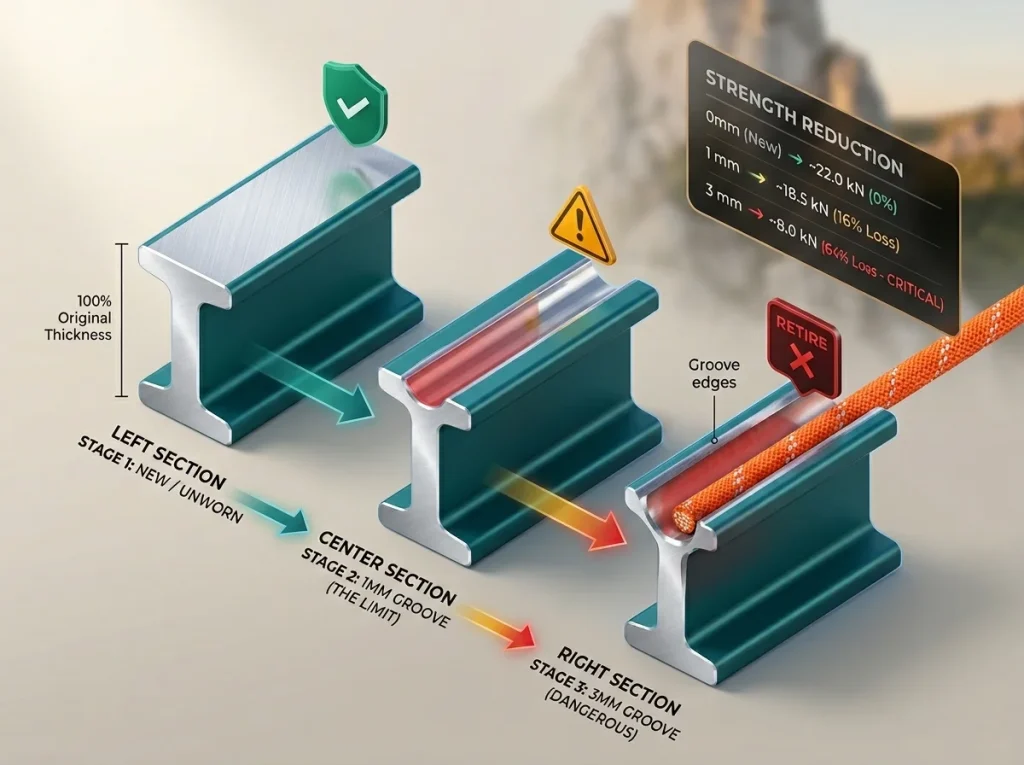
A lead fall generates roughly 5–7 kN at the first clip — well below the rated minimum breaking strength. The hazard is not one catastrophic event. It’s cumulative wear and fatigue. According to a FEM study on localized wear damage and carabiner strength reduction, a groove only 1mm deep reduces cross-sectional area by 10–15% and drops peak load capacity from ~22 kN to roughly 18.5 kN. At 3mm groove depth, that capacity drops to ~8 kN — borderline for a single hard fall on a sport pitch.
Eight kilonewtons. That’s what a 3mm-grooved biner can take before it fails.
Pro tip: The first thing to check after any hard fall is the gate mechanism. Run it through all three positions. If the snap feels different than it did yesterday — even slightly stiffer, even slightly slower — pull that biner from service and inspect before the next burn.
The Three-Stage Gate Functional Test
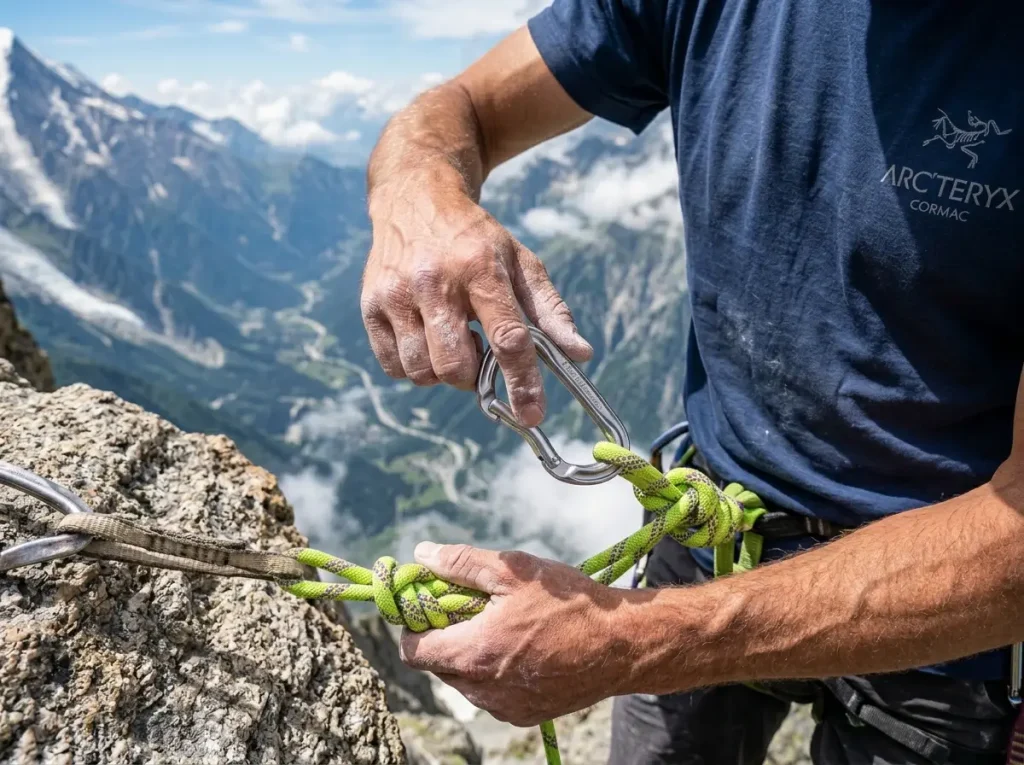
Gate mechanism failure is the most frequent failure mode in carabiners. Not the basket. Not the spine. The gate. And most climbers check it by looking at it and moving on.
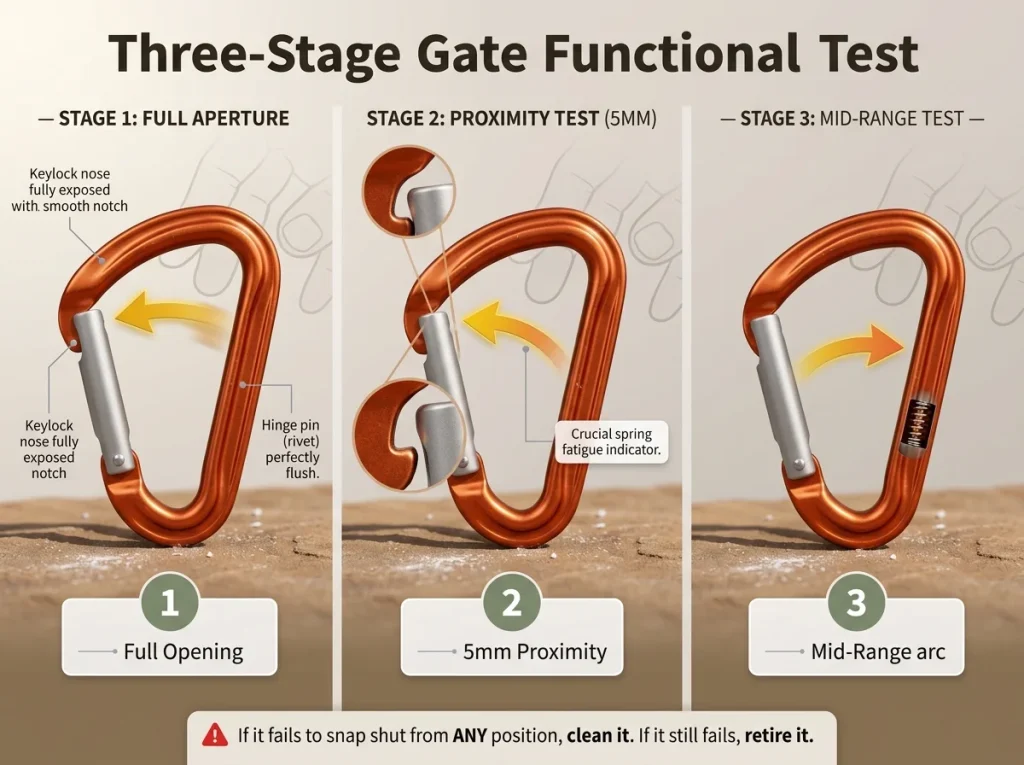
The Three-Stage Gate Test, as documented in DMM’s carabiner inspection and maintenance protocol, tests spring pusher health systematically — not just visual gate position.
Full Opening Test: Open the gate to maximum aperture. Release it without any bias or help from your finger. It must snap shut instantly and completely, with the locking sleeve engaging fully if present.
Proximity Test (5mm): Open the gate only 5mm from the nose. Release. If it returns sluggishly at this distance, the spring cannot initiate closure without momentum. This is the most sensitive indicator of spring fatigue — and the one most people never run because it feels less dramatic than the full-open bounce test. It is not less dramatic.
Mid-Range Test: Open to halfway, release. This detects inconsistent tension across the arc of travel — spring wear or rivet misalignment.
If a biner fails any stage, clean it first. Run the full clean-and-lube workflow for a sticky gate and re-test. Failure after a proper maintenance cycle means one thing: it’s trash.
Interpreting Lateral Gate Play — The Alignment Metric
“Gate play” means lateral, side-to-side movement. A small amount is necessary to prevent binding; the failure threshold is functional, not a millimeter measurement.
The failure criterion: if the gate can be pushed sideways far enough to bypass the nose notch or Keylock slot, the biner is retired. Immediately. No re-test. No debate.
Nose hooking is what happens when misalignment lets a rope or sling load the nose as a lever point instead of clipping cleanly through the gate. Under load, this configuration generates structural failure at 1–2 kN — a fraction of the rated 20 kN. The gate looks closed. The system is not safe.
Bent rivet is the leading cause of excessive lateral play. Check rivet flush-ness and rotation. A loose or bent rivet also reduces hinge tensile strength. On HMS biners used with a Munter hitch, the lateral gate loading is significant — that accelerates rivet wear faster than most climbers expect.
Rivet Integrity and Spring Pusher Assessment
The rivet is the pivot pin. It must be flush with the gate housing, show no corrosion, and exhibit no visible bending or ovalization. Spring pusher contamination — grit, metal shavings, corrosion products — directly reduces closing force. The 5mm Proximity Test is the most reliable way to assess it short of disassembly.
At eye level, look at the gate from the front. Any lateral cant — a diagonal offset relative to the nose — is a red flag.
Wire gate carabiners have no internal spring pusher; the wire itself acts as the spring. Inspect for metal fatigue at the gate base. Any kink or bend in the wire gate triggers mandatory retirement. No sanding fixes it. No lubrication masks it. The wire is gone.
Pro tip: After climbing in salt air — Kalymnos, Thailand limestone, California sea cliffs — run the Three-Stage Test before and after every session. Salt intrusion into the spring chamber is invisible until the gate starts dragging. By then, you’re already behind the problem.
Reading the Wear: The 10% Rule and Groove Depth Measurement
Most articles tell you to retire a biner if it’s “worn.” That’s not a protocol. Here’s the actual metric.
Rope-induced groove wear forms when a grit-laden climbing rope slides through the basket under tension. The rope acts as a sanding belt, progressively removing aluminum. This is most aggressive at lower-off anchors and the first two quickdraws on a high-traffic sport route — where rope velocity under load is highest.
The 1mm Rule and 10% wear rule define the threshold: a groove deeper than 1mm, or one that has consumed more than 10% of the cross-sectional material thickness, is a mandatory retirement trigger. No exceptions. No “it’s probably fine.”
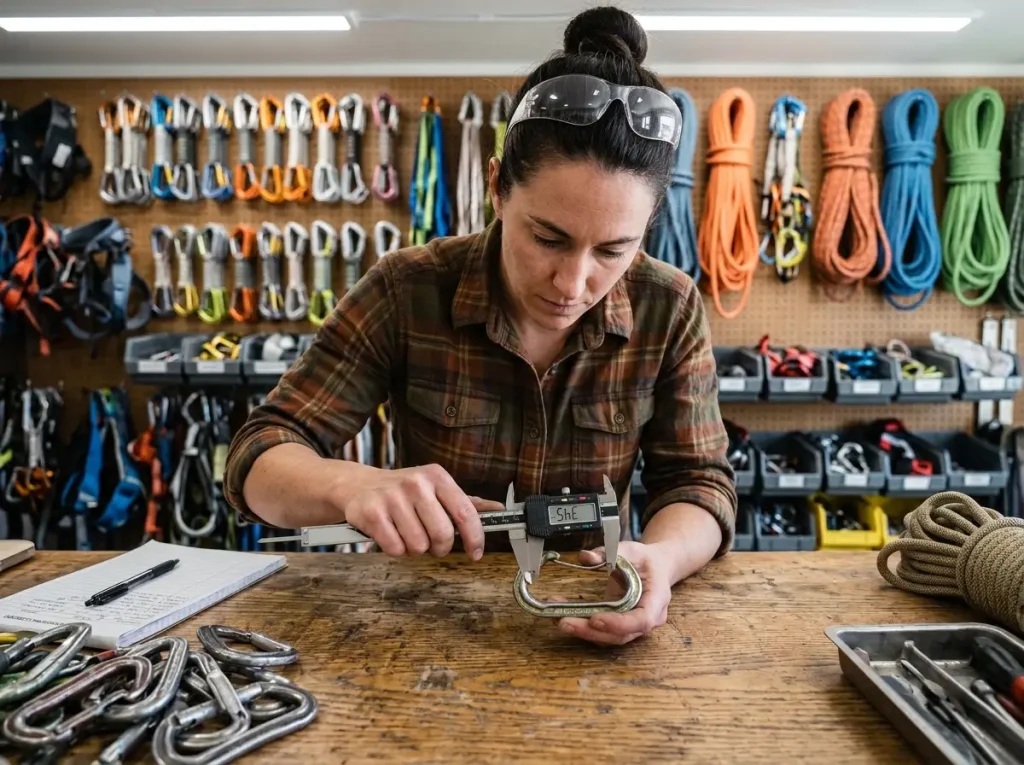
How to measure: a vernier caliper across the groove baseline. Or use a 1mm-diameter drill bit as a no-go gauge — if it sits flush in the groove, the biner is retired. This approach is endorsed by REI’s expert guidance on carabiner cleaning and sanding burrs and it’s simple enough to run at the crag with a cheap set of calipers.
The strength data behind the 1mm limit:
| Groove Depth and Load Capacity Analysis | ||
|---|---|---|
| Groove Depth | Peak Load Capacity | Strength Reduction |
| 0 mm (New) | ~22.0 kN | 0% |
| 1 mm | ~18.5 kN | ~16% |
| 3 mm | ~8.0 kN | 64% |
At 3mm, you’re carrying an 8 kN device on a pitch that can generate 7 kN. That margin is not a margin.
Burr remediation: 220–400 grit sandpaper can smooth minor burrs, but only if the sanding does not push you past the 10% limit. Sand, re-measure, decide. If you’ve hit the limit from sanding — cut it. The piece is done. If you want to track service life systematically, how to track service life across your entire rack with a PPE log gives you a recordkeeping framework that guides and gym managers should be running regardless.
Where Groove Wear Concentrates — Anatomy of the Basket
In D and offset-D biners: wear concentrates at the narrow end of the basket — the spine side — where rope angle and friction are highest under load. In HMS biners: check both the rope-contact zone and the Munter hitch zone, because depending on your belay device, the load path shifts.
Lightweight I-beam biners have less cross-sectional material to start with. The 10% rule hits them faster in absolute millimeters than on heavier round-stock biners. A 17g ultralight sport draw biner can reach the retirement threshold at approximately 0.5–0.6mm of groove depth. That’s half the 1mm threshold people memorize. If you’re running ultralight draws on a project you’ve climbed a hundred times, those biners need quarterly inspection, not annual.
When Groove Edges Become Rope Cutters
A groove in progress has a rounded leading edge. A mature groove has a work-hardened, sharp edge — and that edge can sever a rope under dynamic load.
Edelrid’s lab data is clear on the geometry of rope cutting: doubling the load reduces the sliding distance required for a sharp groove edge to cut the rope to one-quarter of the original distance. A worn biner is not just a weak link. It’s a potential cutting tool that fails under the exact load conditions where you need it most.
The fingernail test: run your fingernail across the basket. If it catches anywhere — any groove, any burr — remove that biner from service until you’ve run the calipers and done the math on sanding.
Environmental Threats: Corrosion, Heat, and the Sea Cliff Problem

This is where most inspection guides stop cold. They tell you to check the gate and measure the groove, and they say nothing about what’s actually happening to your biners when you spend two weeks at Kalymnos or clip the anchor at Malibu Creek in June.
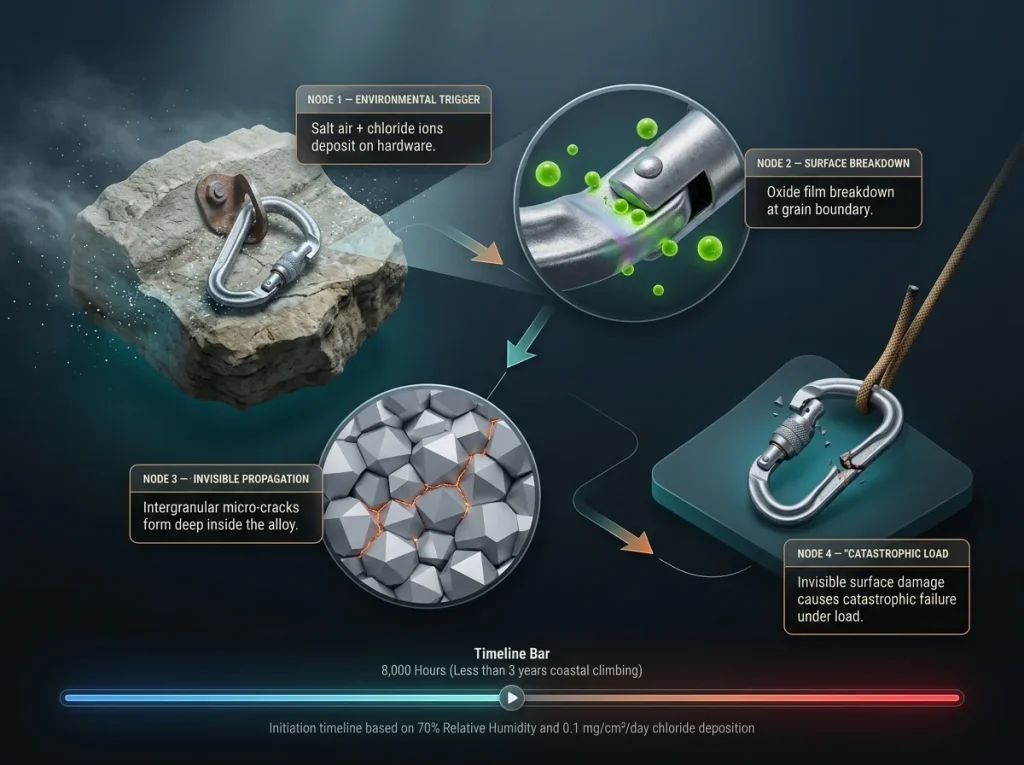
7075-T6 aluminum is the dominant carabiner alloy. High strength-to-weight ratio — no argument there. But it has a specific vulnerability: Stress Corrosion Cracking (SCC) under exposure to chloride ions from salt air combined with tensile stress.
Here’s the mechanism in plain terms: chloride ions eat through the protective aluminum oxide film at the metal’s grain boundaries, kicking off tiny internal cracks that you cannot see and cannot feel. Research data shows that at a chloride deposition density of 0.1 mg/cm² per day and 70% relative humidity, SCC can initiate in as little as 8,000 hours of cumulative exposure. At eight hours per day of coastal climbing, that’s less than three years.
The UIAA technical paper on sharp edges and rope cutting dynamics underlines what makes SCC so hazardous: the cracking is internal, intergranular, and catastrophic under load — no surface sign until the piece fails.
Field indicators: pitting — small, dark crater-shaped holes in the aluminum surface, clustered rather than linear (which would indicate mechanical abrasion). And white rust — powdery aluminum oxide residue in crevices. Any pitting at or adjacent to the gate hinge zone is mandatory retirement. Understanding how SCC and corrosion appear in real anchor failure chains changes the way you read your rack after a coastal trip.
Thermal damage is simpler to screen for: exposure above 60°C (140°F) — a hot car in a desert summer, proximity to a campfire, any fire involvement — can change the T6 temper of the alloy and reduce its strength significantly. Anodization discoloration that isn’t from mechanical abrasion is a thermal damage indicator. If a biner was in a vehicle fire, or left in a trunk that burned, it’s garbage. Cut it without testing.
After every coastal trip, I give every biner a 30°C freshwater rinse, gate-open, hanging gate-down. Not a suggestion. Protocol.
Recognizing Pitting, White Rust, and Chemical Contamination
Pitting versus mechanical abrasion: abrasion leaves linear scrape marks. Pitting leaves crater-shaped holes that may cluster. White rust looks like chalky powder residue in crevices — heavier and more concentrated than normal surface oxidation. Normal surface oxidation on the body is cosmetically insignificant. Gate hinge and spring chamber corrosion is always a failure criterion.
Chemical contamination from battery acid, petroleum products, or concentrated chlorine (pool environments near gym areas) attacks aluminum aggressively. Immersion or significant splash exposure: retire it, no exceptions. There is no cleaning protocol that reverses chemical attack on the alloy.
Pro tip: For sea cliff climbers — Malibu, Red Rocks after rain, any limestone above the Pacific — the gate hinge is the highest-risk site for SCC initiation. It’s a stressed joint under constant spring load in a corrosive environment. Inspect the hinge zone with a 10x loupe every few trips. You’re not looking for anything dramatic. You’re looking for the small stuff that eventually becomes dramatic.
The Dropped Gear Decision Tree
The micro-fracture debate has a definitive answer from metallurgy: a single drop onto a hard surface rarely creates micro-fractures in ductile aluminum because the alloy deforms plastically rather than cracking. But the impact can create stress risers — nicks and dings that serve as initiation points for future fatigue cracks — and it can alter gate geometry in ways the bounce test will catch.
The decision process after a significant drop: visual check for surface trauma, flattened zones, dings on the spine and nose. Then run the complete Three-Stage Gate Test. Any change from pre-drop behavior — any difference in snap quality — means retire. If the drop was multi-pitch height onto rock, Black Diamond’s guidance is direct: since you cannot verify internal damage non-destructively, replacement is the defensible choice.
The $30 biner is never worth the moral calculus of trusting gear you have questions about. If you’re asking the question, you already have your answer.
Professional Maintenance: The Clean-and-Lube Protocol
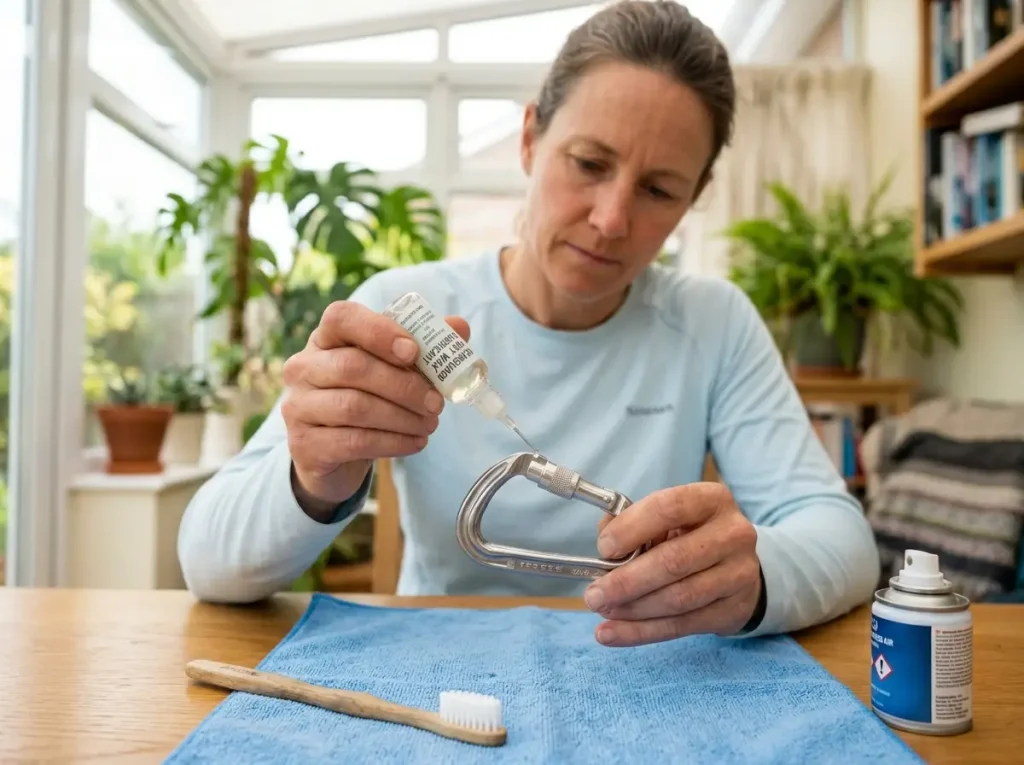
Sticky carabiner gate problems are almost always contamination. The fix is not a new biner — it’s a proper cleaning cycle. Fail that, and then retire.
The maintenance schedule from Petzl’s inspection framework: clean whenever the gate feels gritty during operation, after any saltwater contact, after chemical exposure, and as part of an annual detailed inspection.
Aqueous cleaning: warm water (max 30°C/86°F) plus mild pH-neutral detergent. Soft-bristle brush — an old toothbrush is the right tool — on the gate hinge and spring pusher chamber. No pressure washers. They force water deeper into the spring mechanism.
Critical drying orientation: hang the biner gate-side UP. Not gate-side down. Up. Water must not pool in the internal spring chamber — that causes internal oxidation and accelerates spring fatigue. Most cleaning guides omit this step. It is not optional.
Lubrication once completely dry: 1–2 drops of wax-based dry lubricant or non-silicone oil. Duck Oil or 3-in-1 work. Never WD-40 as a lubricant — it’s a water displacer, not a long-term lubricant, and it leaves gummy residue inside the spring chamber that traps future grit.
Never graphite powder. Graphite creates a galvanic couple with aluminum — an electrochemical incompatibility — and forms a grinding paste when wet. It accelerates the wear it’s supposed to prevent. It’s not a shortcut. It’s a mistake.
The “boil and dry” method works for badly contaminated biners: submerge in gently boiling water for 2–3 minutes with the gate cycling during the boil to flush debris outward, not deeper. Dry gate-side up. If you climb coastal or desert crags regularly, the full trad gear cleaning and lubrication stewardship guide covers this whole system for a full rack.
The Annual Detailed Inspection vs. The Pre-Use Field Check
Two levels of inspection. Both mandatory. Different depth.
Pre-Use Field Check (every session): Rapid squeeze test — gate snaps and seats under finger pressure. Visual check for obvious trauma and corrosion. Locking sleeve function if applicable. Takes thirty seconds.
Annual Detailed Inspection: Three-Stage Gate Test. Lateral play check. Groove depth measurement with calipers. Full aqueous cleaning. Visual check for pitting and corrosion. Anodization condition assessment. This is what the Petzl protocol calls a “competent person” inspection — and for professionals, it requires documentation.
Pro tip: Take a photo of each biner’s basket with a ruler in frame before and after the groove depth measurement. Store in a cloud folder labeled by biner serial number. Costs nothing. Creates a defensible inspection trail if you’re a guide or gym manager and ever have to demonstrate due diligence.
PPE Logging for Guides and Fleet Managers
For anyone managing gear that other people trust their lives to: a formal PPE log is not optional. Minimum fields per IRATA and Petzl standards — type, model, manufacturer, serial or individual number; dates of manufacture, purchase, first use, and last inspection; Three-Stage Gate Test results; groove depth measurements; action logged as Pass, Maintenance Required, or Retired/Destroyed.
An unsigned PPE log is not a legal PPE log. Name and signature of the inspecting competent person is required. Individual serial numbers — which most performance biners now carry — allow per-unit history tracking. That’s the difference between a rack and a fleet.
The 10-year maximum service life rule exists as a safety backstop for high-cycle-use gear in gyms and rental fleets, where load history is high and maintenance records are often incomplete. Regardless of visual condition, age matters when the full usage history is unknown.
When to Retire — and How to Destroy It Right
Here’s where most guides get vague. “Retire if significantly worn.” That is not a protocol.
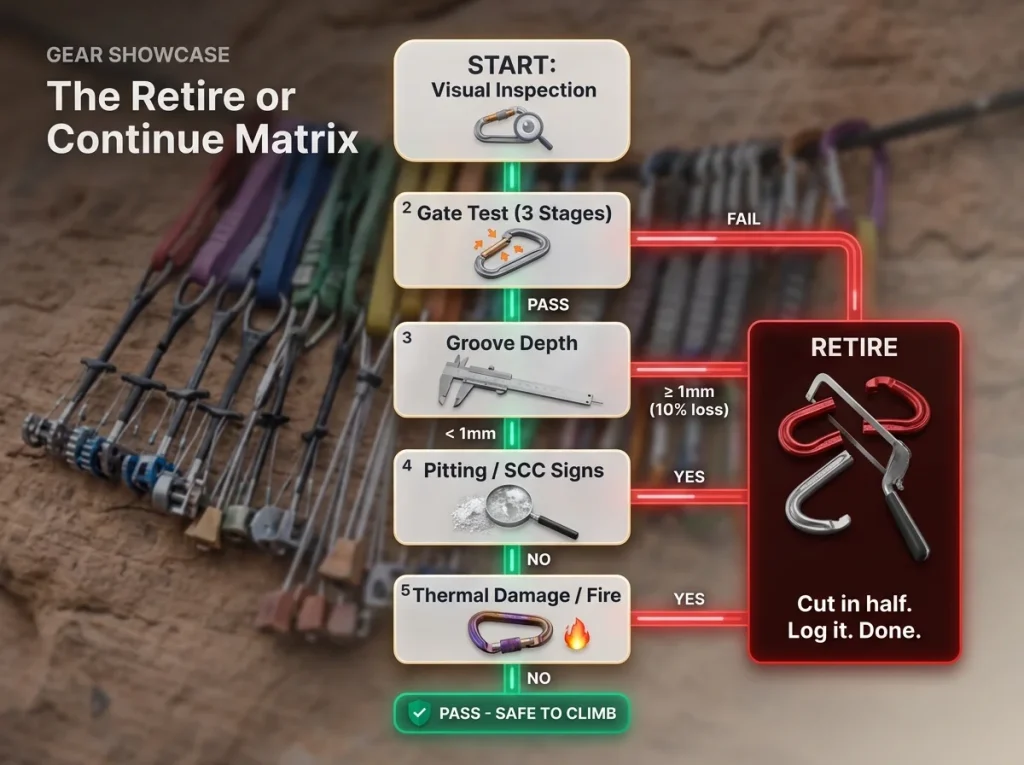
The retirement trigger checklist. Any single criterion on this list means the biner comes off the rack:
- Groove depth ≥ 1mm or ≥ 10% of cross-section
- Gate fails any of the Three-Stage Tests after a full clean-and-lube cycle
- Any pitting at or adjacent to the gate hinge zone
- Visible cracks, significant deformation, or dings on the spine or nose
- Anodization discoloration not from abrasion (thermal damage indicator)
- Involvement in a significant impact event or fire
- Gate can bypass the nose notch (lateral play failure)
- Age ≥ 10 years in a high-cycle-use context
According to Black Diamond’s official carabiner retirement criteria, if you cannot verify the drop height, environmental conditions, or impact surface, replace the carabiner. That’s the standard you hold your gear to.
The Bail Biner Paradox
A carabiner too worn to protect a lead fall is also too worn to serve as the single anchor point during a lower-off or rappel. Using your worst gear as fixed bail protection is not managing risk. It’s transferring it to strangers.
I think about who finds it on the wall after I leave. That thought makes the decision for me.
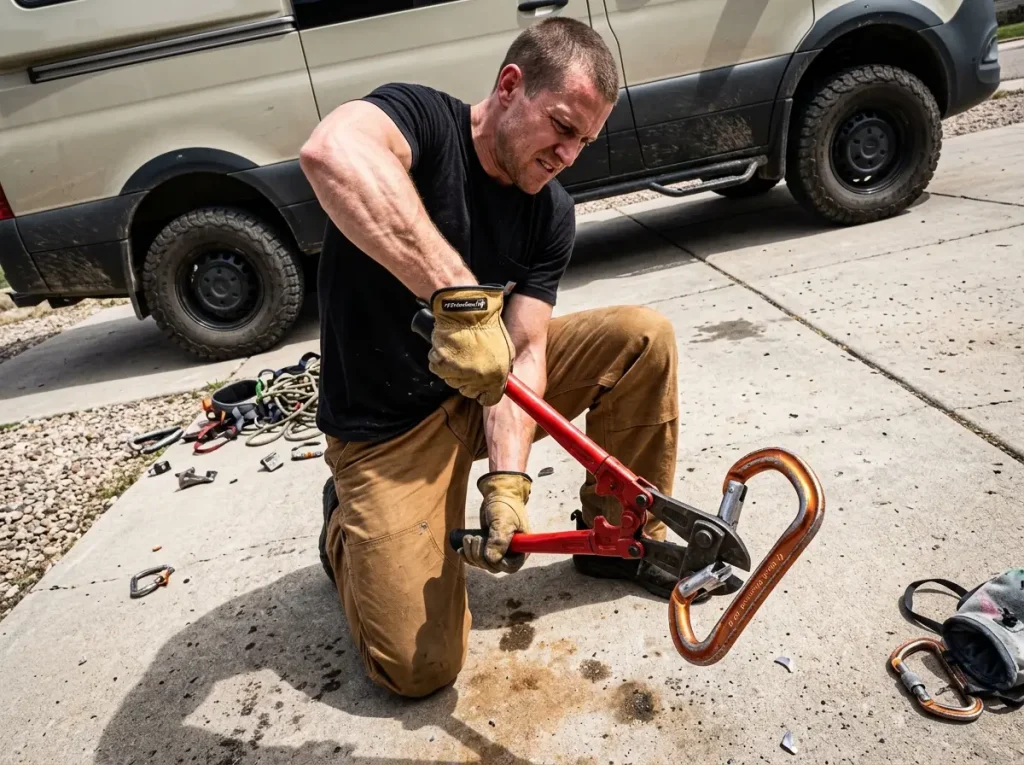
The destruction protocol: cut the biner in half before disposal. Booty hunters — climbers who collect abandoned fixed gear — should not be able to retrieve and use condemned hardware. This is not paranoia. This is the reason the destruction step exists. If you can’t cut it immediately (you’re at the crag), wrap it in red tape, write “DO NOT USE / RETIRED” in permanent marker, remove it from your rack, and deal with it when you get home.
The same radical honesty applies here as it does when retiring your harness: the same radical honesty you need when retiring your harness — the inability to visually confirm hidden damage is exactly what makes these decisions hard and exactly why the protocols exist.
The Lightweight Engineering Trade-off
Modern ultralight biners with I-beam cross-sections sacrifice material for weight. That’s a trade-off, not a flaw — but it demands a faster inspection cycle. A 17g ultralight sport draw biner reaches the 10% wear limit at roughly 0.5–0.6mm of groove depth. Half the number people memorize.
High-mileage sport routes are the worst environment for ultralight hardware. If you’re projecting a 30-meter clip-fest that you’ve fallen on sixty times, your bolt-end biners are seeing groove formation at a rate orders of magnitude faster than the gear on your trad rack. Do not use ultralight biners in fixed anchor positions on high-traffic routes unless you’re committed to quarterly inspection cycles.
Conclusion
Three things to take away from this.
Gate function is binary. Run the Three-Stage Test. A gate that doesn’t snap at any point in its travel — whether at 5mm or full aperture — is not a gate that will reliably protect you. Clean it first. If it still fails, it’s trash.
The 1mm groove is a hard limit, not a guideline. Get calipers. Put them in your crag bag. Eyeballing groove depth is wishful thinking with a serious cost. The difference between 0.8mm (acceptable) and 1.2mm (retire) is invisible to the naked eye.
Retire and destroy. The moment a biner hits a retirement threshold, cut it in half. It cannot be repaired. It cannot be someone else’s problem. The anti-sell is not an attitude — it’s a protocol.
Pull three biners from your rack right now — ideally the ones you’ve had longest or used most heavily. Run the gate test. Run the fingernail test across the basket. Pull out the calipers this weekend. The inspection takes five minutes per biner.
FAQ
When should I retire a carabiner?
Retire any carabiner that exceeds 1mm of groove depth, fails the Three-Stage Gate Test after cleaning, shows pitting near the gate hinge, experienced fire or significant impact trauma, or is 10+ years old in a high-use fleet. If even one of those criteria is met, the decision is made — retire it and cut it in half.
How much gate play is too much on a carabiner?
There is no safe millimeter allowance for excessive lateral play. The failure criterion is functional: if the gate can be pushed sideways far enough to bypass the nose notch or Keylock slot, the carabiner is unsafe and must be retired. Apply lateral hand pressure to the gate — it should seat firmly in the nose without bypassing it.
Is a dropped carabiner safe to use?
Not automatically. A single drop may not cause hidden micro-fractures in ductile aluminum, but it can create stress risers that initiate future fatigue cracks and may change gate geometry. Run the complete Three-Stage Gate Test. If the snap feels different from before the drop, retire it. If the drop was multi-pitch height onto rock, replacement is the defensible choice regardless of visual inspection results.
Can I fix a sticky carabiner gate myself?
Yes, if the stickiness is contamination-related. Rinse in 30°C or 86°F water with pH-neutral soap using a soft brush, dry gate-side UP, then apply 1–2 drops of wax-based lubricant. Never use graphite powder (galvanic corrosion risk on aluminum) or WD-40 (leaves gummy residue). If the gate remains sluggish after a proper boil and dry method cleaning cycle, the spring is fatigued — retire the biner.
What is the 10% rule for carabiner inspection?
The 10% wear rule states that if a rope-induced wear groove is deeper than 1mm or has removed more than 10% of the cross-sectional material thickness at any point on the basket, the carabiner must be retired. This threshold is supported by FEM data showing that a 1mm groove reduces residual cross-sectional strength from ~22 kN to ~18.5 kN — a 16% reduction — while simultaneously creating a sharp edge capable of cutting synthetic rope fibers under fall load.
Safety Notice: Rock climbing and mountaineering are inherently high-risk
activities that can involve physical trauma or fatal incidents. The information on Rock Climbing Realms is for
educational and informational purposes only. Techniques and advice presented here are not a substitute
for professional, hands-on instruction. Conditions and risks vary by location. Always seek guidance
from a qualified instructor before attempting new techniques. By using this website, you agree that you
are solely responsible for your own safety. Any reliance you place on this information is strictly
at your own risk, and you assume all liability for your actions. Rock Climbing Realms and its authors
will not be held liable for any harm, damage, or loss sustained in connection with the use of this information.
Affiliate Disclosure: We are a participant in the Amazon Services LLC Associates Program, an
affiliate advertising program designed to provide a means for us to earn advertising fees by advertising and linking
to Amazon.com. As an Amazon Associate, we earn from qualifying purchases. We are also an official affiliate partner
of Black Diamond Equipment via the AvantLink network. If you click on a Black Diamond affiliate link and make a
purchase, we may earn a commission at no additional cost to you. We also participate in other affiliate programs.
Additional terms are found in the terms of service.