

In this article
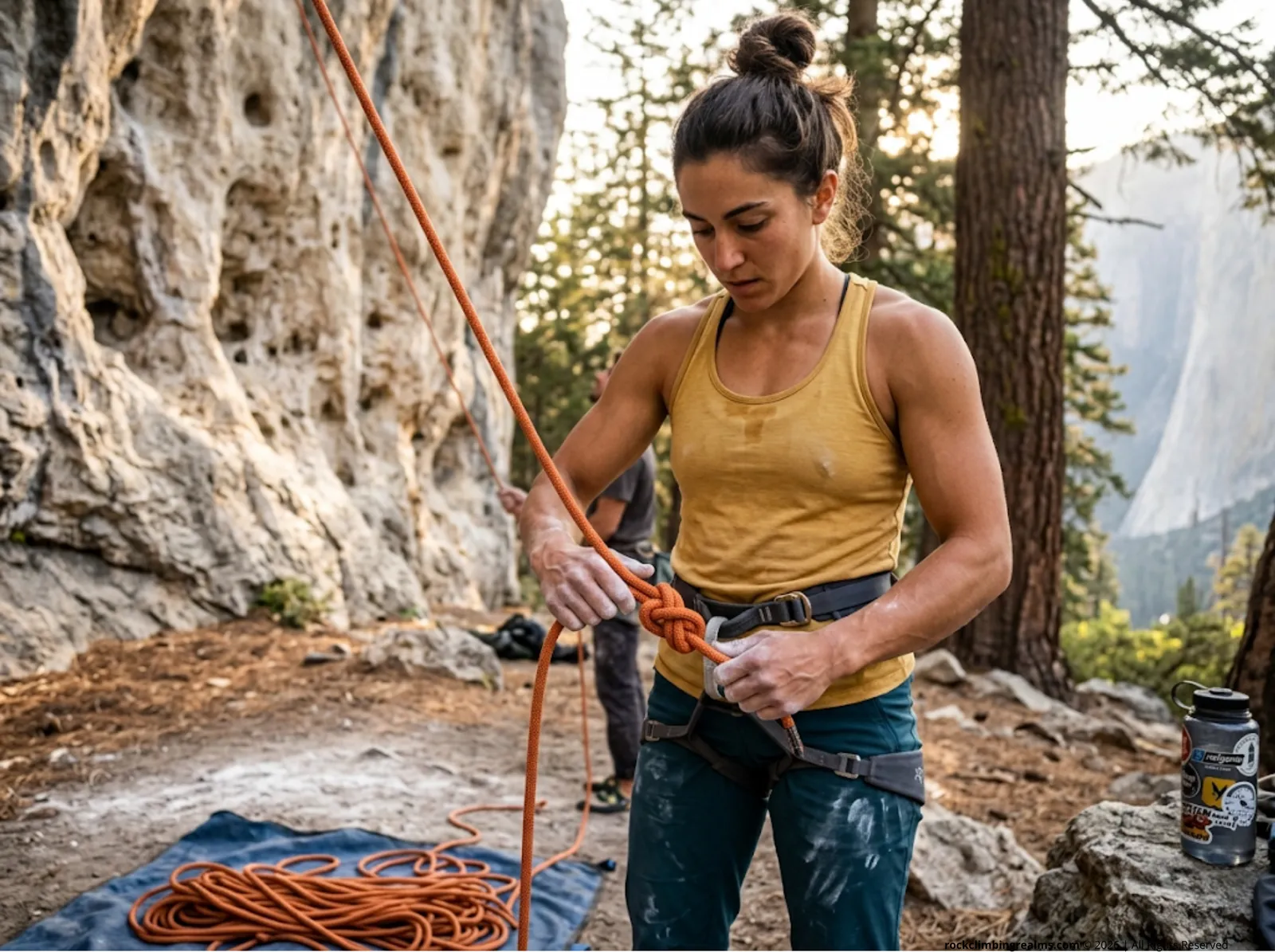
You’re 40 feet up, working a 5.12a, and your belayer yells “tight!” before you clench the crux. Everything in that moment hinges on gear you’ve touched a hundred times but probably never thought hard about — the two horizontal loops threaded with rope at your waist, and the vertical ring hanging below your sternum. Most climbers can’t tell you why those are different components. Some can’t point to both tie-in points without hesitating.
I’ve watched this at gyms, at crags, at the base of Yosemite walls. And it matters — because one of these loops cost one of the most accomplished free climbers this country ever produced his life.
Here’s exactly what each component does, why they’re distinct, and what happens — fiber by fiber — when you mix them up.
⚡ Quick Answer: A modern sit harness has two tie-in hardpoints — one at the waist, one at the leg loop junction — designed specifically for threading your climbing rope using a figure-eight or bowline knot. Below them sits the belay loop, a separate vertical ring built exclusively for metal hardware: carabiners, belay devices, rappel setups. Never thread rope through the belay loop. Never clip a belay device through both tie-in points. The “Soft-to-Soft, Hard-to-Hard” rule encodes this distinction. The two hardpoints exist because Black Diamond’s QC Lab data shows leg loops absorb 70–80% of fall force while the waist handles the rest — and you need both points connected for that distribution to work.
The Anatomy of a Sit Harness — What You’re Actually Looking At
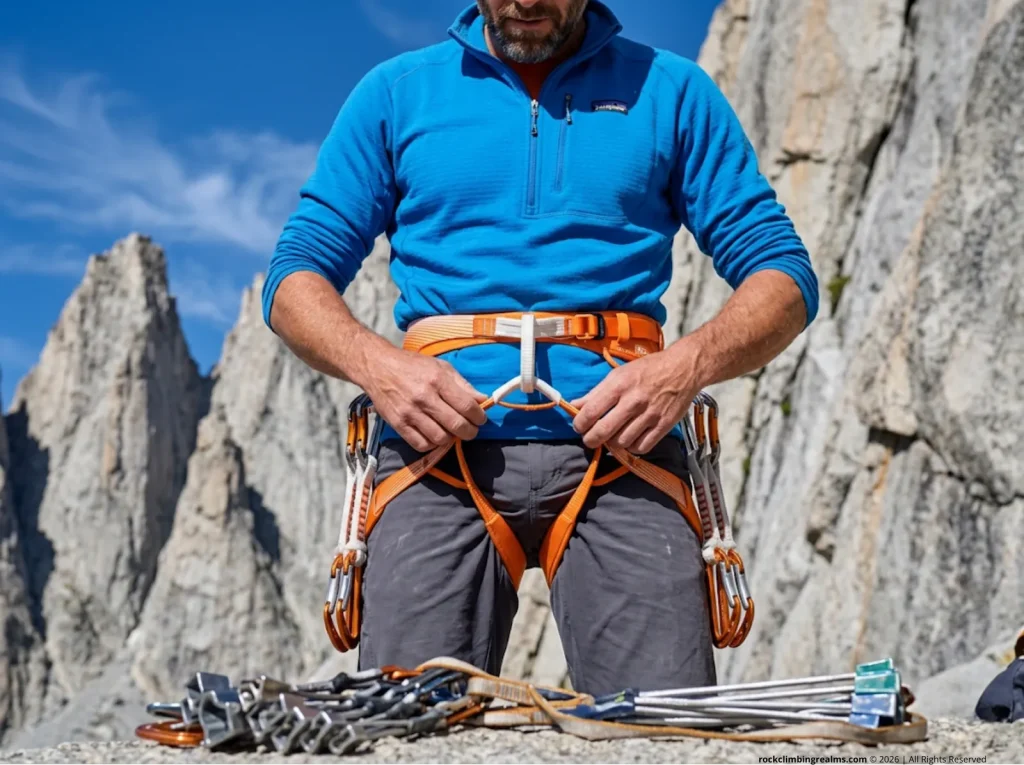
A modern sit harness (classified under UIAA Type C and EN 12277) is not a simple loop of webbing. It’s a load-distribution system built around human skeletal geometry. Here’s what you’re working with.
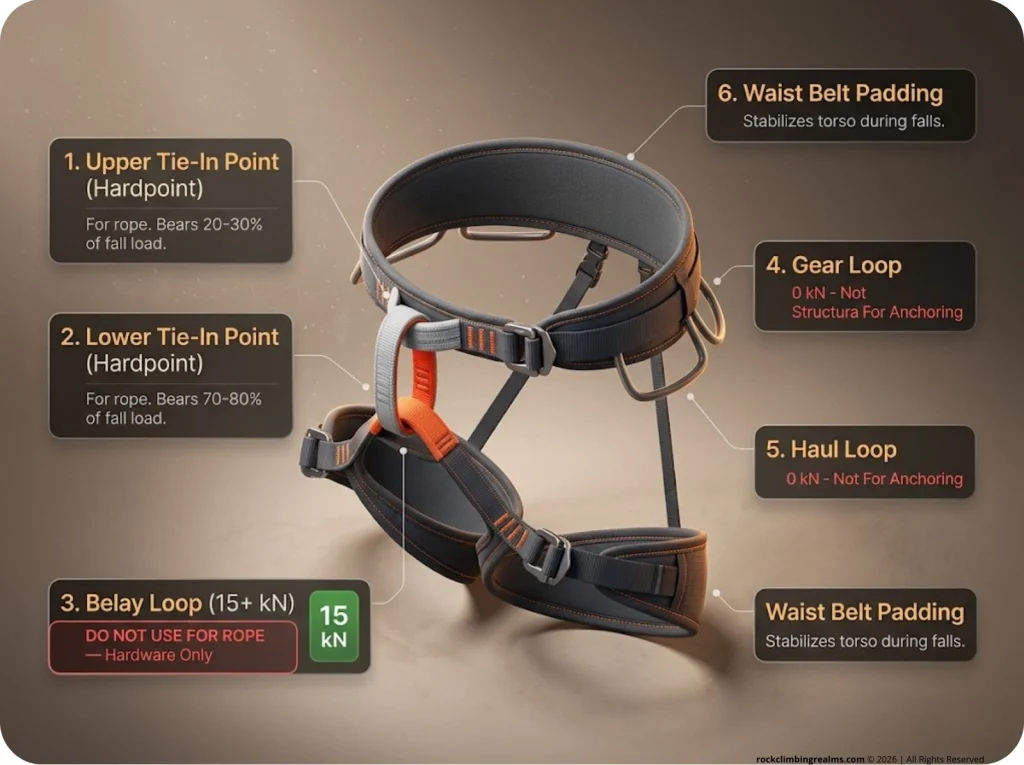
The waist belt wraps your iliac crest — the bony shelf of your pelvis — not your actual waist. If it’s sitting above your hip bones, it’s wrong, and correctly fitting a climbing harness begins with identifying each component before you even buckle it. The two leg loops encircle your upper thighs. Where the waist belt and leg loops meet at the front, you have the tie-in points: two reinforced horizontal loops built from a polyamide core sheathed in HMPE (High Modulus Polyethylene, also sold as Dyneema). These are your hardpoints.
Below and between the tie-in points hangs the belay loop — a single vertical ring of high-strength webbing, often a seamless “Infinity” design on modern harnesses, rated to 15 kN minimum under UIAA Standard 105. This loop bridges the two hardpoints and is built for one thing: metal connectors.
Then there are gear loops — usually 2 to 6 depending on the harness — stitched to the waist belt for racking cams, draws, and nuts. They are not structural. They will not catch a fall. The haul loop on the back of the harness is similarly not a fall-arrest component; Black Diamond’s QC Lab found many haul loops rated at 0 kN for climbing loads.
I’ve watched beginners at the gym double-check their belay loop knot — a loop you never tie into. The rope goes through the two horizontal loops above it, not the ring below.
The 80/20 Rule — Where Force Actually Goes During a Fall
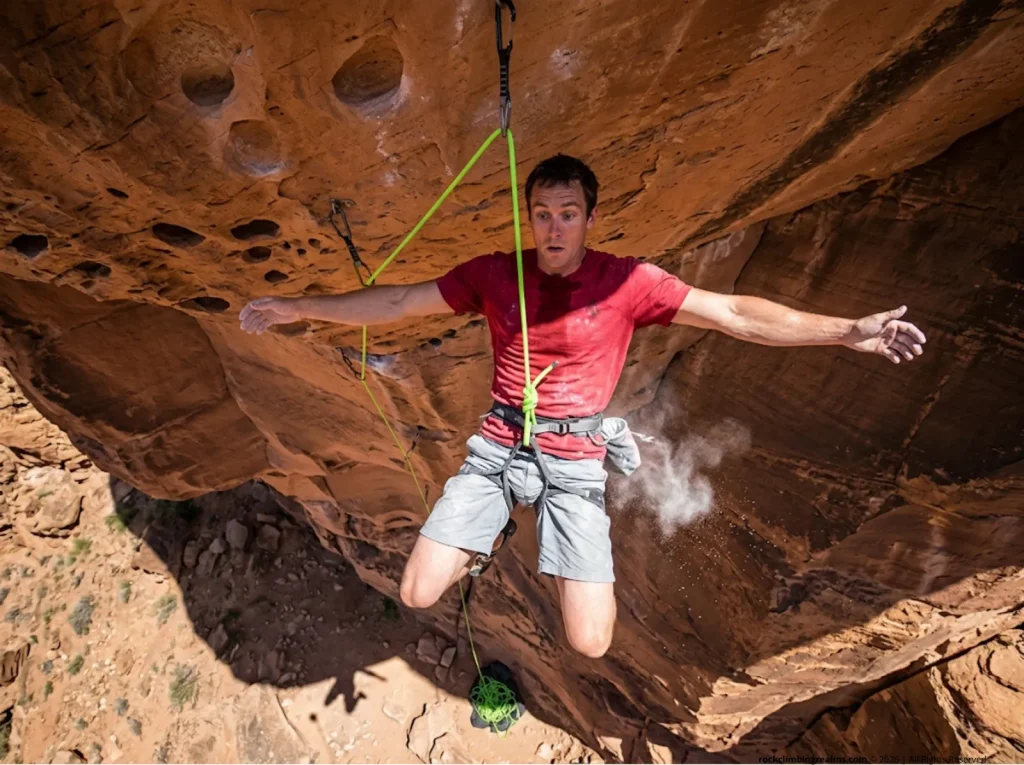
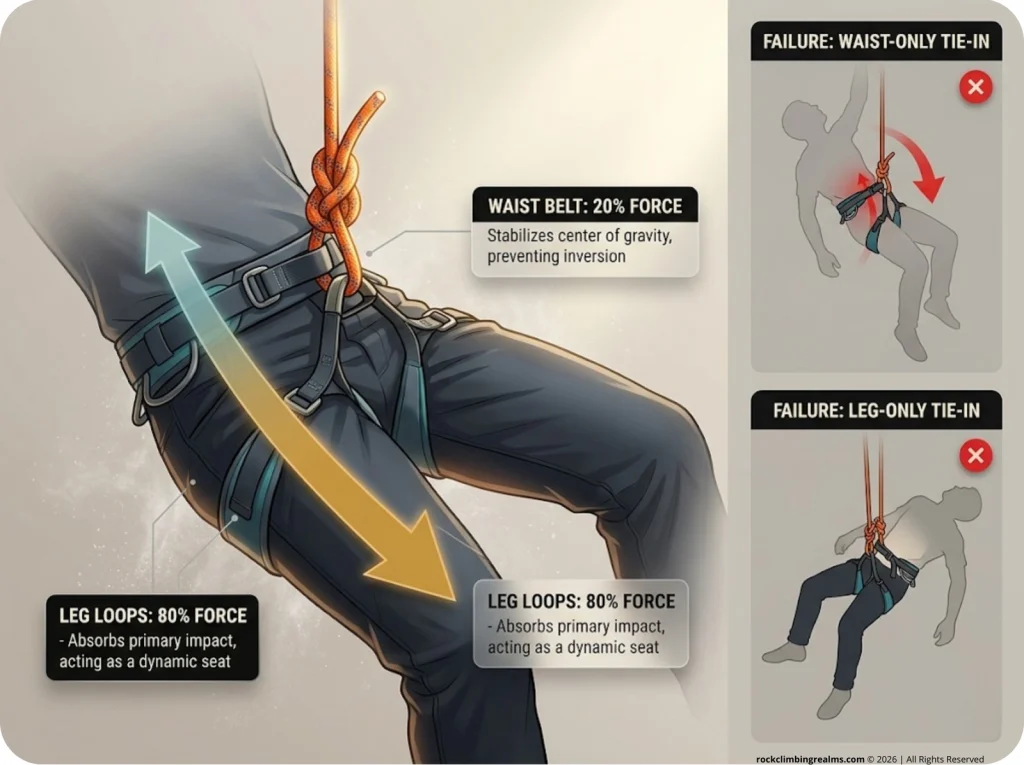
Here’s where most climbers get it backwards. The waist belt looks like the main support — it’s at your core, it’s wide, it feels sturdy. But Black Diamond’s QC Lab has measured this under real fall conditions, and the data is unambiguous: leg loops absorb 70–80% of fall impact force. The waist belt handles 20–30%.
This happens because of where your center of gravity sits — near your hips and pelvis. When you fall, the leg loops act as the primary seat, catching your mass from below. The waist belt’s role is stabilization: it keeps your torso upright and prevents you from pitching forward or flipping.
Kolin Powick (KP), Black Diamond’s QC Lab Director, put it plainly: “Lab testing shows that the leg loops take 70 to 80 percent of the load in a fall… if you only hit one tie-in point, the leg loop takes the majority, but you’re way more likely to flip upside down.”
That last part is the critical piece. If you thread only the upper (waist) tie-in point, your belt migrates toward your ribcage under load — potentially causing internal injury — and your center of gravity ends up above the connection point, making inversion almost certain. If you thread only the lower (leg loop) tie-in point, your weight is technically supported but your upper body has nothing anchoring it. A dynamic, tumbling fall can rotate you right out of the leg loops.
Using both tie-in points creates a distributed load path: 80% pelvis, 20% waist, with the belay loop acting as a bridge that keeps the two hardpoints connected and maintains upright orientation. The mechanical engineering analysis of load distribution in personal fall arrest systems confirms what BD’s lab shows — the geometry of dual attachment is load-path engineering, not redundancy.
Pro tip: Thread your rope bottoms-up — leg loop first — as you pull the tail through. You’ll see both points engage, which makes your partner’s gear check unambiguous.
Understanding how fall forces travel through your system is the first step in preventing a ground fall, and it starts with knowing which loops are actually doing the work.
Soft-to-Soft, Hard-to-Hard — The Mechanical Logic Behind the Rule
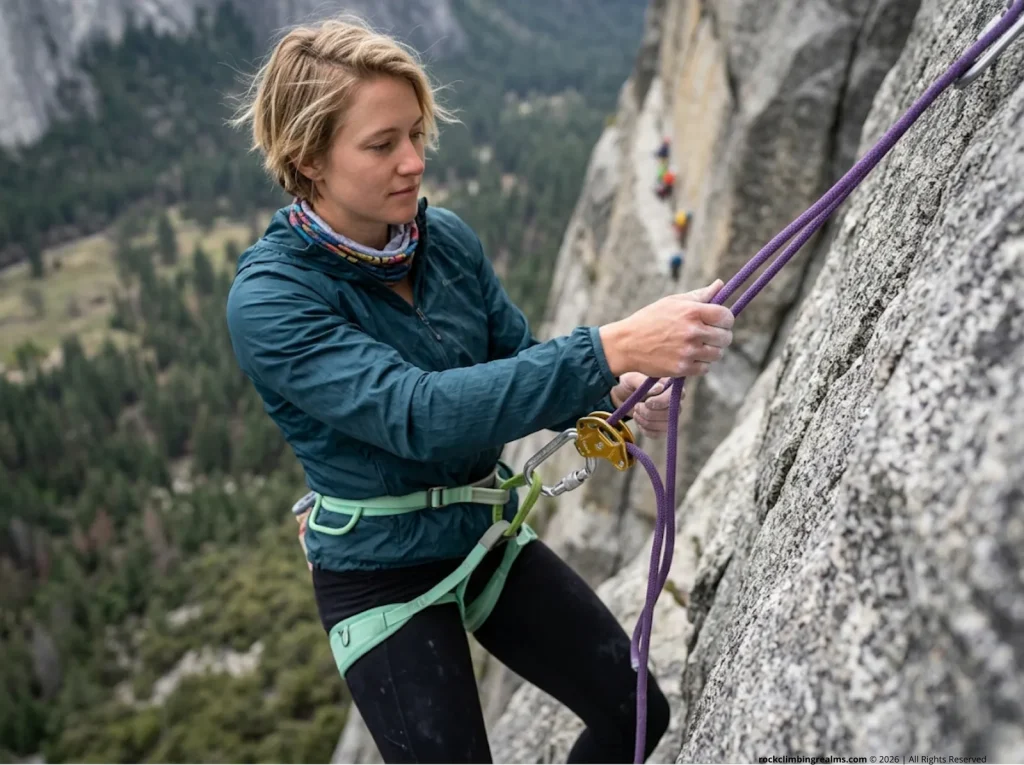
The “Soft-to-Soft, Hard-to-Hard” rule encodes a specific material friction principle — not arbitrary tradition.
Rope through tie-in points: soft goods on soft goods generate moderate, distributed friction. The HMPE sheathing handles rope sawing across thousands of falls. The rope self-orients. Wear distributes. Carabiner on belay loop: the vertical orientation loads the carabiner on its major axis (20–25 kN), and the loop rotates, distributing wear around the full circumference.
Now here’s where people get hurt. Rope on belay loop: the loop can’t rotate to accommodate a rope the way it handles a carabiner. Concentrated sawing friction, not a single violent event, is how it fails. Carabiner through both tie-in points — what’s called the tri-axial trap — is why the GriGri clips to the belay loop and not the tie-in points. Multi-directional loading from waist, left leg, right leg, and device simultaneously drops carabiner strength by 25–50% per Black Diamond’s QC Lab data. The “pivot effect” — webbing contacting the locking sleeve — can physically pry the gate open under tension. The carabiner doesn’t need to break.
Pro tip: Belaying from both tie-in points because you think two loops equals more redundancy is the tri-axial fallacy — the most hazardous misunderstanding in sport climbing safety. One correctly loaded 15+ kN belay loop beats two compromised hardpoints every time.
Why the Belay Loop Is Vertical (Not Horizontal)
The vertical orientation ensures a GriGri or ATC sits face-up, rope feeding vertically toward the first bolt — consistent with how the brake mechanism is designed. Horizontal attachment through the tie-in points forces the brake hand into a lateral plane, reducing stopping power. The seamless “Infinity” loop design allows 360-degree carabiner rotation — not a comfort feature, a wear distribution mechanism.
The Gear Loop and Haul Loop — What They’re NOT For
Gear loops are thinner than structural webbing by design. Never use one for anchoring, rappelling, or clipping a PAS. They hold your rack, not you. The haul loop on the rear exists for bags and trail ropes on multi-pitch terrain — if the harness tag doesn’t show a kN rating for it, Black Diamond’s QC Lab found many rated at 0 kN for climbing loads. Treat it accordingly.
Material Science — Why Tie-In Points Are Built Different
Most harness webbing is Polyamide — Nylon 6 or 6,6 — chosen for its slight elasticity (3–8% stretch under load), which absorbs energy and reduces peak impact force on your body. But nylon loses strength under UV exposure — the UIAA research on UV weathering and polyamide strength degradation in textile PPE documents up to 55% strength loss after 400 days of sun exposure. A harness stored on a sunny wall for three seasons can look perfect while having lost half its strength.
The tie-in points get a different material: a sheathing of HMPE (High Modulus Polyethylene / Dyneema). HMPE resists rope abrasion and is slippery enough to let the rope self-orient during a fall. Paradoxically, HMPE has a lower melting point than nylon — meaning localized friction heat from a girth hitch that doesn’t rotate can melt HMPE fibers invisibly from the inside out before external abrasion would have caused failure.
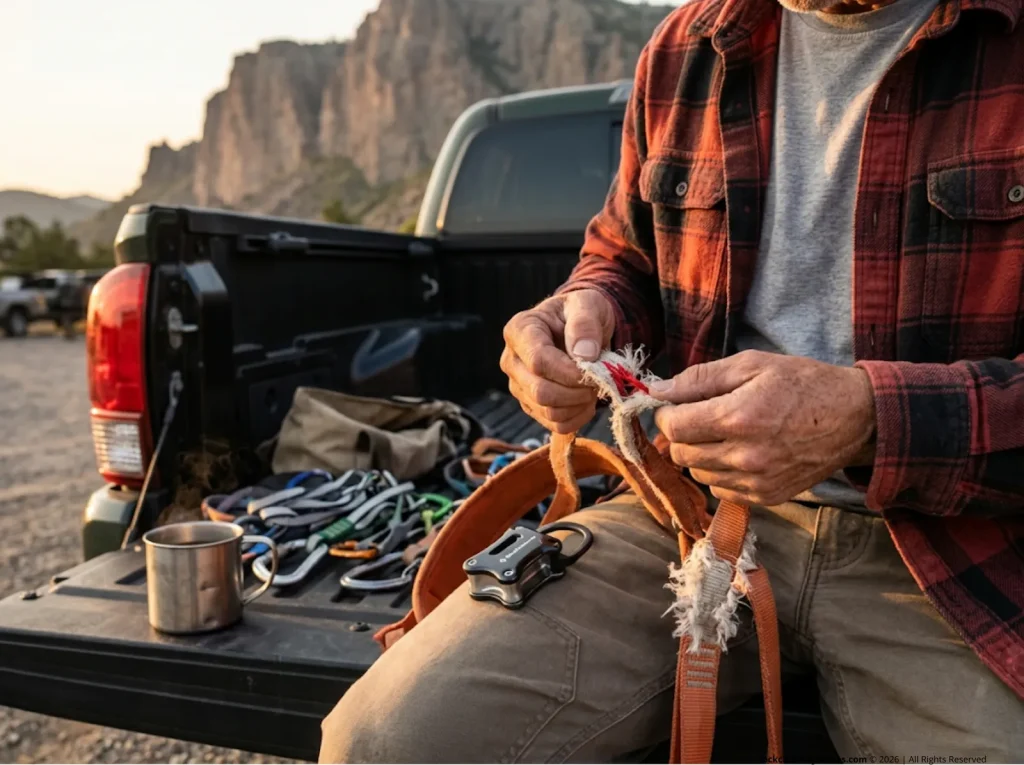
Wear indicators — a contrasting thread, often red, beneath the outer webbing — exist because surface inspection is unreliable. When that thread becomes visible, retire the harness. Not “inspect more carefully.” Retire it.
After about 500 days of outdoor use, I noticed fuzzing on my tie-in point sheathing — HMPE shedding, the sacrificial layer doing its job. The question is always whether enough has shed that the structural core is now exposed. If you can see the red thread, that question is answered.
Pro tip: Knowing when your harness’s webbing has been compromised beyond safe use is a skill. Learn the retirement indicators while your harness is still in good shape, not after a close call.
The Todd Skinner Post-Mortem — What Invisible Wear Looks Like
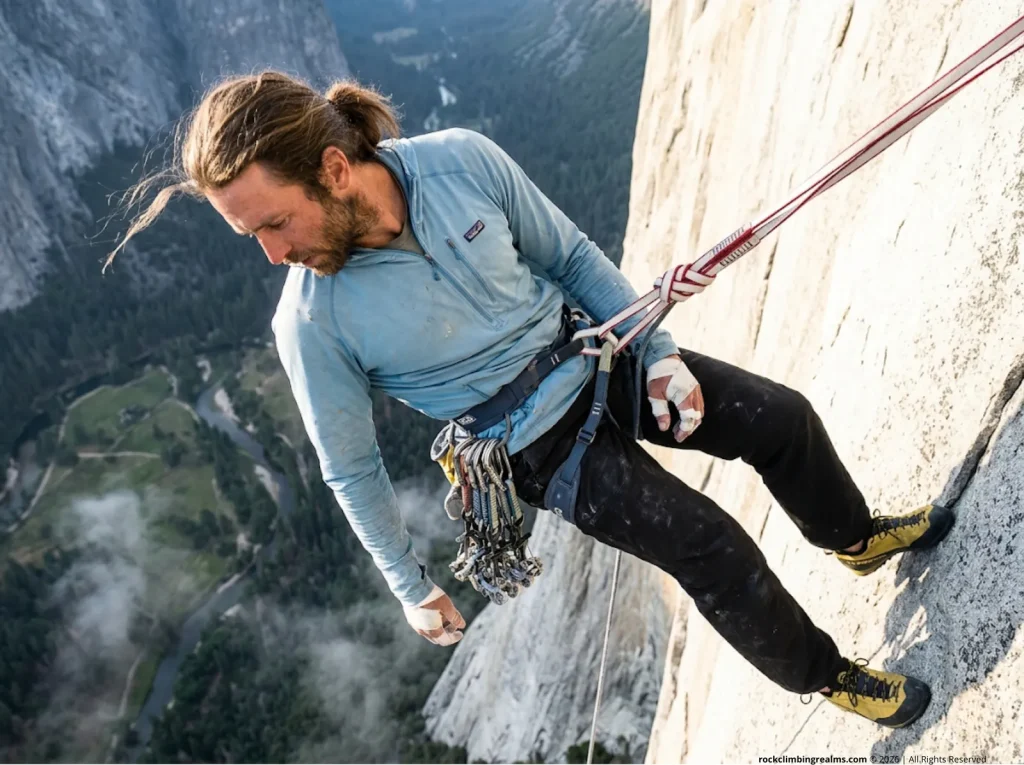
October 2006. Leaning Tower, Yosemite. Todd Skinner, one of the most accomplished free climbers in American history, falls during a rappel. The investigation didn’t find a manufacturing defect, a bad knot, or a single violent event. It found cumulative mechanical fatigue — a failure that had been building for months, or years.
The official National Park Service report on the 2006 Todd Skinner equipment failure at Yosemite confirmed the cause: belay loop failure.
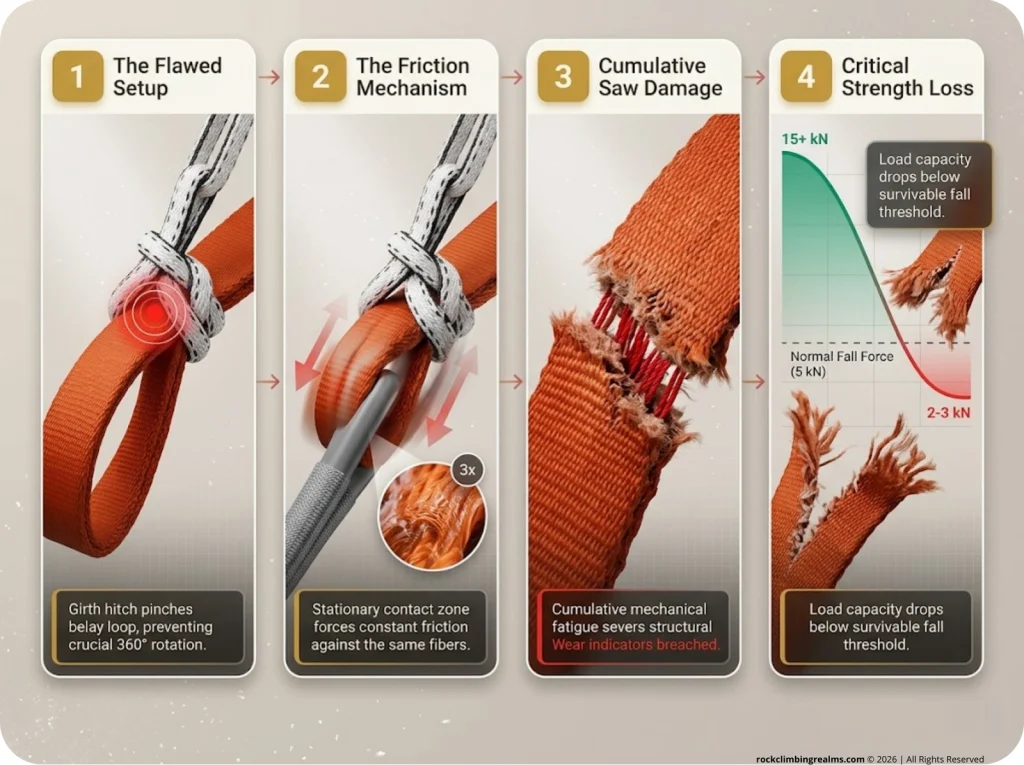
Here’s the sequence Skinner’s accident reveals. He had a PAS — a personal anchor system — girth-hitched permanently to his belay loop, essentially in one fixed position. The girth hitch pinched the loop at a single point, preventing the free rotation that wear distribution requires. As Skinner ascended and rappelled thousands of feet of wall across multiple seasons, the stiffer tie-in point webbing on either side of the hitch sawed back and forth across the now-stationary, pinched belay loop.
Black Diamond’s QC Lab tested heavily-abraded belay loops — webbing cut down to 75% of remaining material — and found they still held approximately 13 kN (roughly 2,900 lbs). Skinner’s loop had degraded past even that threshold, likely to 2–3 kN or less. A normal body-weight rappel loads a belay loop at less than 1 kN. A short fall can spike to 2–5 kN. His loop held until it didn’t.
The part that should stop you cold: that loop passed a visual inspection that morning. The outer sheath was worn, but not obviously broken. This is exactly why the red wear indicator thread exists — it detects structural damage the outer appearance cannot reveal.
The fix for the PAS girth-hitch habit is not to avoid tethers. It’s to attach them so the belay loop can rotate freely. Check for squeaking — that’s the sound of a loop that isn’t spinning. Inspect the contact point of any hitch against the loop before each session. And understand the exact pre-session inspection routine that would have flagged Skinner’s harness condition before it became critical.
The old-school argument against belay loops — “I don’t trust a single loop” — is not completely wrong as a concept. But the engineering answer is not to add more loops. It’s to understand and prevent the cumulative wear mechanism that took Skinner’s life.
Edge Cases — Lanyards, PAS, and the One-Point Harness Debate

Where should a PAS or lanyard actually connect? The answer is more nuanced than most guides admit.
Petzl’s technical documentation states a lanyard “can be attached to the belay loop or the two tie-in points.” Black Diamond’s QC Lab measured a PAS girth-hitched to the tie-in points at 27.7 kN versus 21.9 kN on the belay loop — the hardpoints are stronger for this application. But stronger isn’t always better.
The practical argument for the belay loop comes from rotation. Andy Kirkpatrick, climber and author: “I hate girth-hitching through my harness tie-ins… the material saws on itself when weighting/unweighting… whereas a girth to the belay loop tightens once and that’s that.” A tether on the belay loop tightens under load and holds a fixed position. On the tie-in points it shifts constantly, generating the friction cycle that matters.
For multi-pitch, I use the belay loop for my lanyard to keep the tie-in points clear for rope management. It’s not about rated strength — it’s about the full force-loading comparison between a PAS and a daisy chain at the belay loop and, more practically, about system clarity when you’re 600 feet up and tired.
Alpine harnesses sometimes have only one tie-in point. This is a deliberate weight-versus-safety trade-off — alpine terrain involves shorter falls and more static anchoring where the 80/20 dynamic load split matters less. That trade-off is acceptable in alpine contexts and catastrophic in sport climbing. The key variable is fall factor.
Double belay loops (notably Metolius’s Safe Tech design) market themselves as extra safety. They’re not. The UIAA Safety Commission notes that harnesses have never been known to fail due to lack of strength under standard use. The failure mode is cumulative wear — and two loops don’t prevent wear. Inspection does.
Conclusion
Thread rope through both tie-in points, every time. The 80/20 load split only functions when both hardpoints — upper waist and lower leg junction — are engaged simultaneously. One point alone creates an unstable load path that puts you upside-down.
Soft-to-Soft, Hard-to-Hard, no exceptions. The belay loop is for metal. The hardpoints are for rope. Tri-axial loading and saw-friction are not forgiving of improvisation.
Inspect the rotation of your belay loop before every session. A squeaking, kinked, or non-rotating loop isn’t a quirk. It’s the early signature of the mechanism that cost Todd Skinner his life. Retire it.
Before your next session, run your pre-climb check — but add one step: grab your belay loop and spin it. If it doesn’t rotate freely, that’s your cue. The loop between you and the ground shouldn’t be one you’ve been meaning to look at.
Now go send something.
FAQ
Is it safe to tie into the belay loop?
No. The belay loop is designed for metal connectors, not for soft goods like a rope. Threading your rope through it bypasses the two tie-in hardpoints, removing the load distribution the harness requires. Rope-on-belay-loop also generates a sawing friction pattern the loop isn’t reinforced to handle.
Why does a harness have two tie-in points instead of one?
Because a single attachment point can’t distribute fall force across both the waist and leg loops simultaneously. Black Diamond’s QC Lab data shows leg loops take 70–80% of fall force while the waist handles 20–30%. Without both points connected, a climber risks belt migration and internal injury (waist-only) or ejection through the leg loops (leg-only).
Can you belay from the tie-in points?
Hazardous in normal use. Clipping a belay device carabiner through both tie-in points creates tri-axial loading, reducing carabiner strength by 25–50% and risking gate opening via the pivot effect. Belay from the loop.
What is the strongest part of a climbing harness?
Harness strength is a system property, not a component property. The UIAA mandates 15 kN for the belay loop as a standalone rating; the integrated dual tie-in system exceeds any survivable fall force. Using each component correctly matters more than its rated strength in isolation.
What happens if I only tie into one tie-in point by mistake?
Waist-only: the belt shifts toward your ribs under fall load — high risk of internal injury and near-certain inversion. Leg-only: your weight is supported but you lose upper-body stabilization, sharply increasing ejection risk during a dynamic fall. Kolin Powick, BD QC Lab: If you only hit one tie-in point, the leg loop takes the majority, but you’re way more likely to flip upside down. Verify both points before you leave the ground. Every session.
Safety Notice: Rock climbing and mountaineering are inherently high-risk
activities that can involve physical trauma or fatal incidents. The information on Rock Climbing Realms is for
educational and informational purposes only. Techniques and advice presented here are not a substitute
for professional, hands-on instruction. Conditions and risks vary by location. Always seek guidance
from a qualified instructor before attempting new techniques. By using this website, you agree that you
are solely responsible for your own safety. Any reliance you place on this information is strictly
at your own risk, and you assume all liability for your actions. Rock Climbing Realms and its authors
will not be held liable for any harm, damage, or loss sustained in connection with the use of this information.
Affiliate Disclosure: We are a participant in the Amazon Services LLC Associates Program, an
affiliate advertising program designed to provide a means for us to earn advertising fees by advertising and linking
to Amazon.com. As an Amazon Associate, we earn from qualifying purchases. We are also an official affiliate partner
of Black Diamond Equipment via the AvantLink network. If you click on a Black Diamond affiliate link and make a
purchase, we may earn a commission at no additional cost to you. We also participate in other affiliate programs.
Additional terms are found in the terms of service.