
In this article
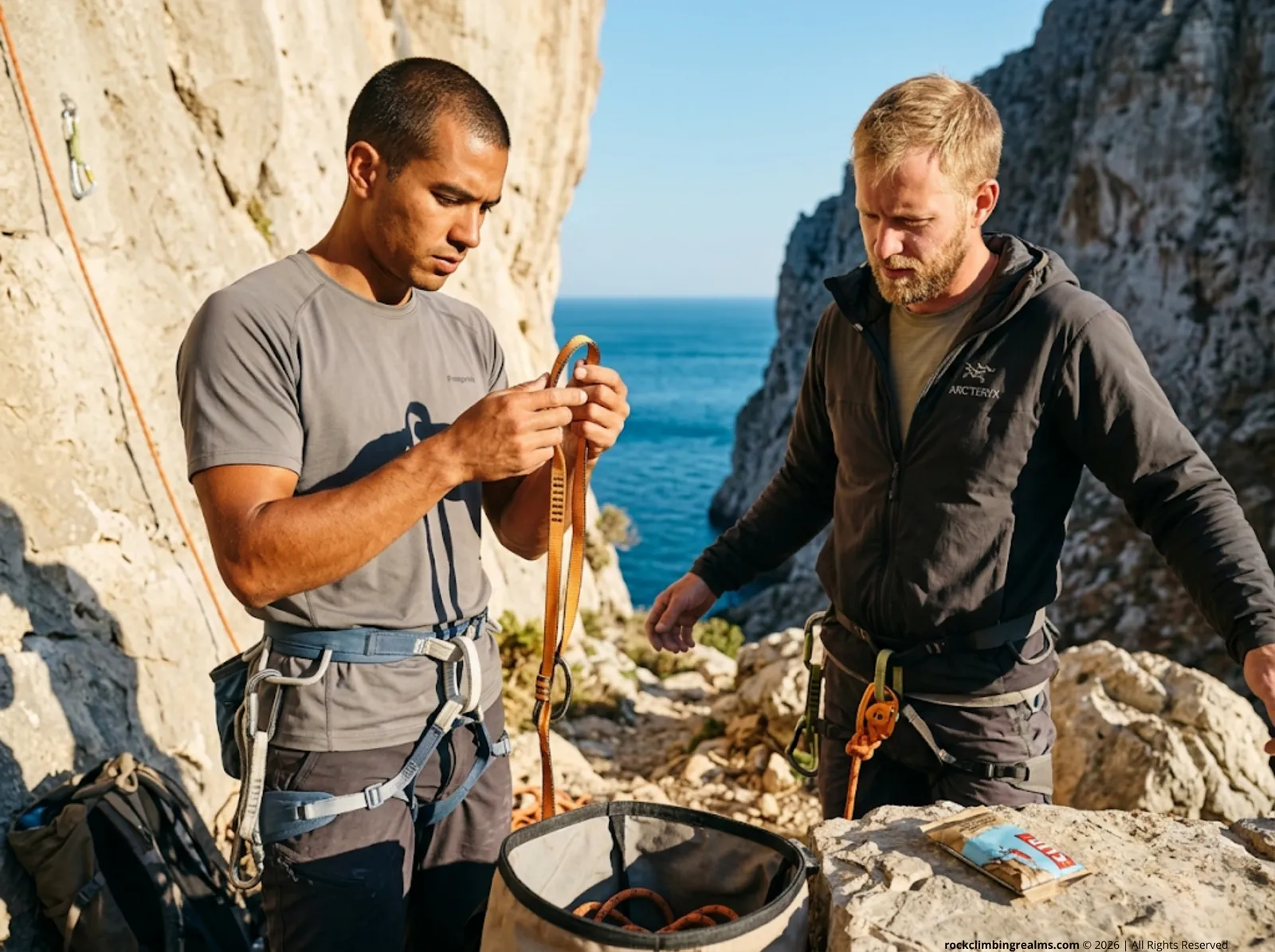
The guy had already flaked his rope and racked up before you’d even exchanged names. His grade spread on Mountain Project looked solid — 5.11 trad leads, solid sport background. He seemed confident. He seemed competent. And then he started to thread his Figure-8 through the leg loop of his harness.
That moment — the split-second gut-drop when your life depends on whether a stranger actually knows what they’re doing — is what this guide is built around. Finding a climbing partner while traveling is manageable. Vetting one is a different discipline entirely.
By the end of this guide, you’ll have a phase-by-phase framework for identifying, screening, and technically auditing any stranger before you commit a rope to them. We’re covering digital platforms, crag-side social diagnostics, a structured crag-side interview script, weight-disparity physics, and the behavioral red flags that separate a high-risk partner from a solid one.
| Climbing Partner Assessment Protocol | ||
|---|---|---|
| Phase | Key Action | Key Risk |
| 1 — Digital Screen | Check gear inventory, not just grades | Self-reported data — unverified |
| 2 — Social Diagnostic | Meet at gym or bouldering sector first | Halo Effect — grade ≠ safety |
| 3 — Technical Interrogation | Run the 4-question interview script | Normalization of Deviance |
| 4 — Execution Protocol | Closed system, Call-Back communication | Transition point fatigue |
⚡ Quick Answer: Vetting a stranger before roping up requires four sequential phases: a digital screen on Mountain Project or RockBase (checking gear inventory, not just grades), a crag-side social diagnostic in a low-stakes environment, a structured technical interrogation with four mandatory safety questions, and a full gear audit against UIAA standards. The single most common mistake is treating grade as a proxy for safety competence. It isn’t. A 5.12 leader who can’t describe their anchor cleaning protocol is a high-risk belay — regardless of what their profile says.
The Digital Layer — Platforms, Profiles, and the Information-Action Gap
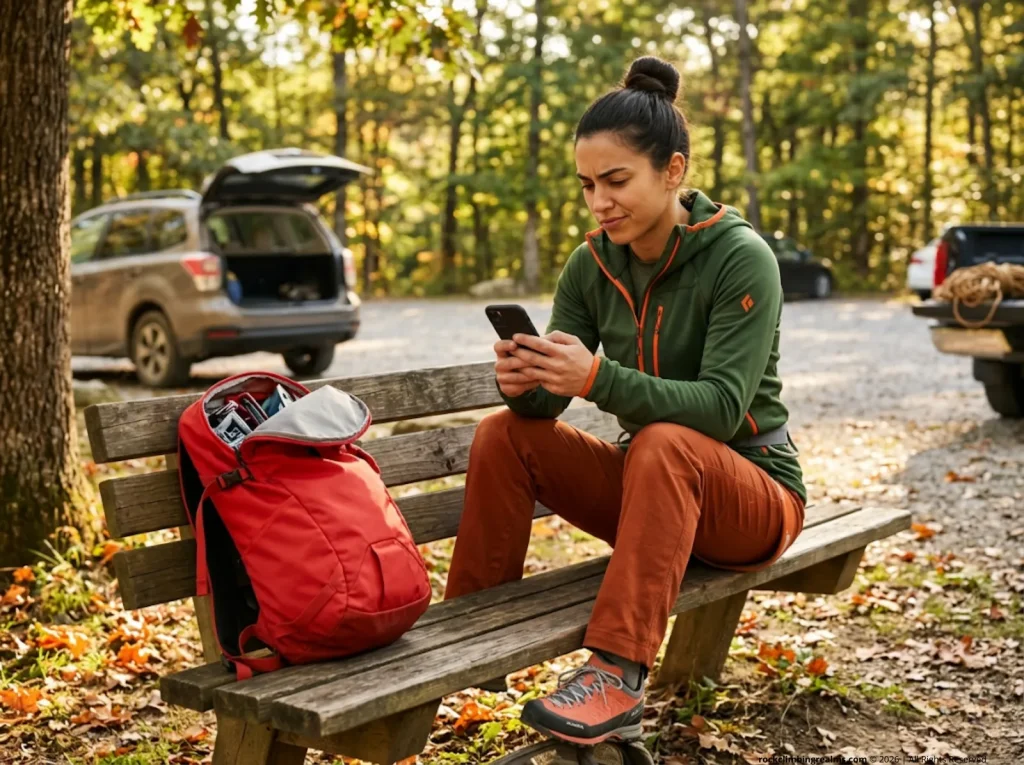
Here’s where most travelers start and most travelers stop: they find someone on Mountain Project Partner Finder with a grade list that matches their objectives, fire off a message, and call that vetting. It isn’t.
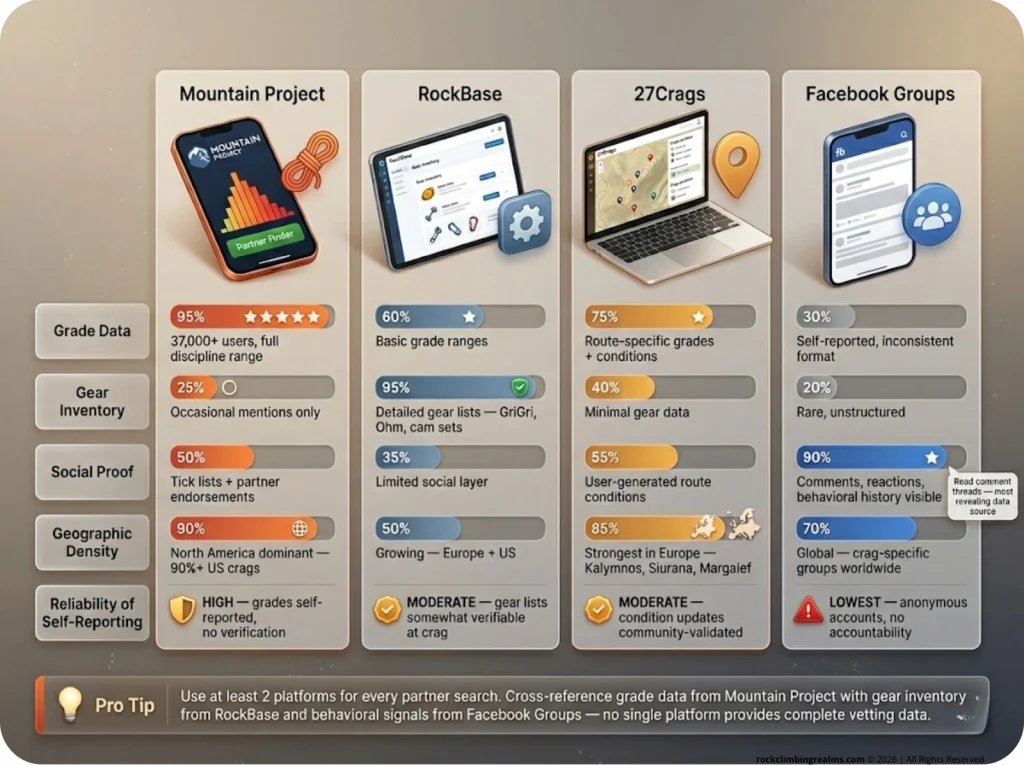
Mountain Project hosts over 37,000 active users spanning 3rd-class scrambles to 5.15d sport leads and M16 mixed — the largest searchable pool of climbing partners globally. RockBase goes one step further by letting users list specific gear inventory: GriGri, Ohm, cam sets. That inventory data is more useful than a max send grade, but it’s still theoretical until you see it in person. 27Crags is the strongest option for European destinations — Kalymnos, Siurana, Margalef — with condition-specific beta and user-generated route updates. Facebook Groups like “Kalymnos Climbing” add a social endorsement layer no algorithm can replicate: read comments on a prospective partner’s posts for behavioral signals. Instagram crag-specific hashtags (#kalymnos, #redrivergorge) let you observe how someone presents themselves before any contact.
The core problem with all of it: a self-reported grade is a performance metric. It says nothing about whether someone can safely clean a sport anchor, manage a closed rappel system, or execute a verbal call-back under noise. As the research on how to find climbing partners before you leave home makes clear, the digital introduction is Tier 1 screening — it advances a candidate to Phase II. It doesn’t authorize rope commitment.
Pro tip: Before your first message, check whether the profile lists specific belay devices and anchor systems — not just a max send. A profile that mentions “GriGri + Ohm” signals a different level of self-awareness than one listing only a grade.
Mountain Project and RockBase — Reading Between the Grade Lines
Mountain Project profiles show grade ranges across disciplines (trad, sport, ice, mixed, aid) and sometimes gear owned. Cross-reference all three signals. A critical red flag: profiles listing only lead grades with no mention of belay experience, gear, or anchor systems. These are performance-focused climbers who may not have internalized the safety systems.
DM them before you meet and ask: “What’s your cleaning protocol for sport routes?” and “What communication commands do you use at the top?” Their answers tell you whether this conversation has happened before — or whether you’re the first person who has ever asked.
Facebook Groups, Reddit, and the Social Proof Layer
Community groups for specific crags offer something algorithms can’t manufacture: real behavioral data. Read comments. Watch how someone responds when a stranger asks a basic question. Reddit’s r/climbing partner threads are high-volume but low-vetting — treat them as a starting pool, not a final selection.
DM a prospective partner 48–72 hours before arriving. Response speed and depth are behavioral data points in themselves. A one-word reply to a technical question is telling. The contrast between a thoughtful reply and a “yeah sure” is exactly the information-action gap at work.
The Information-Action Gap — Why a Profile Is Just a Screening Tool
Digital profiles are static, self-reported, and unverified. The information-action gap is the distance between what a climber claims and what they can execute at the crag. A partner who deflects or refuses to discuss cleaning protocols, belay devices, or communication systems digitally is already showing low tolerance for the vetting conversation. That’s a behavioral red flag before you’ve met face-to-face.
The Crag-Side Social Diagnostic — Bouldering, Etiquette, and Movement Observation
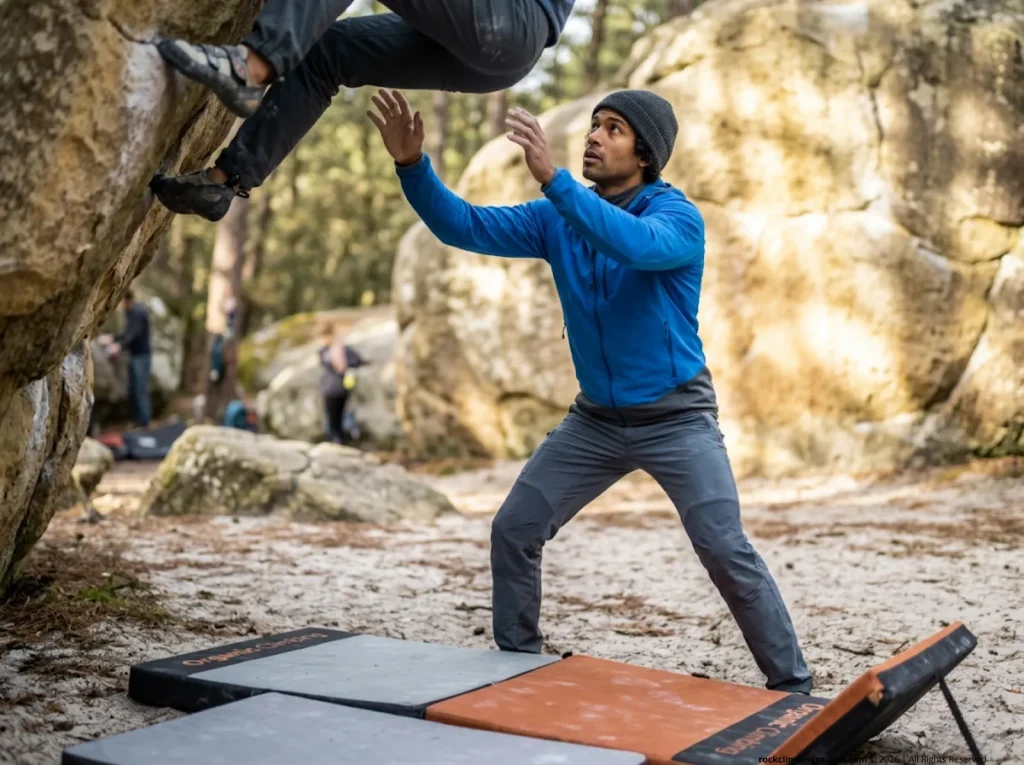
The first physical meeting should never happen at the base of the route you’re planning to lead. Meet at a gym, a bouldering sector, or the warm-up wall. This isn’t excessive caution — it’s how professional climbers operate. The objective hazard at the gym is zero. The information you gather there has full consequence value.
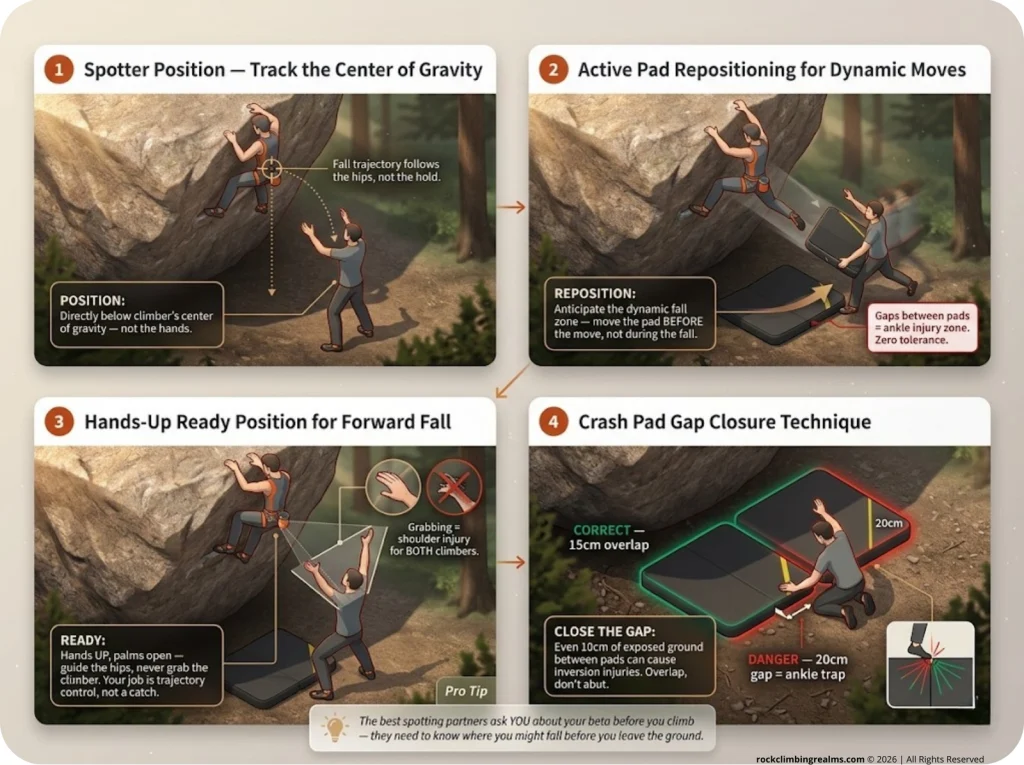
Bouldering sectors function as a movement laboratory. Watch whether a stranger spots attentively — tracking the climber’s center of gravity, repositioning pads for dynamic moves, managing gap coverage. That behavior reveals an understanding of fall physics without a word exchanged. Observe what proper spotting mechanics actually look like before you’re relying on this person to catch you at 12 meters.
Crag etiquette compliance tells you the rest: do they go silent when someone else is on a critical attempt? Do they clear the fall zone when it isn’t their turn? Do they hand out beta nobody asked for? The partner who asks you technical questions — “What knot do you tie in?” or “Do you use a stopper knot?” — is demonstrating reciprocal safety standards. That’s the partner you want.
The Halo Effect runs the other direction too: a partner who immediately projects a route beyond their warm-up grade is showing you the Sunk Cost impulse early. That’s the mindset that pushes people past their no-go criteria when things get serious.
Pro tip: Let them warm up first while you watch. You’ll learn more in 20 minutes of observation than in two hours of conversation.
The “Trade-a-Belay” Tactic at International Sport Crags
At destination crags — Kalymnos, Siurana, The Red (Miguel’s), Yosemite (Camp 4) — the Party of Three is the cleanest field diagnostic available. Find a group of three where one climber is resting. Offer to give a belay first. This sequence — give, then receive — lets you observe the stranger’s brake-hand position, body mechanics, attention during the catch, and timing before you leave the ground on their rope.
The framing matters: calling it a “trade-a-belay” establishes a peer-to-peer relationship, not a dependency ask. It also signals your own competence.
Reading Behavioral Red Flags at First Contact
One sentence tells you more than a dozen profile reviews: “I’ve been climbing for 10 years, I don’t need a partner check.” That sentence is the most important data point in the entire vetting process. For quick reference:
| Climbing Safety Risk Assessment | ||
|---|---|---|
| Red Flag | Technical Risk | Mitigation |
| Dismissing partner checks | High probability of knot failure or device misload | Mandatory verbalization of every check |
| Overconfidence in grade | Energy depletion, hangdogging risk | Start within both climbers’ onsight limit |
| Vague cleaning description | High risk of anchor transition error | Step-by-step walkthrough before leaving ground |
| Impatience with gear vetting | Poor maintenance habits, objective gear failure | Visual audit of all life-critical equipment |
The AAC analysis of human factors in climbing accidents puts 43% of documented accidents on experienced climbers. The data demolishes the “experience equals safety” assumption. Grade and safety competence must be assessed independently. Always.
The Technical Interrogation — The Crag-Side Interview Script
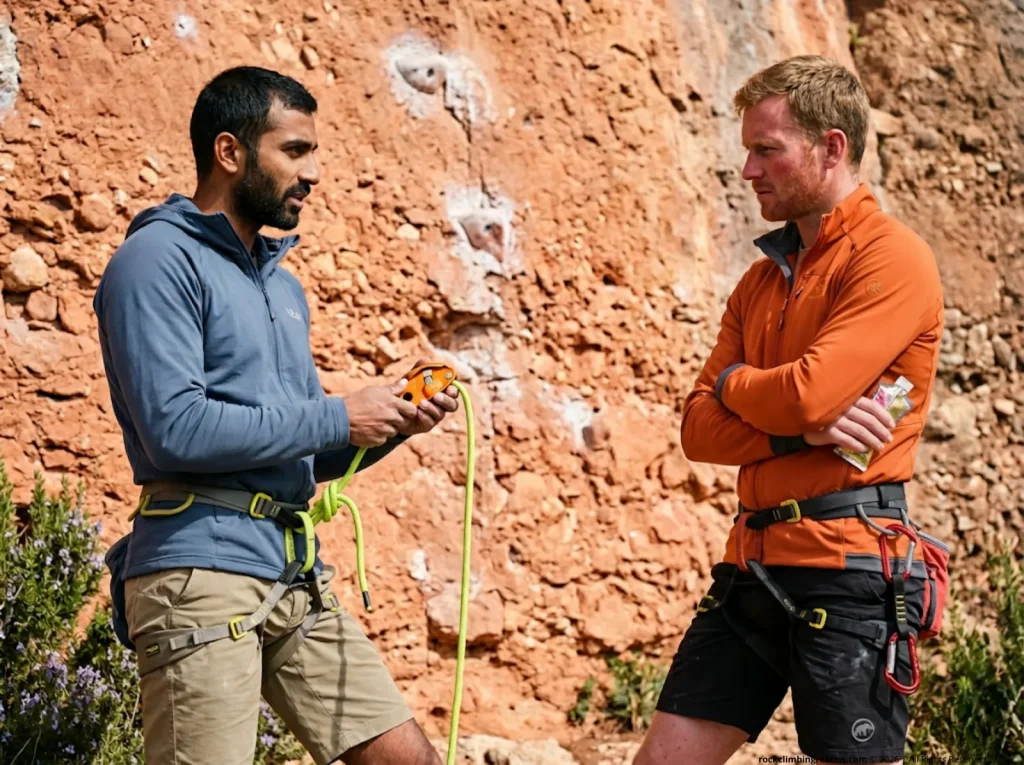
Most guides on this topic tell you to “ask how long they’ve been climbing.” That question is nearly useless. Tenure doesn’t measure systems knowledge. The actual protocol goes four levels deeper.
The technical interrogation is a systematic audit designed to surface gaps before they produce consequences. Here are the four mandatory questions, in sequence:
- Device Competence: “Which belay device are you most proficient with, and do you have experience with assisted braking devices in high-friction scenarios?” This surfaces awareness of GriGri versus ATC performance differences, and whether the person understands when an Ohm belongs in the system.
- Anchor Cleaning Protocol: “How do you intend to clean the route — lowering through the fixed hardware or transitioning to a rappel?” Miscommunication at anchor transitions is a documented leading cause of climbing fatalities. A safe cleaner will describe: clipping direct, going off belay, threading the rope bight, re-tying, confirming “In Direct,” removing draws, then confirming before lowering. “I’ll just lower off the rings” without describing a direct backup system is a significant red flag.
- Communication Commands: “What are your verbal cues for ‘Off Belay’ and ‘In Direct’?” At Kalymnos with surf below you, or in Red River Gorge wind corridors, ambient noise eats unverified commands. Agree beforehand on a Call-Back system: every command is repeated back. Three messages for every state change. Agree also on a rope-tug backup: 2 tugs = “On Belay,” 3 tugs = “Safe, take me off.”
- System Closure: “Do we have a protocol for knotting the rope ends for every pitch?” Failure to maintain a closed system is a recurring theme in rappel accident data. Pauses or hedging on this question are disqualifying for multi-pitch objectives.
A competent partner answers all four without hesitation. Think of this as the aviation Challenge-Response call-back system applied to the vertical environment. In commercial aviation, every command is read back. The same discipline belongs at the base of every route. For the technical standards underpinning each of these checks, the UIAA safety standards for climbing equipment provide the governing benchmarks for rope systems, belay devices, and connectors.
After walking through the script, follow up with the partner check system that catches what the interrogation misses — the hands-on physical check before anyone leaves the ground.
Pro tip: Have your partner load their belay device and demonstrate their loading sequence before the lead. A 30-second physical check has more information density than asking “Do you know how to use a GriGri?”
Ask them to walk through the physical gear sequence on the ground after the verbal walkthrough. If they describe it correctly in words, they should be able to replicate it in hands.
The Physics of the Catch — Weight Disparities, Fall Forces, and Mitigation
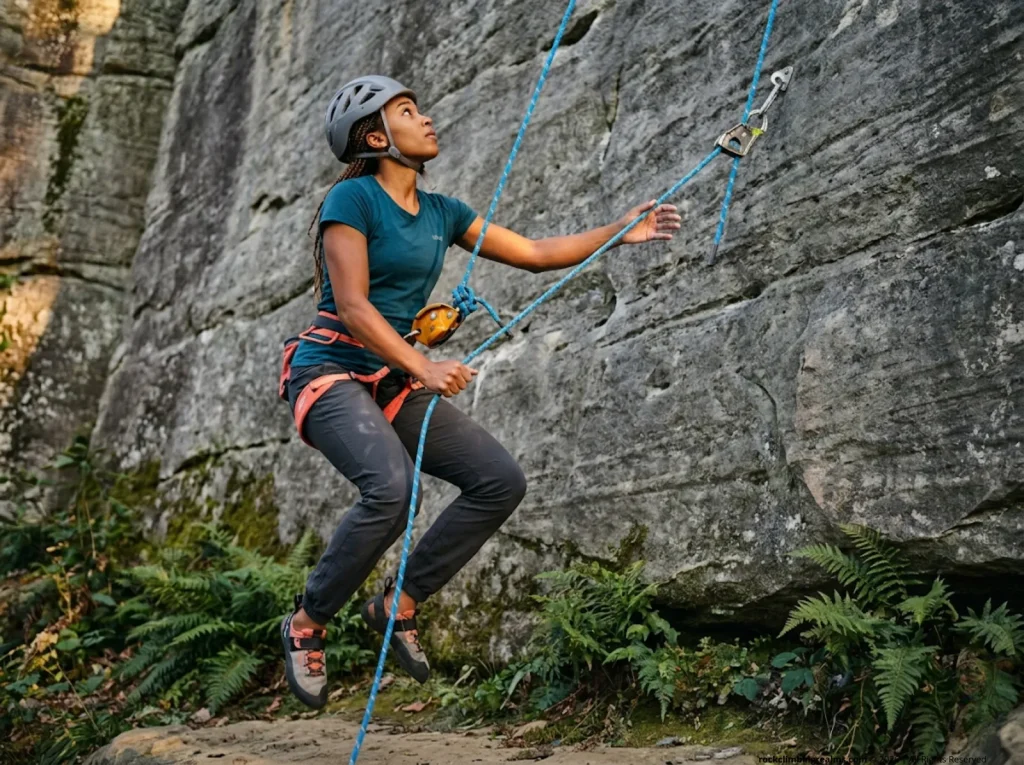 Edelrid Ohm on first bolt at Red River Gorge” class=”wp-image-14727″/>
Weight disparity between a leader and belayer isn’t a social awkwardness problem. It’s a physics problem. And the physics don’t care about anyone’s feelings.
The German Alpine Club (DAV) threshold: a lead climber should not exceed the belayer’s weight by more than 10 kg (roughly 22 lbs) for a standard dynamic catch. Beyond that margin, forces become hazardous without technical intervention. The fall factor governs how hard the catch lands — a short fall directly onto the belay station with a high fall factor generates forces comparable to a much longer fall. Rope length in the system doesn’t negate this.
Ask your partner their weight directly and frame it as a physics question: “I want to make sure I’m running the right belay system for our weight ratio.” A partner who refuses to engage with this is dismissing objective physics. That’s a behavioral red flag.
Active catch mechanics — the belayer jumping slightly upward at the moment of impact — reduce the force at the first deflection point by more than 25%. Stationary passive belaying dramatically amplifies impact force when the leader is significantly heavier. Test this in the gym or on a top-rope warm-up before committing to a hard lead.
For partnerships with weight differences exceeding 20–30%, the Edelrid Ohm is non-negotiable. The Ohm clips to the first bolt in the safety chain. In a fall, the rope feeds into a V-shaped braking slot, increasing friction and making the climber effectively 25 kg lighter for the belayer. See Edelrid Ohm official specifications and weight disparity thresholds for the full rope diameter compatibility (8.6–11 mm single rope) and operational specs. Review the full physics breakdown of the Ohm for weight-disparate partnerships before your first use.
One critical nuance: passive belaying with an Ohm — standing still, relying entirely on the device — can actually increase impact force due to friction engagement timing. The Ohm augments active technique. It doesn’t replace it. The “rocket belayer effect” — a lighter belayer launched upward during a hard fall — is also prevented by the Ohm while preserving belayer mobility.
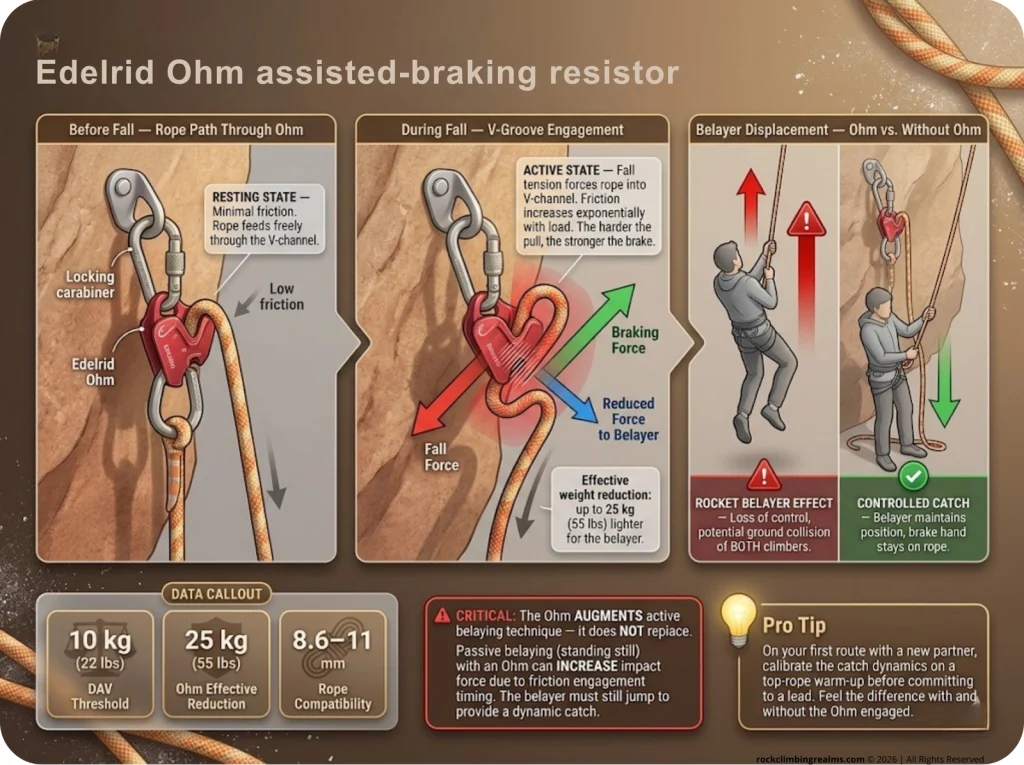
For timing, study the soft catch timing mechanics most belayers miss — the jump windows and body mechanics that turn a hard catch into a soft one.
Pro tip: On the first route with a stranger of significantly different weight, start on a top-rope scenario if available, or the easiest route at the crag, to let both of you calibrate the dynamic catch instinct before committing to a hard lead.
Institutional Standards and the Gear Audit — Verifying the Equipment Chain
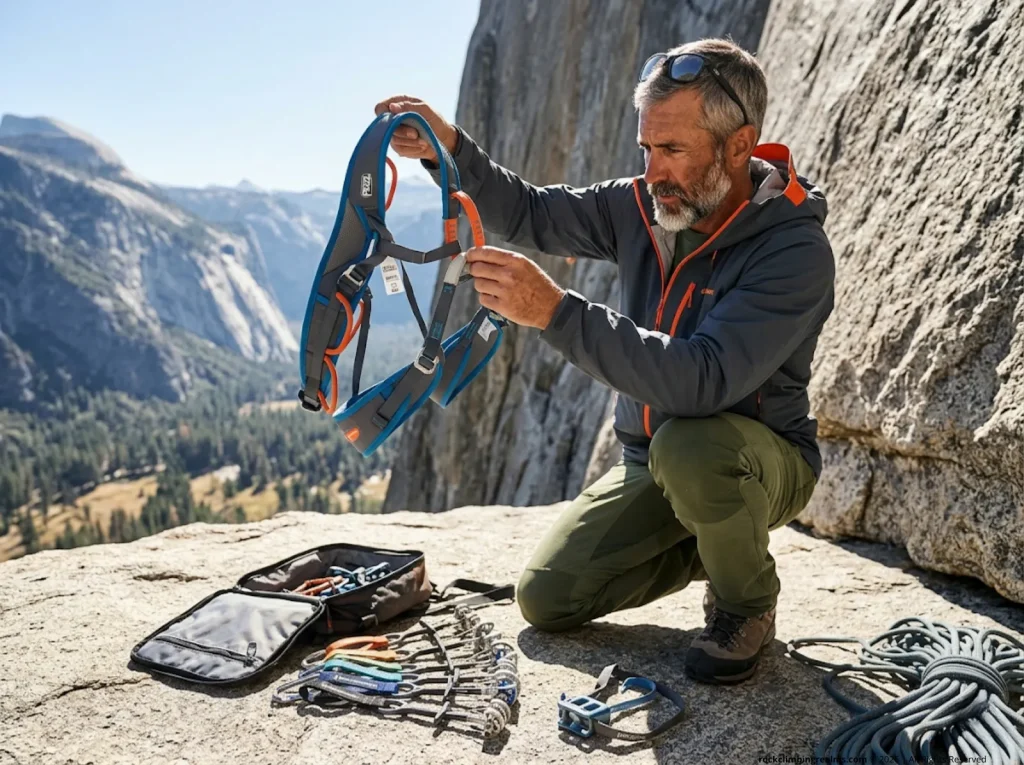
The UIAA has set safety standards for over 25 categories of climbing equipment since 1960. Vetting a stranger’s gear against these standards takes less than five minutes and covers the most common failure modes in the system.
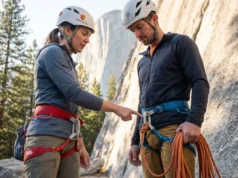
Run the gear audit symmetric: announce that you check your own gear in front of your partner as standard practice. “I always do a quick systems walk-through — I’ll run mine, then cover yours.” This normalizes the mutual check and removes the social friction of implying distrust. The partner who takes offense at a standard systems walkthrough has just delivered the most important data point of the entire session. Reference what each UIAA standard actually demands from your gear if you want to master each inspection category.
Rapid gear audit by UIAA standard:
- UIAA 101 — Dynamic Ropes: Run the full rope through your hands before the first pitch. Flat spots, core-feel irregularities, and sheath looseness at the mid-point are retirement indicators. Ask when it was last washed and how many falls it has caught.
- UIAA 105 — Harnesses: The belay loop is the single most loaded point in the system. Look for fraying, UV discoloration (pale yellow or bleached fabric means webbing strength loss), or sewn bar-tack separation. Ask when they last replaced it — manufacturer guideline is 10 years maximum from manufacture date, and immediate retirement after any high-fall loading.
- UIAA 121 — Carabiners: Squeeze the gate of every locking carabiner in the system. A sticky gate or one that fails to spring fully back to closed is a single-point failure candidate. Check the MBS marking — anything below 20 kN major-axis rating is under standard for primary use. For sticky gates, see how to diagnose and fix sticky carabiner gates in the field.
- UIAA 129 — Braking Devices: Look for deep grooves in the braking slot from rope abrasion. Verify the GriGri cam actuates correctly — check that it isn’t disabled. A partner who loads a GriGri with the cam bypassed is demonstrating the exact failure mode documented in the gym-to-crag transition case study where a climber clipped into a GriGri as if it were an auto-belay, let go at the top, and hit the ground.
If your partner holds an AMGA Single Pitch Instructor (SPI) or IFMGA Mountain Guide credential, treat that as additional evidence — not as a replacement for the technical interrogation. Certification doesn’t preclude Risk Normalization patterns. Credentialed guides vet each other too.
Human Factors — The Cognitive Biases That Kill Competent Climbers
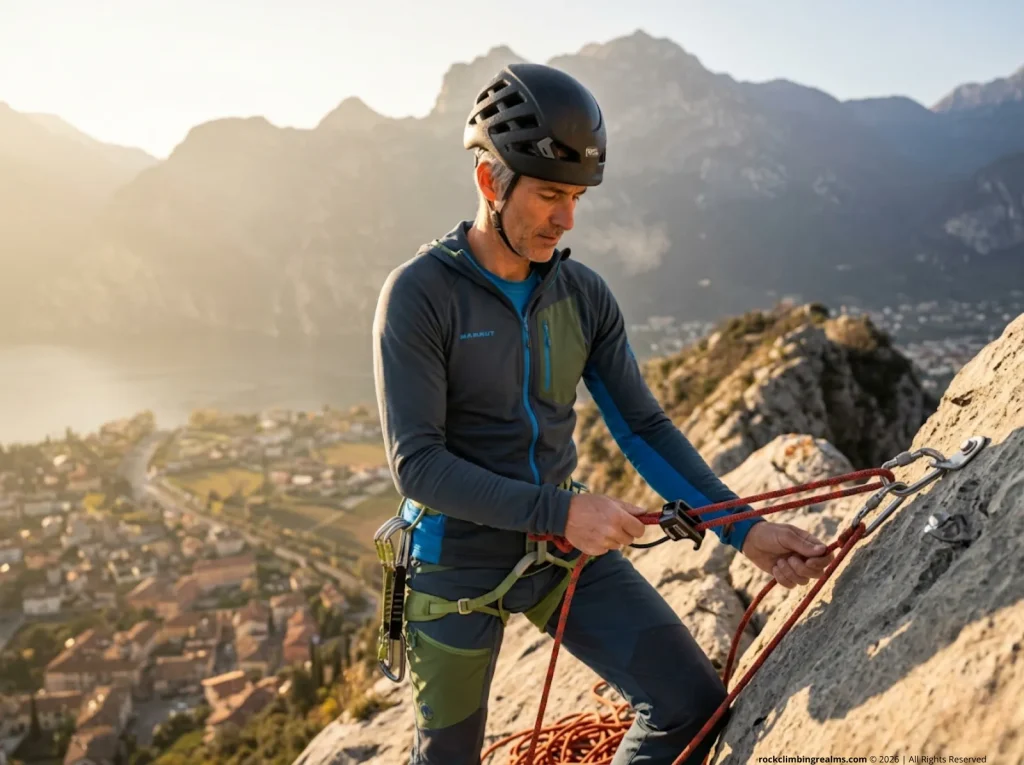
43% of documented accidents involve experienced climbers. That number should permanently retire the belief that tenure equals safety. The mechanism behind most of these accidents isn’t skill failure. It’s psychology.
Four cognitive biases operate in the vertical environment, and you need to audit for all of them in a stranger:
The Halo Effect assumes a high-grade climber is inherently a safe belayer. Grade and safety competence are separate variables. Assess them separately.
Risk Normalization is the most hazardous one: “We’ve skipped that check before and it was fine.” Every time someone skips a check without consequence, the behavior gets reinforced. One day the consequence shows up. The data from the AAC analysis of human factors in climbing accidents doesn’t equivocate on this.
The Expert Trap stops you from questioning an experienced stranger’s anchor or knot because you don’t want to seem paranoid. That hesitation is how climbers get hurt. The script: “I always do a quick systems walk-through before we start — just standard practice. I’ll run mine, then walk through yours.” How the Swiss Cheese Model explains why experienced climbers still fall gives you the structural framework for understanding how small individual decisions combine into accidents.
The Sunk Cost Fallacy is particularly hazardous in travel contexts. A $2,000 flight to Kalymnos and a 4-day weather window don’t obligate you to rope up with an unsafe partner. Agree on explicit no-go criteria in advance. If a stranger can’t meet them, the objective changes — not the criteria.
The majority of severe injuries cluster at transition points: anchors, lead swaps, rappel setups — especially at the end of long days. Mental fatigue at those moments reduces working memory and pushes people toward heuristic shortcuts. The only effective mitigation is a pre-agreed protocol: “We verbalize every state change. No exceptions.” Establish it before the first pitch.
Pro tip: When you notice your own standards slipping (“It’ll be fine, we’ve done this route before”), that feeling is the signal to slow down, not to move faster.
Conclusion
Three things to carry out of this guide:
Grade is a performance metric. Safety is a separate data set. Assess them independently. A 5.12 leader who can’t describe their anchor cleaning protocol is a high-risk belay, regardless of what their profile says.
The physics aren’t flexible. Weight ratio, fall factor, and active catch mechanics determine whether a fall is a clean catch or a deck. Run the numbers. Deploy the Ohm when the weight differential demands it.
Verbalized awareness is the only cognitive bias mitigation that actually works in the field. Perform partner checks out loud. Confirm every state change. Run the Call-Back system from the first pitch — not after the first error.
Before your next trip, build your crag-side interview script in a notes app: the four mandatory questions, your weight ratio threshold, your communication commands, your no-go criteria. Practice delivering it until it feels like a handshake. The best climbing partnerships are built on technical honesty, not social comfort.
Now go send something.
FAQ
Is it safe to find climbing partners online?
Online platforms like Mountain Project and RockBase are safe starting points for finding partners, but a digital profile is not a verified safety credential. Treat it as Tier 1 screening only — move any candidate to a social diagnostic (bouldering session, gym visit) before committing a rope to them, and run the full technical interrogation at the crag.
How do I ask a stranger climbing questions without sounding paranoid?
Frame it as standard practice, not suspicion: I always do a quick systems walkthrough before we start — just the way I was trained. I’ll run you through mine, then cover yours. Professional climbers vet each other every session. A partner who takes offense at a standard safety check has just told you exactly what kind of partner they are.
What apps are best for finding a climbing partner while traveling?
Mountain Project Partner Finder has the highest global user density — over 37,000 active users. RockBase is the best for gear inventory transparency. 27Crags is strongest for European crags with condition-specific data. Use at least two platforms, and treat all profile data as preliminary — not vetted.
What should I do if my new partner is significantly heavier or lighter than me?
Calculate the weight difference. If it exceeds 10 kg (approximately 22 lbs), you’re in German Alpine Club (DAV) intervention territory. At 20–30%+ disparity, deploy the Edelrid Ohm — clipped to the first bolt — and confirm the lighter belayer is using active jump-catch mechanics, not passive standing. The Ohm augments technique. It doesn’t replace it.
Can you go to a climbing gym alone to find a partner while traveling?
Yes. A local climbing gym is one of the best live vetting environments available to a traveling climber. Partner boards at gyms post current requests, and the gym setting provides a low-stakes observation window before any outdoor commitment. Always request a belay device demonstration in the gym before taking the partnership outside.
Safety Notice: Rock climbing and mountaineering are inherently high-risk
activities that can involve physical trauma or fatal incidents. The information on Rock Climbing Realms is for
educational and informational purposes only. Techniques and advice presented here are not a substitute
for professional, hands-on instruction. Conditions and risks vary by location. Always seek guidance
from a qualified instructor before attempting new techniques. By using this website, you agree that you
are solely responsible for your own safety. Any reliance you place on this information is strictly
at your own risk, and you assume all liability for your actions. Rock Climbing Realms and its authors
will not be held liable for any harm, damage, or loss sustained in connection with the use of this information.
Affiliate Disclosure: We are a participant in the Amazon Services LLC Associates Program, an
affiliate advertising program designed to provide a means for us to earn advertising fees by advertising and linking
to Amazon.com. As an Amazon Associate, we earn from qualifying purchases. We are also an official affiliate partner
of Black Diamond Equipment via the AvantLink network. If you click on a Black Diamond affiliate link and make a
purchase, we may earn a commission at no additional cost to you. We also participate in other affiliate programs.
Additional terms are found in the terms of service.