
In this article
The stringer cracked at 3 a.m. on a Thursday — not a pop, not a groan, but the kind of deep, wood-fiber failure that sounds exactly like a mistake you made six months ago when you grabbed the wrong lumber at the big-box store. The wall tilted five degrees. The T-nuts, embedded in ½” CDX, spun freely. Two years of evenings. Gone.
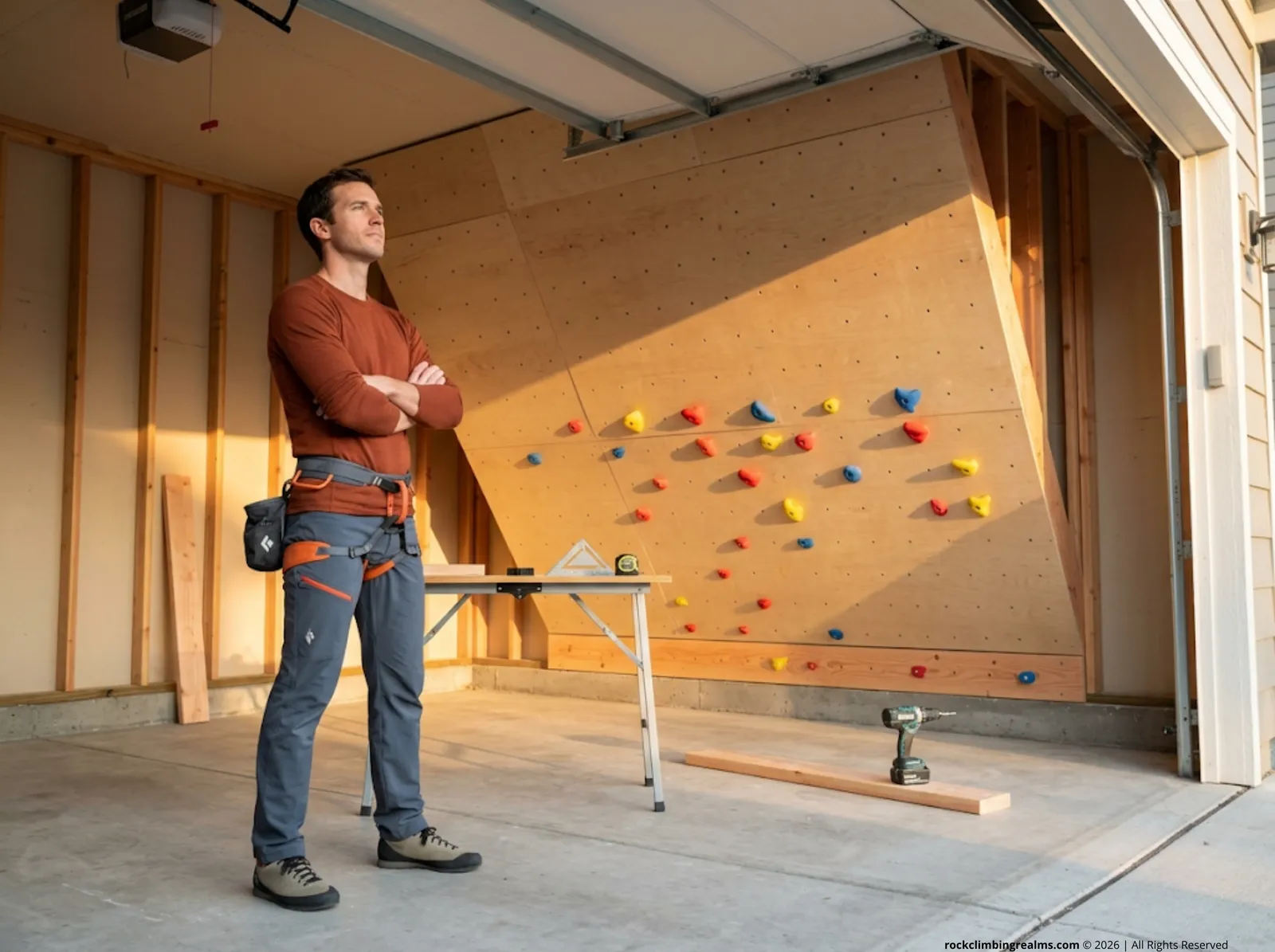
I’ve built walls in garages from Flagstaff to Portland. I’ve seen overengineered disasters and catastrophically underbuilt ones. The mistakes are always the same: wrong plywood, wrong fasteners, no acoustic plan, T-nuts installed backwards from the front because someone watched a YouTube video on mute. This guide corrects all of that before you drive a single screw.
By the end, you’ll understand the load-bearing structure from hold to foundation, why your lumber grade determines your T-nut reliability, and how to pick the wall angle that matches what you’re actually trying to train — not what happens to fit comfortably in your garage.
⚡ Quick Answer: Build your home climbing wall with 3/4″ Baltic Birch plywood, 2×6 Douglas Fir stringers on 16″ centers, and 3-hole screw-in T-nuts. Set the wall at 40–45° for maximum strength gains. Use Simpson SDWS structural screws — not lag bolts, never drywall screws. Install a 10″ multi-layer foam system across the entire fall zone. Skip any of this and you’re building a maintenance problem, not a training tool.
| Quick Reference: Home Wall Engineering Baseline | |
|---|---|
| Variable | Specification |
| Primary stringers | 2×6 Douglas Fir, 16″ on center |
| Plywood | 3/4″ Baltic Birch B/BB (19mm) |
| T-nut standard | 3-hole screw-in (minimum) |
| Design load | 3.0x body weight |
| Minimum foam depth | 10″ total, multi-layer |
| Optimal wall angle | 40°–45° for power/recruitment |
| UIAA anchor minimum | 20 kN axial load |
The Structural Manifesto: Load Paths and Why Walls Fail
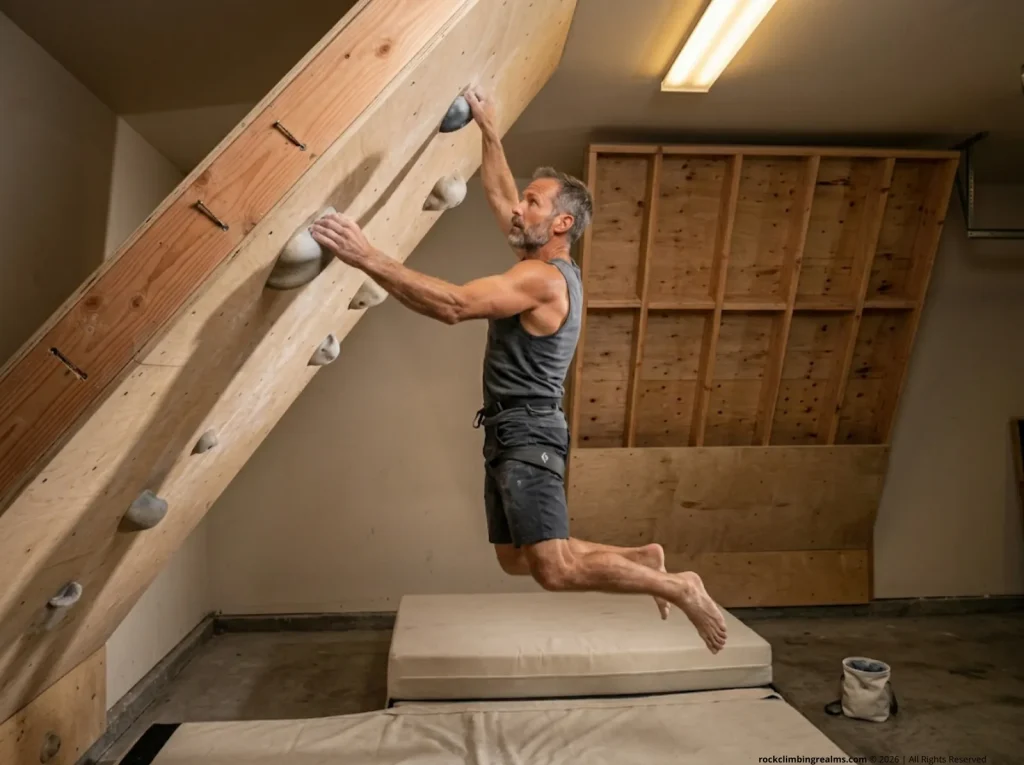
A home climbing wall is not a shelf. It’s not furniture. It is a dynamic load-management system that has to absorb the physics of a 90 kg climber throwing a dyno on a steep overhang — repeatedly, for years. Most garage builds fail because the builder thinks in static terms: “The wall weighs this much, so the frame needs to hold this much.” Wrong. What matters is how hard a real climbing move actually hits the structure.
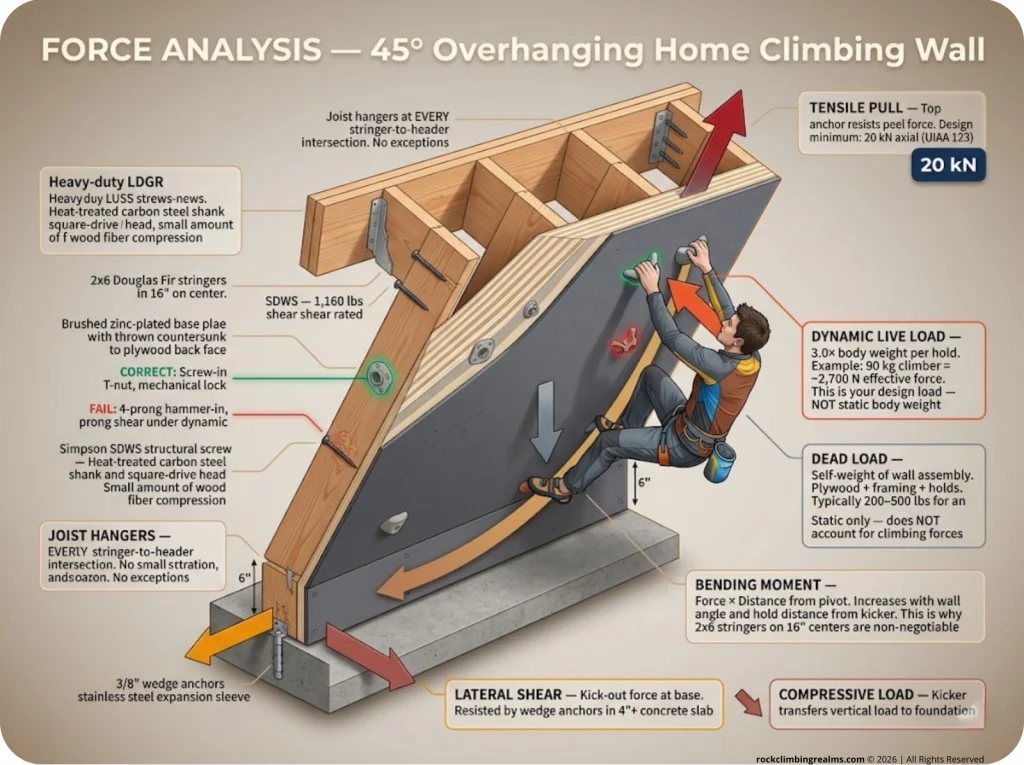
According to dynamic load analysis in sport climbing sensor studies, the realistic design threshold is 3.0x body weight — meaning a 90 kg climber generates roughly 2,700 Newtons of effective force on a single hold during a dynamic move. An 8’x12′ wall at 45° regularly sees combined dead and live loads exceeding 500 lbs. That number touches every fastener in the system.
The real challenge with overhanging walls is what engineers call a bending moment: force applied at the hold combines with the distance from the pivot point (the kicker or floor plate) to create two simultaneous failure modes. Peel force tries to pull the top anchor away from the ceiling. Kick-out force tries to push the base away from the wall. Both happen at once. If your framing is undersized, or your top anchor is inadequate, one of those forces wins — usually at 3 a.m.
For a thorough look at all structural components of a climbing wall before you start sourcing lumber, that reference builds the vocabulary you’ll need.
Pro tip: If you’re attaching framing over existing drywall, stop. Strip it to the studs first. Drywall has zero structural integrity and will microscopically crush under framing pressure over time, loosening anchors in a way you won’t see coming. This is the most common silent failure mode in garage builds.
Dynamic Force vs. Static Load: The Math That Matters
Your body weight is not your design load. A 90 kg climber at rest applies roughly 882 Newtons of force. That same climber cutting feet on a steep overhang applies close to 2,700 Newtons — across a single hold, through a single T-nut, through a single screw, into a single stud. The most hazardous assumption in home wall construction is that a wall “feels solid” at low load. Structural integrity looks the same whether the framing is correct or ruinously wrong — until you actually climb on it hard.
The UIAA 20 kN axial load benchmark is the floor for primary attachment points. Apply that standard to your ledger connections and top anchors, not just to the climbing anchors if you’re building a lead wall.
Framing Scantlings: Why 2×4 Will Cost You the Wall
Here’s where most people go wrong. They price the lumber and reach for 2x4s because Douglas Fir 2×6 adds cost. A 2×6 on edge is roughly 2.5 times stiffer than a 2×4 in the direction that matters — resisting deflection away from the wall. That extra stiffness is not a luxury; it’s what keeps T-nuts seated over years of hard training.
The industry standard for overhanging home lead-climbing walls and home bouldering walls is 2×6 Douglas Fir stringers on 16″ centers. For spans over 8 feet, step up to 2×8 or LVL beams. “Bounciness” from undersized framing is the primary cause of T-nut loosening — a wall that flexes microscopically on every pull trains the T-nuts to spin.
Install joist hangers at every stringer-to-header intersection. Add horizontal blocking (noggins) at mid-span to prevent stringer rotation and add plywood screw points. For free-standing walls, sister the end posts — two 2x6s fastened together — to resist lateral buckling at the base.
Anchoring to the House: Ledger Boards and Code-Compliant Connections
The ledger board connection to your house rim joist is the highest-load single point in the system. LedgerLOK or Simpson SDWS structural screws are the professional standard — code-compliant for lateral-load ledger connections, with rated shear values that survive real dynamic load. Standard wood screws and drywall screws (the black brittle ones) have near-zero shear strength and will snap under the first real dynamic loading event.
One more thing: if your wall is structurally attached to the house in some municipalities, you may need a building permit. Check with your local building department before construction. The disclosure protects your homeowner’s insurance.
The Skin: Plywood Science and T-Nut Reliability
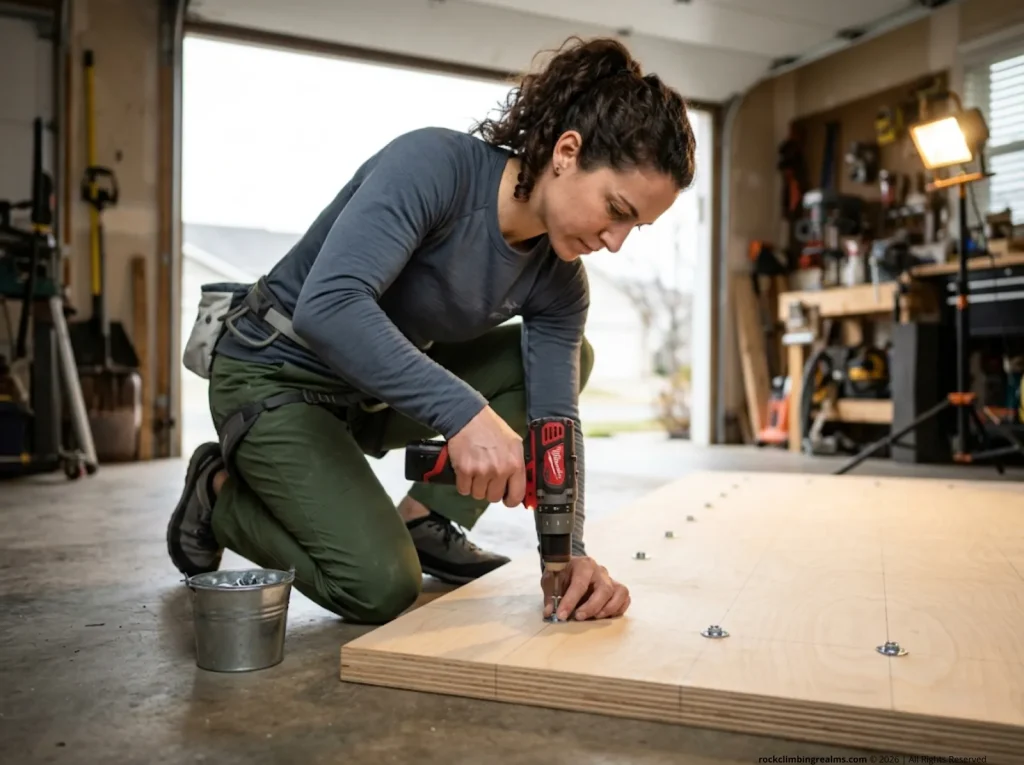
The plywood you choose determines whether you’re building a training tool or a T-nut replacement subscription. This is materials science in a format that matters.
Baltic Birch (B/BB grade) is dense, all-birch through all 13–15 plies, virtually void-free — which is exactly why it’s mandated for high-performance walls. CDX runs lighter with frequent air pockets throughout. OSB fails in shear entirely and is never acceptable for a climbing wall at any loading level. The T-nut retention hierarchy from the research data: Baltic Birch (10/10) → Structural 17mm (8/10) → ACX Softwood (6/10) → CDX (4/10) → OSB (1/10).
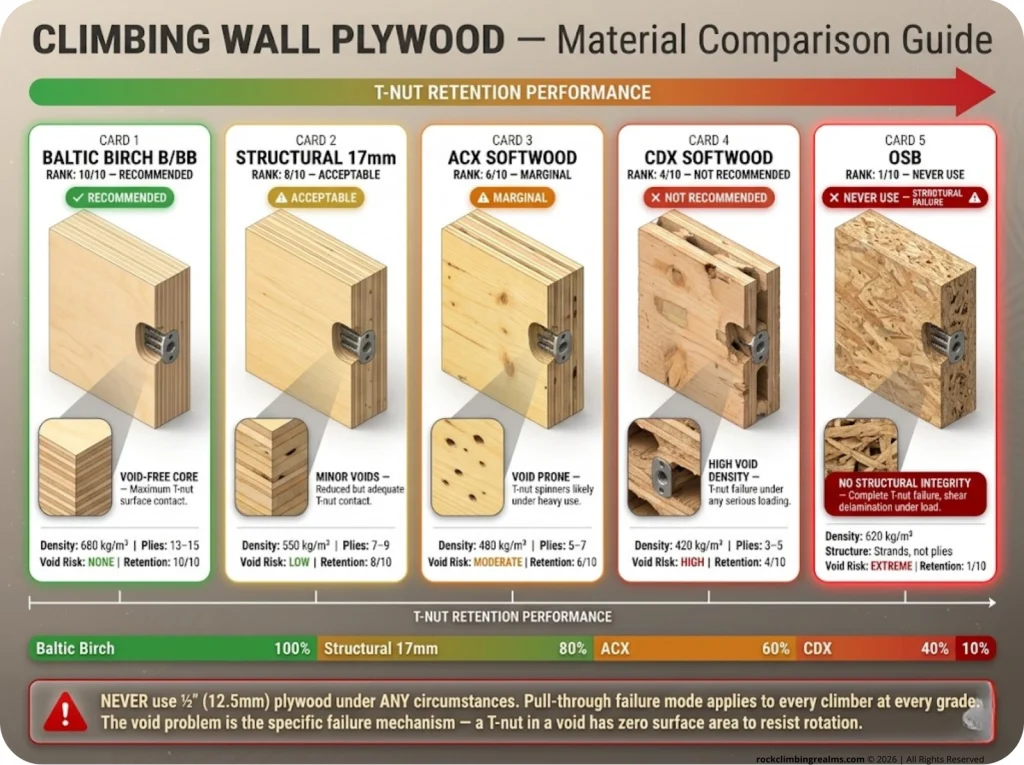
The “void” problem is the specific failure mechanism. A T-nut hammered into a void has zero surface area to resist rotation. The first hard pull produces a spinner. In Baltic Birch, the solid all-birch core is the structural reason the T-nut stays put. In CDX, it’s luck.
Never use 12.5mm (½”) plywood under any circumstances. The pull-out force from hold hardware will pull through thin veneers. This is not a weight concern — it’s a material failure mode that applies to every climber at every grade.
For the exact torque values and screw patterns that prevent spinners, see our guide on proper T-nut installation and hold mounting technique.
The Plywood Hierarchy: Baltic Birch vs. the Budget Options
Baltic Birch comes in 5’x5′ sheets, not the standard 4’x8′. Factor this into your panel layout before you order. A 10’x12′ wall at 45° requires approximately 6 full sheets — calculate first, cut second. The price premium over CDX is real but recoverable: most builders recoup it within 18 months by avoiding T-nut replacement labor alone.
Structural 17mm plywood (7–9 ply) is a viable mid-range alternative but carries void risk that Baltic Birch eliminates entirely. If budget forces a compromise, go to structural plywood before dropping to ACX — and never touch CDX for the climbing surface, regardless of what the guy at the counter recommends.
Screw-In T-Nuts: The Mechanical Lock That Ends Spinners
4-prong hammer-in T-nuts are designed for static furniture. Under the torque of a bouldering hold — often exceeding 40 newton-meters — the prongs shear through wood fibers. The result is a spinner. In a humid garage, zinc-plated 4-prong nuts also rust, giving you a double failure mode: lowest retention strength plus corrosion degradation.
3-hole screw-in T-nuts use a base plate secured to the back of the plywood with three small wood screws. This mechanical lock makes it physically impossible for the nut to spin or blow out. Industrial gym nuts (used on MoonBoards and in commercial gyms) go a step further with a larger base plate.
The correct installation sequence: drill the T-nut holes from the climbing side, install T-nuts from the back before mounting panels to the frame. Retrofitting T-nuts after panels are up is miserable and disruptive. Do it right the first time. Use an 8-inch grid pattern — this is the industry standard that generates approximately 2 T-nuts per square foot and allows maximum hold placement flexibility.
For large macros and volumes, use set screws (socket-head bolts) through additional T-nuts to prevent rotation under the high torque of large holds.
Surface Texture: Friction Coating and Skin Protection
Bare plywood provides insufficient friction for modern rubber compounds. The standard protocol: semi-gloss floor paint mixed with fine-grain silica sand or commercially available texture compound. Sharp masonry sand is overly abrasive — it creates a sandpaper surface that causes flappers on dynamic moves and discourages the high-volume training you built the wall for. Apply two coats, allow full cure, re-coat after 12–18 months as aggregate embeds and grip diminishes.
Fastener Engineering: Structural Screws vs. Lag Bolts
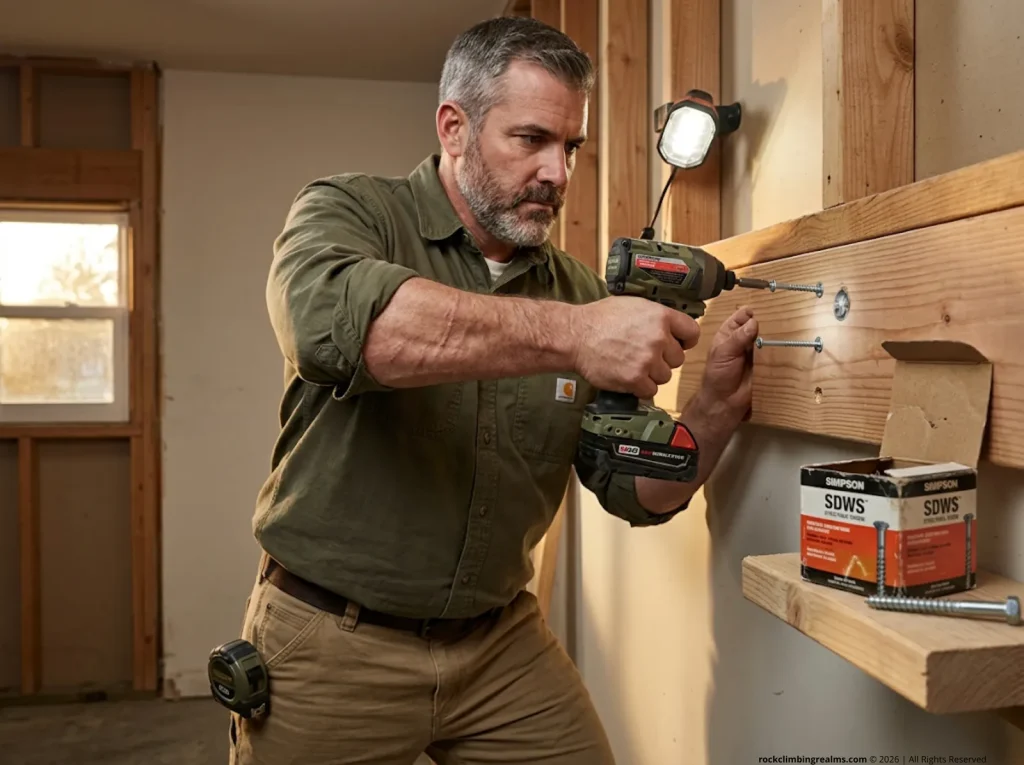
Lag bolts used to be the standard. That era ended. The professional recommendation has shifted completely toward heat-treated structural screws — and the shear strength data is unambiguous.
A Simpson SDWS at 0.220″ shank delivers 1,160–1,235 lbs of allowable shear and 1,833 lbs in tension. A ½” lag bolt at 0.500″ shank delivers 800–1,000 lbs shear — with a larger hole, more wood damage, and values that vary unpredictably based on pilot hole quality and wood species. The structural screw wins on every metric with a smaller footprint. See commercial climbing wall construction specifications for how this plays out at gym scale.
These aren’t arbitrary numbers — they come directly from UIAA safety standards that set the floor for home anchor strength.
Shear vs. Withdrawal: The Two Forces Every Fastener Must Resist
Every primary fastener in a climbing wall frame handles two simultaneous forces. Shear stress acts perpendicular to the fastener shaft — lateral slip between the framing members as a climber swings. Withdrawal acts along the fastener axis — the hold pulling away from the wall. Your ledger connection handles both simultaneously during every dynamic move.
Never rely on a single fastener for primary structural connections. Use a minimum of two per joist hanger, minimum four per ledger-to-wall connection. The physics of redundancy in climbing systems applies at the construction level too.
The Anti-Sell: Hardware That Will Fail You
Big-box “climbing” kits. Cheap plastic holds with thin walls, not designed for high-performance training torque. They crack, they spin, they degrade within months.
Zinc-plated 4-prong T-nuts in a humid garage are a double failure mode: rust exposure plus lowest retention strength. If you find black drywall screws anywhere in your wall’s structural path — remove and replace them before your first real session. This is non-negotiable. They have near-zero shear strength and will snap under the first real dynamic loading event.
Pro tip: The “just over-tighten it” myth costs people walls. Over-torquing cheap T-nuts shears their prongs into wood fibers, accelerating the spinner failure they were supposed to prevent. Torque correctly on the right hardware — don’t compensate for wrong materials with more force.
Joist Hangers and Metal Connectors: The Professional Detail
Metal joist hangers (Simpson LUS or equivalent) transfer load from horizontal blockers to vertical stringers. They work only when installed correctly: seated flush, fastened with the manufacturer-specified screw count and size. Substituting screw sizes or using fewer screws voids the rated load capacity. This matters more than it sounds — a wall that “feels solid” with three screws in a joist hanger may fail under dynamic load with the force values we’re talking about.
For free-standing walls: Simpson ABA adjustable post bases, bolted to the concrete floor with 3/8″ wedge anchors (Hilti Kwik-Bolt or equivalent). Every stringer-to-header intersection in the frame should have a metal connector — not just the ends.
Wall Angle and Training Stimulus: Building for Where You’re Going
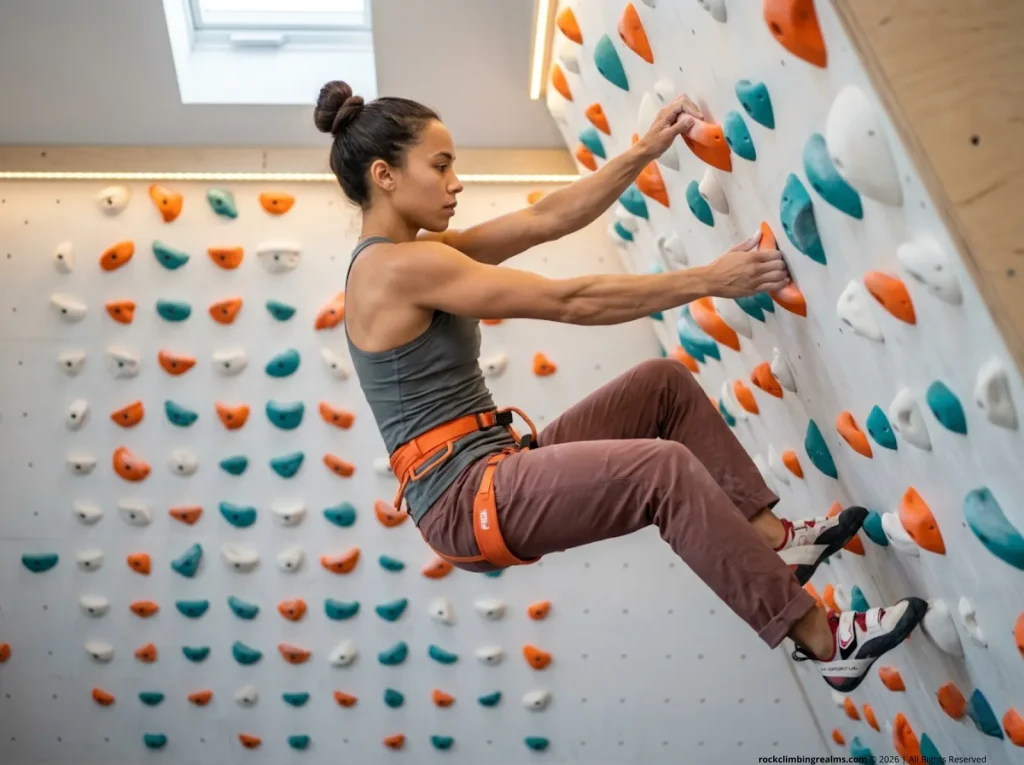
This is the section every competitor misses. Everyone tells you how to build a wall. Nobody tells you which wall to build — based on what your body actually needs to adapt.
Wall angle is the primary driver of what your body actually does on the wall. At 45°, the shoulder works significantly harder than at vertical — the elbow flexors (biceps, brachialis) see a measurable jump in activation with each move. This is active muscular recruitment, not passive elastic loading. Per research on neuromechanics of climbing lock-offs and joint loading, isometric hangs with arms fully extended also minimize elbow and shoulder joint stress compared to 90° lock-offs.
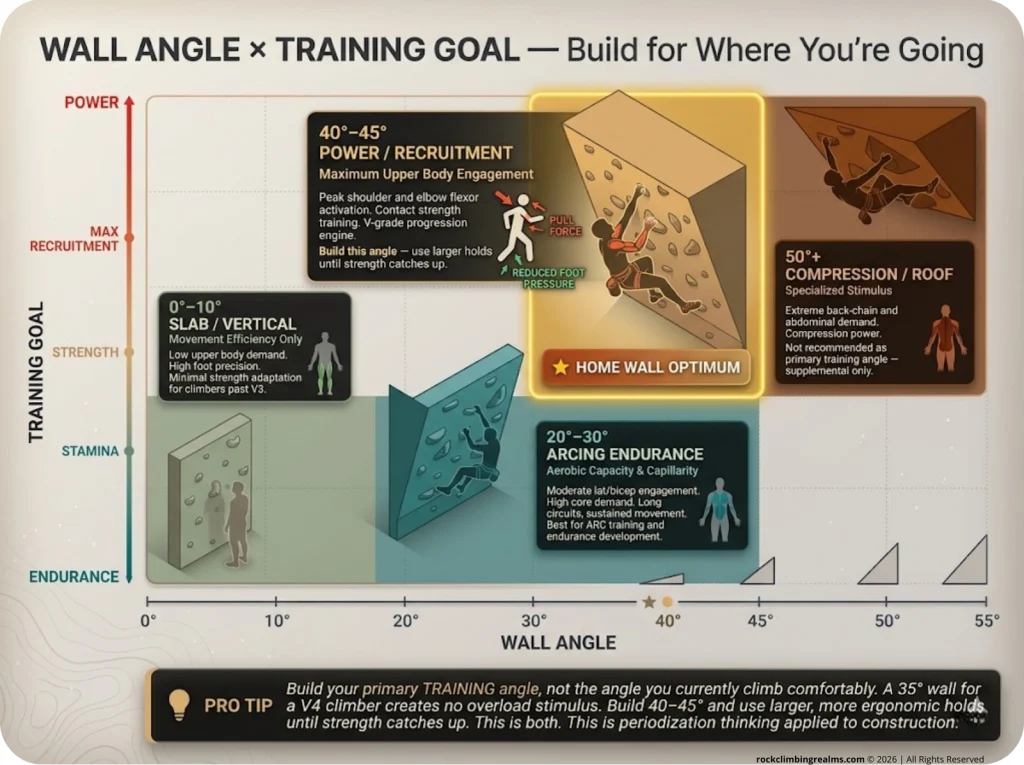
The practical application: a vertical or slightly overhanging wall (under 20°) gives you movement practice but produces minimal strength adaptation for climbers already past V3. Most dedicated climbers outgrow a near-vertical wall within one outdoor season. You’re spending thousands of dollars and a garage. Build the angle that actually makes you stronger.
The angle-to-training-goal breakdown from the research data:
- 0°–10° (Vertical): Low upper body demand, high foot pressure — movement efficiency only.
- 20°–30°: Moderate lat/bicep, high core — ARCing and endurance training, long circuits.
- 40°–45°: Maximum upper body engagement — power training, contact strength, V-grade progression.
- 50°+ (Roof): Extreme back-chain and abdominal — compression power, specialized stimulus.
If you’re debating a fixed MoonBoard-style training board vs. a custom angle, comparing structured training board angles and their programming demands breaks down the real-world trade-offs.
Selecting Your Angle: A Decision Framework
40°–45° for most home builders pursuing strength development — V-grade power focus. The ergonomic holds you can use at this angle allow high-volume training without destroying your skin, and the steepness drives the active recruitment that produces real adaptation.
20°–30° for climbers focused on ARCing (Aerobic Restoration and Capillarity training) and endurance. If long-route fitness is your primary goal, a shallower angle serves it better.
Pro tip: Build your primary training angle, not the angle you currently climb comfortably. A 35° wall for a V4 climber creates no overload stimulus. Build 40–45° and use larger, more ergonomic holds until strength catches up. This is periodization thinking applied to construction — build for where you’re going.
Minimum Dimensions for Effective Training
Minimum wall height is 10–12 feet. Below 10 feet, full-extension lock-offs are impossible and movement variety collapses. Minimum width is 8 feet — below that, lateral problem setting becomes severely limited. For most garages with standard 9’–10′ ceiling height, a 9’–10′ wall height is the practical maximum after accounting for kicker height and headroom for start positions.
Site analysis must come before the design. Measure twice. Confirm concrete floor thickness (minimum 4″ slab for wedge anchors) before committing to a free-standing design. The wall is permanent — the planning phase is not the place to cut corners.
The Kicker Panel: Engineering the Ground Connection
Keep the kicker short. Standard kicker height is 4–8 inches. The taller the kicker, the longer the moment arm, the higher the stress on the floor anchor system. A tall kicker (12″+) creates a lever that puts excessive force on wedge anchors with every dynamic move.
Floor anchors: 3/8″ wedge anchors (Hilti Kwik-Bolt) set in concrete with manufacturer-specified embedment depth — typically 2.5″. For garage slabs under 4″ thick, consult a structural engineer or relocate the wall to span between structural walls instead.
Acoustic Engineering and the Silent Build
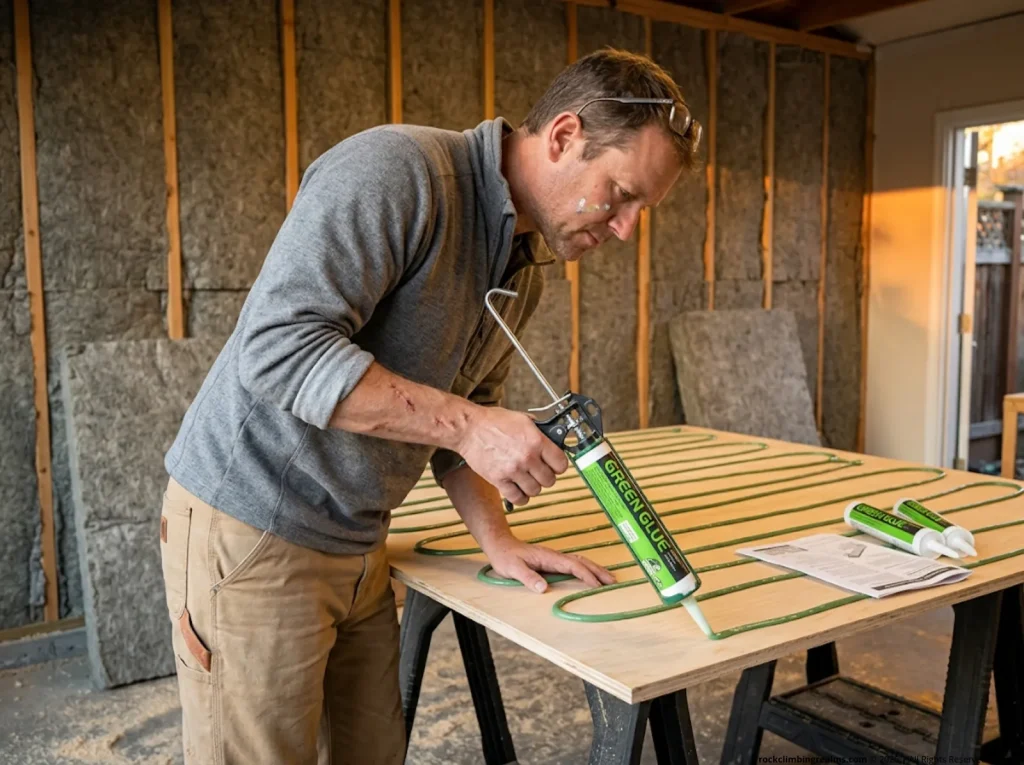
Zero competitors cover this. I’m covering it because it determines whether your wall is usable for years or becomes a household conflict within months.
A climbing wall acts as a large sound diaphragm — every heel hook, foot slam, and hold slap transmits as structure-borne vibration through the studs and into adjacent rooms. In an attached garage or basement adjacent to living space, this is not an inconvenience. It’s a problem that ends training sessions.
Three mechanisms address it. Damping: Green Glue (a viscoelastic compound) applied between plywood layers converts vibrational energy to heat, specifically effective at the frequency range where climbing impacts cluster. Absorption: Rockwool (mineral wool, NRC rating near 1.0) fills stud bays, absorbing airborne sound and eliminating the hollow drum effect of an empty wall cavity. Decoupling: Resilient hat channels between the frame and house structure physically break the vibration transmission path.
Commercial gym construction standards that inform home wall builds solved this problem at scale. Their CapEx engineering decisions translate directly to what you’re doing in your garage.
The Technical Mentor protocol: sandwich two layers of plywood with Green Glue and fill all stud bays with Rockwool. A wall that is “bombproof” in strength and silent for the rest of the household.
Green Glue and Viscoelastic Damping: The Science
Green Glue goes between the structural plywood and a secondary 5/8″ drywall or plywood layer. Application: two tubes per 4’x8′ sheet, in a random zigzag pattern — not as a structural adhesive but as a viscoelastic sandwich. This distinction matters: applying it as structural adhesive eliminates the damping mechanism.
One practical note: Green Glue reaches peak performance at 30 days post-installation. Build the wall, expect reduced acoustic performance for the first month. Plan accordingly if you share the space with family members who value sleep.
Mineral Wool and Decoupling: Making the Wall Disappear
Fill every stud bay completely — no air gaps, no compression. Mineral wool performs on volume fill, not density packing. Compressing it reduces effectiveness. Resilient channel installation has one hard rule: screw only through the channel flange, never through the stud. A single screw that bridges the channel and the stud “short-circuits” the decoupling and eliminates most of the benefit. This is the most common installation mistake and it’s invisible after the fact.
The Landing System and Safety Standards
The most common home wall injury is a “bottoming out” incident — tailbone or feet striking concrete through insufficient padding. The CPSC Public Playground Safety Handbook — surface impact standards is explicit: concrete, asphalt, and paved surfaces should never be the base for climbing equipment. This applies to your garage floor.
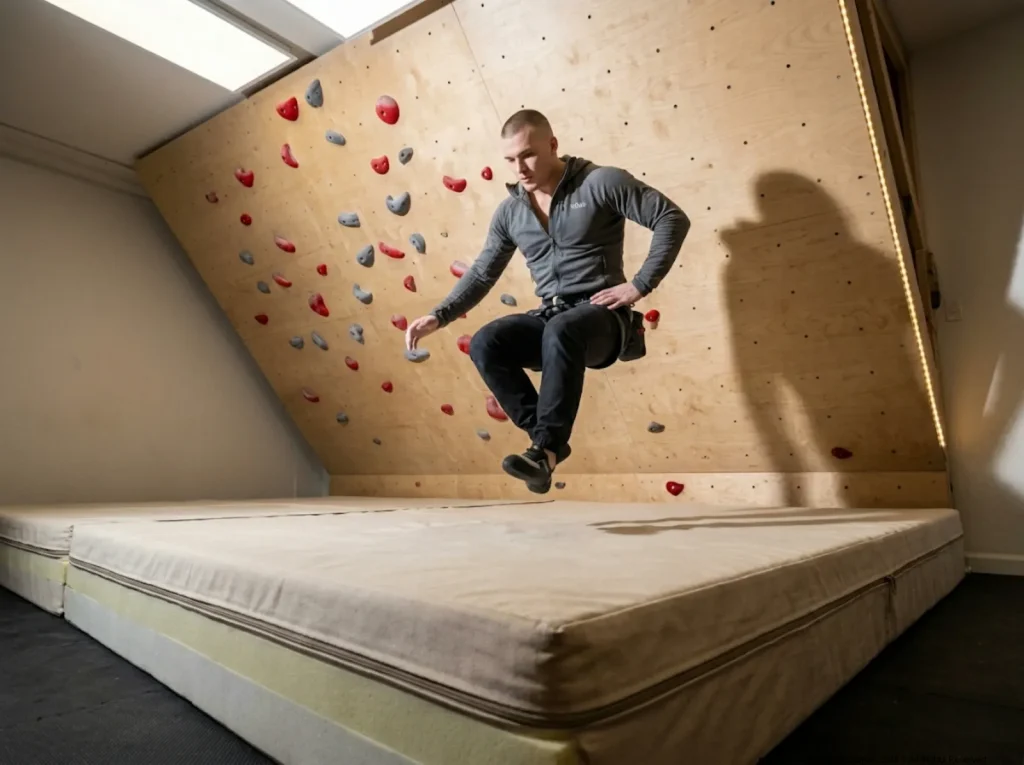
A single crash pad is insufficient for an 8’x12′ training wall. The fall zone must be a continuous, multi-layer system covering the entire footprint plus 6-foot run-out zones in every direction.
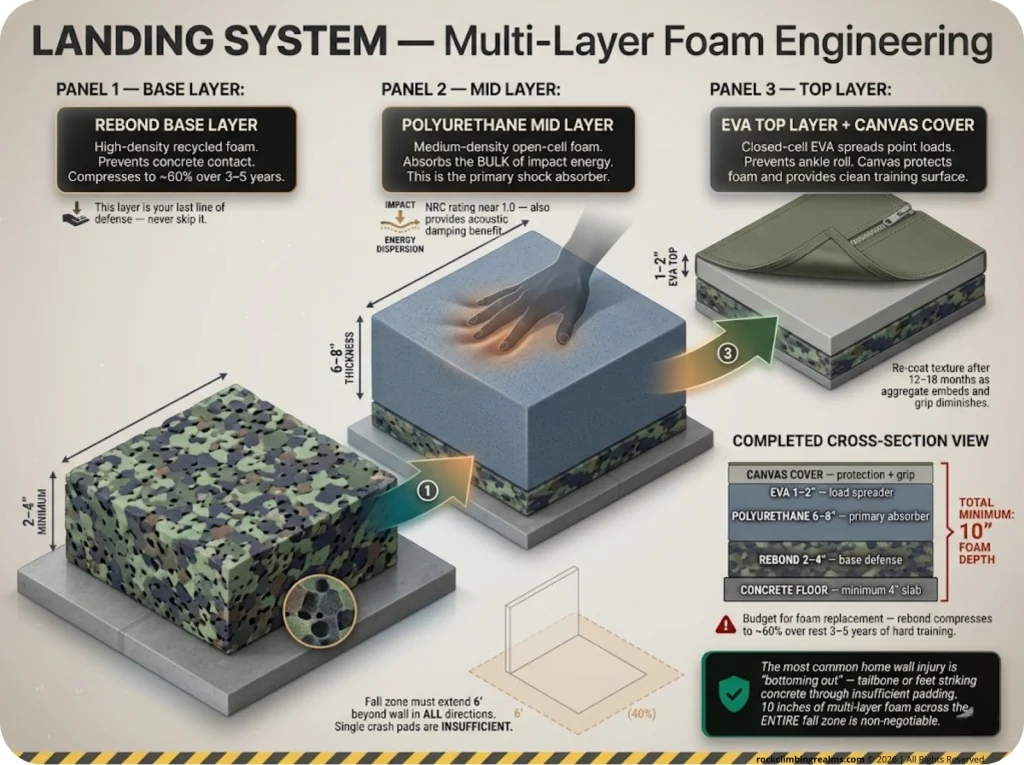
The multi-layer foam engineering system from the research data:
- Top layer (1–2″): Closed-cell EVA foam — spreads load, prevents ankle roll.
- Mid layer (6–8″): Medium-density polyurethane — absorbs the bulk of impact energy.
- Base layer (2–4″): High-density rebond foam — prevents bottoming out on the concrete.
Total minimum: 10 inches across the entire fall zone. Foam doesn’t last forever — rebond compresses to about 60% of original height over 3–5 years of hard training. Budget for replacement.
The landing system handles the physics — bouldering fall technique that your landing system must support covers the mechanics of how you should be landing on it.
UIAA Standard 123: Anchors for Lead and Top-Rope Walls
If your home wall includes a top rope or lead anchor, UIAA Standard 123 (Version 5, 2025) is the design floor. The 20 kN requirement comes from UIAA certification standards behind every anchor rating — read it before you order any anchor hardware.
Only UIAA-certified expansion anchors (concrete) or glued-in anchors (masonry) are appropriate. In humid garages or coastal environments, Stress Corrosion Cracking (SCC) is a real failure mode for stainless steel anchors — use SCC-certified anchors, not standard AISI 316 stainless. Top-rope anchor redundancy follows SERENE/ERNEST principles: no single point of failure, equalized load distribution, no extension in the event of failure.
Pro tip: Humid garage environments accelerate anchor degradation faster than most builders expect. Inspect your anchors every 6–12 months, not just at installation. A corroded anchor looks identical to a sound one until it doesn’t hold a load.
Hold Strategy and Route-Setting for Year-Round Progression
Before you order holds, field-tested home wall climbing holds and the buyer traps to skip will save you from the most expensive mistakes first-time home wallers make. The short version: avoid big-box kits, buy from Metolius, Atomik, or Escape Climbing, and buy more holds than you think you need.
For a primary training wall (10’x12′), aim for a minimum of 150–200 T-nut positions populated with holds to provide meaningful route setting variety. The recommended hold type distribution for performance-focused V-grade progression training: 40% jugs and incut holds for warm-up and high-volume training, 30% slopers and compression holds, 20% pinches, 10% crimps and pockets.
For the systematic approach to problem setting that puts your hold investment to work, setting real routes and training problems on your home wall is the companion guide.
Pro tip: The spray wall method — semi-random high-density hold placement across the entire board — is the highest-ROI approach for solo training. Each session, you find or create new sequences from the existing holds. This maximally utilizes the hold investment and prevents the training stagnation that comes from a static problem set.
Hold Density, T-Nut Grid, and First-Order Purchasing
An 8″ grid generates approximately 2 T-nuts per square foot. For a 10’x12′ wall (120 sq ft), plan for 200–250 T-nut positions, even if you drill fewer initially. Doing this now costs almost nothing. Retrofitting T-nuts into a mounted panel is time-consuming and disruptive.
Starting hold recommendation: 150 holds minimum, weighted toward large ergonomic shapes (jugs, big slopers) that allow high-volume training without skin damage. Grade the first set of problems at V0–V3 — hold placement determines difficulty initially, not hold type.
Bolt-on holds are repositionable, which is the training wall’s greatest asset. Screw-on holds are semi-permanent — better for footholds and texture variety in lower-angle sections.
Long-Term Training Evolution: The Spray Wall and Periodization
Rotate problems every 3–4 weeks. If the hardest problem on your wall feels submaximal for a training cycle, you’re behind — set new problems before the calendar tells you to. The spray wall method gives you infinite variety from a fixed hold set.
If you’re using a standardized board format like a MoonBoard or Kilter Board, the associated app provides thousands of benchmarked problems and performance tracking — the highest-ROI tech integration for a home wall.
Keep the long game in mind. A home wall built to the engineering baseline in this guide — carpentry done right, structural engineering respected, materials chosen for performance rather than budget — that wall trains you for years. A wall built to cut costs trains you to fix T-nuts.
Conclusion
Three things to take away.
First: your wall is only as strong as its weakest material. Baltic Birch, screw-in T-nuts, and structural screws are not upgrades — they’re the engineering baseline. Anything below that is building a maintenance problem.
Second: build the angle your training demands, not the angle your comfort wants. 40–45° drives the active recruitment that produces real strength gains. A vertical wall gives you movement practice at the cost of real adaptation.
Third: acoustic isolation and landing systems are not afterthoughts. They determine whether the wall is usable for years or becomes a source of household conflict and injury within months.
Pick your angle. Pull your permits if required. Order Baltic Birch. Set the first problem on a wall you built to the physics, not to the budget.
Now go send something.
FAQ
Is it cheaper to build or buy a home climbing wall?
Building your own wall almost always costs less than commercial alternatives like a MoonBoard or Kilter Board. A quality DIY 10’x12′ wall runs $1,500–$3,000 in materials; branded training boards with installation start at $3,000–$5,000 and up. The real advantage is customization — every dimension, angle, and T-nut position is yours.
What wood is best for a home climbing wall?
3/4 (19mm) Baltic Birch plywood in B or BB grade is the professional standard. Its void-free, 13–15-ply core gives T-nuts maximum surface area to resist pull-out and rotation. ACX structural plywood is a viable budget alternative. CDX softwood and OSB are not acceptable for climbing walls at any hold-loading level — the void problem eliminates them structurally.
How steep should a home climbing wall be?
For performance training focused on strength development (projecting V5–V10+), 40–45° is the evidence-backed optimum: it maximizes upper-body recruitment while allowing ergonomic hold shapes that enable high-volume training without skin damage. For endurance and ARC training, 20–30° is more appropriate. Build for your performance goal, not comfort — most climbers outgrow a vertical wall within one season.
Do I need a permit to build a home climbing wall?
It depends on your jurisdiction and how the wall attaches to the house. A free-standing indoor climbing wall in a garage typically doesn’t require a permit. A wall structurally attached to the house via a ledger board may trigger a building permit requirement in many municipalities. Check with your local building department before construction — the disclosure protects your homeowner’s insurance.
How many T-nuts do I need for a home climbing wall?
An 8-inch on-center grid generates approximately 2 T-nuts per square foot. For a standard 10’x12′ training wall (120 sq ft), plan for 200–250 T-nuts to capture the full grid. Install all T-nuts before mounting panels — retrofitting after the panel is up is possible but significantly more difficult and disruptive.
Safety Notice: Rock climbing and mountaineering are inherently high-risk
activities that can involve physical trauma or fatal incidents. The information on Rock Climbing Realms is for
educational and informational purposes only. Techniques and advice presented here are not a substitute
for professional, hands-on instruction. Conditions and risks vary by location. Always seek guidance
from a qualified instructor before attempting new techniques. By using this website, you agree that you
are solely responsible for your own safety. Any reliance you place on this information is strictly
at your own risk, and you assume all liability for your actions. Rock Climbing Realms and its authors
will not be held liable for any harm, damage, or loss sustained in connection with the use of this information.
Affiliate Disclosure: We are a participant in the Amazon Services LLC Associates Program, an
affiliate advertising program designed to provide a means for us to earn advertising fees by advertising and linking
to Amazon.com. As an Amazon Associate, we earn from qualifying purchases. We are also an official affiliate partner
of Black Diamond Equipment via the AvantLink network. If you click on a Black Diamond affiliate link and make a
purchase, we may earn a commission at no additional cost to you. We also participate in other affiliate programs.
Additional terms are found in the terms of service.