
In this article
The pop came from my ankle, not the rock. I’d tossed my pad directly under the holds—right where I was looking—and peeled off a V4 overhang in Chaos Canyon. My feet cut first. My body swung backward. And I landed half on the pad, half on a patch of alpine wildflowers I’d dragged the mat across to get there.
The ankle healed in six weeks. The brown smear where those flowers used to be was still visible the following season.
After years of adjusting pads for partners, watching preventable injuries, and seeing what careless placement does to the base of boulders across Rocky Mountain National Park and the Shawangunks, I’ve learned something most guides skip: where you drop your pad isn’t just a safety decision. It’s an environmental one. And most boulderers get both wrong.
This guide breaks down how your body actually falls, the research-backed damage that sloppy placement causes, and a step-by-step protocol for landing safe without crushing the ecosystem that keeps your crag open.
⚡ Quick Answer: Place crash pads under your hips (your center of gravity), not under the holds. Cover all three fall zones—sit-start, crux, and top-out. Offset seams to prevent ankle rolls. Always choose durable natural surfaces like bare rock or packed dirt. Lift and carry your pads—never drag them across vegetation.
The Physics of Where You Actually Land
Center of Gravity Is Not Where You Think
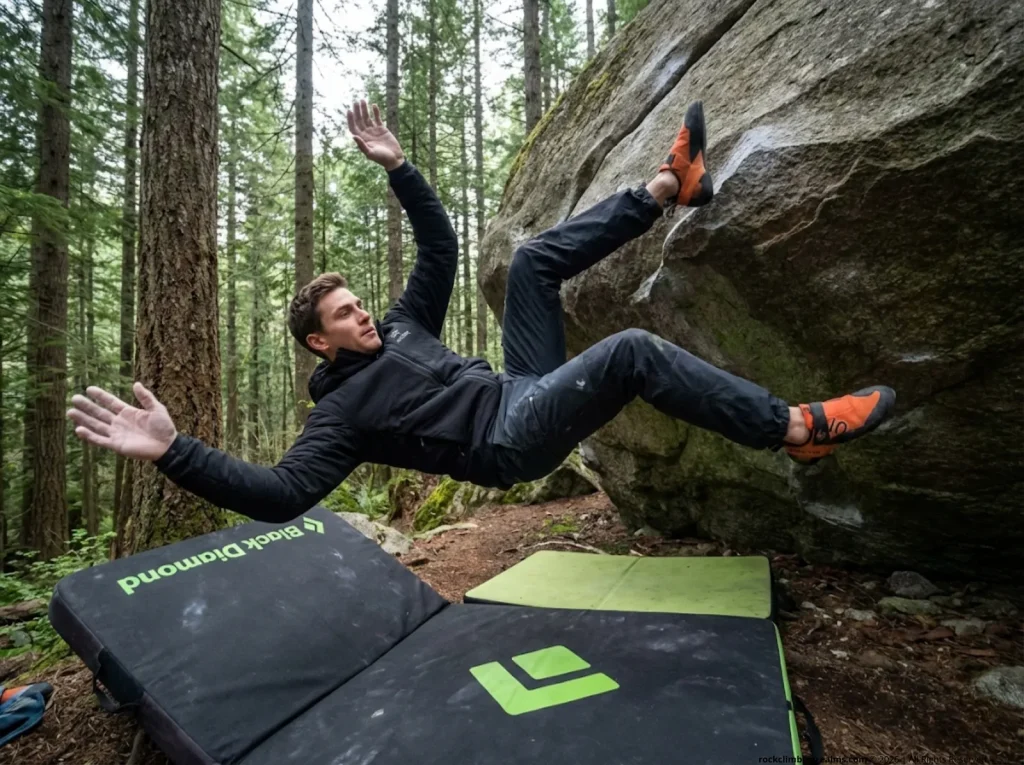
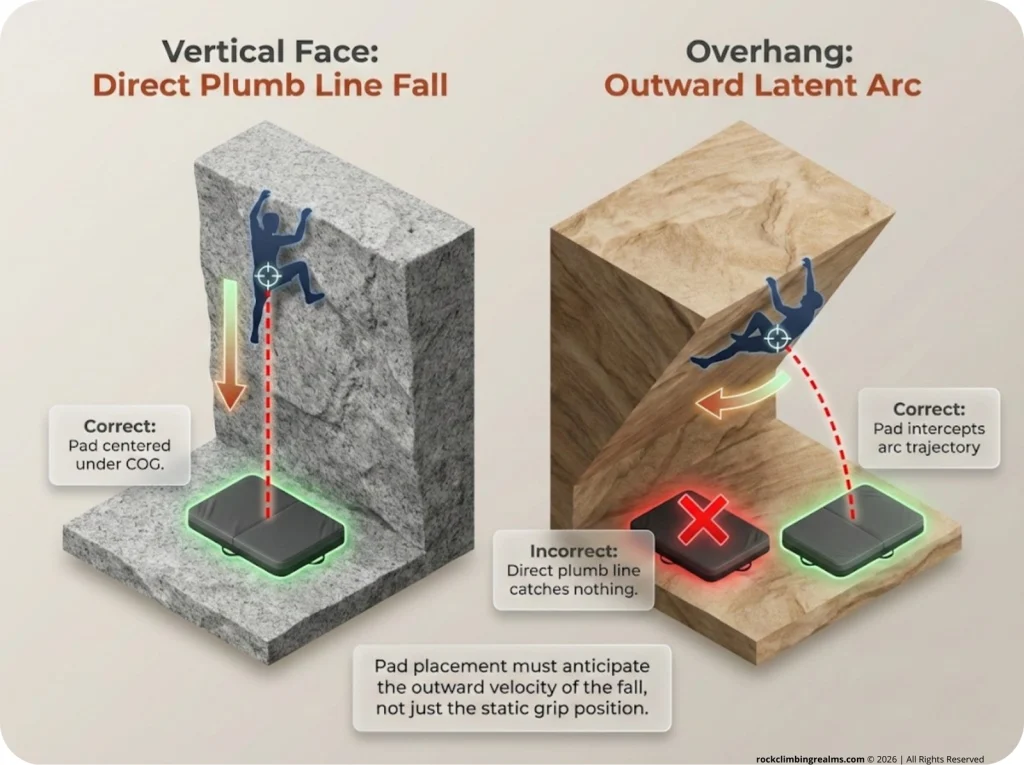
Here’s the mistake nearly everyone makes: you stare at the holds, so you toss the pad under the holds. But your body doesn’t fall from your hands. It falls from your hips.
Your center of gravity sits at your core, roughly at hip level. That’s the point that dictates your fall vector—the path your body actually travels through the air. Jesse Firestone, who’s spent 35-plus years coaching boulderers, puts it bluntly: “Climbers generally have a habit of putting the pads too far in.” They’re lining up with fingers instead of pelvis.
On vertical terrain, the drop is straightforward—your COG falls nearly straight down. But on overhangs, your feet come off first, and backward momentum swings your body out and away from the wall. That means your pads need to be placed farther back than your instincts tell you. Miss this, and you land on the edge of the pad—or the ground behind it.
Pro tip: Before every attempt, do a test fall from the crux height. Actually let go. Watch where your body lands relative to the pad. Adjust before you commit to the send.
The Three Fall Zones You Must Cover
Every boulder problem has three distinct landing zones that need coverage.
The sit-start zone covers those awkward low falls. You’re close to the ground, so it feels safe—but uneven terrain and hidden rocks under thin pads catch ankles here more than anywhere else. The transition/crux zone is where most falls happen. Align pad center with your projected hip position at the hardest move. The top-out zone is the one most people forget. Backward falls from the top send your body farther from the wall than you’d expect.
Walk the entire base before placing a single pad. Map each zone, then build coverage from the crux outward. If you’re short on pads, the crux zone gets priority—always.
Barndoor and Projectile Vectors
A barndoor—that rotating swing when your body pivots off one side of the wall—sends you on a lateral arc, not straight down. Your pad setup needs to match. On traverse problems, the fall zone shifts sideways with every move. One static pad position won’t cover the full problem.
Dynamic moves send your body at an angle—both out and down. If you’re throwing for a dyno toward one side, your body follows that direction when you miss. Good pad placement accounts for the direction of the move, not just the height of the fall.
This is the piece most safety guides leave out entirely. They tell you “put the pad under you” without explaining that where “under you” is changes based on wall angle, move direction, and whether you’re cutting feet or barn-dooring off a sidepull. Understanding fall vectors and landing zone fundamentals turns guessing into a system.
Pad Tetris: Building Safe Landings on Ugly Terrain
Offset Seams or Eat the Consequences
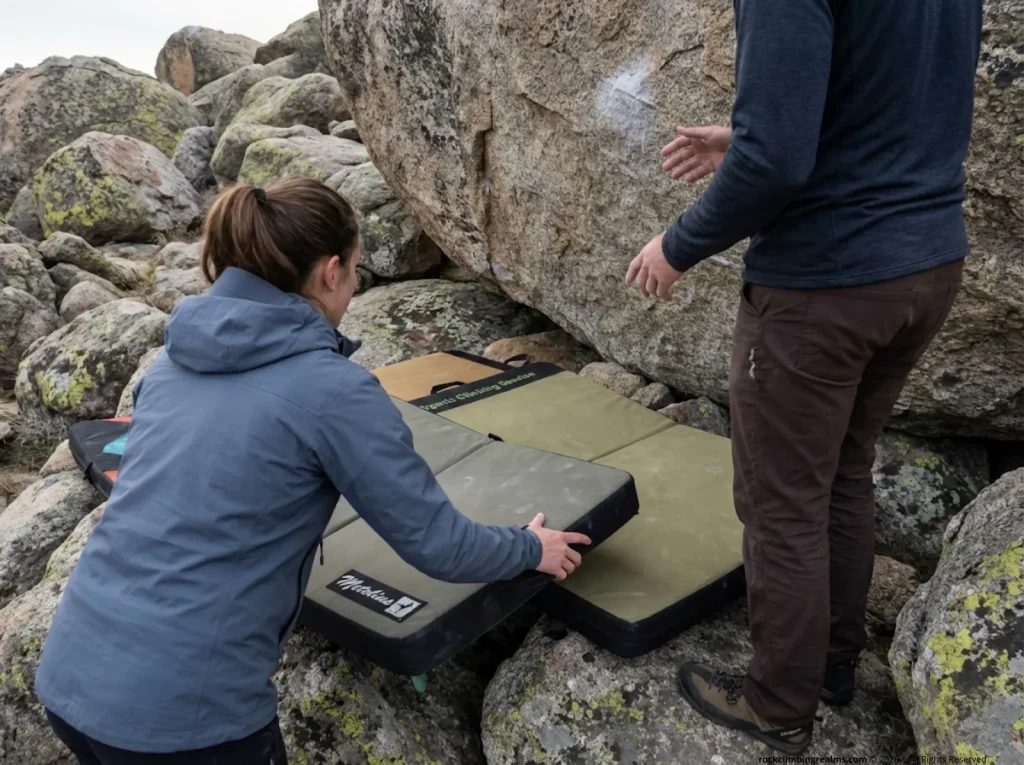
Ankle sprains account for 28% of bouldering injuries in analyzed fall scenarios, and a huge chunk of those come from landing on seam gaps between pads or right on the pad edge. The fix is dead simple: offset the seams so gaps never align under your primary fall zone.
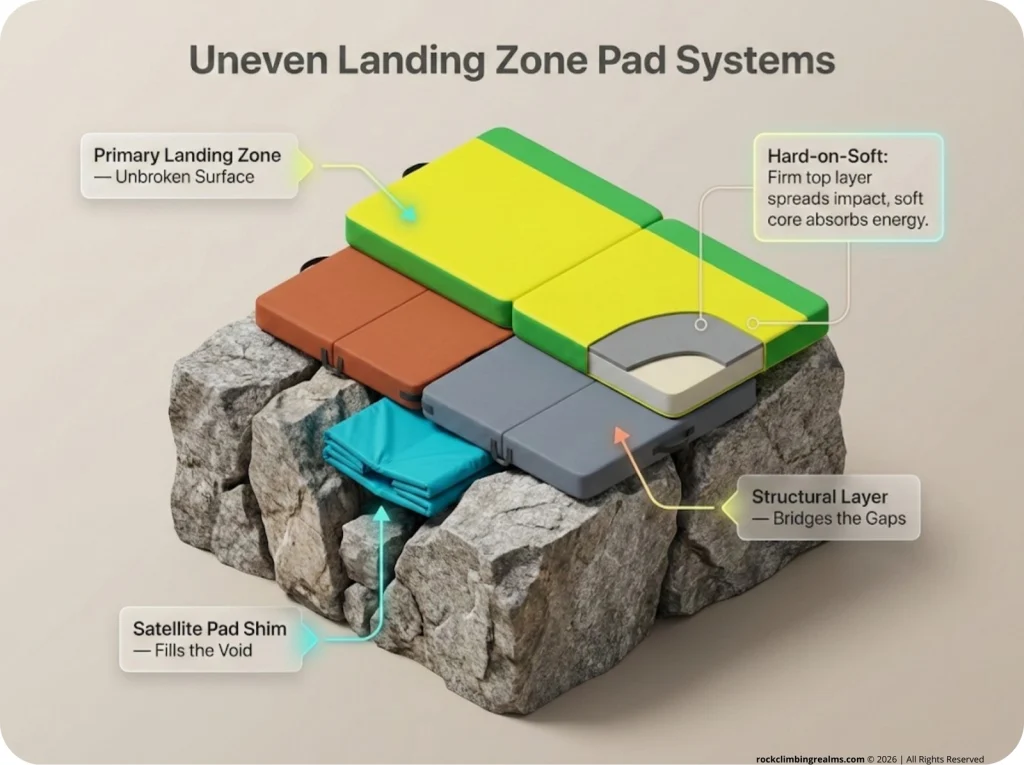
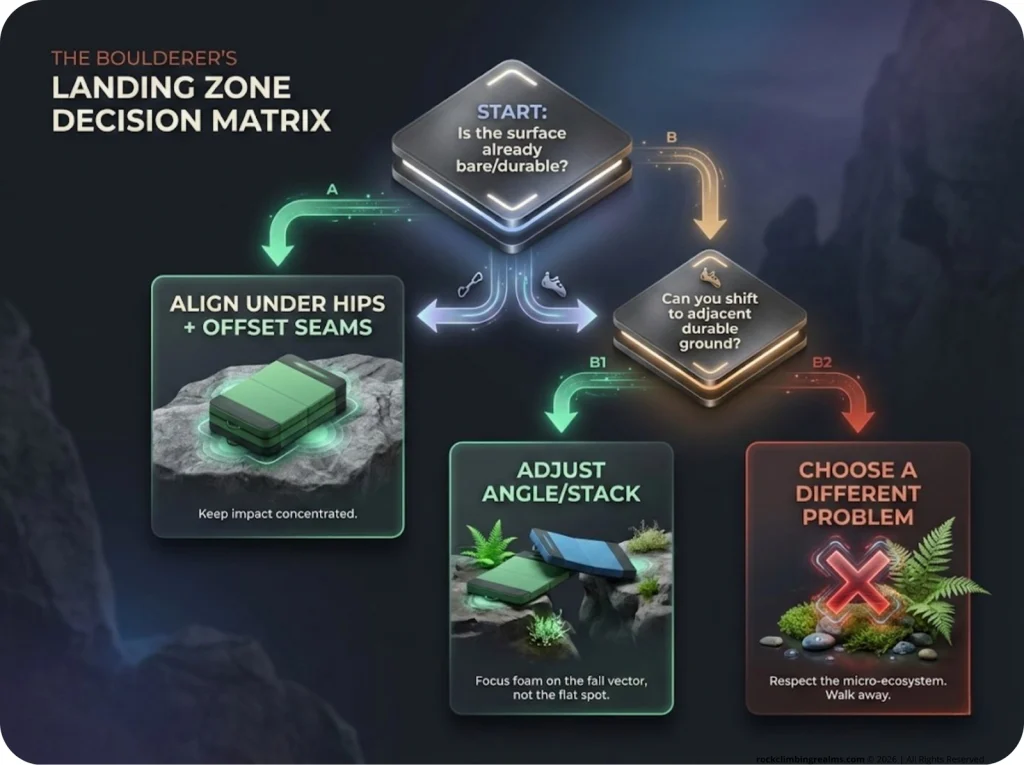
When stacking for high falls, use the hard-on-soft foam stacking rule—firmer pad on top, softer underneath. This spreads the impact without you needing to flatten the ground or move rocks. The natural uneven terrain stays exactly as it is. Your landing surface stays level.
Pro tip: Mark the safe center of your pad with a chalk handprint. When rocks are hidden underneath and the landing looks uniform, that handprint tells your spotter exactly where to direct your fall.
3D Stacking for Talus Without Moving Rocks
On talus fields like you’d find in Squamish or RMNP’s Emerald Lake bouldering zones, the ground is a minefield of ankle-rolling hazards. The old way—moving rocks to make a flat landing—is exactly what creates modified landing zones and damages the vegetation around them.
Pad Tetris is the solution. Use folded pads, smaller satellite pads, or accessory slider pads as shims to level the surface. The goal is a flat landing zone created entirely by pad geometry, never by rearranging nature. Walk the landing surface before stacking—feel for hidden gaps and sharp edges that your top pad might mask.
The right pad stack makes this easy. The Tetris method for eliminating gaps in landing zones covers the stacking sequences in detail, but the principle is simple: work with the terrain’s shape instead of against it.
Communication and the Pad Fairy Role
For group sessions, designate one person as the pad fairy—the climber who communicates pad positions and repositions them as the climber moves through different fall zones. This isn’t a joke role. It’s the most important job on the ground.
Spotter communication matters more than spotter strength. Call out before every attempt: confirm fall zone coverage, pad positions, and who’s moving what if the climber progresses past the current setup. The pad fairy directs the fall to pad center—not just “being there.”
Your Pad Is a Footprint (Literally)
What the Research Actually Says
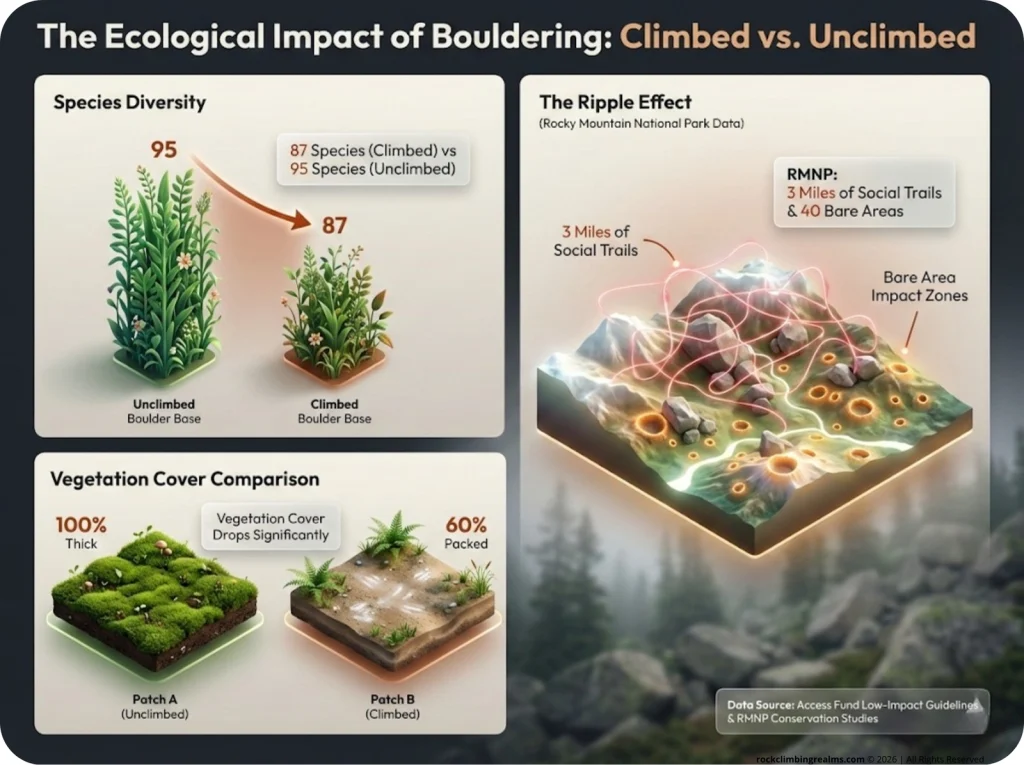
This isn’t guesswork. Tessler and Clark’s 2016 study in the Gunks compared climbed vs. unclimbed boulders side by side—same rock type, same elevation, same aspect. The climbed boulders showed lower species richness (87 species vs. 95) and measurably lower vegetation cover. Base trampling from crash pads was explicitly noted as a driver.
In RMNP, Utah State University researchers mapped nearly 3 miles of informal social trails and 40 visitor-created bare ground areas in the Chaos Canyon and Emerald Lake bouldering zones. That’s not a trail network—that’s vegetation damages caused by boulderers walking between problems and dragging pads.
Tessler and Clark didn’t mince words: “Even moderate increases in bouldering activity will have a substantial impact on vegetation.” These findings now drive National Park Service research on bouldering impacts and federal management decisions in wilderness areas. Ignore them, and we lose access.
If you’re bouldering in desert terrain with fragile biological crust, the stakes are even higher—read up on cryptobiotic soil rules every climber needs before you set foot near those natural areas.
Boulder Gardening and Modified Landing Zones
Boulder gardening—removing lichen, moss, or live plants from the boulder face or base—and creating modified landing zones by moving rocks and branches are the highest-impact behaviors documented at bouldering areas worldwide. Even “minor” modifications compound across hundreds of visits per season.
In RMNP’s 2015 boulderer survey, climbers themselves rated stashing crash pads as inappropriate (mean 2.92 out of 7) and carrying pads out each visit as highly effective (mean 6.15 out of 7). The climbing community already knows this is wrong. The gap is between knowing and doing.
The Counter-Intuitive Truth About Pads
Here’s the twist that nobody talks about: thoughtful pad placement on durable surfaces can actually reduce total trampling compared to unmanaged foot traffic. As Access Fund guidance on low-impact pad handling points out, pads used as traffic concentrators on designated bare rock focus impact to a defined spot instead of letting dozens of feet scatter across a wider area.
The goal isn’t “no pads.” It’s smart pads on the right surfaces—turning your crash pad from an impact tool into a wilderness conservation tool. Correct pad placement is as important as having enough foam.
Pro tip: For group sessions, designate one landing zone and keep everyone’s pads in the same durable spot. Don’t let each person scatter pads wherever they want. Concentrated impact heals faster than scattered damage.
The Veg-Smart Placement Protocol
Step 1: Read the Ground Before the Rock
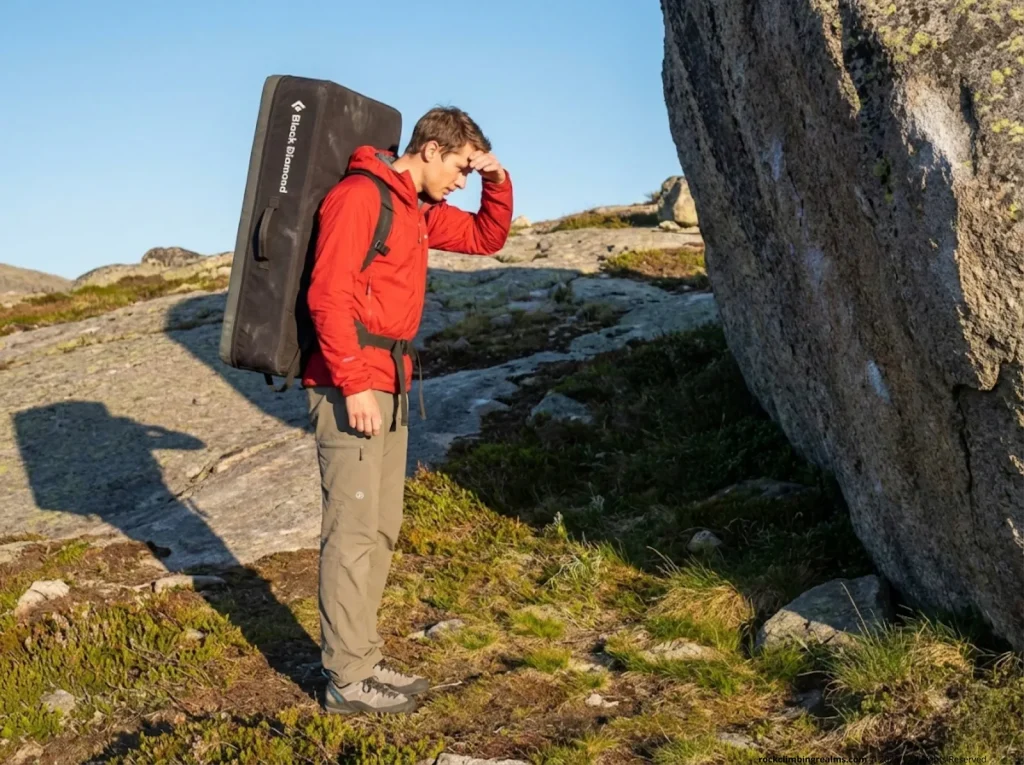
Before you look at the problem, look at the landing. Scan for already-bare rock, existing packed dirt, or durable surfaces with no living ground cover. Mentally flag any moss, lichen, wildflowers, or biological soil crust.
If the only viable landing area has vegetation coverage, assess whether an alternative pad setup—offset, stacked, or angled—can shift coverage to adjacent durable ground. Sometimes a 3-foot adjustment puts your pad on bare granite instead of shrubs and plants. That 3 feet is the difference between zero impact and a scar that lasts years.
Step 2: Lift, Carry, Never Drag
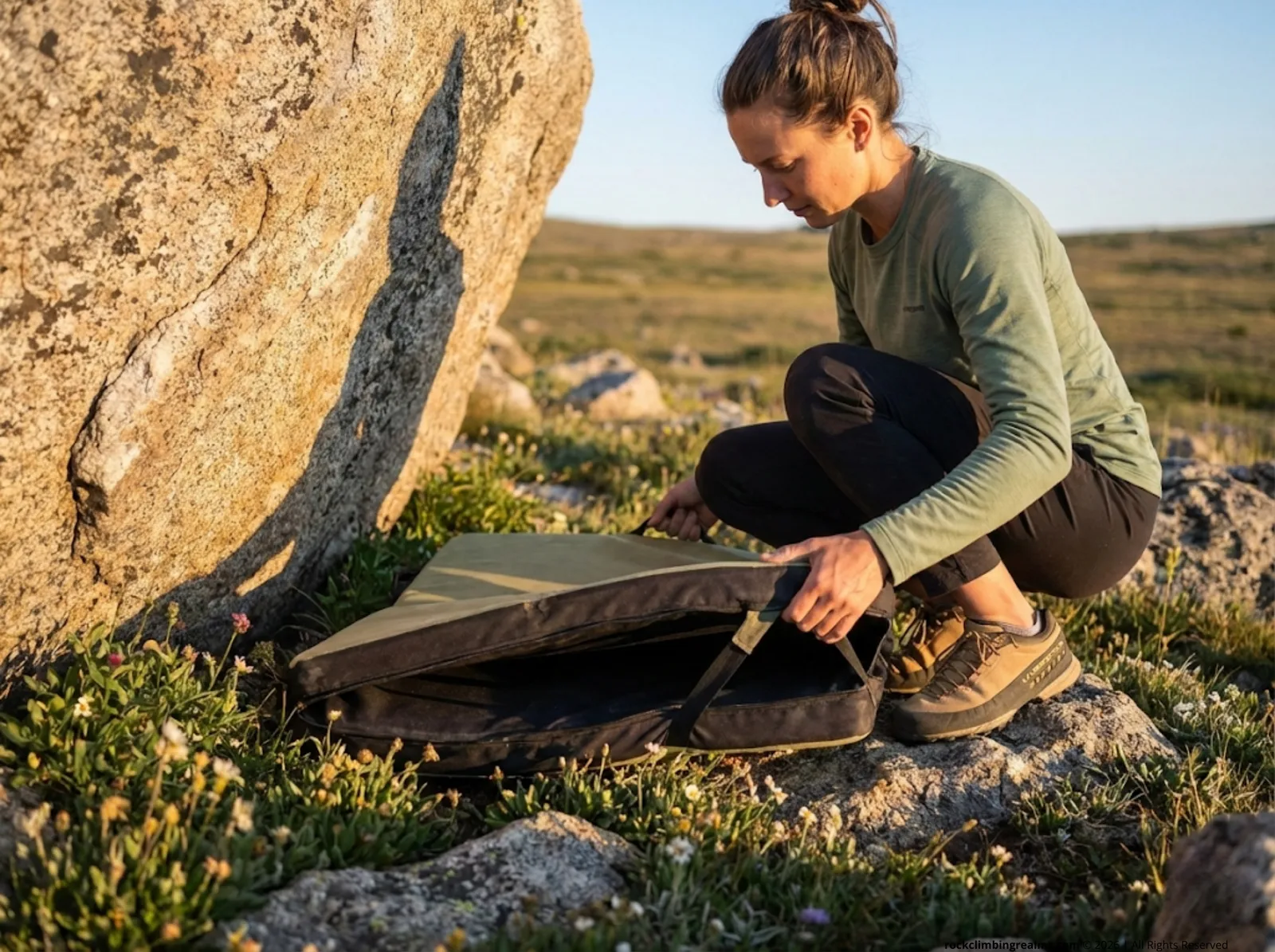
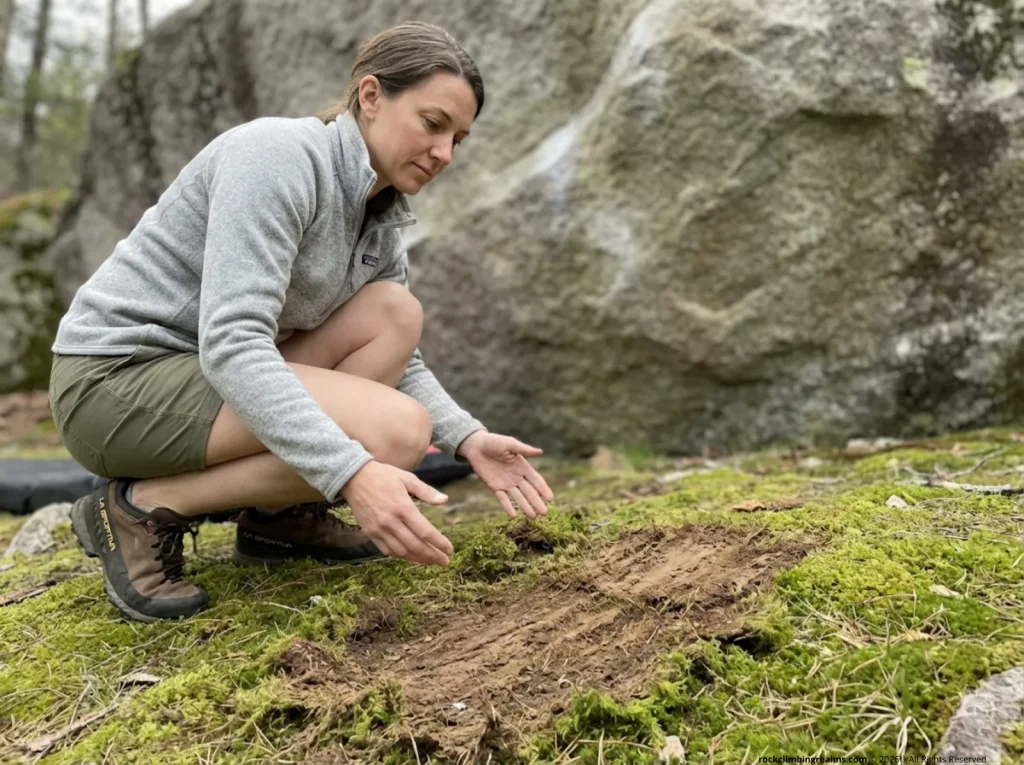
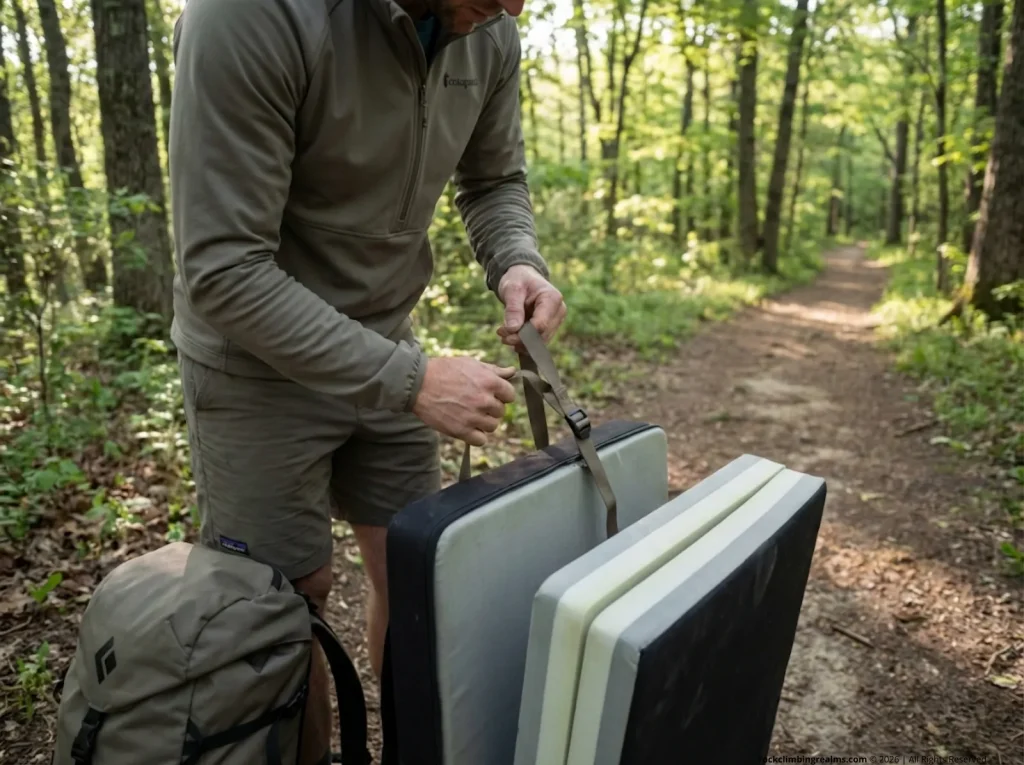
Crash pads must be lifted and carried—never dragged. One drag across moss or alpine flowers leaves a mark visible for seasons. The no-drag rule isn’t optional. It’s the single easiest thing you can do to avoid vegetation damage, and it costs you exactly zero extra minutes if you’re using your carry straps like they’re designed.
Use the straps every single time, even for a 10-foot move between problems. Your full-size pad weighs maybe 15 pounds. Carry it.
Step 3: Leave the Landing Zone Exactly as You Found It
No rock moving. No branch clearing. No stashing crash pads behind boulders for next weekend. Stashed pads create persistent bare spots and social trails that compound over time. RMNP’s Bouldering Steward program actively removes hidden pads and educates groups on the spot.
At the end of your session, pick up every pad and carry it out. Look at the ground where your pads sat. If it looks different than before you arrived, something went wrong. Living by the climber’s pact for practical stewardship means the park looks the same after you leave as before you showed up.
Pro tip: Check the Leave No Trace Center boulderers’ perceptions study for data on what behaviors the climbing community itself considers acceptable. Knowing the numbers gives you leverage when someone in your group starts clearing rocks “just a little.”
High-Stakes Scenarios That Change Everything
Highball Ethics in Fragile Ecosystems
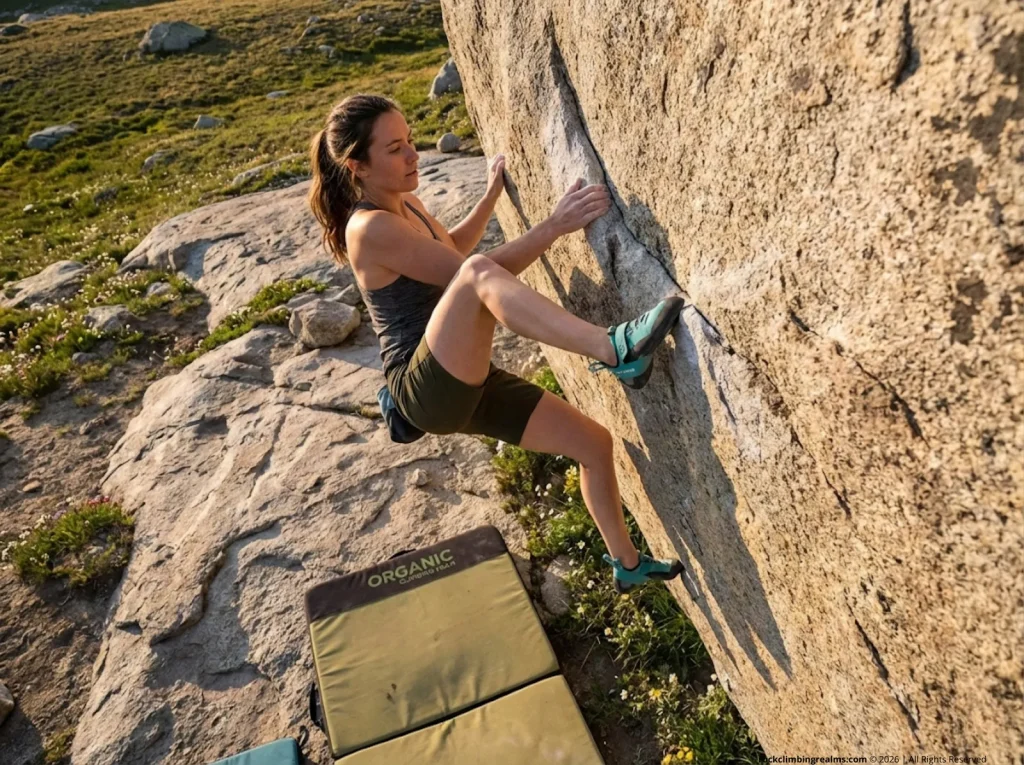
In alpine bouldering areas like RMNP or Squamish, a single modified landing zone can affect rare microhabitats for decades. On highball bouldering problems, the temptation to clear more ground for a bigger landing increases with the height. Resist it.
More pads and better stacking always beats modifying the terrain. If you need a bigger safety net, bring more friends with multiple pads—not a shovel. These federal wilderness areas often have steward programs. Find them, learn from them, and follow their guidance before you touch anything.
Traverse Problems and Moving Fall Zones
On traverse problems, the fall zone shifts laterally with every move. Static pad placement fails completely. This is where spotters and the pad fairy role become critical—someone must actively reposition pads as the climber moves.
Plan the traverse zone layout before starting. Map 3-4 pad positions across the path and pre-assign who moves pads where. This takes 60 seconds of navigation and prevents the scrambling chaos that crushes plants and twists ankles.
Wet and Overgrown Landings
Rain-soaked or heavily vegetated landings aren’t an excuse to modify the terrain. Use extra pads to bridge over delicate areas rather than clearing them. If the landing is genuinely unsafe and can’t be managed without gardening, walk away. Some problems aren’t worth the ecological cost.
Bishop’s fragile bouldering ecosystem offers hard lessons on this front—sustainability lessons from Bishop’s fragile bouldering ecosystem detail what happens when thousands of climbers make “small” modifications over time.
Gear Choices That Make Responsible Placement Easier
What to Look for in a Veg-Friendly Pad
A crash pad with a comfortable carry system is one you’ll actually carry out every session instead of stashing. That alone solves half the environmental problem. Look for padded shoulder straps, a waist belt, and a profile that doesn’t snag on trail brush.
Smaller accessory pads give more layout flexibility on tight durable zones. Bottom fabric durability matters—a pad that shreds on rock creates microplastic debris on top of everything else. And Pad Tetris compatibility (how well the pad plays with others in 3D stacking) determines whether you can solve natural uneven terrain without touching a single rock. Check out our expert framework for choosing crash pads for the complete selection breakdown.
Building a Multi-Pad System
One full-size pad is rarely enough for real outdoor bouldering. A 2-3 pad system—one full size pad plus 1-2 satellite pads—covers most fall zone configurations without needing to modify anything. The satellite pads fill gap roles in your pad stack and extend coverage on traverses.
Pair with friends to build group coverage. Three climbers with two pads each equals six pads and nearly infinite layout options. Just designate one person for pad management so coverage stays organized instead of chaotic.
Conclusion
Three things separate a climber who lands safe and leaves no trace from one who tweaks an ankle and damages a patch of alpine wildflowers:
Place pads under your hips, not under the holds. Track your center of gravity across all three fall zones—sit-start, crux, and top-out. Your body falls from your core, not your fingers.
The ground under your pad matters as much as the pad itself. Choose durable natural surfaces. Never drag. Never modify. Never stash.
Pad Tetris and smart stacking solve every terrain problem without touching a single rock, branch, or plant. If you can’t make the landing zone safe without gardening, walk away and find a different problem.
Next time you walk up to a boulder, spend 30 seconds reading the ground before you read the problem. Your ankles—and the crag—will thank you.
Now go send something.
FAQ
How do you place crash pads for bouldering?
Position them directly under your hips’ projected fall path, not under the holds. Cover all three zones—sit-start, crux, and top-out—and offset seams so you never land in a gap. Always test with a practice fall from low height before committing to hard moves.
What are the environmental impacts of bouldering on vegetation?
Climbed boulders in the Shawangunks showed lower species richness (87 vs. 95 species) and reduced vegetation cover, with base trampling from crash pads explicitly documented. RMNP mapped 3 miles of informal social trails and 40 bare areas created by bouldering activity.
Should you move rocks or plants to make a better crash pad landing?
No. Modified landing zones and boulder gardening cause lasting vegetation loss, soil compaction, and erosion. Use pad stacking—Pad Tetris—to level uneven terrain instead. If the landing can’t be made safe without modification, choose a different problem.
What is boulder gardening and is it okay?
Boulder gardening means removing lichen, moss, plants, or loose rock from the boulder face or base to improve a route or landing. It permanently damages rock-associated vegetation communities that can take decades to recover, and climbing access organizations explicitly discourage it.
How many crash pads do you need for outdoor bouldering?
For most problems, a 2-3 pad system—one full-size plus 1-2 satellite pads—provides adequate coverage across fall zones without needing to modify the terrain. For highball problems or complex traverses, coordinate with climbing partners to combine pads for wider coverage.
Safety Notice: Rock climbing and mountaineering are inherently high-risk
activities that can involve physical trauma or fatal incidents. The information on Rock Climbing Realms is for
educational and informational purposes only. Techniques and advice presented here are not a substitute
for professional, hands-on instruction. Conditions and risks vary by location. Always seek guidance
from a qualified instructor before attempting new techniques. By using this website, you agree that you
are solely responsible for your own safety. Any reliance you place on this information is strictly
at your own risk, and you assume all liability for your actions. Rock Climbing Realms and its authors
will not be held liable for any harm, damage, or loss sustained in connection with the use of this information.
Affiliate Disclosure: We are a participant in the Amazon Services LLC Associates Program, an
affiliate advertising program designed to provide a means for us to earn advertising fees by advertising and linking
to Amazon.com. As an Amazon Associate, we earn from qualifying purchases. We are also an official affiliate partner
of Black Diamond Equipment via the AvantLink network. If you click on a Black Diamond affiliate link and make a
purchase, we may earn a commission at no additional cost to you. We also participate in other affiliate programs.
Additional terms are found in the terms of service.