
In this article
The plastic hold is greasy with the sweat of a hundred strangers, while the granite crimp bites back with a cold, indifferent sharp edge. This isn’t just a change in texture; it is a collision of two distinct universes: the controlled environment of indoor gym culture and the wild, regulated anarchy of outdoor crag culture.
You walk into the modern climbing gym for fitness and community, but you step onto the crag entering a social reality governed by unwritten laws. To navigate the space between the padded floor and the exposed ledge, you must understand the invisible forces—status, ethics, and identity—that bind the tribe together.
As a guide who has spent decades transitioning clients from the safety of indoor mats to the complexities of alpine environments, I can tell you that technique is only half the equation. The other half is cultural competence. Failing to understand the social dynamics of the crag doesn’t just make you look like a novice; it can endanger access to the very cliffs we love.
In this analysis, we will dismantle the social architecture of climbing. We will look at why we obsess over this sport, how “cool” functions as a currency, and why the economic reality of outdoor climbing is far more fragile than your gym membership suggests.
Why Can’t We Just Quit? (The Science of Serious Leisure)
What makes climbing different from other hobbies?
Climbing demands a level of commitment that separates it from casual pastimes like watching movies or hiking a groomed trail. Sociologists classify climbing as a “systematic pursuit” where participants acquire specialized skills and knowledge over a distinct career trajectory.
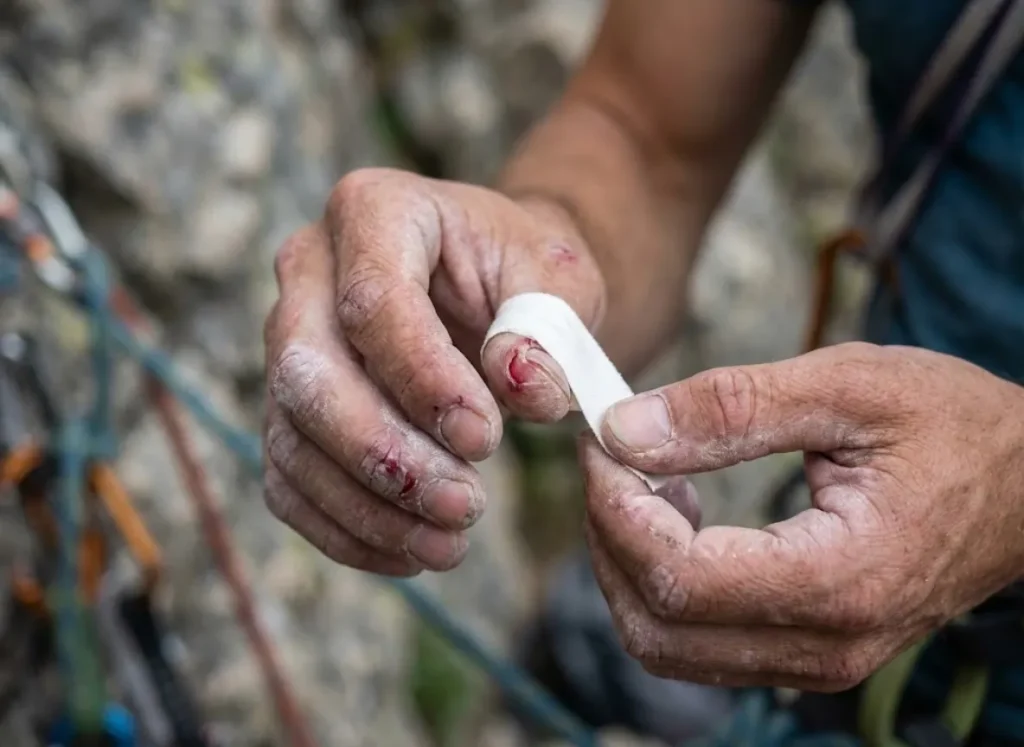
Unlike casual leisure, the sociology of climbing defines the activity by perseverance. You have to actively choose to endure physical pain—shredded fingertips, cramped toes—and psychological stress to move upward. This intensity creates a shift in how we see ourselves. You stop saying “I climb” and start saying “I am a climber.”
This identity fusion is central to Robert Stebbins’ foundational Serious Leisure Perspective, which argues that the rewards of such activities are often found in the retrospective glory of overcoming adversity. We call this “Type 2 Fun”—experiences that are miserable while they happen but deeply fulfilling in memory.
The addiction is chemical as much as it is social. The balance of high skill and high risk triggers flow theory, an autotelic experience that demands constant escalation. However, maintaining this state safely requires mastering the mental training frameworks necessary to keep fear from turning into panic.
Pro-Tip: If you find yourself burning out, stop chasing grades for a month. Focus entirely on “volume days” where the goal is perfect movement on easier terrain. This resets your flow state without the cortisol spike of projecting at your limit.
Is it okay to never climb harder grades?
Yes. In fact, the vast majority of the climbing population eventually reaches a “maintenance stage” where they stop chasing higher numbers.
We call this the “Flatliner” phenomenon. In the climbing social hierarchy, there is a massive cohort that plateaus at a competent level—often around 5.10 or V4—and stays there for years. This is not a failure; it is a valid sociological station.
For the Flatliner, sport climbing shifts from a quest for physical dominance to a mechanism for social anchorage. This maintenance stage allows non-specializing climbers to preserve their access to the community without the grueling suffering required for elite performance.
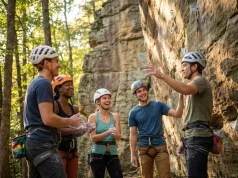
As detailed in research on climbing social worlds at Texas A&M University, these climbers derive value from the “confederacy of peers“—the act of hanging out at the cliff—rather than the vertical achievement itself. The gym functions as a “Third Place” (akin to Ray Oldenburg’s concept), acting as a social magnet where relationships are forged.
Recognizing the validity of the Flatliner is essential for a healthy community. It counters the toxic “crusher” mentality that suggests you are only valuable if you are sending harder routes. However, even if you stay at one grade, it helps to know the subjective nature of difficulty by understanding how gym climb grades emerge from the setter’s mind, which often differs wildly from outdoor ratings.
How Does Status Work in the Climbing World? (Capital & Habitus)
Why doesn’t money make you ‘cool’ in climbing?
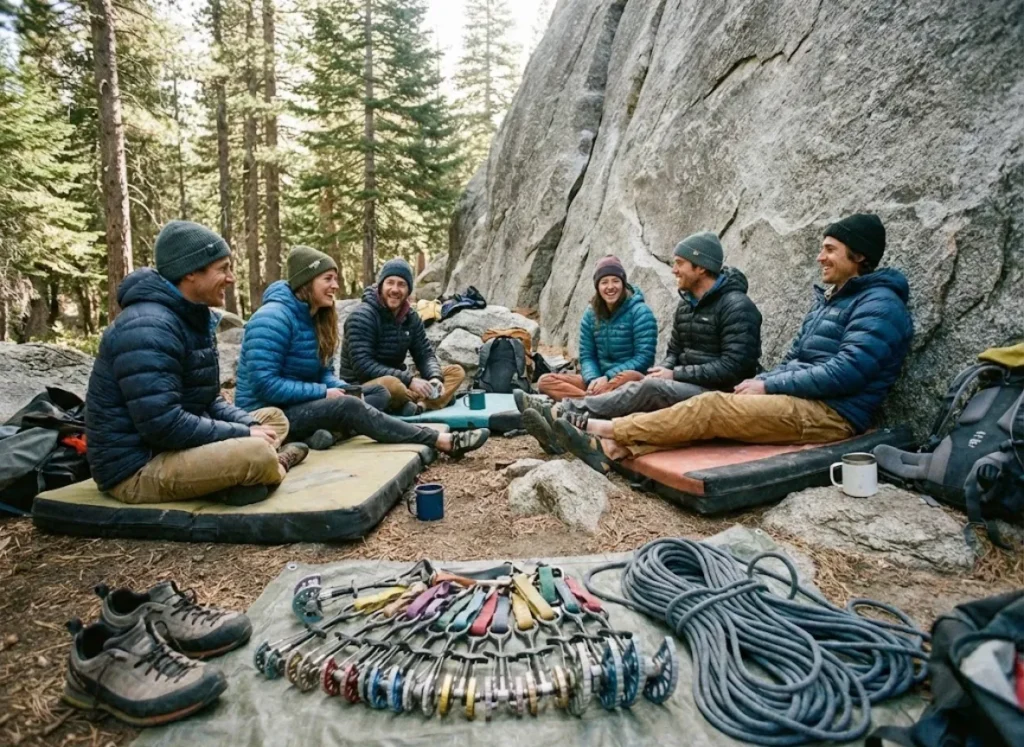
You cannot buy respect at the crag. You can buy the most expensive Arc’teryx jacket and a pristine rack of cams, but if you don’t know how to place them, you are viewed with suspicion rather than admiration.
This is best explained by Pierre Bourdieu’s theory of capital. In the “field” of climbing, Economic Capital (money) has very little exchange rate with Symbolic Capital (prestige). Status is earned through Subcultural Capital—specialized knowledge that signals authenticity.
This includes knowing the history of the climbing area, understanding the nuances of safety systems within the belayer/climber dyad, and speaking the language. A climber with a tattered harness who moves with fluid precision holds more climbing capital than a wealthy novice struggling on a warmup. To avoid being labeled an outsider, you must invest time in learning climbing lingo to gain fluency and demonstrate you belong to the subculture.
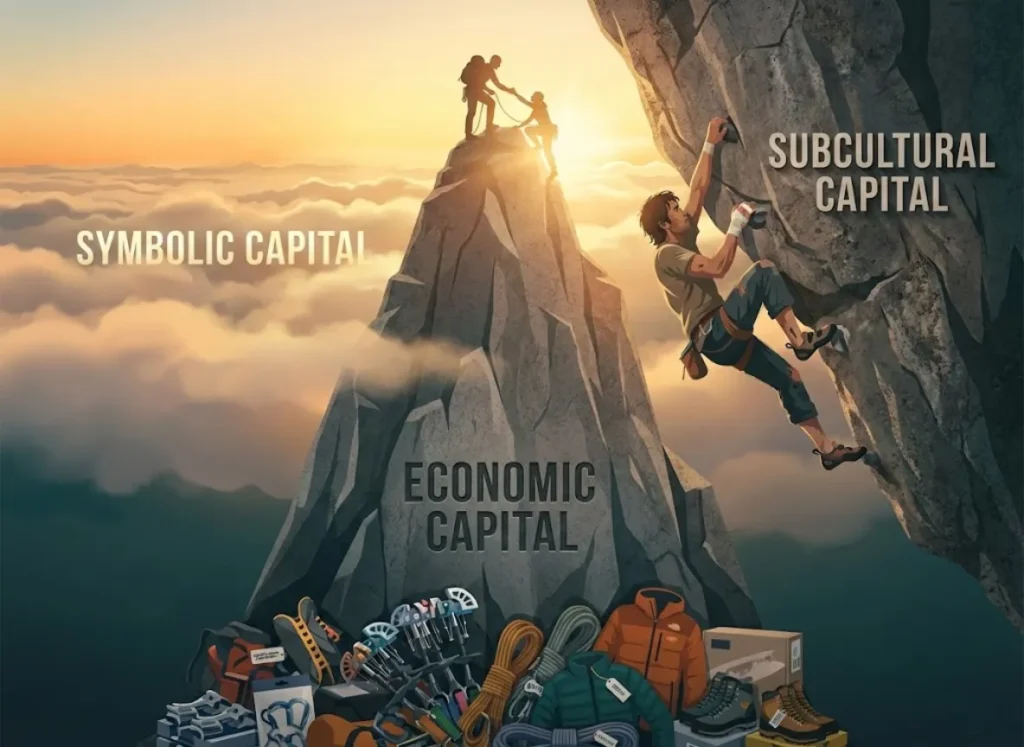
Interestingly, status can sometimes be inverse to wealth. The “dirtbag culture” aesthetic—living in poverty to maximize climbing time—signals a total commitment to the lifestyle. However, this dynamic is gendered and class-dependent. As shown in studies on habitus in adventure sports, the way we move and interact is deeply ingrained. Historical masculine hegemony often makes it harder for those outside the traditional demographic to gain that crucial Symbolic Capital.
Why is there friction between gym climbers and outdoor climbers?
The tension between gym rats and trad dads is usually a clash of habitus—deeply ingrained habits and dispositions. The “Indoor Habitus” is built on assumed safety: the floor is padded, the climbing walls are engineered, the bolts are checked by staff, and noise is encouraged.
The “Outdoor Habitus” is built on distrust: gravity checks the bolts, rockfall is real, and silence is a safety tool. When a gym climber brings indoor behaviors—sprawling gear across the trail, blasting music, or assuming a fixed draw is safe—it creates friction in the crag ecosystem.
Experienced outdoor climbers view this not just as annoying, but as dangerous. Gatekeeping, often criticized, is frequently a defensive mechanism intended to preserve the safety ethics of the outdoor space.
The danger lies in the confidence gap. A 5.11 gym climber has the physical strength to pull hard moves outside, but rarely possesses the risk assessment skills to match. This “Gym-to-Crag” transition is the most dangerous period in a climber’s life. Bridging this gap requires mastering the gym-to-crag transition with humility, treating the outdoors as a completely new sport rather than a continuation of the gym.
Further complicating this is the conflict between recreational specialization and place identity. As noted in recent research on the conflict between recreational specialization and place identity, highly specialized climbers often feel a deep, territorial stewardship over crags, leading to gym-to-crag politics with newer visitors who treat the land as a consumable commodity.
Who Pays for the Rocks? (Ethics & Economics)
Why are outdoor crags considered a ‘fragile’ resource?
We often treat cliffs as permanent, invincible structures. Economically, however, a crag is a “Common-Pool Resource” (CPR). It is rivalrous, meaning that crowding reduces the quality of the experience for everyone, but it is non-excludable, meaning it is difficult to stop people from coming.
This sets the stage for the Tragedy of the Commons. Unlike a climbing gym, which can build new walls to meet demand, the geology of a climbing area is finite. High traffic leads to polished rock, eroded trails, and micro-trash that stays in the soil for decades.
When the resource degrades, or when parking chaos overwhelms local residents, land managers solve the problem by closing access. The “public” in public land does not mean “managed.” The burden of care falls on the user.
Detailed analysis of Common-Pool Resources in rock climbing shows that without strong social norms, these areas inevitably degrade. This makes strict adherence to ethics vital. You must go beyond basic cleanup and start following the climber’s guide to Leave No Trace ethics to ensure these areas survive for the next generation.
How does the ‘Free Rider’ problem threaten outdoor access?
The most dangerous misconception in climbing is that outdoor bolts are maintained by the government.
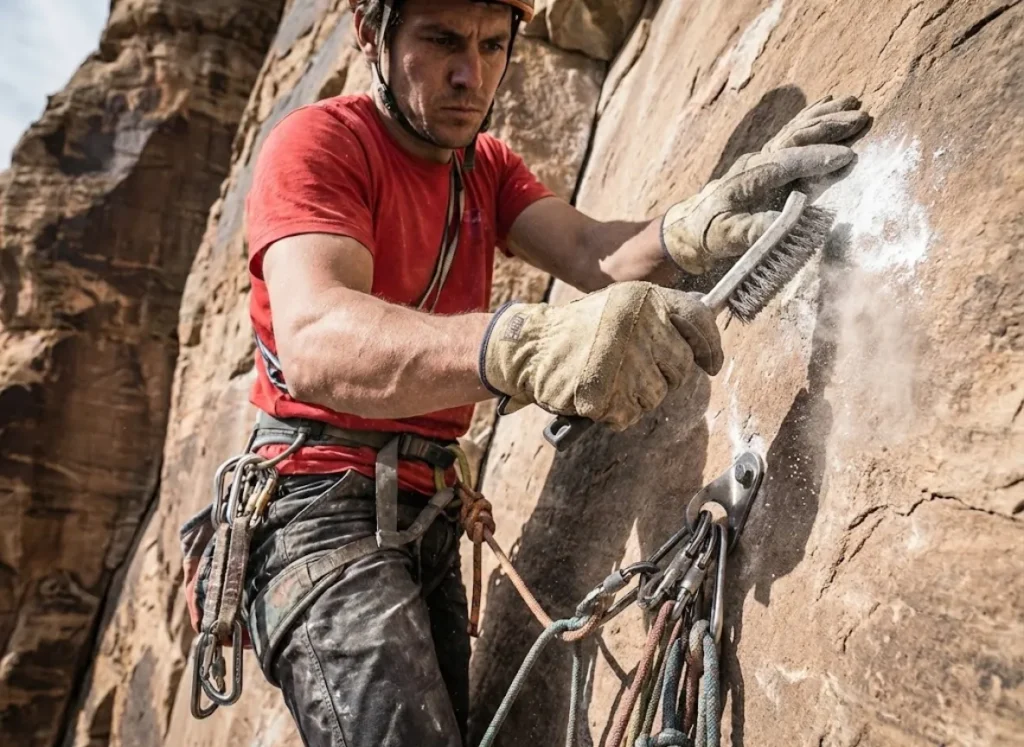
They are not. Outdoor infrastructure is a “Public Good” installed by volunteers at personal cost. Bolters and equippers act as net providers of these goods. Equipping a single sport route costs upwards of $200 in stainless steel hardware, not counting the days of labor to scrub and drill.
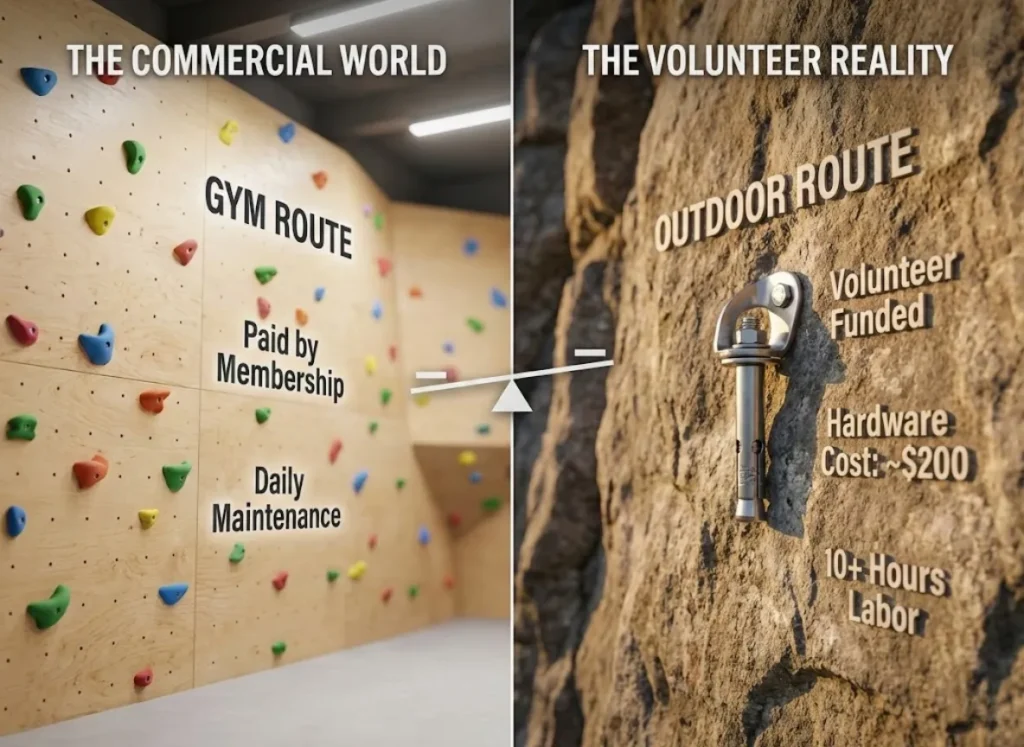
The “Free Rider problem” occurs when thousands of climbers, who happily pay $100 a month to a gym, climb outside for “free” without contributing to the local bolt fund. We are currently facing a crisis of altruism. A small group of aging equippers cannot keep up with the maintenance required for the booming population of new climbers.
Bolts from the 90s are rusting, and anchors are wearing through. Without funds, they cannot be replaced.
Pro-Tip: If you climb outside more than five days a year, you are morally obligated to donate to your local climbing organization (LCO). Consider it your “outdoor gym membership.”
Major organizations are trying to fill the gap, such as the Access Fund’s anchor replacement grants, but they rely on donations. We must shift from a consumer mindset to a citizen mindset. We need to be decoding climbing access threats and solutions and realizing that if we don’t pay for the rocks, nobody will.
Has the ‘Dirtbag’ Dream Been Sold Out? (Gentrification)
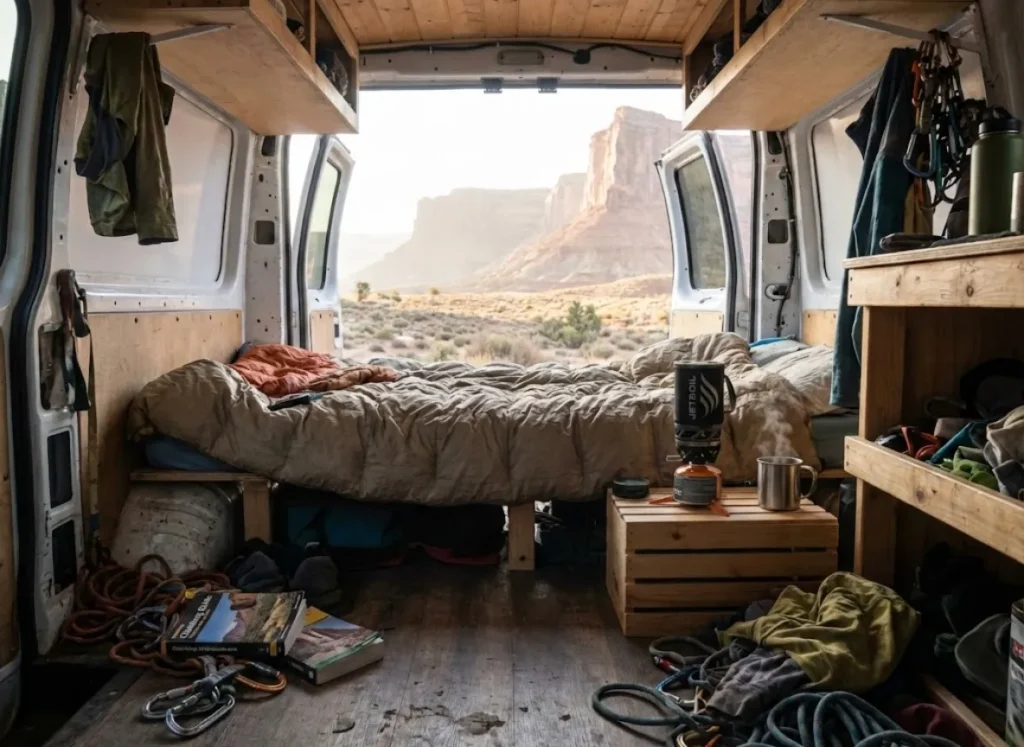
How has the definition of a ‘dirtbag’ changed since the 1970s?
The original dirtbag of the Yosemite Golden Age defined wealth differently than the rest of America. They lived in Camp 4, ate scavenged food, and dodged park rangers, all to maximize their time on the wall. Poverty was a choice; the currency was freedom. This was the sport’s counter-cultural roots.
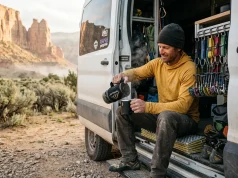
Today, the aesthetic of the dirtbag has been subjected to commodification via #VanLife. What was once a necessity for the obsessed is now a luxury lifestyle for digital nomads in $100,000 Sprinter vans. The cost of entry has skyrocketed.
High gas prices, reservation-only campsites, and the need for remote work technology have pushed the true dirtbag—the one living on pennies—to the margins. Sociological studies on VanLife subcultures highlight a tension between authenticity and performative poverty.
The modern “Trust Fund Dirtbag” creates an identity crisis within the community, blurring the lines between those who live in a van to climb and those who climb to post about living in a van. If you are looking to enter this lifestyle authentically, start by building a comprehensive climber van life system that prioritizes function over Instagram aesthetics.
What barriers prevent climbing from being truly inclusive?
Despite the boom in gym popularity, outdoor climbing remains strikingly homogenous. This “Green Ceiling” persists due to significant economic and structural barriers. While a pair of shoes is enough for the gym, outdoor climbing requires a vehicle, gas money, and a trad rack that can cost as much as a used car.
Geography also acts as a filter. The “Nature Gap” affects those who do not live near public lands or lack the generational knowledge to navigate them. Furthermore, recreational specialization and diversity metrics indicate that as the activity becomes more specialized, diversity often decreases.
Cultural gatekeeping—the use of jargon and unwritten rules—can make the crag feel hostile to new climbers who don’t fit the traditional mold. Breaking down these walls requires intentional effort, such as supporting affinity groups and gear libraries. We must actively work on addressing barriers to diversity in climbing to ensure the future of the sport reflects the diversity of its participants.
Conclusion
Climbing is far more than physical exercise; it is a complex social world with its own economy, hierarchy, and ethical code.
- It is a Serious Leisure pursuit where we forge identity through shared struggle.
- Status is driven by Symbolic Capital—your skills and stewardship matter more than your bank account.
- Moving outdoors requires a shift in Habitus, trading the consumer mindset for one of risk management.
- The cliffs are a Common-Pool Resource, reliant on our collective altruism to prevent degradation.
The next time you clip a bolt or walk a trail, remember that you are participating in a fragile experiment. Don’t just consume the rock; protect it. Join your local Access Fund chapter or volunteer for a crag clean-up day to turn your membership into true stewardship.
FAQ – Frequently Asked Questions
What is the difference between a Gumby and a Dirtbag?
Gumby is a slang term for a novice climber who lacks awareness of safety or etiquette (low subcultural capital), often regardless of their physical strength. A Dirtbag historically refers to a climber who sacrifices financial stability and material comfort to dedicate their life entirely to climbing (high subcultural capital).
Why are local climbers often hostile toward gym climbers?
This hostility usually stems from a clash of habitus—gym climbers often unknowingly bring indoor behaviors (noise, crowds, assumption of safety) to outdoor spaces. Locals view this as a threat to the preservation of the crag and the safety of the group.
What does Serious Leisure mean in the context of climbing?
Serious Leisure is a sociological term describing hobbies that require deep perseverance, a career of skill acquisition, and a strong personal identity. It explains why climbers often treat their sport with the dedication typically reserved for a profession.
Is Flatlining in climbing a bad thing?
No, flatlining—reaching a skill plateau and staying there—is a valid sociological stage where the climber prioritizes community and enjoyment over the stress of constant progression. Flatliners form the stable social backbone of many climbing communities.
Safety Notice: Rock climbing and mountaineering are inherently high-risk
activities that can involve physical trauma or fatal incidents. The information on Rock Climbing Realms is for
educational and informational purposes only. Techniques and advice presented here are not a substitute
for professional, hands-on instruction. Conditions and risks vary by location. Always seek guidance
from a qualified instructor before attempting new techniques. By using this website, you agree that you
are solely responsible for your own safety. Any reliance you place on this information is strictly
at your own risk, and you assume all liability for your actions. Rock Climbing Realms and its authors
will not be held liable for any harm, damage, or loss sustained in connection with the use of this information.
Affiliate Disclosure: We are a participant in the Amazon Services LLC Associates Program, an
affiliate advertising program designed to provide a means for us to earn advertising fees by advertising and linking
to Amazon.com. As an Amazon Associate, we earn from qualifying purchases. We are also an official affiliate partner
of Black Diamond Equipment via the AvantLink network. If you click on a Black Diamond affiliate link and make a
purchase, we may earn a commission at no additional cost to you. We also participate in other affiliate programs.
Additional terms are found in the terms of service.