
In this article
I found a set of Black Diamond Camalots on Mountain Project — six pieces, sizes 0.5 through 3, for $180. The seller had 200+ posts, answered every question without hesitation, and could tell me exactly which routes each cam had been on. I bought them. That was seven years ago, and those cams have caught falls I’d rather not think about. The point isn’t that I got lucky. It’s that I did my homework before I ever sent a payment.
Buying used climbing gear is one of the smartest financial moves in the sport — if you know what you’re doing. If you don’t, you’re gambling with something you’d rather not gamble with. This guide covers exactly what’s safe to buy used, what you should always buy new, how to inspect gear like someone who’s been on real rock, and two checks almost nobody talks about: reading manufacturer date codes and verifying recalls before you hand over your money.
Quick Answer: Here’s a safe process for buying used climbing gear:
- Identify the gear category — hard goods (cams, stoppers, biners) are lower risk; soft goods (ropes, harnesses) are higher
- Run the brand and model through the CPSC recall database and the UIAA safety list
- Locate the manufacturer date label and read the date code to verify actual age
- Perform a visual inspection appropriate to the gear type (gates, grooves, slings, cables)
- Assess the seller — a climber who knows their gear’s history beats any anonymous listing
- Walk away from anything with unknown history, missing labels, or a seller who can’t answer basic questions
Hard Goods That Are Usually Safe to Buy Used
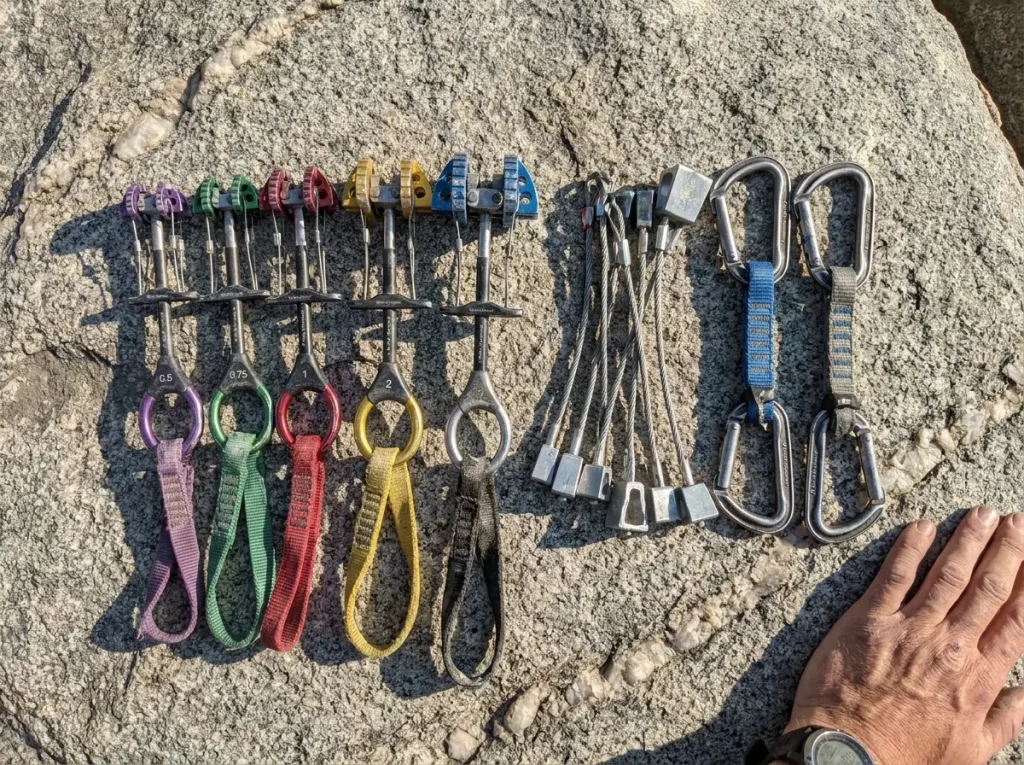
The first thing to understand about used climbing gear is that the risk is not uniform across categories. Metal gear — the stuff made from aluminum, steel, and titanium — has a lifespan that’s largely determined by condition, not age. A 12-year-old cam in clean condition is safer than a 3-year-old cam that was stored in a wet trunk.
Camming devices
Camming devices are the workhorses of the secondhand market. A set of cams in good shape will cost you 30–40% less than new, and a full trad rack of Black Diamond Camalots at that discount is several hundred dollars back in your pocket.
The cams that should give you pause are the ones with frayed trigger wires — that’s the first thing to check. The wires should flex without resistance, and the lobes should spring back together without hesitation. Look at the lobe surfaces closely. Light scuffing is normal. Deep gouging or any kind of cracking is not.
Check the stems. They should be straight. A bent stem usually means the cam took a heavy fall in an awkward position — which doesn’t necessarily retire the piece, but it changes the story you’re buying. Finally, look at the sling condition and color. Faded or discolored slings signal UV exposure, which degrades nylon strength over time even when no physical damage is visible.
Stoppers and passive protection
Passive protection — stoppers, hexes, nuts — is about as indestructible as climbing gear gets. They’re just machined aluminum and cable wire. Check the cable: it should be clean, straight, and unfrayed.
The anodized color finish will show wear, and that’s cosmetic. What you’re looking for is fraying at the swage point where the cable meets the metal, or severe kinking that’s created a permanent bend. Either is a reason to walk.
Carabiners and quickdraws
Carabiners are safe to buy used with one critical caveat: the rope basket. Run your fingernail along the groove where the rope runs. If you feel a burr — a raised metal edge — that’s a retirement flag. A sharp burr can sheath a rope in one loaded fall.
The gate should spring back with an audible snap when you release it. Sticky gates are a no. Any biner with a bent spine or basket goes straight in the recycle bin.
For quickdraws, press every section of the dogbone flat between your fingers and look for thread loss at the sewn sections. The stitching is where a dogbone fails, and it can fail invisibly until it doesn’t. Rotations at the biner end of the dogbone — where the rope-side carabiner can twist — are a sign the draw has been loaded hard many times.
For a complete carabiner inspection protocol, including gate play measurements and groove depth limits, how to inspect a carabiner for gate play and wear covers every checkpoint worth running before you hand over money.
Belay devices
A new ATC costs $20 at most shops. The math on buying a used belay device rarely works out. If you’re committed, look for original coloring inside the device (worn grooves change the friction characteristics) and no sharp edges on the rope channel. Tube devices from before 2010 that have a pyramid shape on the outlet end are outdated designs — skip them entirely.
Gear You Should Always Buy New
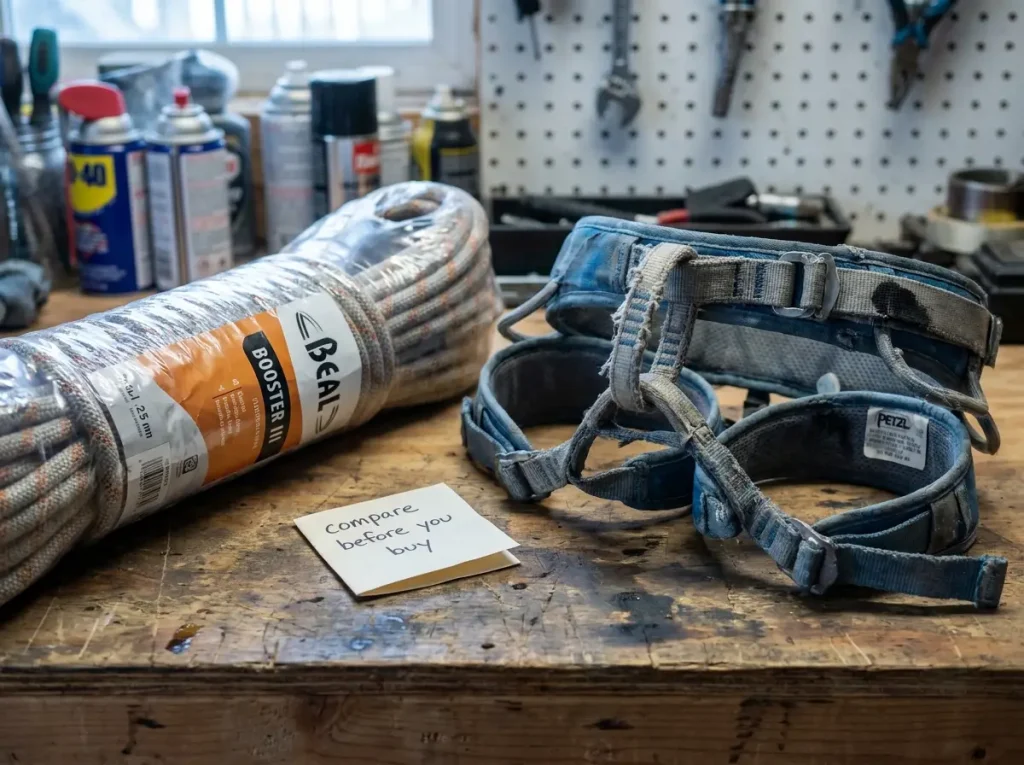
This is the short list, and the logic behind it is simple: the stuff that can fail invisibly, under load, without warning, is not secondhand gear territory.
Ropes
Climbing ropes are the one piece of gear where looking good and being safe are completely different things. You cannot see UV degradation, chemical contamination (gasoline, bleach, battery acid — all of which destroy nylon faster than falls do), or the history of falls a rope has absorbed. The sheath can look pristine while the core has been compromised. For more on understanding rope condition from the inside out, how to flake a rope properly covers the core shot pinch test — but that test is a yes/no on obvious core shots, not a certification of overall rope integrity.
Don’t buy used ropes.
Harnesses
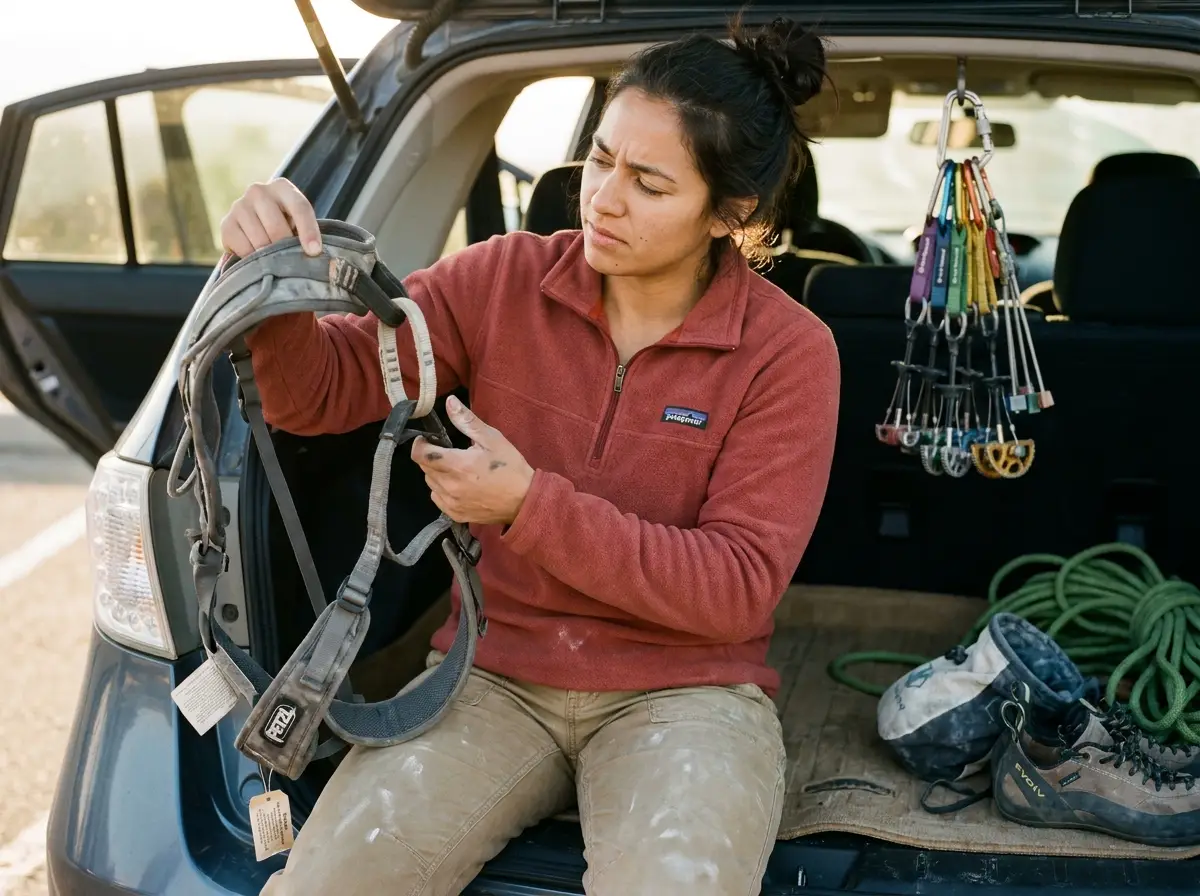
Climbing harnesses look like webbing and buckles, but what’s actually holding you in a fall is the structural integrity of the bar tacks — the dense stitching at load-bearing points — and the health of the webbing itself at a molecular level. Webbing degrades with UV exposure, sweat, and time in ways that produce no visible warning. Modern harnesses include wear indicators — sections of the belay loop that are a contrasting color underneath, meant to show through when the outer layer has worn enough to raise a concern. You won’t get those on an older harness without knowing its history.
The only exception is gear from someone you know personally, who can document that the harness is relatively new, was stored properly, and hasn’t been loaded in a fall. For an understanding of what harness retirement criteria actually look like — including what those internal wear indicators are doing — see your climbing harness is dying and you can’t see it.
Helmets — the gray zone
Climbing helmets are the most misunderstood secondhand gear category. The foam that absorbs impact — EPS or EPP — compresses permanently in a single significant impact. It leaves no external evidence. No crack. No dent. Just a helmet that can no longer protect you the way it could before.
The hard rule: any helmet with an unknown fall history should be treated as if it’s been in a fall. The only legitimate used helmet purchase is from someone who bought the wrong size, never wore it, and can prove it’s unused — still in the original packaging, ideally. A climber who swears their helmet “never took a serious hit” is telling you what they remember, not what happened.
How to Inspect Used Climbing Gear Before You Buy
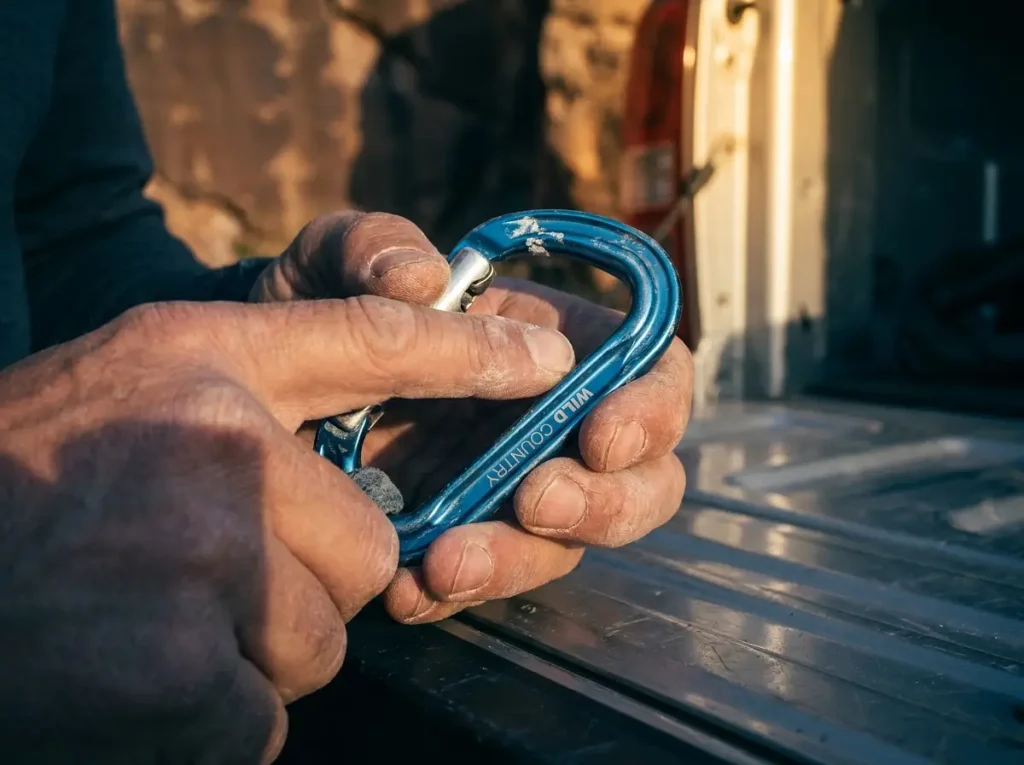
Inspecting cams and passive gear
For cams: trigger wires first, then lobe surfaces, then stem alignment, then sling. The sling should pass the same inspection as any webbing — no discoloration beyond the expected fading, no stiff sections, full stitching. Check the label while you’re there (more on that in the date codes section below).
For stoppers: flex the cable by hand. It should move smoothly through its full range without any sections that feel locked or permanently bent. The swage fitting at each end should be smooth with no separation starting.
Pro tip: Always ask to inspect in person before money changes hands. Any serious seller agrees immediately. Anyone who resists telling you to “just trust the photos” is telling you something important.
Inspecting carabiners and quickdraws
The fingernail drag along the rope basket groove is the one move. Do it on every biner, every time.
Work the gate through its full range — open and close it 10 times fast. It should feel the same on rep 10 as on rep 1. Any stiffness that gets worse with repetition is a gate spring problem.
Inspecting shoes and soft goods
Climbing shoes are generally safe used, and the inspection is straightforward: rand rubber around the toe edge (the rubber strip that wraps the toe box), sole rubber thickness, and seam integrity. Rand that’s worn through to the shoe upper, or sole rubber that’s ground down to the midsole, means you’re one session away from a resoling. That’s not a deal-breaker — just price it in.
For slings and cordalettes, bend every section through its full range. Stiff sections, brittle feel, visible UV bleaching, or any section that’s flattened under pressure all signal a sling that’s past its useful life.
The rope inspection you can actually do
If you’re evaluating a rope for any reason, the pinch test reveals obvious core shots. Run the rope through your hands and create a tight bend at any soft or uneven section. A healthy rope makes a tight circular bend.
A section with core damage makes a flat, kinked bend — the sheath has the rope shaped but the core is missing underneath. It’s not a comprehensive safety test, but it catches the worst cases. Then keep walking.
How to Read Gear Date Codes and Verify Age
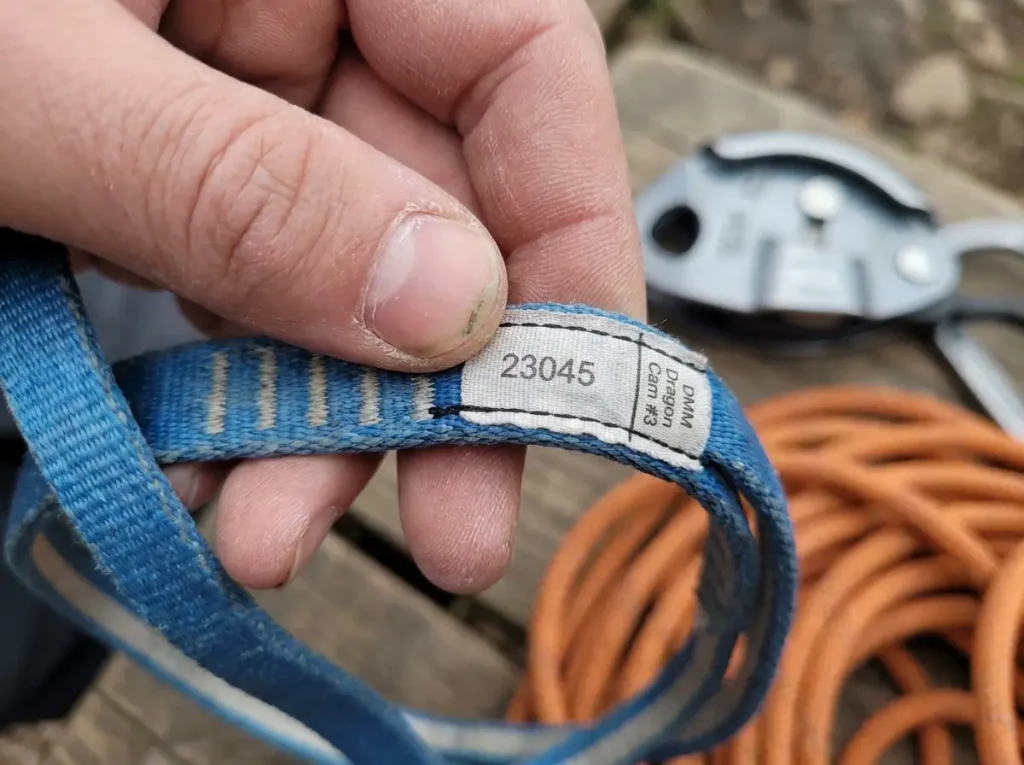
Here’s something almost nobody does before buying used climbing gear: read the label. Not the brand tag — the manufacturer date code label. Every CE/UIAA-certified climbing product has one.
It’s small, sometimes tucked under a layer of webbing or stamped into a metal spine, but it’s there. And it tells you exactly how old the gear is regardless of what the seller says.
Where to find the labels
On cams, the date label is typically sewn into the sling — the same label that carries the CE marking and manufacturer info. On carabiners and quickdraws, look for it stamped into the aluminum spine or printed on the dogbone webbing label. On slings and cordalettes, it’s a sewn-in tag. Some older pieces have it stamped directly into the metal.
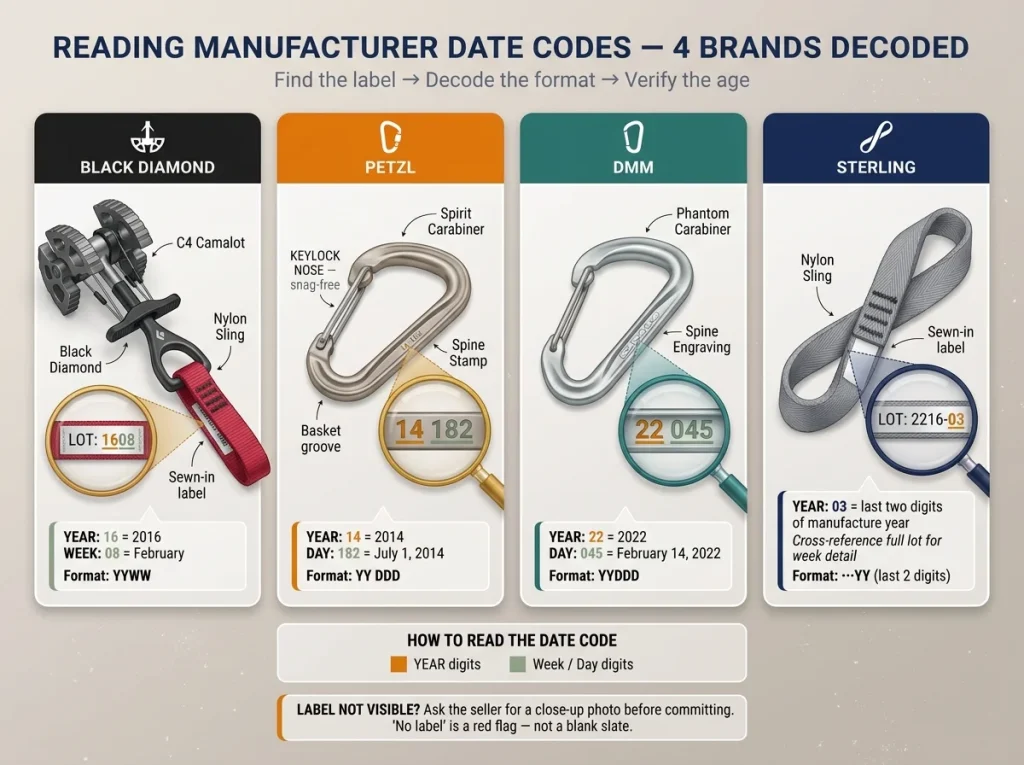
Brand-specific date code formats
Sterling and Black Diamond ropes/slings: The first two digits of the lot number = year of manufacture, the next two = week of that year. A code reading “1608” was made in the 8th week of 2016 — that’s February 2016. That cam is a decade old.
Petzl gear: Format is YY DDD — year followed by the day of the year. “14 182” means the 182nd day of 2014, which is July 1, 2014.
DMM: Format YYDDD — “22045” is the 45th day of 2022, which is February 14, 2022. A perfectly acceptable used cam.
Beal: Look for the lot number on the label and find the last two digits — those are the year.
What gear age means for your decision
Soft goods — anything made of nylon or Dyneema webbing, including slings, cordalettes, and harness straps — have a manufacturer-recommended maximum service life of 10 years regardless of condition. The UIAA and manufacturers like DMM’s sling inspection guidelines are explicit about this: even a sling stored in a drawer for a decade should be retired.
For metal gear, there’s no absolute age limit if the piece passes visual inspection. A 20-year-old cam with clean lobes, functional trigger springs, and an intact sling is functional climbing gear. The label tells you the age — your eyes and hands tell you the condition.
Pro tip: “No label” is not a blank slate — it’s a red flag. Manufacturing records exist for every CE/UIAA-certified piece. If a cam or biner has no legible date label, you have no idea what you’re holding.
How to Check If Used Gear Has Been Recalled
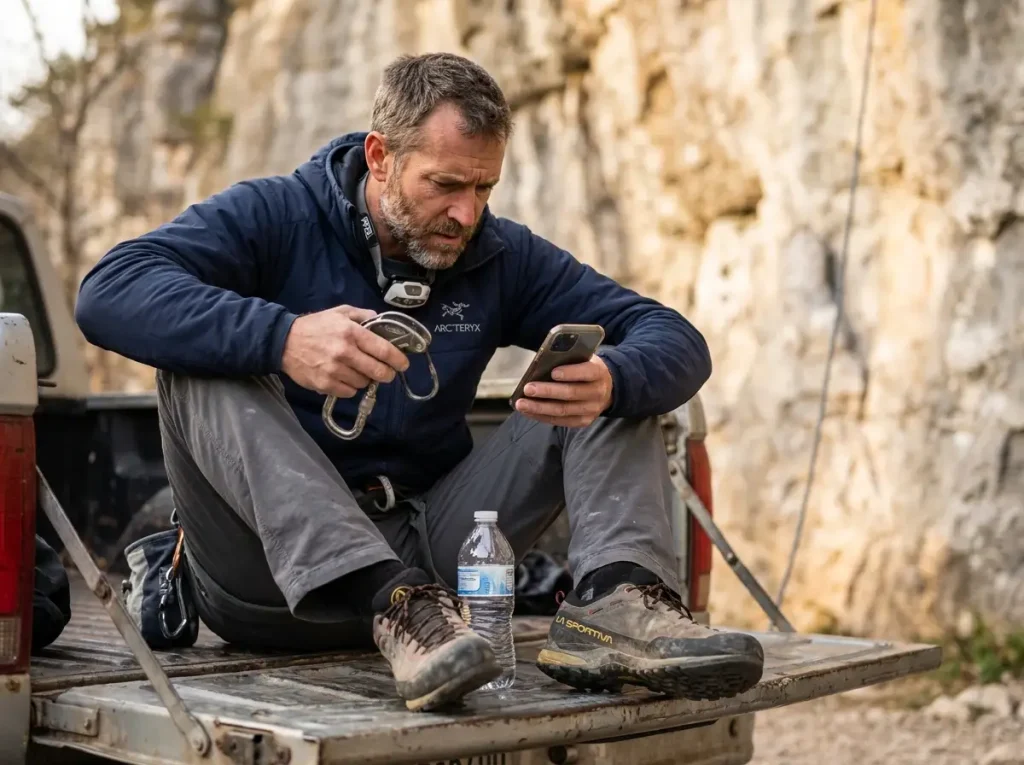
Black Diamond recalled the BD Vision harness in 2025 for fall hazard. Before that, they recalled a series of camming devices in 2016. Petzl recalled equipment in 2006. Trango recalled the Vergo belay device in 2017. These are not hypothetical risks — these are pieces of gear that were actively sold, used, and then identified as hazardous.
The problem: gear doesn’t come with a warning label when it’s recalled. It just sits in someone’s closet or gets listed for sale, looking like any other piece of used gear.
The CPSC recall database
The US Consumer Product Safety Commission maintains a searchable database at CPSC.gov/Recalls. Before completing any used gear transaction, search the brand name and product type. It takes two minutes. You can also subscribe to recall email alerts — select “sporting goods” as a category and anything that shows up related to climbing lands in your inbox automatically.
The UIAA safety recall list
The UIAA Safety Commission maintains an international recall database at theuiaa.org/safety/safety-recalls, which includes partial recalls, model-specific warnings, and notices from manufacturers that may not have made it to the CPSC. It covers recalls reported since 2009 and includes European brands that don’t always appear in the CPSC system.
A real example
The BD Vision harness recall in 2025 involved a specific manufacturing defect in the tie-in point area. The recall allowed original purchasers to get a replacement directly from Black Diamond. Secondhand buyers of a recalled piece get nothing — they’re holding a product that’s been formally identified as a fall hazard with no recourse from the manufacturer. The two-minute database check eliminates this risk entirely.
Pro tip: This check matters even for hard goods. Most people assume metal gear doesn’t get recalled. It does. Run the search every time.
Where to Buy and How to Vet the Seller
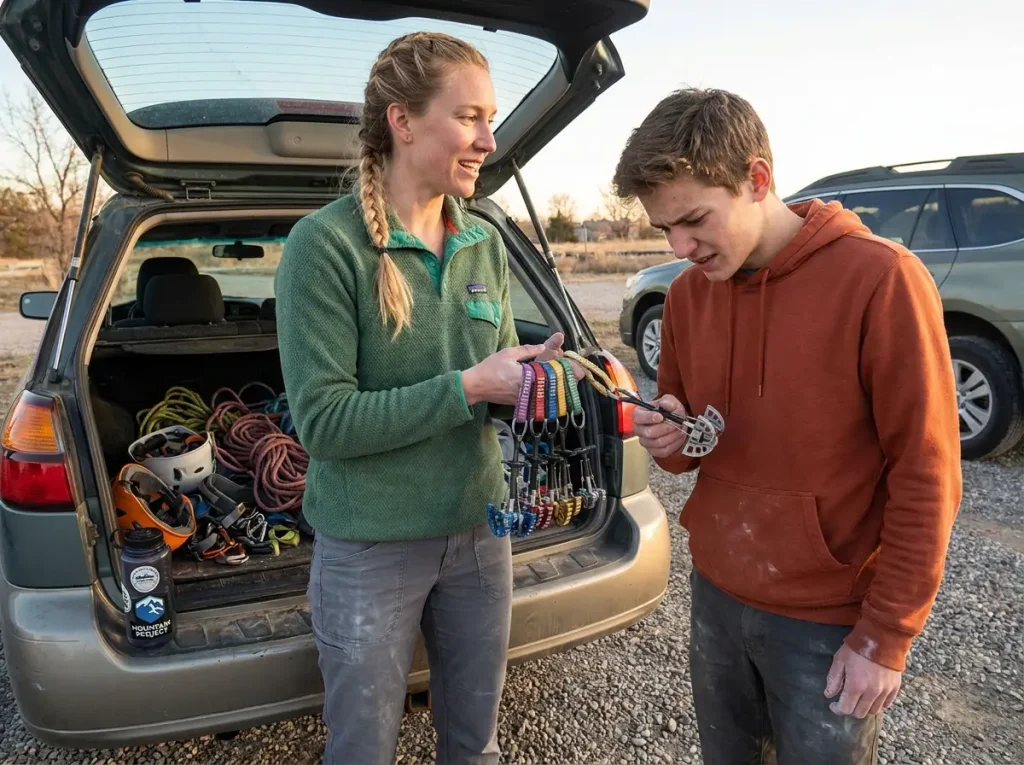
The gear is only half the equation. The source determines how much history you can actually verify — and that matters as much as the condition of the piece itself.
Best sources — lowest risk
The safest used gear purchase is from someone you know, who has been climbing for years, who is upgrading their gear and can answer every question about its history. They know which routes it’s been on, how many falls it’s held, and how it’s been stored. That knowledge is worth real money.
The next best option is forum users on Mountain Project or similar communities who have significant post history and completed transaction records. Community accountability works — someone with 500 posts and 100 positive gear trades has a reputation to protect. That’s different from an anonymous online listing. For building a broader network of vetted climbing contacts, how to vet a stranger before you rope up traveling covers the same instincts applied to finding climbing partners.
GearTrade and REI Used both involve some level of inspection before resale. Not foolproof, but better than nothing.
Mid-tier sources
Craigslist and Facebook Marketplace listings range from excellent deals to genuine hazards, often with no way to tell from photos alone. Always insist on in-person inspection. If you’re paying the asking price without seeing the gear in hand, you’re taking on risk the seller should be sharing.
Red flags from any seller
This applies regardless of the platform:
- They can’t tell you if the gear has ever been dropped from height onto rock or concrete
- They’re “selling for a friend” and can’t answer questions about the gear’s history
- No manufacturer date labels visible in photos and they won’t provide close-up photos
- Price is suspiciously low without explanation
- They push back when you ask to inspect in person
Source risk scoring: A non-climber selling “old outdoor stuff” from their garage is the highest-risk scenario for any piece of gear, even hard goods they claim were never used — they have no ability to assess condition. An experienced climber upgrading their trad rack is the lowest-risk source. The difference matters as much as the inspection itself.
If the gear purchase decision is part of a larger question about whether to buy or rent during a climbing trip, climbing gear rental vs. buying for travel breaks down the cost math for both options.
Conclusion
Three things that make a used gear purchase solid: the right category (hard goods built for repeated use), a clean inspection, and a seller who knows what they’re selling. Three things that matter more than most people realize: reading the manufacturer date code, running a two-minute recall database check, and understanding that a non-climber who says gear is “barely used” is genuinely not qualified to tell you that.
Building a rack from secondhand gear is how most climbers have done it for decades. The system works when you work it — meaning you bring the same attention to a used cam purchase that you’d bring to clipping a fixed pin on a grade above your comfort zone. The information exists. Use it.
Next time you’re eyeing a used rack on Mountain Project, pull up CPSC.gov on your phone and check the model before you commit. Takes 90 seconds. Might save everything else.
Q1 Is it safe to buy a used climbing harness?
Generally, no. A used harness carries hidden risks that visual inspection can’t detect — webbing degradation from UV exposure, sweat chemistry, and unknown loading history all affect structural integrity without leaving visible evidence. The only acceptable used harness is from a trusted person who can document minimal use and proper storage.
Q2 Can you buy a used climbing rope?
Avoid it. You can’t assess fall history, UV damage, or chemical contamination from appearance. A rope that passes the pinch test for obvious core shots may still have compromised core integrity from years of loaded falls. The cost of a new rope is far less than the cost of a rope that fails.
Q3 How do you inspect used climbing cams before buying?
Check trigger wire condition first — wires should flex freely with no fraying. Then check lobe surfaces for deep gouging or cracking. Test stem alignment (should be straight). Inspect the sling stitching and color. Finally, read the date label on the sling to confirm actual manufacture date.
Q4 What should you look for when buying used carabiners?
Run a fingernail across the rope basket groove — any burr or sharp edge means retire it. Test the gate 10 times in rapid succession; stiffness that builds means a weakening gate spring. Avoid carabiners with bent baskets, bent spines, or locking mechanisms that don’t seat cleanly.
Q5 Where is the best place to buy used climbing gear?
Mountain Project’s gear forums and GearTrade are the safest options for buying at arm’s length. Climbers who are upgrading and selling to known contacts in their community are the safest overall source. The key is always access to the gear’s full use history — anything less than that requires compensating with extra scrutiny during inspection.
Safety Notice: Rock climbing and mountaineering are inherently high-risk
activities that can involve physical trauma or fatal incidents. The information on Rock Climbing Realms is for
educational and informational purposes only. Techniques and advice presented here are not a substitute
for professional, hands-on instruction. Conditions and risks vary by location. Always seek guidance
from a qualified instructor before attempting new techniques. By using this website, you agree that you
are solely responsible for your own safety. Any reliance you place on this information is strictly
at your own risk, and you assume all liability for your actions. Rock Climbing Realms and its authors
will not be held liable for any harm, damage, or loss sustained in connection with the use of this information.
Affiliate Disclosure: We are a participant in the Amazon Services LLC Associates Program, an
affiliate advertising program designed to provide a means for us to earn advertising fees by advertising and linking
to Amazon.com. As an Amazon Associate, we earn from qualifying purchases. We are also an official affiliate partner
of Black Diamond Equipment via the AvantLink network. If you click on a Black Diamond affiliate link and make a
purchase, we may earn a commission at no additional cost to you. We also participate in other affiliate programs.
Additional terms are found in the terms of service.