
In this article
Your fingertips are torn up. You’ve been on the same V6 at Flagstaff for two hours and cannot figure out why the hold keeps greasing out. The climber next to you — same grade, same body weight — is sticking it clean, session after session. The difference isn’t strength. It’s that he knows he’s climbing granite, not sandstone, and he hasn’t chalked up once in the last three attempts. You’ve been fighting the rock instead of reading it.
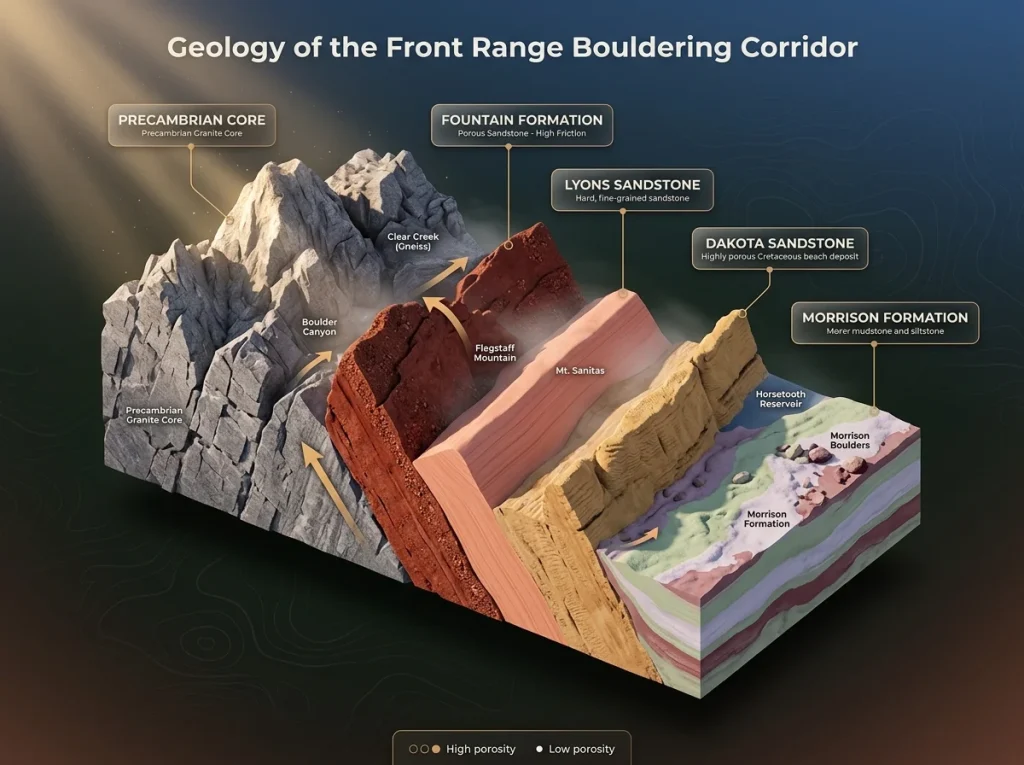
The Front Range isn’t one bouldering area — it’s four distinct geological laboratories, each demanding a different technical approach. This guide breaks them down by rock type, so you stop guessing and start sending.
| Bouldering Areas Comparison | ||||
|---|---|---|---|---|
| Area | Rock Type | V-Range | Best Season | Approach |
| Horsetooth | Dakota Sandstone | VB–V13 | Year-round | 5–10 min |
| Flagstaff | Fountain Sandstone + Granodiorite | V0–V12 | Sept–May | 5–20 min |
| Boulder Canyon | Boulder Creek Granodiorite | V4–V15 | Summer/Fall | 10–30 min |
| Clear Creek Canyon | Gneiss/Schist | V3–V10 | Year-round | <10 min |
| Morrison Boulders | Morrison Formation | V1–V10 | Oct–Apr | 15–25 min |
⚡ Quick Answer: The Front Range spans four main rock types — Dakota sandstone at Horsetooth, Fountain Formation sandstone and granodiorite at Flagstaff, Boulder Creek Granodiorite in Boulder Canyon, gneiss at Clear Creek, and polished Morrison mudstone near Denver. Each demands a different chalk strategy: wipe excess chalk on granite and gneiss; apply freely on porous sandstone. Season matters too — granite climbs best in summer shade, sandstone peaks in fall and winter, and Clear Creek’s Nomad Cave stays dry year-round. Match your approach to the geology and you’ll stop leaving sends on the table.
The Geology That Decides Your Technique
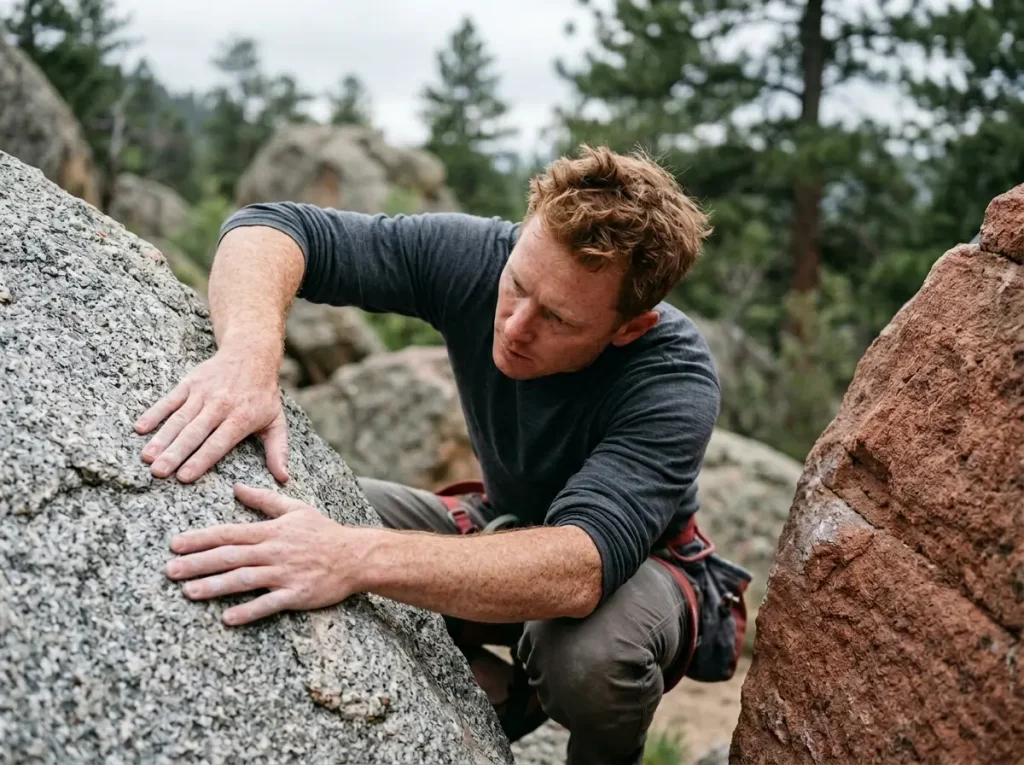
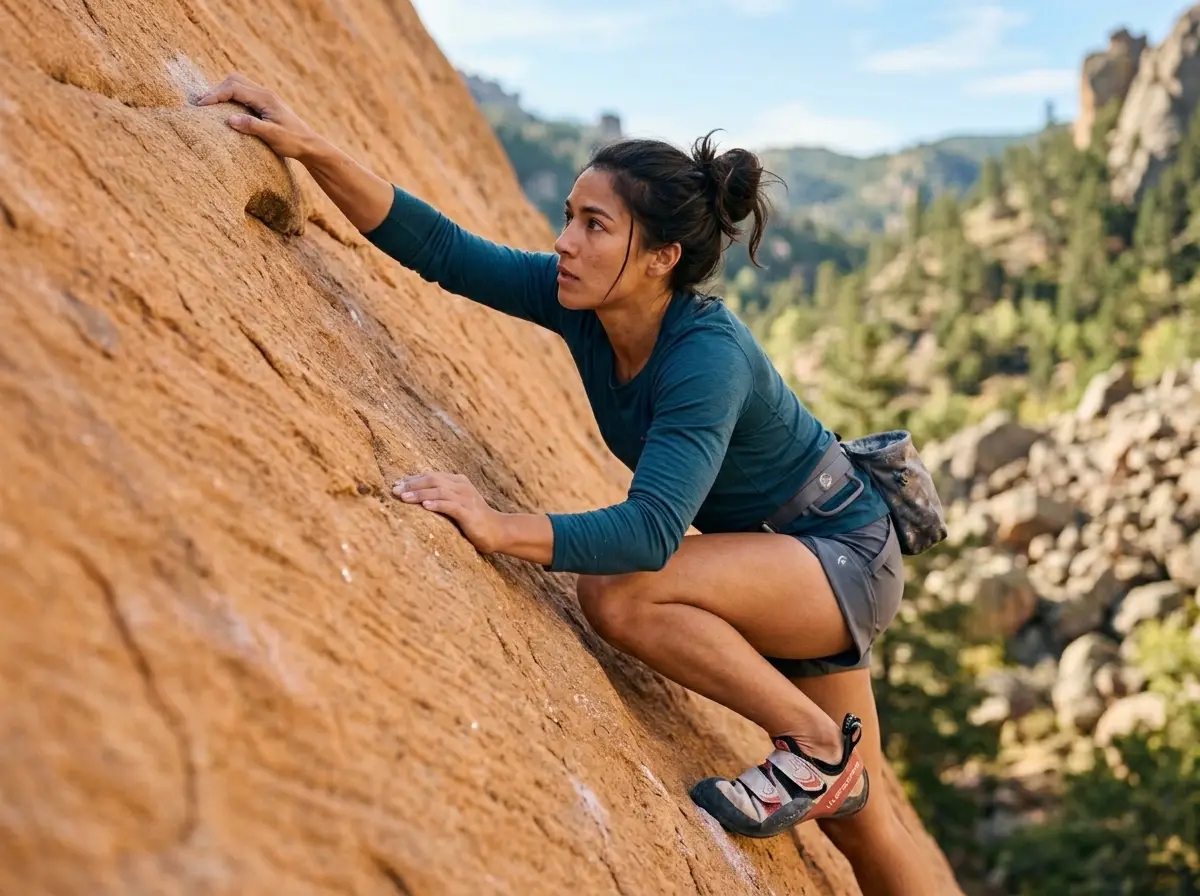
The Front Range exposes 1.7 billion years of geological history in a 50-mile corridor. Two rock families control everything about how you move. Igneous and metamorphic rock — granite, gneiss — has near-zero porosity and an interlocking crystal structure. Sedimentary rock — sandstone, mudstone — is porous, grainy, and absorbs everything your skin produces.
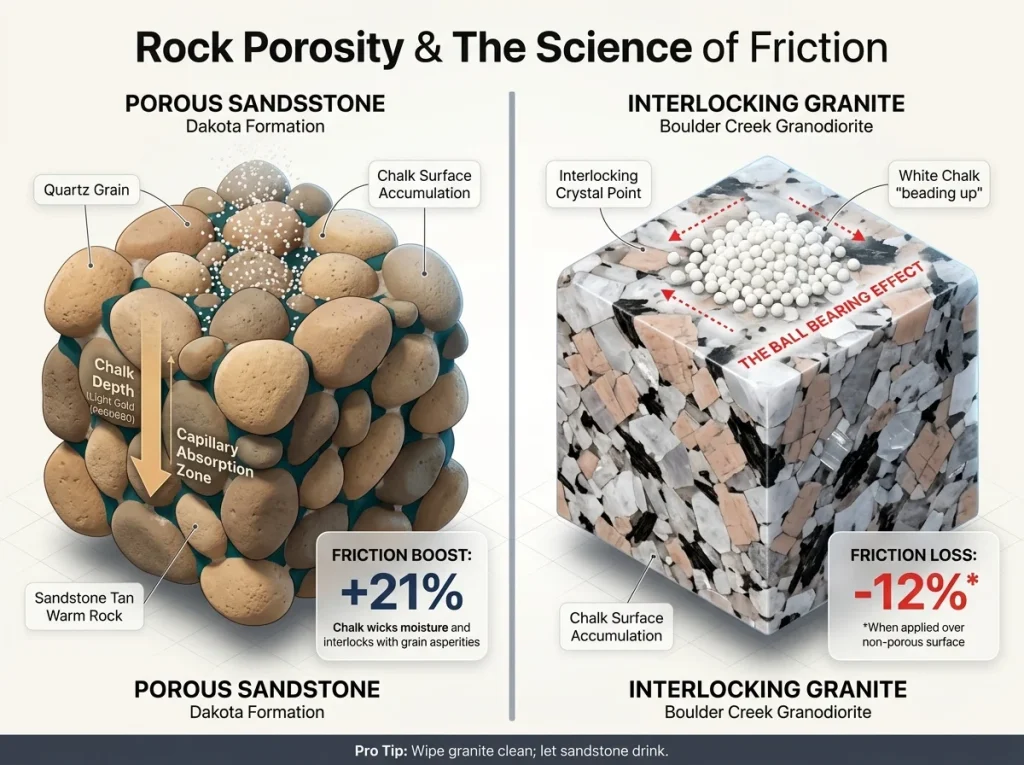
That distinction is your operating manual. Porosity decides whether chalk works for you or against you. On porous Dakota sandstone at Horsetooth Reservoir, chalk wicks sweat and bites into grain structure, boosting friction by around 21% according to research on climbers’ perception of hold surface properties and slip resistance. On non-porous Boulder Creek Granodiorite, excess chalk forms a loose, granular layer on the surface of the rock that your skin skims right over. Nobody calls this by its textbook name at the crag, but the effect is real: more chalk, less grip.
Porosity, Chalk Science, and the Ball Bearing Effect
Here’s the part nobody talks about at the trailhead. On granite and gneiss, excess chalk doesn’t dry your skin into the asperities — it creates a slippery intermediate layer. The chalk grains roll between your skin and the rock surface. That’s the Ball Bearing Effect, and it’s why the guy chalking up every move on a granite problem is working harder than the guy wiping his hands clean before each attempt.
The fix on non-porous rock: apply chalk to dry the hands, then wipe most of it off before contact. Skin must reach the rock’s crystal structure directly. On porous sandstone, the opposite protocol applies — chalk absorbs rapidly and needs reapplying after each attempt because the rock drinks it. For a deeper breakdown of why chalk fails on granite, the physics are worth understanding before your next granite session.
Viscoelasticity and Skin Adaptation by Rock Type
Your fingertip skin is a viscoelastic material — it deforms into rock texture under load, then partially springs back. On 40-grit Dakota sandstone at Horsetooth, thick calluses are the price of admission. But if those calluses get too thick, they lose compliance and start ripping in chunks — the classic flapper. Regular maintenance with 80–100 grit sandpaper, smoothing calluses flush with surrounding skin, keeps them functional. Think of it as tire tread management. Tread that’s too worn has no grip; tread that’s too chunky tears off.
Polished Morrison mudstone is the opposite problem. Thick calluses hydroplane on that surface. Morrison rewards hydrated, supple skin — maximum contact area, maximum compliance, minimum friction loss. Don’t go to Morrison after a long granite session with your skin ground raw. You’ll be fighting the rock all day and have nothing to show for it. Managing skin for different rock textures is a separate skill from training, and it’s not optional on the Front Range.
How to Read Rock Before You Leave the Ground
Take 30 seconds before your first attempt. Look at crystal size — coarse crystals like those in Boulder Creek Granodiorite generate high friction but chew skin fast. Fine-grained Lyons Sandstone at Mount Sanitas requires precise edging rather than smearing. Check for water streaks and seepage lines, which signal micro-porosity variation within a single boulder. Tap suspicious sections: a hollow sound indicates a detached flake, common on Fountain Formation sandstone at Flagstaff. Dark polish on Morrison holds means those sections are nearly frictionless — treat them like glass and slow down. The City of Boulder’s OSMP geology documentation maps the exact formation boundaries if you want to study the terrain before driving up.
Northern Front Range: Dakota Sandstone at Horsetooth Reservoir
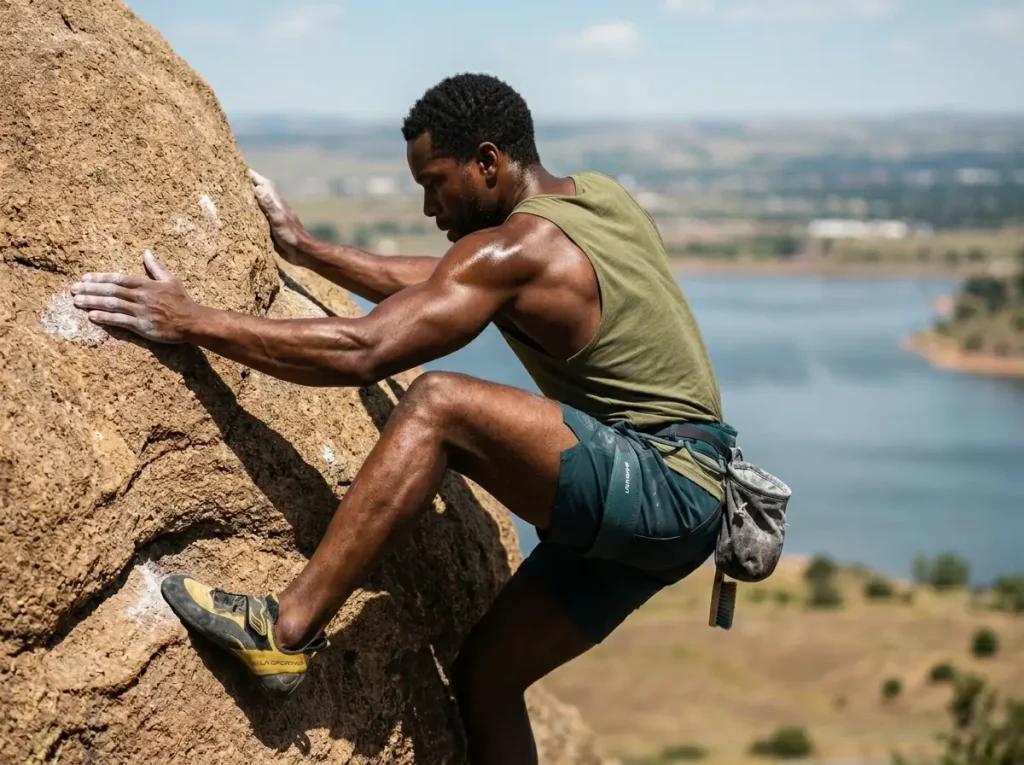
Horsetooth sits west of Fort Collins and doesn’t get the same name-drop frequency as Flagstaff Mountain or Boulder Canyon, but the Dakota sandstone here is some of the best friction climbing on the Front Range. This is Cretaceous beach deposit — ripple marks still visible in some slabs, 40-grit texture that rewards aggressive footwork, a diversity of crimps and slopers that punishes climbers who think grip alone gets them up.
Day-use parking costs $6 and the lot fills fast on weekends. Arrive before 8 AM or expect to walk. Summer midday friction drops off on south-facing walls — the morning window on north-facing Rotary Park problems is worth the alarm.
Pro tip: On Dakota sandstone, resist the urge to shake out with chalk between attempts. Let your skin dry naturally and feel the friction return first. The rock will absorb whatever you give it — better to time the chalk for the section that actually needs it.
Rotary Park — The Technical Breakdown
Rotary Park packs 100+ problems into a compact area, which makes it ideal for high-volume sessions without burning approach time. The Eliminator Boulder alone is worth the drive: Right Eliminator Prow (V4) demands compression and full-body tension through a sequence where most people barn-door if their hips aren’t square. Moon Arete (V9–10) on the same boulder requires precise heel-hook mechanics at the crux — the heel position is very specific, and you’ll spend at least two sessions just figuring out the foot placement before you can commit to the pull.
Punk Rock Traverse (V5) is what local crushers lap for endurance circuits. Sitting Moon (V12) is a power testpiece that starts on the east face and runs through a long pull sequence with no shaker holds. Grade’s honest. Bolt Wall (V1) is the area’s well-known sandbag trap — technically the grade says beginner, but it’s a highball with a consequential fall zone.
Landing Zone Assessment for Horsetooth Highballs
Rotary Park ground is uneven and rocky. The standard minimum is two large crash pads; three is better for anything above V5, and that’s not being conservative — that’s reading the terrain. The bigger mistake people make is pad placement, not pad quantity. Stagger seams. A single gap in pad coverage is where ankles go on the Horsetooth talus zones.
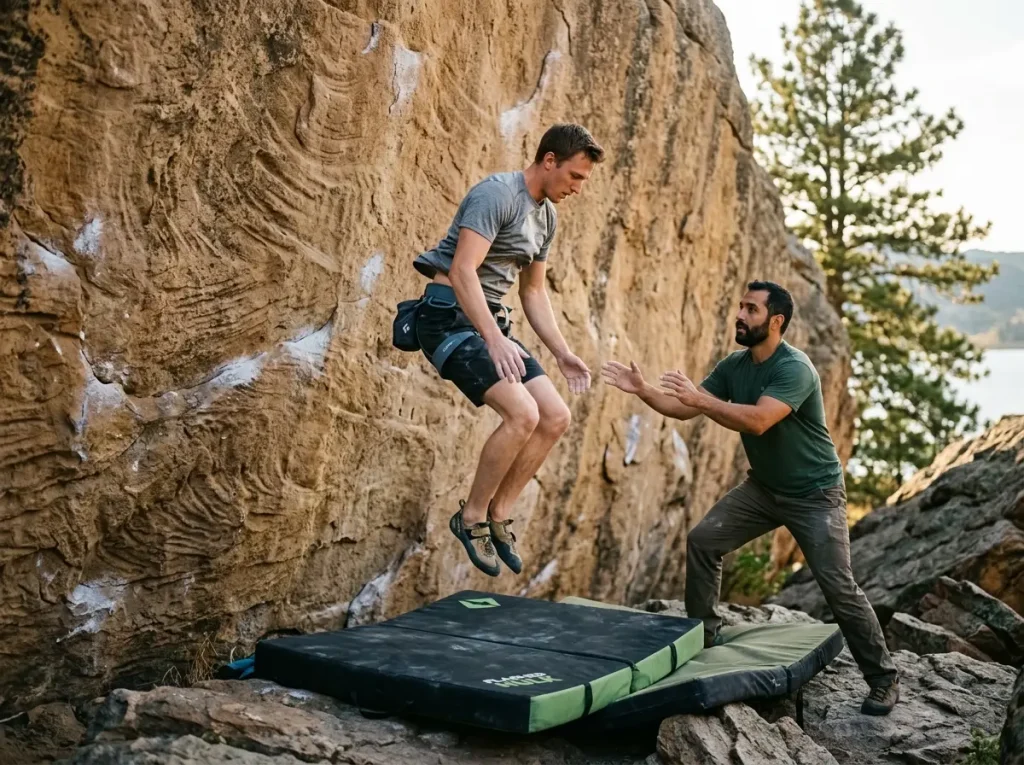
The spotter’s job here is guidance, not catching. Guide hips toward pad center, follow the fall trajectory with your hands at hip height. Stacking pads to eliminate gaps in Horsetooth’s talus landing zones is its own discipline — worth reading before your first highball session here. Stepping in to catch a falling climber transfers force through your spine, not the pad. That’s not a trade worth making.
Pro tip: Brief your spotter before every attempt. Agree on fall trajectory, primary spotter zone, and pad coverage. Thirty seconds of setup prevents six weeks of recovery.
Central Front Range: Flagstaff Mountain and Boulder Canyon
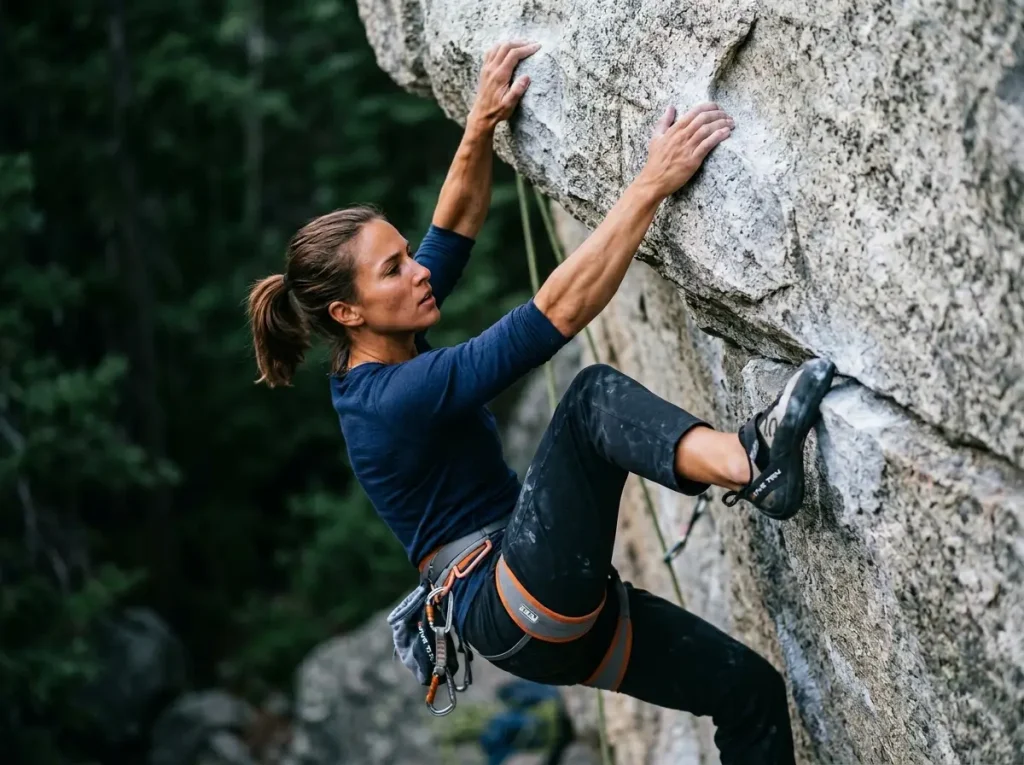
These two venues share nothing except proximity to Boulder. Flagstaff is the most storied bouldering area on the Front Range — 400+ problems on mixed Fountain Formation sandstone and Boulder Creek Granodiorite, notoriously sandbagged grades, and a local culture that will humble you fast if you show up expecting the numbers to mean what they mean everywhere else. Boulder Canyon is the granite counter-program: bulletproof granite that takes heat poorly but handles summer shade well, less prone to hold breakage, and home to some of the hardest problems in the country.
Understanding the tactical differences between sandstone and granite bouldering matters everywhere on the Front Range, but nowhere more than at Flagstaff where both rock types appear on the same hillside. Non-Boulder County vehicles need an OSMP parking permit for non-Boulder County vehicles: $5 daily, $25 annual. Don’t assume walk-up payment is an option — buy online ahead of time.
Flagstaff Mountain — Reading the Grades and the Rock
Sandbagging at Flagstaff isn’t random — it’s institutional. Problems were set decades before grade standardization, and the local consensus has become its own grading system. Your V-grade outdoors is likely your V-grade indoors minus one or two. Go in calibrated, not confident.
The mixed geology means every session might involve two completely different chalk protocols depending on which boulder you’re standing in front of. Fountain Formation = porous, takes chalk well, smearing rewarded. Granodiorite patches = apply the Ball Bearing Effect protocol and wipe before contact. Trice (V12), one of the world’s first V12s, sits on Granodiorite and demands extreme finger strength along with precise body tension. First Overhang (V6) is a technical strength test where position matters more than power — the barn-door sequence at the crux has ended many attempts by climbers who try to muscle through it.
The Monkey Traverse (V4) is the area’s benchmark local lap. If you’re lapping it clean, you’re dialed into Flagstaff movement. If it’s eating you, add another session before chasing harder testpieces.
Boulder Canyon — Summer Granite Campaigns
Access runs 5+ miles up a busy canyon highway — carpool when possible and park only at designated pullouts. The canyon creates hard shade sectors by mid-morning, which is exactly why summer granite works here when it doesn’t at fully exposed areas. Plan your session around sun position, not the clock.
The Game (V15) sits at the top of what’s achievable on granite compression. Study the movement even if you never attempt it — it demonstrates economy of motion that applies at every grade below it. The Citadel (V8) is the realistic benchmark for advanced climbers visiting for the first time.
Raptor closures affect Eagle Rock, Blob Rock, and Vampire Rock February 1 through July 31. Call ahead or check the Boulder Climbing Community calendar before driving up in spring.
The Metamorphic Corridor: Clear Creek Canyon
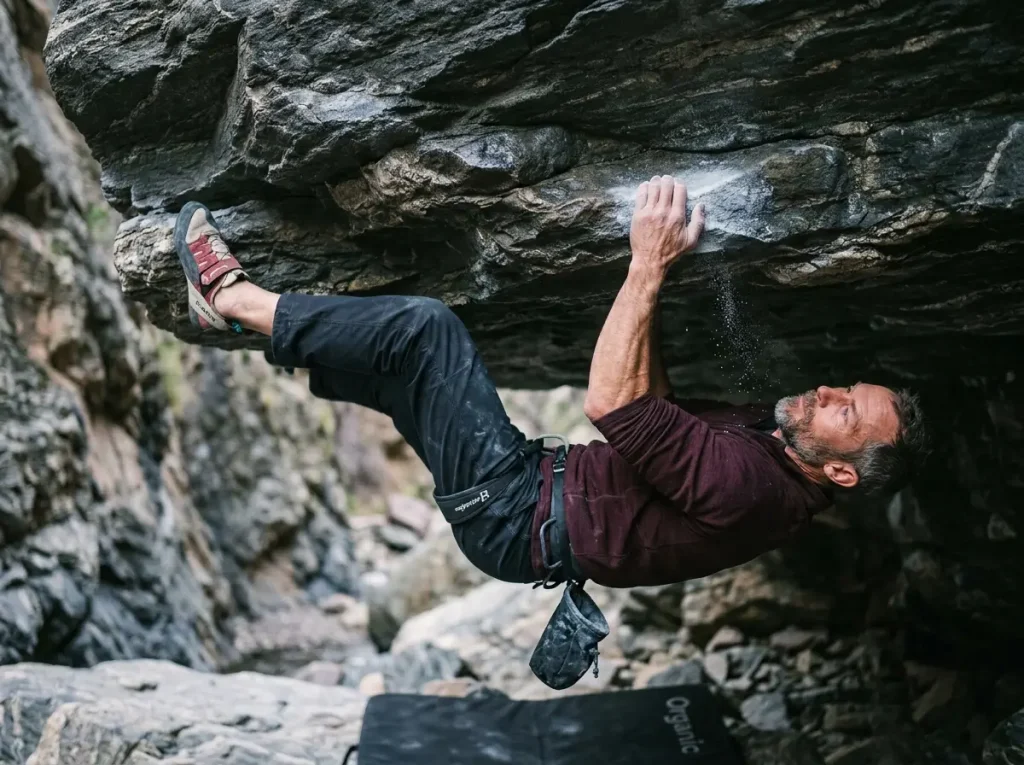
Clear Creek runs 15 miles west of Golden and climbers consistently underrate it. The gneiss here is a metamorphic rock that delivers granite-like friction with schist-like layering — blocky horizontal roofs on the same boulders as water-polished slopers and technical crimps. Problem variety is high, approaches are minimal, and a micro-climate architecture makes it functional year-round.
Most approaches are under 10 minutes. For an after-work session when you can’t get to Flagstaff in time, Clear Creek is the answer. The science behind raptor nesting closures at Clear Creek matters here — annual closures at the Blonde Formation and active eagle nest zones run February 1 through July 31. Check the Boulder Climbing Community before driving out in spring.
Tunnel Sectors — Grade and Style Map
Tunnel 1 carries the heaviest traffic: Joy Stand (V6) and Joy (V7) are accessible, well-traveled, and good for quick sessions when you need to move efficiently. Water-polished features on both require precise foot placement — slop on your feet here and you’re off.
Tunnel 2’s Formula 50 (V10) is the local benchmark for serious climbers. The movement is complex across multiple hold sequences, not a single crux — you need to stay composed through the whole problem. Tunnel 5 is the go-to sector for intermediate through advanced climbers wanting maximum style variety: Into the Light (V7) and Moulin Rouge (V10) offer contrasting technique demands on the same approach.
Army of the Dead sector has the most committing highball lines in the canyon. Full pad deployment, experienced spotters, and a realistic assessment of your head game before you commit to these.
Chasing Shade and Reading the Canyon Micro-Climate
Gneiss retains heat more efficiently than sandstone. A wall that felt perfect in the morning can shift after a cold front in late afternoon, giving you a second friction window. Learn to time your sessions around the canyon’s shadow patterns rather than the temperature forecast.
Nomad Cave is the most valuable piece of micro-climate beta in Clear Creek: the cave geometry prevents water infiltration on the main problems during light rain. When other areas shut down in afternoon showers, Nomad Cave stays functional. On hot summer days, the canyon holds cool air until early afternoon — your effective window is dawn to around 11 AM before heat pulls north from Golden. After that, chase shade or go home.
Pro tip: On gneiss, wiping excess chalk before contact applies the same logic as granite — near-zero porosity means the surface can’t absorb it. Don’t reflexively reapply after every move. Let the skin contact the rock.
Morrison Boulders: The Polished Proving Ground
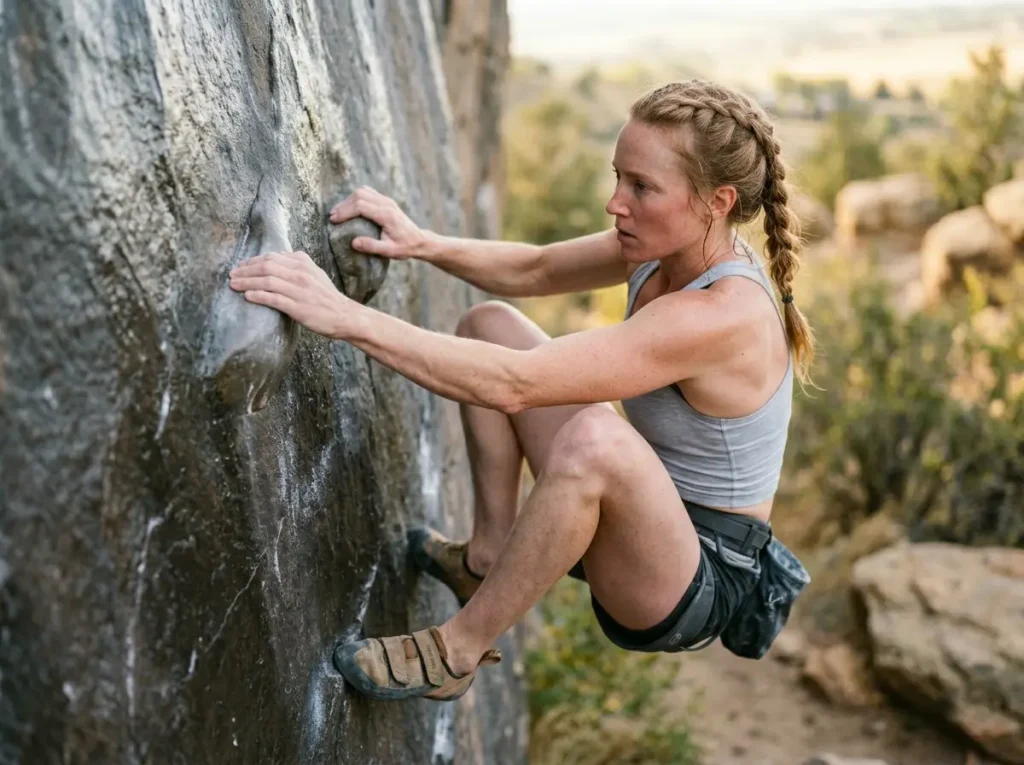
Morrison is 20 minutes from downtown Denver, which is both its appeal and its problem. The Morrison Formation mudstone and sandstone here is roughly 150 million years old and decades of high-volume traffic have polished the holds to near-glass smoothness. The style is punishing. Greasy slopers demand maximum body tension. Wicked crimps are real but unforgiving. Nothing here will feel casual.
Rattlesnake awareness is non-negotiable April through October. Tap boulders and ledges with your brush handle before reaching. Scan landing zones before pad placement. Carry a basic first aid kit. The approach slabs have plenty of warm ledge habitat.
Friction Mechanics on Polished Rock
Send temps on polished Morrison mudstone are not a preference — they’re a requirement. Above 60°F, the friction margin collapses. Optimal conditions sit in the 38–55°F range with low humidity. Getting there when the sun is still low and the rock feels cold is the only way to have a productive session. Mid-afternoon Morrison in September is a waste of drive time.
High-tension movement is the technique here. Think of every move as a static compression problem even on dynamic sequences. The sloper game punishes momentum climbers who try to use body swing to generate advantage. Skin must stay supple enough to deform into the micro-asperities of the polished surface — which means hydrated skin, not post-granite callus armor. If you’ve just done three days of Horsetooth, your skin is wrong for Morrison.
The Pedestal Rule and Area Ethics
The scratched line in Cave sector floor is a community contract, not a suggestion. Starting below that line and calling it the grade is bad faith climbing. The pedestal rule protects both the problem’s identity and the community’s grade consensus. Morrison has a locals-gym feeling despite its proximity to Denver — treat it like someone’s home crag.
Leave No Trace is intensified here because of urban traffic volume. Pack out every wrapper. Brush tick marks after sessions. Carry pads on the trail rather than dragging — dragging accelerates erosion on approach paths. Understanding outdoor bouldering ethics before your first trip to Morrison will save you from the kind of friction that doesn’t help with climbing. Avoid Morrison sandstone for 24–48 hours after significant rain. The palm test: press flat for five seconds; if you feel moisture or the rock feels clammy, it’s not ready.
The Physics of Safe Landing: Crash Pads and Spotting on Front Range Highballs
Every fall in bouldering is a ground fall. No rope, no belay, full gravity from problem height. A 75 kg climber falling 4 meters hits at roughly 31.9 km/h. A 10-meter highball fall — not uncommon at Flagstaff’s upper sectors — means impact at over 50 km/h. The free-fall impact velocity calculator puts specific numbers to what your gut already senses looking up at a highball: height compounds fast.
Crash pad foam works by extending the duration of your deceleration — more time to stop means lower peak force, which is the difference between walking away and not. This is why foam quality and density matter more than pad thickness alone. A cheap thick pad can deliver a harder impact than a quality thin one.
Pad Configuration for Front Range Terrain Types
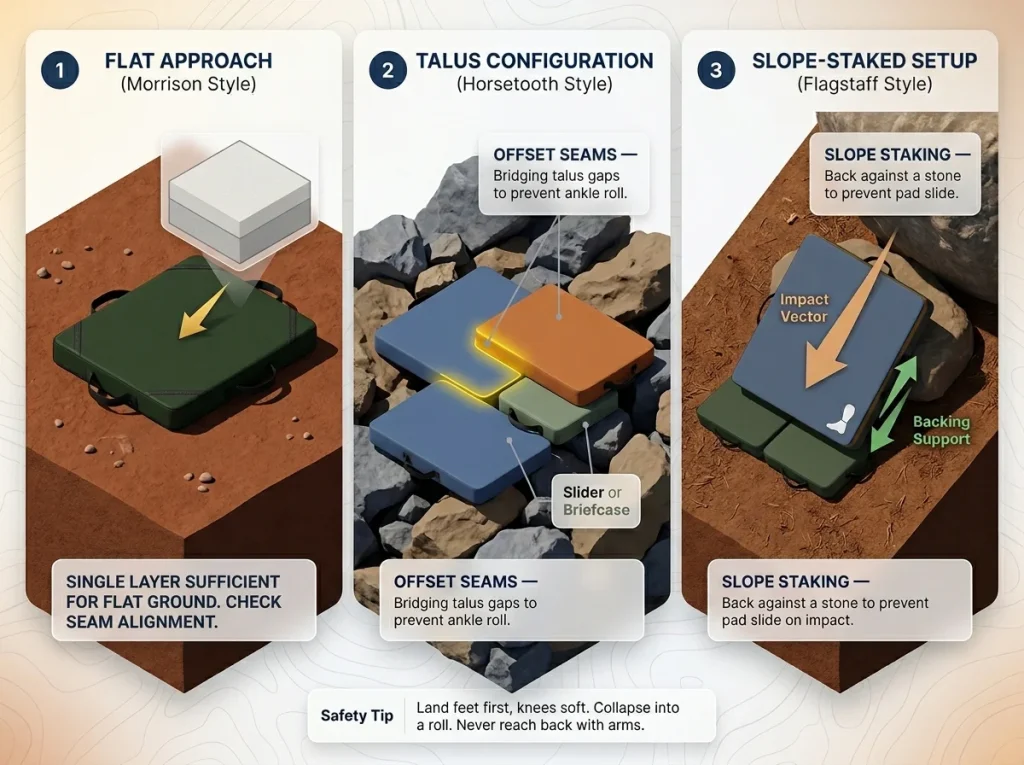
Flat approaches at Morrison and Clear Creek tunnel sectors usually need a single pad — but focus on seam alignment, not just coverage. On talus terrain at Horsetooth’s Rotary Park and Flagstaff’s lower sectors, two pads minimum, and offset the seams. Use briefcase or slider pads to fill gaps and cover rock protrusions. A gap the width of an ankle is still a gap.
Steep slope landings at Flagstaff’s upper boulders add another variable: the pad slides on impact if it’s not backed against something solid or properly weighted upslope. A pad that moves the moment you land it is functionally useless. Back it with a rock, stake it, or position a spotter with a foot on the edge — but solve for pad movement before you pull.
The hard-on-soft rule: soft foam layer always faces the climber, hard foam base faces the ground. Flip a pad by accident and you’ve removed most of its energy absorption.
The Roll Technique and Active Spotting Protocol
Land feet first, knees soft at no more than 90 degrees, then collapse controlled into a roll distributing impact across the largest back surface possible. The failure modes send people to the ER: locked knees on impact, or reaching back with arms to break the fall. Locked knees compress straight into the joints. Outstretched arms fracture wrists. The three bouldering fall mistakes that send climbers to the ER covers exactly these patterns in detail.
Active spotter positioning: stand offset from the anticipated fall line, knees bent, hands ready at hip height. Don’t reach overhead — that puts your arms in the way without giving you control. Communicate before the attempt. Agree on the fall trajectory, the primary spotter zone, and pad coverage. Thirty seconds of real conversation prevents weeks of recovery.
Front Range Logistics: Permits, Closures, and Access Management
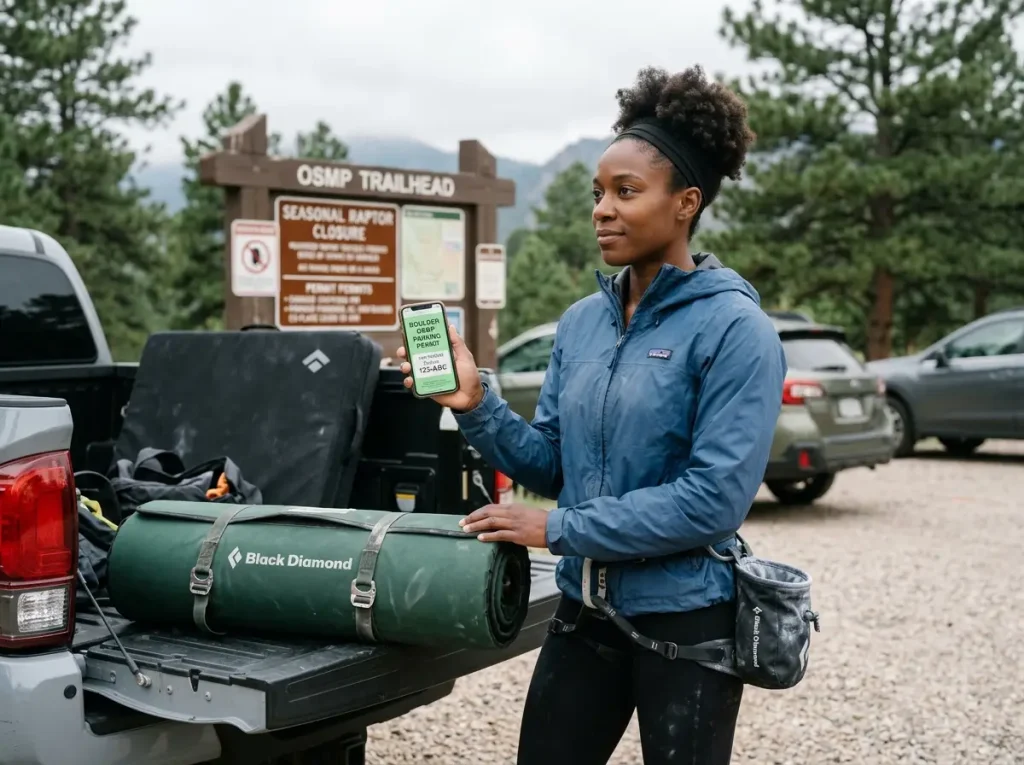
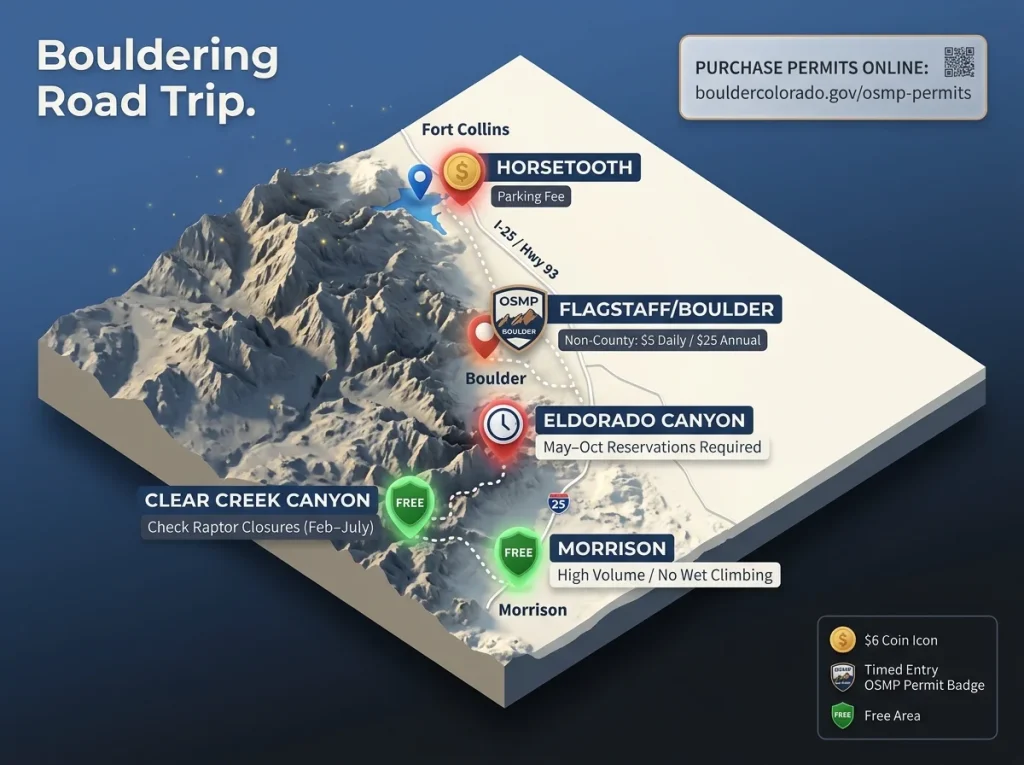
The most common mistake visiting climbers make at Flagstaff Mountain is arriving without an OSMP permit. Non-Boulder County vehicles get ticketed, and towing is possible during peak enforcement. The permit is $5 daily or $25 annually — the annual rate breaks even after five visits and pays for itself immediately for anyone making the Front Range a regular destination. Purchase at bouldercolorado.gov/osmp-permits before you leave home. Walk-in and bike-in access doesn’t require a permit, so the 3-mile bike approach is a genuine option for permit-free half-day sessions.
Horsetooth Reservoir charges $6 for day-use parking — no permit system, but the lot fills by 9 AM on weekends. Eldorado Canyon State Park requires timed-entry reservations on weekends and holidays May through October, on top of the standard park pass.
The Boulder County Parking Permit Puzzle — Solved
The annual OSMP permit breaks even after five Flagstaff visits. If you’re making the Front Range a regular destination, buy it at the start of the season and stop thinking about it. For climbers visiting once or twice, buy the $5 daily permit online before you drive — don’t assume you can sort it out at the trailhead.
The permit covers parking; it doesn’t restrict access by foot or bike. If you’re already in Boulder and want to avoid the permit altogether, the 3-mile bike approach to Flagstaff cuts your access cost to zero and adds negligible time. Most climbers don’t bother because it sounds like extra effort — but a half-hour ride up is also a warmup.
Sandstone Ethics — The Wet Rock Calculus
Fountain Formation at Flagstaff and the Flatirons, and Morrison mudstone near Denver, both absorb water during rain. The internal bonds in the rock weaken through the moisture-penetration zone. A climber pulling on a wet sandstone hold generates shear force the weakened structure cannot resist. Holds snap, and those holds don’t grow back. The USDA Forest Service raptor nesting closure protocols for Boulder Ranger District covers the access closure side, but the wet-rock ethic is about the rock’s survival.
The 24-hour rule is a minimum. After significant rain — more than half an inch — 48 hours is the safe standard. Touch test: press your palm flat to the rock face for five seconds. If you feel moisture, or the surface feels cool and clammy rather than dry, walk away. The science behind the wet sandstone rule at Front Range crags gets into the chemistry of why this matters, for climbers who want more than just the rule.
Pro tip: Check the area-specific raptor closure calendar at boulderclimbers.org before driving out February through July. Eagle Rock alone costs Boulder Canyon climbers full months of the best season in years when they don’t check first.
Conclusion
Three things determine what kind of session you have on the Front Range.
First, rock type is your operating system. On granite and gneiss, excess chalk is the enemy — wipe it off before contact. On sandstone, chalk is a tool — use it and let the rock absorb it. Treat the geology as instruction, not scenery. Knowing which protocol applies before you chalk up separates people who send from people who wonder why they keep slipping.
Second, safety scales with height, not grade. A V1 highball at Flagstaff carries the same impact as an expert problem at the same height. Assess your landing zone before your first attempt every time. Offset pad seams. Brief your spotter on fall trajectory. These aren’t precautions for beginners — they’re what experienced climbers do because they’ve done the math.
Third, access is conditional and earned. Boulder County permits, raptor closures, and wet-rock rules are not bureaucratic inconvenience. They’re the price of keeping these areas open. Pay the permit. Check the closure calendar. Touch the rock before you pull on it.
Pick one area from this guide that’s outside your current rotation. Study the rock type. Go with the right chalk strategy and a pad system that matches the terrain. The Front Range has 1,700+ problems. You have not run out of sends.
FAQ
Is bouldering in Colorado free?
Most Front Range bouldering areas charge parking fees rather than climbing fees. Horsetooth Reservoir costs $6 for day-use parking; Flagstaff Mountain requires an OSMP permit for non-Boulder County vehicles at $5 daily. The climbing itself is free. The access infrastructure is not.
Where is the best place to boulder in the Front Range for beginners?
Morrison Boulders and Clear Creek Canyon tunnel sectors offer the most beginner-accessible problems (V0–V4) with short approaches and defined landing zones. Avoid Flagstaff as a first outdoor destination — the sandbagged grading system will demoralize you before you’ve calibrated your outdoor baseline. Start where the grades are honest.
What is the best month to climb in Colorado or the Front Range?
September through November is the consensus peak season: temps in the 45–60°F range work for all rock types, summer crowds have cleared, and raptor closures have lifted. For year-round climbing, Clear Creek Canyon’s gneiss holds heat well, Nomad Cave stays dry, and Horsetooth’s north-facing sectors handle summer better than most alternatives.
Do I need a permit for Flagstaff Mountain bouldering?
If your vehicle is registered outside Boulder County, yes. Buy it at bouldercolorado.gov/osmp-permits before you arrive. Walk-in and bike-in access does not require a permit. Vehicles without permits risk ticketing; towing is possible during peak enforcement.
Why does chalk work differently at Flagstaff than at Boulder Canyon?
Flagstaff’s mixed geology spans porous Fountain Formation sandstone — where chalk increases friction by roughly 21% — and non-porous Boulder Creek Granodiorite, where excess chalk creates the Ball Bearing Effect and reduces friction. Same mountain, two completely different chalk protocols depending on which boulder you’re standing in front of. Read the rock, not just the grade.
Safety Notice: Rock climbing and mountaineering are inherently high-risk
activities that can involve physical trauma or fatal incidents. The information on Rock Climbing Realms is for
educational and informational purposes only. Techniques and advice presented here are not a substitute
for professional, hands-on instruction. Conditions and risks vary by location. Always seek guidance
from a qualified instructor before attempting new techniques. By using this website, you agree that you
are solely responsible for your own safety. Any reliance you place on this information is strictly
at your own risk, and you assume all liability for your actions. Rock Climbing Realms and its authors
will not be held liable for any harm, damage, or loss sustained in connection with the use of this information.
Affiliate Disclosure: We are a participant in the Amazon Services LLC Associates Program, an
affiliate advertising program designed to provide a means for us to earn advertising fees by advertising and linking
to Amazon.com. As an Amazon Associate, we earn from qualifying purchases. We are also an official affiliate partner
of Black Diamond Equipment via the AvantLink network. If you click on a Black Diamond affiliate link and make a
purchase, we may earn a commission at no additional cost to you. We also participate in other affiliate programs.
Additional terms are found in the terms of service.