
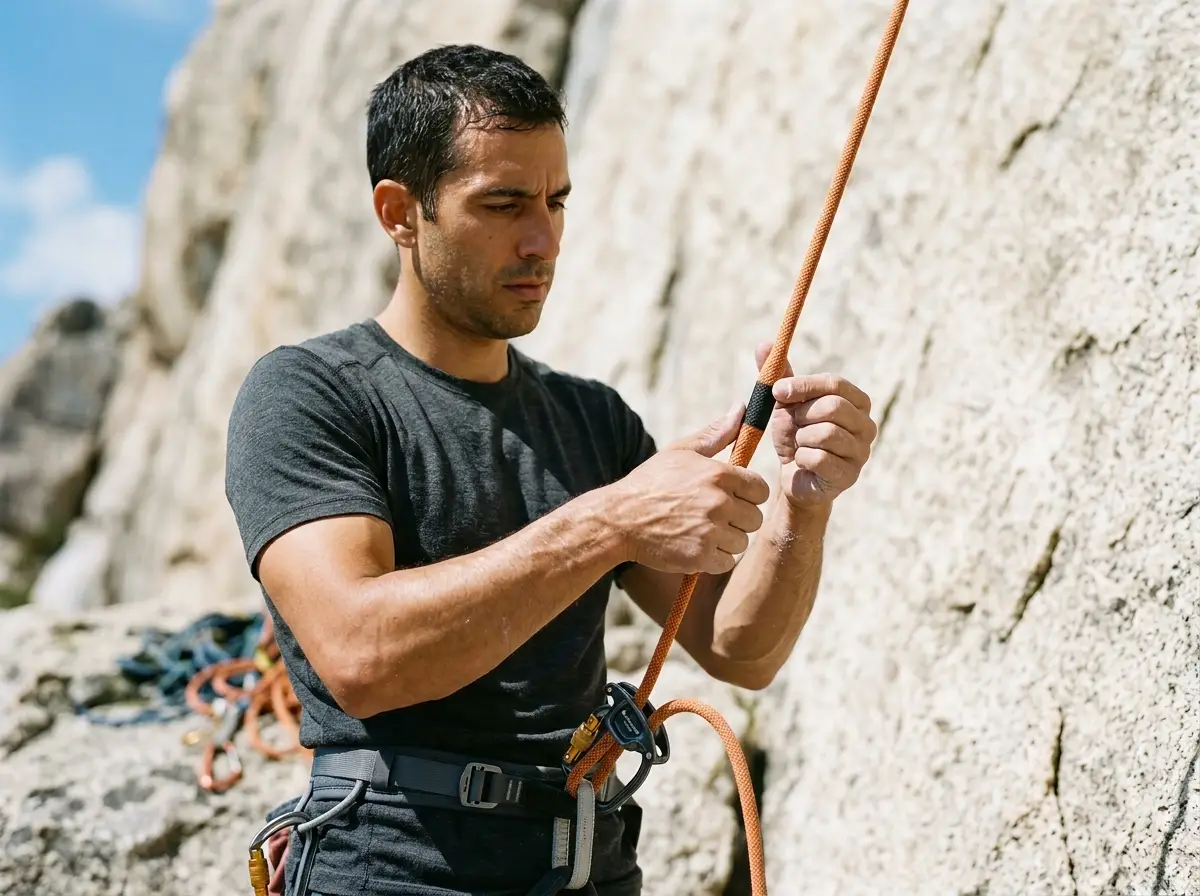
In this article
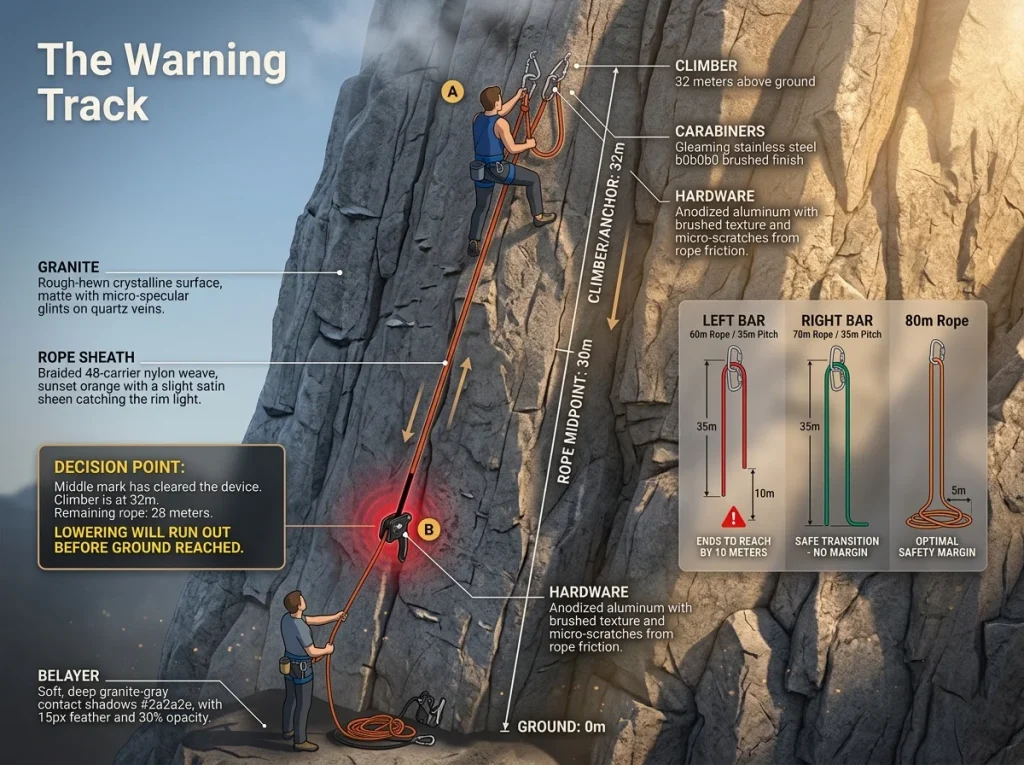
You’re 30 meters up, clipping the last bolt on a route you’ve been projecting for three weekends straight. Your belayer starts paying out slack. Then you hear it — a hesitation in the rope’s feed, a small gasp from below. “Middle!” Too late. The rope runs through before you reach the anchor with enough length to lower. You’re now in a negotiation with gravity at the top of a 32-meter pitch with a 60-meter rope that just ran out of math.
This is the scenario the middle mark exists to prevent. Most climbers know they “should” have one. What they don’t know is why — the exact mechanism by which a black stripe on a rope sheath becomes a genuine life-safety system. This article covers that. The mark’s function in belayer psychology, what a Sharpie actually does to Polyamide 6, what modern break tests show, and why even experienced climbers miss this call more often than the ANAC data should allow.
⚡ Quick Answer: The climbing rope middle mark is a decision-point signal — not a decorative label. When it passes through the belay device during a lower, the belayer knows the rope’s midpoint has cleared the device, meaning the remaining rope may not reach the ground. On pitches over 30 meters, this matters enormously. Use a UIAA-approved, water-based marker like the Beal Rope Marker to mark your rope. Pair the center mark with 10-meter end marks and always tie stopper knots before rappelling. That three-layer system is what guides actually use.
Why the Middle Mark Is a Safety System, Not a Label

The concept comes from baseball. The warning track — that strip of dirt in front of the outfield wall — tells an outfielder running backward that the wall is coming. It doesn’t stop the collision. It triggers a decision. The middle mark works exactly the same way.
When the mark passes through the belay device during a lower, the correct response isn’t to keep paying out rope. It’s to stop, communicate, and force a deliberate decision: can this route be lowered, or does it require a rappel? On a 32-meter sport pitch with a 60-meter rope, the middle passes through the device before the climber reaches the anchor. That’s not a coincidence — that’s the mark doing its job as a decision point.
Most belayers treat the mark as information rather than as an interrupt. There’s a difference. UIAA and AMGA/IFMGA guidance is clear: when the mark hits, stop feeding rope and call it — “Middle! You have less than half the rope left!” Every pitch, every time, regardless of how well you know the route. That verbal call forces conscious processing at the exact moment the belayer’s brain is running on autopilot. The mark works not because it’s visible, but because it breaks the default lowering routine.
The AAC’s ANAC data records “lowering off the end” incidents rising from 6 to 12 per year between 2016 and 2018 — directly tracking the expansion of sport routes into the 30-40 meter range. Understanding belaying fundamentals that make the middle mark meaningful is the prerequisite. The mark is inert without the communication protocol behind it.
I’ve watched experienced belayers blow past the middle mark on 30-meter sport laps more times than I can count — not because they didn’t see it, but because they were already in the rhythm of paying out rope. The mark only works if you’ve trained yourself to treat it like a brake, not a milestone. That habit takes deliberate practice, usually during a low-stakes top-rope session before it becomes automatic on lead.
Pro tip: Think of the middle mark not as a center point but as a “belay device checkpoint.” When it passes through, stop feeding rope and communicate — every single pitch, whether the route is 15 meters or 40.
The chemistry behind how you apply that stripe matters more than most people realize — and shapes everything about which marker you should reach for.
The Chemistry Behind Rope Marking — What Your Sharpie Actually Does
Here’s where most guides give up and say “solvents are bad.” That’s not useful. What actually happens when permanent marker ink hits a climbing rope?
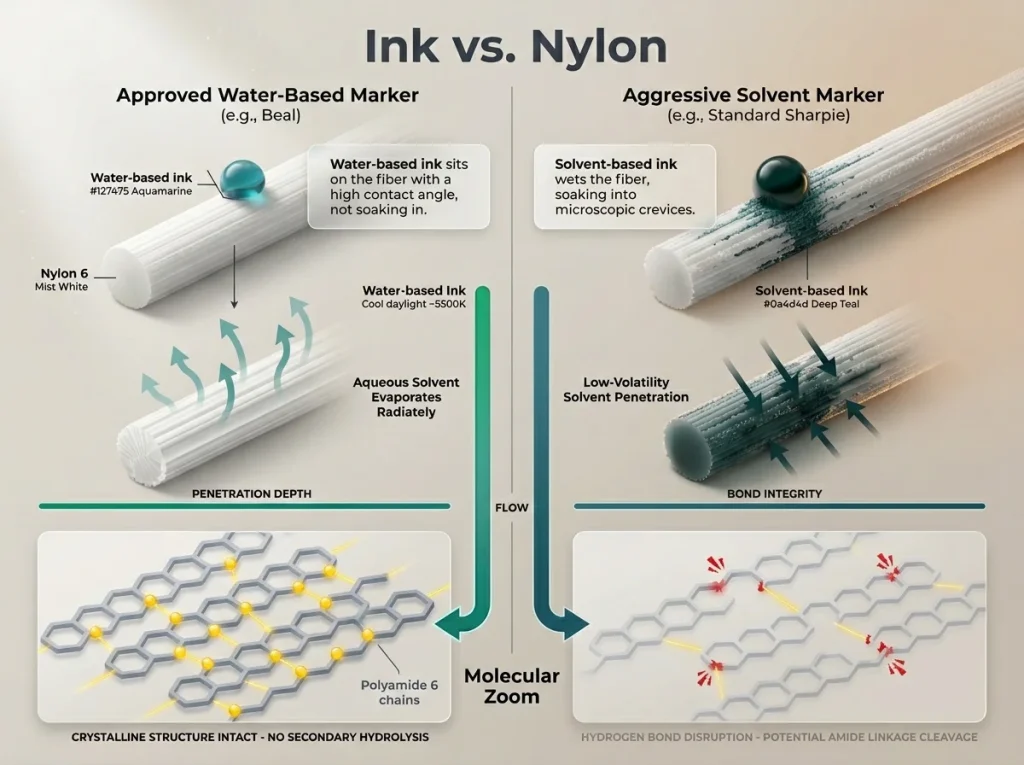
Climbing ropes are built from Polyamide 6 — Nylon 6 — a polymer made of long molecular chains bonded together through amide linkages. Those hydrogen bonds between adjacent chains are what give the rope its ability to absorb energy during a fall. They’re also what certain solvents attack.
Standard permanent markers — Sharpies, Edding pens — use solvent-based ink carrying isopropanol, butanol, or diacetone alcohol. These are polar solvents that can penetrate Polyamide 6’s semi-crystalline structure and interfere with hydrogen bonding between polymer chains. In the worst case — slow-drying, aggressive solvent formulas — this can initiate hydrolysis: actual cleavage of the molecular bonds, which permanently reduces the polymer’s energy-absorbing capacity. Research into polyamide 6 molecular chain degradation via NIST research on polyamide degradation mechanisms confirms this pathway exists under the right conditions.
The 1998 German Alpine Club (DAV) test found reductions of up to 50% in energy absorption when a marked section was placed at the sharp test edge during drop testing. Three marked samples held only 5-7 UIAA falls versus 12-15 for unmarked controls. That sounds brutal. But the headline misses critical context.
Fast-drying inks — which most common markers use — evaporate the solvent within seconds of contact. The solvent leaves before significant chemical penetration of the sheath occurs. The DAV test was also designed to isolate worst-case conditions: the marked section positioned exactly over a sharp edge at maximum load. That specific geometry almost never occurs in actual climbing use.
The deeper problem is variability. Marker formulas are not standardized. A Sharpie from 2005 has a different chemical profile than one from 2024 — manufacturers reformulate without public notice. UIAA’s position isn’t that every marker is a chemical hazard; it’s that no one can guarantee any given marker is safe. That’s a reasonable regulatory stance. Use verified products alongside solid rope inspection and care protocols that complement your marking system.
The chemistry tells you why the rule exists. The break test data tells you exactly how much it matters in practice — and the answer is more nuanced than either camp admits.
The Data — What Modern Break Tests Actually Show
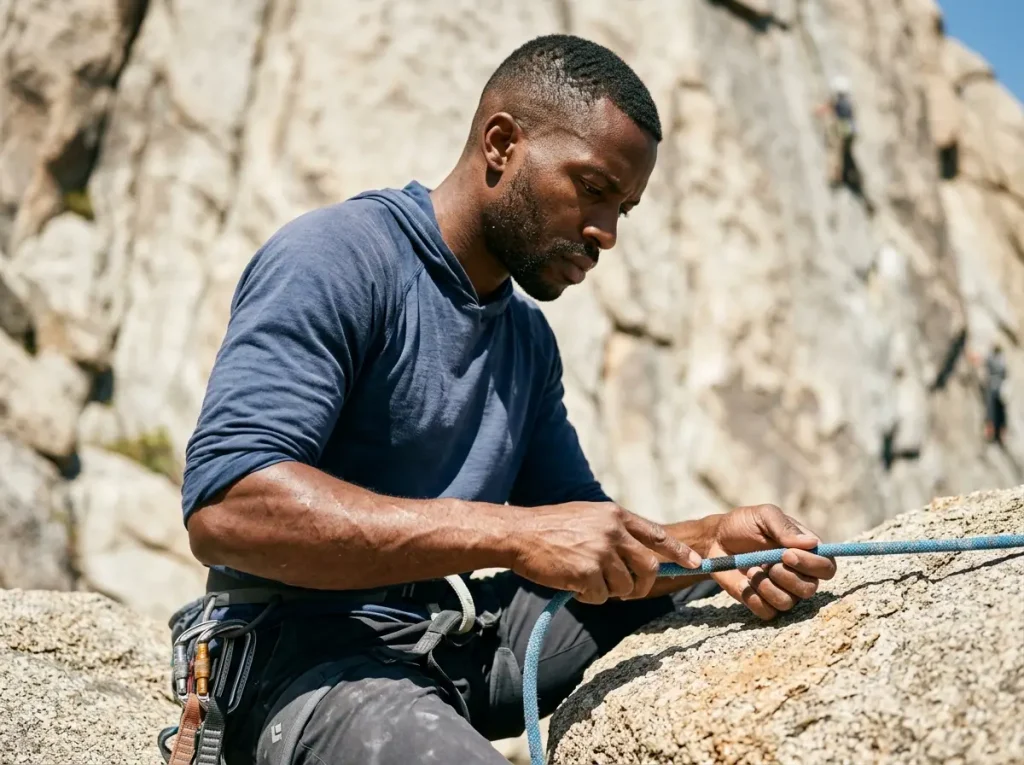
Kolin Powick at Black Diamond’s Quality Control Lab ran the test that matters most: ropes marked with a standard Sharpie, pulled to destruction. Every single rope broke at the knot, not at the mark.
That result is the critical data point. A figure-eight knot reduces rope strength by 20-25%. An overhand knot cuts it by up to 35%. For a middle mark to be the failure point in a real fall, it would need to be degraded below the residual strength of the knotted section — a threshold that standard Sharpie ink, under normal use, doesn’t reach. Rope performance variables that compound with marking decisions like wet conditions and sheath wear add to the picture, but the knot remains the structural weak point regardless.
HowNot2’s 2024 break test data confirmed the same finding. Ropes marked with both standard Sharpies and the specialized Beal Rope Marker failed at the knot in every trial. Neither sample broke at the ink zone. Peak forces were limited by knot failure, full stop.
There’s an important distinction between static tensile strength and dynamic energy absorption. The 1998 DAV tests showed reduced energy absorption — the number of UIAA falls a rope could survive — not necessarily reduced peak static strength. Both data sets matter for a complete picture. But the practical bottom line is clear: under real-world climbing conditions, the risk of rope failure from proper marking is so small it doesn’t register against the documented risk of not marking the rope on a long pitch.
Pro tip: If you’re still uneasy about chemical compatibility, use the Beal Rope Marker. It’s water-based, purpose-formulated for Nylon 6, and officially approved by Beal, Blue Water, New England, and Lanex. It costs under $10 and removes all ambiguity about solvent chemistry.
The original 1998 UIAA notification on rope marking by users remains the primary historical source for this concern — but the 25 years of empirical testing that followed tells a more nuanced story. That nuance matters most when you’re deciding between ink and what seems like the cleaner solution: bi-pattern construction.
Bi-Pattern Ropes and the False Center Trap
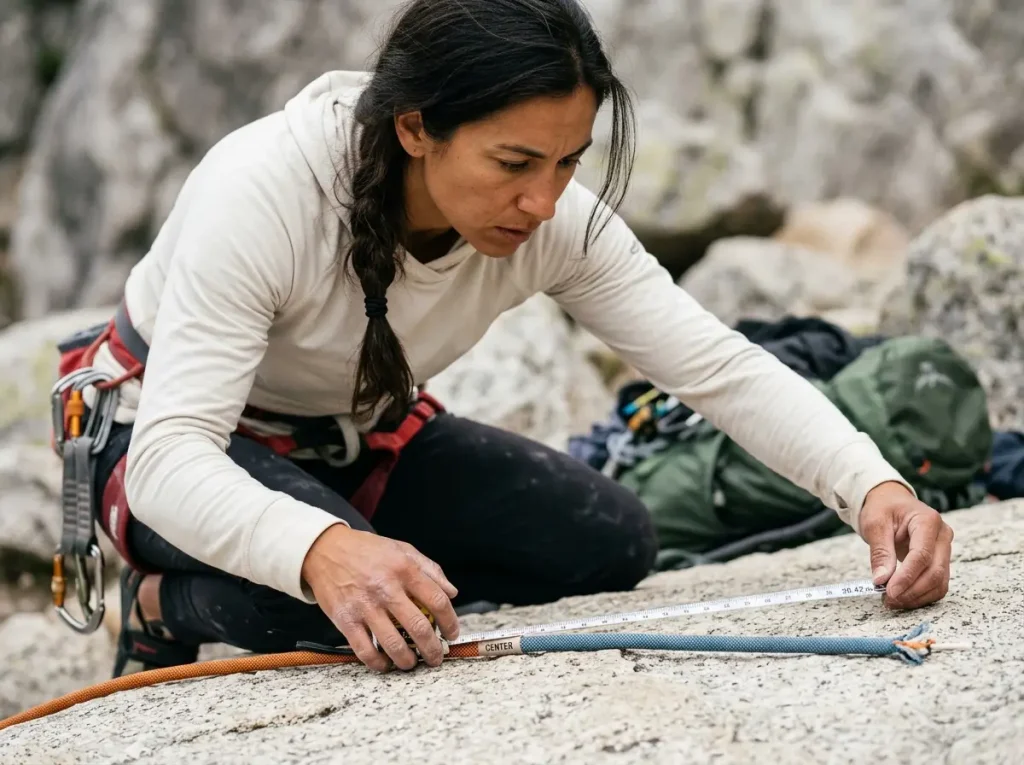
Bi-pattern ropes eliminate the chemical question entirely. During manufacturing, the braiding machine switches bobbins of colored yarn at the midpoint, creating a visible weave change in the sheath. No ink, no solvents, no fading. Most climbers who know about bi-pattern ropes consider the problem solved. It isn’t.
Here’s the failure mode no one explains: the False Center trap.
When you chop 5 meters off one end of a worn rope — which is what you do when the end takes a core shot or frays past usefulness — the bi-pattern change, which originally marked 35 meters on a 70-meter rope, is now 5 meters off-center. If you rig a rappel using that pattern as your midpoint reference, one strand is 5 meters shorter than the other. On a 33-meter rappel, one end reaches the ground. The other terminates 5 meters short.
That’s a ground fall on a rope you trusted completely. The British Mountaineering Council guidance on rope markings and bi-pattern standards confirms that UIAA 101’s ±1% middle mark accuracy requirement no longer applies to the original pattern boundary after cutting.
The very permanence that makes bi-pattern ropes attractive is the mechanism of the hazard. Climbers normalize unconditional trust in the pattern. Then they cut the rope and forget to recalibrate. Think about your climbing partners who’ve “chopped the end” — how many of them checked the new center measurement with a tape before the next pitch?
After any rope cut, treat the bi-pattern change as retired. Tape-measure the new center from both rope ends on a flat surface. Apply a fresh, approved ink mark before the rope goes back into service. How rope diameter and construction choices affect marking decisions is worth understanding before you even choose a rope type.
Pro tip: After any rope cut, measure the true center with a tape measure before you tie any knots. Even 10 centimeters of error matters at 35 meters. Don’t trust your memory of where the old center was.
Whether you’re re-marking after a cut or applying a center mark to a new rope for the first time, the application protocol is where most people cut corners — and where most marks fail before they should.
How to Mark Your Rope — The Technical Protocol
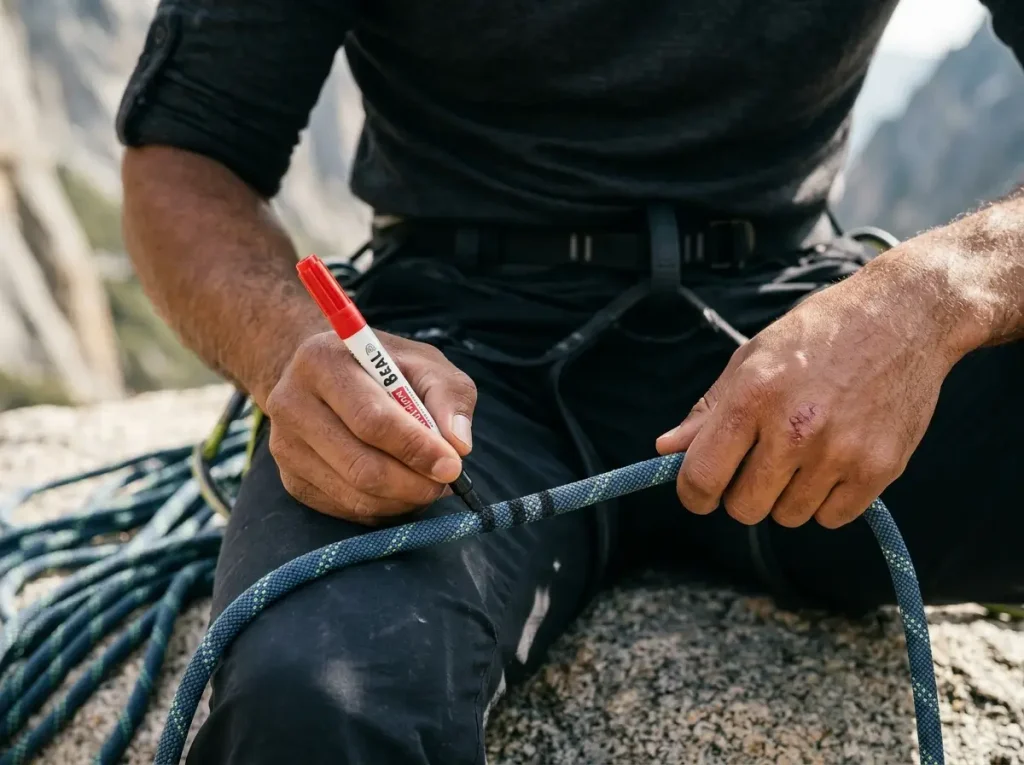
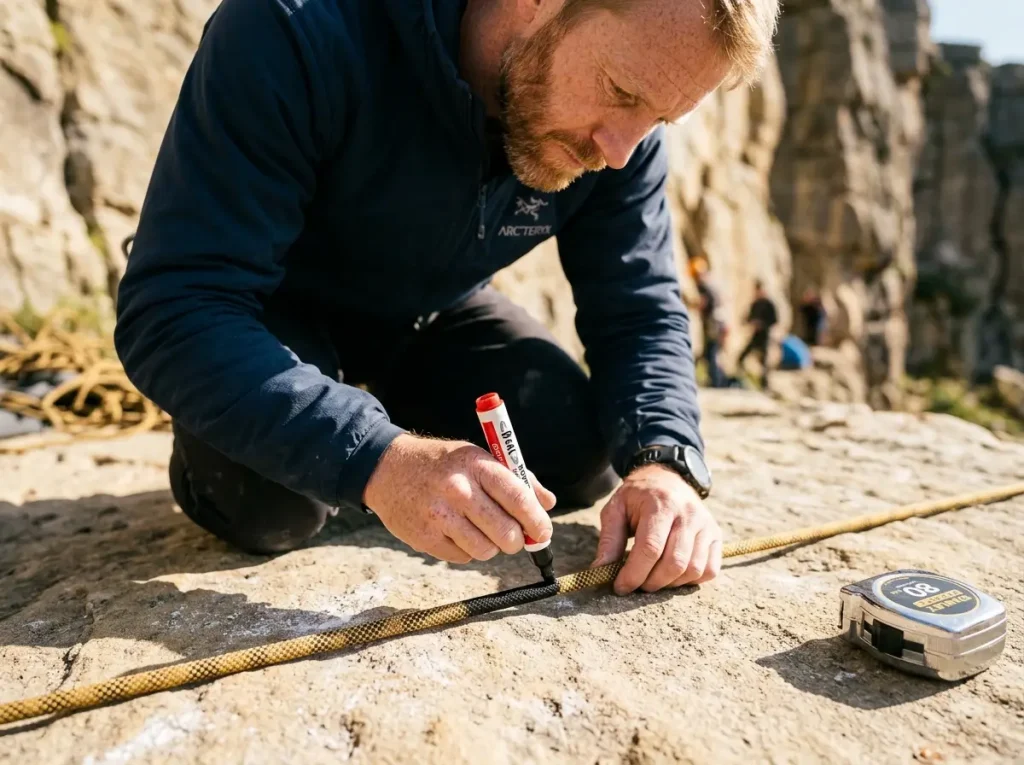
The gold standard for re-marking is the Beal Rope Marker. Water-based ink, Polyamide 6 compatible, no hydrogen bond disruption, no hydrolysis risk. Every time.
Finding true center is simple but worth doing correctly. Fold the rope in half on a flat surface, apply light tension from both ends to equalize core stretch, mark the fold point. Then verify with a tape measure from both ends before applying ink. This takes about three minutes. Do it anyway.
The rope must be clean before you mark it. Aluminum oxide from granite, chalk, and dirt all prevent ink from bonding with the sheath fibers. A light wipe with a damp cloth — no soap — dried fully before marking. The UIAA 101 dynamic rope standard — sheath slippage and middle mark accuracy specifications requires sheath slippage to be less than 40mm after five pulls. On high-use ropes with significant slippage history, measure true center before marking even if the manufacturer’s mark is still visible — the sheath may have migrated from the original factory position.
Apply the mark outdoors. Aqueous inks have trace solvent components, and outdoor application allows rapid evaporation. Mark width matters: 3-5 cm of mark, multiple passes, applied wide enough to be visible at belaying distance. A single narrow stripe disappears at 8 meters of rope between you and the device. Nobody calls what they can’t see.
A three-stripe pattern at center — versus a single bar — creates faster visual recognition during a fast lower. Then add 10-meter end marks using a single stripe — a different pattern from your center mark. When that single stripe passes through your device, you know: 10 meters of rope below you. Hard stop.
This two-warning system — middle mark as decision point, end marks as emergency stop — is what professional guides actually run. Rope washing protocols to maintain mark adhesion and sheath integrity extend the life of the mark. Photograph the mark positions against rope-end measurements in your gear log the day you apply them.
Visual marks do their job on sunlit pitches. They don’t cover everything. For alpine terrain and night descents, there’s a second system that works when ink can’t.
Tactile Marks — Reading the Rope in the Dark
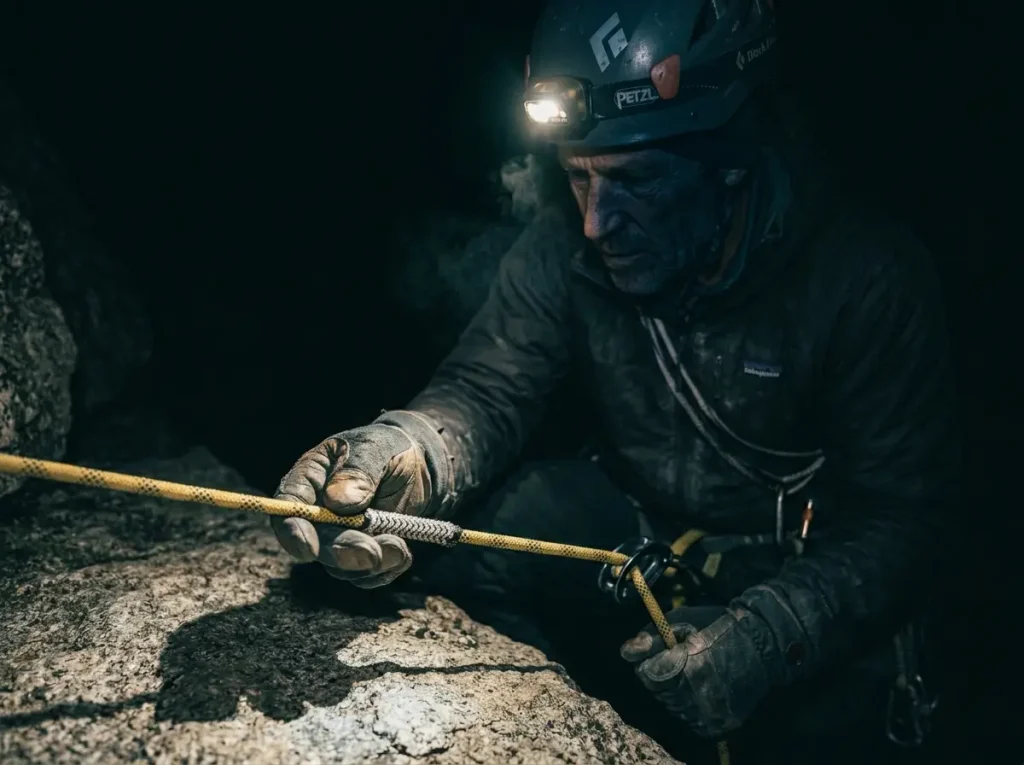
At 3am on a multi-pitch alpine descent, ink is useless. You cannot see it through headlamp glow at any useful belaying distance. This is not a hypothetical. Thread whipping exists precisely to solve it.
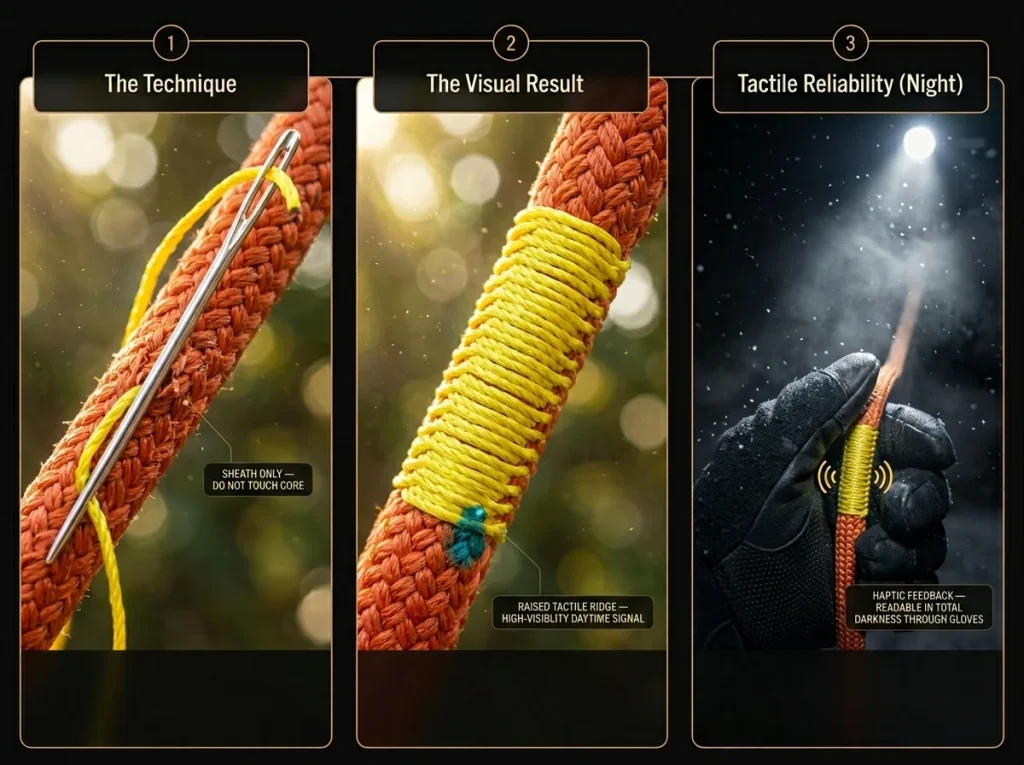
Thread whipping uses a darning needle to weave 2-3 cm of heavy-duty nylon thread through the mantle fibers at the sheath midpoint — without penetrating the core. The core must stay untouched. Thread through the sheath only. The resulting section creates a tactile ridge that reads through gloves, in total darkness, on a snow-covered ledge at altitude.
The haptic inspection signal has a bonus: when the whipped section passes through a GriGri or ATC at speed during a lower, it creates a momentary increase in friction — an audible click or hesitation. The belayer gets a multi-sensory warning even when visual confirmation isn’t available.
Ink fades under UV exposure and abrasion. A well-executed thread whipping persists for years of regular use and can be carefully snipped and removed if the rope is cut and the center shifts. It’s adaptive in a way ink isn’t. Rappelling accidents where low-visibility conditions were a contributing factor are preventable by exactly this kind of redundant system design — one layer compensates when another fails.
The limitation is technique. Practice on a retired rope segment before you touch your primary line. The thread path must weave through the sheath only — core penetration creates a localized stress point that defeats the safety purpose entirely.
The first time I tried thread whipping I was on a headwall after an unplanned bivy, working with cold hands and a headlamp. The ridge was there, but I wasn’t confident I hadn’t touched the core. I spent the next morning re-doing it on a piece of retired rope until the needle path felt automatic before trusting it on my primary line. Learn the stroke first. The mountain will give you plenty of chances to use it.
The gear side of this equation is learnable. The harder problem — the one that accounts for most of the real accident data — is behavioral.
Human Factors — Why Even Experienced Climbers Miss This
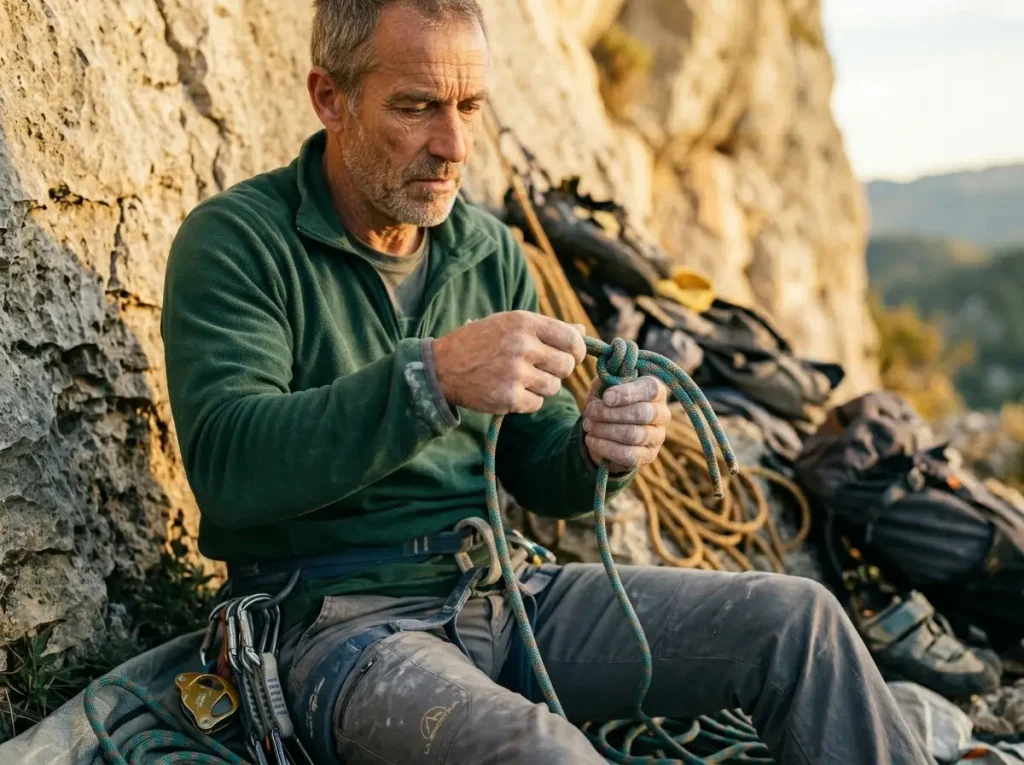
The AAC data is uncomfortable reading. Experienced climbers — 10+ years — account for 40% of climbing fatalities. That’s not incompetence. That’s the mechanics of risk normalization.
When a climber lowers a partner without checking the middle mark and nothing goes wrong, the brain’s threat-assessment system quietly downgrades the perceived hazard of that behavior. Do it twenty times with no consequence and the behavior is effectively invisible. It has been normalized into the background of automatic actions. Then comes the borrowed rope, or the new crag, or the 35-meter pitch they didn’t measure before racking up. The heuristic fails without warning.
Decision fatigue compounds this. ANAC data shows accident clustering at end-of-day and summit transitions — exactly when cognitive resources are depleted and shortcuts dominate. The middle mark works here because it requires near-zero cognitive processing. You see it, you stop, you call it. No calculation required. The information bypasses fatigued reasoning and triggers a reflex response — but only if that reflex is trained.
Belayer error statistics and what the AAC data actually shows makes for sobering reading in this context. The borrowed-rope failure mode is particularly common: veterans who “know their routes” make assumptions about rope length that fail silently when the line they’re using has been shortened by a previous owner.
Stopper knots are the layer that catches what the mark misses. AAC research indicates stopper knots could prevent roughly 90% of belay-related lowering deaths. In AMGA/IFMGA guiding, stopper knots in both rope ends before every rappel and lower are non-negotiable. They are not a sign of paranoia. They are the definition of a closed system.
The full stack looks like this: rope integrity (UIAA-certified, maintained, not degraded) → proactive rope management (visible middle mark, 10-meter end marks, verbal “Middle!” call) → physical fail-safe (stopper knots in both ends). Each layer compensates for a specific failure mode in the others. The mark fails if it fades; the stopper knots catch what the mark misses. Safer climbing through understanding the Swiss Cheese Model is the framework that explains why all three layers are required — any single layer has holes; the stack doesn’t.
Pro tip: Before any multi-pitch session, spend 10 seconds confirming the middle mark is visible at belaying distance — arm’s length of rope between you and the mark, standing at your normal belay stance. If you can’t see it clearly, re-mark it before you leave the car.
Conclusion
Three things to take away from this.
The middle mark is a decision trigger, not a decoration. When it passes through your belay device, stop feeding rope and communicate — every single pitch, regardless of how well you know the route. The communication protocol is the safety feature. The mark just forces the moment.
Chemistry matters, but the risk math is clear. Use a UIAA-approved, water-based marker like the Beal Rope Marker. The practical risk of rope failure from proper marking is near zero. The risk of a fatal lower without a visible mark is documented, rising, and preventable.
The mark is only as good as your system. Pair it with stopper knots, 10-meter end marks, and a verbal protocol on every descent. These aren’t three separate habits — they’re one integrated system where each component covers the failure mode of the others. Redundancy built that way isn’t paranoia. It’s how you make it back to the car consistently.
The next time you flake your rope at the base of a route, take 10 seconds to confirm the middle mark is visible and centered. If it’s faded or missing, re-mark it before the session. Not this weekend. Now.
FAQ
Can I use a Sharpie to mark my climbing rope?
A standard Sharpie is strongly discouraged by UIAA and most rope manufacturers. Its solvent formula varies between production runs and may initiate chemical degradation of Polyamide 6 under worst-case conditions where the marked section coincides with sharp-edge loading. In modern break tests — Black Diamond QC Lab and HowNot2 2024 — Sharpie-marked ropes have not failed at the mark. But the safety margin reduction documented in the 1998 DAV tests is real, and the variability problem remains. Use the Beal Rope Marker instead: water-based, Nylon 6 compatible, purpose-tested, and under $10.
Why do climbing ropes have a middle mark?
The middle mark serves two primary functions. First, it equalizes both strands during a rappel, ensuring each side reaches the anchor equally. Second, it warns the belayer during a lower that the rope midpoint has passed through the device — signaling that the remaining rope may be too short to safely complete the lower. On routes exceeding 30 meters, that second function becomes critical lead climbing systems infrastructure, not an optional convenience.
How do you find the middle of a rope without a mark?
Fold the rope in half on a flat surface, apply light tension from both ends to equalize core stretch, and mark the fold point. Verify with a tape measure from both rope ends before applying any ink. On bi-pattern ropes that have been shortened, never use the pattern change as a proxy for center after cutting — always measure from both ends to confirm true midpoint.
Does marking a rope weaken it?
Under real-world conditions, properly applied marks — especially water-based products like the Beal Rope Marker — do not weaken a rope to any degree that affects safety. All documented modern break test data shows ropes failing at the knot, not at the mark. The 1998 UIAA warning is based on a sharp-edge stress concentration scenario that does not replicate normal climbing use. The risk of not marking your rope and missing the middle during a long lower vastly exceeds the risk of the mark itself affecting performance.
How long does a rope middle mark last?
An ink-based mark lasts 1-3 seasons depending on use frequency, UV exposure, cleaning habits, and abrasion level. Thread whipping lasts multiple years. Factory bi-pattern marks are permanent but become unreliable after cutting. Inspect your mark before every multi-pitch session — if visibility drops below 5 cm at your typical belaying distance, re-mark it with approved ink before the session. PPE inspection includes checking the functional visibility of your marks.
Safety Notice: Rock climbing and mountaineering are inherently high-risk
activities that can involve physical trauma or fatal incidents. The information on Rock Climbing Realms is for
educational and informational purposes only. Techniques and advice presented here are not a substitute
for professional, hands-on instruction. Conditions and risks vary by location. Always seek guidance
from a qualified instructor before attempting new techniques. By using this website, you agree that you
are solely responsible for your own safety. Any reliance you place on this information is strictly
at your own risk, and you assume all liability for your actions. Rock Climbing Realms and its authors
will not be held liable for any harm, damage, or loss sustained in connection with the use of this information.
Affiliate Disclosure: We are a participant in the Amazon Services LLC Associates Program, an
affiliate advertising program designed to provide a means for us to earn advertising fees by advertising and linking
to Amazon.com. As an Amazon Associate, we earn from qualifying purchases. We are also an official affiliate partner
of Black Diamond Equipment via the AvantLink network. If you click on a Black Diamond affiliate link and make a
purchase, we may earn a commission at no additional cost to you. We also participate in other affiliate programs.
Additional terms are found in the terms of service.