
In this article
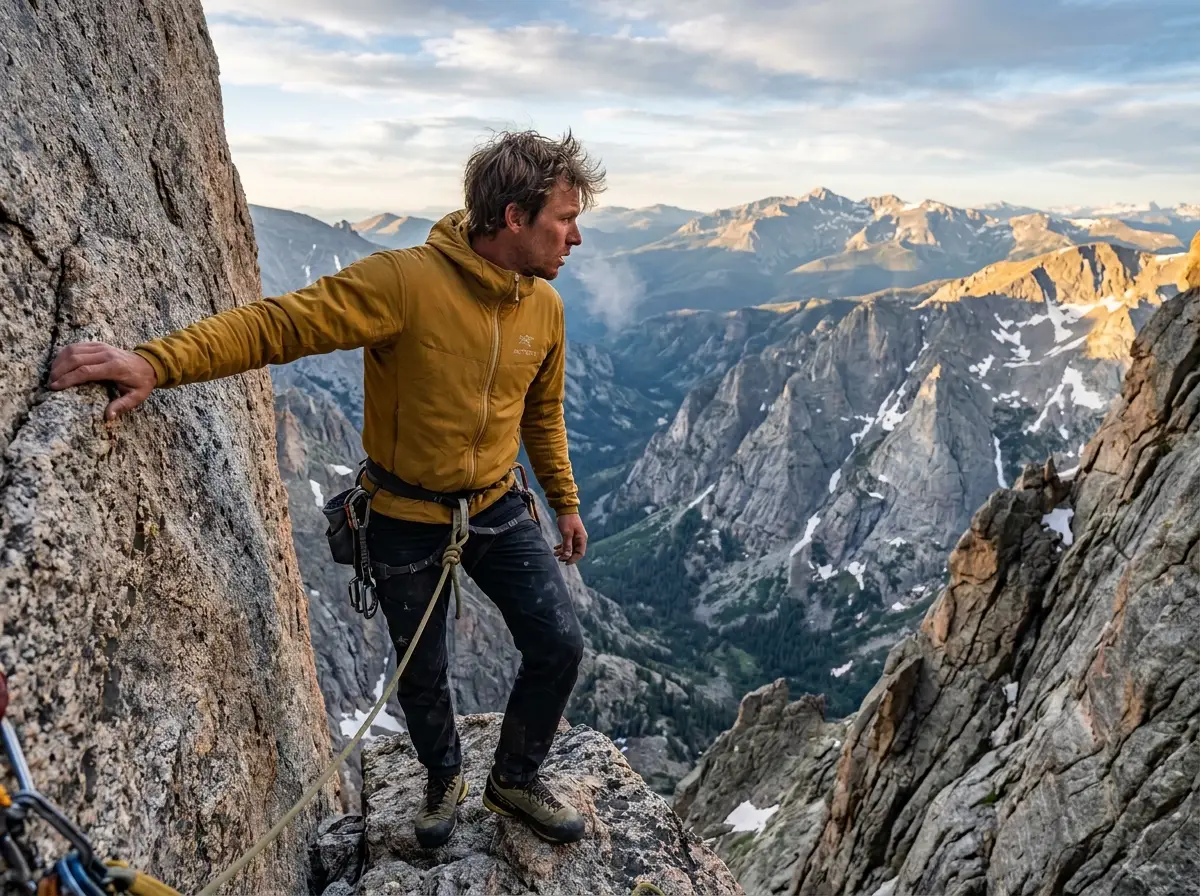
The descent was supposed to take three hours. By the time fatigue had settled into the quads, the Keyhole was gone. Not hidden — gone. The climber scanning the ridge had taken the wrong notch. The false one, sitting higher on the northwest face, looking almost identical to the real thing when your brain is running on six hours of broken sleep and 60% of the oxygen it needs. Below that false notch: 5th-class terrain and 1,000 feet of open air. That is where the 2008 Ledges incident began. Not with a storm. Not with darkness. With a decision made by a depleted mind that was absolutely certain it was making the right call.
I’ve spent years studying accident reports on this mountain. The pattern is always the same. The longs peak keyhole route doesn’t claim people on the way up. It claims them on the way down, when they’ve already stopped thinking.
This guide treats the Keyhole Route as the high-consequence alpine objective it actually is — not the “difficult hike” that most popular blogs print. Fifteen miles round trip, 5,000 feet of gain, Class 3 rating, trailhead at 9,405 feet, summit at 14,259 feet. Those numbers mean something. By the time you’re done reading, you’ll know what.
⚡ Quick Answer: The Longs Peak Keyhole Route is a 15-mile round trip, 5,000-foot gain, Class 3 alpine scramble — not a hike. Start between midnight and 3 AM to summit by 10 AM and descend all technical terrain before afternoon thunderstorms hit. The most hazardous moments happen on the descent, not the climb. Wear approach shoes (not hiking boots), carry a UIAA-rated helmet for the Trough, know your AMS turn-around triggers, and pre-commit to your turn-around time before you leave the trailhead. Two-thirds of the 80+ recorded incidents on this mountain are traumatic falls — most on the way down.
The Statistical Reality: Why This Route Claims Experienced People
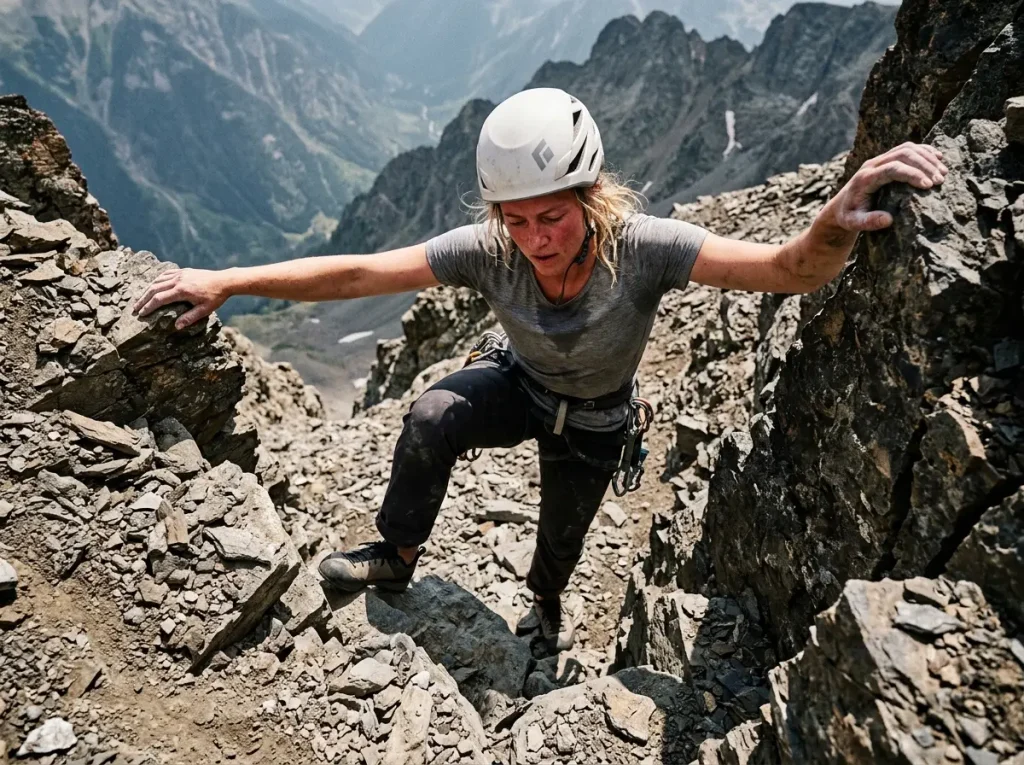
Between 1915 and 2024, Rocky Mountain National Park recorded 80 fatalities on Longs Peak. Sixty-six percent of them — the overwhelming majority — were traumatic falls. Not lightning. Not cardiac events. Falls. On Class 3 terrain that most climbers describe as “manageable” when they’re fresh at 5 AM, and then navigate completely differently at 1 PM with glycogen-depleted legs and a hypoxic brain calling every shot.
The mountain draws 7,000 to 10,000 summit attempts every year. Average it out and you get roughly two fatalities annually. That ratio sounds low until you start reading the American Alpine Club accident report analysis and notice who the victims actually are. Intermediate outdoor recreationists are disproportionately represented. People who’ve done other 14ers. People who hiked regularly. People who thought they knew what they were getting into.
That’s the thing nobody tells you about the technical threshold on Longs. The Keyhole — that notch in the northwest ridge visible from the Boulderfield — is not just a geographic marker. It’s a transition point. On the east side of that notch, you’re hiking. On the west side, you’re climbing. The movement changes, the consequence of a slip changes, and the demands on your decision-making change. The mountain doesn’t care if you’ve done 30 other 14ers. It cares what your brain is doing at 2 PM after a 3 AM start.
The Descent Trap: Why Post-Summit Is the Hazard Zone
Accident analysis from the NPS and the AAC shows a consistent pattern: accidents cluster between 11 AM and 2 PM, long after the summit push. Descending requires eccentric muscle contractions — your quads are braking against gravity on every step, which is more neuromuscularly taxing than going up, and more prone to failure when you’ve burned through your glycogen reserves.
Layer hypoxia on top of that. At 14,259 feet, unacclimatized climbers experience measurably reduced information processing and higher error rates in motor tasks. Add sleep deprivation from a mandatory 3 AM start, and the PMC research on sleep deprivation and altitude hypoxia synergy documents what most guides only describe anecdotally: the combination hits harder than either variable alone. You get “micro-lapses” — brief neurological blanks lasting under a second — that are the actual mechanism behind most descent stumbles. You’re not being careless. Your brain is briefly offline.
Set an alarm at the summit. When it rings, you turn around. No debate, no “we’re so close,” no conditions negotiation. The alarm goes off and you move.
A good habit before you start: run through a structured risk assessment before committing to Class 3 terrain the night before. Not on the mountain. At camp, when you’re still rational.
The False Keyhole Trap: Navigational Parallax on the Ridge
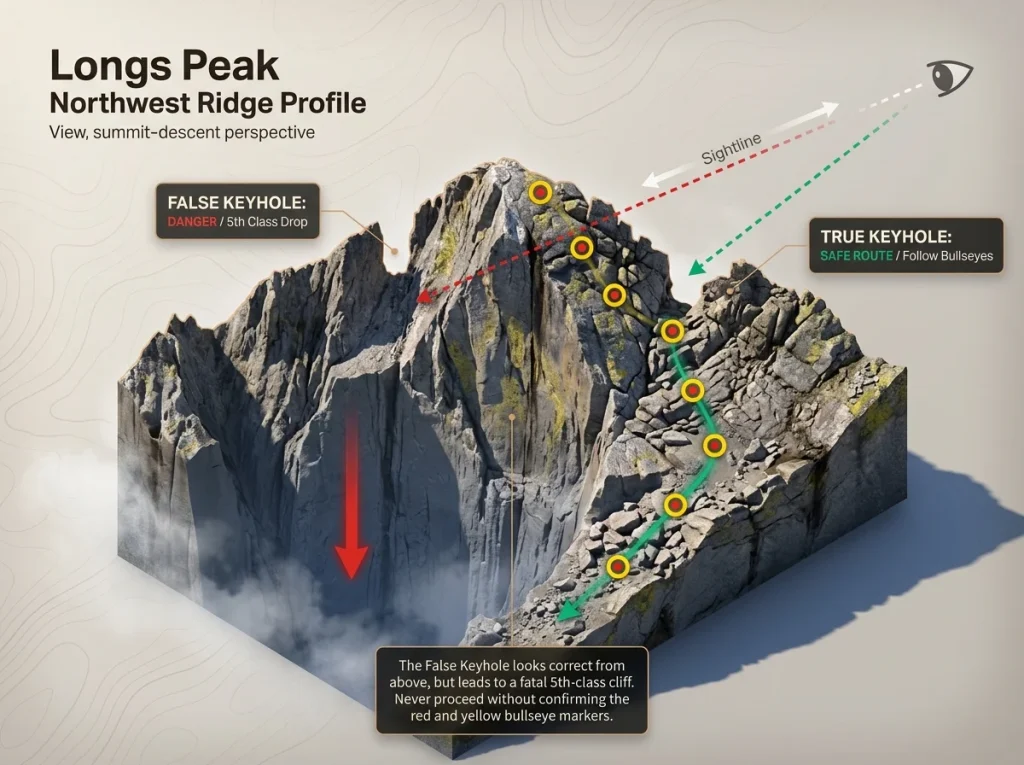
The False Keyhole is a notch higher on the northwest ridge that looks nearly identical to the true Keyhole when you’re looking at it from the summit side on the way down. During the ascent, you approach the true Keyhole from below and to the east. During descent, that spatial relationship reverses, and a fatigued brain with compromised information processing matches the notch to the wrong memory.
Below the False Keyhole: 5th-class terrain. Unroped falls there are uniformly fatal. The only defense is the red-and-yellow bullseye markers painted on the rock. If you’re losing visual contact with them for more than three consecutive markers, stop. Do not continue in a direction that “looks right.” Retrace to the last confirmed bullseye. That’s the whole protocol.
The NPS incident report on the 2008 Ledges fatality is worth reading in full before you go up. Not for motivation. Because understanding exactly how that sequence of errors happened is the closest you can get to inoculating yourself against making the same ones.
Sectional Beta: The Four Technical Zones Beyond the Keyhole
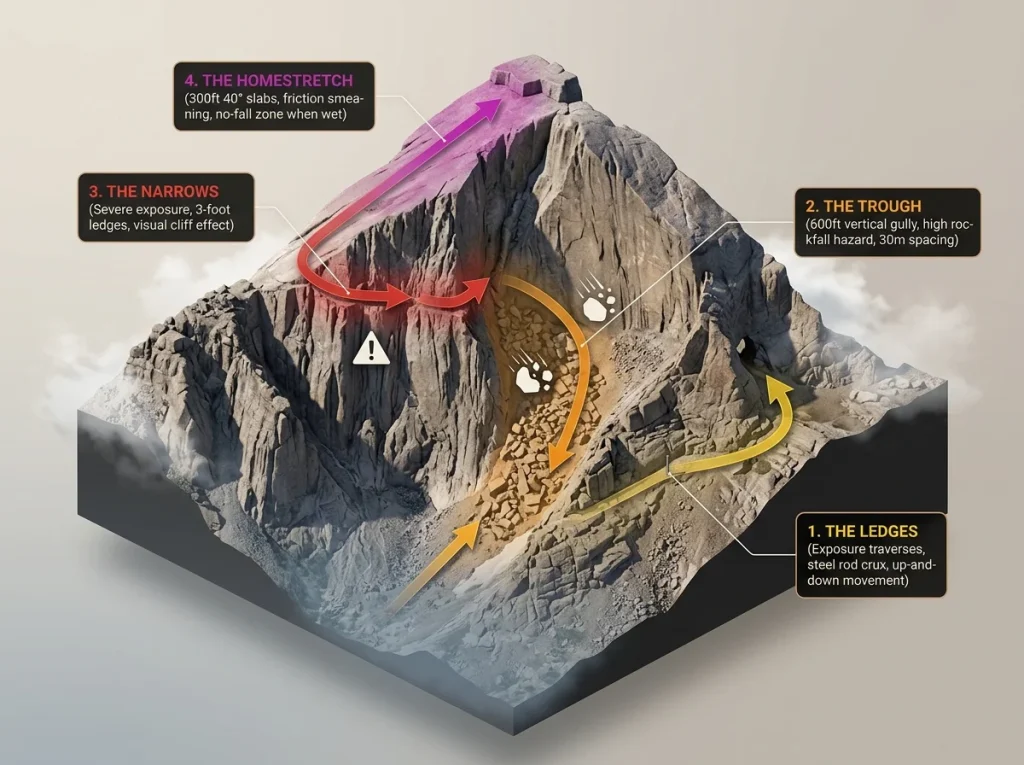
Past the Keyhole, the route enters four technically distinct sections: the Ledges, the Trough, the Narrows, and the Homestretch. Each has a specific movement pattern, a specific objective hazard, and a specific way it tends to go wrong. The elevation gain above the Keyhole is roughly 1,000 vertical feet of Class 3+ terrain. The whole thing is marked with bullseye paint. Losing those markers is the most common precursor to a fatal navigation error.
The three-point contact rule applies across all four sections. Three limbs anchored before moving the fourth. It sounds obvious. It stops being obvious when you’re 1,000 feet above Glacier Gorge and your legs are shaking.
The Ledges: Exposure Management and the Technical Deviation
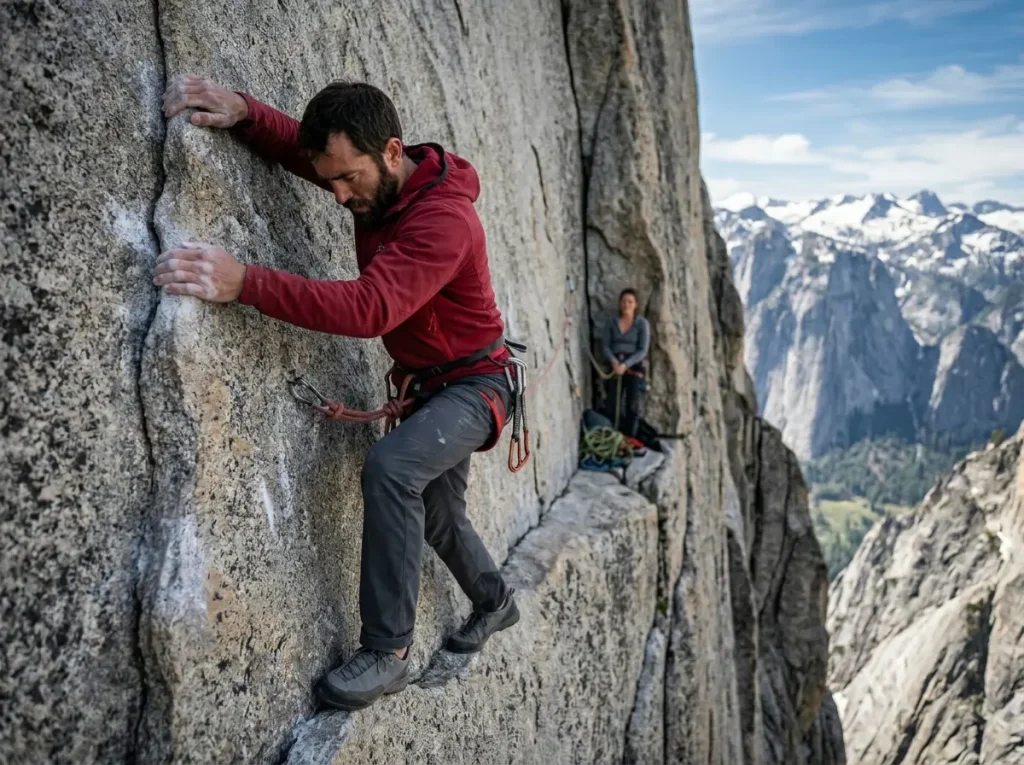
The Ledges are a traverse across the western face with Glacier Gorge dropping 1,000 feet below your feet the whole way. One-third through, the route does something that catches almost everyone off-guard: it climbs about 50 vertical feet upward before descending 100 feet to reach the base of the Trough. That up-and-over move is easy to miss when you’re tired, and skipping it puts you on horizontal terrain that gets dangerously loose, fast.
There’s a steel rod bolted into the rock at the highest-exposure point. Some guides use it as a quick belay anchor for clients who are struggling psychologically with the drop. If you’re soloing and you find yourself at that rod with your hands shaking, lean into the wall — not away from it. Every instinct you have will try to pull you backward. That’s the fear response talking. Leaning away from the wall reduces the friction your shoe has on the rock, which makes slipping more likely, which makes you more afraid, which makes you lean further out. The feedback loop runs the wrong direction fast.
Pro tip: At the steel rod on the Ledges, face the wall. Press your hips in. Breathe before you move. The vestibular system is noise on exposed terrain — your shoe rubber is signal.
The Trough: Rockfall and Why Your Helmet Is Non-Negotiable
The Trough is a 600-foot vertical gully of unstable talus. It’s also the most consistent rockfall hazard on the route — the gully shape funnels dislodged rock downward, and the traffic volume means someone above you is always moving.
A 5-kilogram piece of granite dislodged from the top of the Trough reaches roughly 20 meters per second before it impacts a climber — around 1,000 joules of kinetic energy. Skull fracture thresholds start at about 100 joules. If you’re still debating whether to bring a helmet, that number settles it. You want a UIAA EN12492-rated helmet — not a bike helmet, not a construction hard hat — specifically rated for overhead rockfall. Understanding helmet impact ratings before entering the Trough is not optional, and the tribological research on rubber-granite friction in contaminated conditions backs up the physics on both footwear and impact protection.
Space out 30 meters minimum between party members. When ascending, stay climber’s right. When descending parties are coming through, wait in a protected alcove — not in the middle of the funnel. The crux of the Trough is a 30-foot section of steeper, solid rock at around 13,700 feet. That’s your last reasonable turn-around assessment point before the serious exposure starts.
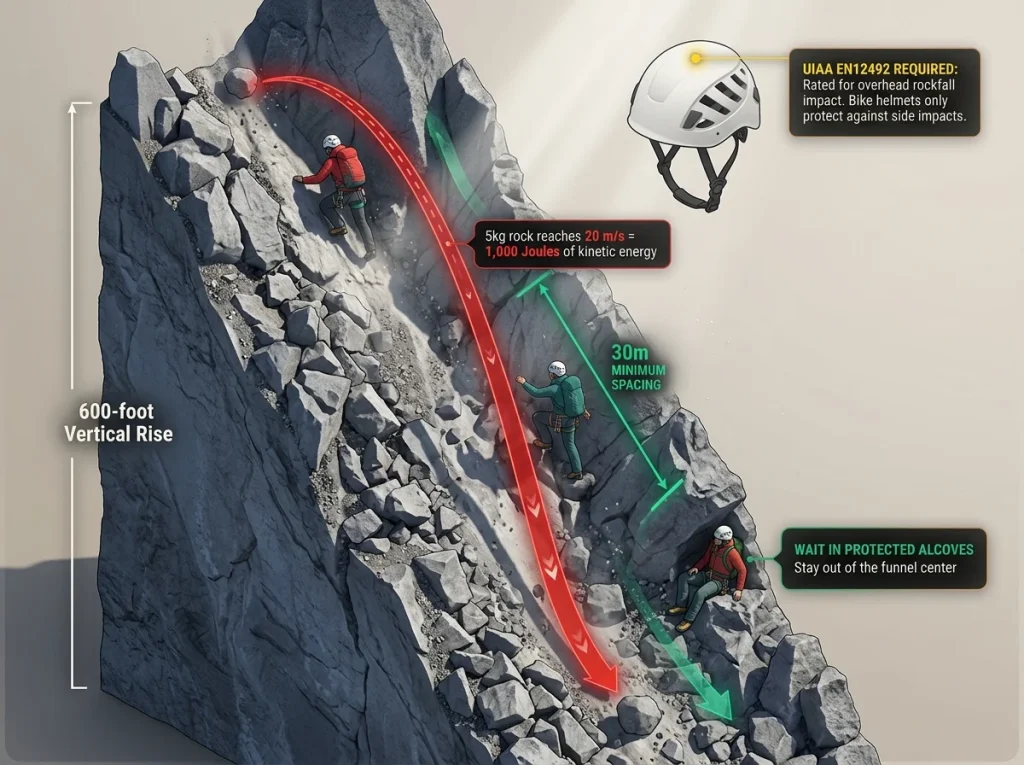
Pro tip: “Deliberate step-loading” in the Trough means test every stone before committing your weight. Press down with one foot, feel for the gravel underneath. A “floating” rock on a gravel underlayer will slide the moment it takes your full bodyweight — and the person below you is in the fall line.
The Narrows: The Visual Cliff Effect
The Narrows cross the south face at widths that get under three feet in sections. The drop into the basin below is vertical and very far down. This triggers what’s called the Visual Cliff Effect — a biological fear response to extreme verticality that causes over-gripping. When you over-grip, your forearm muscles fatigue rapidly, fine motor control degrades, and your movement quality drops at exactly the moment you need it most.
The counter-move is simple but hard: breathe deliberately, and focus only on the next three feet of terrain in front of you. Not the drop. Not the exposure. The next foot placement. Guides teach this because it works — it narrows your attention bandwidth enough to process the movement without the cognitive load of the full exposure.
There’s one specific move near the Narrows exit that every trip report describes as “terrifying in a photo but manageable in person.” That’s accurate. The visual is worse than the actual movement. Lean slightly into the mountain. Five degrees of outward lean shifts your weight away from the rock contact zone and reduces shoe friction. Five degrees sounds small until you’re on a three-foot ledge above significant air.
No exposure problem in alpinism is ever solved by staring at it.
The Homestretch and Descent: Slab Mechanics on Silver Plume Granite
The Homestretch is a 300-foot push on polished Silver Plume granite slabs at roughly 40 degrees. The primary technique is smearing — maximizing the rubber surface area in contact with the rock. There are no defined edges. You’re relying entirely on adhesion between your rubber compound and the granite micro-texture.
On dry granite, the static friction coefficient for quality climbing rubber runs between 0.90 and 1.15. On wet granite — after even a brief afternoon snow squall — it drops to 0.45 to 0.55. On verglas, it’s around 0.15. That’s not a subtle reduction. Wet Homestretch is a no-fall zone. If moisture hits that slab, a slip doesn’t stop until the Narrows.
Temperature matters too. Cold rubber at a 3 AM start is stiffer and loses the compliance properties that generate adhesion. This is why the Homestretch actually gets more tractable as the sun warms the rock — another argument for the midnight start. For climbers wanting the full technical picture on smearing mechanics and rubber compliance under load, that guide breaks down the rubber-rock interface in useful detail.
Descending the Homestretch: most experienced climbers either face the rock and down-climb, or use a crab-walk to lower the center of gravity. Leave the trekking poles stowed. They interfere with hand balance on smooth slabs and give you false confidence on terrain where your hands are the primary anchor system.
Gear Engineering: What You Need vs. What Everyone Else Brings
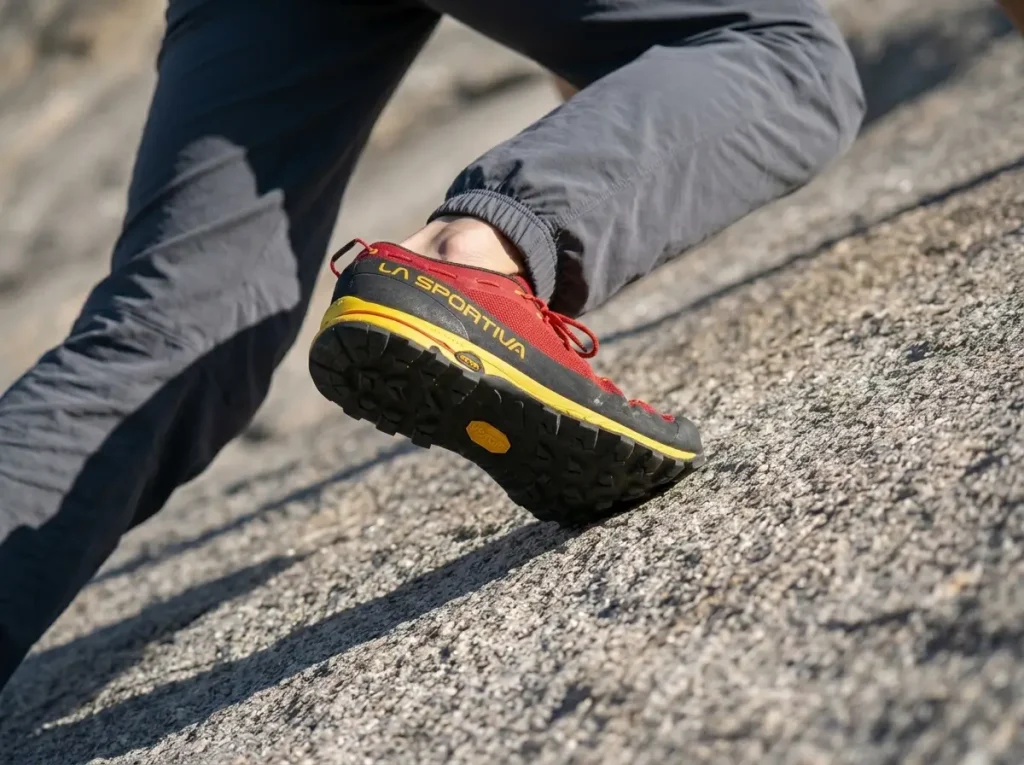
Footwear is the single most important technical variable on this route. Standard hiking boots are too clunky for the precision the Narrows requires and don’t have the rubber adhesion the Homestretch demands. Approach shoes — the hybrid between a hiking boot and climbing shoe — are what guides and experienced scramblers bring.
The two rubber compounds worth understanding are Vibram Megagrip and Vibram Idrogrip. Megagrip balances wet and dry performance and holds up better on abrasive approaches. You find it on the La Sportiva TX4 (1 lb 10 oz, best for heavier loads) and the Arc’teryx Konseal (1 lb 6 oz, waterproof, good lateral support for early-season snow approaches). Idrogrip was originally designed for fly fishing — it offers superior wet adhesion on technical rock, but it wears faster on dry, gritty approaches. The La Sportiva TX2 Evo (1 lb 4 oz) runs Idrogrip and is the choice for technical scrambling days when you know the approach will be bone dry. Check the RMNP official gear requirements for Longs Peak for the current season’s specific recommendations.
Before you drive to Estes Park, do this test: put the shoes on and stand on a 30-degree wet slope. If you’re sliding on a damp parking lot curb, the rubber is wrong for the Homestretch. Break them in on at least two local Class 2-3 sessions first. Cold, stiff leather on the Homestretch is a liability, not just discomfort.
Pro tip: Break in approach shoes on terrain with similar angles to the Homestretch. The rubber needs to have flex memory before it hits 40-degree polished granite at altitude.
The Helmet Decision: Not a Recommendation, A Systems Requirement
UIAA EN12492 certification is required — not suggested. The rating covers overhead rockfall impact (not just side impacts, which is all a bike helmet tests for). EPS foam helmets are light and widely available, but they’re one-impact-use items. Any significant strike deforms the foam internally in ways that aren’t visible. Inspect after impact; replace if in doubt.
Fit matters: a loose helmet at 14,000 feet, rotating on impact, gives you roughly the same protection as no helmet. The strap should be snug under the chin with no slack. Check helmet construction and EPS vs EPP impact ratings for the full comparison of hardshell, foam, and hybrid construction types if you’re shopping before the trip.
Altitude Physiology: How Hypoxia and Sleep Deprivation Work Against You
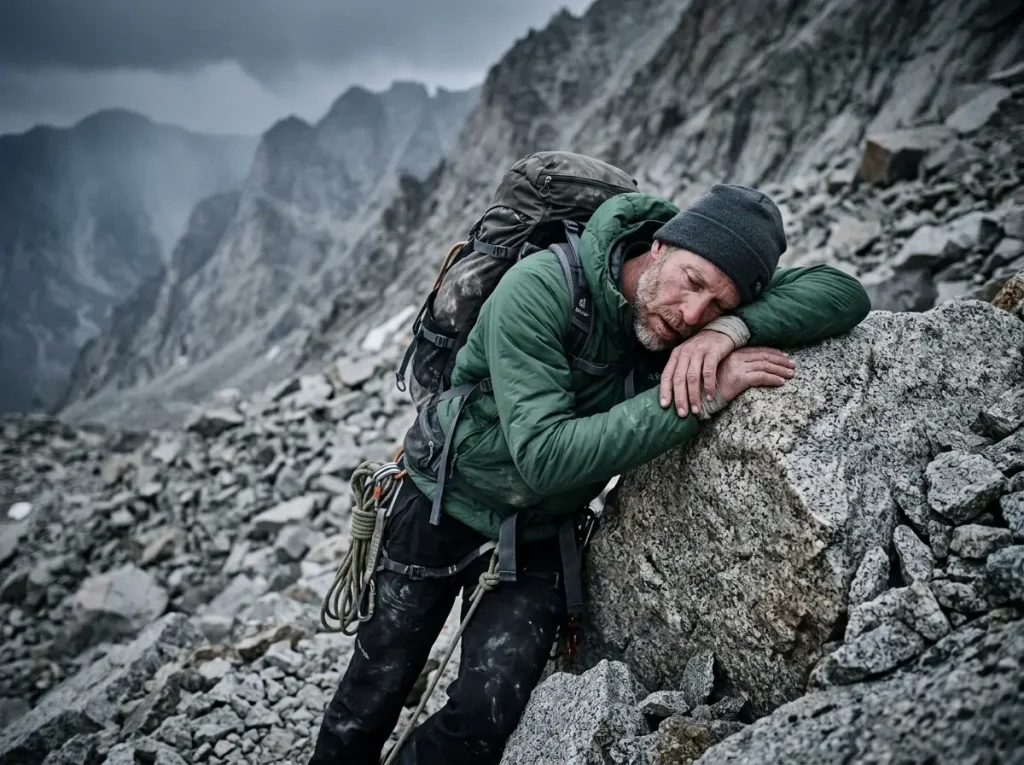
At 14,259 feet, the partial pressure of oxygen is roughly 60% of what it is at sea level. That number doesn’t mean much until you understand what it does to the brain. Information processing slows. Error rates in motor tasks climb. Risk assessment accuracy drops — not because you become reckless, but because your brain’s capacity for self-correction actually diminishes. Summit fever doesn’t require ego. It can be pure biochemistry. You rationalize because your brain is working with a reduced oxygen budget.
According to altitude acclimatization and AMS recognition research from the National Institutes of Health, between 50% and 85% of unacclimatized individuals reaching 4,500 meters develop AMS symptoms: headache, nausea, dizziness, fatigue. HACE — High-Altitude Cerebral Edema — is the life-threatening escalation. Symptoms: headache that doesn’t respond to ibuprofen, ataxia (staggering gait), confusion. The only treatment is immediate descent. No discussion.
The midnight-to-3AM start compounds this. Acute sleep deprivation interacts with hypoxia in ways that are measurably worse than either alone. The altitude acclimatization protocols and AMS field recognition guide covers the Lake Louise diagnostic criteria in detail — understand it before you go.
The Acclimatization Protocol: Two to Three Days Minimum
“Climb high, sleep low” is the protocol. Spend two to three nights in Estes Park at around 8,000 feet before attempting the summit. Take day hikes to 11,000-12,000 feet — Chasm Lake at 11,800 feet and Flattop Mountain at 12,324 feet are optimal. Even 48 to 72 hours at altitude begins erythropoietin production and starts increasing red blood cell count within the first week.
Signs you are not acclimatized enough to attempt the summit: resting heart rate more than 20 beats per minute above your baseline, headache when lying down, SpO₂ below 85% at 9,000 feet. And this one sounds obvious but people ignore it every season — no alcohol the night before. Alcohol worsens hypoxic sensitivity measurably. The beer in Estes Park belongs on the way home, not the night before.
AMS Recognition and the Turn-Around Trigger
The cognitive trap with AMS is that the people most affected are the least equipped to accurately self-assess their symptoms. Hypoxia doesn’t feel like impairment — it often feels like confidence. Rely on your partner’s assessment, not your own. If your partner is staggering, behaving oddly, or producing a cough with discoloration — those are HACE or HAPE symptoms. Begin descent immediately, no committee vote required.
Carry 500 mg ibuprofen for mild AMS relief. But only to be comfortable while descending. Not to mask symptoms so you can keep climbing. That’s a category error that has ended badly for people.
Timing, Weather, and the 10 AM Rule
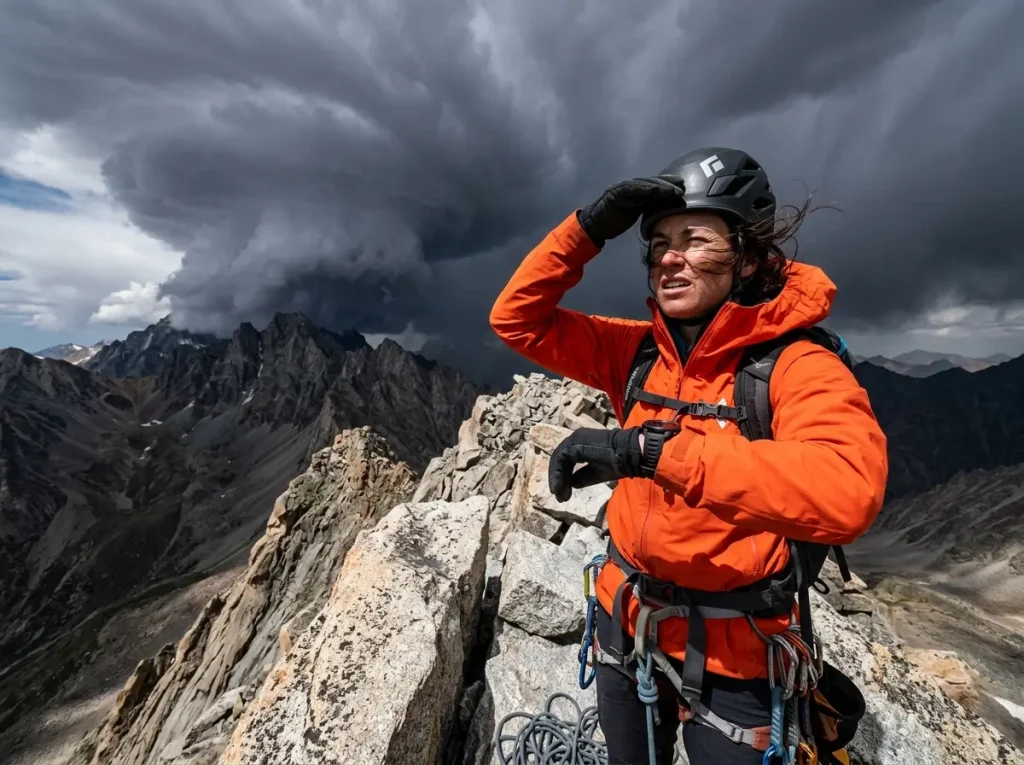
Longs Peak functions as an orographic machine — it forces moist air from the Colorado plains up into the thin alpine atmosphere, generating localized, violent thunderstorms with very little warning time. Colorado ranks near the top of US states for lightning fatalities, and the Denver Convergence Vorticity Zone enhances storm ignition along the entire Front Range. During the North American Monsoon (mid-July through August), near-daily afternoon convection cycles mean thunderstorms are not a possibility — they’re a schedule.
The National Weather Service Colorado lightning climatology data documents the frequency and geography of Colorado lightning. On the flat, exposed summit of Longs Peak — where you are the tallest object for a significant radius — there’s no ambiguity about the risk. Dry thunderstorms, where lethal cloud-to-ground strikes occur without rainfall, are common on the Front Range. A blue sky at the summit can turn hostile in under 20 minutes.
Reading the Weather Window: Tool Stack for Longs Peak
Use the National Weather Service Mountain Area Forecast and Mountain-Forecast.com for hourly summit predictions. Check the day before and again at your departure time — a forecast showing more than 30% thunderstorm probability before noon is a hard no-go. JonathanVigh.com provides historical Longs Peak weather data and probability models for a longer-range read on your window.
The subtler read: on calm, clear mornings at the trailhead, storm cells can be building on the Divide to the west and be completely invisible from the east side. They arrive with less than 30 minutes of warning at the summit level. Visual assessment at the trailhead does not substitute for an hourly forecast. For climbers who want to build real micro-climate meteorology literacy, reading mountain weather patterns before committing to a summit attempt is the guide to read before trip planning.
The Hard Turn-Around Rule and Summit Fever Countermeasures
Write your turn-around time down before you leave the trailhead. Share it with someone not on the climb. Text a friend your time and commit that they should call SAR if they haven’t heard from you by a specific follow-up time. This is a pre-commitment device — its value is that it removes the turn-around decision from the mountain, where your judgment is compromised, and places it in the trailhead parking lot, where your judgment is not.
Summit fever cognitive traps are recognizable if you’ve memorized them: “we’re so close,” “it’s still early,” “the clouds don’t look that bad.” Treat those exact phrases as automatic red flags — not as signals to evaluate whether conditions are actually fine. If you’re having an internal debate about whether to continue, the answer is already given. That debate doesn’t happen when conditions are genuinely safe.
Success is defined as returning to the trailhead intact. Summit is the bonus.
Search and Rescue Reality: Why Self-Reliance Is the Only Plan
RMNP operates one of the most capable SAR teams in the country. In the 2008 Ledges incident, 32 NPS rescuers and additional volunteers were required for the evacuation — and a litter-carry on Class 3 terrain with fall-protection anchors is a slow, complex operation under any conditions. An injured climber on the backside of Longs is likely to spend at least one night out before evacuation completes, even with optimal response.
Cell coverage is non-existent above the Boulderfield. Helicopter evacuation at 14,000 feet in summer is constrained by “High/Hot/Heavy” conditions — reduced air density limits rotor lift, and winds above 30 knots (common near the summit) ground helicopter operations entirely. The NPS mortality data for National Park fatalities documents how consistently these constraints affect outcomes.
A cell phone is not a rescue plan. Your pack is your rescue plan.
The Forced Bivouac: Heat Loss and Survival Systems
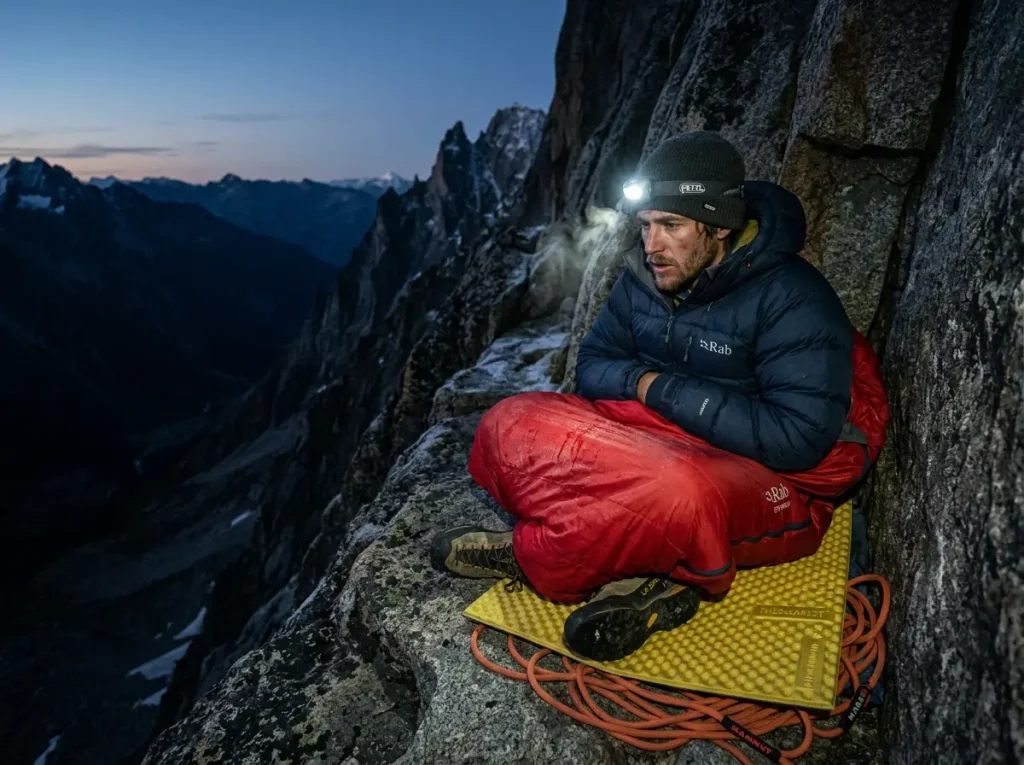
Pack for a night out every time, regardless of the forecast. The kit: bivy sack, closed-cell foam pad, emergency food. That’s the minimum.
Heat loss in an unplanned overnight happens three ways. Convection — wind pulling body heat away — is the primary threat. A bivy sack like the Rab Storm Bivy creates a stagnant air boundary layer that dramatically reduces convective heat transfer. Conductive heat loss to granite can account for up to 20% of total heat loss — lying directly on the rock is slow hypothermia. Your foam pad, your rope, your empty pack — anything between you and the granite is essential. Emergency blankets only reflect infrared radiation; they’re useless without a windproof outer shell to address convection.
Wet clothing loses 90% of its insulation value. If caught in a storm on the descent, stop and change into any dry layer you have, even if it means stopping momentarily on exposed terrain. The vertical medicine and backcountry first aid protocols for climbers covers improvised rescue and WFR-level decision trees for the scenarios that actually happen up there.
Before You Drive to Estes Park
Three things go with you everywhere on this mountain.
First: the hazard is the descent, not the climb. Two out of three fatalities on Longs Peak are traumatic falls. Most happen on the way down, after the summit, when the brain is running on fumes and the legs are done. The mountain’s most hazardous feature is the climber’s own mental state at 1 PM.
Second: every gear choice that saves weight or money reduces margin. The Homestretch is friction-dependent slab at 14,000 feet. Your rubber compound matters. Your helmet matters. Your bivy capability matters. The cheapest gear decision on Longs is always the most expensive one in the field.
Third: turn-around rules only work if they’re pre-committed. A rule you’re willing to debate at the moment of decision is not a rule. Write it down, share it, and hold it.
Spend two weekends on Class 3 alpine scrambling on terrain within a day’s drive before you go — the Flatirons, Mt. Ida, any approach that requires hands on rock. Log those days. Get comfortable with the movement. Longs Peak is one of the best objectives in the lower 48, and it will be there when you’re ready.
FAQ
Is the Longs Peak Keyhole Route hazardous?
Yes — Longs Peak is statistically Colorado’s most lethal mountain. The Class 3 rating means an unroped fall on the technical sections is the primary failure mechanism, and most victims are not pure beginners. The key variable is treating it as a high-consequence alpine objective rather than an advanced hike.
Do I need a rope for the Longs Peak Keyhole Route?
Most unguided parties don’t carry or use a rope. Some guides offer a short fixed line at the highest-exposure sections of the Ledges for clients struggling psychologically. If you’re uncertain whether you can manage Class 3 exposure without a rope, build experience on lower-consequence terrain first, or hire an AMGA-certified guide in Estes Park.
How hard is the Homestretch on Longs Peak?
Physically, the moves are moderate Class 3 — the difficulty is friction-dependent. On dry Silver Plume granite with approach shoes and proper friction smearing technique, it’s methodical. On wet or iced granite, the friction coefficient drops more than 50%, making it a no-fall zone. Always check conditions before committing to the summit push from the Narrows.
What is the best time to start climbing the Keyhole Route?
Midnight to 3 AM is the professional standard, targeting a summit no later than 10 AM to descend all technical sections before the daily Colorado Front Range convection window (11 AM to 2 PM). Starting later than 4 AM significantly compresses your lightning-safe window.
What happens if you get caught on Longs Peak after a storm?
Self-reliance is the plan. Cell coverage is non-existent above the Boulderfield. Helicopter evacuation is conditional on wind speed and air density — both are frequently at the limit on Longs. Pack a bivy sack, closed-cell foam pad, and emergency food capable of sustaining a forced overnight. Notify someone at the trailhead of your turn-around time and check-in plan.
Safety Notice: Rock climbing and mountaineering are inherently high-risk
activities that can involve physical trauma or fatal incidents. The information on Rock Climbing Realms is for
educational and informational purposes only. Techniques and advice presented here are not a substitute
for professional, hands-on instruction. Conditions and risks vary by location. Always seek guidance
from a qualified instructor before attempting new techniques. By using this website, you agree that you
are solely responsible for your own safety. Any reliance you place on this information is strictly
at your own risk, and you assume all liability for your actions. Rock Climbing Realms and its authors
will not be held liable for any harm, damage, or loss sustained in connection with the use of this information.
Affiliate Disclosure: We are a participant in the Amazon Services LLC Associates Program, an
affiliate advertising program designed to provide a means for us to earn advertising fees by advertising and linking
to Amazon.com. As an Amazon Associate, we earn from qualifying purchases. We are also an official affiliate partner
of Black Diamond Equipment via the AvantLink network. If you click on a Black Diamond affiliate link and make a
purchase, we may earn a commission at no additional cost to you. We also participate in other affiliate programs.
Additional terms are found in the terms of service.