
In this article
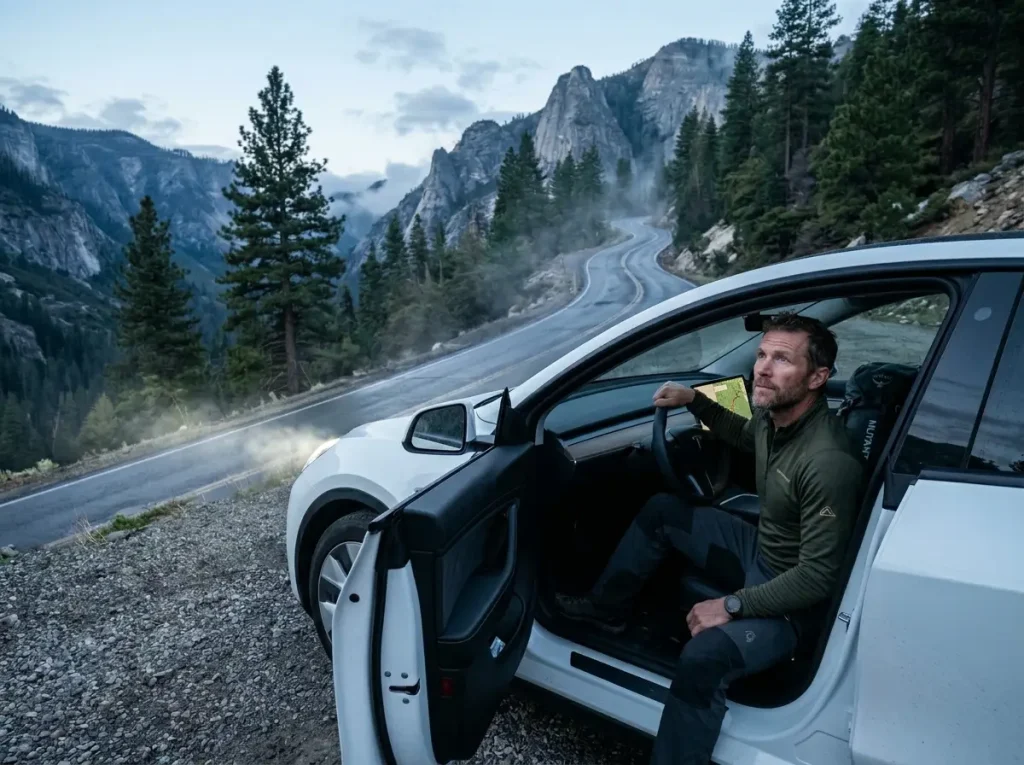
The ETA on ABRP said we had 12 miles of range left. The Buttermilks trailhead was 14 miles up the road. It was 22°F, the roof rack was loaded with two crash pads and a trad rack, and the nearest Supercharger was back in Bishop — 27 minutes the wrong direction. That’s when it hit me: I’d spent two years obsessing over EV specs and had still managed to treat the approach like an afterthought.
I’ve driven EVs to crags from the Eastern Sierra to Red River Gorge, made every range calculation mistake there is to make, and cooked one outlet at a climbing cabin doing it wrong. What I’ve learned is that the car is part of the technical gear list now. And most EV guides are written by people who haven’t driven a loaded hitch box down a switchback in the dark.
Here’s what they miss.
⚡ Quick Answer: Your EV’s range estimate is wrong at the crag — often by 30 to 50 percent — because it doesn’t account for roof-mounted crash pads, mountain elevation gain, cold trailhead overnights, or desert thermal management. The fix is manual energy budgeting using A Better Route Planner with realistic consumption inputs, cross-checked against PlugShare for real-time charger status. Plan your state of charge at each stage — not the estimated miles — and always target 60 to 70 percent SOC at the trailhead to capture regenerative braking on the descent.
| EV Charging Levels Comparison | ||||
|---|---|---|---|---|
| Charging Level | Miles Gained/Hour | Practical Climbing Use | Connector Type | Minimum Hardware |
| Level 1 (120V) | 3–5 mi/hr | Cabin/Airbnb overnight top-up | NEMA 5-15 (standard) | Manufacturer EVSE |
| Level 2 (240V) | 15–30 mi/hr | RV park overnight, full recovery | NEMA 14-50 / J1772 | 32–48A EVSE + adapter kit |
| DC Fast Charge (DCFC) | 100–300+ mi/hr | 30-min gateway stop between sessions | NACS / CCS | Compatible vehicle + network account |
Why Your EV Loses More Range Than the App Predicts at Crags
The app doesn’t lie exactly. It just doesn’t know what you put on the roof.
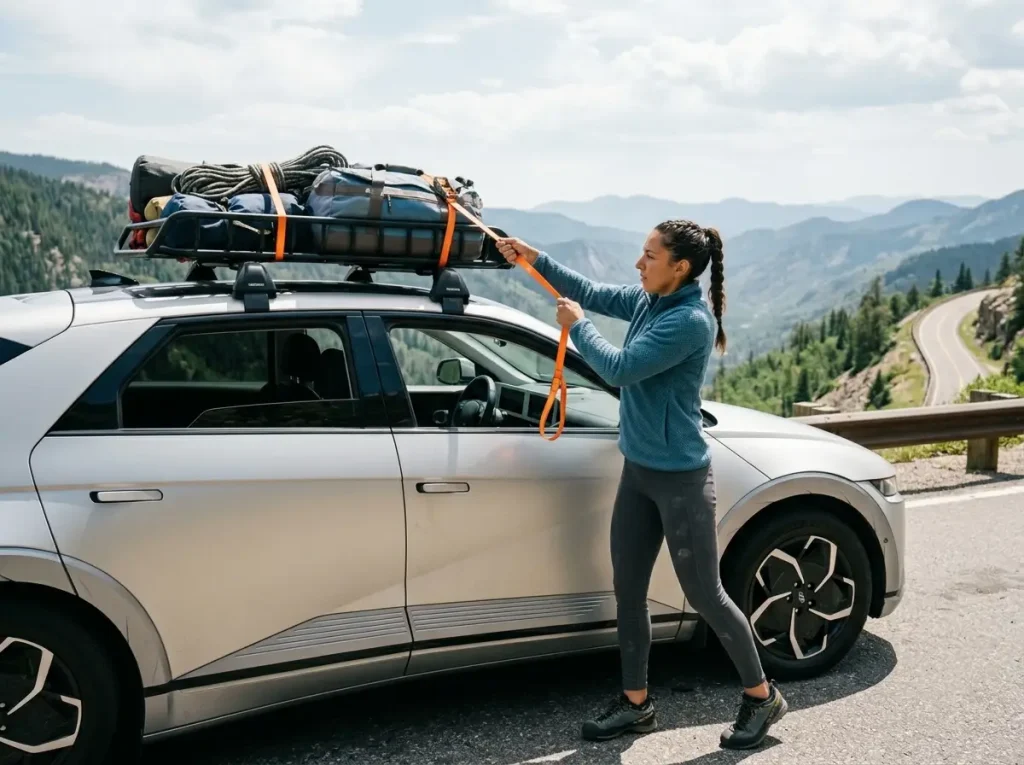
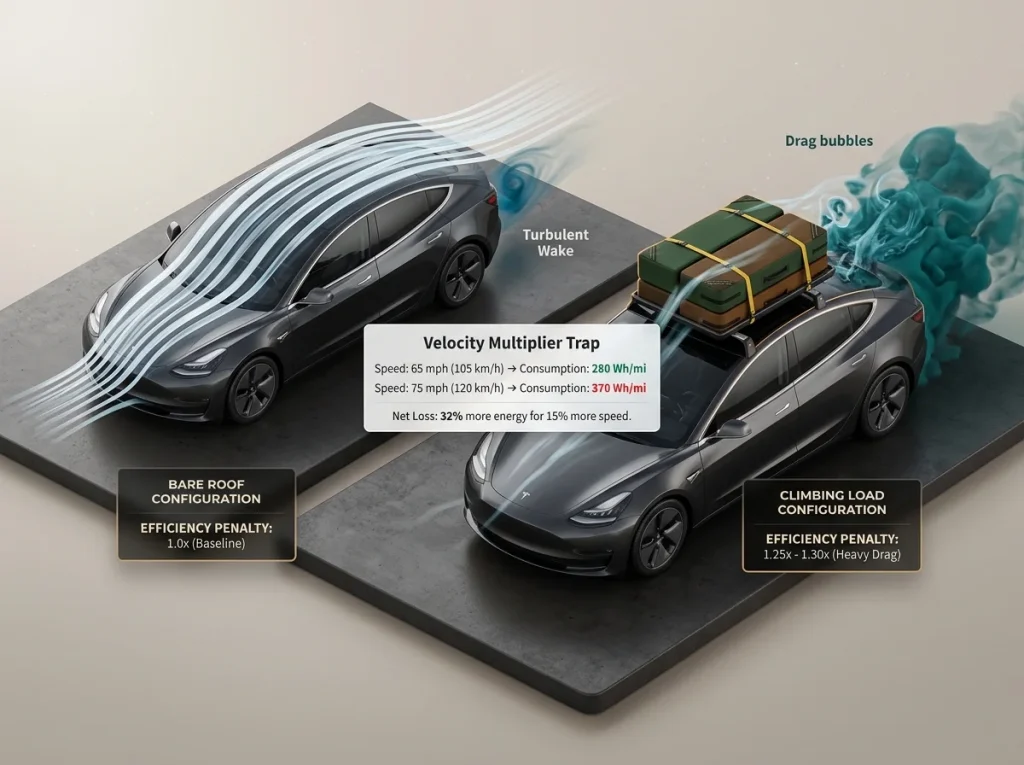
Roof-mounted cargo increases both your drag coefficient and the frontal area the car pushes against the air. According to a Lawrence Berkeley National Laboratory roof rack drag study, even an empty roof rack cuts efficiency by up to 12 percent at highway speeds. Stack two crash pads and a rope bag on top and you’re in a different car. A Tesla Model 3, which runs a baseline efficiency of around 4.0 mi/kWh stock, drops to roughly 3.5 mi/kWh with empty crossbars — and falls to 2.5 to 3.0 mi/kWh loaded with climbing gear. That’s a 25 to 30 percent penalty before you’ve touched a mountain road.
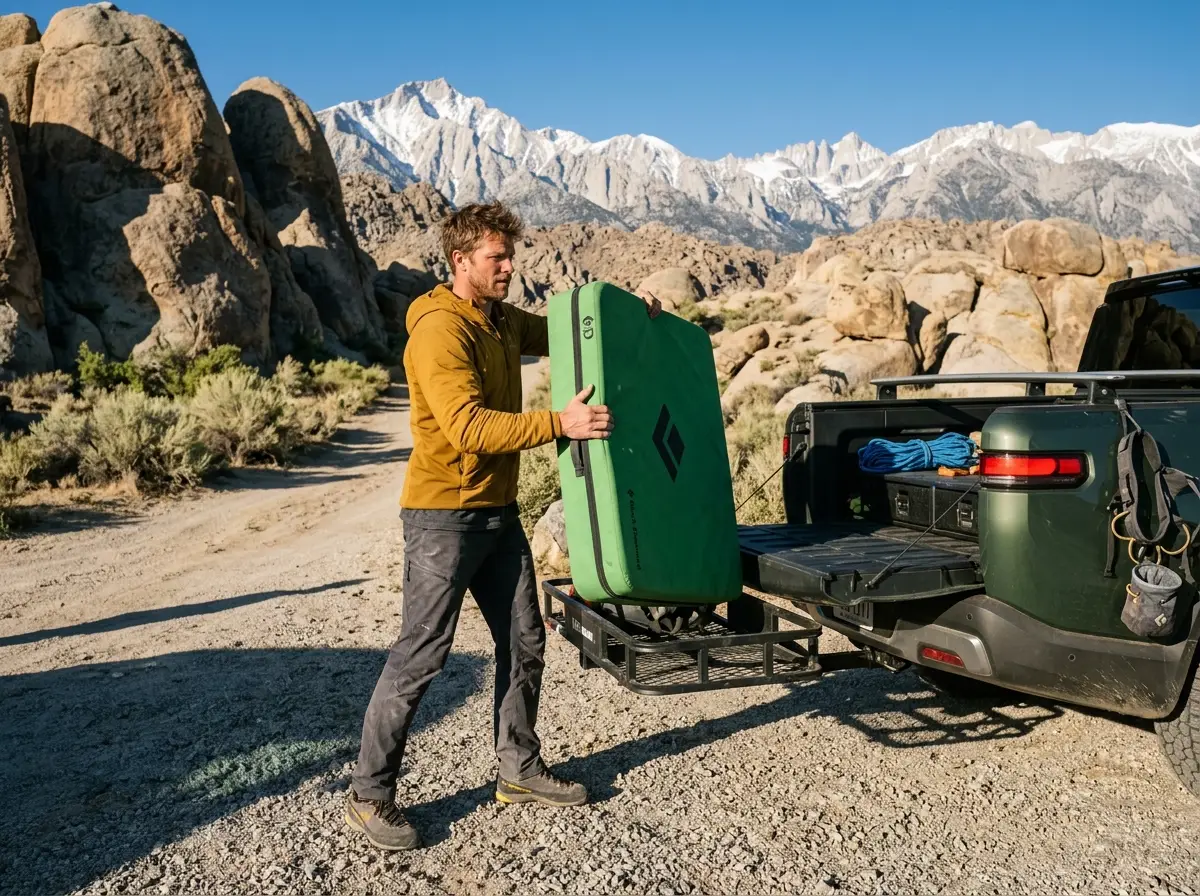
The hitch box advantage is the single best move an EV climber can make. Rear-mounted cargo stays inside the vehicle’s existing slipstream, so frontal area barely changes. Switching from roof-stacked pads to a hitch-mounted carrier — something like a Yakima MegaWarrior — can recover nearly 40 Wh/mi on a highway stretch. The app starts being accurate again. You also get a longer wheelbase footprint to think about in tight slab parking lots, and a tongue weight limit to respect (usually 200 to 350 lbs on the receiver), but those are manageable trades.
The deeper problem is velocity. Aerodynamic drag force scales with speed squared, but the power needed to push through that drag scales with speed cubed. At 65 mph with a loaded roof rack, you’re working hard. At 75 mph, you’re doing something closer to foolish. The concrete numbers: a 200-mile highway run at 70 mph with roof-mounted gear can consume around 350 Wh/mi. The same stretch at 63 mph drops to roughly 275 Wh/mi. That’s 15 kWh difference — enough for 50-plus additional flat miles.
For climbers engineering a mobile basecamp for extended road trips, the same aerodynamic math applies regardless of vehicle size.
Pro tip: Set cruise at 63 to 65 mph any time you’re running with roof racks loaded. It’s not conservative driving. It’s the only way the math works.
The Drag Equation Applied to a Climbing Load
When aero engineers talk about drag coefficient and frontal area, here’s what it means in plain terms: a cleaner shape moving through air leaves a smaller turbulent wake behind it. Add a rack with pads and a gear box and you’ve turned a sports sedan profile into something closer to a box truck. The practical consequence for a Tesla Model 3 loaded for the crag is that it handles drag roughly like a crossover SUV — despite having the aerodynamics of a sports car when stripped clean.
The velocity compounding is the part most people skip. Going from 65 to 75 mph doesn’t increase drag power by 15 percent. It increases it by roughly 33 percent. For a loaded EV already pulling 280 Wh/mi, that jump puts you at 370-plus Wh/mi. You can watch it happen in real time on the energy display.
The Velocity Trap — Why Highway Miles Hurt More Than Mountain Miles
Here’s the counterintuitive reality: the flat-speed highway section before the mountain approach often consumes more energy than the mountain itself. At 70 mph with a loaded roof rack, real-world range on a 200-mile approach can run 350 Wh/mi. Drop to 63 mph and you’re back around 275 Wh/mi. That 75 Wh/mi difference over 200 miles is 15 kWh — roughly 50 miles of extra range on flat ground.
Headwinds compound it further. On the I-395 corridor into the Eastern Sierra, winter headwinds can add 10 to 15 percent more consumption on top of the already-elevated roof rack penalty. ABRP has a wind compensation setting most users leave on default. Switch it to manual and dial it up.
The Hitch Box Solution — Practical Setup for Crash Pads and Racks
A dedicated hitch cargo platform keeps pads, rope bags, and soft gear behind the car rather than above it. Exposure to wind is minimal because the vehicle body is doing the work of cutting air ahead of the cargo. The downside is real: the car extends 6 to 12 inches longer, parallel parking in Bishop gets interesting, and you need to check your receiver’s tongue weight rating before loading up.
Enclosed hitch bags reduce drag further. An exposed rack holding unsecured crash pads adds more turbulence than a contained bag does. Worth noting if you’re already pushing the aerodynamics.
The Gravitational Debt — Calculating Your Mountain Approach Budget
Most EV articles talk about range in flat-road terms. Climbing areas don’t exist in flat-road terms.
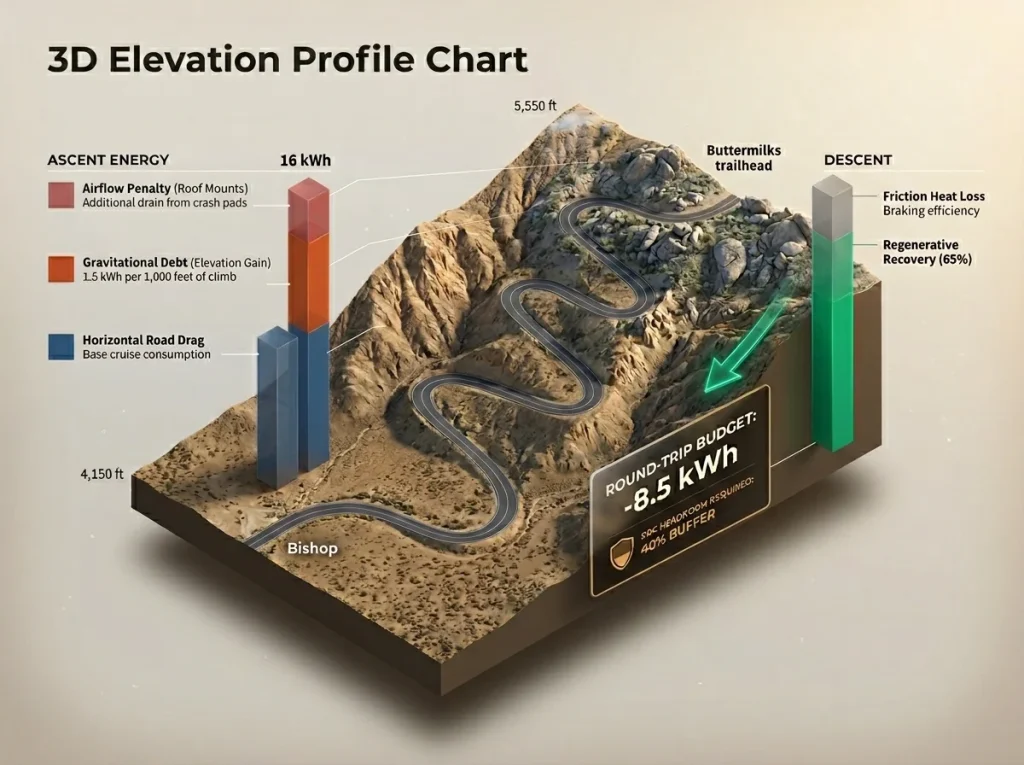
When you drive uphill, you’re converting battery energy into altitude. The rule of thumb for EV analysts: 1.5 kWh per 1,000 feet of elevation gain, accounting for drivetrain losses and rolling resistance. For a concrete example: the drive from Skykomish (1,000 ft) to Stevens Pass (4,050 ft) covers 16 miles of horizontal road plus 3,050 vertical feet of elevation. That elevation alone costs roughly 4.58 kWh — nearly doubling the flat-road energy budget for that same distance.
Apply the same calculation to Bishop’s Buttermilks approach, where the trailhead gains 1,400 vertical feet from town, and you start to see why the app’s range estimate always seems optimistic by the time you’re parking.
The good news is the descent. Regenerative braking recovers 60 to 70 percent of the energy spent climbing. A 1,000-foot descent returns roughly 1.0 kWh to the battery pack. Net round-trip cost for a 1,000-foot elevation change: approximately 0.5 kWh — a loss, but a manageable one.
Here’s the catch almost nobody mentions: if you arrive at the trailhead at 100 percent SOC, the battery pack can’t accept regenerative energy on the way down. The vehicle defaults to friction brakes, and you’re burning potential recovery as heat. A Yosemite approach via Tioga Pass (9,945 ft) on a full charge is exactly this mistake. We made it once. The brakes glowed.
The SOC headroom rule is simple: never charge above 80 to 85 percent before a significant mountain descent. You want room to capture that energy on the way down.
Pro tip: Target 60 to 70 percent SOC at the summit. That buffer lets you run maximum regen on the descent while still keeping enough charge for the drive out.
The elevation gain energy consumption calculator from Saxton Research is the best free tool for running these numbers with real vehicle mass inputs. It’s not pretty, but it’s accurate.
Calculating Your Approach Energy Budget (Step-by-Step)
The process takes five minutes and is the difference between confidence and anxiety by mile 80:
- Find trailhead elevation in CalTopo.
- Subtract current elevation.
- Multiply vertical feet by 1.5 kWh per 1,000 feet.
- Add horizontal miles times your loaded Wh/mi consumption.
- Compare to your available kWh in the pack, not the estimated range display.
Step 5 is where most people slip. Your car shows estimated miles. What it doesn’t show, prominently, is raw kWh remaining. Know your pack size: a Rivian R1T runs 135 kWh usable, a Tesla Model 3 Long Range runs 82 kWh. Know the number. Use the number.
In A Better Route Planner, use Custom Speed mode and manually set consumption to 110 percent of your baseline when loaded with a roof rack. Default settings will leave you short.
Point of No Return — When the Trailhead Becomes a Trap
Joshua Tree has no infrastructure inside the park. The nearest DCFC is the Rivian Outpost, 0.9 miles from the visitor center. Cellular service disappears in most of the park. If your real-world range calculation is off and you’re deep in the park on a 105°F afternoon, you’re not calling anyone for help.
Desert heat adds a layer that cold climates don’t: active thermal management drains the battery even when you’re parked. A car sitting in the Joshua Tree sun for six hours can lose 5 to 8 percent SOC before you’ve moved a wheel. Factor it.
Define your point of no return before you leave the last charger: the distance at which turning around costs you the same energy as continuing. Past that point, you commit.
Thermodynamics of the Overnight — Cold Weather, Camp Mode, and Vampire Drain
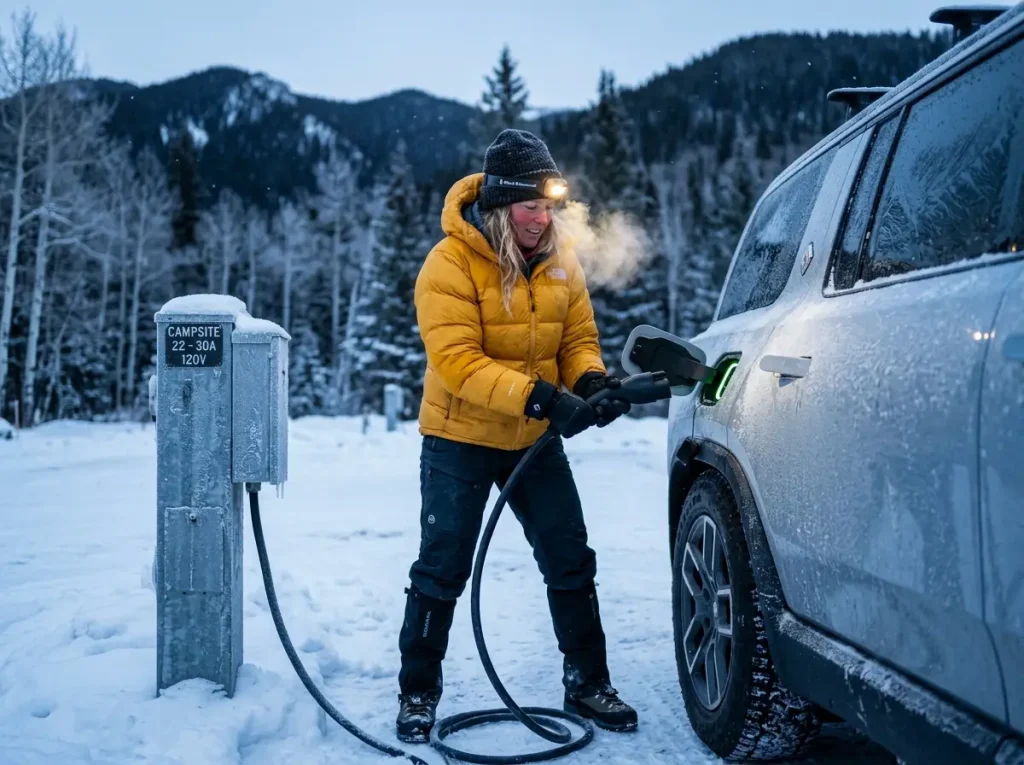
Winter bouldering at Hueco Tanks. We woke up to 31 percent battery after a night at 18°F. No Camp Mode running — we’d left it off to “save charge.” The vampire drain had taken 19 percent overnight just from standby. We drove to El Paso on 8 percent SOC with heart rates to match.
Cold weather and camp mode energy draw are the two variables that destroy multi-day trip planning if you ignore them. Below 50°F (10°C), lithium-ion cells develop higher internal resistance. Usable capacity drops. In genuine cold, you can lose 20 to 50 percent of effective range. Rivian owners in Vermont and Colorado report 3 to 5 percent SOC loss per day just parked at a trailhead in cold weather.
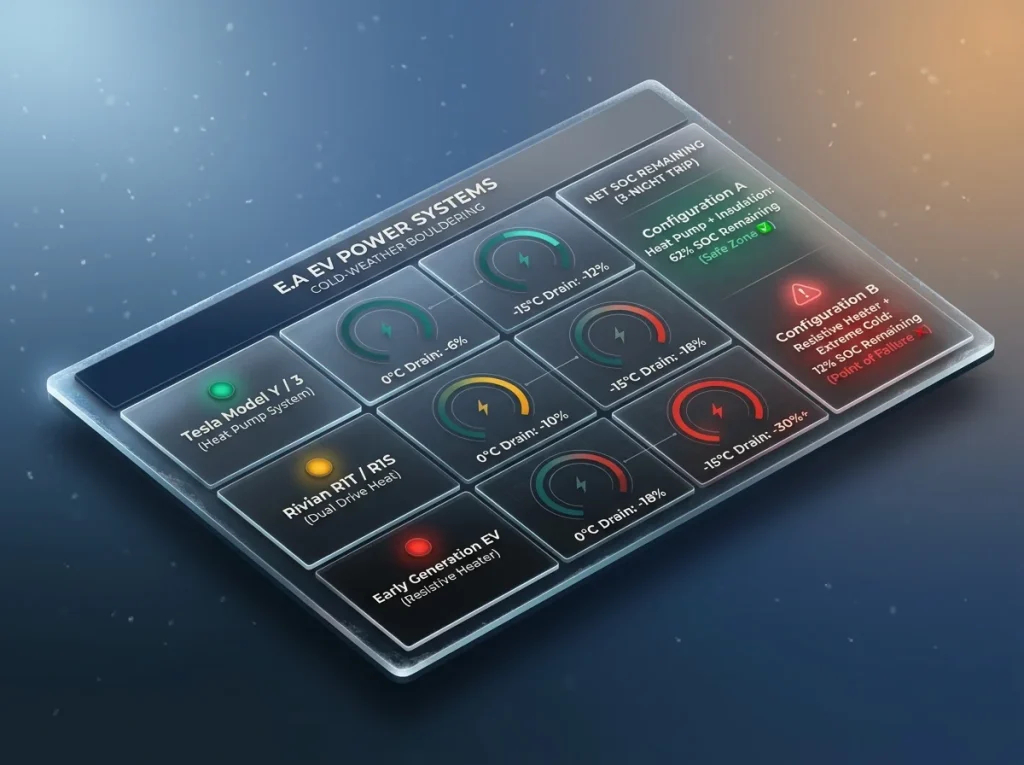
Camp Mode overnight draw depends on what’s heating the car:
- Tesla Model Y (heat pump): 5 to 10 percent SOC per 8-hour night.
- Older resistive-heater EVs: 15 to 25 percent SOC per night.
- Extreme cold at -15°C: up to 20 to 30 percent SOC, regardless of vehicle.
For a 3-day winter trip in a resistive-heater EV, that’s potentially 60 percent SOC consumed before you’ve driven a mile. A Rivian R1T — with its 135 kWh pack — burns 27 kWh just sleeping in cold conditions. Budget for it explicitly.
The same discipline of managing cold-weather energy at altitude applies to your vehicle as it does to your body. Both systems lose efficiency fast when the temperature drops.
Pro tip: Schedule your departure time in the EV app the night before and enable battery preconditioning. Allow 20 to 30 minutes before departure in sub-freezing conditions. Critical caveat: preconditioning only prevents SOC loss when the car is plugged in. Running it off battery before you leave just moves the drain earlier.
Vampire Drain Protocol for Extended Trailhead Parking
Without Camp Mode running, vampire drain in moderate temperatures runs 1 to 3 percent SOC per day. In cold, it climbs to 3 to 5 percent. A 5-day trad trip with no plugged charging means budgeting up to 25 percent SOC just for being parked.
The fix most people don’t use: disable Sentry Mode during multi-day trailhead stays. Sentry Mode’s cameras and processing chip pull an additional 1 to 2 percent SOC per day. On a 5-day trip, that’s 5 to 10 percent gone for security footage nobody watches.
On Tesla: Settings → Safety → Sentry Mode → OFF. Do it before you leave the car.
If SOC drops below 20 percent overnight, some EVs disable Camp Mode automatically to protect the battery. Set a low-SOC alert threshold in the app before you sleep — waking up cold at 3am at a trailhead is avoidable.
Electrical Safety at the Crag — The Fire Hazard Nobody Talks About
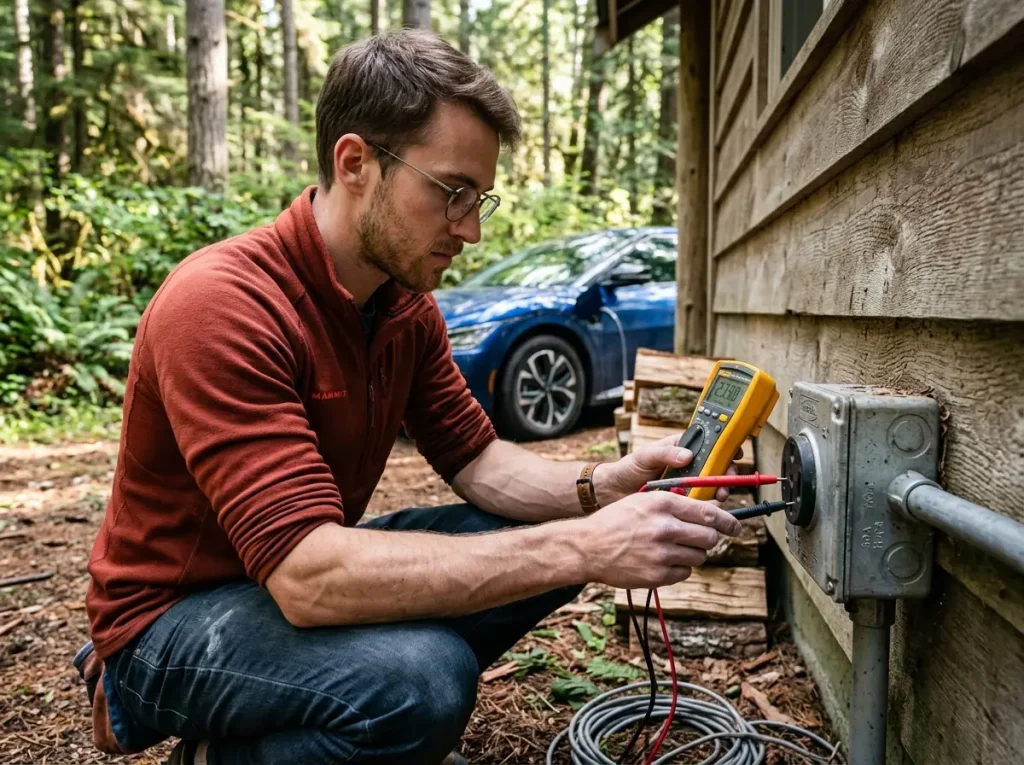
I plugged a Kia EV6 into a “NEMA 14-50” outlet at a climbing cabin in the Columbia River Gorge. The outlet was a 30-amp dryer circuit, not a 50-amp receptacle. By midnight, the outlet was warm to the touch. The cabin owner had no idea. We’d been pulling 12 amps through a circuit that wasn’t rated or wired for it.
This is the conversation that generic EV guides skip entirely.
The NEC continuous load rule is fundamental here: any load running more than three hours must use only 80 percent of the circuit’s rated capacity. An EV drawing overnight charges for 10 to 12 hours triggers this immediately. A 50-amp NEMA 14-50 circuit is therefore limited to delivering 40 amps to an EV — not 50.
Cheap residential-grade receptacles use plated steel or low-grade copper alloy contacts. High-amperage continuous charging creates heat. Over charge cycles, contacts expand and contract, spring tension loosens, resistance climbs — and that feedback loop ends in arcing and fire. Industrial-grade units (Hubbell 9450A, Bryant 9450) are built for this kind of sustained use. The difference in cost is roughly $20. The difference in risk is significant.
For more on NEMA 14-50 safety standards for EV charging, Emporia Energy’s guide covers the derating rules in detail.
Think of applying managed charging to an unknown circuit the same way you’d use a probability-severity risk matrix on a route: reduce the load on an unknown system to reduce the potential consequence.
Extension Cord Reality — When It’s Acceptable and When It’s Not
Standard 16 AWG and 18 AWG household extension cords are for lamps and phone chargers. An EV pulling 12 to 16 amps for 24 continuous hours will heat those wires until the insulation fails — usually before any breaker trips.
If you absolutely need an extension cord in an emergency, the minimum spec is 10 AWG, 30-amp rated, fully uncoiled. Coiling creates an inductive heat trap. At 25 feet of 10 AWG cord on a 40-amp circuit, expect a 2 to 3 volt drop — derate to 24 amps output to compensate.
Pro tip: Carry a $15 outlet tester with a voltage meter. Check continuity and voltage sag under load. If voltage drops more than 5 volts when the car starts drawing, the circuit is undersized. Stop and solve it before 2am.
The Ethics of Stealth Charging — Property Owners and Access
Electricity for a full EV charge runs $5 to $15 in most parts of the country. It’s a small amount, but pulling power from a cabin’s old residential wiring without asking can trip breakers on freezers, medical equipment, or critical systems in backcountry structures. Always ask. Always inspect.
Colorado HB23-1233 (signed in 2023) protects renters’ rights to charge in assigned parking spaces in HOA-governed buildings — relevant if you’re renting a condo in Estes Park or Silverton for a climbing trip. That’s state law. Elsewhere, you’re relying on good faith.
Keep a $20 cash envelope in the glovebox labeled “charging fee.” Showing willingness to pay converts most “no” responses to “yes.”
Crag-by-Crag Infrastructure Guide — The Real Beta by Region
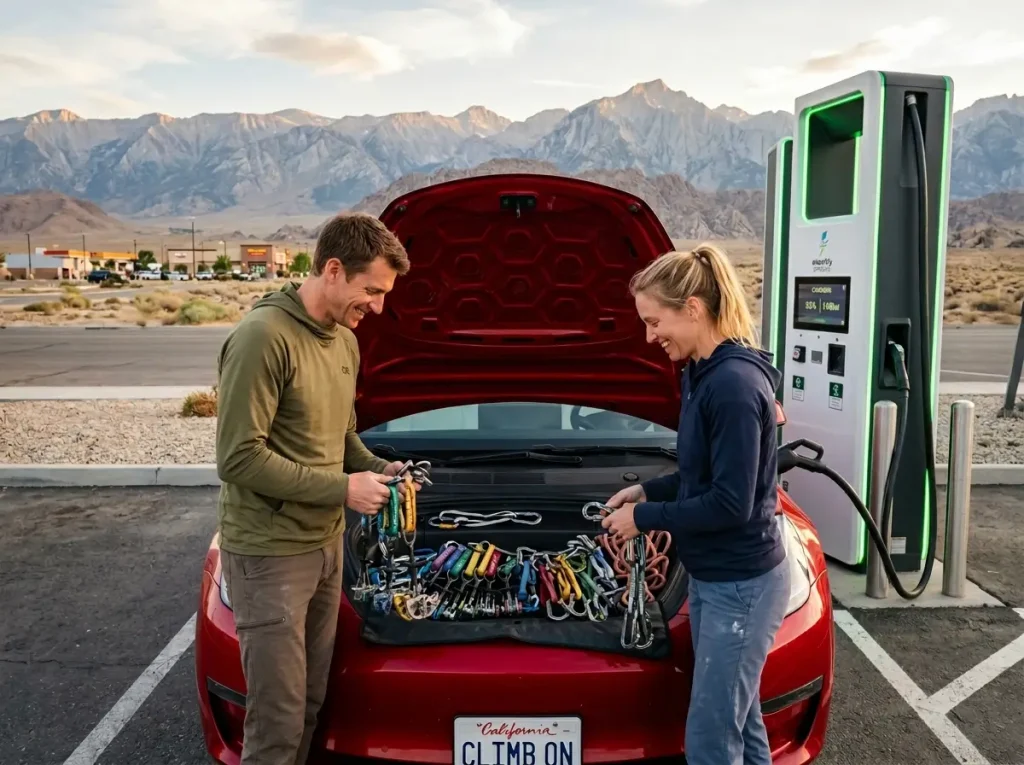
The mistake most EV climbers make is treating all crags the same. They’re not even close.
Yosemite has the best infrastructure of any national park for EVs. According to Yosemite National Park EV charging infrastructure, the park runs 54 Level 2 chargers distributed across Curry Village (20), Wawona Store (24 at 11 kW), and Yosemite Falls Parking (10). Rate is $0.37/kWh plus a $0.30/minute idle fee after session completion. Charge before 7am to beat the morning rush. The Valley is also a range trap on approach from the east — Tioga Pass crests at 9,945 feet. Arrive with buffer. For the full approach including permit logistics and route selection, see planning a Yosemite climbing trip.
Joshua Tree has zero infrastructure inside the park. Gateway dependency is complete. The Rivian Outpost at 0.9 miles from the visitor center has 12 DC fast charger stalls. Chiriaco Summit on I-10 covers the eastbound approach. Once inside the park, cellular is gone, temperatures regularly exceed 100°F in season, and active thermal management runs your battery down while you’re on the wall. Plan for 5 to 8 percent SOC drain per 6-hour park day in summer heat.
Bishop and the Eastern Sierra work as a hub-and-spoke model. Charge in Bishop, orbit out to the Buttermilks or Tablelands daily. You don’t need to charge at the trailhead because you’re not far enough out to require it. The infrastructure is there: two Tesla Supercharger locations (12+ stalls each), the Rivian Adventure Network at 787 N Main St (6 stalls), and Electrify America at the Vons Shopping Center (4 stalls). Eighty-seven percent of Bishop’s public chargers are Level 3 DCFC. It’s genuinely convenient.
Red River Gorge is a different situation entirely. The Slade Visitor Center has two free solar-powered Level 2 J1772 chargers — that’s the only free public option. Cliffview Resort has Tesla Destination chargers now open to the public, but they have a line on weekends. Multi-day strategy here means NEMA 14-50 adapters at campgrounds with 50-amp RV hookups and hosts willing to accommodate. Long-range EVs (300-plus miles of EPA range) are strongly preferred. Vehicles with under 250 miles need careful planning from Lexington.

Pro tip: 48 hours before departure, run your full route in ABRP with realistic settings — loaded vehicle, mountain mode, accurate highway speed. Cross-check every charger stop against PlugShare check-ins from the last 30 days. A charger that shows “available” in ABRP may have a 30-minute real queue at 8am Saturday.
Planning Tools — ABRP, PlugShare, and the Pre-Trip Verification Protocol
A Better Route Planner handles route optimization with real-time consumption modeling. Set it to Custom Speed mode, dial in your actual vehicle configuration, and it becomes a genuinely useful tool instead of an optimistic guess.
PlugShare tells you whether a specific charger is actually working. User check-ins from the last 48 hours tell you more than any database status. Enable “Show offline stations” to see planned but non-operational chargers — dead stations are more common in rural mountain towns than anyone admits.
Use both. Before every road trip to a remote crag, run the ABRP route, identify every charging stop, and verify each one in PlugShare against recent check-ins.
Connector Protocols and Adapter Strategy for Remote Crags
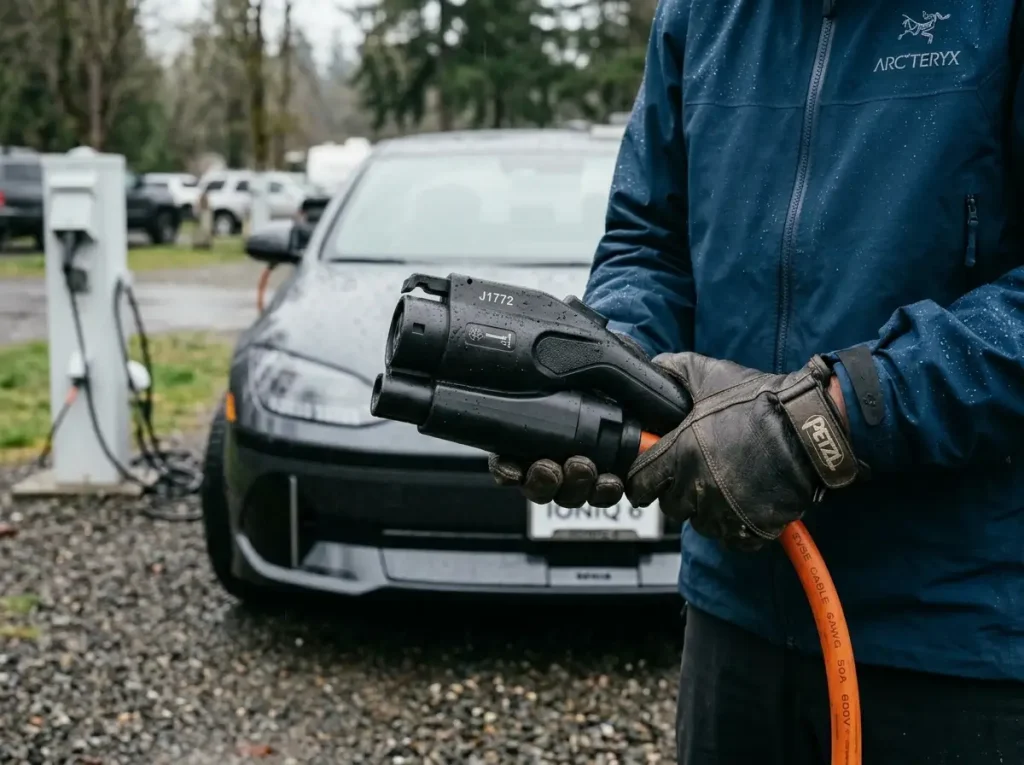
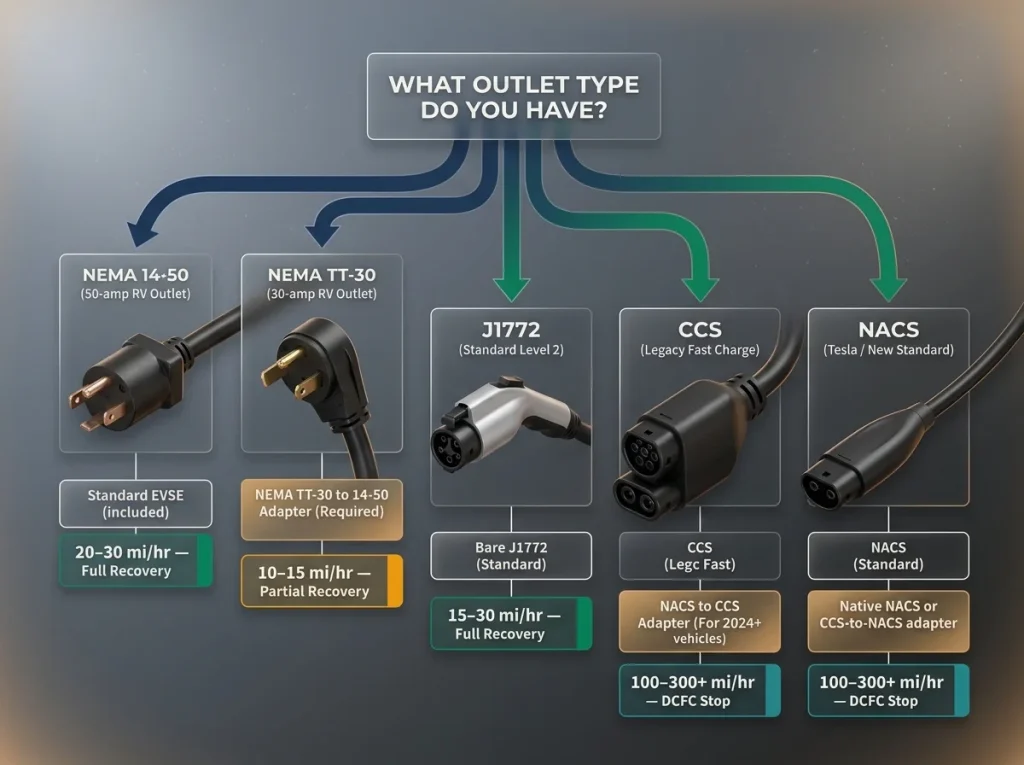
I showed up at a Durango RV park with a NEMA 14-50 adapter. The site had a NEMA TT-30 (30-amp RV plug). No adapter in the car. Added 22 miles overnight instead of 60. That fix cost $15 and now lives permanently in the charger bag.
The connector type landscape in 2026 has mostly consolidated. NACS (North American Charging Standard, formerly Tesla) is now the dominant fast-charging port — Ford, GM, Rivian, Honda, and Nissan have all adopted it. Legacy CCS adapters are still worth carrying for older vehicles and some public networks. J1772 remains universal for Level 1 and Level 2 charging — every non-NACS EV has one.
Add these adapters to the climbing trip packing list the same way you’d add a GriGri backup — non-negotiable.
The EV climber’s permanent adapter kit:
- NEMA 14-50 adapter (ships with most EVs)
- NEMA 6-50 adapter (older dryer circuits)
- NEMA TT-30 adapter (standard RV park plug)
- J1772 to NACS adapter, if applicable
Total weight: roughly 2 pounds. Fits in the charger bag next to the portable EVSE. Leaving any of these home is how you gain 22 miles instead of 60 at a Durango RV camp.
NACS vs. CCS — What You Actually Need in 2026
Most new EVs sold since 2024 use NACS natively. Most public DC fast charger networks have added NACS connectors alongside CCS. If you’re driving a 2022 non-Tesla, you’re still on CCS — carry the NACS-to-CCS adapter and check network compatibility before committing to a stop.
kW acceptance rate is the other number to know. A Rivian R1T accepts up to 220 kW. A Hyundai IONIQ 5 handles 240 kW. A Nissan LEAF maxes at 50 kW. When multiple networks are available in a gateway town, choose the 150+ kW option if your vehicle supports it. A 30-minute charge window is the difference between spending an extra hour in town and getting back to the crag for evening burns.
Level 1 as Emergency Infrastructure — The Cabin Protocol
Level 1 (standard 120V, 12A from a wall outlet) gives you 3 to 5 miles of range per hour. Over 10 hours, that’s 30 to 50 miles. Useful as an overnight top-up at a climbing cabin or Airbnb. Not useful as your primary charging plan for a multi-day trip.
Always use the manufacturer’s portable EVSE for Level 1 — not third-party units. Manufacturer units have integrated GFCI protection built in. If the cabin outlet is on a 15-amp circuit, your EVSE may auto-derate to 8 amps. Budget 20 to 30 miles overnight in that case, not 50.
RV Park Strategy — The Overlooked EV Climbing Asset
KOA and private RV campgrounds in mountain gateway towns almost universally have 30-amp (NEMA TT-30) and 50-amp (NEMA 14-50) hookups. At 40 amps overnight, you can recover 150 to 200-plus miles. RV park wiring is typically better-spec than cabin wiring because it’s designed for sustained 50-amp RV loads — lower risk than residential outlets.
Book KOA Patio Sites specifically — they reliably have 50-amp service. Confirm when you book. Showing up and discovering only 30-amp hookups cuts your overnight recovery roughly in half.
Three Things to Take Away
Your EV’s range estimate is built for factory configuration on flat roads at moderate speed. It doesn’t know you’ve got two crash pads on the roof, a thousand feet of elevation ahead, and a cold night at the trailhead. That gap is on you to close.
Calculate energy budgets manually. Use ABRP with honest inputs — realistic loaded consumption, actual highway speed, mountain mode. Compare against kWh remaining, not estimated miles.
Know your crag before you leave your driveway. Bishop is a DCFC hub. Joshua Tree is a gateway-dependency trap. Red River Gorge requires campground adapter strategy. The infrastructure gap between best and worst case is about 80 miles of meaningful charging difference.
Treat electrical safety as part of the gear list. A warm outlet at a climbing cabin is a failing outlet. Never charge through coiled household extension cords. Always apply the 80-percent NEC continuous-load rule on unknown NEMA 14-50 circuits.
Pull up your next climbing road trip destination in ABRP right now. Input your actual vehicle configuration — roof rack, full load, honest highway speed. See where the real range lands. Then cross-check every charging stop in PlugShare. That 15 minutes of pre-trip work is the difference between a clean approach and an unplanned detour to a Bishop Supercharger.
FAQ
Can EVs handle steep mountain inclines without losing significant amounts of range?
Yes — but the energy cost is predictable, not mysterious. Budget 1.5 kWh per 1,000 feet of elevation gain, separate from horizontal driving consumption. A 5,000-foot approach to a high-altitude trailhead costs roughly 7.5 kWh just for elevation. Plan explicit SOC headroom at the summit so regenerative braking can recover energy on the way back down — target 30 to 40 percent buffer when you arrive at the top.
How do I find EV chargers near climbing areas in rural areas?
Run two apps together. A Better Route Planner handles route optimization and energy modeling. PlugShare gives you station-level reliability from actual user check-ins — it tells you if the charger was working 48 hours ago, which matters more than whether it exists. For very remote crags like Red River Gorge, also check campground listings for 50-amp RV hookups. In chargers in rural areas, the private RV campground network is often more reliable than public EV infrastructure.
How much does cold weather affect EV range on a climbing road trip?
Cold weather typically cuts usable real-world range by 20 to 40 percent depending on temperature and vehicle. Below freezing, plan for a minimum 25 percent reduction as your baseline. Add overnight Camp Mode if you’re sleeping in the car — 5 to 25 percent SOC per night depending on heating technology and outside temp. Pre-condition the battery while plugged in before every cold-morning departure. Skipping this on a 15°F morning costs you roughly 15 percent range before you’ve turned the key.
Is it safe to charge an EV from a campground outlet or remote cabin?
Only after you verify the circuit. Check that the NEMA 14-50 outlet is industrial grade (Hubbell or Bryant spec), on a dedicated 50-amp circuit, with 6 AWG copper wiring. A warm outlet, discoloration, or a loose-fitting plug means a failing circuit — stop immediately. On any unknown circuit, set managed charging to 24 amps maximum as a safety margin. Never run a coiled extension cord. The fire risk from a failing outlet contact is real and the warning signs are easy to miss when you plug in at midnight.
What is the best EV for climbing road trips in 2026?
The vehicle that earns the approach on technical grounds. Three attributes matter: 100-plus kWh usable pack, 150-plus kW DC fast-charge acceptance for short gateway stops, and solid thermal management for temperature swings. The Rivian R1 platform (R1T, R1S) covers all three and includes native NACS for Supercharger access along with a 7.2 kW onboard charger for Level 2 overnight charging. The Hyundai IONIQ 6 offers 240 kW peak acceptance in a more affordable package. Whatever you drive, a rear-hitch cargo system is the single highest-ROI modification before your first climbing road trip.
Safety Notice: Rock climbing and mountaineering are inherently high-risk
activities that can involve physical trauma or fatal incidents. The information on Rock Climbing Realms is for
educational and informational purposes only. Techniques and advice presented here are not a substitute
for professional, hands-on instruction. Conditions and risks vary by location. Always seek guidance
from a qualified instructor before attempting new techniques. By using this website, you agree that you
are solely responsible for your own safety. Any reliance you place on this information is strictly
at your own risk, and you assume all liability for your actions. Rock Climbing Realms and its authors
will not be held liable for any harm, damage, or loss sustained in connection with the use of this information.
Affiliate Disclosure: We are a participant in the Amazon Services LLC Associates Program, an
affiliate advertising program designed to provide a means for us to earn advertising fees by advertising and linking
to Amazon.com. As an Amazon Associate, we earn from qualifying purchases. We are also an official affiliate partner
of Black Diamond Equipment via the AvantLink network. If you click on a Black Diamond affiliate link and make a
purchase, we may earn a commission at no additional cost to you. We also participate in other affiliate programs.
Additional terms are found in the terms of service.