
In this article
The route is 8c+—what Ondra would call a warm-up. He doesn’t pull on. He stands at the base for two minutes, head slightly back, neck loose, eyes running the line like a mechanic reading a schematic. Then he moves. One hand. One foot. 1.25 seconds. Another. No hesitation. No wasted motion. By the time most climbers would be shaking out, he’s clipping the third bolt. This isn’t psyche. This isn’t talent buried in a gene pool somewhere in the Czech Republic. This is physics running on a human skeleton that has been engineered, through years of deliberate overclock, to exploit leverage the rest of us don’t know we have.
I’ve been obsessing over the data on Ondra for a long time, and the more you dig into the actual mechanics—the head-as-pendulum technique, the respiratory strategy, the metabolic thresholds—the more his dominance stops looking like a miracle and starts looking like a very sophisticated machine that happens to breathe. This article is a mechanical deconstruction of that machine. We’ll work through the specific adaptations that make Silence (9c) possible, and pull out exactly what transfers to the rest of us.
| Climbing Performance Comparison | ||
|---|---|---|
| KPI | Adam Ondra | Standard Elite |
| Move Speed | 1.25s per move | 2.0–3.0s per move |
| Peak Finger Force | 110–117% BW (20mm) | >111% BW |
| Finger Thickness Ratio | 0.31 (middle finger) | 0.277–0.293 |
| AnCap Score | ~25% (endurance profile) | ~35% (Megos/bouldering) |
| Shoe Downsize | 44 EU → 40 EU | Varies |
| Grade Portfolio | 127 routes at 9a+ | — |
⚡ Quick Answer: Adam Ondra’s training works because it targets physics, not just effort. His head-as-a-pendulum technique reduces finger load by repositioning his center of mass. His “weak” finger strength (110–117% body weight) is amplified through integrated kinetic chain training, not raw isometric capacity. His screaming is the Valsalva maneuver—a structural core engineering strategy, not an emotional release. And his 4×4 woody protocols are a chemistry lab for proton handling. The biggest transfer for non-elite climbers: shoulder stability and movement economy matter more than raw finger numbers.
The Pendulum Mechanism: How Ondra’s Neck Rewrites the Physics of Balance
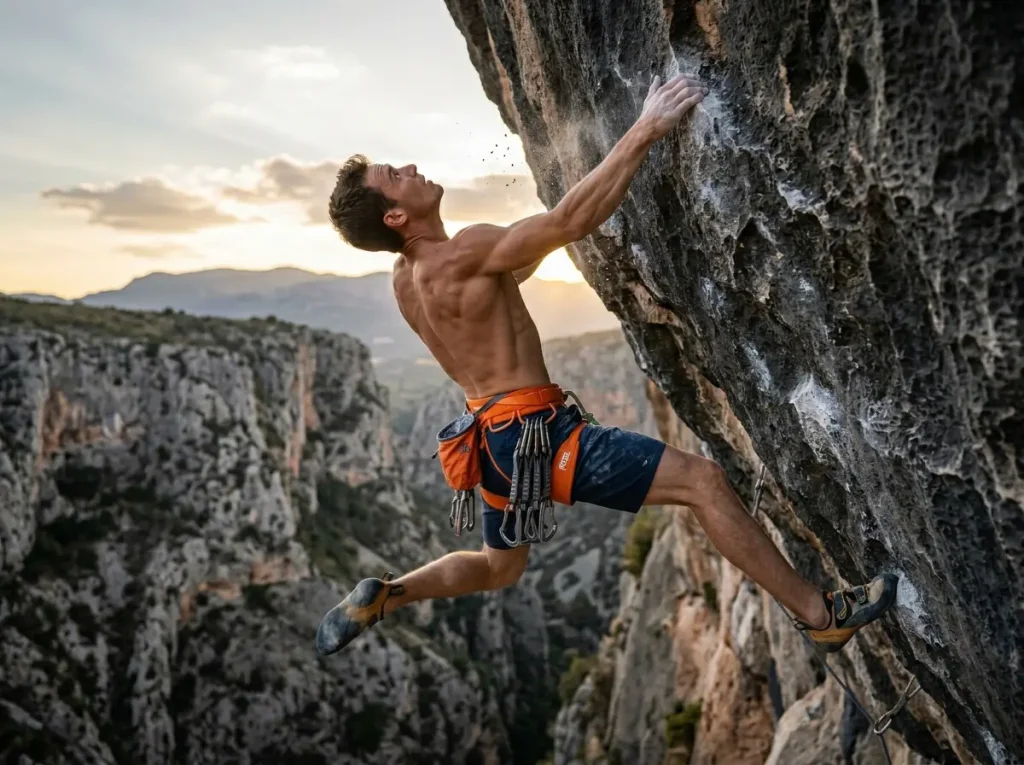
Here’s where everyone gets it wrong: they watch Ondra on a steep route and think the secret is his arms. It’s not. It’s his neck.
Biomechanics experts Martin Zvonar and physiotherapist Klaus Isele documented something unusual in Ondra’s movement on steep limestone at Flatanger—each time he finishes a move, his head tilts back slightly. It looks stylistic. It’s not. It’s a calculated shift of his center of mass (COM) away from the wall. When COM moves outward from the wall, the laws of static equilibrium respond: normal force on his feet increases. His feet cling harder. Not because he willed them to, but because the physics changed.
The functional consequence is straightforward. When your COM sits closer to the vertical plane of your feet on overhanging terrain, your finger flexors do less anti-gravity work per move. The fingers aren’t somehow stronger—they’re just fighting a smaller load. And Ondra’s longer-than-average neck gives him a COM lever arm that most climbers simply can’t replicate at the same magnitude. That part is anatomy. The timing of it, though—that’s trainable.
Geometric entropy (GE) is how you measure this. Low GE means your COM takes a direct, efficient path through a sequence. High GE means wasted adjustments, wasted energy. Ondra’s COM traces one of the most linear paths in the elite field. The measurable result: 1.25 seconds per new hand or foot contact, versus 2.0–3.0 seconds for standard elite climbers. That pace isn’t aggression. It’s a deliberate strategy to minimize Time Under Tension (TUT) for the finger flexors and exploit micro-rests during the reaching phase of each move.
At high contraction levels, muscle fibers compress surrounding capillaries, cutting blood flow and burning through the phosphocreatine system fast. Moving quickly breaks that occlusion cycle. It’s not about rushing. It’s about denying the pump the window it needs. The same COM physics that govern his 9c efficiency are laid bare in speed climbing, where any deviation is measured in tenths of a second—see our breakdown of center of mass management in speed climbing.
Pro tip: If you’ve ever felt your feet pop on an overhanging move mid-reach, you’ve felt exactly what Ondra’s neck is counteracting. Try looking slightly up and back the moment your reach hand lands. The foot suddenly holds better. It’s not an illusion—the geometry changed.
The Finger Strength Paradox: Why 110% Is More Than Enough
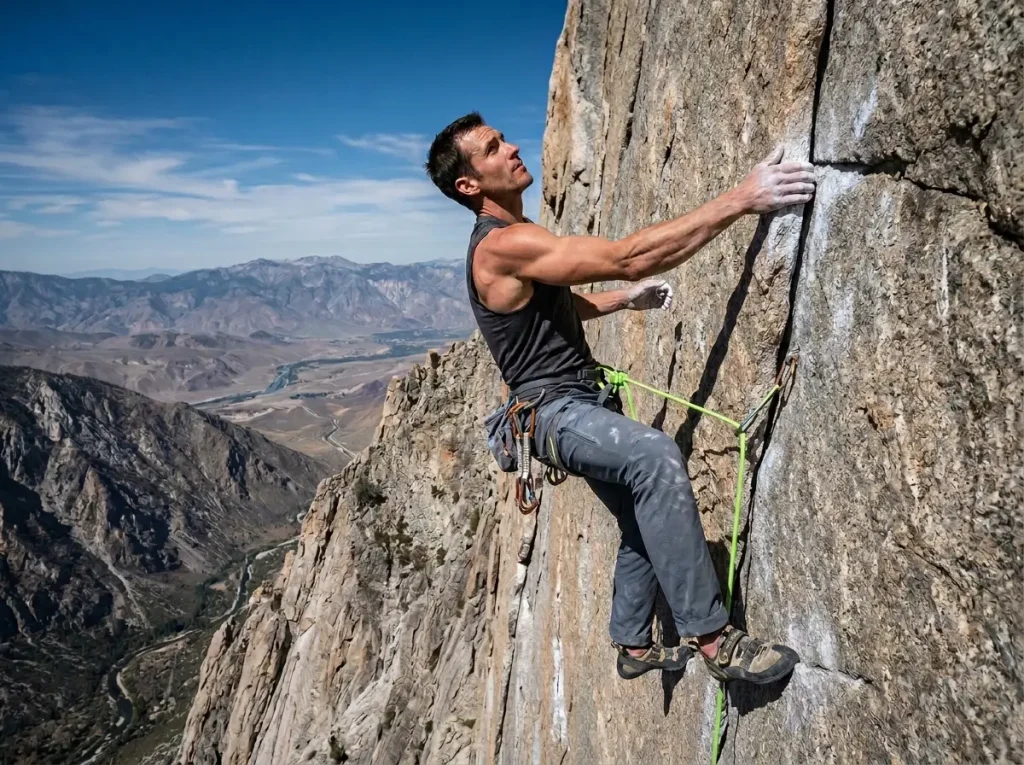
Ondra has said his fingers are “weak” compared to his peers. He’s not being modest. Lattice Training data backs him up: Ondra peaks at 110–117% of body weight (BW) on a 20mm edge. Alexander Megos peaks at 132% BW. Both climb 9c. That gap is the finger strength paradox, and if you don’t understand it, you’ll spend years on a hangboard going nowhere.
The differentiator is what Ondra’s coach Patxi Usobiaga calls integrated strength. Finger force is only as useful as the kinetic chain behind it—rotator cuff, scapular stabilizers, posterior chain. If those links are weak, force leaks between the fingertip and the foothold. Ondra’s training uses supersets (hangboard sets paired immediately with heavy deadlifts) specifically to build that chain under load. The hangboard hits the A2 pulley. The deadlift hammers the posterior chain while the finger flexors are already fatigued. Over time, the whole system learns to transmit force without dissipation.
His finger thickness ratio adds another layer. Ondra’s middle finger thickness-to-length ratio is 0.31, versus Alex Honnold’s 0.293 and Magnus Midtbo’s 0.277. Higher ratio means more resistance to shearing forces during crimping. That’s anatomy, not training. But his flash of Jade (V14) demonstrates recruitment efficiency—he activates a higher percentage of available motor units per move than most climbers can, regardless of their isometric ceiling. Before chasing higher numbers on a hangboard, confirm you’re testing correctly—our guide on proper finger strength testing protocols breaks down the MVC-7 method, the same framework used in elite assessments.
The practical implication is uncomfortable for most climbers: if your finger strength already clears 111% BW and you’re still plateauing, more hang time won’t fix it. Your shoulder girdle is the problem. That’s where the connection between resistance training and climbing performance becomes directly relevant—the research validates the integrated superset approach at a physiological level.
The other thing worth naming: most intermediate climbers test and train their fingers in isolation, on standardized hold angles, with rested shoulders. Ondra’s system is the opposite. The chain is trained together, under accumulated load, so the whole sequence from scapula to fingertip knows how to work as one piece. That’s the part no hangboard app is measuring.
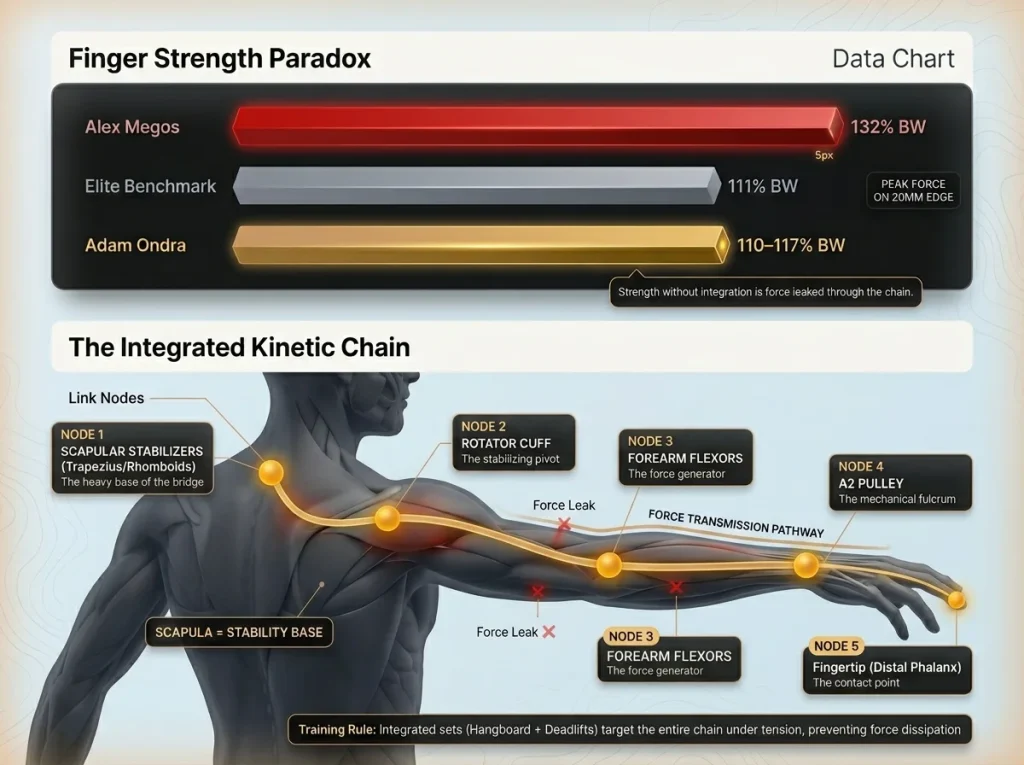
Pro tip: I’ve tested climbers who could hang a 30mm edge one-armed but whose shoulders were so destabilized they couldn’t transfer that force to the rock cleanly. Ondra’s apparent “weakness” is hiding the real lesson: the chain from scapula to fingertip has to transmit force without dissipation. Fix the chain, not the terminal link.
The Chemistry of Not Pumping Out: Critical Force and Proton Handling
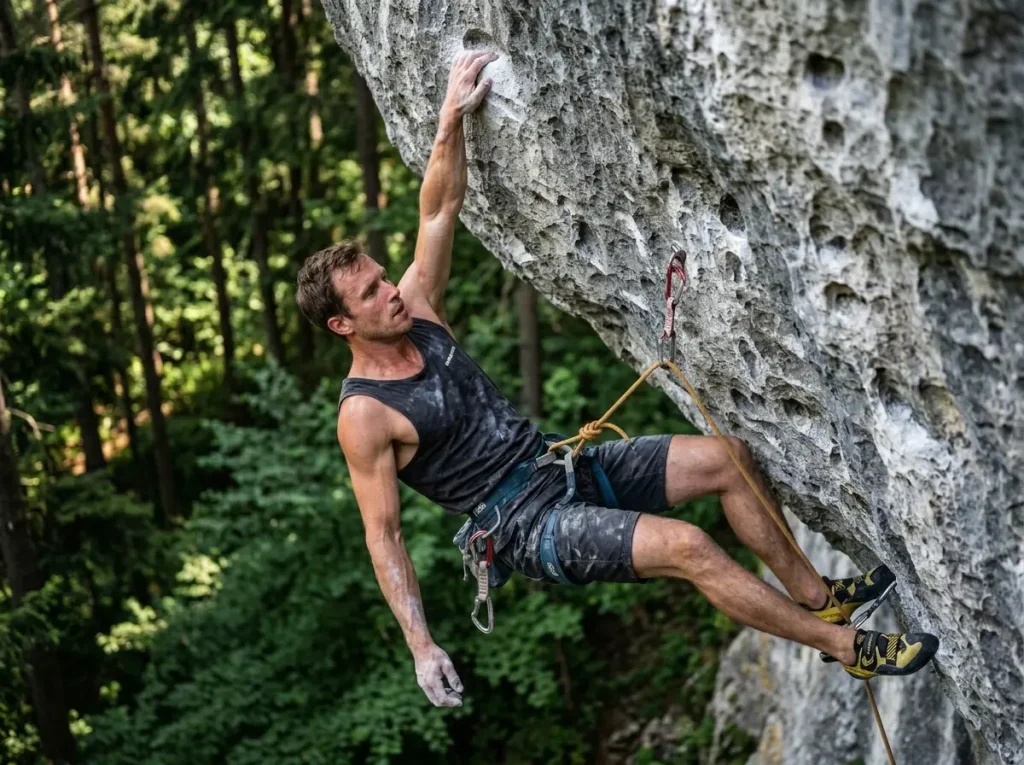
Most climbers think the pump is a strength problem. It’s a chemistry problem.
Critical Force (CF) is the maximum isometric load your forearm flexors can sustain through purely aerobic metabolism. Below CF, you can theoretically climb indefinitely. Above it, you’re drawing down your anaerobic reserve—and the clock starts. Ondra’s CF is unusually high in his forearm flexors, which means he recovers on holds that are “no rest” for most climbers. That’s not a vague compliment about his fitness. It’s a measurable physiological adaptation earned through high-volume aerobic interval training.
His AnCap (anaerobic capacity) score sits around 25%, versus Megos’s 35%. Lower AnCap favors long, sustained sport routes. Higher favors short explosive bouldering. Neither is better—they’re different metabolic profiles suited to different terrain. Ondra’s profile is purpose-built for routes like Silence.
Here’s the chemistry behind the pump: high-intensity climbing forces glycolytic metabolism, which produces hydrogen ions (H⁺). Those ions accumulate, drop intracellular pH, and your forearms stop cooperating. That’s the pump. Proton handling is your muscle’s ability to export those H⁺ ions fast enough to maintain contractility through a crux. Ondra’s 4×4 woody sessions—four hard problems, four rounds, minimal rest—are specifically designed to force adaptation in the transporters responsible for that export. He’s not just training fitness. He’s training a chemical clearance system.
If you want to build the same proton-handling capacity without a 40-degree woody, our guide on the complete science of the pump gives you the full training framework. The clinical trial on finger extensor training vs. flexor training in climbing performance adds relevant context on the physiological variables that matter most.
The 85-second rest cycle used in beginner versions of this protocol isn’t arbitrary. It matches the partial phosphocreatine (PCr) resynthesis window—enough recovery to drive the next bout without full reset, which is exactly the stress the adaptation requires. Run shorter rest periods and you burn out the session. Run longer and you lose the training signal. The specificity of that number is the difference between doing 4x4s and actually building what Ondra built.
Pro tip: The difference between coming off at the crux and clipping the anchor isn’t usually strength. It’s whether your forearms can clear enough H⁺ ions to maintain contractility for two more moves. That’s trainable. Ondra’s woody sessions are literally chemistry drills wearing the costume of climbing.
Respiratory Physics: Why Ondra Screams (And Why You Should Too)
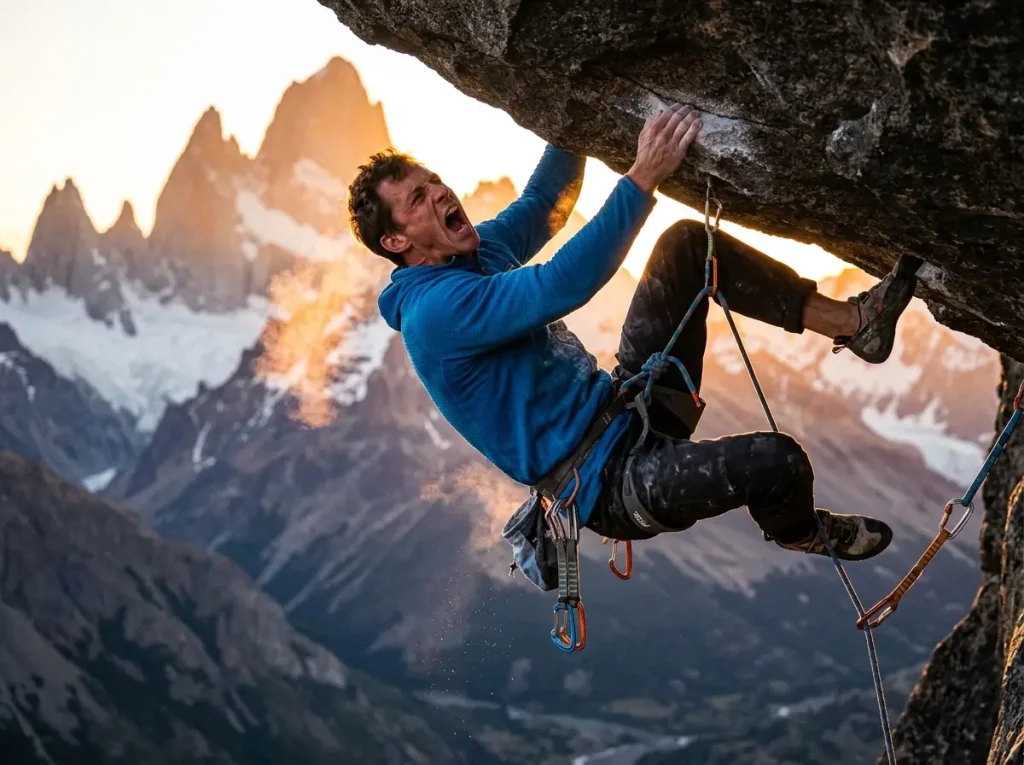
The screaming is not what it looks like.
When Ondra hauls through a crux on a 9c route and the sound comes out—that sharp, compressed exhalation—most people watching read it as intensity or emotion. The physiology says something different. It’s the Valsalva maneuver: a forceful exhalation against a semi-closed glottis, which sharply increases intra-abdominal pressure (IAP). The vocalization is just the audible side effect of the mechanism. The mechanism itself is structural engineering.
Think of the core as a bridge between your feet and your hands. On overhanging terrain, any slack in that bridge—any “core sag”—increases the distance between your COM and the wall. Finger load spikes. The Valsalva eliminates that slack. By creating a rigid core cylinder, Ondra transfers leg-generated force directly through the torso to the hands without dissipating it through a soft midsection.
Two things happen when IAP goes up: first, force transfer—leg power reaches the hands cleanly. Second, shoulder stabilization—a rigid core gives the shoulder girdle a solid base to work from, which maximizes finger recruitment capacity. The same shoulder rigidity that the Valsalva enables is the foundation of every locked-off crux position; our breakdown of lock-off strength mechanics explains how to build that base deliberately.
Ondra also shifts timing by difficulty. On easier sections, he uses purposeful, rhythmic breathing to stay aerobic. On limit moves, he locks with the Valsalva—brief, explosive, then releases. Think of it as respiratory pacing gears. Most recreational climbers have one gear: hold your breath or don’t. He has three.
Try this on a dead-hang you can barely stick: inhale fully, then exhale hard against a closed throat. Feel your core go rigid? Your grip suddenly holds better because your shoulder base just stabilized. That’s the IAP mechanism running in real time. Now do it on your crux move instead of holding your breath randomly and wondering why the feet keep cutting. The Lattice Training video “Beyond Strength: 6 Lessons From Adam Ondra’s Climbing” covers this alongside five other technical pillars—it’s the most instructionally dense piece of footage on his mechanics publicly available:
The Woody Bible: 30°/40° Angles, 4x4s, and the Gear of Training
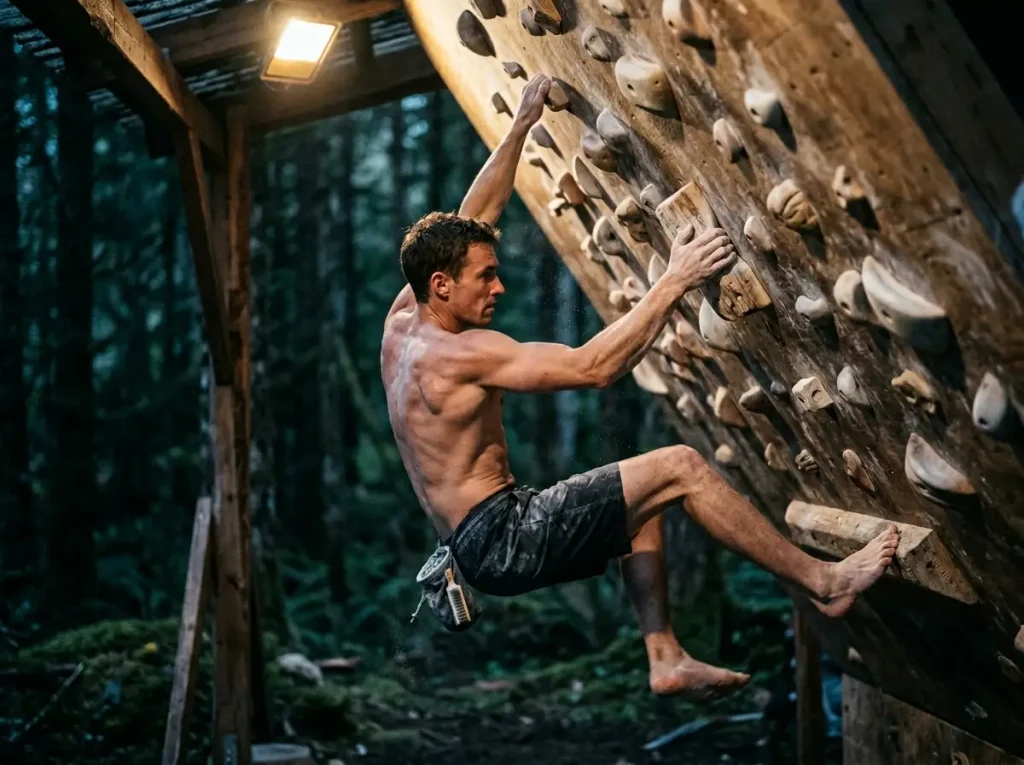
Ondra doesn’t train in commercial gyms. He doesn’t train on a Moonboard or a Kilterboard. His objection is specific: standardized boards train strength on fixed hold angles and movement patterns. That’s precisely the limitation. Real 9c terrain is unpredictable. The sequence is improvised. The footholds are where they are.
His solution is an 8×12-foot spray wall—a board with a random, dense array of holds where no two sessions look the same. The spray wall forces technique into sub-optimal positions, building the motor versatility that world-class sport routes demand. If you’re currently training on one of these systems and wondering whether to make a change, our cost-and-training comparison of how standardized boards compare to spray walls for technique development gives you the data to decide.
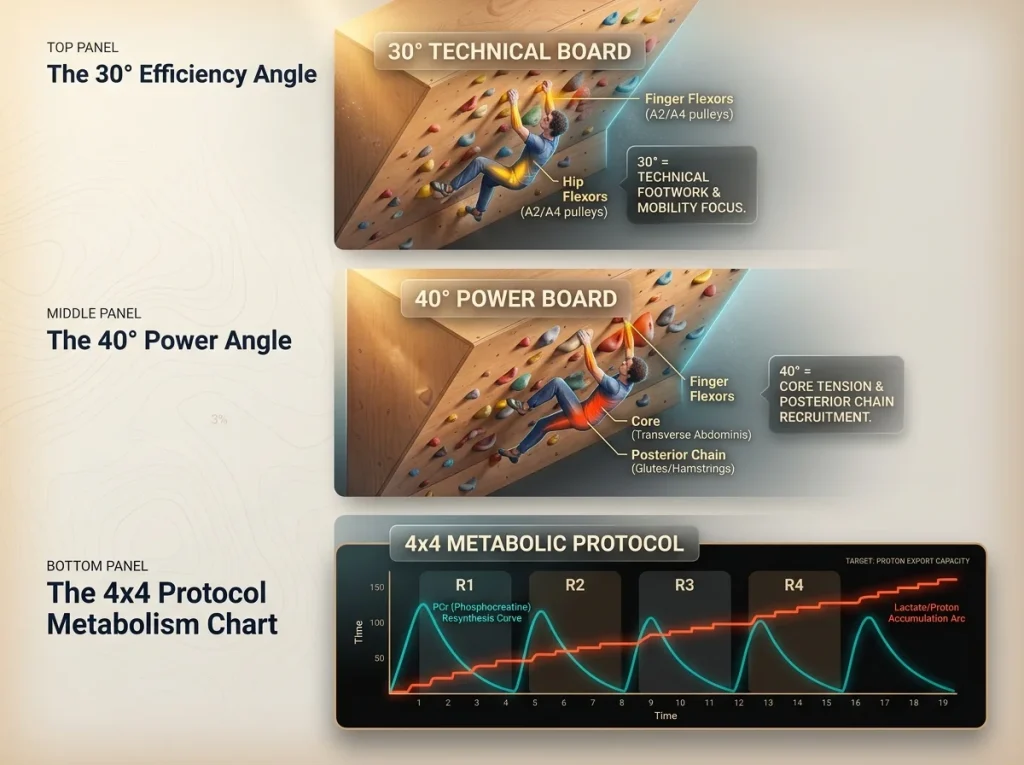
The 30°/40° golden angles each serve a distinct purpose. Thirty degrees stresses technical footwork and hip flexibility while keeping meaningful load on the finger flexors. Forty degrees mirrors the steepness of Silence’s limestone—raw power, core tension, posterior chain engagement. The volume of movement at these angles is the engine behind his aerobic efficiency.
The sessions themselves look like this: 4×4 bouldering (four problems, four rounds, minimal rest) for proton handling and power-endurance; integrated strength supersets (hangboard sets paired immediately with deadlifts) for kinetic chain integrity; Silent Feet drills targeting placement accuracy and metabolic waste reduction; Max Hangs at 7 seconds to maintain the 110–117% BW baseline. Each element addresses a specific physiological target. Nothing is in there for variety or aesthetics.
The woody size—8×12 feet—matters. It’s large enough to link moves. Small enough to force load specificity. Ondra’s public statements on the spray wall are consistent: the board is chaotic by design. Chaos is the point. Perfecting Your Climb: Spraywall Training | Tips & Tricks by Adam Ondra shows him explaining exactly why the improvisation matters for technique transfer.
Pro tip: I spent three months on a Kilterboard and improved my numbers on the board while going backwards on real rock. Isolation does that—you train the grip angles the board provides, not the chaos of actual stone. Ondra’s spray wall is deliberately chaotic. That is the adaptation.
The Equipment Interface: Two Different Shoes for a 9c First Ascent
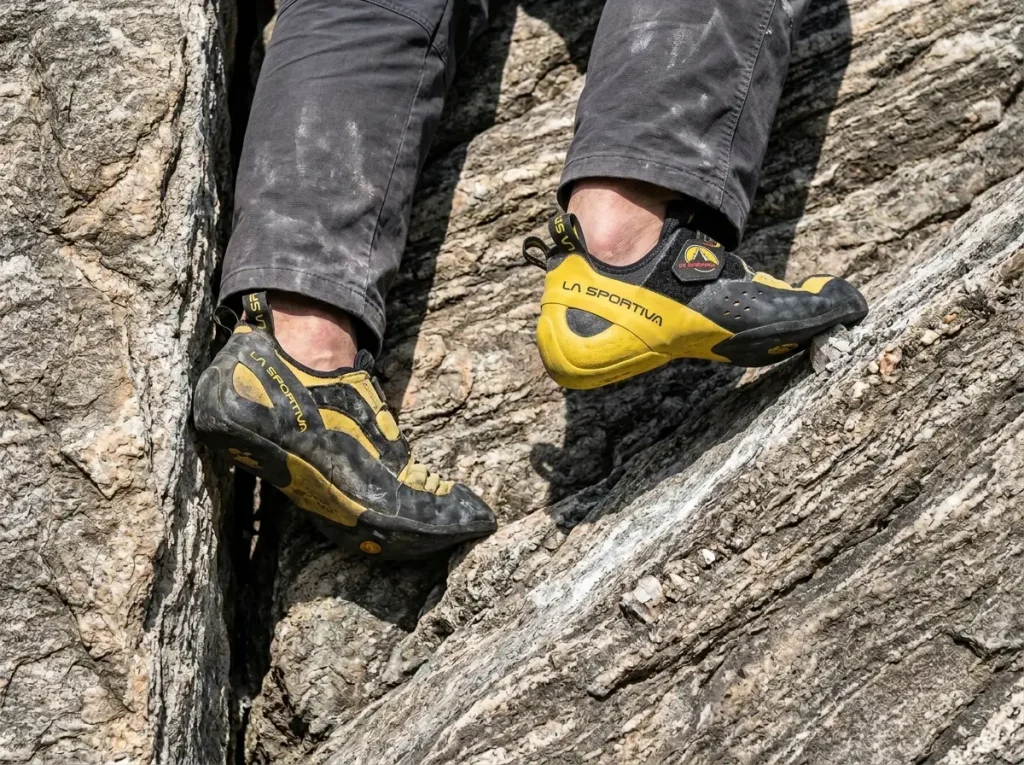
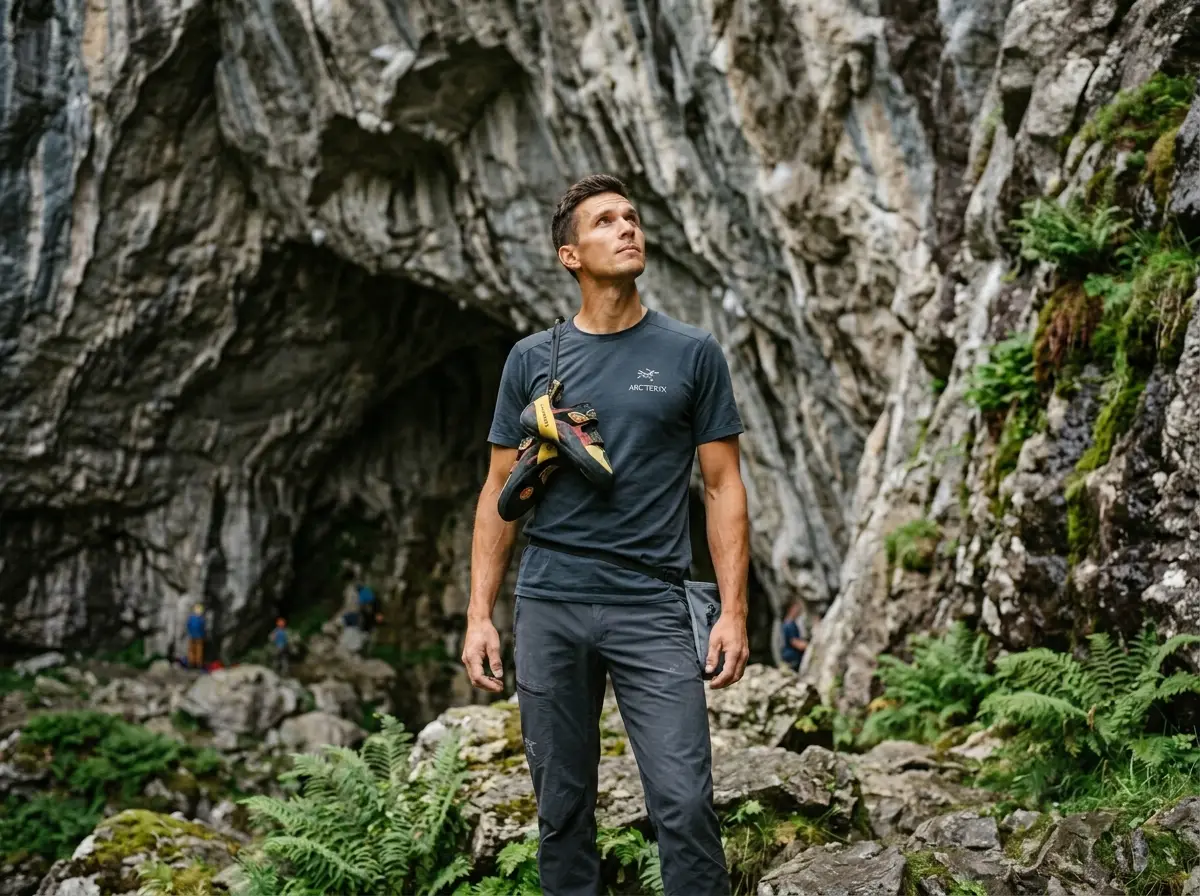
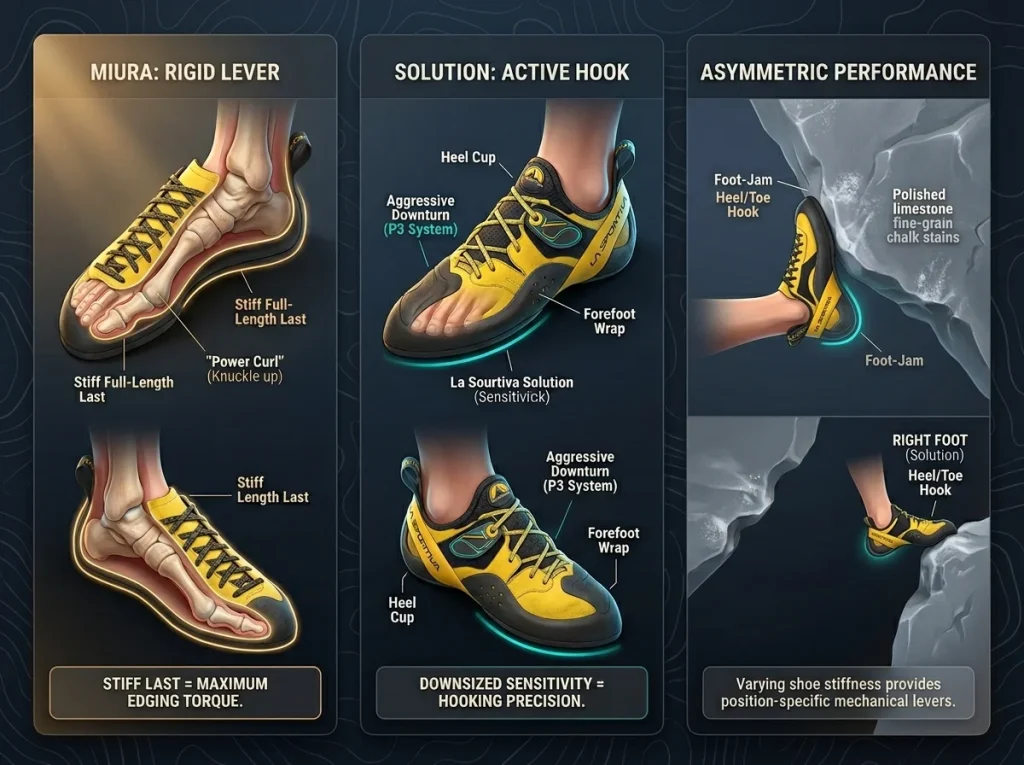
For the first ascent of Silence, Ondra wore a La Sportiva Miura on his left foot and a La Sportiva Solution on his right. Not because he forgot to match them. Because the crux demands two completely different mechanical functions from the same human foot.
The critical moment is a specific foot-jam that Ondra has described as “absolutely essential”—without it, the sequence that follows is physically impossible. The jam requires a shoe that behaves like a rigid lever resisting rotational torque in a crack. That’s the Miura: edging power, lateral stiffness, precisely the profile you want when your foot needs to lock without collapsing under load. The right foot, meanwhile, needed to hook and pull on steep overhanging limestone. That’s the Solution: aggressively downturned, high sensitivity, built for feel over stiffness.
His shoe downsizing follows the same logic. Street size 44 EU, climbing size 40 EU. Four sizes down. That compression places the big and second toes in a “power curl” that maximizes force on micro-edges. Vibram XS Grip2 rubber maintains friction. The P3® System keeps the shoe’s shape under dynamic load. None of this is comfort. It’s precision. Our guide to La Sportiva’s fit and last system for different foot morphologies breaks down why those architectural differences matter when you’re making your own selection.
The lesson for everyone else isn’t to buy Miuras. It’s to stop thinking of shoes as general-purpose climbing equipment and start thinking of them as position-specific levers. A highly downturned shoe is a single-purpose tool. Ondra knows exactly which tool each position requires. Most of us are still reaching for the same hammer regardless of the job. He tested multiple models across multiple seasons before arriving at the asymmetric decision. That’s the anti-sell principle applied to footwear.
The Neuro-Plasticity Engine: Why “Fun” Is a Training System
Here’s the counterintuitive part. Ondra trains 4–5 hours per day, six days a week, at intensities most climbers can’t hold for an hour. That volume should produce cortisol accumulation—the neurological enemy of motor learning. Chronically elevated cortisol impairs the synaptic plasticity that encodes new movement patterns into the cerebellum. At his training volume, he should be getting worse at climbing. He doesn’t.
The explanation is his fun-first attitude, which sounds like a personality quirk and operates like a cortisol management system. By maintaining psychological play during sessions, he keeps dopamine elevated. Dopamine is the primary regulator of neuro-plasticity—the mechanism by which complex motor sequences get encoded into the cerebellum for automatic retrieval. Without it, volume produces fatigue. With it, volume produces skill. Al López and Eric Hörst have independently noted this as a key differentiator: most high-end climbers train with anxiety. Ondra trains with engagement.
Three things fall out of this architecture. First, high-volume skill acquisition—thousands of moves per session become feasible without mental burnout. Second, visualization proficiency—mental rehearsal becomes detailed enough to function as pre-programmed motor responses before an attempt even begins. Third, arousal control—8b/9a terrain stops registering as hard, psycho-physiologically, which leaves full cognitive resources available for the 9c crux. Our 4-week mental training protocol for climbing gives you a structured approach to building this arousal control deliberately.
The implication for everyone else is uncomfortable: grinding through sessions you hate is neurologically counterproductive. Volume only builds motor skill when the nervous system is in a receptive, dopamine-elevated state. Joyless suffering produces accumulated fatigue, not elite movement economy. How you feel during training is not a soft consideration. It’s a training variable. The easiest gains most climbers have never touched are right there in the session quality, not the session length.
Pro tip: I noticed I learned new moves fastest on days when I genuinely didn’t care if I sent. The second I started “trying,” the learning slowed. Ondra seems to have figured out how to permanently live in that first mental state—not as a personality quirk, but as a deliberate physiological tool.
Conclusion
Three things worth taking from the Ondra framework.
One: his strength is his system, not his fingers. At 110–117% BW—barely above the 9c minimum benchmark—he doesn’t have the strongest fingers in the room. He wins through a fully integrated kinetic chain, low geometric entropy, and force transfer that most climbers waste through poor shoulder stability and inefficient COM management.
Two: his respiratory system is a structural component. The Valsalva maneuver is not a breathing tip—it’s core engineering. IAP creates a rigid torso that transfers leg power to the fingers without leaking it through the midsection. If you’re not timing your exhale to your crux move, you’re leaving force on the table.
Three: training volume only works if your nervous system is online. His 4–5 hours per day is possible because the fun-first protocol keeps dopamine elevated and cortisol suppressed—the neurochemical conditions for motor skill encoding. Suffering your way through sessions produces fatigue, not analytical climber gains.
Take one concept from the Ondra framework this session. Just one. Try the head-back COM shift on your next overhang and feel whether your feet suddenly grip better. Or time your exhale to your crux move. Or go into your next board session with the explicit goal of having fun, not sending. The physics don’t care about your motivation. They respond to the correct inputs.
FAQ
How many hours does Adam Ondra train per day?
Ondra typically trains 4–5 hours per day, six days per week. That volume is only possible because his training methodology prioritizes skill acquisition in a dopamine-elevated, cortisol-managed state. Grinding joylessly for 5 hours per day produces a different outcome entirely—accumulated fatigue without the motor encoding.
What is Adam Ondra’s finger strength compared to other elite climbers?
Ondra’s peak finger force sits at 110–117% of body weight on a 20mm edge—at or just above the minimum benchmark for 9c-level climbing. Alexander Megos reaches 132% BW, another 9c climber. Ondra compensates through superior movement economy, integrated kinetic chain strength, and COM management rather than raw isometric capacity. The gap between those two approaches is the finger strength paradox.
Can recreational climbers apply Adam Ondra’s training methods?
Selectively, yes. His 4×4 woody protocols, Valsalva core technique, and fun-first neurological approach are transferable. His extreme shoe downsizing (four EU sizes) and the anatomical advantages of his neck length and finger thickness ratio are not replicable. The most valuable transfer is the integrated strength superset model and the principle that COM efficiency, not raw finger force, tends to be the actual limiting factor for intermediate climbers.
What is the Valsalva maneuver and how does Ondra use it in climbing?
The Valsalva maneuver is a forceful exhalation against a semi-closed glottis, which increases intra-abdominal pressure. Ondra uses it on limit moves to create a rigid core cylinder—this transfers leg-generated force through the torso to the hands without dissipation, and stabilizes the shoulder girdle for maximum finger recruitment. His vocalizations during hard moves are the audible byproduct of this respiratory strategy.
Why does Ondra prefer a spray wall over a Moonboard or Kilterboard?
Ondra has said standardized boards focus too much on strength itself—they train force production on a fixed set of hold angles and movement patterns. A spray wall, with its random, dense array of holds, forces technique into improvised, sub-optimal positions. That’s the exact demand of unpredictable world-class sport routes. For high-volume, technique-focused training within a small space, the spray wall produces better transfer to real rock. It also demands more cognitive engagement per session, which keeps dopamine up and cortisol down—which loops back to neuro-programming adaptation.
Safety Notice: Rock climbing and mountaineering are inherently high-risk
activities that can involve physical trauma or fatal incidents. The information on Rock Climbing Realms is for
educational and informational purposes only. Techniques and advice presented here are not a substitute
for professional, hands-on instruction. Conditions and risks vary by location. Always seek guidance
from a qualified instructor before attempting new techniques. By using this website, you agree that you
are solely responsible for your own safety. Any reliance you place on this information is strictly
at your own risk, and you assume all liability for your actions. Rock Climbing Realms and its authors
will not be held liable for any harm, damage, or loss sustained in connection with the use of this information.
Affiliate Disclosure: We are a participant in the Amazon Services LLC Associates Program, an
affiliate advertising program designed to provide a means for us to earn advertising fees by advertising and linking
to Amazon.com. As an Amazon Associate, we earn from qualifying purchases. We are also an official affiliate partner
of Black Diamond Equipment via the AvantLink network. If you click on a Black Diamond affiliate link and make a
purchase, we may earn a commission at no additional cost to you. We also participate in other affiliate programs.
Additional terms are found in the terms of service.