
In this article
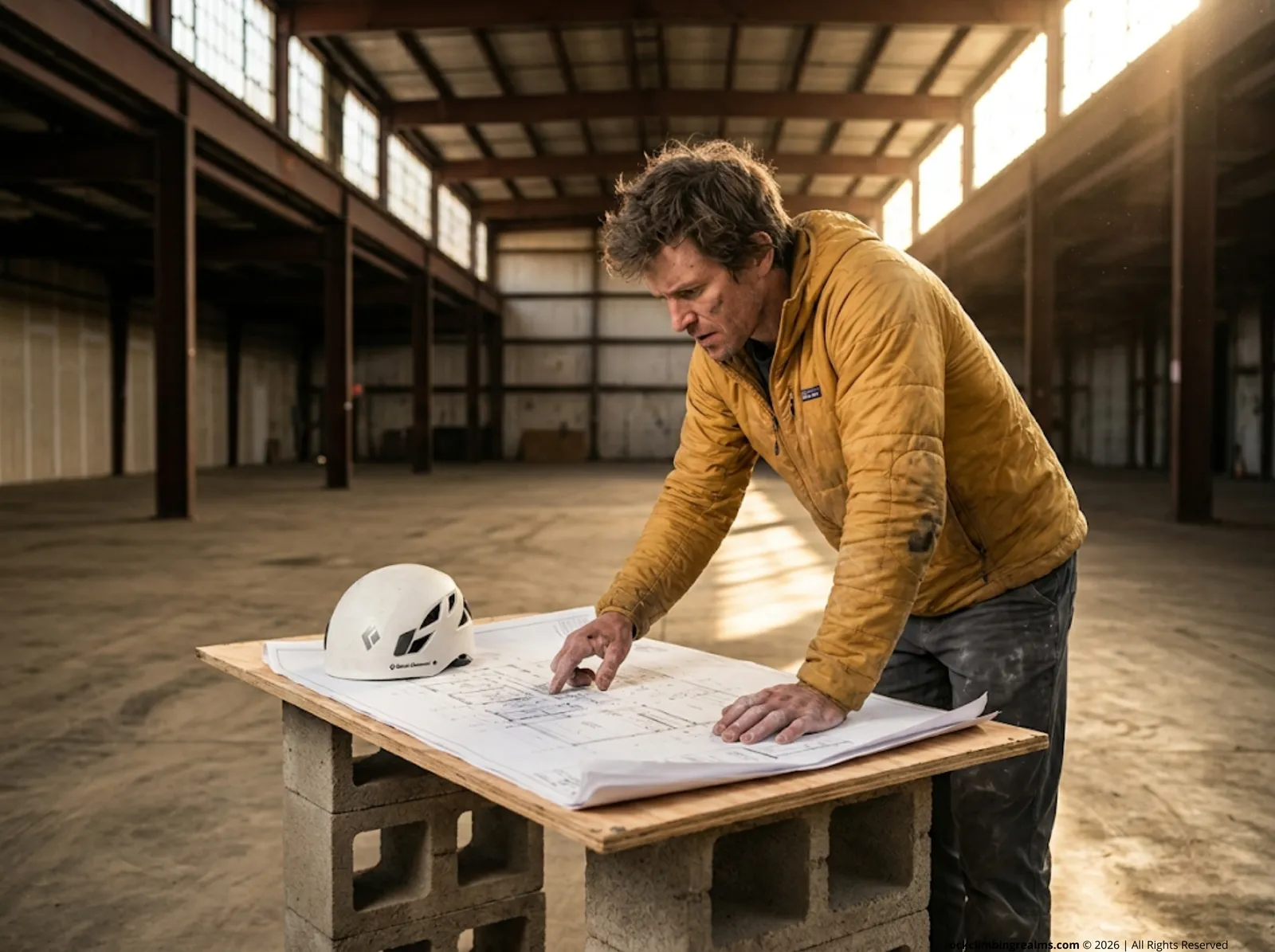
You’re sitting across from a commercial loan officer who has never touched a carabiner in their life. You’re trying to explain why you need a million dollars to bolt plastic shapes onto an empty warehouse wall. Your spreadsheet shows a $57,000 monthly burn rate, and if your structural math for T-nut loads is even slightly off, your insurance premiums will bleed you dry before opening day. This isn’t a passion project anymore; it’s a high-stakes real estate and infrastructure play. As someone who has navigated these exact negotiations and spent a decade analyzing climbing facilities from the inside out, I can tell you the reality is harsh. This guide deconstructs the exact initial capex financial data, structural realities, and technical operational strategies you need to build a professional climbing gym business plan that secures bank funding and ensures your facility survives the first five years.
⚡ Quick Answer: Building a profitable climbing gym requires an initial capital expenditure of around $1 million for a standard 10,000 square foot bouldering facility. The bulk of this budget goes to structural build-outs and specialized wall fabrication. Securing financing typically involves an SBA 7(a) loan, which demands a solid business plan, a 10% to 20% founder equity injection, and a personal guarantee. Operational break-even aims for 60 days, but full capital payback averages 50 months.
The Pitch: Securing $1 Million in Investment Capital
The Blunt Reality of a Climbing Gym CapEx Budget
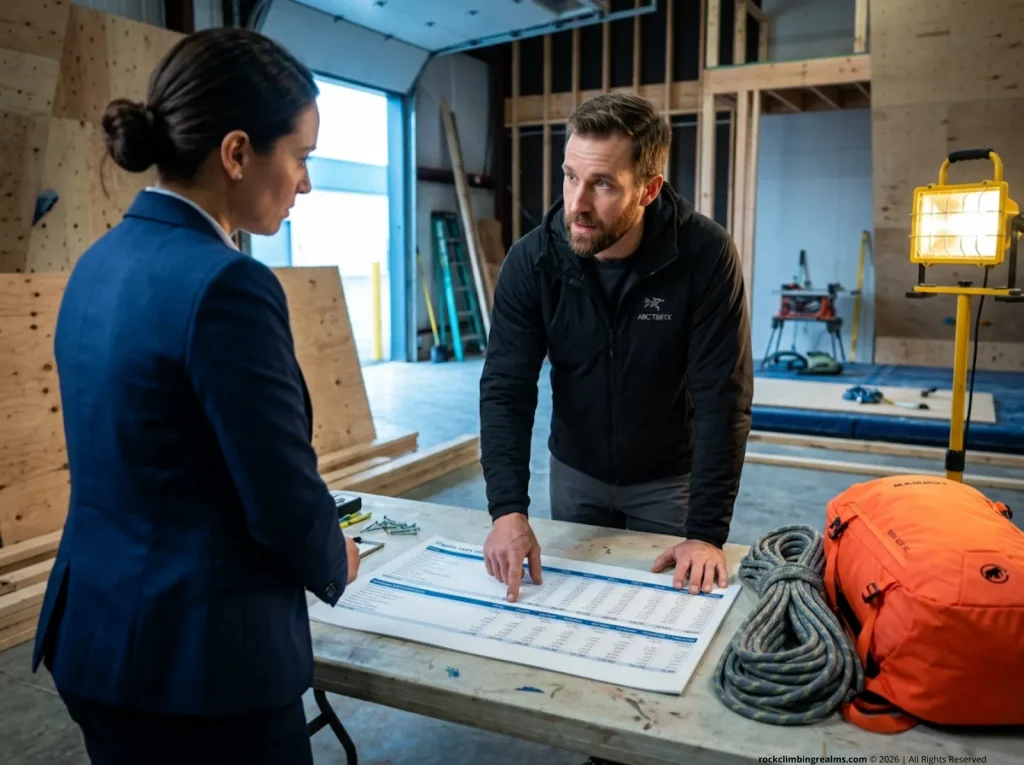
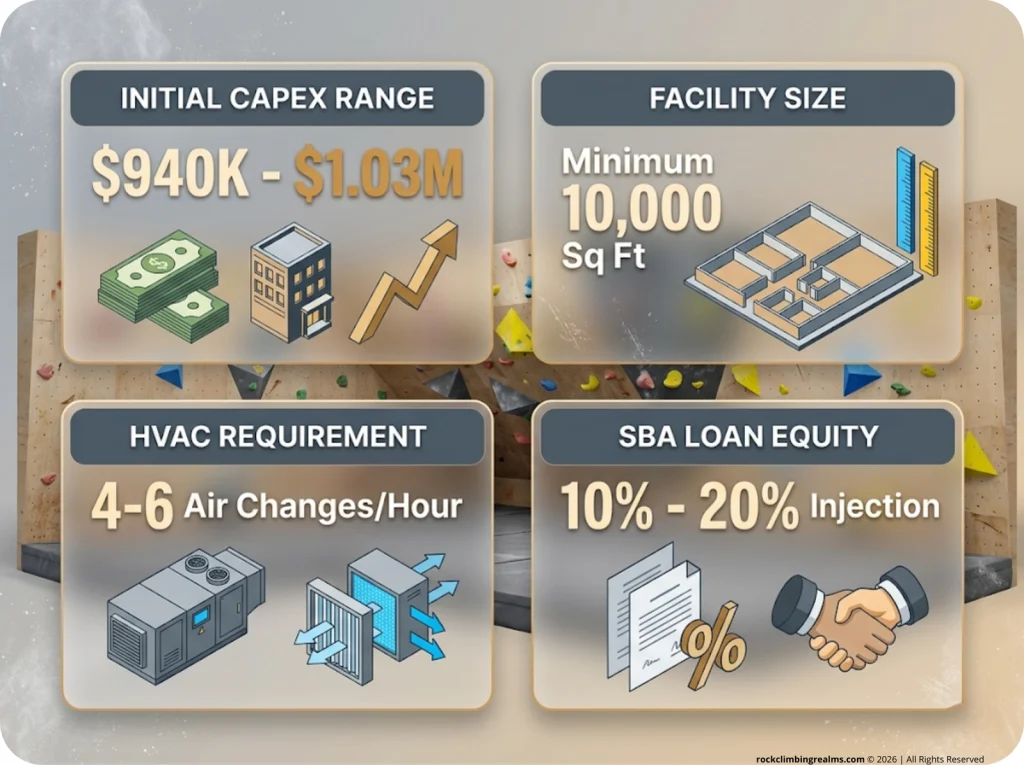
When you start drawing up the numbers, the structural reality hits hard. The upfront capital required to build a facility is immense, typically ranging from $940,000 to $1,036,000 for a standard 10000 sq ft bouldering gym. Physical build-out consumes about 42.5% of the total budget, eating up roughly $400,000 before you even buy a single hold. Specialized wall fabrication usually from major builders like Walltopia or Vertical Solutions takes another 31.9%, demanding around $300,000.
Pro-Tip: Over-budget your plumbing and electrical. Retrofitting climate control and complex wiring in an old warehouse almost always runs 20% over initial contractor estimates.
You are paying for heavy infrastructure, not just climbing gear. When pitching for investment capital, your financial model has to prove you understand this ratio thoroughly. You need to demonstrate exactly how climbing gyms actually make money through memberships, retail, and recurring services to justify these massive upfront expenses.
Navigating SBA 7(a) Loans and Personal Guarantees
Most founders don’t have a million dollars sitting in cash. Securing funding for a climbing gym usually means dealing with the federally-backed SBA 7(a) loan guidelines. This program provides up to $5 million, which acts as the industry standard for commercial gym builds. However, banks demand significant skin in the game. You’ll need to provide 10% to 20% in founder’s equity.
If you own an equity stake of 20% or more, expect to sign an unconditional personal guarantee. This often means tying up your personal real estate as collateral. You must show the bank comprehensive market research and a clear realistic path to profitability. They want to see your projected return on investment over a standard 50-month payback horizon.
Modeling Your Operational Runway (The $96K Cushion)
Opening your doors is just the first hurdle. Your gym will immediately face a massive monthly burn rate. Expect your operational expenses to sit around $57,000 every month just to keep the lights on, the air clean, and the staff paid. You need a cash cushion of at least $96,000 to survive the first few months of operation.
A well-modeled facility aims for operational break-even within 60 days. Anything slower and you risk bleeding out your cash reserves. When pitching to private equity funding partners or a local bank, the mantra is speed and aggression. The industry won’t wait for you to find perfect terms, so lock in the money efficiently.
The Market: Real Estate, Zoning, and Structural Math
Why “Deep” Urban Expansion Beats Untapped Markets
The current trend in gym development favors fighting for territory in established metropolitan hubs. In 2024, 90% of new U.S. facilities opened in existing cities through deep urban expansion rather than testing unproven rural markets. Driven by the IFSC competitions and the massive Olympic impact on the sport’s popularity, the demand for accessible training centers is intense.
A successful gym acts as your members’ target ikigai—the sweet spot of passion, community, and purpose. It becomes a community hub or a reliable third place for modern athletes. Extensive location scouting in urban environments ensures you capture enough baseline foot traffic to sustain the heavy operational costs.
The High-Ceiling Warehouse Hunt (20-Foot Minimums)
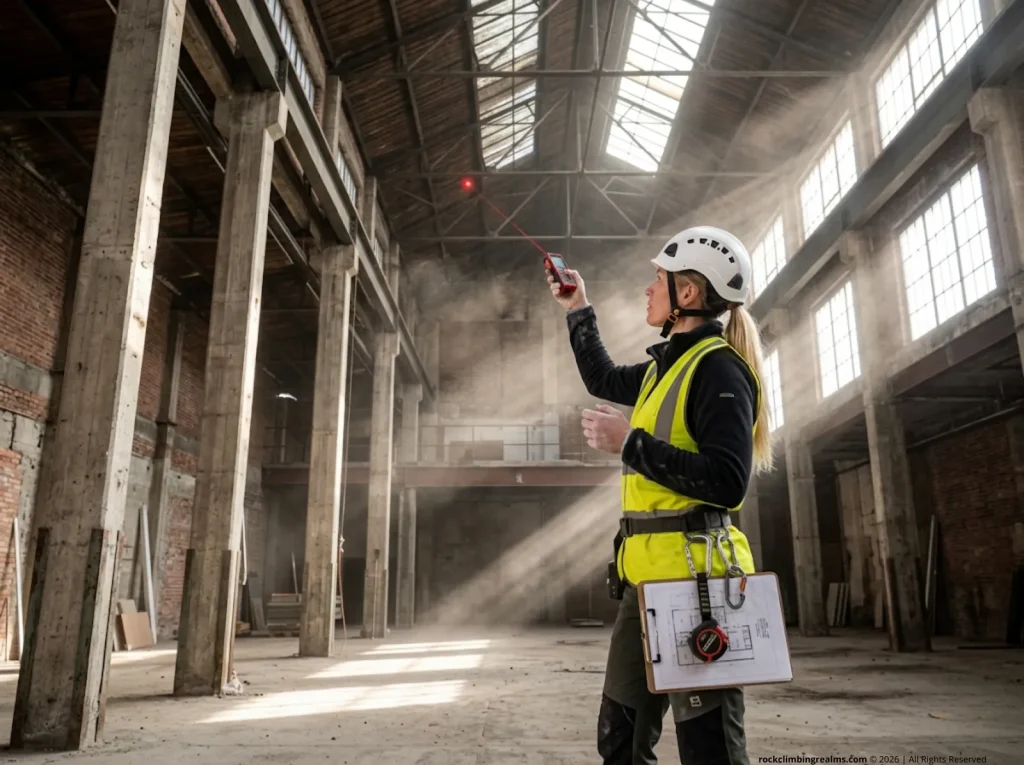
You aren’t just looking for an empty room. You are hunting for a concrete box that can handle massive cantilevered loads without stress fractures. Commercial real estate requirements for bouldering facilities specifically necessitate a high ceiling warehouse with a strict 20ft height minimum. If you plan to offer rope routes for lead climbing, you’ll need significantly more vertical clearance, usually pushing 40 to 50 feet.
Because strict bouldering gyms require less vertical space, they account for 73% of new development projects. The lower ceiling requirements open up more real estate options and keep build-out costs physically manageable. However, industrial spaces trigger complex zoning regulations for assembly occupancy. Securing commercial occupancy permits often presents severe friction, easily burning $20,000 to $35,000 in legal and engineering fees.
The Engineering of T-Nuts and Heavy Load Capacities
The physical construction of your walls requires exact structural engineering. Wall fabrication typically sees a cost to build a climbing wall averaging $35 to $50 per square foot of climbing surface. The geometry and angles strictly dictate the price. Every single T-nut and bolt must be engineered to withstand roughly 700 pounds of pull-out force.
When a 200-pound climber whips, that shock load transfers right into the plywood and steel framing. Understanding mounting climbing holds for maximum safety and durability requires precise panel-to-panel joints with gaps no larger than 0.5 inches to prevent catastrophic finger entrapment. You need an official engineering stamp on every CAD drawing before the city will even consider an inspection.
The Talent: Routesetting Diversity as a Retention Strategy
Treating Routesetters as Product Developers
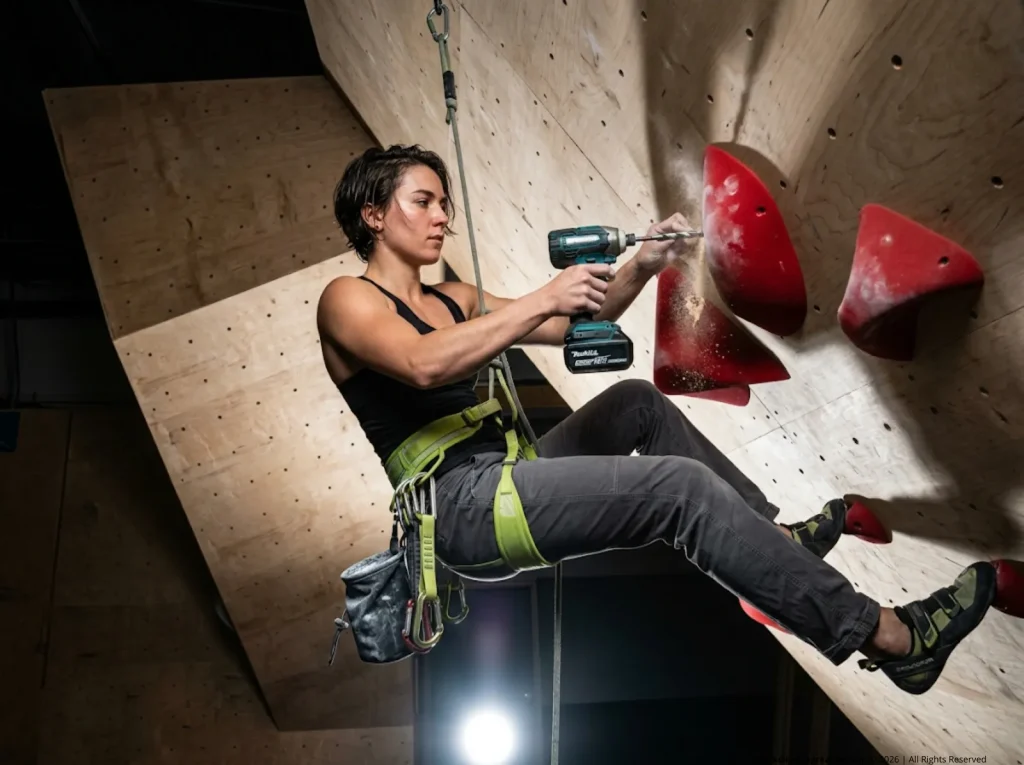
Your front desk sells the membership, but your setting team keeps the doors open. Professional route setting is the actual physical product your customers constantly consume. Head setters command an average salary of $54,531 annually, reflecting their critical role as the primary product developers in your facility.
They dictate the daily physical experience for everyone doing recreational climbing to professional athletes undergoing focused pro training. If your setting gets stale or repetitive, your member retention metrics will crash fast. Bad setting alienates the experienced core climbers first. If the veterans pack up and leave, the gym loses its soul and eventually its profit margins.
The Financial Cost of Homogeneous Climbing Holds
A setting team consisting entirely of tall male climbers produces reachy problems that alienate a huge portion of your customer base. This homogeneity directly increases your customer churn rate among shorter climbers and women. Diversity inside your route setting team correlates directly with stabilized and reliable recurring revenue.
You need a massive plastic inventory to support creative execution. Supplying a diverse variety of climbing hold shapes and grips is a heavy, recurring expense. Sourcing resin from commercial suppliers requires a constant purchasing cycle to keep the walls feeling textured, fresh, and challenging.
2025 Staff Salary Benchmarks and Operational Roles
Operating a modern training facility requires a substantial and expensive payroll. According to the CBJ (Climbing Business Journal), the average hourly wage for a U.S. climbing gym employee hit $23.88 in 2025. This covers everyone from the setting crew on the ropes to the shift managers on the floor.
Your front desk staff, averaging $20,708 annually, act as your first immediate line of risk management. They ensure rules are followed and facility orientations are strictly enforced. To supplement the physical setting demands, modern gyms invest heavily in interactive training boards. Systems like Kilter, Tension, or Latitude Climbing walls cost between $5,000 and $15,000, but they provide high-density training options that require absolutely zero manual resetting.
Pro-Tip: Pay your front desk staff more than minimum wage. They are the gatekeepers of your liability systems and the direct face of your customer service. Cheap, unmotivated labor at the desk costs you thousands in lost memberships and legal risks.
The Environment: Defeating Chalk Dust and Liability
The Invisible Threat of Sub-10 Micrometer Particulates
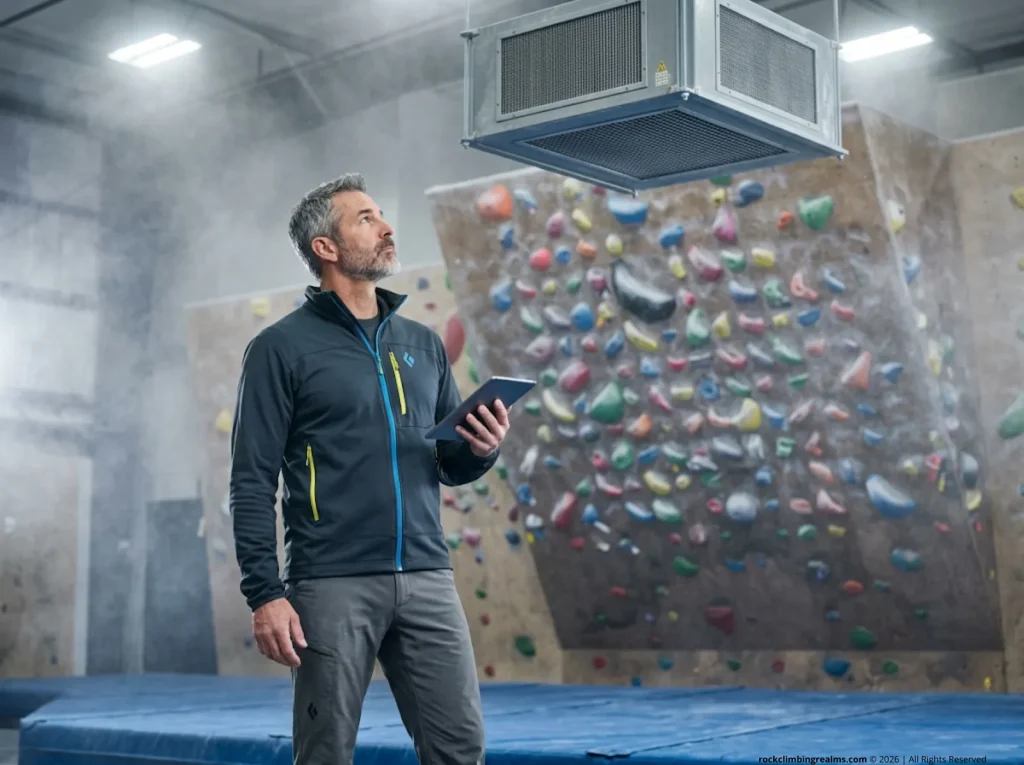
Indoor climbing creates an incredibly hostile atmospheric environment. The constant daily use of chalk releases thick clouds of fine chalk dust. These particles are so incredibly small—some smaller than a single micrometer—that they stay hanging in the air all day.
If you walk into a gym and see a permanent white haze near the ceiling, you are looking at an operation that under-budgeted their HVAC system violently. Recent data shows that tiny bits of worn shoe rubber add serious pollutants to the mix, doubling the absolute need for aggressive filtration. Serious athletes know exactly what sophisticated climbers evaluate when choosing a climbing gym, and coughing through a thick cloud of dust is an immediate, permanent dealbreaker.
Engineering 6 Air Changes Per Hour (Electrostatic Filtration)
Standard commercial AC units flip the air in a room about 1.5 times an hour. That won’t cut it for a climbing gym. A specific requirements for a climbing gym is a system that recycles the room’s air 4 to 6 times every hour to maintain safe breathing conditions and keep the dust off the critical friction slabs. Special HVAC ventilation systems are flat-out non-negotiable.
You need specialized electrostatic filters hung right above the action. These units pull chalk directly from heavily trafficked walls while operating continuously at a quiet 52 dBA. This isn’t just about customer comfort; it’s an infrastructural necessity to protect the lungs of your staff.

Insurance Caps and the 15-Foot Bouldering Baseline
Risk management drives the specific physical dimensions of your build. Carrying adequate general liability insurance is entirely mandatory, typically costing between $2,000 and $5,000 annually. However, keeping your bouldering walls strictly under the 15-foot threshold guarantees lower insurance premiums across the board.
Beyond customer liability, you also have to factor in workers’ compensation, averaging $0.75 to $2.50 per $100 of operational payroll. Navigating the Climbing Wall Association 4th Edition Industry Practices manual helps establish solid defensive legal baselines. Staying compliant with these height restrictions and daily safety checks keeps your insurance carriers happy.
The Build: Safety Mats, Hold Chemistry, and Sustainability
ASTM-Compliant Flooring and the 12-Inch Threshold
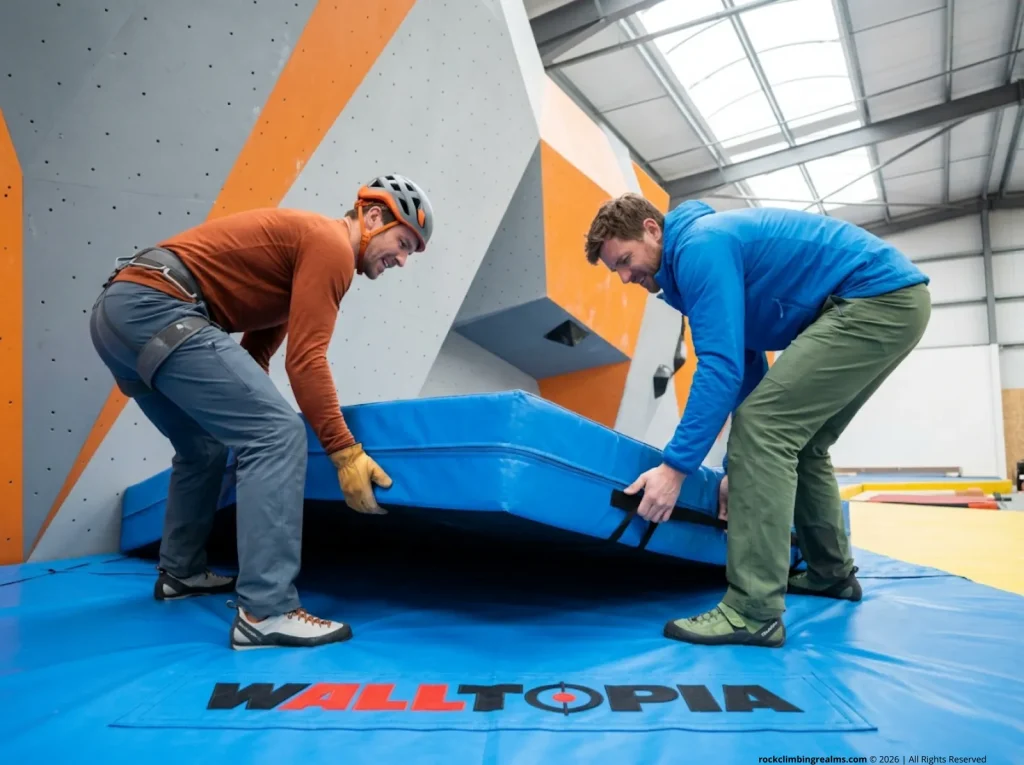
The most critical safety system in your gym sits directly on the concrete floor. Falling is guaranteed in climbing, making high-density safety mats your primary physical defense against catastrophic injury. You must install continuous foam padding with a minimum 12-to-15-inch thickness to meet baseline compliance and satisfy insurance mandates.
The worst sound in a gym isn’t a scream; it’s the hollow thud of someone hitting a compromised crash pad. Following strict ASTM standards for crash pad foam protects your climbers and keeps you out of court. The initial cash investment is massive, but skimping here guarantees a devastating lawsuit.
The Shift From Polyurethane to Recyclable PE Holds
The commercial climbing sector generates massive amounts of industrial plastic waste. The average functional lifespan of a traditional polyurethane climbing hold is only one to two years before it wears smooth and goes to a landfill. Staying ahead of the operational curve means adopting rigorous sustainability measures fast.
Switching to recyclable polyethylene holds extends their usable life to three to five years and drastically reduces your operation’s localized carbon footprint. Savvy operators use hold retexturing services to chemically strip and resurface high-value fiberglass volumes. Practicing eco-friendly practices isn’t just a marketing tactic; it physically reduces your long-term capital bleed. Similar to tracking climbing gear lifespan and retirement for personal equipment, managing your gym’s plastic inventory requires a strict rotation cycle.
Institutionalizing CWA Daily Quality Inspections
You cannot rely on simple luck to prevent structural accidents. Daily visual and tactile inspections of physical anchor points, quickdraws, and top-rope redirects are legally necessary to defend against brutal negligence claims. Implementing documented safety checks is a baseline requirement for institutional standards for indoor climbing walls. By establishing these routines, you build a rigid culture of risk mitigation.
Many modern gym owners are repurposing brownfield industrial sites, actively cleaning up contaminated land to create facilities that help the community rise above traditional fitness spaces and align with ecological practices. Treating the business as a responsible physical entity builds profound loyalty in the local market.
The Software: Point-of-Sale and Digital Infrastructure
The Non-Negotiables: Digital Waivers and Subscription Billing
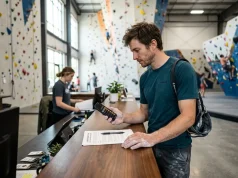
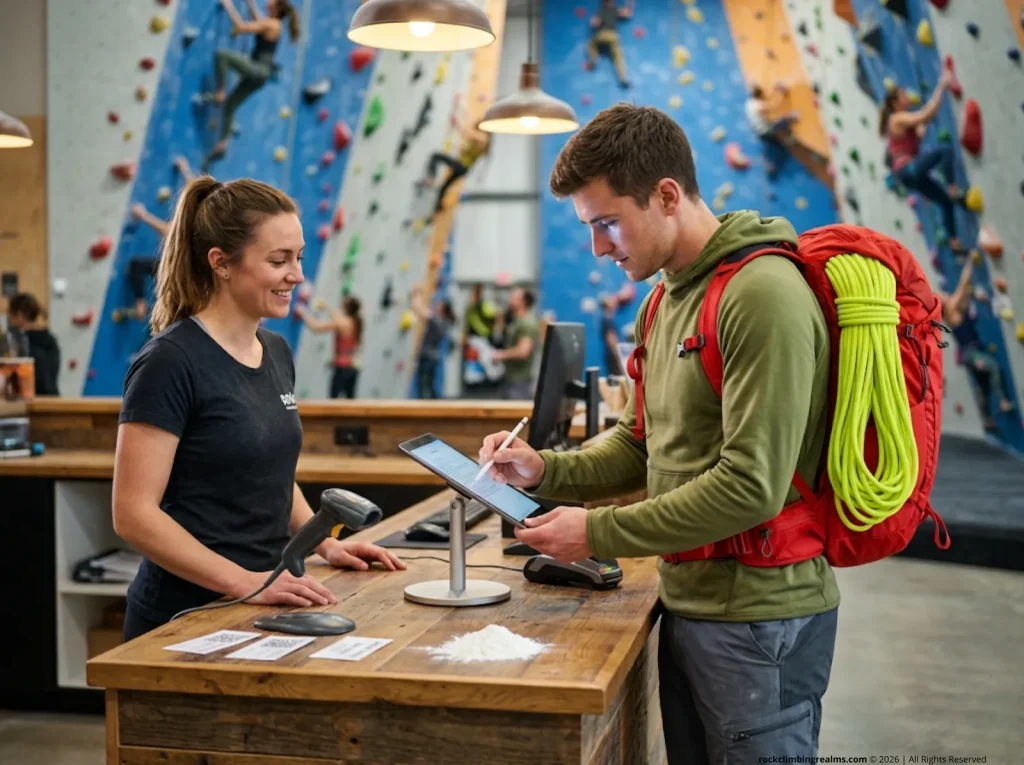
Your front desk software will crash precisely at 6:00 PM on a Tuesday when the facility hits maximum capacity. You must build a rock-solid software CRM tech stack today. The system acts as your central nervous system, simultaneously managing digital liability waivers, processing recurring active subscriptions, and handling basic retail chalk sales.
If the software goes offline, absolutely nobody climbs. The system must maintain offline waiver-signing capabilities to keep traffic moving. You also need solid processes for LLC formation documentation tracking and liability protection deeply integrated into the digital customer intake flow.
Evaluating Rock Gym Pro vs. Modern Cloud Alternatives
Choosing the right digital platform early is critical. Rock Gym Pro remains the entrenched legacy leader, costing between $104 and $299 per month. Despite an archaic visual interface, it offers deep, granular data analytics built specifically for climbing operational workflows.
However, cloud-native challengers are aggressively replacing old systems. Established platforms like Capitan and PerfectGym provide branded mobile apps and automated renewals. Alternative tools like WodGuru offer an intuitive UI at a lower price point, roughly $85 a month, which works exceptionally well for smaller bouldering operations. Advanced systems integrate AI-driven analysis tools to flag at-risk accounts before they cancel, giving you the specific data you need to actively increase revenue.
Pro-Tip: Whatever gym management software you choose, run rigorous stress tests on the waiver kiosk system before grand opening day. A bottleneck at the waiver station during peak hours will infuriate your new customer base instantly.
Conclusion
Building a sustainable climbing facility requires bridging the gap between a genuine passion for the sport and cold, hard structural economics. You must engineer your physical air quality to combat chalk dust, leverage SBA loans with precise financial payback horizons, and prioritize diverse route setting to stop subscriber churn. Compile these metrics, lock down your real estate, and present a rock-solid business plan that proves you understand the mechanics of profit just as well as you understand the mechanics of a lead fall. Run the numbers, secure the space, and build a gym that survives the brutal first five years.
FAQ
How much does it cost to build an indoor climbing wall?
Wall construction averages $35 to $50 per square foot of custom climbing surface. Complex, steep designs for a full-scale gym often push the total wall fabrication cash budget well beyond $300,000 before you buy holds.
Is owning a climbing gym profitable?
Yes, provided the facility maintains high member retention and diversifies revenue through retail, children’s programming, and weekend birthday parties. Operational break-even can occur in 60 days, though total capital recoupment typically takes about four years.
What is the minimum ceiling height for a bouldering gym?
Commercial bouldering facilities require an absolute minimum ceiling height of 20 feet. This height allows for standard 15-foot physical climbing walls while providing the necessary clearance for athletes to top out safely.
Can I get an SBA loan for a climbing gym startup?
Yes, the SBA 7(a) loan program exists as the most common path to physical funding. It demands borrowers to securely inject 10% to 20% in founder’s equity and sign a comprehensive, binding personal guarantee.
What are the main requirements for a climbing gym?
Beyond the physical walls and crash pads, you need heavy-duty HVAC systems for aggressive air filtration, robust management software for liability waivers, and commercial liability insurance. You also must adhere strictly to local zoning laws for commercial assembly.
Safety Notice: Rock climbing and mountaineering are inherently high-risk
activities that can involve physical trauma or fatal incidents. The information on Rock Climbing Realms is for
educational and informational purposes only. Techniques and advice presented here are not a substitute
for professional, hands-on instruction. Conditions and risks vary by location. Always seek guidance
from a qualified instructor before attempting new techniques. By using this website, you agree that you
are solely responsible for your own safety. Any reliance you place on this information is strictly
at your own risk, and you assume all liability for your actions. Rock Climbing Realms and its authors
will not be held liable for any harm, damage, or loss sustained in connection with the use of this information.
Affiliate Disclosure: We are a participant in the Amazon Services LLC Associates Program, an
affiliate advertising program designed to provide a means for us to earn advertising fees by advertising and linking
to Amazon.com. As an Amazon Associate, we earn from qualifying purchases. We are also an official affiliate partner
of Black Diamond Equipment via the AvantLink network. If you click on a Black Diamond affiliate link and make a
purchase, we may earn a commission at no additional cost to you. We also participate in other affiliate programs.
Additional terms are found in the terms of service.