
In this article
Third bolt of my 5.12a project, and my forearms were already screaming. I’d driven two hours, hiked twenty minutes, chalked up, and pulled on. No warm-up. I figured the approach hike counted. It didn’t. Lactic acid clamped my flexors shut within three moves. Flash pump. Day over before it started.
I spent the next year testing every warm-up protocol I could find. PT-backed tendon glides from Hoopers Beta. Portable hangboard repeaters from Lattice Training. The classic pyramid climbing method from Climbing.com. Some worked partially. Most didn’t hold up at hard outdoor crags where the easiest route is still 5.11. But one hybrid routine, built from the best pieces of each method, consistently delivered safer sends and stronger fingers from the first attempt.
Here’s exactly how it works, phase by phase, so you never waste another crag day.
⚡ Quick Answer: The most effective sport climbing warm up routine at crag is a 5-phase hybrid: approach-hike cardio (5-10 min), dynamic mobility (3-5 min), finger and shoulder priming with tendon glides and recruitment pulls (5 min), pyramid climbing from easy to near-project difficulty (10-15 min), then a 10-15 minute depump rest before your project. Total time: about 20 minutes. This protocol prevents flash pump, primes your neuromuscular system, and works even at crags with no easy routes.
The Flash Pump Problem (And Why Your Crag Warm-Up Keeps Failing)
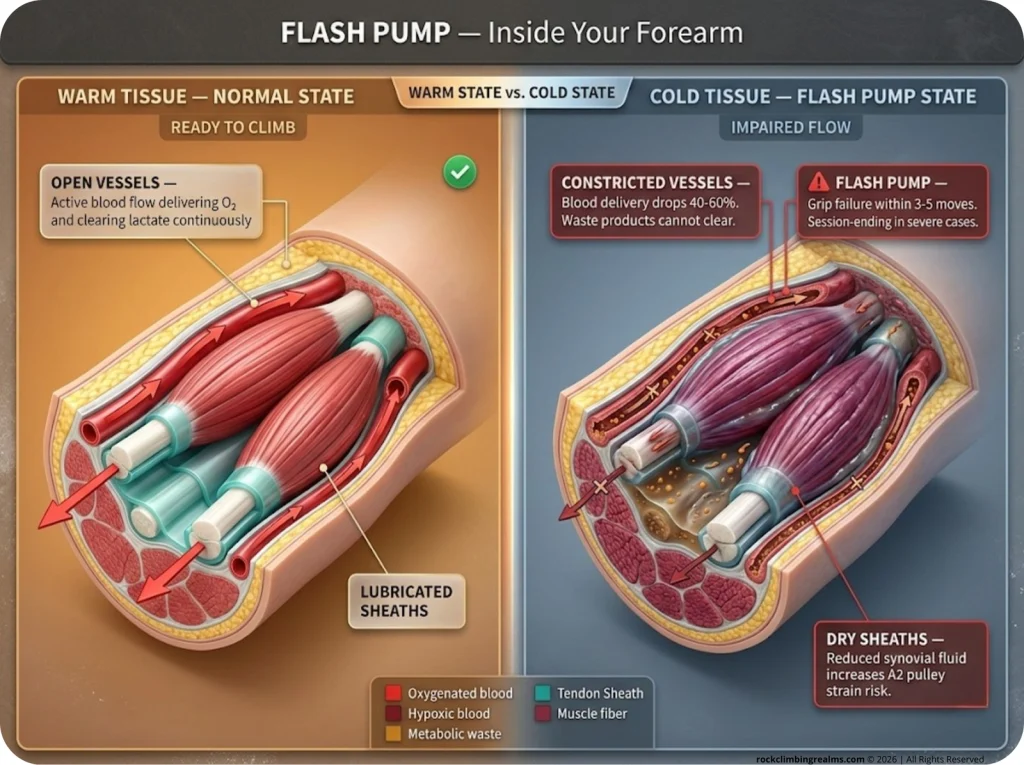
What Flash Pump Actually Does to Your Forearms
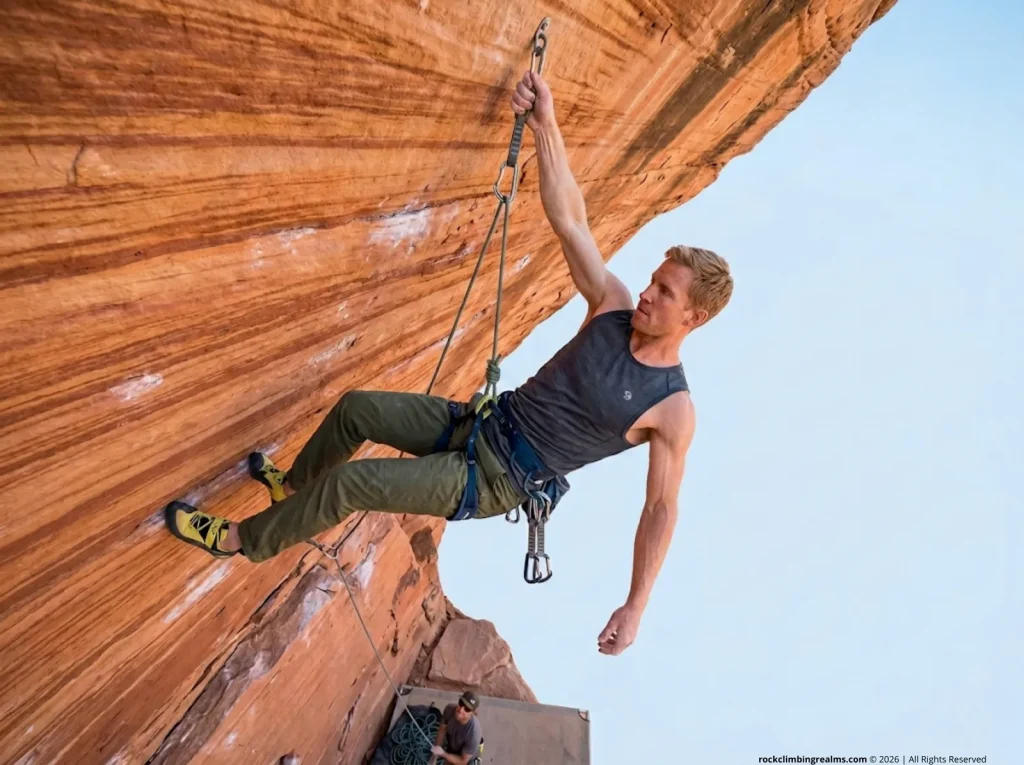
Flash pump is that brutal forearm burn you get when you jump on hard routes before your body is ready. Cold flexor tendons plus sudden high loads equals a flood of waste products in blood vessels that haven’t opened up yet. Your grip dies. Your forearms feel like concrete. And unlike normal pump, flash pump can end your entire session, not just the current attempt.
The injury risk is real too. According to a PMC survey of hand injuries in climbers, fingers account for 41% of all climbing injuries. Tendon strain on cold tissue is one of the fastest paths to a blown A2 pulley. If you’ve ever dealt with how pulley injuries develop and how to recover week by week, you know that’s a months-long nightmare you want to avoid.
Why the Approach Hike Isn’t Enough
The approach hike handles one thing well: raising your core temperature and heart rate. That’s Phase 1 of a proper warm-up. But it does zero work on tendon activation, shoulder readiness, or finger-specific loading. Walking doesn’t get fluid moving through your finger joints, doesn’t prime your rotator cuff, and doesn’t prepare the forearm systems that sport climbing hammers hardest.
Think of it this way: the hike warms your engine. But your fingers are still cold-starting.
Gym vs. Crag — The Logistics Gap
In the gym, you’ve got a VB wall, easy slabs, and a bouldering area where you can ease into V0 problems on big jugs. At the crag, especially at hard sport areas, the easiest route might still be 5.11. There’s no warm-up-friendly jug ladder. No easy top-rope.
This is the logistics gap that ruins sessions. Most climbers skip finger priming because there’s literally nothing easy to pull on. That gap is solvable, and I’ll show you exactly how.
Phase 1 — General Activation (The Smart Approach)
Using the Approach Hike as Built-In Cardio
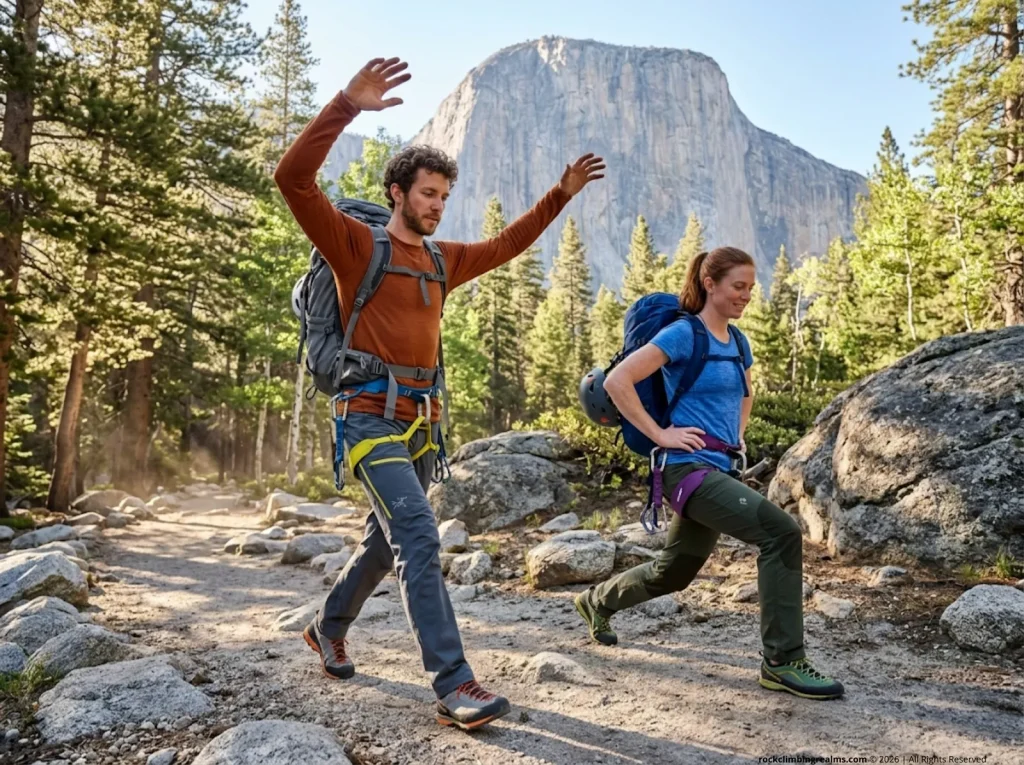
Walk at a pace that gets your heart rate up without arriving gassed. Ten to fifteen minutes of approach hike at moderate intensity delivers oxygen to your extremities, opens blood vessels, and raises tissue temperature. If your approach is under five minutes, add jump rope cardio, jumping jacks, or a brisk walk at the parking lot before you hit the trail.
On cold days, this phase becomes even more important. Low temperatures constrict blood vessels, which means your fingers and forearms need more active blood flow priming before you ask them to hold body weight on small edges.
Dynamic Mobility That Actually Matters
Once you’re at the base, spend three to five minutes on dynamic stretching. Arm circles. Wrist circles. Hip openers. Leg swings. Shoulder windmills. Side twists. Lunges. Keep everything moving and rhythmic.
Skip the static stretches before climbing. As explained by Johns Hopkins orthopaedic surgeons, warming up with climbing-specific activities is more protective than cross-training, and stretching statically before loading actually reduces muscle output. Save the long holds for your cooldown.
Pro tip: Do your dynamic mobility during the last two minutes of the approach hike. Arm circles while walking, hip openers at the trailhead. You’ll save five minutes at the base.
Phase 2 — Finger and Shoulder Priming (The Missing Link)
This is where most warm-up routines fall apart. They go straight from “hike to the crag” to “pull on a route.” The finger and shoulder priming phase fills that gap, and it’s what separates a good day from a blown one.
Tendon Glides — The 2-Minute Fix Most Climbers Skip
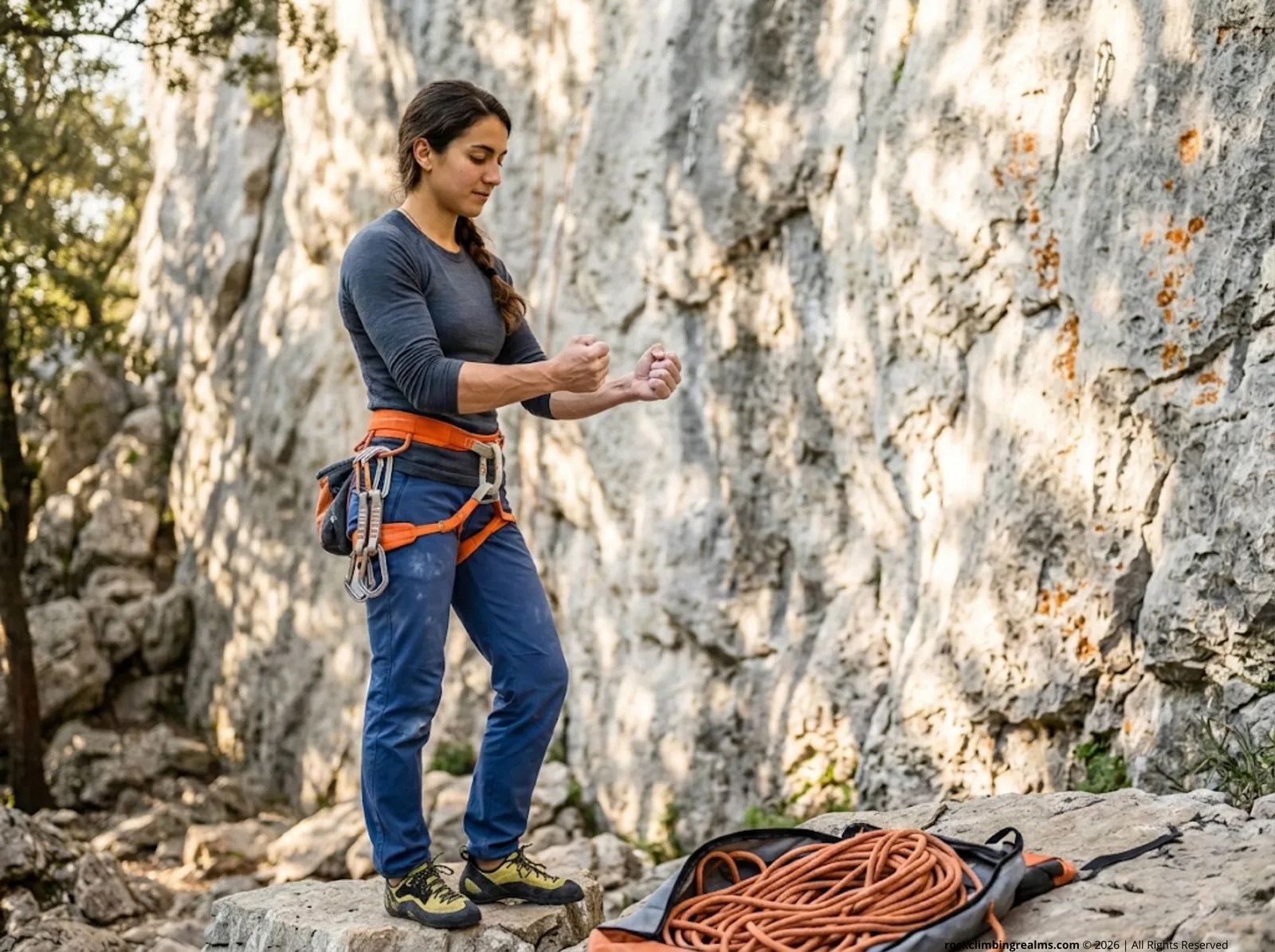
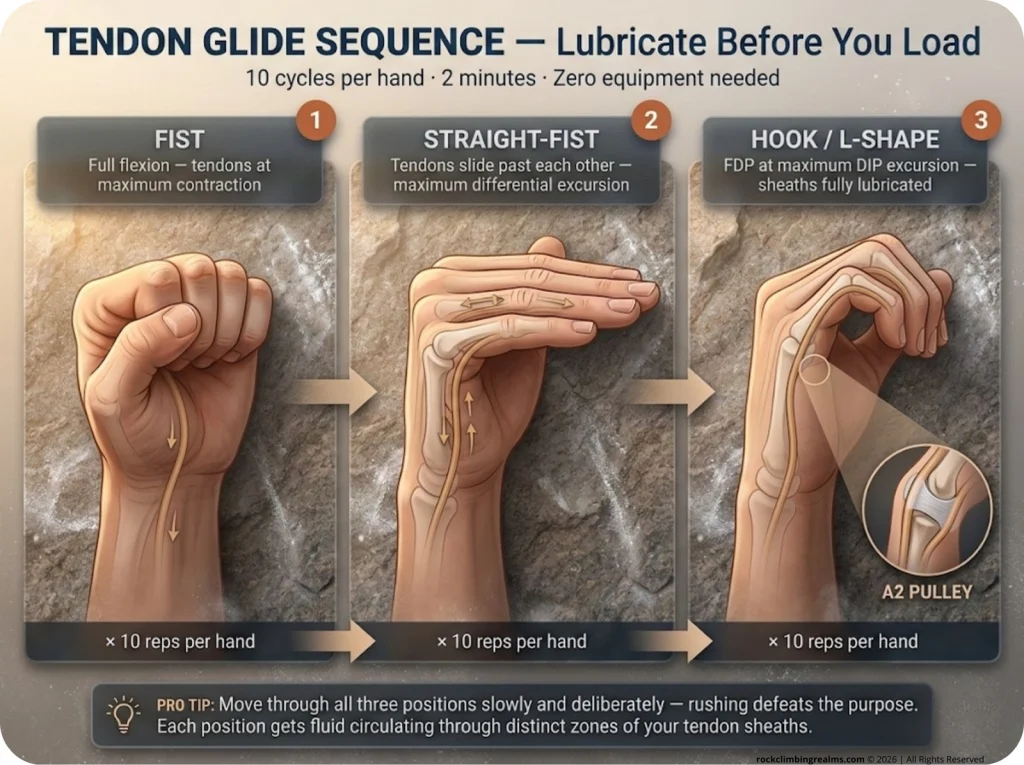
Tendon glides take two minutes and cost you nothing. Cycle your fingers through three hand positions: fist, straight-fist, hook (or L-shape). Ten cycles per hand. This gets the tendons in your fingers sliding smoothly past each other — what PTs call maximum excursion — and lubricates the sheaths that protect them. Think of it as oiling a chain before you ride.
Jason Hooper, a physical therapist and the voice behind Hoopers Beta, puts it simply: “Recruitment pulls will make sure you climb stronger and safer than if you hadn’t warmed up.” He’s right. I’ve tested sessions with and without this step, and the difference in finger readiness is obvious from the first move.
“No Moneys” and Shoulder Pre-Activation
The No Moneys exercise is a theraband drill: elbows pinned to your sides, palms facing up, and you pull outward against the band for external rotation plus scapular activation. Ten to twelve reps. It fires up roughly half your rotator cuff before you ask your shoulders to hold weight overhead.
Pack a light theraband in your chalk bag pocket. It weighs nothing and takes sixty seconds. If you’re serious about building antagonist strength for injury-free climbing, this small step makes a real difference.
Recruitment Pulls — Neural Priming on Real Rock
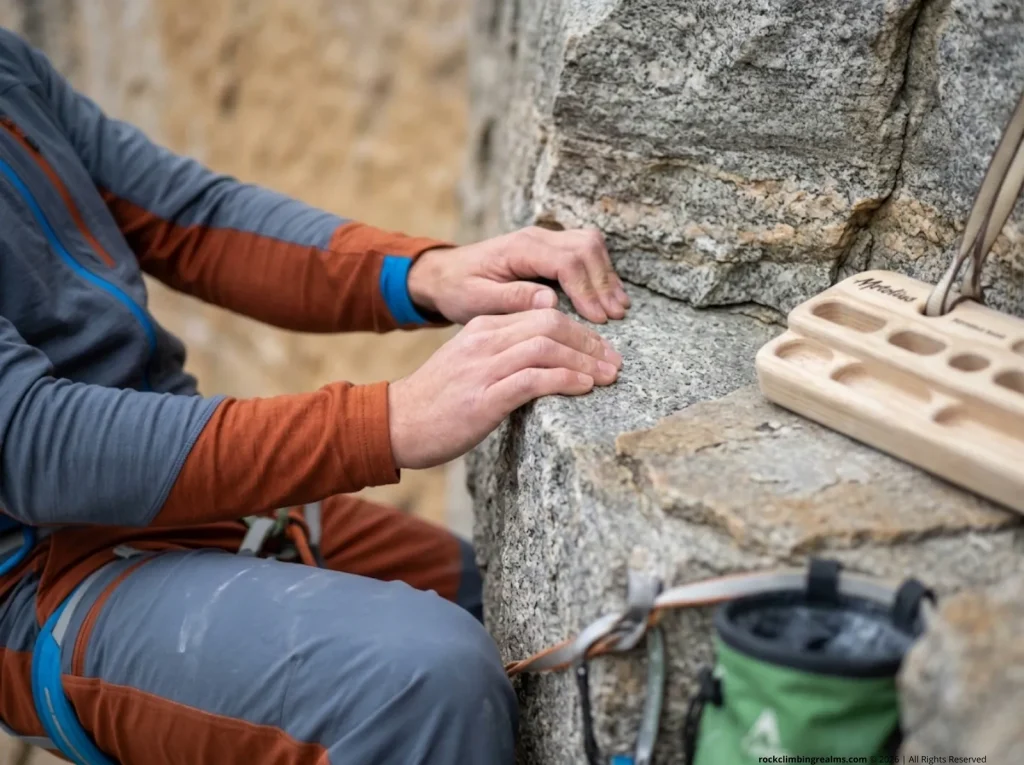
Find a rock edge, ledge, or natural feature at chest height. Pull into it with a half-crimp grip for five seconds. Rest five seconds. Repeat three to four sets. Then switch to an open position grip and do the same.
These recruitment pulls aren’t training. They’re neural priming — waking up the nerve pathways between your brain and your finger muscles. Intensity should sit around 70-80% effort. Enough to feel the tendons engage, not enough to fatigue.
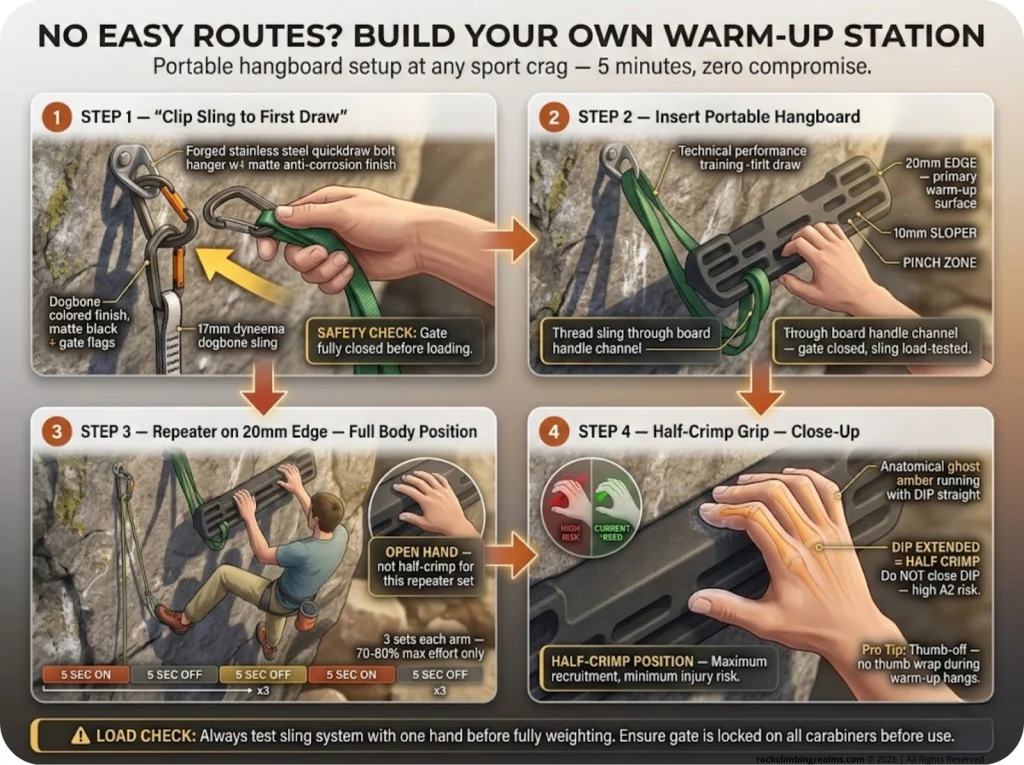
Pro tip: If the rock at your crag base has no usable edges, use a portable hangboard clipped to a sling on the first bolt. Ollie Torr from Lattice Training demonstrates this technique on Peak District routes where no easy lines exist.
Phase 3 — The Pyramid Progression (Sport-Specific Loading)
The 80-Move Baseline
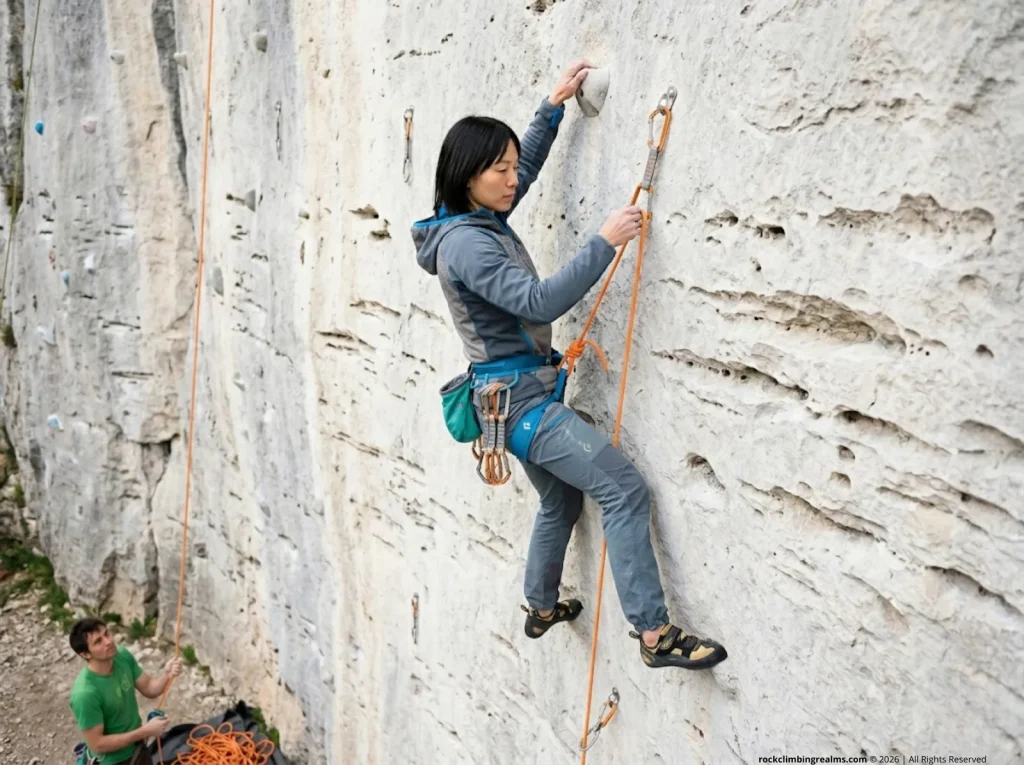
The Philly Rock Gym protocol calls it “4 up, 4 down”: climb four easy routes and downclimb each one. That’s roughly 80 moves at low difficulty, enough to flush blood through your forearms and load your pulleys gradually without shock.
Downclimbing doubles your warm-up volume without adding pump. You’re working your muscles on the way down while keeping intensity low, which primes the exact tissue you’ll need for sustained sport climbing effort.
Grade-Specific Pyramid for Sport Climbers
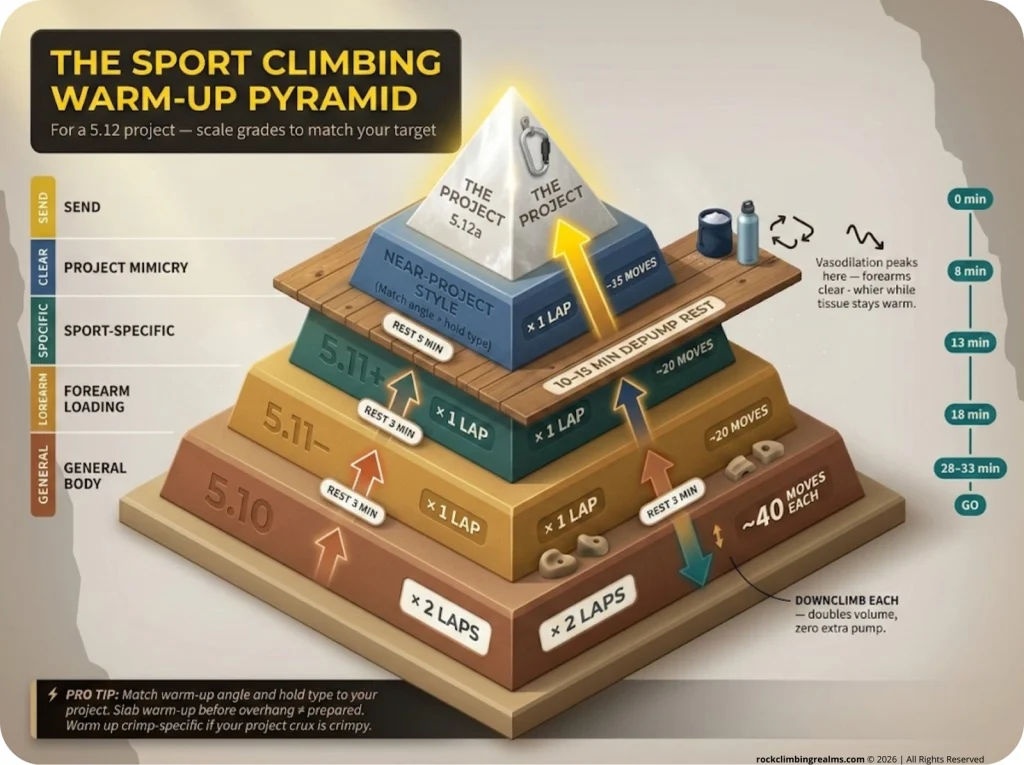
For a 5.12 project, JP Whitehead at Climbing.com recommends this progression: two laps on 5.10, one on 5.11 warm-up, then one near-project route that mimics your target’s angle and style. Rest ten to fifteen minutes. Then pull on.
The key is matching your warm-up to your project. If your route is steep and crimpy, warm up on steep and crimpy. Slab warm-ups for overhanging projects don’t prepare the right muscle groups. Include clipping practice in your pyramid laps too, especially if your project has pumpy clip positions. For a deeper breakdown, check out how to project a sport route without wasting burns.
Project Mimicry — The Secret Weapon
Your final warm-up climb should approximate the angle, hold type, and movement style of the route you’re projecting. This is project-style mimicry, and it’s where generic warm-ups fail. Warming up on a slab before pulling on a 30-degree overhang is like jogging before a sprint race. Similar muscles, wrong application.
If the crux is full crimp on small edges, prime with full crimp. If it’s long moves between slopers, warm on routes with long reaches and open-hand holds. Finish with mental priming — sit at the base, close your eyes, and run through the crux sequence in your head. Breathing integration here calms your nervous system and sharpens focus.
The No-Easy-Routes Protocol (When the Crag Won’t Cooperate)
This is the section nobody else writes, because it requires gear and creativity instead of just “climb easy routes.” But at many hard sport climbing crags, there are no easy routes. Every line starts at 5.11. So what do you do?
Portable Hangboard Repeaters
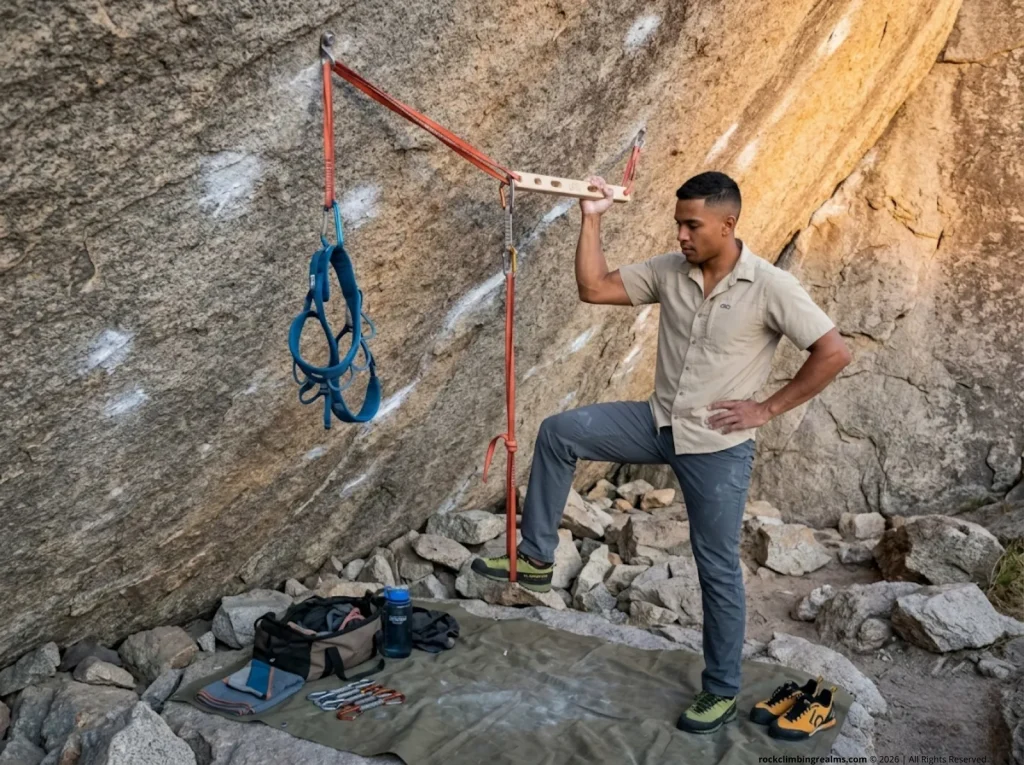
Clip a sling to the first bolt or a draw. Slide your Lattice Training Mini Bar or any portable hangboard through the sling. Stand with one foot in a foot loop for counterbalance. Pull onto the 20mm edge with one arm: five seconds on, five seconds off, three sets. Switch arms.
Follow with ten-second max hangs at comfortable intensity, then finish on specific grip work — 10mm front-three in full crimp if that’s what your project demands. The whole thing takes five minutes and replaces the easy climbing you don’t have access to. If you want to build these skills further, look into hangboard workouts that build safe finger strength.
Traverse and Boulder Solutions
Low crag traverses along the base of the cliff work well for gradual loading. Three to five minutes of continuous horizontal movement builds forearm readiness without the commitment of a full route. If boulders exist nearby, start on easy problems and build to moderate difficulty.
You can also do recruitment pulls on natural holds at the cliff base. Cracks, pockets, edges at chest to overhead height — anything that lets you load your fingers progressively.
Cold Weather Adjustments
Cold conditions demand adjustments across every phase. Extend your tendon glides to fifteen cycles instead of ten. Run your repeaters at seven seconds on instead of five — slower muscle recruitment in cold temperatures needs longer holds. Keep hands in pockets between sets, because re-warming cold fingers is much harder than maintaining warmth.
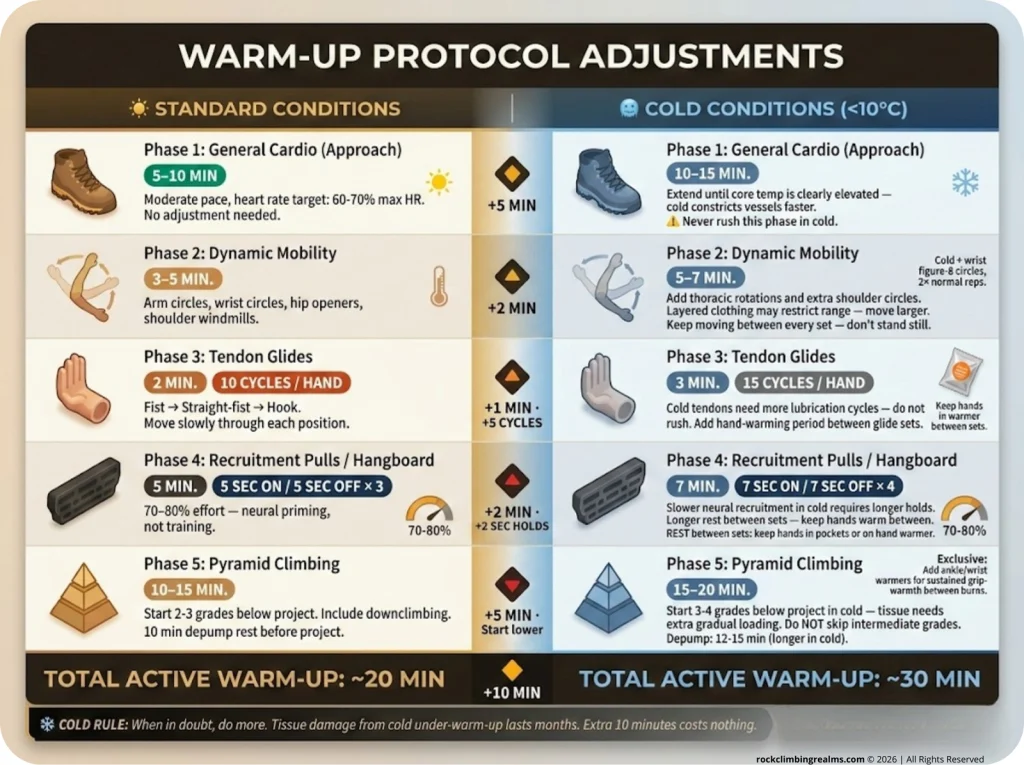
Pro tip: Stuff chemical hand warmers in your chalk bag on truly cold days. Warm chalk means warmer fingers between attempts. Small detail, big difference.
Three Warm-Up Mistakes That End Sessions Early
Jumping Grades Too Fast
Going from easy 5.10 laps straight to your 5.12 project without an intermediate step is the single most common cause of flash pump. Each grade increase in your warm-up should feel noticeably harder but never desperate. The fix is simple: add one stepping stone. 5.10 → 5.11- → 5.11+ → rest → project.
Confusing Training for Warming Up
Max hangs, campus board sets, and limit bouldering are training activities, not warm-up activities. Your pre-climb routine should stay at 70-80% perceived effort. If your “warm-up” leaves you tired, you’ve done a workout where you needed a primer.
Dawn LaPorte, M.D. at Johns Hopkins, found that warming up with climbing-related activities was more protective than warming up with a cross-training approach. Specific beats generic. Every time.
Skipping the Depump Rest
The ten to fifteen minute rest to depump after your pyramid and before your project is non-negotiable. This window clears built-up waste from your forearms while keeping tissue temperature elevated. You arrive at your project warm but not pumped.
Active rest works best: walk around, shake out, drink water, review beta. Skip this rest and you’re functionally flash-pumped — arriving at your hardest attempt already depleted. For more on how pump actually works in your forearms, read the science behind the pump and how to train endurance.
Pro tip: Set a phone timer for twelve minutes after your last warm-up climb. When it goes off, you’re ready. No guessing.
Conclusion
Three things determine whether your crag day is a send or a waste of gas. First: the five-phase routine works because each phase solves a problem the others can’t. Approach-hike cardio warms your engine. Dynamic mobility loosens your joints. Tendon glides and recruitment pulls wake up your fingers. The pyramid loads your system progressively. The depump rest clears the runway.
Second: when the crag has no easy routes, portable training tools replace what’s missing. A Mini Bar, a sling, and a theraband weigh less than a kilogram and solve the biggest excuse climbers have for skipping finger priming.
Third: flash pump is 100% preventable. Fifteen minutes of deliberate preparation is the difference between a blown session and a clean send.
Next time you park at the trailhead, resist pulling on cold. Run all five phases. Time it. Then notice how much stronger your fingers feel on the first move of your project. That’s not luck. That’s your body doing what it does when you give it a proper warm-up.
Go send something.
FAQ
How long should you warm up before sport climbing at the crag?
About 15-20 minutes of active preparation, plus a 10-15 minute depump rest. That breaks down to roughly 5 minutes of approach cardio, 3-5 minutes of dynamic stretching and tendon glides, 5-10 minutes of progressive climbing, then rest before your project. The total is short, but every phase matters.
How do you warm up your fingers for climbing without easy routes?
Use a portable hangboard or sling clipped to a bolt for repeaters (5 seconds on, 5 seconds off, 3 sets per arm on a 20mm edge), followed by 10-second hangs. Combine with tendon glides (10 cycles per hand) and recruitment pulls on natural rock features like ledges and cracks.
What stretches should I do before rock climbing?
Dynamic stretches only — arm circles, wrist circles, hip openers, leg swings, shoulder windmills. Never static stretch before climbing. Static holds reduce force output and don’t protect against injury. Save your long stretches for the cooldown after your session.
How do you avoid flash pump at the crag?
Build into your session gradually with the pyramid warm-up method. Start two to three grades below your project and work up, with a 10-15 minute depump rest before attempting hard routes. Flash pump happens when cold muscles meet high intensity. Close that gap and it disappears.
Is the approach hike enough for warming up to climb?
No. The hike handles general cardio and raises core temperature, but it does nothing for tendon activation, shoulder priming, or neuromuscular activation. You need at least tendon glides, recruitment pulls, and a climbing pyramid to be ready for hard sport climbing.
Safety Notice: Rock climbing and mountaineering are inherently high-risk
activities that can involve physical trauma or fatal incidents. The information on Rock Climbing Realms is for
educational and informational purposes only. Techniques and advice presented here are not a substitute
for professional, hands-on instruction. Conditions and risks vary by location. Always seek guidance
from a qualified instructor before attempting new techniques. By using this website, you agree that you
are solely responsible for your own safety. Any reliance you place on this information is strictly
at your own risk, and you assume all liability for your actions. Rock Climbing Realms and its authors
will not be held liable for any harm, damage, or loss sustained in connection with the use of this information.
Affiliate Disclosure: We are a participant in the Amazon Services LLC Associates Program, an
affiliate advertising program designed to provide a means for us to earn advertising fees by advertising and linking
to Amazon.com. As an Amazon Associate, we earn from qualifying purchases. We are also an official affiliate partner
of Black Diamond Equipment via the AvantLink network. If you click on a Black Diamond affiliate link and make a
purchase, we may earn a commission at no additional cost to you. We also participate in other affiliate programs.
Additional terms are found in the terms of service.