
In this article
The third time my #3 cam slammed into my thigh mid-crux, I knew something had to change. I was 400 feet up a Yosemite splitter, forearms screaming, and I couldn’t find the right piece without looking down at my harness. That’s a Critical Failure on thin granite feet.
That moment launched a six-month field test across 47 routes, three racking systems, and more gear swaps than I care to admit. After twenty years of trad climbing, I thought I had this figured out. I was wrong.
Here’s exactly what I learned about harness gear loop organization—the tested protocols that actually work when your forearms are pumped and the afternoon clouds are building.
⚡ Quick Answer: The best rack organization depends on your route type. For single-pitch trad, rack everything on your harness with small cams front, large cams back. For multi-pitch with partner swaps, use a hybrid system: core pieces on harness, specialty gear on a compact sling. For alpine chimneys, prioritize a gear sling that can shift away from the wall. Consistency matters more than the system—always put the same piece in the same spot.
The Physics of Racking: Why Organization Affects Performance
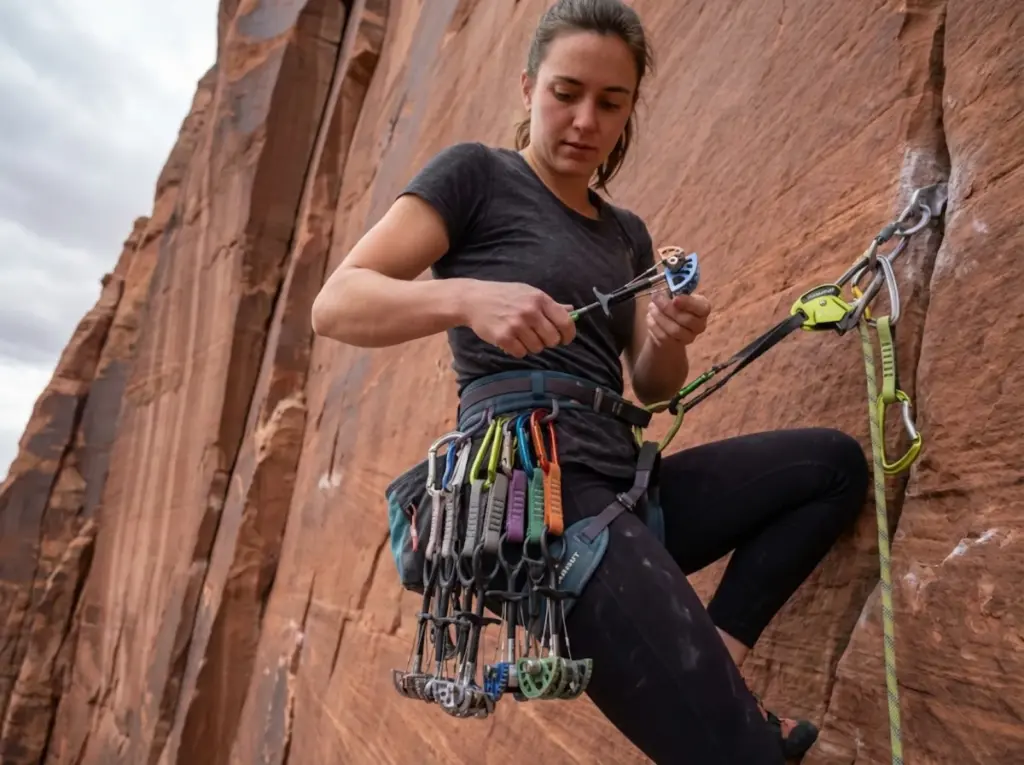
Your trad rack weighs anywhere from 5 to 10 pounds depending on what you’re carrying. That’s a significant external load hanging off your body, and where you put it changes everything about how you move on rock.
Weight Distribution and the Center of Gravity Problem
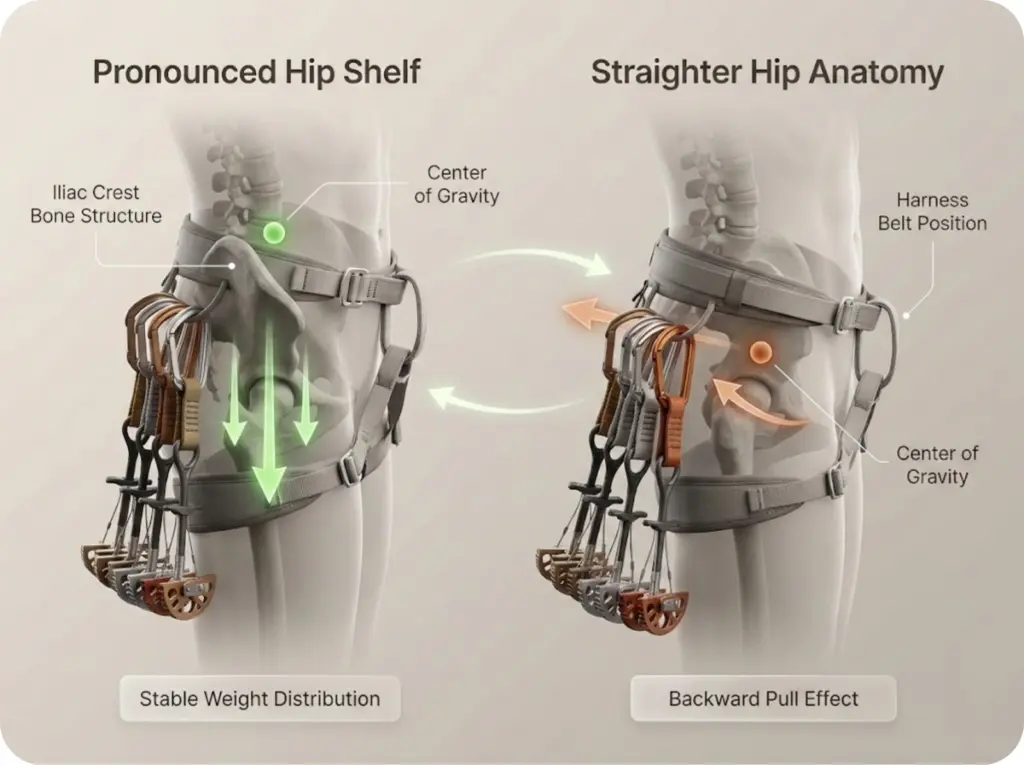
The physics are simple but brutal. A loaded rack shifts your center of gravity away from the wall. When that weight swings or pulls you backward, your fingers have to work overtime to compensate.
The key is your hip shelf—the bony prominence of your iliac crest. Climbers with wider hips naturally support heavy racks because the harness belt sits stable on that shelf. If you’ve got straighter hip anatomy, the weight can pull your harness downward, creating real problems on steep terrain.
I learned this the hard way watching my partner struggle with the same rack that felt invisible on my hips. Different bodies need different solutions—there’s no universal “correct” setup.
Pro tip: Rack your larger, heavier cams toward the back of your harness. This keeps the weight closer to your spine and stops the forward lean that works against you on slabs.
Understanding proper harness fit for gear-heavy climbing will help you dial in your specific anatomy. The iliac crest positioning makes or breaks your comfort on long routes.
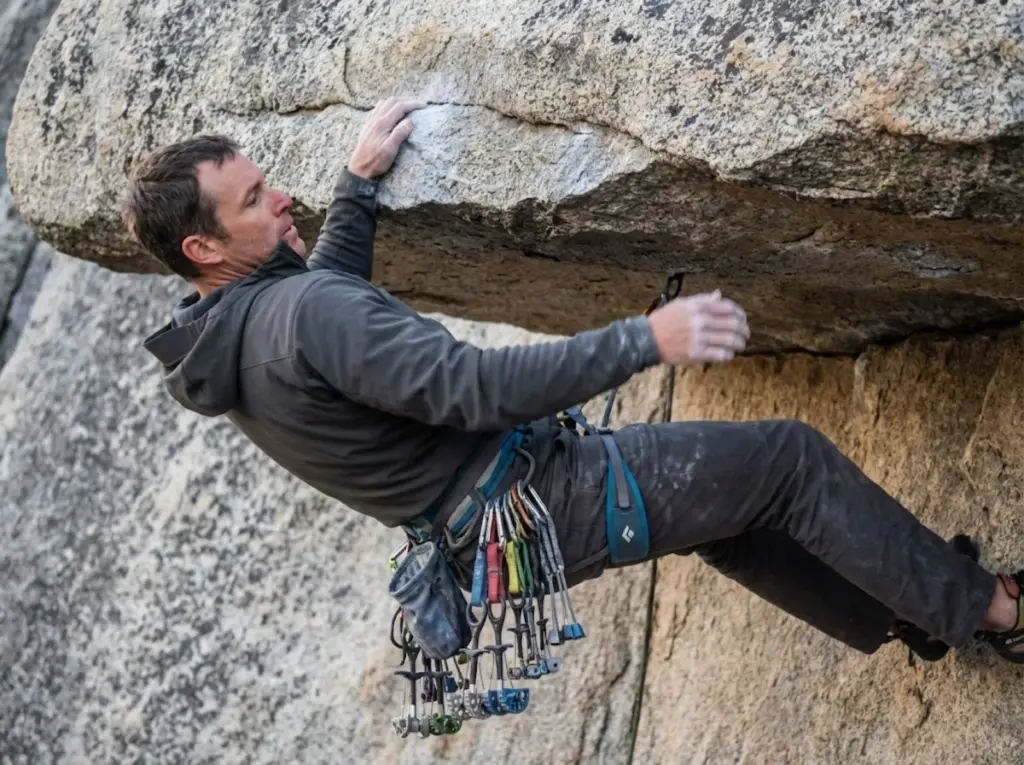
Cognitive Load: The Science of Blind Selection
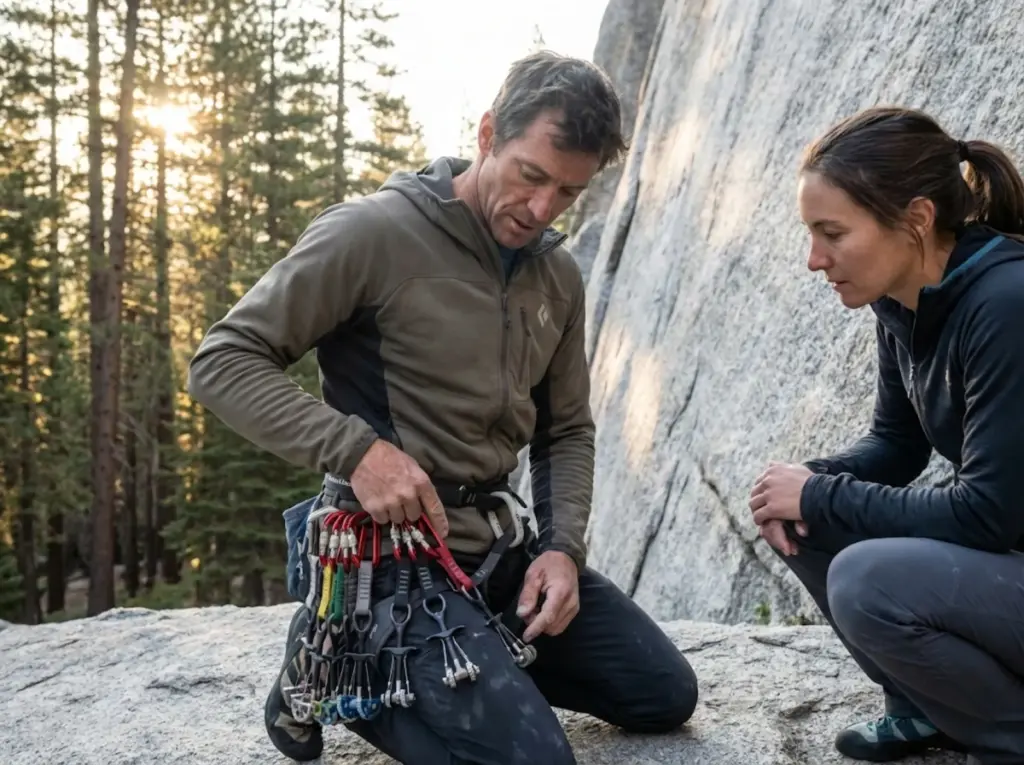
Here’s what separates efficient climbers from those fumbling on every placement: muscle memory. When you rack your #2 Camalot in the same spot every single time, your hand learns where it lives. You can grab it without looking.
AMGA instructor Jason D. Martin puts it bluntly: “Everything should have a place, and it should always go back to that same place when you’re done with it.”
This isn’t about being obsessive. It’s about survival. When you’re pumped, scared, or climbing in poor lighting, proprioceptive memory takes over. Your hand reaches where the piece should be, and it’s there. Every time.
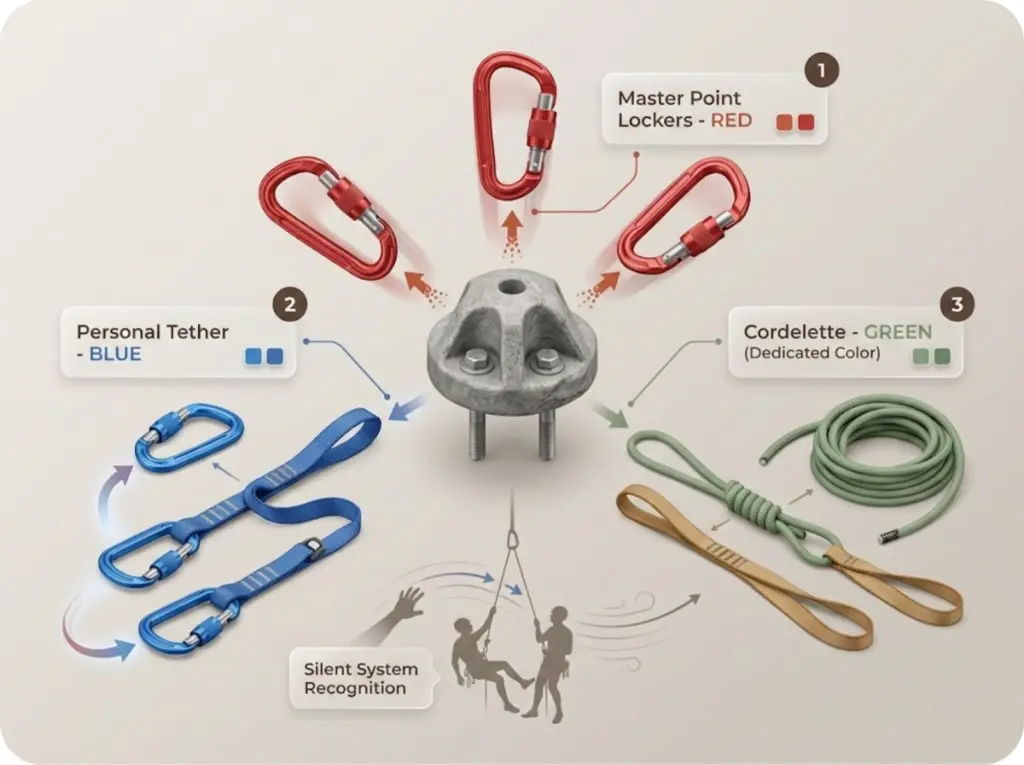
Color-matched carabiners accelerate this process. Match your racking biners to your cam colors, and you’ve got both tactile and visual confirmation. Some climbers take it further—color-coding their entire anchor kit so partners can clip in without verbal instructions.
The connection between training your brain for high-stress climbing situations and racking discipline is direct. Both are about reducing cognitive load when it matters most.
The Swing Factor: Momentum Physics on Technical Terrain
A swinging gear sling creates rotational force that can pull you off balance on delicate slab moves. Harness-mounted gear keeps your center of gravity stable, but it comes with trade-offs in chimneys where the gear can pin against the wall.
The chandelier effect is the enemy. That’s what happens when you overload a single gear loop until all the pieces tangle together and move as one clump instead of individually. I’ve watched experienced climbers burn 30 seconds trying to extract a single cam from that mess.
System 1: Harness-Centric Racking (“Shoot from the Hip”)
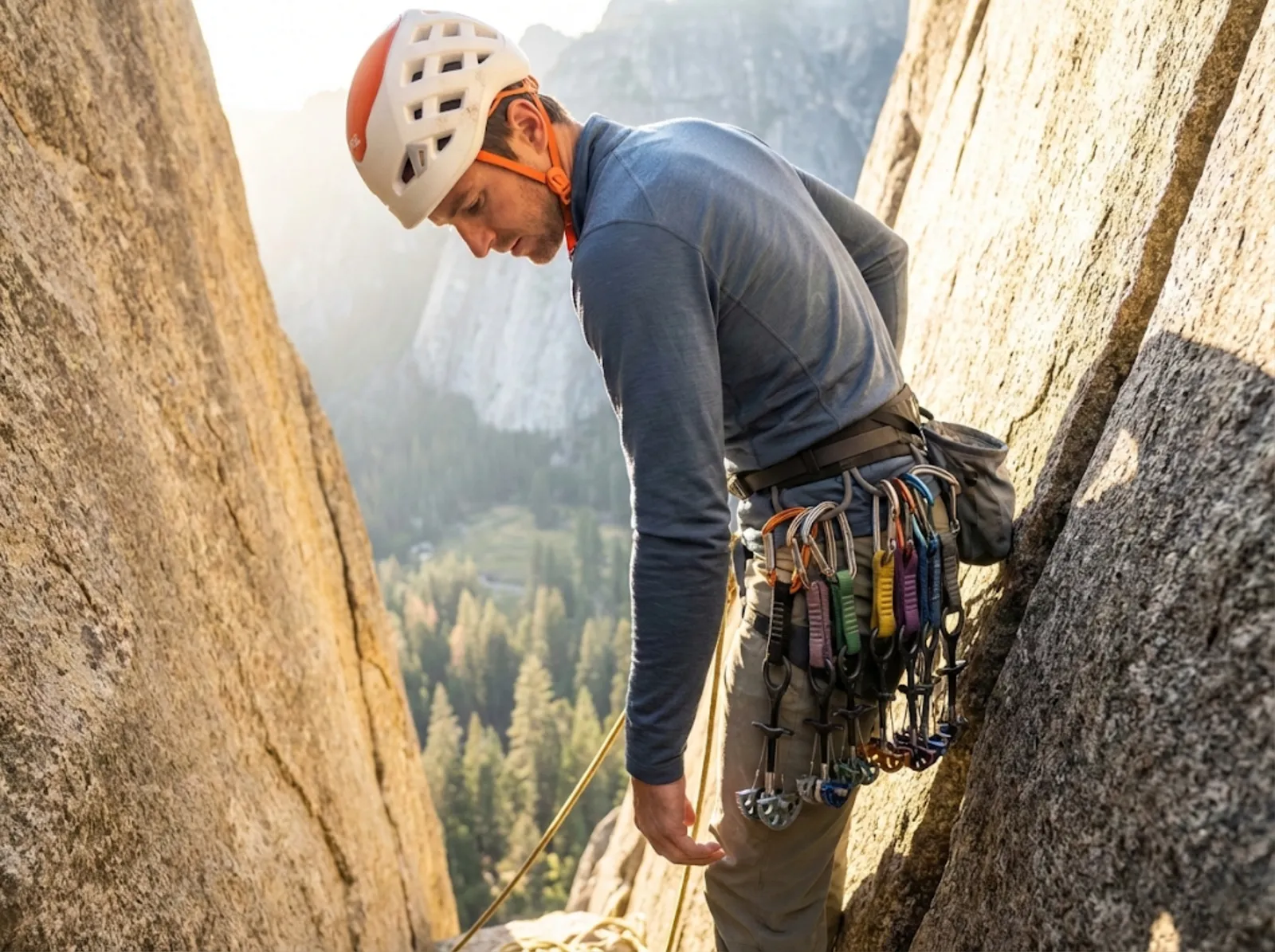
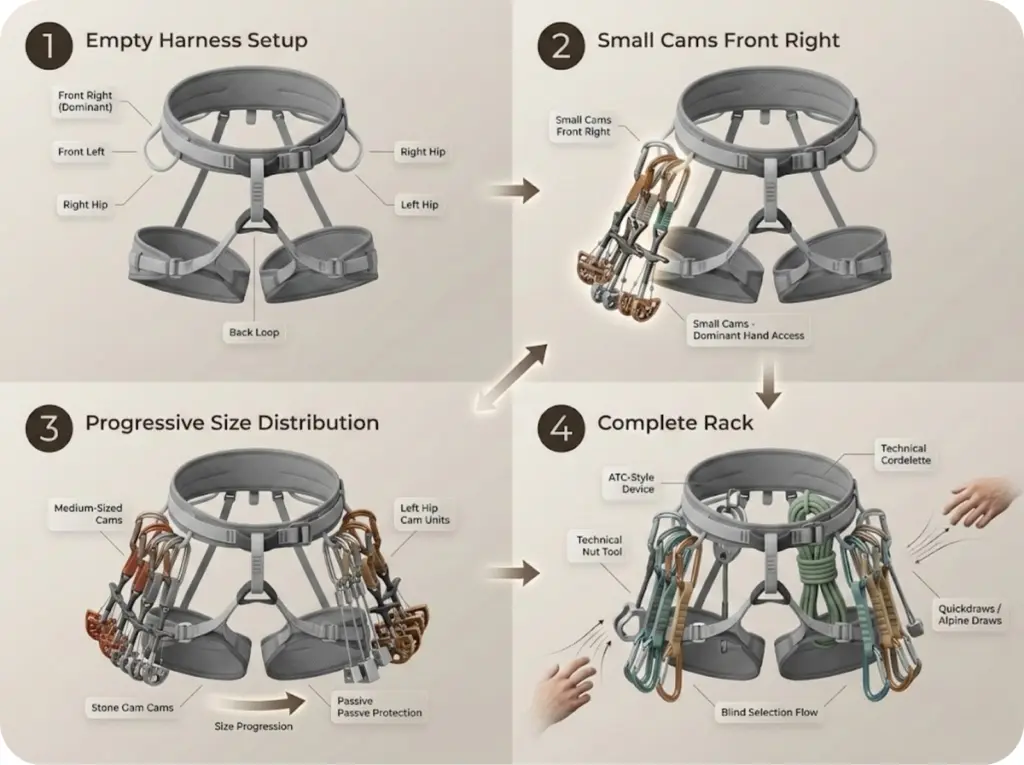
This is the modern standard for multi-pitch routes and technical face climbing. Gear lives on your harness gear loops, distributed in a logical pattern that enables blind selection.
The Anatomy of a Trad Harness
Your harness design matters more than most climbers realize. Trad-specific harnesses feature 4-7 gear loops depending on the model. The difference between molded and flexible loops affects how your gear hangs and how quickly you can grab it.
Molded gear loops maintain their shape under load, making clip-on access faster. Flexible loops conform to your body but can collapse when empty, slowing you down. The Misty Mountain Cadillac and Black Diamond Solution are favorites among multi-pitch veterans for their loop capacity and positioning.
That fifth gear loop on some harnesses—the haul loop—often has a lower weight rating. Don’t load it with heavy cams expecting it to perform like the front loops.
Professional climber Babsi Zangerl explains the preference simply: “I prefer the gear loops because the gear is placed on the side of your harness and it is not in the way.”
Choosing between trad and sport harness designs comes down to how much gear you’re carrying and how often. Sport harnesses with minimal loops won’t cut it for loaded racks.
The Small-to-Large, Front-to-Back Protocol
Here’s the standard convention that most guides teach:
Your smallest cams go on the front gear loop closest to your dominant hand. Sizes increase as you move toward your back loops. Passive protection—your nuts and stoppers—lives on the secondary front loop. Quickdraws, alpine draws, and slings distribute across your rear loops.
Your belay device, anchor material, cordelette, and nut tool go on the back gear loop or the fifth loop if your harness has one.
This convention enables blind selection. Your hand knows that reaching forward-right gets the small cam, while reaching back-left finds the large one. No looking required.
The American Alpine Institute’s racking protocols follow this exact system. It’s not arbitrary—it’s battle-tested across thousands of guided climbs.
When Harness Racking Fails
Harness-centric racking breaks down in specific scenarios. Chimney climbing pins your gear loops against the rock, making access impossible. Double racks with full sets of cams in multiple sizes overcrowd your loops.
Layered clothing in alpine conditions buries your gear loops under jackets and insulation. And climbers without a pronounced hip shelf find the harness rotating and slipping under heavy load.
Pro tip: Short climbers should rack their cams through the thumb loop instead of the sling. This raises the gear height and stops the knee-banging that plagues smaller climbers on every placement.
System 2: Gear Sling Racking (“Shoulder Rack”)
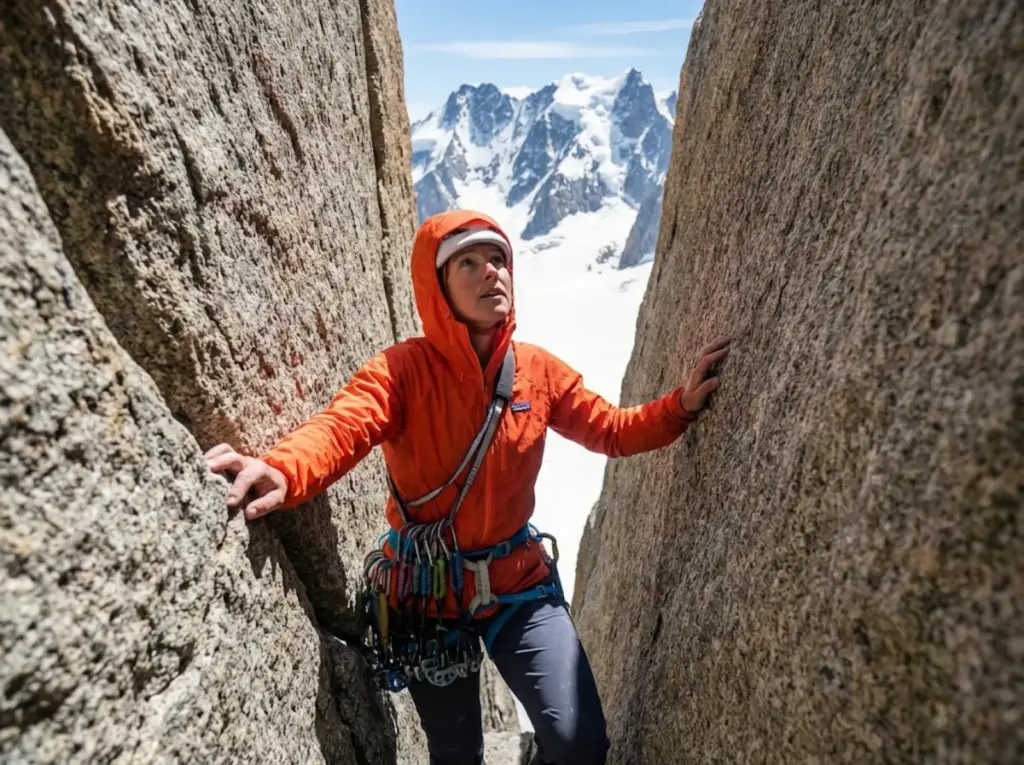
The gear sling fell out of fashion for technical rock climbing, but it remains essential for alpine terrain and specific scenarios where harness limitations become dangerous.
The Alpine Advantage: Speed Swaps and Heavy Loads
The standout feature of sling-based racking is partner exchange speed. Instead of transferring pieces one at a time, you hand over the entire sling in a single motion. On routes where you’re swinging leads every pitch, this saves serious time.
Gear slings also dominate in chimneys and offwidths. When your harness loops would pin against the rock, a gear sling can shift to the non-contact side of your body. The gear stays accessible when harness racking would leave you stuck.
Double racks work on slings without the chandelier effect. Each sling can hold a complete size progression, keeping pieces separated and accessible.
IFMGA guide Dougald MacDonald explains his approach: “In winter I like a gear sling… it’s useful to have a gear sling when you have to ‘dump’ kit back onto the sling quickly if pumped.”
For alpine efficiency tactics where moving fast means moving safe, slings earn their place in serious terrain.
The Visibility and Balance Trade-offs
Gear slings come with real costs. The rack hangs in front of your chest, blocking your view of footholds on technical face climbing. The higher center of gravity increases your barn-door potential on steep overhangs.
The weight concentrates on your shoulder rather than your hips. Over a long route, that trapezius loading creates fatigue that hip-distributed weight doesn’t.
British trad specialist Hazel Findlay notes the inverse benefit: “Using your harnesses’ gear loops encourages you to bring less stuff.”
Building an Effective Gear Sling System
If you’re running a sling system, Dyneema slings at 10mm width offer superior weight-to-strength ratio compared to traditional nylon. Padded options like the Metolius Rabbit Runner reduce shoulder dig under heavy loads.
Color-code your slings for size separation—left sling holds small cams, right sling holds large cams. Always attach the sling to your belay loop with a locking carabiner when leading. Dropped racks during falls are expensive and dangerous.
Standard 60cm slings work for most climbers. Taller climbers may need 120cm to prevent gear from banging below their thighs.
System 3: Hybrid Racking (The Tested Winner)
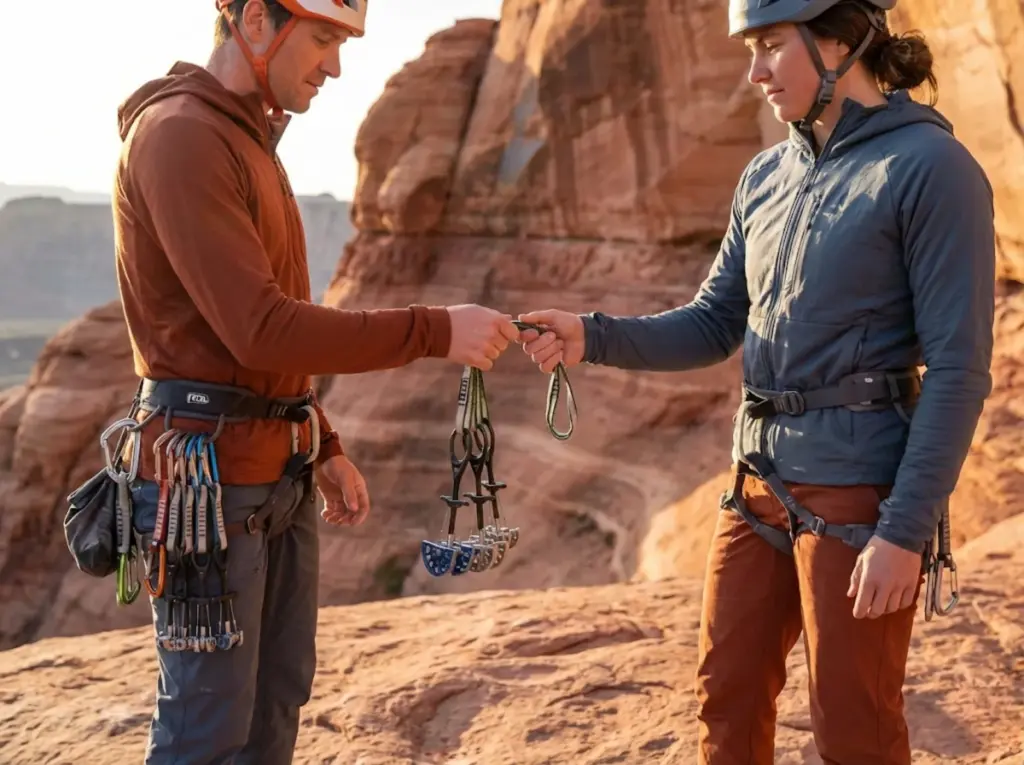
After six months of testing, no single system won across all scenarios. The hybrid configuration emerged as the optimal solution for climbers who face varied terrain.
The Field Test Protocol
I tested across 47 routes on granite, sandstone, and mixed terrain. The metrics that mattered: cam retrieval time, partner swap speed, perceived fatigue at belay stations, and fumbles per pitch.
Single pitch routes showed different optimal configurations than multi-pitch. Weather variables—layering compatibility, wet rock adjustments—changed the equation again.
The conclusion was clear: route beta anticipation before leaving the ground matters more than any fixed system.
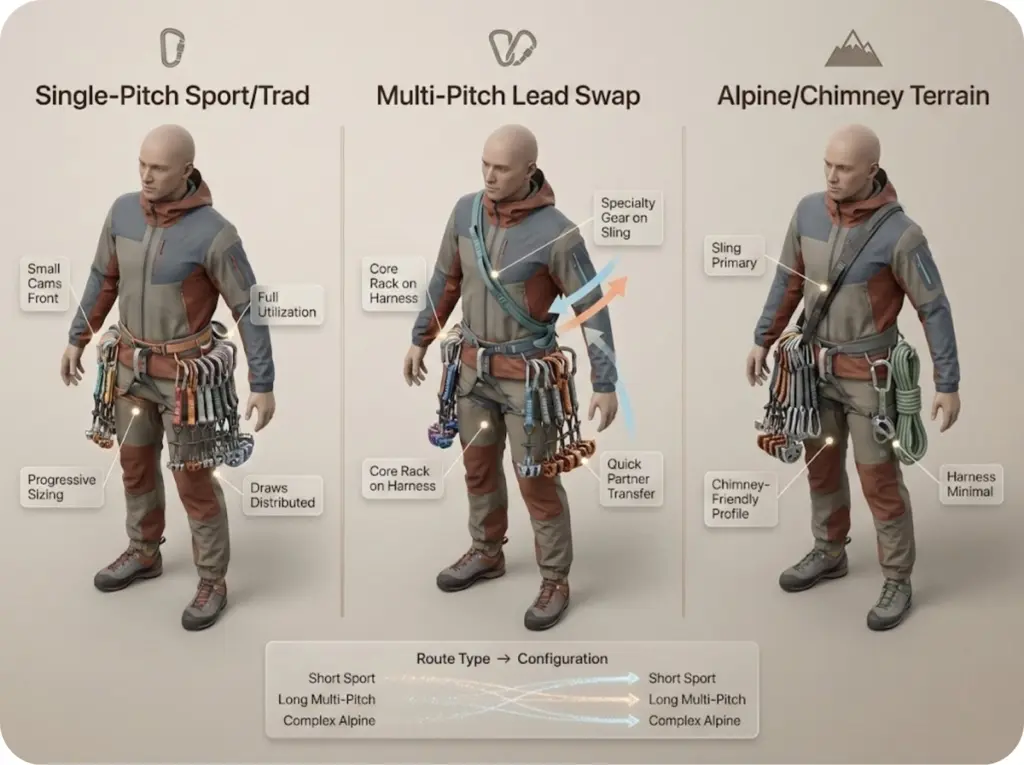
The Winning Configuration
For single-pitch sport/trad mix: full harness racking with small-to-large, front-to-back organization.
For multi-pitch with lead swapping: core rack (most-used sizes) on harness, specialty pieces (large cams, tricams, hexes) on a compact sling.
For alpine/chimney terrain: prioritize gear sling, with belay device and anchor material on harness back loop only.
For heavy double racks: split between harness (dominant sizes) and sling (backup sizes).
The protocol: assess the route before leaving the ground, configure your system at the base, and don’t change mid-route.
Understanding building your first trad rack helps newer climbers identify which pieces constitute their “core rack” versus specialty gear.
The Follower’s Re-Rack Protocol
The second climber dictates multi-pitch efficiency more than most teams realize. When you’re following a pitch and cleaning gear, you should organize each piece onto your harness in size order as you remove it.
Arriving at the belay “rack-ready” eliminates 5-10 minutes of transition time per pitch. On an eight-pitch route, that’s an hour saved—often the difference between summiting in sunshine or getting caught in afternoon weather.
As one AMGA guide reminded me during testing: “Time is safety in the mountains.”
This connects directly to efficient multi-pitch transitions. The follower’s rack transfer sets the team up for success on the next pitch.
Gear Loop Mistakes That Hurt Efficiency
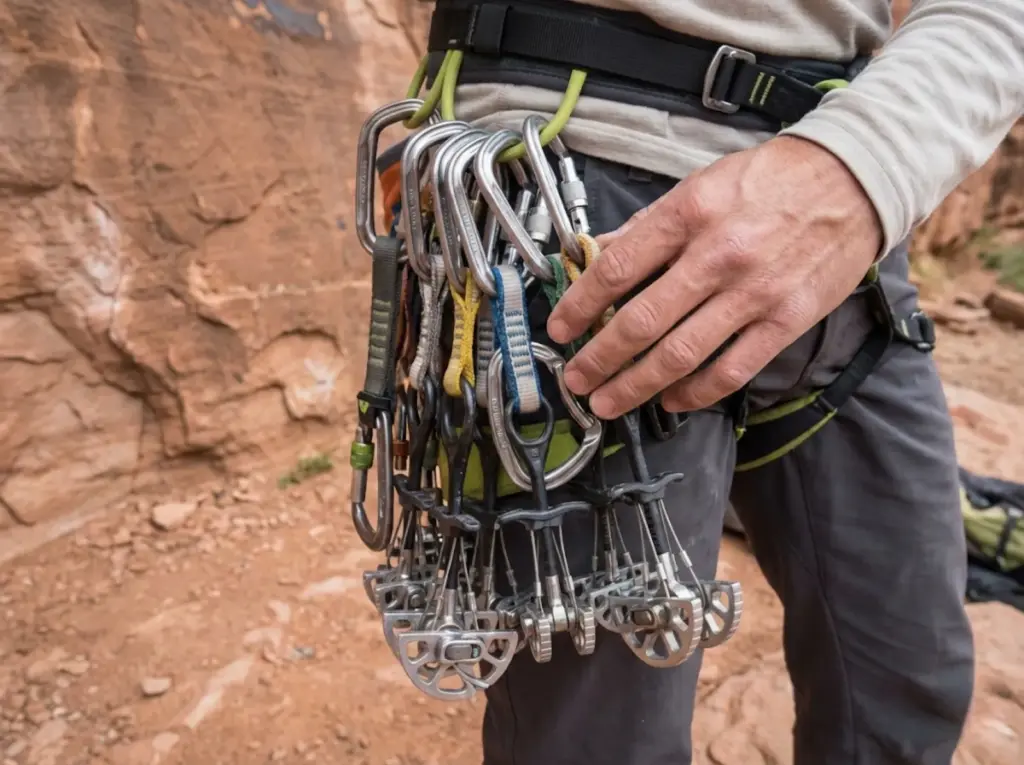
Even experienced climbers sabotage themselves with preventable errors. Here’s what to avoid.
Overcrowding and the Chandelier Effect
Stacking more than 3-4 pieces on a single gear loop creates the chandelier effect. Pieces hang together and move as a unit instead of individually. You can’t select the cam you need without pulling three others with it.
Alpine draws count as two or three pieces due to their bulk. Factor that into your loop distribution.
The fix is simple: spread gear across all available loops, even if the arrangement feels asymmetrical. Most fumbles during my testing occurred when climbers overloaded their dominant-side front loops.
Ignoring Body Type Variations
Your body determines your optimal system. Climbers without pronounced hip shelves need longer-rise harnesses or gear sling supplementation. Short-stature climbers suffer from knee-banging with standard cam slings.
Climbers with wider hips—including many women—need different loop positioning than narrow-hipped climbers. A harness designed for one body type won’t transfer configurations cleanly to another.
Understanding women’s harness fit considerations addresses these anatomical differences directly.
Pro tip: Test your racking configuration on a hangboard before committing to routes. Hang in your harness with a full rack for 60 seconds. Anything that digs, tangles, or slides will be worse at 400 feet.
The “Random Dump” at Belays
Piling cleaned gear in a heap at the belay creates chaos. Pieces tangle, carabiners hook through each other, and your partner’s next pitch starts with five minutes of sorting.
The re-rack as you go protocol eliminates this entirely. It also forces you to inspect each piece while placing it—quality control built into the process.
Optimizing Your System: Advanced Tactics
Once you’ve got the fundamentals working, these refinements push efficiency further.
Color-Coding Beyond Cams
Matching carabiner colors to cam brand colors is standard. Advanced practitioners extend this to their entire anchor kit.
Designate a specific color for all master point locking carabiners. Use a different color for personal tether components. When your partner needs to clip into your anchor at a hanging belay, they know exactly which locker to grab without verbal communication.
The goal: any partner can work with your system without explanation. This matters when the wind is howling and shouting instructions doesn’t work.
Terrain-Specific Adjustments
Different rock types demand different rack priorities.
Granite cracks with their clean parallel features work well with sandblasted cam lobes that grip slick surfaces. You can carry fewer backup sizes. Sandstone splitters with uniform crack widths mean you’ll use one size repeatedly—double that size on your front loop.
Mixed terrain requires keeping hexes and tricams accessible for flared placements where cams fail. Overhanging limestone demands light racks with extendable quickdraws—rope drag kills you before pump does.
The relationship between geology and protection choices runs deep. Rack for the rock you’re climbing.
The Pre-Climb Rack Audit
Before leaving the ground, spend 60 seconds on a verbal rack check with your partner. Identify the 3-4 workhorse pieces you’ll use most on the route and confirm their accessibility.
Check for worn slings, sticky cam releases, and carabiner gate direction on every biner. This short audit catches issues that would cost minutes—or create danger—on route.
Build this into your pre-climb ritual alongside partner communication protocols and rope inspection. The complete pre-climb safety ritual includes rack verification as a core step.
Conclusion
Three things emerged from six months of testing across nearly fifty routes:
System matches terrain. No single racking approach works everywhere. Hybrid configurations let you optimize for each route’s specific demands.
Consistency builds speed. The “where” matters more than the “what.” Muscle memory enables blind selection when you’re too pumped to look at your harness.
The follower sets the pace. Re-racking while cleaning eliminates belay chaos and can save an hour on long routes.
Configure your system before your next multi-pitch day. Run through two mock belay transitions at the base, timing each partner swap. The ten minutes you invest on the ground will pay dividends 400 feet up when your forearms are screaming and the afternoon clouds are building.
FAQ
How many gear loops do I need for trad climbing?
Most trad climbers need at least 4 gear loops for comfortable racking. For heavy double-rack scenarios or long alpine routes, look for harnesses with 5-7 loops plus ice clipper slots. The Misty Mountain Cadillac and Black Diamond Big Gun are favorites among multi-pitch veterans.
Should I rack cams on carabiners or clip them directly to my harness?
Always use racking carabiners. They allow quick clip-and-unclip under stress, protect your gear loop webbing from cam sling wear, and enable the color-matching system that accelerates blind selection. Wiregate carabiners work best for their low weight and resistance to gate vibration.
How do I stop my gear from swinging and hitting my legs?
Three solutions work: rack heavier pieces toward the back of your harness to keep weight centered, use shorter racking carabiners or rack through thumb loops, and for shorter climbers, consider a gear sling to raise piece height above knee level.
Is a gear sling necessary for multi-pitch climbing?
Not always, but highly recommended for alpine routes, chimney-heavy terrain, or when swinging leads with a heavy double rack. A compact sling holding specialty pieces supplements harness racking without the visibility trade-offs of full sling-based systems.
How often should I reorganize my racking system?
Never mid-route, and rarely between similar routes. Once you establish a system, maintain it for at least a full season to build muscle memory. The exception: when changing disciplines, reconfigure before your first route of the new style.
Safety Notice: Rock climbing and mountaineering are inherently high-risk
activities that can involve physical trauma or fatal incidents. The information on Rock Climbing Realms is for
educational and informational purposes only. Techniques and advice presented here are not a substitute
for professional, hands-on instruction. Conditions and risks vary by location. Always seek guidance
from a qualified instructor before attempting new techniques. By using this website, you agree that you
are solely responsible for your own safety. Any reliance you place on this information is strictly
at your own risk, and you assume all liability for your actions. Rock Climbing Realms and its authors
will not be held liable for any harm, damage, or loss sustained in connection with the use of this information.
Affiliate Disclosure: We are a participant in the Amazon Services LLC Associates Program, an
affiliate advertising program designed to provide a means for us to earn advertising fees by advertising and linking
to Amazon.com. As an Amazon Associate, we earn from qualifying purchases. We are also an official affiliate partner
of Black Diamond Equipment via the AvantLink network. If you click on a Black Diamond affiliate link and make a
purchase, we may earn a commission at no additional cost to you. We also participate in other affiliate programs.
Additional terms are found in the terms of service.