

In this article
The ache starts small—a whisper at the inside of your elbow after a steep bouldering session, a twinge in your shoulder during the mantle top-out. You shake it off, hydrate, stretch. Two weeks later, you can barely grip a coffee mug.
For the 50-82% of climbers who report at least one injury annually, this trajectory feels sickeningly familiar. The irony? While we obsess over finger strength and lat power, we systematically ignore the muscles that prevent the breakdown—the antagonists.
After working through my own battle with climber’s elbow, I’ve learned the hard way that training what hurts is only half the equation. Here’s what actually works—the self-assessment-driven framework for building antagonist strength that separates injury-free climbers from the chronically sidelined.
⚡ Quick Answer: Antagonist training targets the push muscles that oppose climbing’s dominant pulling pattern—think triceps, chest, wrist extensors, and rotator cuff. Train these 2-3 times per week for 15-20 minutes post-climbing to reduce injury risk by up to two-thirds. The key is matching your antagonist work to your climbing style and using a simple self-screening protocol to target YOUR specific imbalances.
Why Climbers Develop Dangerous Imbalances
The Physics of a Pulling-Dominant Sport
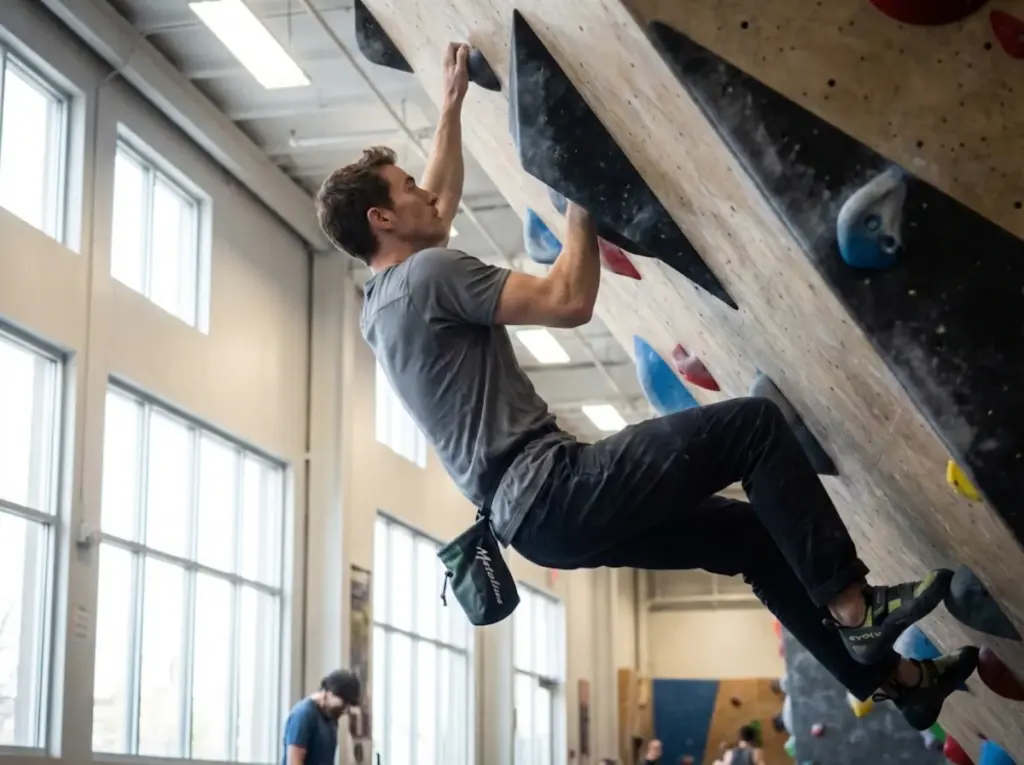
Climbing is a lopsided love affair with pulling muscles. Your latissimus dorsi, biceps brachii, and finger flexors work overtime session after session while their opposites—triceps, chest, wrist extensors—barely fire. Over time, this creates measurable structural change.
The result? Your shoulders roll forward into what climbers call “gorilla posture.” Your humerus internally rotates. Your scapulae lose their anchor points. That postural shift you notice in photos isn’t just vanity—it’s your rotator cuff screaming for backup.
Data from US Emergency Departments shows 47,251 climbing injuries treated between 2014-2023, with upper extremity injuries accounting for up to 71.4% of cases. Your forearms and shoulders are taking the hit because they’re structurally outmatched.
As Dr. Jared Vagy puts it: “Antagonist muscles act as stabilizers that prevent joint collapse under high load.” Without that stabilization, every crimp and mantle becomes a dice roll with the biomechanics behind common climbing injuries.
The Elbow-Shoulder-Finger Chain of Failure
Here’s what the generic training advice misses: injuries cascade. That nagging elbow pain rarely starts at the elbow.
Finger flexor pulley injuries account for 41% of specific climbing injuries—but the root cause is often upstream. Weak wrist extensors force your flexors to over-stabilize, creating the cellular precondition for medial epicondylitis. Similarly, scapular instability (weak serratus anterior and rhomboids) causes your shoulder to compensate, stressing the biceps tendon.
Esther Smith, DPT warns about the “Bag of Rocks” syndrome: “Hanging loose puts undue stress, wear, and tear on the soft tissues that function to connect the bones in our shoulders.” That energy-saving rest position on jugs? It’s slowly shredding your labrum.
Warning Signs You Shouldn’t Ignore
Your body sends signals long before injury becomes chronic. Watch for:
- Medial elbow tenderness after high-volume crimping sessions
- Loss of overhead range of motion—can’t touch palms together above your head
- “Clicky” shoulders during warm-up rotations
- One hand “pumping out” significantly faster than the other
Pro tip: If your knuckles go white gripping a coffee mug the morning after a session—that’s not dedication, that’s forearm crisis mode. Scale back volume and prioritize extensors.
The 3-Minute Self-Screening Protocol

Shoulder Assessment: The Zipper Test and Total Motion Ratio
Most climbers guess at their weaknesses. Stop guessing.
The Zipper Test: Reach one hand over your shoulder while the other reaches behind your back toward your spine. The gap between your fingertips should be less than one hand-length. Anything wider indicates serious restriction.
The 176° Rule: Here’s the number most sources won’t give you. Measure your internal and external shoulder rotation at 90° abduction. Add them together. The sum should equal or exceed 176° (roughly 115° external + 61° internal).
If your internal rotation falls below 61° while external rotation stays high, you’re in GIRD territory—Glenohumeral Internal Rotation Deficiency. This isn’t flexibility; it’s dysfunction. And it’s the precursor to impingement.
This mathematical approach prevents the hypermobility that often masquerades as “good mobility” in yoga-heavy content. For the validated shoulder assessment protocol, Dr. Hooper’s methodology offers detailed benchmarks.
Elbow & Wrist: The Fist Test
Extend your arm fully, make a tight fist, and rotate your wrist through full pronation and supination.
Pain at the medial elbow during fist formation points to early flexor tendinopathy. Pain during rotation only suggests pronator teres dysfunction—often misdiagnosed as general elbow pain and treated incorrectly.
If your wrist extensor strength fails before 15 reps against light band resistance, you’ve found your weak link. This correlates directly with higher elbow injury rates.
Finger Assessment: DIP Isolation Test
Hold your PIP joint (the middle knuckle) straight with your other hand. Now try to flex only the distal tip (DIP).
Inability to flex in isolation suggests flexor digitorum profundus strain or interosseous weakness. Compare range symmetrically between hands—asymmetry greater than 20° indicates compensation patterns.
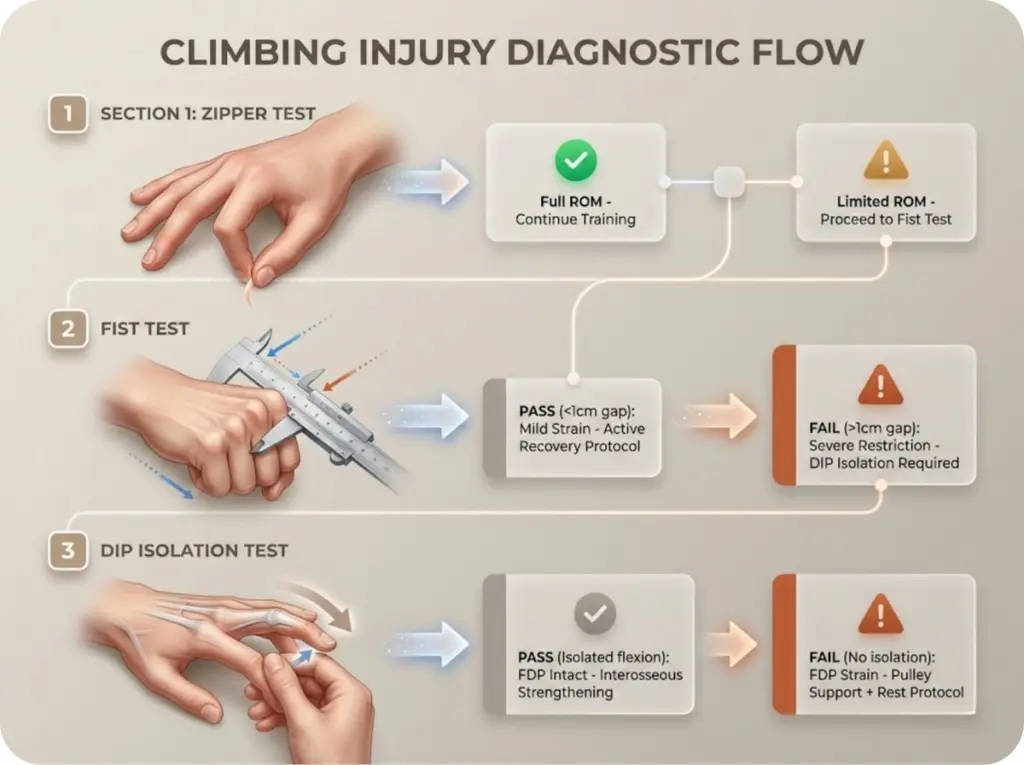
This test reveals the hidden curriculum of finger injuries: your interosseous muscles provide fine-tuning counter-tension to powerful flexors. When they fail, your pulleys take the load. Check out taping strategies for pulley support if you’re already symptomatic.
Essential Antagonist Exercises by Body Region
Upper Back & Shoulders: Fighting the Hunch
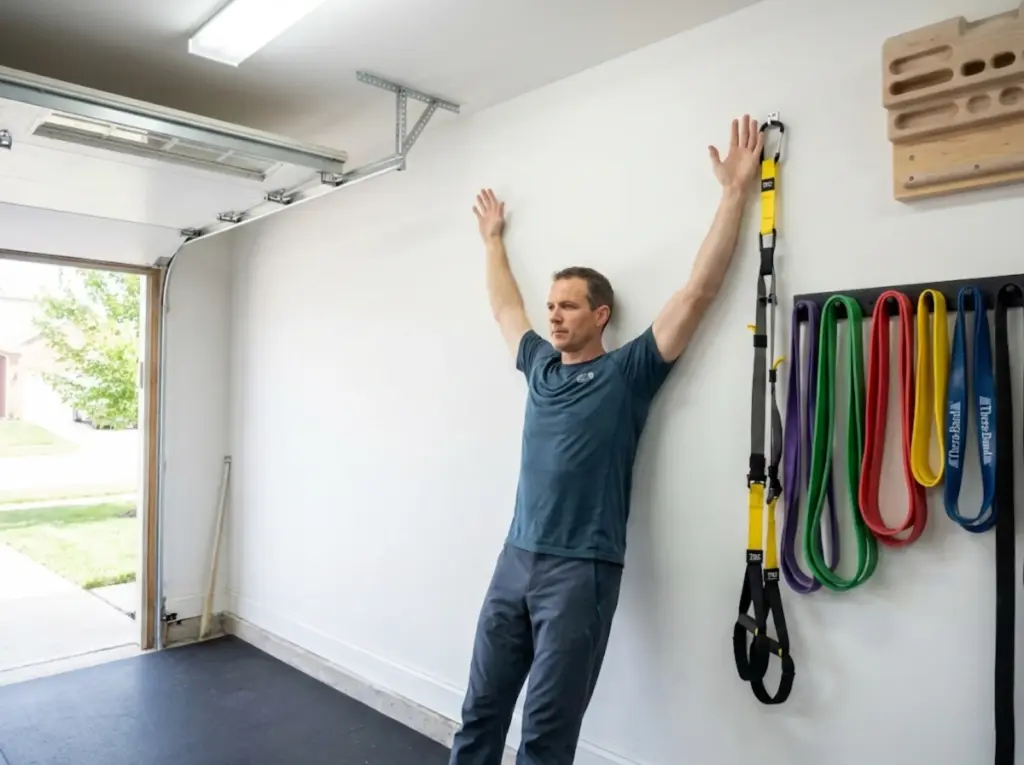
The goal here is reversing thoracic kyphosis and rebuilding external rotation strength.
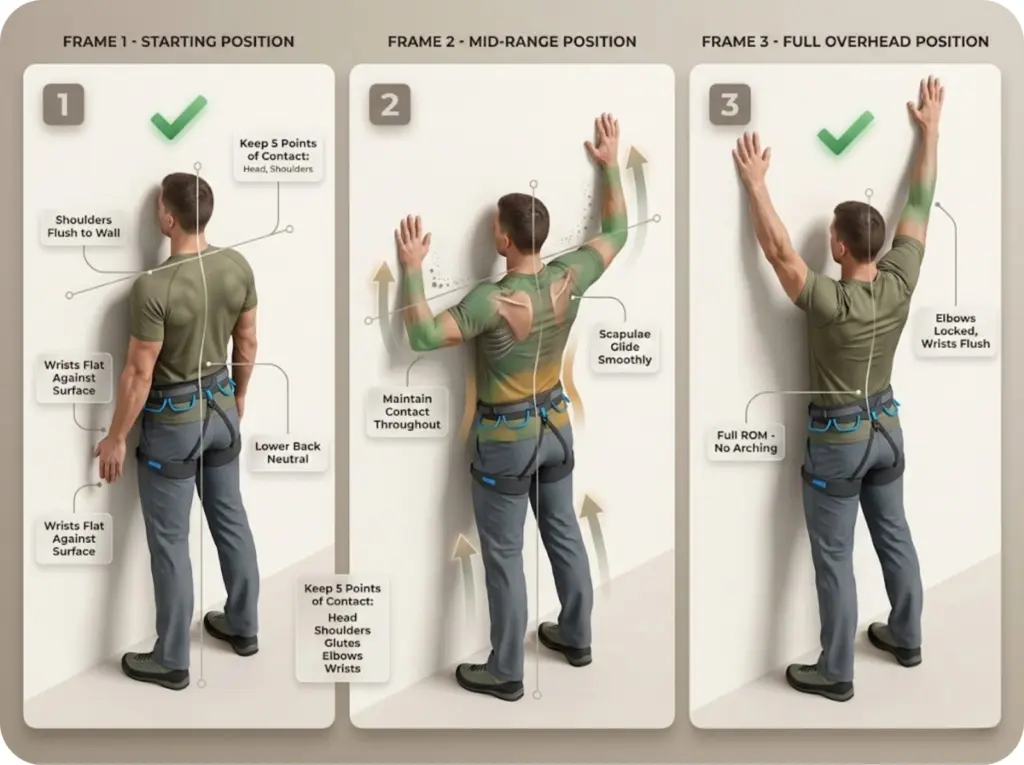
Wall Angels remain the gold standard. Stand with your back against a wall, squat slightly, and move your arms in a snow angel motion while keeping your hands and wrists flush against the surface. Three sets of ten, post-climbing. It sounds simple until you try keeping your wrists flat through the full range.
High Elbow Band Rotation targets your rotator cuff in the functional overhead position climbers actually use. Face a band anchored at chest height. Bring your elbow to shoulder height at 90°, then rotate your palm forward against resistance. Three sets of twelve each arm.
Sling Trainer T’s and Y’s hit the lower trapezius and rhomboids—what I call the “anti-hunch” muscles. Using a TRX or rings, lean back and pull your body up by moving arms into T or Y shapes. Three sets of eight to ten will humble most climbers.
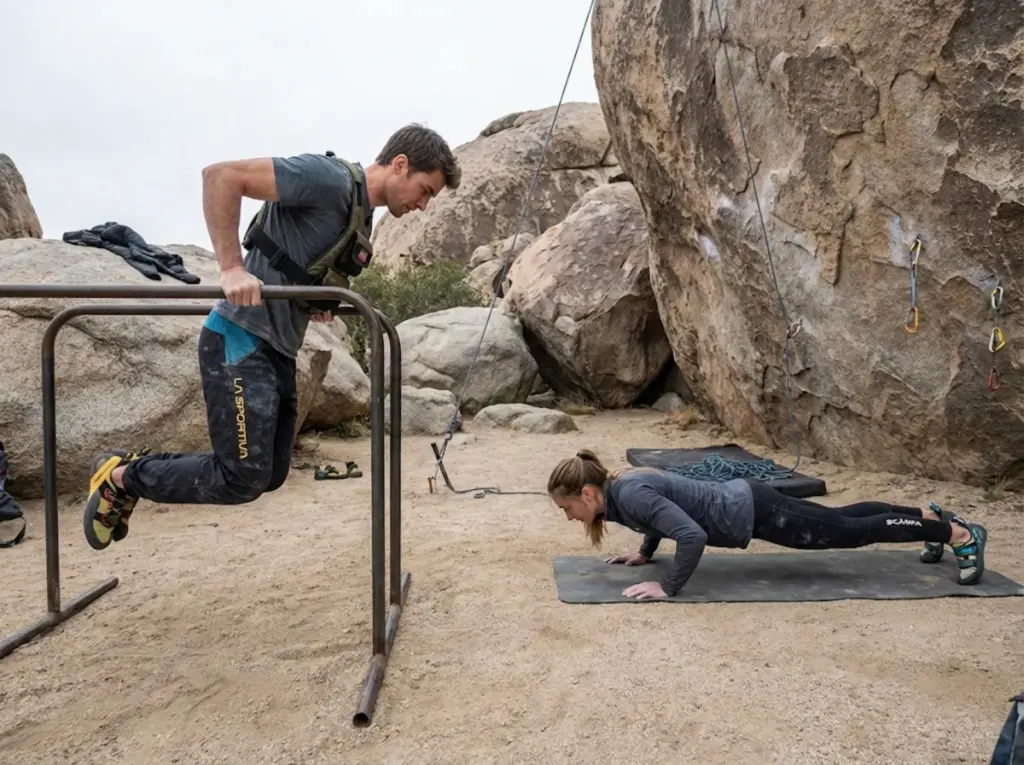
Dave MacLeod found that simple press-ups “sufficed to act like a magic wand” for his chronic elbow pain. Sometimes the obvious solution works. Five to ten push-ups between every two boulder problems builds antagonist volume without adding gym time.
For a deeper systematic approach to shoulder resilience, FRC protocols for building joint resilience offer a progressive roadmap.
Forearms & Elbows: The Epicondylitis Prevention Zone
This is where most climbers fail—and where prevention pays the highest dividend.
Weighted Dowel Lowers train both concentric and eccentric contraction in your wrist extensors. Using a heavy dowel or wrist roller, slowly alternate flexing your wrists to lower and raise a weight. The eccentric phase (lowering slowly) has superior tendon-healing properties. Three sets of eight in each direction.
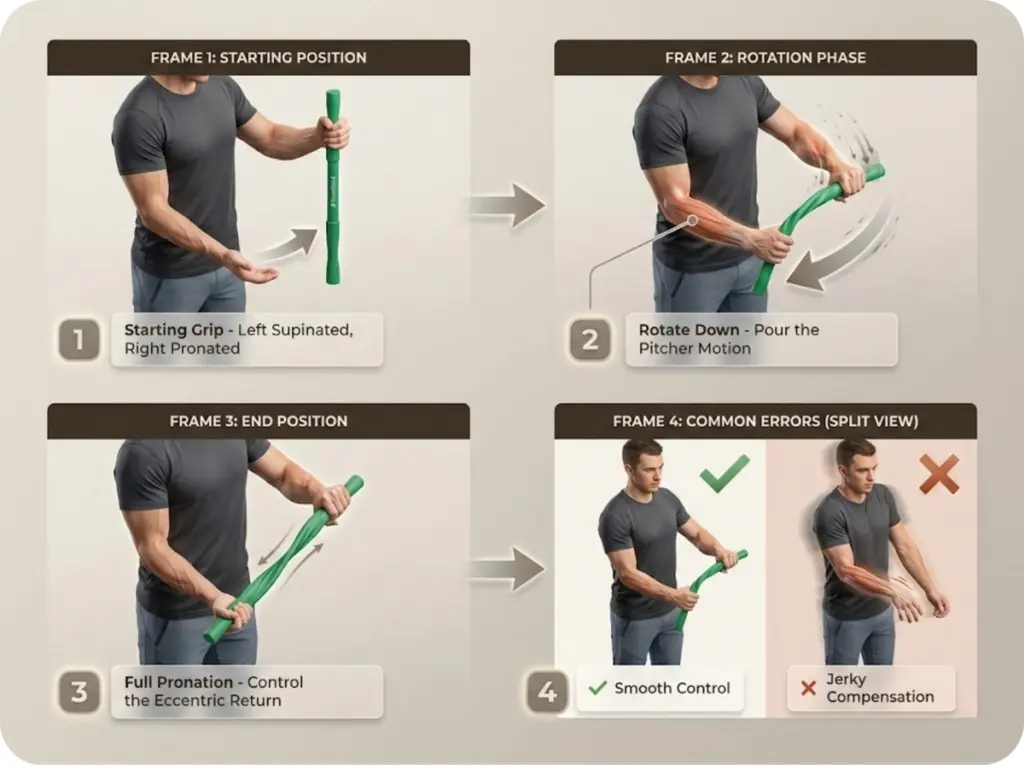
FlexBar “Over the Top” Pronations target the pronator teres, often the actual source of medial elbow pain. Hold a rubber FlexBar and rotate your forearm as if pouring from a pitcher. Start light—three sets of fifteen.
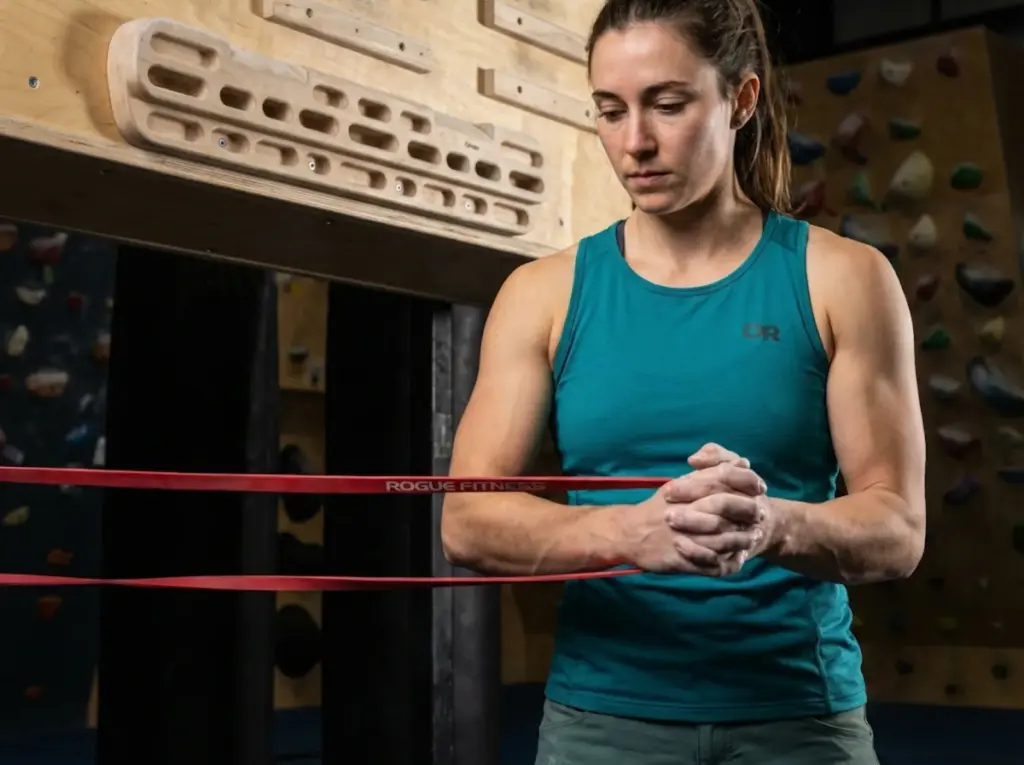
Finger Expansions with a rubber band, Powerfingers, or rice bucket engage the interosseous muscles that provide counter-tension to your flexors. Three sets of fifteen to twenty reps.
Eric Hörst points out that cheap rubber band extensions alone won’t cut it for serious climbers. You need progressive overload—increasing resistance systematically as you adapt.
Pro tip: Perform 5-10 push-ups after every two boulder problems. This builds pushing volume without extra gym time and creates immediate balance against your pulling work.
For integration with finger training, see balancing your hangboard program.
Core & Lower Body: The Kinetic Connection
Body tension isn’t just core strength—it’s the bridge between footwork and grip. Weak core forces your fingers to compensate for every instability in your trunk.
Swiss Ball Pike trains this directly. Start in a plank with feet on the ball, then lift your hips toward the ceiling. This teaches your body to maintain trunk stability while limbs are in motion—exactly what happens during dynamic deadpoints. Three sets of eight to ten.
Tibialis Raises balance the powerful calves you use for edging. Stand with heels on the edge of a step, lower toes below the platform, then lift toes up. This protects your ankles during the high-impact landings typical of bouldering. Three sets of fifteen each leg.
Nordic Hamstring Curls protect against hamstring strain during aggressive heel hooks—one of the highest-risk moves in modern bouldering. If you’re hooking hard, your hamstrings need eccentric strength to match.
The 4-Week Antagonist Strength Calendar
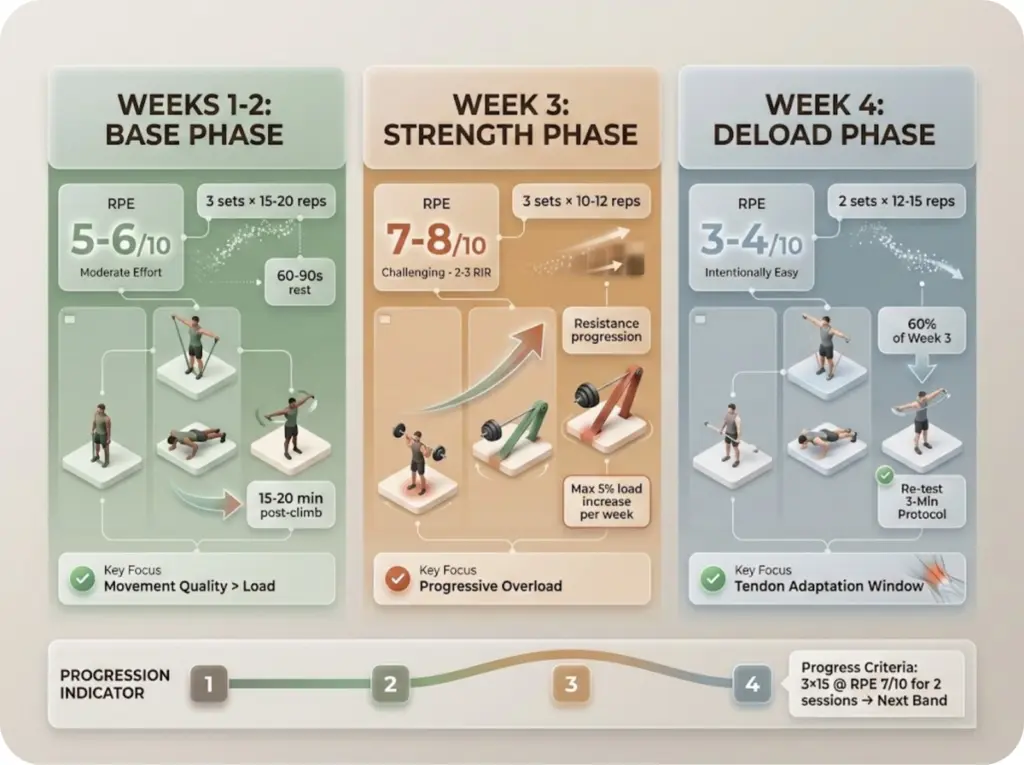
Weeks 1-2: Base Phase
The goal here is movement quality, not load. Think of this as teaching your nervous system new patterns.
RPE target: 5-6/10. Should feel moderate—not exhausting. Protocol: three sets of fifteen to twenty reps per exercise, sixty to ninety seconds rest. Perform antagonist work fifteen to twenty minutes after climbing while blood is still flowing to tissues.
Focus on full range of motion and eccentric control. Video yourself to audit posture—rounded shoulders during push-ups defeats the entire purpose.
For complementary programming, foundational strength programming for climbers provides the agonist framework.
Week 3: Strength Phase
Now you add load.
RPE target: 7-8/10. Challenging but with two to three reps in reserve. Protocol: three sets of ten to twelve reps, increasing band resistance or adding external load.
Use the RPE-1 strategy for bands: assess effort on the first repetition of a set. Should feel 6-8/10 for strength building. If the first rep feels easy (RPE 2-4), move your hand closer to the anchor or double the band.
Never increase resistance more than 5% per week. Tendons adapt slower than muscles, and pushing load too fast is how you trade one injury for another.
Week 4: Deload Phase
RPE target: 3-4/10. This should feel easy—intentionally so.
Protocol: two sets of twelve to fifteen reps at roughly 60% of week 3 resistance. Re-run the 3-Minute Self-Screening Protocol and document objective changes.
Deloading isn’t laziness; it’s required for tendon adaptation. Connective tissue remodels slower than muscle, and without this recovery window, you’re just accumulating damage.
Progress to a thicker band (Yellow to Red) when you can complete three sets of fifteen at RPE 7/10 for two consecutive sessions. That’s your signal for the next cycle.
Discipline-Specific Programming
Boulderer Protocol: Power Focus
Bouldering demands explosive power—and your antagonist work should match.
Train limit-strength: five to eight rep range, high load, three to five minutes rest between sets. Primary exercises: weighted dips, overhead dumbbell press, heavy wrist roller.
The 7-53 protocol logic applies: high-intensity work with full recovery for neurological gains. Your ATP stores need roughly 53 seconds to recharge—don’t rush rest periods for power work.
Frequency: twice weekly in strength phases, preferably 48 hours or more after max bouldering sessions. See peaking protocols for competition bouldering for seasonal integration.
Route Climber Protocol: Endurance Focus
Route climbing demands sustained output—and your antagonist training should build fatigue resistance in stabilizers.
Train strength-endurance: fifteen to twenty rep ranges, moderate load, sixty-second rest. Primary exercises: push-ups to technical failure, scapular isometric holds (60 seconds), band rotations at high reps.
Emphasize isometric postural holds—maintaining proper shoulder position on forty-meter pitches requires anti-fatigue in your stabilizers, not raw power.
Frequency: two to three times weekly, can be performed same day as route climbing (after session). Integrate with endurance circuits: antagonist sets between climbing intervals builds density.
Pro tip: Downclimb your warm-up routes to double your time under tension and build eccentric stability. This is “free” antagonist training built into your session.
Conclusion
The data is clear: a 17.2% increase in climbing injuries over the past decade, with up to 82% of climbers reporting at least one injury annually. But the antidote isn’t climbing less—it’s training smarter.
Three non-negotiables:
- Run the 3-Minute Self-Screening Protocol before designing any program. You can’t fix what you haven’t measured.
- Match your antagonist training to your discipline. Boulderers need power; route climbers need endurance.
- Progress resistance systematically using the RPE-1 metric. Five percent weekly ceiling, period.
The climbers who stay injury-free for decades aren’t genetically gifted—they’re structurally balanced. Put in the work now, and the grade pyramid takes care of itself.
FAQ
How often should I do antagonist training as a climber?
Most climbers benefit from two to three sessions per week, ideally fifteen to twenty minutes post-climbing while blood is still flowing to tissues. Consistency beats intensity—two brief sessions beat one exhausting workout.
Can antagonist exercises fix existing elbow pain?
Yes, but with caveats. Eccentric wrist extension and pronation exercises can help mild epicondylitis. Sharp or radiating pain requires professional diagnosis first. Stop any exercise that causes pinpoint pain and consult a climbing-aware physical therapist.
What’s the minimum effective dose for injury prevention?
Just ten to fifteen minutes of targeted pushing and rotation work, twice weekly, can reduce injury risk by up to two-thirds. The push-ups-between-problems approach works well for time-pressed climbers.
Should I train antagonists on the same day as climbing?
Yes—performing antagonist work immediately after climbing capitalizes on elevated blood flow and seems to accelerate recovery rather than hinder it. Just don’t do max-effort antagonist work before climbing, which can reduce grip stability.
Do I need special equipment for antagonist training?
You can start with just bodyweight (push-ups, wall angels) and progress to resistance bands for ten to twenty dollars, which cover 90% of needs. A suspension trainer, FlexBar, or dumbbells expand options but aren’t required.
Safety Notice: Rock climbing and mountaineering are inherently high-risk
activities that can involve physical trauma or fatal incidents. The information on Rock Climbing Realms is for
educational and informational purposes only. Techniques and advice presented here are not a substitute
for professional, hands-on instruction. Conditions and risks vary by location. Always seek guidance
from a qualified instructor before attempting new techniques. By using this website, you agree that you
are solely responsible for your own safety. Any reliance you place on this information is strictly
at your own risk, and you assume all liability for your actions. Rock Climbing Realms and its authors
will not be held liable for any harm, damage, or loss sustained in connection with the use of this information.
Affiliate Disclosure: We are a participant in the Amazon Services LLC Associates Program, an
affiliate advertising program designed to provide a means for us to earn advertising fees by advertising and linking
to Amazon.com. As an Amazon Associate, we earn from qualifying purchases. We are also an official affiliate partner
of Black Diamond Equipment via the AvantLink network. If you click on a Black Diamond affiliate link and make a
purchase, we may earn a commission at no additional cost to you. We also participate in other affiliate programs.
Additional terms are found in the terms of service.