

In this article
Stepping into a quiet, ancient woodland where magnificent sandstone boulders, sculpted by millennia, rest on sandy plains. This is the Fontainebleau Forest, the birthplace of modern bouldering and one of Europe’s top bouldering destinations. To experience bouldering in Fontainebleau is to touch history, but this pilgrimage to the sport’s Mecca presents a profound paradox: the very passion that draws us to its tens of thousands of worthwhile bouldering routes now poses the greatest threat to its delicate ecosystem. This beginner’s guide is built on a simple pledge: to visit not as a consumer, but as a conscious participant in the forest’s preservation.
Your journey begins as a curious novice, drawn by the allure of the “Magic Forest.” Together, we’ll walk through the practical steps of planning your first bouldering trip and mastering the specific techniques of climbing here. But more importantly, you’ll come to understand that becoming a true “Bleausard” means becoming a guardian of this unique natural and cultural heritage. It’s about learning why this incredible rock dictates a unique climbing style, how to plan a low-impact visit, and embracing the non-negotiable code of conduct that protects the rock for future generations. True competence here is measured not just by the grades you climb, but by the respect you show to the rock, the forest, and the sport’s bouldering history.
What Foundational Knowledge Must a Beginner Master?
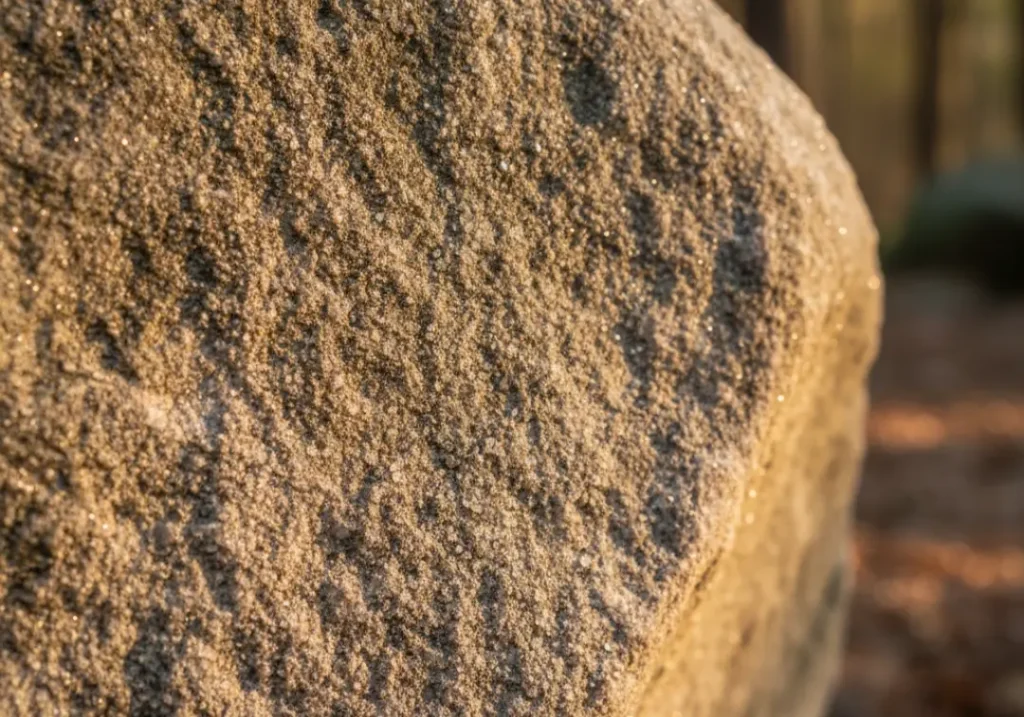
To climb well in Fontainebleau, you must first understand the ground beneath your feet and the rock under your hands. The Forest of Fontainebleau’s unique geology is the source of its legendary climbing—from techy slabs to fickle, slippy slopers—but also its profound fragility. This connection between the stone’s creation and our responsibility to it is the foundation of everything that follows.
Why is Fontainebleau’s Sandstone So Unique and Fragile?
The story of these sandstone boulders begins 30 million years ago, in the Oligocene epoch, when the Paris Basin was a warm, shallow sea fringed with vast coastal sand dunes. The rock you touch today is an erosional remnant of that ancient shoreline, a deposit known as the Fontainebleau Sandstone.
Its composition is remarkably pure, with a quartz content of over 99%. This fine-grained structure is what provides the incredible, high-friction texture that climbers seek. Over millions of years, natural erosion and a process of localized silicification—the hardening of sand into ultra-hard quartzite—sculpted this landscape, leaving a smattering of dense, durable boulders scattered across a floor of soft, forgiving sand.
But this incredible geology comes with a critical vulnerability. The sandstone is porous, acting like a natural sponge. When it rains, water penetrates deep into the rock, weakening the internal bonds that hold the sand grains together. In this saturated state, the rock becomes incredibly fragile. A hold that feels solid when dry can crumble or shear off completely under a climber’s weight when wet. This is the central truth of Fontainebleau climbing: the very thing that makes the forest magical also makes it delicate. Understanding this vulnerability is the first step; the next is learning the language of the forest itself, which is written in painted circuits that guide you from one boulder to the next.
For official validation of the forest’s protected status and sensitive ecosystem, which corroborates the claims about its fragility, you can review Fontainebleau’s official UNESCO Biosphere Reserve designation. These local ethics are a specific application of the fundamental rules of rock climbing that govern our sport worldwide.
How Do the Color-Coded Circuits Guide a Beginner’s Journey?
Wandering through the deep woodland, you’ll quickly notice that the boulders are adorned with small, painted arrows and numbers. These aren’t random graffiti; they are markers for the famous color circuits, a curated tour of a bouldering area that typically includes 20 to 50 boulder problems of a similar difficulty level. This ingenious system was invented in 1947 by Fred Bernick, who wanted to simulate a long mountain route to build endurance for alpine training, decades after bouldering first began here as a mountaineering training ground. It has since evolved into the defining way to experience the forest, a structured path for exploration that often makes a guidebook unnecessary for a day’s climbing.
Each circuit begins at a départ, a painted rectangle with the circuit number, and climbers follow the numbered arrows in sequence to the last boulder, the arrivée. For a beginner, this system is a gift. It provides an ideal framework for a first visit, encouraging continuous movement, skill development, and exploration over the singular pursuit of a high grade, often called “grade hunting.”
Fontainebleau Circuit Colors for Beginners
A guide to understanding the difficulty ratings in the forest of Fontainebleau.
Climbing Focus
Focuses on basic balance and movement. Low boulders with good landings.
Grade Information
Font Grade Range: 1A – 3C (PD Alpine Grade). V-Grade Equivalent: VB – V0.
Climbing Focus
A step up. Introduces more technical moves and requires more thought and body positioning.
Grade Information
Font Grade Range: 2A – 4B (AD Alpine Grade). V-Grade Equivalent: VB – V0.
Climbing Focus
The classic intermediate challenge. Expect steeper angles, smaller holds, and more complex sequences.
Grade Information
Font Grade Range: 3C – 5C (D Alpine Grade). V-Grade Equivalent: V0 – V2.
The color of the markings indicates the general difficulty of the circuit, which can be a bit of a shock when compared to the Fontainebleau grading system for individual problems. While the system was formally standardized in the 1980s, you might still encounter historic, non-standard colors like purple (mauve). For your first trip, focus on the primary beginner routes:
- Yellow circuits: Graded Peu Difficile (PD), or “a little difficult,” this is your ideal starting point. It corresponds roughly to grades 1A-3C.
- Orange circuits: Graded Assez Difficile (AD), or “fairly difficult,” this is a solid step up in technicality and power, sitting in the 2A-4B range.
- Blue circuits: Graded Difficile (D), or “difficult,” this is the classic intermediate challenge (3C-5C) and a major milestone for any developing boulderer.
The true beauty of the circuit system is its emphasis on experience. Following these painted pathways is part of the adventure, allowing you to discover an area’s best problems and learn the unique, footwork-intensive style of Bleau climbing. For a first-time visitor, the most effective and enjoyable way to experience the forest is to pick a yellow or orange circuit and see how far you can get. But as you follow the numbers, you’ll encounter another challenge: the notorious boulder grading enigma.
How Should a Beginner Plan a Sustainable First Trip?
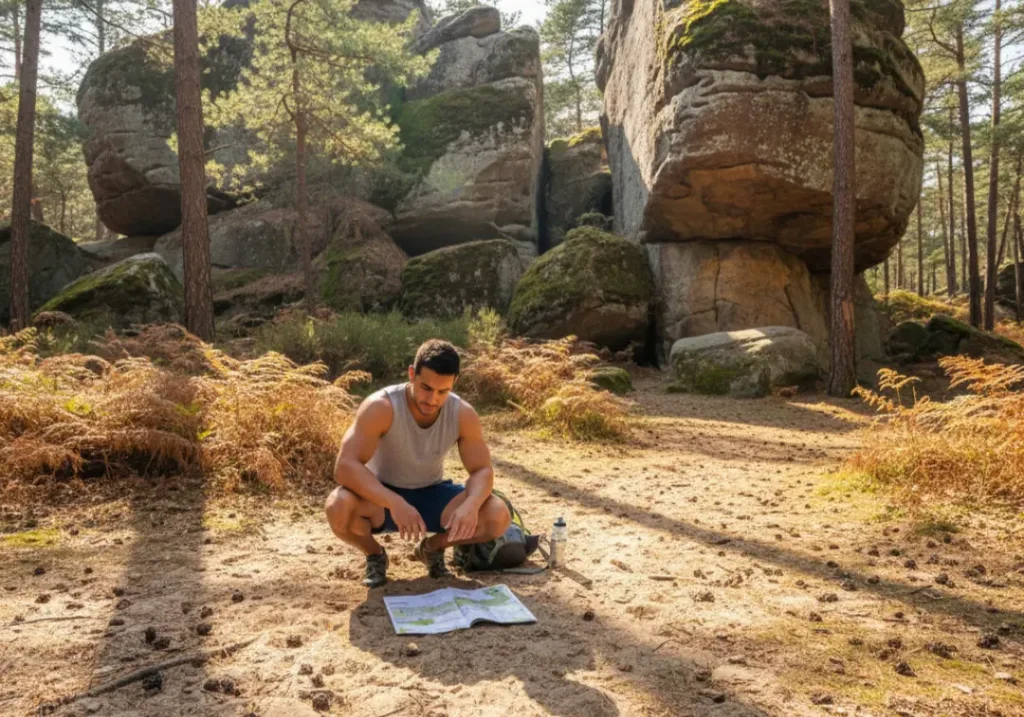
A successful bouldering trip to Fontainebleau is about more than just climbing; it’s about making responsible choices from the moment you start planning. Every decision, from your transport options to accommodation options, is an opportunity to minimize your impact and honor the privilege of visiting this special place.
What is the Most Sustainable Way to Travel and Get Around?
The most efficient and sustainable way to get to Fontainebleau without a car is by public transport. From Paris, the Transilien Line R train departs from Gare de Lyon and arrives at the Fontainebleau-Avon train station in about 40-50 minutes. You can check the official schedules for the Transilien R line to plan your journey. Other stations along this line, such as Bois-le-Roi, provide excellent accessibility to the northern sectors like the popular bouldering area Rocher Canon.
Once you arrive, resist the urge to rely on renting cars. Local buses, like Line 1, connect the station to the Fontainebleau town center and even popular climbing areas like the legendary Bas Cuvier. However, the best option for flexibility and freedom is to rent a bicycle. Bikes can be brought on the train for free, and they significantly reduce the approach times to many climbing areas, allowing for a more immersive experience of the region. While there are many car parks, they fill up quickly and can be targets for break-ins.
By embracing public transport and cycling, you not only minimize your carbon footprint but also take the first active step in fulfilling the “Sustainable Climber’s Pledge.” If you plan to stay overnight, accommodation options range from camping and self-catering gîtes (like those found on Gites de France) to hostels such as the popular Fontaineblhostel. Consider finding climber-friendly camping to keep your trip both affordable and low-impact. Arriving sustainably is the first step; the next is choosing the right time to visit to ensure both optimal conditions and minimal impact.
What Gear is Non-Negotiable for a Safe and Responsible Visit?
Your standard gear requirements—climbing shoes, a chalk bag, and one or more bouldering pads—are the foundation of your essentials checklist. For Fontainebleau’s friction-dependent style, many boulderers prefer softer, more sensitive climbing shoes over stiff, aggressive models to maximize the amount of rubber in contact with the rock on slopers and slabs.
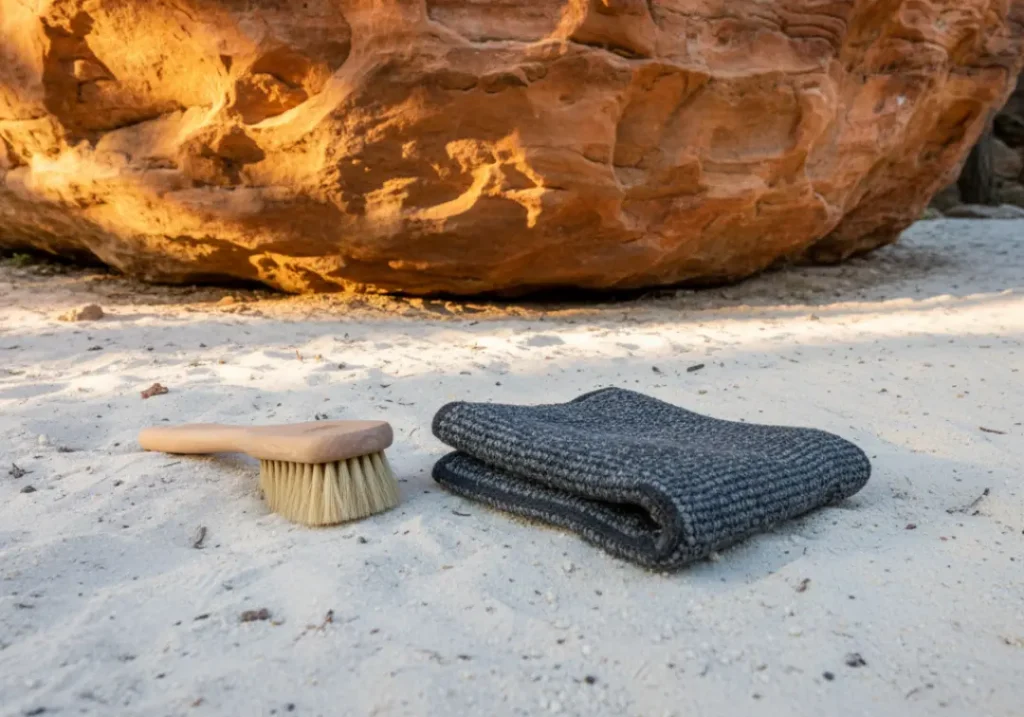
Beyond these basics, however, are two non-negotiable items that define a responsible Bleausard. These aren’t for performance; they are for preservation.
- A soft-bristled brush. This is required for cleaning sand and excess brush and chalk from holds. Wire brushes are absolutely forbidden, as they permanently damage the delicate rock.
- A small towel, doormat, or piece of carpet. This is used to meticulously wipe sand and dirt from the soles of your climbing shoes before every single attempt.
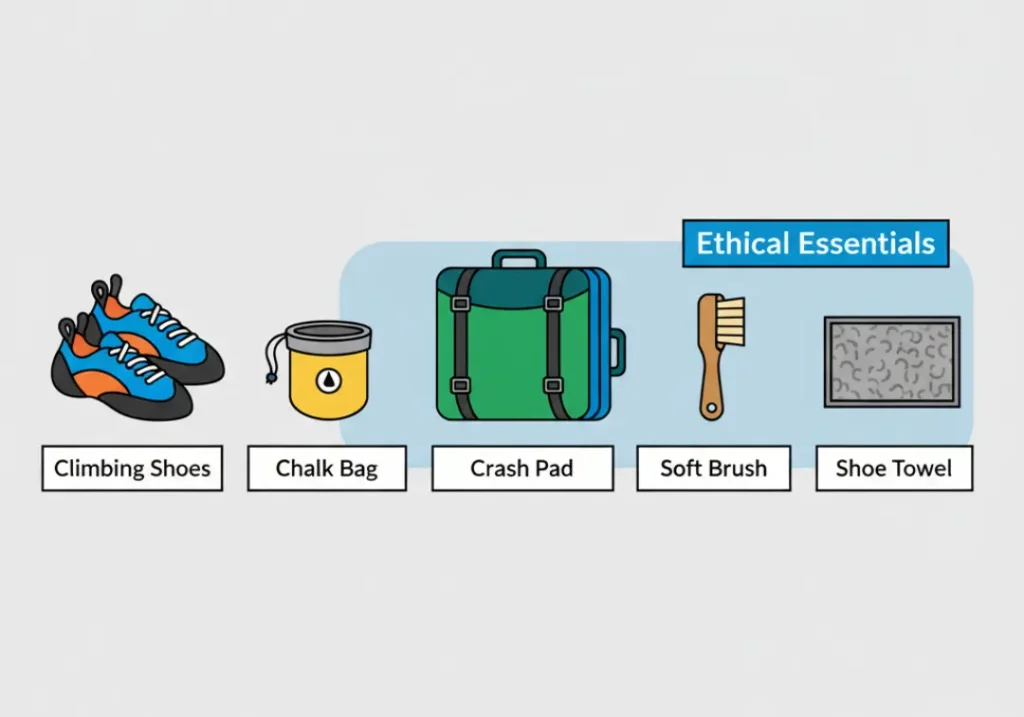
The “why” behind these items is simple and profound. The single action of cleaning your feet prevents you from grinding sand into the holds, which acts like sandpaper and slowly polishes the rock’s precious texture, ruining it for everyone. Using a soft brush, rather than just your hand, removes chalk without eroding the delicate sandstone crystals, ensuring the holds remain in their natural state.
For those traveling light, renting climbing gear is a convenient and sustainable choice. Crash pad rental services are available in the Fontainebleau area, allowing you to avoid the hassle of flying with a bulky bouldering mat. Be sure to book rentals in advance, especially during the peak seasonal factors of spring and autumn, to ensure availability. For a deeper dive into the basics, check out this guide on essential bouldering gear for beginners.
With your sustainable travel planned and ethical kitbag packed, it’s time to focus on the climb itself.
How Does a Beginner Approach the Climb Itself?
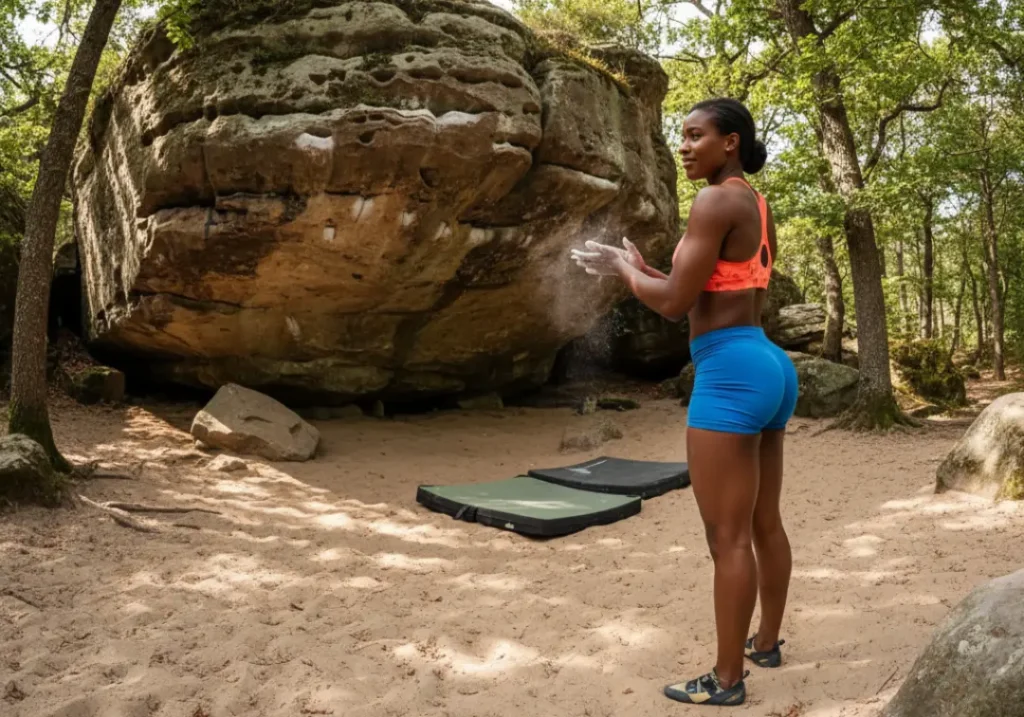
Climbing in Fontainebleau requires a different mindset and a distinct set of physical skills. It’s a dance of balance, tension, and friction that can feel perplexing to climbers accustomed to more positive, incut holds. The various climbing styles—from slippy slopers, technical slabs, and nervy top-outs to physical moves on overhangs and even the occasional dyno or highball—are what make this place so special. Mastering these foundational techniques is key to your sustainable beginner progression plan.
What is the “Bleau Style” and How Can It Be Mastered?
The unique geology of the forest has dictated a style built on subtlety, not just strength. The three pillars of Bleau technique are slopers, slabs, and mantles.
- Mastering Slopers: Slopers are the signature hold of Fontainebleau—rounded features with no positive edge. Success depends on maximizing friction. Use an open-handed grip to get as much skin on the rock as possible, and keep your body position low and directly beneath the hold, often with straight arms, to create a downward pull.
- Dancing on Slabs: Slab climbing involves ascending rock that is less than vertical. It is an exercise in pure faith in your feet. The key is to keep your weight concentrated over your shoes, trusting the friction of the rubber. It requires precise, delicate footwork and a strong sense of balance.
- The Art of the Mantle: A boulder problem isn’t finished until you are standing on top. A mantle is the crucial transition from pulling with your arms to pushing with them. It involves getting a hand high on the lip of the boulder, bringing a foot up to that same level, and executing a “palm press” to shift your weight over the edge and stand up.
Pro-Tip: The best way to practice mantles is in a low-consequence setting. Find a very low, flat-topped boulder, even one you can sit on. Practice the sequence of getting a hand on top, bringing a high foot up, and pressing yourself up. Repeat it until the movement feels fluid and the balance shift becomes second nature.
To excel, you must internalize the slab mantra: “Butt out, heels down.” This position moves your center of gravity away from the wall, driving pressure straight down through your feet and maximizing the grip of your shoes. On slopers, focus on creating a downward, oppositional pull rather than an outward one that will cause a slip; this is about generating body tension, not just raw power. Success in Bleau is less a measure of brute force and more a testament to technical prowess. Don’t be discouraged if you struggle on “easy” grades at first; it’s a normal part of the learning curve and a sign that you are truly engaging with the style. The entire craft is built on a foundation of precise footwork, balance, and body tension, skills that must be practiced deliberately. These techniques are specific applications of more universal fundamental climbing movements that are essential for success on any rock type.
Now that you understand the fundamental movements, let’s identify the perfect outdoor classrooms to practice them.
Where Are the Top Beginner-Friendly Circuits?
A good beginner area in Fontainebleau is defined by a high concentration of quality yellow and orange circuits, low-to-the-ground boulders, great rock quality, and relatively easy access. For your first visits, heading to one of these popular bouldering areas for beginners will ensure a productive and enjoyable day.
Top 5 Beginner Areas in Fontainebleau
A guide to the best areas for new climbers, featuring easy circuits and accessibility details.
Key Characteristics
Family-friendly, soft sandy landings, low boulders.
Pro-Tip
Can be noisy from the nearby motorway, but the climbing is excellent.
Key Characteristics
Huge variety, beautiful setting, easy access from parking.
Pro-Tip
Accessible by train from Bois-le-Roi station (45 min walk).
Key Characteristics
Massive area, great for mixed groups, sharp rock.
Pro-Tip
For an easier start, try the excellent yellow circuit at nearby Hautes Plaines.
Key Characteristics
Extremely family-friendly, expansive, excellent easy circuits.
Pro-Tip
Shares a car park with Cul de Chien; perfect for a two-sector day.
Key Characteristics
Dries very quickly after rain, great for iffy weather.
Pro-Tip
Located on a hill, offering great views and airy conditions.
- Canche aux Merciers: This is one of the most highly recommended sectors for newcomers due to its popularity as a learning ground. It features excellent circuits of all grades, low boulders, and exceptionally soft, sandy landings, making it an ideal, low-stress environment.
- Rocher Canon: A classic, beautiful area that is easily accessible from the Bois-le-Roi train station. It offers a fantastic variety of climbing on well-regarded yellow, orange, and blue circuits with over 500 documented problems.
- Franchard Isatis & Hautes Plaines: Isatis is a large, popular area within the greater Franchard sector, perfect for groups with mixed abilities. For pure beginners, the nearby Franchard Hautes Plaines boasts what many consider one of the best and most enjoyable yellow circuits in the entire forest.
- Rocher aux Sabots & Cul de Chien: Located in the vast Trois Pignons area, these adjacent sectors are quintessential Font. Rocher aux Sabots offers beginner routes and is exceptionally family-friendly, with a superb white circuit for children. A short walk leads to the iconic Cul de Chien, famous for its picturesque “beach” of white sand and an excellent, long orange circuit.
- 95.2: This area is a bit more scattered but is famous for one particular attribute: its very quick drying time. This makes it a strategic choice for climbing on days with iffy weather, along with other quick-drying spots like Apremont and Gorge des Chats.
Pro-Tip: For your very first day, choose an area with a high density of problems like Canche aux Merciers or Rocher aux Sabots. This minimizes walking time and maximizes climbing time, allowing you to build confidence and get a feel for the movement on dozens of problems.
These areas are managed under the official France’s Office National des Forêts (ONF) regulations, which provide the legal framework for visitor conduct. While these are great starting points, guidebook recommendations from sources like Fontainebleau Fun Bloc or 5+6 can reveal countless other gems.
What is The Bleausard’s Code of Conduct?
Visiting Fontainebleau comes with a profound responsibility. These ethics are the final piece of this comprehensive introduction, outlining the explicit rules that form the social contract among the local climbing community. Adhering to them is not optional; it is the essence of being a Bleausard and completes your transformation from a visitor into a guardian.
What is the Unbreakable Golden Rule of Fontainebleau?
There are many rules of etiquette, but one principle of protecting the rock stands above all others as absolute and non-negotiable: Never Climb on Wet or Damp Sandstone.
When the porous sandstone is saturated, its internal structure becomes incredibly weak. The pressure from your hands and feet can easily cause holds to crumble, snap, or shear off completely. This damage is permanent. A historic climb that has existed for decades can be altered or destroyed forever in a single moment of poor judgment. This also means absolutely avoiding “pof,” an old practice of using dried resin to enhance grip, which clogs and damages the rock surface.
After heavy rain, the rock can take 24 hours or even longer to dry completely from the inside out, especially when weather conditions are cool or humid. You must learn to assess the conditions carefully. If the ground is dark and damp, or if the rock itself feels cool or “sweaty” to the touch, it is not dry enough to climb. When in doubt, the only responsible choice is to find a different activity—go for a hike, visit the town, or rest. There is no excuse for climbing on wet boulders. Following this rule is the ultimate sign of respect for the environment, for the history of our sport, and for the climbers who will come after you.
Beyond this golden rule, a broader set of sustainable practices ensures every aspect of your visit leaves a positive trace. These are perfectly aligned with the universal Leave No Trace ethics for climbers that all responsible outdoor users should follow.
Conclusion
Fontainebleau’s magic stems directly from its unique, porous sandstone. This is the source of its classic friction climbing and also its extreme fragility, making the “no wet climbing” rule paramount. For any beginner, the color-coded circuit system provides the ideal pathway to navigate the forest, encouraging a focus on movement and exploration over a simple chase for grades. A truly sustainable trip is built on conscious choices: using public transport, respecting the local environment, and carrying specific ethical gear like a shoe towel and a soft brush for low-impact brushing. Ultimately, becoming a true “Bleausard” is about more than climbing hard; it’s about embracing a code of conduct and actively participating in the effort to preserve sandstone in this world-class climbing area.
Share this first timer’s guide with anyone planning their first trip to Fontainebleau to ensure we all act as guardians of the Magic Forest.
Frequently Asked Questions about Beginner Bouldering in Fontainebleau
Is Fontainebleau suitable for beginner rock climbers?
Yes, Fontainebleau is excellent for beginners due to the color-coded circuit system, especially the yellow and orange circuits designed for learning. Bouldering areas for beginners like Canche aux Merciers and Rocher aux Sabots offer low-to-the-ground boulders with soft, sandy landings, making them perfect for starting out.
How do you get to Fontainebleau bouldering without a car?
The most efficient way is to take the Transilien Line R train from Paris Gare de Lyon to Fontainebleau-Avon. From the train station, you can use local buses or rent a bicycle to access many popular climbing areas.
What is the best time of year to boulder in Fontainebleau?
The best time to visit depends on seasonal factors. The prime seasons are spring (March to May) and autumn (September to November) for optimal friction with mild temperatures and lower humidity. Summer can be too hot, and winter has a higher chance of rain, which can make the rock unclimbable for days.
What specific gear do I absolutely need for Fontainebleau?
Besides standard climbing shoes, chalk, and a crash pad, you must bring a soft-bristled brush for cleaning holds and a small towel or doormat for cleaning your shoes before every climb. These two items are non-negotiable for protecting the fragile sandstone from polishing and damage.
Safety Notice: Rock climbing and mountaineering are inherently high-risk
activities that can involve physical trauma or fatal incidents. The information on Rock Climbing Realms is for
educational and informational purposes only. Techniques and advice presented here are not a substitute
for professional, hands-on instruction. Conditions and risks vary by location. Always seek guidance
from a qualified instructor before attempting new techniques. By using this website, you agree that you
are solely responsible for your own safety. Any reliance you place on this information is strictly
at your own risk, and you assume all liability for your actions. Rock Climbing Realms and its authors
will not be held liable for any harm, damage, or loss sustained in connection with the use of this information.
Affiliate Disclosure: We are a participant in the Amazon Services LLC Associates Program, an
affiliate advertising program designed to provide a means for us to earn advertising fees by advertising and linking
to Amazon.com. As an Amazon Associate, we earn from qualifying purchases. We are also an official affiliate partner
of Black Diamond Equipment via the AvantLink network. If you click on a Black Diamond affiliate link and make a
purchase, we may earn a commission at no additional cost to you. We also participate in other affiliate programs.
Additional terms are found in the terms of service.