In this article
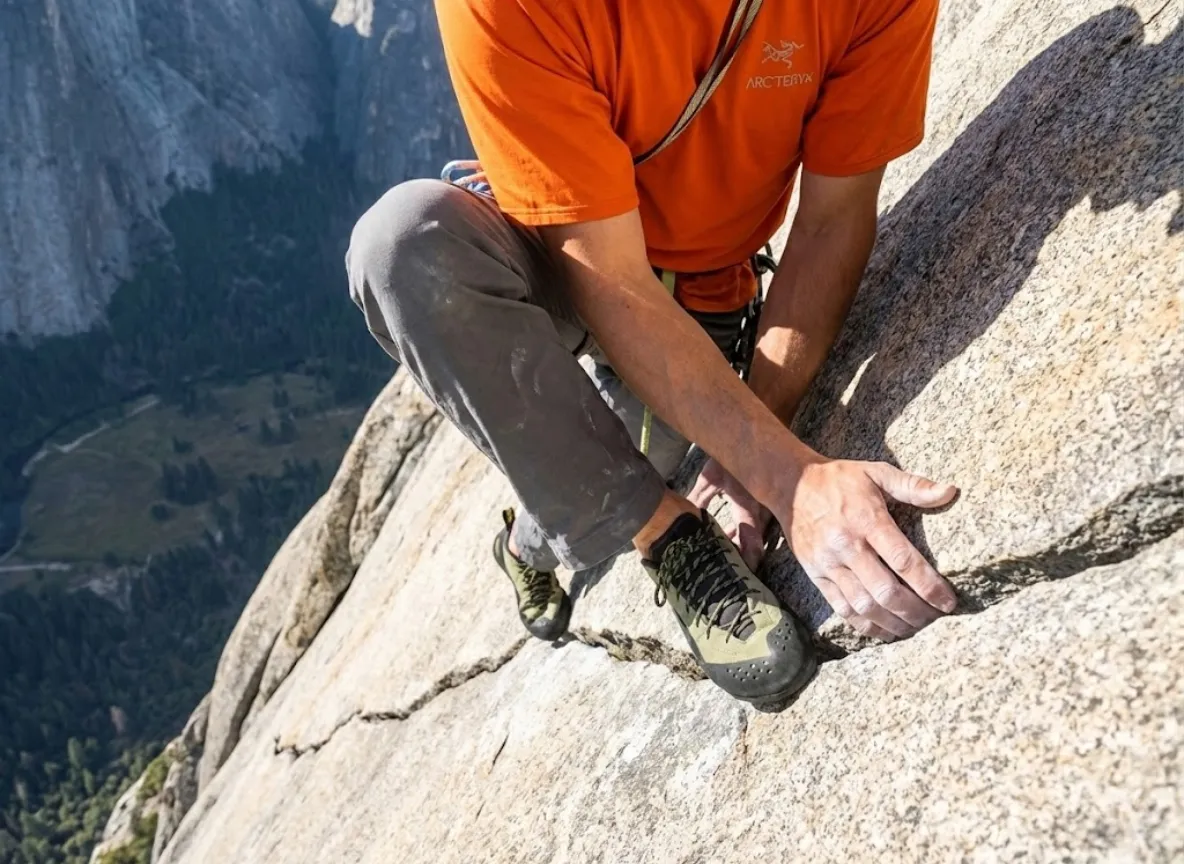
You are fifty feet up a friction slab in Yosemite, toes smearing on a featureless dish of granite. You dip your hand into your chalk bag, coat your fingers in a thick layer of white dust, and press down on the rock. Instead of sticking, your hand fires off the hold with a dry, glassy pop.
This isn’t a failure of strength; it is a failure of rock climbing biomechanics and tribology (the science of wear, friction, and lubrication).
In my years guiding clients from the Peak District gritstone to the domes of Tuolumne Meadows, I have watched strong climbers fall off V4 slabs because they treated all rock the same. They believed that magnesium carbonate always increases grip. The geological reality is far less forgiving: on non-porous rock, excess chalk acts as a high-performance lubricant, reducing the coefficient of friction.
This guide dissects why you slip, contrasts the porous nature of sandstone against the sealed surface of granite, and defines the right protocols to get the best grip possible.
What Is the “Friction Paradox” in Climbing?

The “Friction Paradox” refers to the conflict between the sensation of dry skin and the actual mechanical grip. While rock climbers intuitively equate dryness with adhesion, scientific investigation reveals that chalk can significantly reduce your ability to hold on specific surfaces, turning a helper into a hazard.
Why does chalk feel different on granite compared to sandstone?
Most climbers assume chalk improves grip simply by acting as a drying agent for fingertip moisture. However, elite climbers often report a “glassy” sensation when using heavy chalk on polished granite or quartzite. This creates a dangerous loop where a product designed to help you stick actually causes you to slip.
The root of this chalk paradox lies in conflicting data. While early studies by Amca et al. suggested friction gains, research published in the Journal of Sports Sciences (Li et al., 2001) demonstrated that on granite, chalk significantly decreased grip compared to dry hands.
Li hypothesized that a layer of dust particles interfered with the skin-rock interface. Climbers often confuse the feeling of high skin friction (stiffness) with actual adhesion, leading them to use too much product even when it compromises the hold. To understand this fully, we must look at the science behind chalk’s effectiveness and how it interacts with different bearing surfaces.
How Does Rock Geology Dictate Grip Mechanics?
The mechanical properties of the rock—specifically how porous and rough it is—determine whether chalk helps or hurts. We cannot simply treat the rock as a static canvas; its material science plays an active role in whether you stay on the wall.
How does porosity influence moisture management?
Geotechnical engineering classifies rocks by their ability to absorb fluids, known as porosity. Sedimentary rocks like sandstone, limestone, and clay-rich formations act like a “geologic sponge.” They have plenty of space between their grains to wick away sudation (sweat) and trap chalk dust. On these formations, you can use more chalk because the rock helps you manage the mess.
Intrusive igneous rocks like granite, and metamorphic rocks like gneiss or schist, are different. They feature an interlocking crystal structure with almost zero porosity, creating an effectively sealed surface. According to U.S. Geological Survey data on rock porosity, this lack of permeability means sweat and chalk cannot soak into the rock.
Instead, moisture and dust pool on the surface, creating a “slurry” or paste. This lack of drainage means the moment where friction aids become friction problems is reached almost instantly on granite. Success requires shifting your mindset from mastering climbing rock types generally to managing this specific viscoelastic layer to prevent hydroplaning.
What is the “Ball Bearing Effect” described in tribology?
The “Ball Bearing Effect” happens when loose dust sits between two surfaces, acting like microscopic ball bearings. On smooth, sealed surfaces like glacial-polished granite, excess chalk dust creates a moving layer that prevents the fingertip skin from locking into the rock’s micro-texture.
Instead of the skin pressing into the rock asperities (rugosities), it skims over the rolling particles. This drastically reduces your static friction limit. The principles of particle-induced lubrication explain that this effect depends entirely on the normal force (pressure perpendicular to the surface).
Heavy loads (hanging on a jug) can crush this layer, but light loads (delicate smearing on a slab) are highly prone to slipping. This explains why friction slab climbing often relies on the delicate, low-force movements where chalk fails. To fix this, climbers must remove the “rolling elements” by wiping hands after chalking, leaving only a microscopic film. This concept is similar to how we treat the definitive guide to climbing shoe rubber (like Stealth C4 rubber or Vibram XS Grip2), where clean contact is vital.
Pro-Tip: On technical granite slabs, chalk up, then clap your hands forcefully and wipe your fingertips on your pant leg before touching the rock. You want the drying agent in your pores, not sitting on top of your ridges.
What Protocols Optimize Friction for Specific Rock Types?
Once we accept the physics, we can choose the right tools, separating high-performance agents from common fillers like calcium carbonate.
How does standard Magnesium Carbonate differ from Upsalite?
Standard block chalk is a crystal salt with a relatively low surface area for moisture absorption. In contrast, Upsalite is a special form of magnesium carbonate designed to stop crystals from forming. A study on mesoporous magnesium carbonate properties confirms this creates a disordered structure with massive surface area.
This structural difference allows Upsalite to absorb significantly more moisture per unit of volume than standard chalk. For granite climbers, this is a major advantage because it allows for a “Low Volume, High Drying” approach. By using less physical powder to achieve the same drying effect, you minimize the dust layer, reducing the risk of the ball-bearing effect.
Magnesium Carbonate Comparison
Analyzing the structural properties and absorption capacities of Standard vs. Upsalite MgCO3
Pore Structure
Crystalline / Non-mesoporous structure with limited internal surface accessibility.
Absorption Capacity
Low relative to Upsalite; functions as a basic industrial or pharmaceutical grade material.
Pore Size
Highly efficient mesoporous structure with pores smaller than 6 nanometers.
Absorption Capacity
Extreme absorption capability, reaching up to 10x the capacity of standard magnesium carbonate.
Generic chalks often contain calcium carbonate fillers, which are less absorbent and naturally slippery, making them a liability on sealed rock. When choosing the right chalk, looking for purity and structure is critical for low-friction environments.
Why is brushing critical for friction maintenance on granite?
Brushing on granite is not just about cleaning dirt; it is a mechanical reset required to remove the paste of sweat and chalk left by previous attempts. Because granite cannot absorb this sludge, it creates a glazed layer that fills the surface microstructure necessary for friction.
A Boar’s Hair brush is essential because its natural porous bristles can absorb oils and lift the grease. Nylon bristles simply smear the oils around. However, even the best brushes fail against certain chemicals.
Liquid chalk containing Rosin (pine sap) poses a severe threat. Research on the impact of resin tackifiers on surface friction indicates that while resin increases grip initially, it hardens into a permanent, glassy seal that is nearly impossible to remove.
The “Granite Protocol” dictates using alcohol-based liquid chalk (no resin) for a base layer degrease, followed by a minimal application of high-purity powder. When selecting the best rock climbing brushes, prioritize bristle density to effectively break up that glazed layer.
Pro-Tip: Check the ingredients on your liquid chalk. If it says “Colophony,” “Rosin,” or “Styrax Benzoin,” keep it off the granite. These are tree saps that polish the rock permanently over time.
The Takeaway
Chalk is conditional. It enhances friction on porous sandstone via absorption but acts as a lubricant on non-porous granite via the “ball bearing” effect. The paradox of slipping while “dry” is often a result of the granular layer destabilizing under light tangential forces.
To solve this, climbers must respect the physics of weight—crushing the chalk on jugs, but minimizing it on slabs. By utilizing Upsalite and resin-free liquid chalks, you can achieve a “High Dry, Low Volume” state essential for sticking to impermeable surfaces.
Explore our full library of technical climbing guides to further refine your movement and material knowledge for your next project.
FAQ – Frequently Asked Questions
Does chalk actually increase friction?
It depends on the rock type and humidity. Chalk increases friction on porous rocks (sandstone) by managing moisture but often decreases friction on smooth, non-porous rocks (granite) by creating a slippery granular layer. The feeling of grip often comes from increased skin compliance (stiffness), which can be misleading regarding actual adhesion.
Is liquid chalk better for granite?
Yes, provided it is alcohol-based and resin-free. The alcohol acts as a powerful degreaser that strips oils without leaving a thick dust layer. Avoid sticky liquid chalks containing rosin, as they glaze the rock and reduce the coefficient of friction over time.
What is the best type of chalk for granite climbing?
Upsalite (Mesoporous Magnesium Carbonate) or high-purity block chalk is superior. Its massive surface area allows you to use a tiny amount of powder to achieve maximum drying, avoiding the ball bearing slip effect.
Why do I keep slipping on granite slabs despite chalking up?
You are likely experiencing Granular Layer Failure. On low-angle slabs, there isn’t enough normal force (weight) to crush the chalk particles, causing your shoes or skin to roll on the dust like marbles. Try wiping your hands after chalking.
Risk Disclaimer: Rock climbing, mountaineering, and all related activities are inherently dangerous sports that can result in serious injury or death. The information provided on Rock Climbing Realms is for educational and informational purposes only. While we strive for accuracy, the information, techniques, and advice presented on this website are not a substitute for professional, hands-on instruction or your own best judgment. Conditions and risks can vary. Never attempt a new technique based solely on information read here. Always seek guidance from a qualified instructor. By using this website, you agree that you are solely responsible for your own safety. Any reliance you place on this information is therefore strictly at your own risk, and you assume all liability for your actions. Rock Climbing Realms and its authors will not be held liable for any injury, damage, or loss sustained in connection with the use of the information contained herein.
Affiliate Disclosure: We are a participant in the Amazon Services LLC Associates Program, an affiliate advertising program designed to provide a means for us to earn advertising fees by advertising and linking to Amazon.com. As an Amazon Associate, we earn from qualifying purchases. We also participate in other affiliate programs. Additional terms are found in the terms of service.