

In this article
You’re standing in the shop holding two shoes. One is built around a rubber the brand calls the stickiest on the planet, and the honest answer is that on your home crag it might grip worse than the other one. That isn’t shop-floor gossip: a 2024 University of Birmingham tribology study put climbing shoe rubber on granite and found that softer compounds did not consistently out-grip harder ones. Hardness is the one number every brand publishes, and on its own it’s the weakest predictor of grip in the whole equation. What follows is what each compound actually wins, what it quietly costs you, and how to match one to the rock under your feet instead of to the copy on the box.
Here’s how the major compounds stack up before we get into why the spec sheet lies.
| Compound | Hardness Feel | What It Wins | What It Costs You |
|---|---|---|---|
| Vibram XS Edge | Firm, holds its shape | Edge retention on small features, long life | Less feel through the sole on smears |
| Vibram XS Grip 2 | Soft, conforms | Smearing, toe hooks, sensitivity | Wears faster than XS Edge on edges |
| Five Ten Stealth C4 | Soft, tacky | Raw friction, gym plastic and steep rock | Burns through fastest of the group |
| La Sportiva FriXion | Medium, forgiving | Durability while you learn footwork | Gives up peak friction at your limit |
| Evolv Trax / Butora NEO Fuse | Medium to firm | Balanced life-to-grip, value picks | Neither the grippiest nor the hardest |
Climbing Shoe Rubber Compounds by Brand

Every shoe box lists a rubber name as if it means something to you. Four companies own nearly the whole market, and the names on the box are marketing at least as much as chemistry. Here’s the map a climbing partner would draw on a napkin before you spend money.
The first thing worth knowing is that rubber compound and shoe brand are separate decisions. Compounds get licensed and swapped across companies, so a Vibram sole shows up on a La Sportiva and on a Scarpa in the same season. The logo on the heel tells you almost nothing about what’s under the toe.
Vibram’s XS Family
Vibram is the most widely licensed compound line in climbing, and its XS family splits along a hardness axis. XS Edge is the firm end, built to hold its shape against small features. XS Grip and XS Grip 2 sit softer and tackier, tuned for conforming to rock rather than resisting it. XS Flash shows up in gym-focused shoes, and Megagrip mostly lives on approach shoes rather than climbing lasts.
A compound is a specific recipe of polymers and fillers, not a marketing label. That’s literal: a shoe-sole rubber composition patent filed with the USPTO reads like a chemistry document because that’s what it is. When a brand changes a compound, it changes the recipe, not the sticker.
Five Ten’s Stealth Line
Five Ten built its reputation on Stealth rubber, and the line runs from Stealth C4 (the soft, tacky workhorse) through Mi6 (softer still, and famously short-lived), to HF and Onyxx at the firmer, harder-wearing end. Stealth is the compound family with the loudest reputation in climbing, and we’ll get to whether that reputation survives contact with real rock.
FriXion, Trax, and the Underdogs
La Sportiva runs Vibram across much of its catalog but also makes its own FriXion compounds (Black, Eco, White), which tend to land in the medium, forgiving band aimed at climbers who are still wearing shoes out with footwork rather than mileage. If you want the model-by-model breakdown, La Sportiva runs Vibram on most of its lineup and reserves FriXion for specific tiers, which is worth understanding before you assume the brand equals the rubber.
Evolv makes Trax in three flavors (SAS, XE, GT). Butora runs NEO Fuse. Mad Rock has Science Friction, and Unparallel fields its own UP compounds. Past those, the survey gets genuinely long: Boreal, Tenaya, Ocun, Red Chili and Black Diamond all field their own sticky rubber formulations or license someone else’s, and a few of them are running compounds that would surprise you if the logo were different. These are the names the big-three marketing rarely mentions, which has nothing to do with how they perform and everything to do with advertising budgets.

Shore A Hardness and What the Numbers Mean

“68A” on a spec sheet means nothing until somebody tells you a car tire tread is around 70A. Then it clicks in about a second.
How Durometer Testing Works
The Shore A hardness scale measures how far a standardized indenter sinks into a material under a set load. A durometer is the gauge that does it. The number that comes out describes resistance to indentation, and that’s all it describes. It is a hardness test. It is not a grip test. Hold onto that distinction, because the entire second half of this article turns on it.
The 60A to 85A Window
Climbing compounds cluster between roughly 60A and 85A. The anchors that make that range intuitive are everyday objects: a soft rubber band sits around 25A, car tire tread around 70A, and a hard plastic shopping cart wheel around 95A. So a shoe listed in the high 60s reads as “closer to tire rubber than to a rubber band,” which is a far more useful sentence than the number by itself.
At the low end of that window, a compound feels tacky and sensitive, and it disappears quickly. At the high end, it edges like a plank and can outlast the soft stuff by a season or more. Everything interesting happens in between.
Why the Number Alone Lies
Here’s the trap. Hardness is the only figure brands publish, so climbers weight it heavily. It’s the available number, not the right one. Grip is a product of hardness working together with the rubber’s surface texture and how that texture meets the specific rock you’re standing on. Publishing one third of an equation and letting readers treat it as the whole thing is a marketing decision, not a physics one.
There’s a deeper reason the number can’t carry the load. Climbing rubber is viscoelastic, which means it behaves partly like a solid and partly like a thick liquid: it flows into texture under pressure and over time, and how much it flows depends on temperature and how long you stand there. A durometer reading captures one instant at one temperature. Your foot on a hold is a different experiment entirely.

Soft vs Stiff Rubber and What You Trade

There’s no winner here. There’s a trade. Soft rubber conforms to whatever is under it. Stiff rubber holds its shape against it. The rock decides which behavior you want, and your footwork decides how long you get to keep it.
What Soft Rubber Buys You
Soft compounds deform around texture. On a smear, that means more actual contact area with the rock. On a toe hooking move, it means the rubber grabs instead of skating. On heel hooking, it means the heel cup conforms rather than levering off. And you feel more of it, because a soft sole transmits what’s under your foot instead of muting it. Sensitivity is real and it’s the main reason climbers fall in love with soft rubber.
The Scarpa Vapor V runs Vibram XS Grip 2 and is a clean example of what the soft end delivers (men’s · women’s). It’s a shoe you can feel the rock through, which is exactly the point and exactly the bill. If you want the full picture of how one brand distributes compounds across its range, Scarpa spreads XS Grip 2 and XS Edge across different lines on purpose, and the reasoning behind that split is more honest than most catalogs.
What Stiff Rubber Buys You
Firm compounds resist deformation, and on a tiny edge that’s the whole game. Vibram XS Edge is noticeably harder than Stealth C4 or XS Grip 2, and on a quarter-inch granite seam it keeps its corner instead of rounding over under your weight. That corner is what you’re standing on. Lose it and you’re standing on nothing.
Stiff rubber also lasts. Less deformation per move means less abrasion per move, and the math compounds over a season.
The Semi-Stiff Middle Nobody Markets
Most climbers live in the middle band, and almost nobody advertises to them, because “reasonably balanced” doesn’t sell a shoe. The recurring beginner mistake, repeated in forum threads season after season, is buying the softest compound available because it’s described as the best, without ever asking how fast it disappears for the way they actually climb.
Matching Rubber to the Rock You Climb

This is the section that quietly answers the title. The stickiest compound on the market loses to a Vibram on rounded granite smears, and the reason is geometry, not marketing. Friction behaves differently on every rock type, which is the same reason chalk fails on granite — grip is always a conversation between two surfaces, never a property of one.
Granite
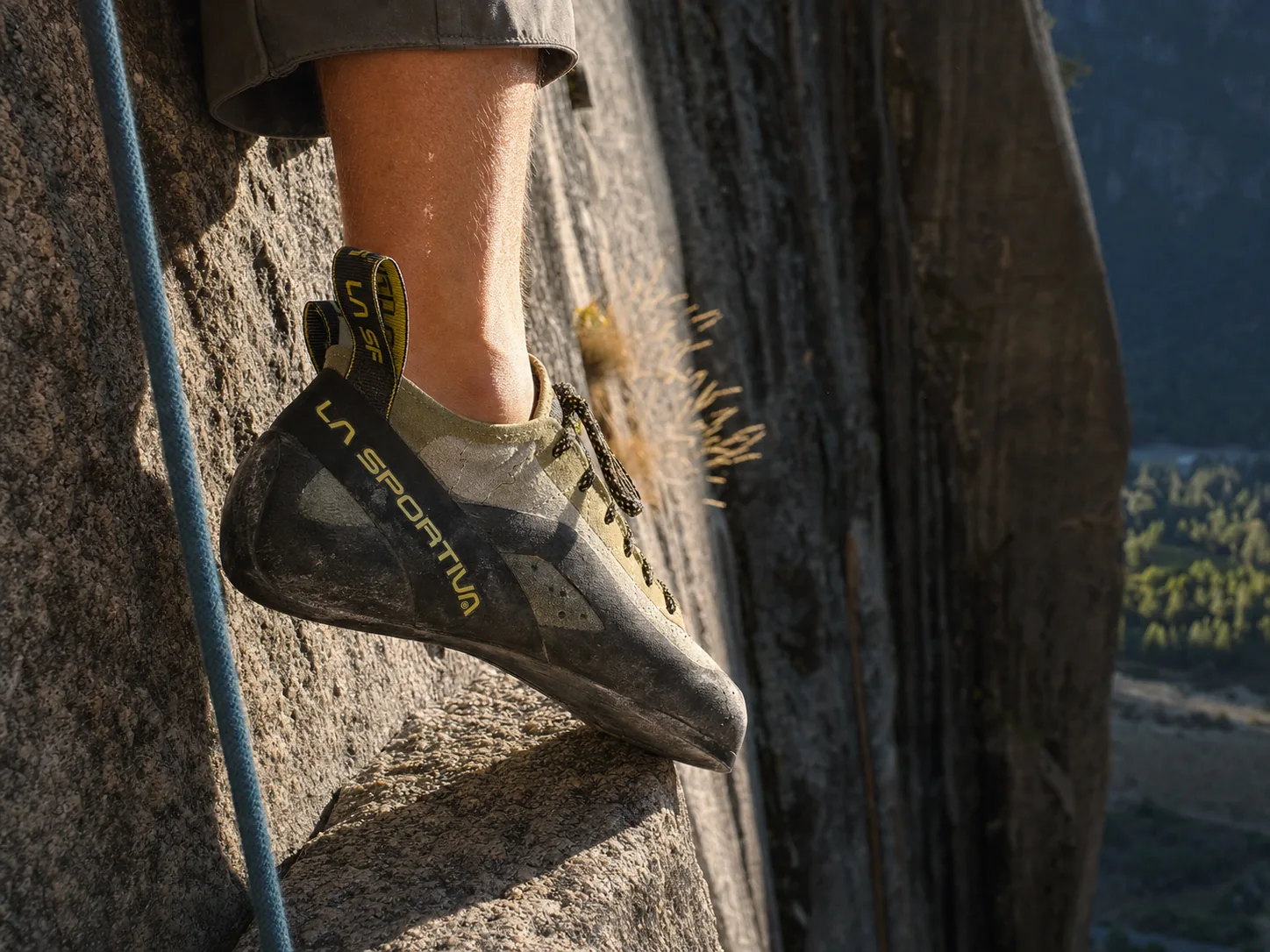
Granite grip is friction grip. The features are rounded, the crystals are coarse, and there’s often nothing to stand on but the angle. Here, multiple forum and review sources converge on the same answer: Vibram XS-family compounds are favored over Stealth on gritstone and rounded granite, because performance depends on the rubber conforming to low-texture stone rather than on raw tack. The compound with the better reputation loses to the compound with the better fit.
When granite does give you an edge, you want it held. The La Sportiva TC Pro runs XS Edge over a 4mm sole and is the reference shoe for exactly this, a shoe built to stand on a seam for a full pitch without the corner folding. If you climb granite and your feet are the limiting factor, the TC Pro is a premium pick that earns the tier for a specific reason rather than a general one.
Limestone and Sandstone
Limestone rewards edge retention. Pockets and small edges ask the sole to hold a shape under load, which points toward the firmer end of the range. Raw stickiness does less for you on a two-finger pocket than a sole that doesn’t collapse. If your hands are crimping and your feet are on matching small edges, a firm compound is doing quiet work you’ll never feel until it’s gone. That logic scales up on multi-pitch days, where a sole that holds its edge through hour four is worth more than one that felt incredible in the parking lot.
Sandstone is the honest one. It’s textured and fragile, and much of the grip comes from the rock itself. Compound matters less here than most climbers believe, and anyone who tells you a specific rubber transforms sandstone is selling something.
Volcanic Rock and Gym Plastic
Volcanic rock and basalt are abrasive enough to eat soft rubber at a rate that surprises people the first season. Gym plastic does the same thing with a different mechanism: high volume, repeated identical movements, and a surface engineered for grip already. Soft compounds shine indoors and vanish indoors. Both facts are true at once.

How Temperature Changes Your Grip

“The send felt easier in the cold” isn’t in your head, and it isn’t only your skin. The rubber has a temperature window, and you’ve probably spent every summer climbing outside it.
The Cold Window
Rubber reaches peak friction just before it turns glassy, roughly in the 32 to 41°F range. That’s the physics behind every November redpoint story you’ve heard. Cold rock, not warm rock, is when your rubber is doing its best work, right up until it gets cold enough to go hard and slick.
On cold days, stuff your shoes inside your jacket between burns instead of leaving them on the pad. You’re not being precious about it. You’re pulling the rubber back into its grip window before you step on, and the difference on a marginal smear is not subtle.
Heat and the Gummy Zone
Above roughly 80°F, soft compounds go gummy and unstable. They feel tacky in your hand and behave worse on rock, because the same chain mobility that makes rubber conform also makes it smear and roll under load when it gets warm. Harder compounds hold their behavior better in heat. A hot afternoon on soft rubber will feel measurably less locked-in than the same route at dawn.
The Hot Trunk Mistake
Here’s the one that quietly ruins good shoes. Rubber left above about 120°F, which a car trunk clears easily on a summer afternoon, cross-links its polymer chains permanently. It comes back harder and less sticky, and it does not recover when it cools. This is not a temporary dip you wait out. Below freezing there’s a mirror version: rubber can micro-crack without healing on rewarming.
Climbers rarely connect the cause to the effect, because the shoe doesn’t fail on the drive home. It fails three sessions later, and everyone blames the compound.
Durability and Wear Rate Across Compounds

Every compound has a price, and you pay it in resoles. Nobody prints that on the box.
Which Rubbers Burn Fast
Stealth C4 is stickier and less durable than Vibram XS Grip 2. That’s a documented differential, not an opinion, and Mi6 sits further down the same slope. If you’re a heavier climber standing on small-footprint edges, you burn through C4 noticeably faster than the same climber in XS Grip 2 on the same routes. The grippiest rubber isn’t free. You pay for it in resoling frequency, and the receipt arrives sooner than you’d like.
The Five Ten NIAD Moccasym is a fair way to meet the Stealth family without committing to a full stiff shoe, a slipper that shows you what the compound does and how quickly it tells you about it. It’s a mid-tier pick that makes the durability tradeoff legible in one season. Once the wear gets real, the exact moment wear crosses into resole territory is a judgment call worth making early rather than late.
Which Ones Last
XS Edge and Trax SAS sit at the durable end. Less deformation per move, less abrasion per move, more sessions per sole. That’s the entire mechanism, and it’s why a firm compound can be the cheaper choice over two seasons even when it costs more on day one.
There’s a second-order effect worth knowing about. The rubber you wear off has to go somewhere, and indoors it goes into the air: researchers at the University of Vienna measured rubber-derived compounds released into gym air as soles wear down, identifying 15 of them in a 2025 study across European bouldering gyms. It’s early research and it isn’t a reason to panic. It is a reason to notice that “wear rate” describes a physical process with a destination, not just a line item on your gear budget.
Your Weight Changes the Math
Compound name is one input. Your weight, your footwork quality, and your rock are the other three, and together they move the wear rate more than the compound does. A light climber with precise feet on limestone will outlast a heavy-footed climber on basalt in the same shoe by a margin that makes the compound comparison look like a rounding error.
Which is why “dead” shoes is community shorthand for a real thing: shoes whose rubber has glazed or hardened past useful grip, no matter how much sole is physically left on them.
Rubber Thickness as Its Own Decision

Two shoes, same compound, different sole thickness, and they climb like different shoes. Rubber thickness is the variable most climbers forget is a variable at all.
3mm to 4mm
Climbing soles run roughly 3mm to 6mm, and thin is its own philosophy. At 3mm to 4mm you feel a dime-sized edge through your foot, which is glorious on a technical face and punishing on a long approach or a full day of bouldering laps. You’re trading protection for information.
5mm to 6mm
Thicker soles give you edging power and protection, and take back that “read the rock” feedback. On a long granite pitch where your feet are working for an hour, that trade is often correct even though it feels less exciting in the shop.
Thickness vs Midsole
Here’s the interaction nobody explains. Thickness works with midsole stiffness, not independently of it. A thin sole over a stiff midsole edges better than the thickness number suggests, because the midsole is doing the structural work. This is why climbers blame the compound for a shoe that feels dead when the real culprit is a thick sole sitting over a stiff midsole. The rubber never had a chance to talk to you.
Why Stickier Rubber Isn’t Automatically Grippier

This is the payoff. The industry sells stickiness. A peer-reviewed tribology study says stickiness on its own doesn’t predict grip. Both of those sentences are true, and the gap between them is where climbers waste money.
What the Birmingham Study Found
In September 2024, a 2024 University of Birmingham tribology study on climbing shoe rubber found that softer compounds don’t automatically out-grip harder ones, published in Sports Engineering. The finding is specific and it matters: friction on granite emerged from hardness, surface roughness, and interfacial adhesion working together. Not hardness alone. Not softness alone.
Read that again, because the implication is bigger than it looks. “Softer equals stickier equals better” is a half-truth that survives because it’s simple and because it’s the only variable on the box. The coefficient of friction between your sole and the rock is a property of the pair of surfaces, never of the rubber alone, which is why no compound can carry a single grip rating that means anything. How your rubber’s surface texture meets your rock’s surface texture matters as much as the durometer reading. Change the rock and the ranking changes with it.
This also explains something climbers notice and then talk themselves out of. Two people can argue honestly about the same two compounds, both be describing real experiences, and both be right, because they climb on different stone. The compound didn’t change. The interface did.
The “Stickiest in the World” Claim
Five Ten’s Stealth has been called the highest-friction rubber in the world by Rock and Ice, National Geographic Adventure, and Climbing magazine. That’s real ink behind a real claim, and it isn’t fabricated. It’s also the wrong question.
“Stickiest” and “best for your rock” are different questions, and only one of them is printed anywhere. On rounded gritstone or a granite smear, a Vibram compound frequently out-grips Stealth despite losing the marketing war outright, because conformability beats tack when there’s no texture to grab. The claim is defensible. The conclusion climbers draw from it is not.
A new compound built on Formula 1 racing-tire technology recently entered the market with exactly the kind of hook that sells shoes. Treat it the way you should treat every “stickiest ever” claim: name it, don’t crown it, and wait for independent testing of the kind Birmingham just demonstrated is possible.
How to Read a Rubber Spec Sheet
So what do you do with a spec sheet that only gives you one third of the picture? You read hardness as a proxy for behavior, not for grip. A low number tells you it will conform and wear fast. A high number tells you it will hold an edge and last. Neither number tells you it will stick to your rock, and no brand is going to publish the variable that would.
The practitioner read is blunt: the number brands publish is the one that predicts grip least well by itself.

Glazing, Break-In, and the Life of a Sole

Nobody warns you that brand-new rubber can feel worse than the pair you just retired, or that a sole with plenty of rubber left can be functionally finished. Both are normal. Both have a mechanism, and neither one is in a single article on the first page of results.
The Too-New-and-Slippery Phase
Fresh rubber has a surface layer that hasn’t been worked yet. Out of the box it can feel oddly slick, and climbers who just spent real money on a compound with a reputation immediately assume they got a bad pair or bought the wrong thing. The break-in period for the rubber surface (which is separate from the break-in of the upper and the fit) usually resolves within a few sessions as the surface roughens into its working texture.
Knowing this in advance changes what you do with it. You don’t return the shoe. You don’t project in it on day one either.
How to Spot Glazing
Glazing is the community word for the rubber surface going smooth and shiny and losing bite, and it’s caused by heat, wear, or repeated smearing on the same holds. The mechanism is the same polymer chain mobility that governs the temperature window: the sole glazes on a hot slab day for the same physical reason grip fades in the heat. The slang and the science are describing one thing.
You can see it before you feel it. Tilt the toe into low light and look for a polished sheen that reads flatter and shinier than the matte, faintly textured rubber further back toward the arch. The difference between those two zones is your diagnosis. And you’ll feel it first in the least forgiving place: smearing is exactly where a glazed sole announces itself, because a smear has no mechanical backup when the friction goes.
The failure has a texture to it. Grip goes from locked-in to skating over the course of a hot afternoon session on a slab, and the fix in the moment is unglamorous: chase shade, wait out the worst of the heat, or accept that today’s burns are practice.
Keep a “send rubber” pair. Climbers who project seriously rotate an unglazed pair reserved for redpoint burns and beat up an older pair for volume and warmups. It sounds fussy until the first time you throw down on a project in shoes that still have their bite.
Bringing a Glazed Sole Back
A lightly glazed sole often comes back with gentle re-roughening. Very light abrasion on the contact patch takes the polish off and exposes fresh texture, and it costs you a small amount of rubber life to recover a meaningful amount of grip. Do it sparingly, because you’re spending sole to buy friction.
There’s a point past saving. When the rubber has hardened through rather than polished on the surface (a hot trunk, or simple age), roughening does nothing, because the problem isn’t the surface. That’s a resole, and no amount of sandpaper argues with chemistry.
What the Stickiest Rubber Actually Costs You

Nobody in the top results will tell you whether the expensive rubber is worth it, so let’s do it here. The stickiest compound isn’t free. You pay for it in resole frequency, and the honest framing is: how many extra resoles are you buying for that extra stick?
The Resole Math
The wear differential is the receipt. Stealth C4 is stickier and less durable than XS Grip 2, and heavier climbers burn it faster. Translate that into your actual life. If a compound gives you a small friction gain and costs you a resole every season instead of every two, then across four years you’ve bought two extra trips to the cobbler to get a benefit you can only use at your physical limit.
Cost per wear is the frame nobody applies to rubber, and it flips the answer for most climbers. The gain is real. The question is whether you’re ever in a position to spend it.
There’s a second half to the math that rarely gets said. A resole isn’t only money, it’s downtime. Your shoes are gone for a stretch while the shop works through its queue, and if that pair is your only pair, the compound that wears twice as fast has just cost you climbing days on top of the bill. Climbers who resole often either keep a backup pair or plan the send season around the shop calendar, and both of those are real costs that never appear in a compound comparison.
Which leads to the strategy most experienced climbers land on without anyone teaching it: two pairs, deliberately mismatched. A durable mid-tier compound absorbs the volume, the gym laps, the warmups, the sloppy days. A grippier pair stays fresh for the burns that matter. The soft compound lasts because it isn’t being asked to do the work it’s bad at, and the total spend across a season usually lands lower than running one premium pair into the ground twice.
When Premium Rubber Pays
Sometimes it’s obvious. If you’re projecting at your limit, one percent of friction is the difference between the send and another burn, and burning a sole faster to get it is a rational trade. If you have one route that matters this season and your feet are the limiting factor, buy the stick. That’s what it’s for.
When It Doesn’t
Here’s the part that doesn’t get written. Volume sessions in the gym, laps on gym plastic, working technique on moderate terrain: you will erase a premium compound before it ever does anything for you that a mid-tier compound wouldn’t have done. You paid for a ceiling you never touched.
The honest conclusion is that most climbers are buying a compound they’ll destroy before it performs. That’s not a moral failing, it’s just the wrong tool bought for the right reasons.
Which is why the compounds outside the big three deserve a look. The Butora Acro Comp runs NEO Fuse, a fifth compound family the big-three marketing simply doesn’t discuss, at a price under the flagship tier. It’s a genuine value pick for climbers who’d rather spend the difference on more days out than on a friction ceiling they’ll sand off in a season.
The recurring story in resole threads is a climber who matched their choice to marketing hype instead of their own footwork style, then burned through the resole in half the sessions they expected. The rubber did exactly what it was designed to do. It just wasn’t designed for them.
Picking Rubber When You Resole

The first time you buy a shoe, you’re guessing. By the time you resole it, you have data, and the data is your own worn-out sole. Almost nobody reads it.
Read Your Own Wear Pattern
Flip the shoe over. The wear pattern is a document about how you climb, written by you, over a season, in rubber.
An inside-edge-heavy pattern (a pale polished strip running from the big toe back toward the arch) says you edge, and you’d probably be better served by a firmer compound that holds that corner. A toe-heavy pattern says steep terrain and toe hooks, which argues for something softer and grippier. A smear-heavy pattern with broad, even wear across the forefoot says friction climbing, and points toward conformability over edge retention.
This is the only moment in a shoe’s life where you choose rubber with real evidence in hand instead of a guess about who you’ll be.
Read the depth as well as the location. A broad, shallow polish across the forefoot is a different message from a deep, narrow trench at the edge: the first says you spread load across the sole, the second says you concentrate it in one spot, and a compound that survives the first can disappear under the second. Two climbers can wear a sole in the same zone at completely different rates, and that difference is the one your resoler cares about.
Also look at where the rubber is untouched. Most climbers only inspect the worn part, but a heel that still looks factory-fresh after a season tells you something real about your footwork, and it means paying for a premium compound back there is spending money on a surface you don’t use.
When to Change Compounds
Change compounds when the wear pattern disagrees with the factory’s assumption about you. The factory picked a rubber for a market segment. Your sole describes a person. When they conflict, trust the sole.
Sometimes they agree, and the factory got it right. That’s a valid finding too, and it’s worth confirming rather than assuming.
The timing matters as much as the compound. Rubber choice at resole is a decision you only get to make if you send the shoe in while there’s still rand left to build on. Push past that and the shop is rebuilding structure before it can even talk to you about compounds, which costs more and returns a shoe that never quite fits the way it did. The climbers who get the most out of resole rubber selection are the ones who send shoes in early enough to have options.
One caution on switching. Changing compound changes how the shoe feels, and if you swap to something firmer, the first few sessions back will feel like the shop got it wrong. Give it the same break-in period you’d give a new pair before you judge the decision. Plenty of climbers have condemned a perfectly good resole on day one and gone back to a compound that was never right for them.
What to Tell Your Resoler
The recurring theme across resole threads is that experienced resolers match rubber to the climber’s specific wear pattern, not to whichever compound is objectively best in the abstract. But they can only do that if you tell them something useful.
Don’t ask your resoler for “the same rubber.” Tell them how you wear the sole out (inside edge, toe, or heel), what rock you’re on most, and roughly what you weigh. That’s the conversation that gets you the right compound. “Same as before” just repeats the factory’s guess about a climber who isn’t you.
One more thing worth saying out loud: how you treat the shoe between resoles decides how many resoles it earns, and it decides it more than the compound does. A shoe stored properly and cleaned occasionally will take a resole cycle the trunk-baked pair simply won’t survive.

Beginner or Advanced Which Rubber You Should Buy

Everything above becomes one decision, and the decision depends entirely on where you are right now. Rubber is one input into matching the whole shoe to how you actually climb, and it’s the input climbers over-think while under-thinking fit.
If You’re New
The answer is boring and it’s still right: softer, forgiving compounds on a flat last. Not because beginners deserve less, but because you are going to destroy these shoes learning footwork, and that’s what they’re for. Buying a premium friction ceiling now means paying to erase it with the exact mistakes you’re supposed to be making.
“Forgiving” isn’t a personality trait, it’s mechanics. A medium compound on a flat last spreads your weight across the whole sole, which means a foot placed slightly wrong still holds. A soft compound on an aggressive last concentrates everything on the toe, so a placement that’s off by a few millimeters skates. Early on, most of your placements are off by a few millimeters. The forgiving shoe isn’t hiding your mistakes from you, it’s keeping you on the wall long enough to stop making them.
The La Sportiva Tarantulace runs FriXion and has been the honest entry answer for years (men’s · women’s). The Evolv Defy and Elektra do the same job with Trax (men’s · women’s). Neither is exciting. Both let you spend your first season learning instead of resoling. If you’re still deciding on the whole shoe rather than the rubber, the neutral first pair worth actually buying is a narrower question than it looks.
There’s a hidden benefit to the boring pair that nobody mentions. A durable compound wears slowly enough to leave a readable wear pattern, and that pattern is the data you’ll use to buy your second pair properly. A soft compound wears so fast and so broadly that by the time you look at it, the sole is just gone. Your first shoes are supposed to teach you something about your own feet, and the forgiving rubber is what makes the lesson legible.
When to Switch
The switch trigger isn’t a grade. It’s the moment your footwork stops being the limiting factor and the rubber starts being it. That’s a specific feeling: you place your foot precisely, you weight it correctly, and it still goes. When that happens on a move you understand, the compound is finally the problem worth solving.
Until then, switching is buying a solution to a problem you don’t have yet.
There’s a reliable way to tell the two apart, and it costs nothing. When a foot blows, ask yourself whether you actually committed weight to it. Most early foot failures are placement failures: the foot was set on the edge of the hold, or the climber pulled harder with their hands the instant it felt uncertain, which unloads the shoe and guarantees the skate. That’s footwork. When you place precisely, commit fully, and the rubber still releases, the compound is finally in the conversation.
Be honest about the count. If that second scenario happens once a season, you have a footwork project, not a rubber problem.
The Grade Myth
Climbers switch to aggressive shoes with sticky compounds because of the number in their logbook rather than because of what their feet are doing. The logbook is a poor signal. Somebody climbing 5.11 on sport climbing volume with sloppy feet will get less from XS Grip 2 than someone climbing 5.9 with precise feet on granite.
Match the compound to your actual session mix rather than to your ambition. A climber doing three gym sessions a week and one outdoor day a month is a gym climber with a hobby, whatever the logbook says, and should buy for the plastic that’s eating the rubber.
Run the count honestly, because most climbers buy for the version of themselves that shows up four weekends a year. Add up where your last twenty sessions actually happened, not where you meant to be. If sixteen of them were on plastic, you’re buying gym rubber, and the outdoor days you’re optimizing for are being subsidized by a compound that spends most of its life getting sanded off by holds it was never chosen for.
The same logic runs the other way, and it’s the part that gets missed. A climber with one project that genuinely matters, on rock they know, at the edge of what they can do, is under-served by a durable all-rounder. That person should buy the stick, accept the resole, and stop pretending the compound comparison applies to them. The framework isn’t beginner-versus-advanced so much as it’s honest-versus-aspirational.
The Bottom Line
Three things worth carrying out of here.
Hardness is the number brands publish and the one that predicts grip least well on its own. Match texture to your rock, not marketing copy to your ego. The Birmingham study did the work of proving what climbers on gritstone have been saying for years.
The stickiest compound has a receipt, and it’s written in resoles. Premium rubber pays when you’re at your limit and burns money when you’re not.
Your worn-out sole is better buying data than any spec sheet, because it describes you instead of a market segment.
So flip your shoes over before your next session and actually look at where the rubber is gone. That wear pattern is the only rubber recommendation ever built specifically for your feet.
Frequently Asked Questions
01Can you resole climbing shoes with a different rubber than the original?
Yes, and the resole is usually the smartest time to switch. Your worn sole shows exactly how you climb, whether that’s inside-edge heavy, toe heavy or smear heavy. Experienced resolers match the compound to that pattern rather than defaulting to the factory rubber.
02Why do my new climbing shoes feel slippery?
Fresh rubber has a surface layer that hasn’t been worked in yet, so a new pair can genuinely feel less grippy than the shoes you just retired. It passes within a few sessions as the surface roughens into its working texture. It isn’t a defect and it isn’t the compound’s fault.
03Does leaving climbing shoes in a hot car ruin the rubber?
Yes, and permanently. Rubber left above roughly 120°F cross-links its polymer chains and comes back harder and less sticky for good. It does not recover when it cools, which makes a hot trunk between crag days one of the fastest ways to ruin a good pair.
04Is Five Ten Stealth or Vibram better?
Neither, and the question itself is the trap. Stealth earned its high-friction reputation honestly, but on rounded granite or gritstone smears a Vibram XS-family compound often out-grips it, because conformability matters more than raw tack there. Match the compound to your rock instead of to the brand argument.
05Which climbing shoe rubber is best for granite?
Vibram’s XS family is the common pick for granite and gritstone, where grip depends on the rubber conforming to rounded, low-texture features rather than on raw stickiness. The 2024 University of Birmingham tribology study supports the reasoning: on granite, softer compounds did not consistently out-grip harder ones.
Safety Notice: Rock climbing and mountaineering are inherently high-risk
activities that can involve physical trauma or fatal incidents. The information on Rock Climbing Realms is for
educational and informational purposes only. Techniques and advice presented here are not a substitute
for professional, hands-on instruction. Conditions and risks vary by location. Always seek guidance
from a qualified instructor before attempting new techniques. By using this website, you agree that you
are solely responsible for your own safety. Any reliance you place on this information is strictly
at your own risk, and you assume all liability for your actions. Rock Climbing Realms and its authors
will not be held liable for any harm, damage, or loss sustained in connection with the use of this information.
Affiliate Disclosure: We are a participant in the Amazon Services LLC Associates Program, an
affiliate advertising program designed to provide a means for us to earn advertising fees by advertising and linking
to Amazon.com. As an Amazon Associate, we earn from qualifying purchases. We are also an official affiliate partner
of Black Diamond Equipment via the AvantLink network. If you click on a Black Diamond affiliate link and make a
purchase, we may earn a commission at no additional cost to you. We also participate in other affiliate programs.
Additional terms are found in the terms of service.