
In this article
I retired my tenth rope last spring. Not because I counted to some magic number of falls — because the sheath felt wrong. Thin in one section, almost papery, the kind of texture that makes your fingers pause mid-flake and think: “I don’t trust this anymore.” That moment, more than any chart or manufacturer timeline, is when most experienced climbers actually make the call.
But I’ve also watched people climb on ropes that should have been cut into dog leashes years ago — faded, stiff, flat spots every few meters. The problem isn’t that rope retirement information doesn’t exist. The problem is that it comes from three competing sources — age, fall count, and visual inspection — and nobody tells you what to do when they disagree.
This article breaks down how climbing rope retirement actually works, what the UIAA fall rating really means in practice, and the decision framework I use after going through ten ropes across a decade of climbing.
Here’s how age and falls compare at a glance:
| Climbing Rope Retirement Guidelines | ||
|---|---|---|
| Factor | Retire When | Why |
| Age (unused) | 10 years from manufacture | Nylon degrades even in storage |
| Age (heavy use) | 1–2 years | Cumulative micro-damage from loading |
| Fall factor > 1.0 | Inspect immediately, likely retire | Extreme forces stress the core |
| Visible core shot | Immediately | Structural integrity compromised |
| Sheath slippage | Immediately | Core and sheath no longer work together |
| Failed pinch test | Immediately | Internal core damage confirmed |
What the UIAA Fall Rating Actually Means (And Doesn’t Mean)
The Lab Test vs Real Life
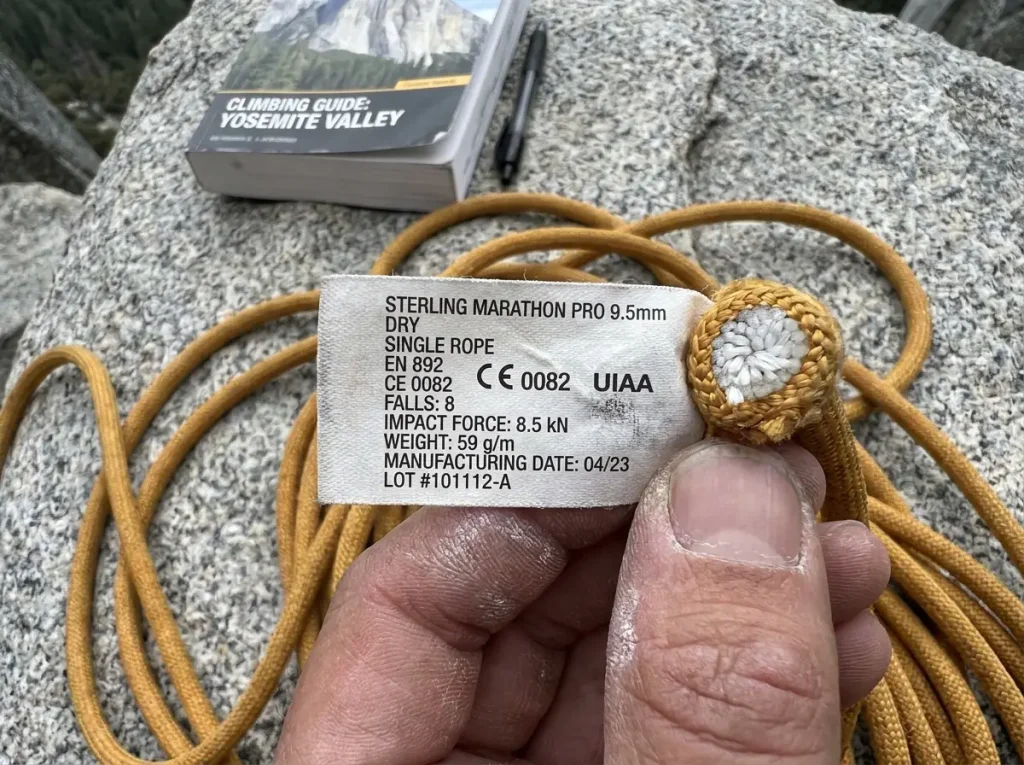
Every climbing rope comes with a UIAA fall rating — a number like 6, 8, or 12 that represents how many test falls the rope survived in a laboratory. Here’s what most people get wrong: that number does not mean “your rope can take 8 falls before retirement.”
The UIAA test simulates a worst-case fall that almost never happens in real climbing. The test setup: a static anchor point, a fall factor of 1.77, an 80kg weight, and only 2.8 meters of rope in the system. That’s a near-factor-2 fall on minimal rope — the kind of violent loading that occurs only in very specific scenarios, like falling at the first bolt with no slack out.
Why You Haven’t Taken a UIAA-Severity Fall
A typical sport climbing fall — 3 to 5 meters with 15+ meters of rope out and a competent belayer giving a soft catch — produces a fall factor well below 0.5. That’s a fraction of the UIAA test severity. Your rope absorbs normal falls with barely measurable degradation. The cumulative wear from hundreds of low-factor falls comes from sheath abrasion over rock, not from the core being overstressed.
When Falls Actually Damage the Core
The falls that matter for retirement decisions are the ones that approach or exceed factor 1.0 — and they’re rare in sport climbing. They happen in trad when you’re above your gear with limited rope out, in alpine situations with static belays, or in specific scenarios where the rope runs directly over a sharp edge during the fall. After any fall like this, inspect the rope immediately. If it feels flat, stiff, or different in the loaded section, it’s time to retire.
Pro tip: Track your high-factor falls in a rope log. Not every fall — just the ones where you fell before the third piece of protection with minimal rope out, or any fall that felt harder than usual. These are the ones that actually stress the core.
How Age Degrades Your Rope (Even in Storage)
What Happens to Nylon Over Time
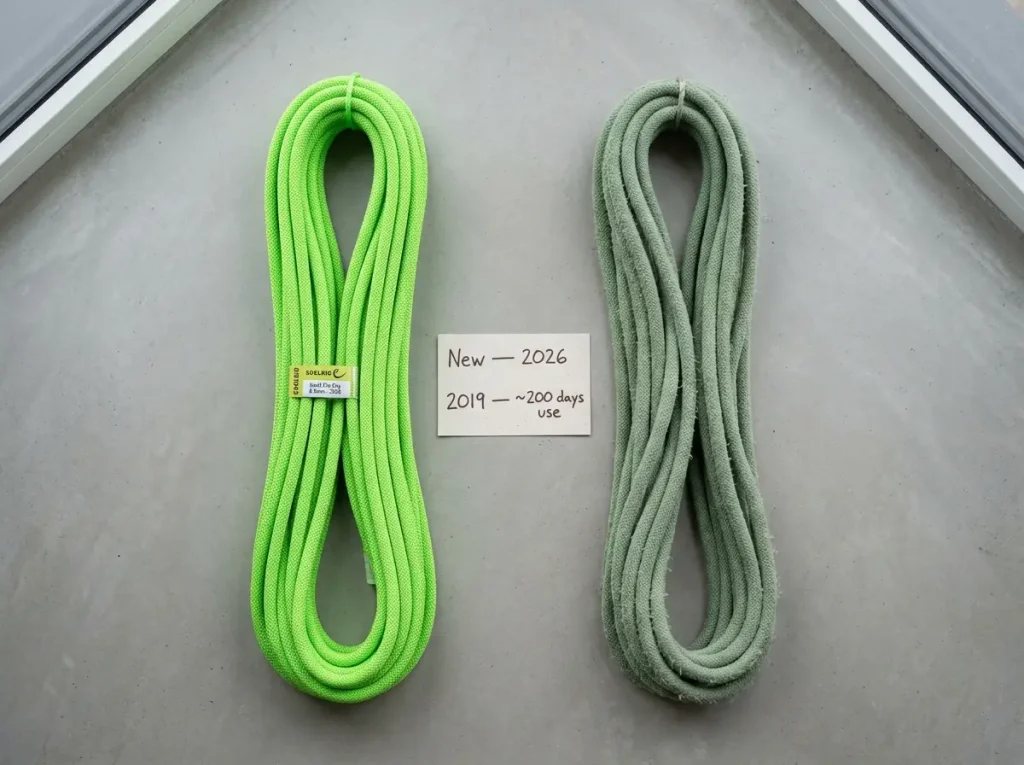
Climbing ropes are built from nylon (polyamide 6), a synthetic polymer that degrades slowly even when you’re not using it. The degradation is primarily hydrolytic — moisture in the air breaks the long polymer chains over years, reducing the material’s capacity to absorb energy. Heat accelerates this process. So does chemical exposure: battery acid from a forgotten headlamp in the gear bin, gasoline fumes in a garage, cleaning solvents left nearby.
The UIAA’s research on rope aging — conducted by safety pioneer Pit Schubert — confirmed that ropes stored in reasonable conditions retain adequate strength for roughly a decade. After that, the molecular structure has degraded enough that the rope’s dynamic properties can’t be guaranteed, even if it looks fine.
The Manufacturer Timeline
Every manufacturer publishes a lifespan table. They’re all nearly identical because they follow the same UIAA recommendation framework. The general consensus for a rope first used within a year of manufacture:
- Weekly use (guide or gym-setter level): 1 year or less
- Regular use (2-3 days per week): 1-3 years
- Moderate use (weekend climber): 3-5 years
- Occasional use (monthly or less): 5-7 years
- Never used, properly stored: maximum 10 years from manufacture date
These timelines assume no catastrophic falls and no visible damage. They’re conservative because manufacturers can’t predict your specific conditions.
Why a 10-Year-Old Rope Isn’t “Fine Just Because It Looks Fine”
The tricky part about age-based degradation is that it’s invisible. The rope doesn’t change color when it crosses a threshold. It doesn’t get soft in one obvious spot. The nylon just gradually loses its ability to stretch dynamically under load — which is the entire function of a climbing rope. You won’t know it’s compromised until it matters most. This is why the 10-year absolute limit exists even for unused ropes. The material science says trust has an expiration date.
Pro tip: Write the date of first use on your rope’s tag with a Sharpie the day you take it out of the wrapper. Two years later, you won’t remember whether you bought it in 2024 or 2025 — and the difference matters.
When Falls Actually Damage the Rope
The Fall Factor Spectrum
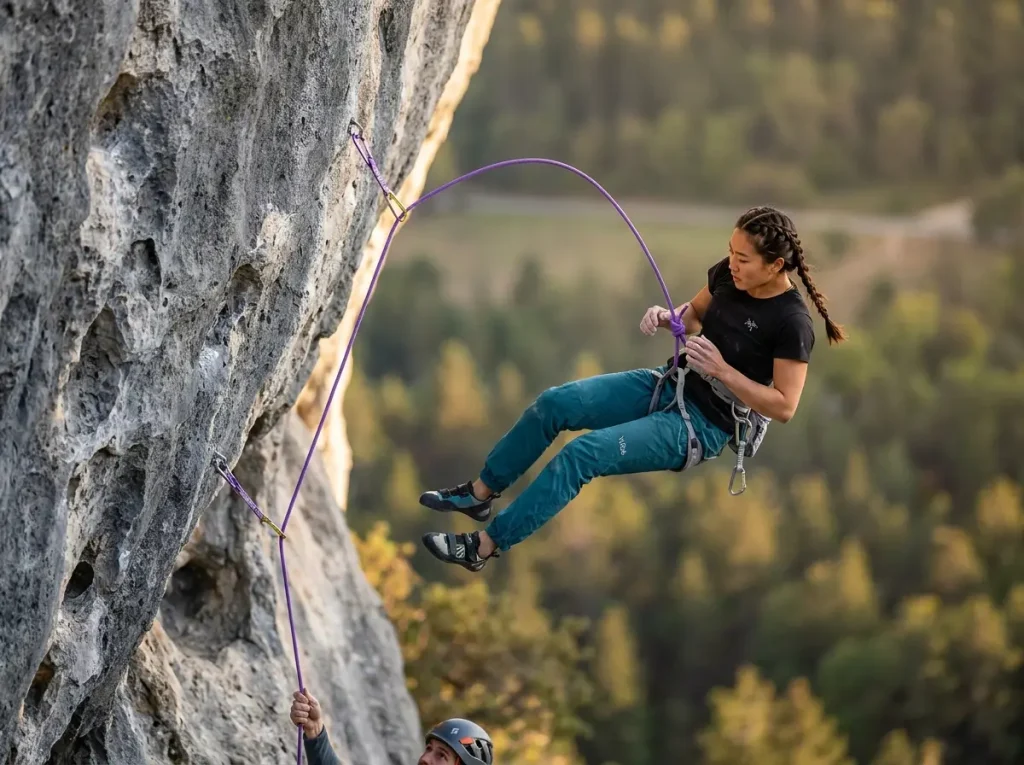
Not all falls are equal. A 10-foot fall on 50 feet of rope barely registers on your rope’s structural integrity. A 10-foot fall on 12 feet of rope is a completely different event — the fall factor is nearly 1.0, meaning the rope absorbs the full energy of the fall with minimal length to distribute it across. Understanding this spectrum is the key to knowing which falls to worry about and which to dismiss.
Falls below factor 0.3 — which includes the vast majority of sport climbing falls — cause negligible core damage. The sheath wears from rubbing over rock during the fall, the quickdraw carabiner, and the anchor hardware, but the load-bearing core stays well within its design envelope.
The Falls That Demand Immediate Inspection
Three scenarios require you to stop, untie, and inspect the rope before climbing again:
Any fall with a factor above 1.0. Any fall where the rope ran over a sharp edge during the catch. Any fall that felt significantly harder than normal — a short rope grab, a stuck rope that loaded suddenly, or a factor-2 scenario at the first bolt. After catching any of these, inspect a two-meter section on each side of the loaded point. Feel for flatness, stiffness changes, or sheath bunching.
The Real Retirement Trigger From Falls
Here’s what competitors don’t tell you: the UIAA rating doesn’t translate to a fall countdown. Real-world climbing falls rarely approach the severity of the test — so your rope can absorb hundreds of normal falls without meaningful core degradation. The actual retirement trigger from falls isn’t a count. It’s a single event (high-factor fall, edge loading) followed by a failed inspection.
If you’ve taken a hard fall and the rope passes inspection — no flat spots, no sheath slippage, no stiffness changes — it’s still functional. But if you’ve taken a hard fall and something feels different, trust that feeling. Ropes are cheap compared to spinal surgery.
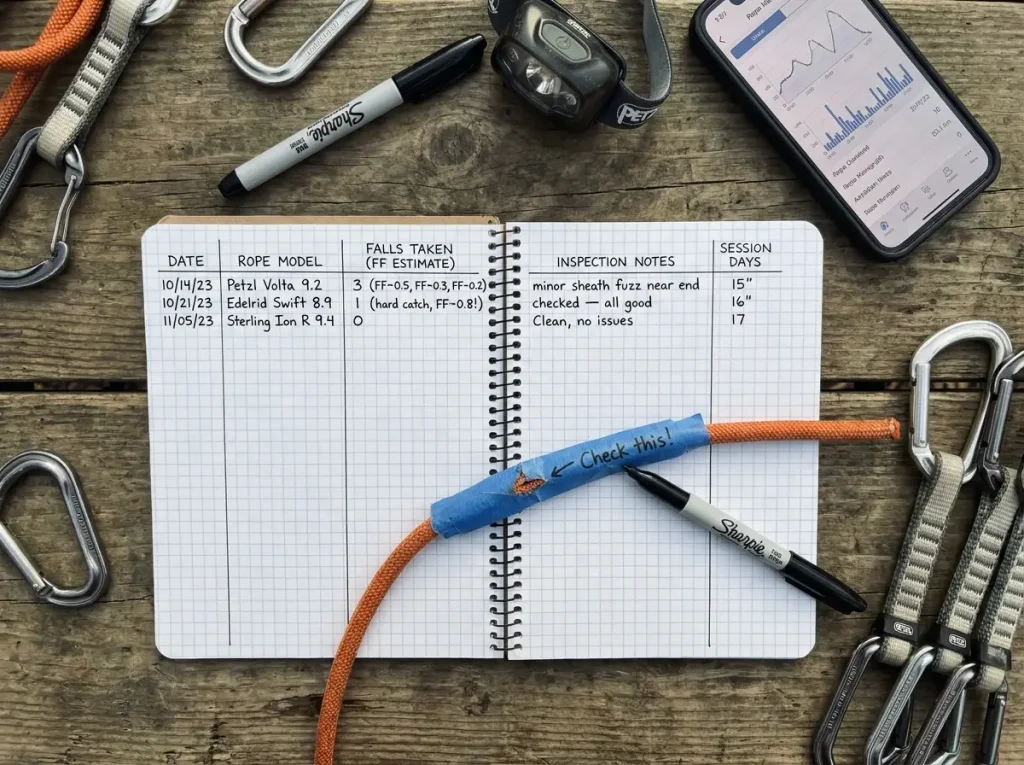
Pro tip: After a hard catch, mark the loaded section with tape. Inspect it more carefully next time you flake out, and monitor whether that section develops flat spots or stiffness over the next few sessions.
The Pinch Test and Feel-Along Method
How to Actually Inspect a Rope
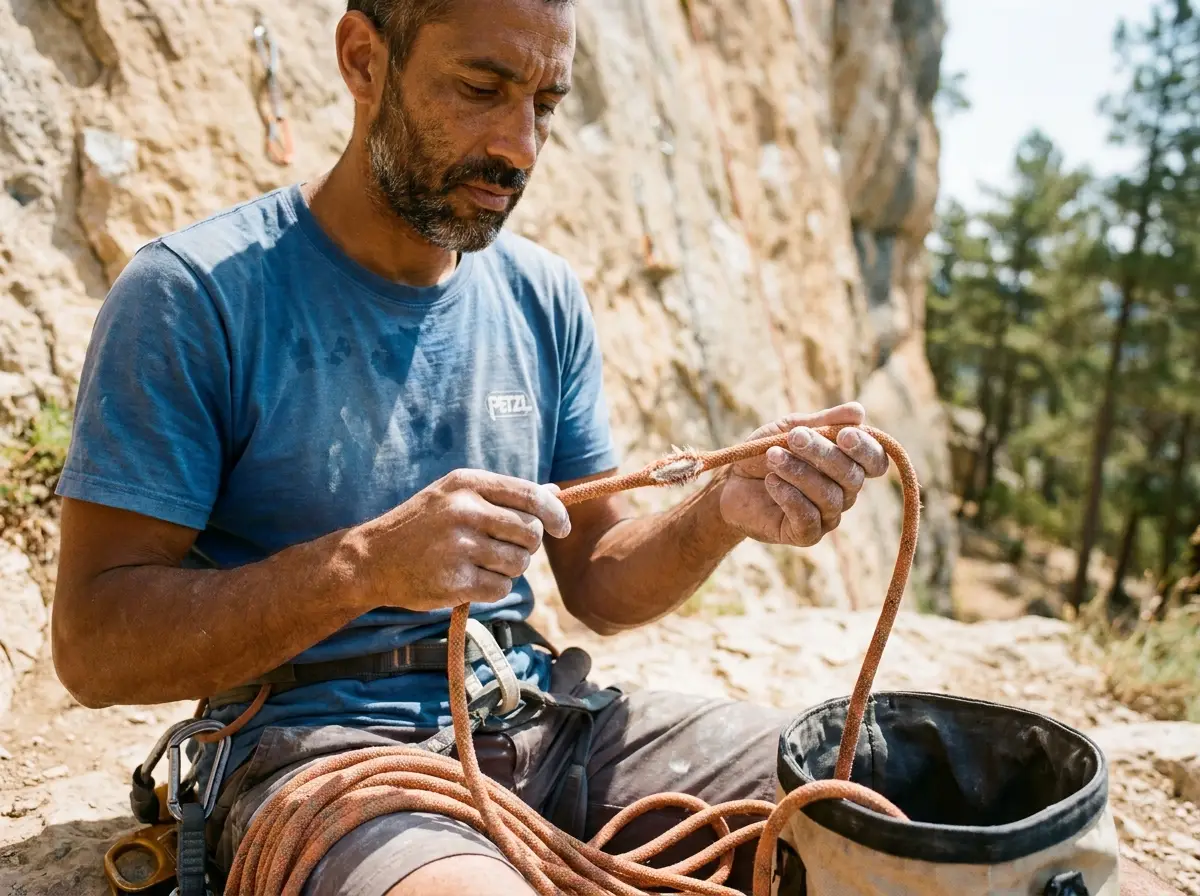
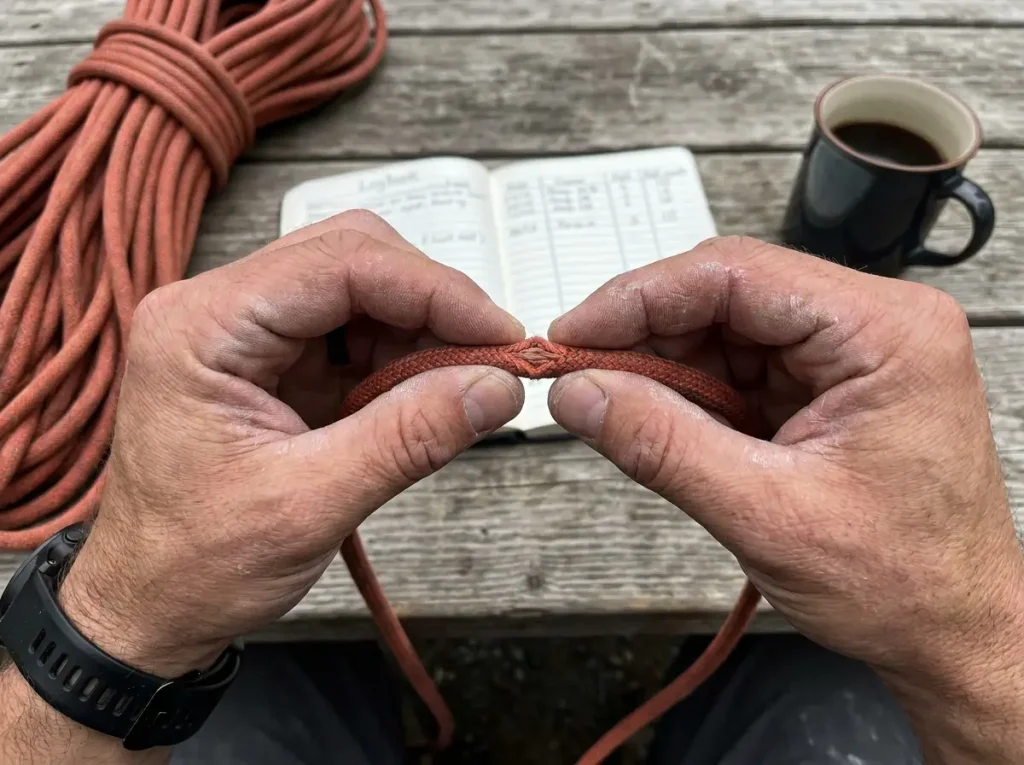
The pinch test is the most reliable field inspection for internal core damage. Hold the rope between your thumb and fingers and pinch it into a U-shape. A healthy rope holds its circular cross-section — the core resists compression evenly. A rope with internal damage will feel flat, soft, or will compress unevenly in the damaged section. The sheath folds inward where the core has lost density.
Run the entire rope through your hands during every flake-out. This is the feel-along method — and it catches problems that visual inspection misses. You’re feeling for flat spots, abrupt stiffness changes, sections where the rope feels thinner or mushier than the rest, and any area where the sheath slides independently of the core (sheath slippage).
Visual Signs That Mean Immediate Retirement
Core shot — white core fibers visible through the sheath. Retire immediately. No exceptions, no “it’s just a small one.” A core shot means the structural integrity is compromised at that point. Some climbers cut the rope at the damage point and use the shorter section — this is acceptable only if the remaining section is long enough and the rest passes full inspection.
Sheath slippage — the sheath bunches up in one area and feels loose over the core elsewhere. This means the sheath and core are no longer mechanically bonded and the rope’s load-bearing system is compromised.
Severe glazing — shiny, stiff sections from friction heat. The nylon melted locally, fusing fibers and creating a weak point.
What Normal Wear Looks Like
Not everything requires retirement. Moderate fuzzing of the sheath is normal wear — the outer fibers abrade over rock and hardware. The rope still functions fine. Mild discoloration from dirt is cosmetic. Marking your rope’s middle with tape or marker doesn’t compromise it. Slight softening over months of use is the nylon breaking in. These are signs of a working rope, not a retired one.
The Gray Zone — When Inspection Says Fine but Experience Says No
Ropes That Pass Every Test but Feel Wrong
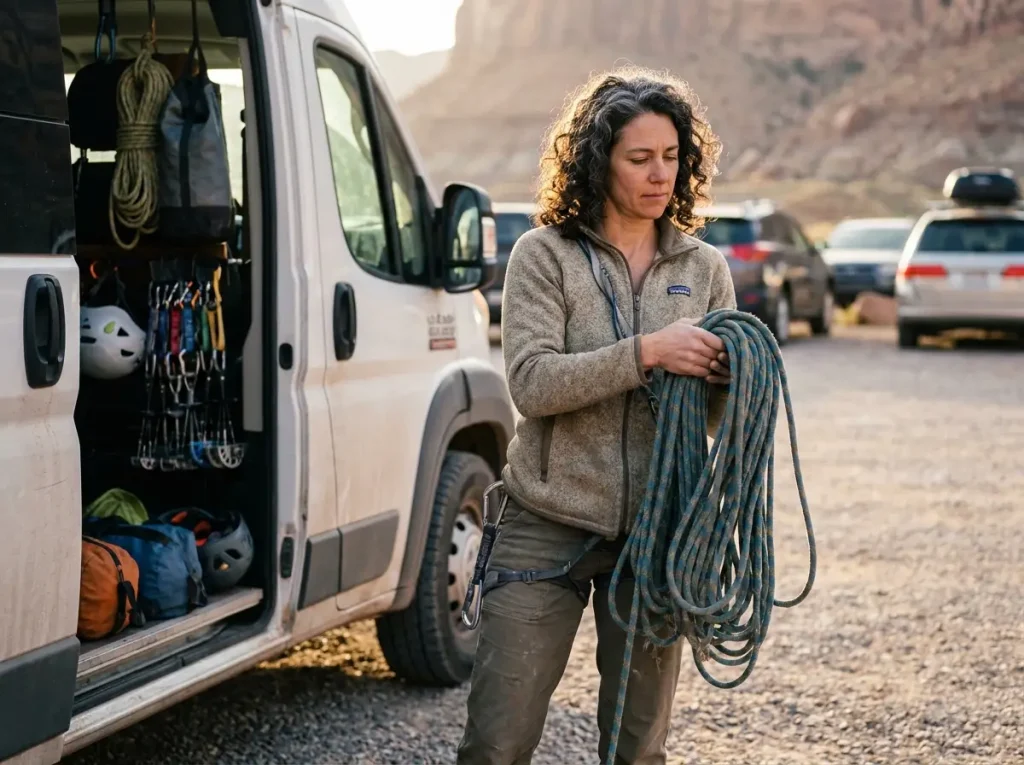
After enough years, you develop a sense for rope condition that goes beyond inspection criteria. A rope that passes the pinch test, shows no core shots, has no sheath slippage — but just doesn’t feel right. Maybe it’s lost its stretch. Maybe the hand-feel has gone from supple to waxy. Maybe you can’t point to anything specific, but you wouldn’t lend it to your partner.
This is the gray zone, and it’s real. Nylon degradation doesn’t always announce itself through the inspection criteria. Sometimes the rope’s dynamic properties have diminished in ways that only reveal themselves under load — and the only indicator is that experienced hands notice something has changed.
The Downgrade Path
When a rope enters the gray zone, retirement doesn’t have to mean the trash can. A rope that no longer feels trustworthy for lead climbing might serve perfectly well as a top-rope cord, a rappel line, or a hauling rope where falls aren’t part of the equation. Downgrading extends the useful life while respecting the reduced confidence. Mark downgraded ropes clearly — tape on both ends, Sharpie on the tag — so they never accidentally end up on the sharp end again.
Trust the Hands That Have Flaked a Thousand Ropes
If you’ve been climbing long enough to develop gray-zone intuition, trust it. The cost of a new rope is a fraction of what’s at stake. You don’t need to justify the feeling with a failed inspection criterion. “It doesn’t feel right anymore” is a complete and valid reason to retire a rope. It’s experience talking — and experience is more accurate than any timeline chart.
Pro tip: If you’re debating whether to retire a rope, ask yourself: “Would I let my climbing partner lead on this?” If the answer is no, you have your answer.
Building Your Personal Retirement Decision Tree
The Three-Variable Framework
Climbing rope retirement isn’t a single threshold. It’s the intersection of three variables: age, mechanical history, and current condition. When they all agree — old, hard-used, showing wear — the decision is obvious. When they disagree — young rope with one hard fall, or old rope that inspects perfectly — you need a framework.
Variable 1 — Age: How long since first use? Approaching the manufacturer timeline for your usage level? Past it?
Variable 2 — Mechanical history: Any falls above factor 0.7? Any edge-loaded catches? How many total climbing days?
Variable 3 — Current condition: Does it pass the pinch test everywhere? Any visual damage? Does it feel the same as when it was new?
If any single variable is in the “retire” zone, retire. If two variables are borderline, retire. If one variable is borderline and the other two are fine, increase your inspection frequency and monitor.
A Real-World Decision Example
Your rope is 3 years old. You climb twice a week — moderate use. No factor-1 falls, but one hard catch last fall where you marked the section with tape. Sheath is fuzzy but uniform. Pinch test passes everywhere, including the marked section. What do you do?
Answer: you’re fine. Three years at moderate use is mid-timeline. No high-factor events. Passes physical inspection. Keep climbing, keep inspecting, revisit in 6 months. The marked section is your canary — if it develops a flat spot later, that’s your trigger.
What the Rope Log Captures
Keep a simple record: date of first use, estimated climbing days per month, and any notable falls or incidents. You don’t need to count every whipper — just the ones that felt hard. Check our complete rope inspection and care guide for the full inspection protocol and our gear lifespan tracking system for a template that covers all your soft goods.
Conclusion
Rope retirement isn’t a formula — it’s a judgment call informed by three inputs. Age gives you the outer boundary: ten years max, less if you climb hard. Falls give you event-specific triggers: anything above factor 1.0 demands inspection and potentially retirement. And physical condition — what your hands tell you during every flake-out — is the most accurate real-time indicator of all.
The UIAA fall rating isn’t a countdown clock. Normal climbing falls don’t degrade your core in meaningful ways. The things that actually retire ropes are time, edge loading, and the slow accumulation of abrasion that eventually shows up as flat spots or sheath failure.
Write your first-use date on the tag. Track your hard falls. Run the rope through your hands every session. And when it doesn’t feel right anymore — even if you can’t explain exactly why — trust yourself. That’s a decade of experience talking through your fingertips.
Q1 How many falls can a climbing rope take before retirement?
There’s no fixed number. The UIAA fall rating tests worst-case falls (factor 1.77) that rarely occur in real climbing. Normal sport climbing falls barely stress the core. Retire based on high-factor events and physical inspection, not a fall count.
Q2 Does a climbing rope expire if never used?
Yes. Manufacturers set a 10-year maximum from the date of manufacture, even for ropes stored in ideal conditions. Nylon degrades through hydrolysis over time, reducing its ability to absorb dynamic energy safely.
Q3 How do you know when a climbing rope is worn out?
Run it through your hands feeling for flat spots, soft sections, or stiffness changes. Perform the pinch test to check core integrity. Look for visible core fibers, sheath slippage, or glazed sections. Any of these means immediate retirement.
Q4 Can you still climb on a rope with sheath damage?
Minor fuzzing is normal wear and doesn’t require retirement. A core shot — where the white core is visible through the sheath — requires immediate retirement. Moderate sheath damage that hasn’t reached the core is a judgment call, but erring toward retirement is always the safer choice.
Q5 How long does a climbing rope last in storage?
Up to 10 years from manufacture if stored in a cool, dry, dark place away from chemicals, UV exposure, and heat sources. Realistically, most basements and garages expose ropes to enough humidity and temperature swings to shorten that window.
Safety Notice: Rock climbing and mountaineering are inherently high-risk
activities that can involve physical trauma or fatal incidents. The information on Rock Climbing Realms is for
educational and informational purposes only. Techniques and advice presented here are not a substitute
for professional, hands-on instruction. Conditions and risks vary by location. Always seek guidance
from a qualified instructor before attempting new techniques. By using this website, you agree that you
are solely responsible for your own safety. Any reliance you place on this information is strictly
at your own risk, and you assume all liability for your actions. Rock Climbing Realms and its authors
will not be held liable for any harm, damage, or loss sustained in connection with the use of this information.
Affiliate Disclosure: We are a participant in the Amazon Services LLC Associates Program, an
affiliate advertising program designed to provide a means for us to earn advertising fees by advertising and linking
to Amazon.com. As an Amazon Associate, we earn from qualifying purchases. We are also an official affiliate partner
of Black Diamond Equipment via the AvantLink network. If you click on a Black Diamond affiliate link and make a
purchase, we may earn a commission at no additional cost to you. We also participate in other affiliate programs.
Additional terms are found in the terms of service.