
In this article
I watched a climber rig a top-rope anchor on a tree that looked solid from ten feet away. Up close, the roots sat in three inches of forest duff on bare granite. One good fall would have ripped the whole thing out of the ground. That climber was me, fifteen years ago, and it changed how I look at every tree, boulder, and rock feature I consider wrapping a sling around. Natural anchors are some of the best protection you can build — when they’re good. When they’re not, they fail without warning. Here’s what separates a bomber natural anchor from one that puts you at serious risk.
Quick Answer: Here’s how to build safe natural anchors with trees and boulders:
- Assess the tree — at least 6 inches in diameter, alive, well-rooted in solid ground
- Test boulders by pushing and pulling — only use refrigerator-sized or larger rocks with full ground contact
- Sling at the base with a cordelette or doubled runner, keeping the angle under 60 degrees
- Equalize multiple anchor points to a single master point with reversed and opposed locking carabiners
- Pad the edge and protect bark from sling abrasion before loading the system
What Makes a Natural Anchor Work (And What Makes It Fail)
The SERENE Principles in Plain Language
Every climbing anchor — natural or otherwise — needs to meet a set of criteria before you trust it with a fall. The climbing community uses the acronym SERENE as a checklist: Strong, Equalized, Redundant, Efficient, No Extension. Some instructors add SA for Solid Angle, making it SERENE-SA.
In plain terms: your anchor needs to be strong enough to hold the forces it’ll see, the load needs to be shared between anchor points, and if one piece fails the whole system shouldn’t collapse. Those are the non-negotiables. Everything else is technique.
For natural anchors specifically, the first criterion — Strong — is where most mistakes happen. A cam or a bolt has a rated strength stamped on it. A tree doesn’t. A boulder doesn’t. You’re making a judgment call every time, and the consequences of getting it wrong are severe. Understanding how anchor failures actually happen makes you a better judge of what’s in front of you.
Why Natural Anchors Fail Differently Than Gear
When a cam blows, it usually walks out of a crack. You can see the placement degrading if you’re paying attention. When a natural anchor fails, it tends to fail catastrophically — the tree uproots, the boulder shifts, the horn snaps. There’s often no warning.
The UIAA has documented anchor failures where climbers trusted features that looked solid on the surface but had hidden weaknesses — rotten cores in living trees, hairline fractures behind boulders, root systems in soil too shallow to hold a dynamic load. Natural anchors require a different kind of assessment than manufactured gear because you can’t read a spec sheet. You have to develop a feel for what’s trustworthy, and that takes time on the rock.
How to Assess a Tree Before You Trust Your Life to It
The Five-and-Alive Rule
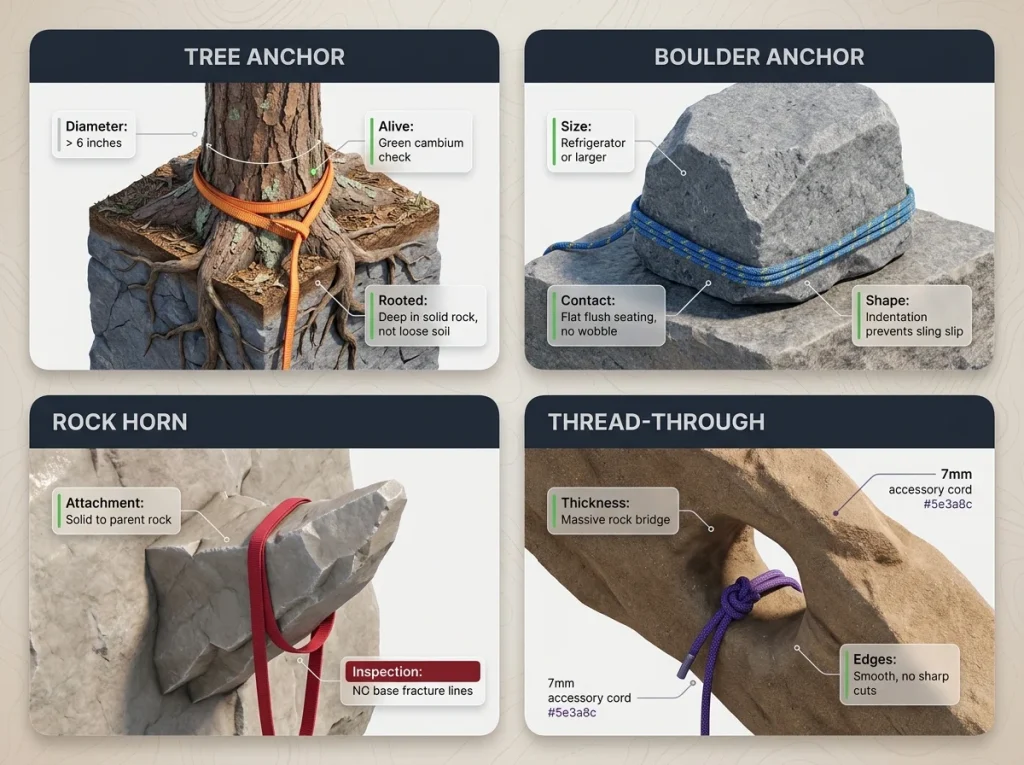
The baseline: your tree needs to be at least six inches in diameter (some guides say five, but I default to six for any anchor that might see a lead fall), alive, well-rooted in solid ground, and stable when you push against it hard with your foot.
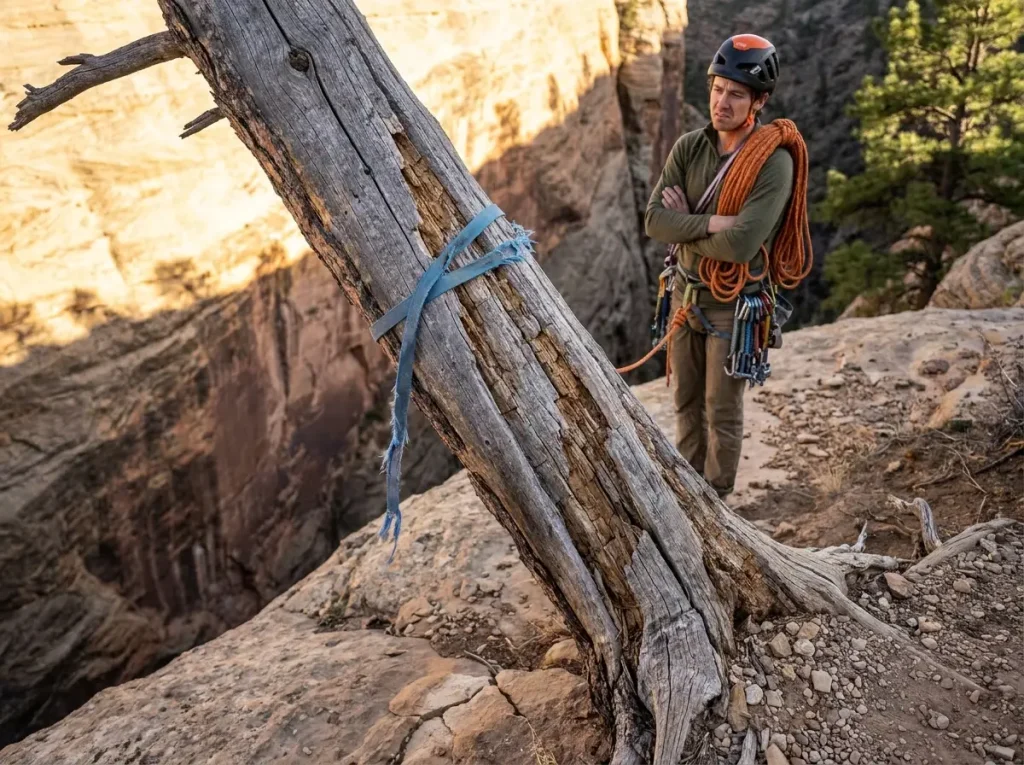
“Alive” matters more than people think. A standing dead tree loses structural integrity faster than you’d expect. The wood dries, becomes brittle, and the root system begins to decay even while the trunk looks fine from the outside. A dead pine that’s been standing for two seasons can snap at the base under loads a healthy tree half its size would shrug off.
Check the bark. Green cambium under a scratch means the tree is alive. Dry, crumbly wood beneath the bark means it’s not. Check the base for mushrooms and fungal growth — both signal internal rot. And check the lean. A tree that leans toward the cliff edge is already under tension from its own weight.
The Root System Problem Nobody Talks About
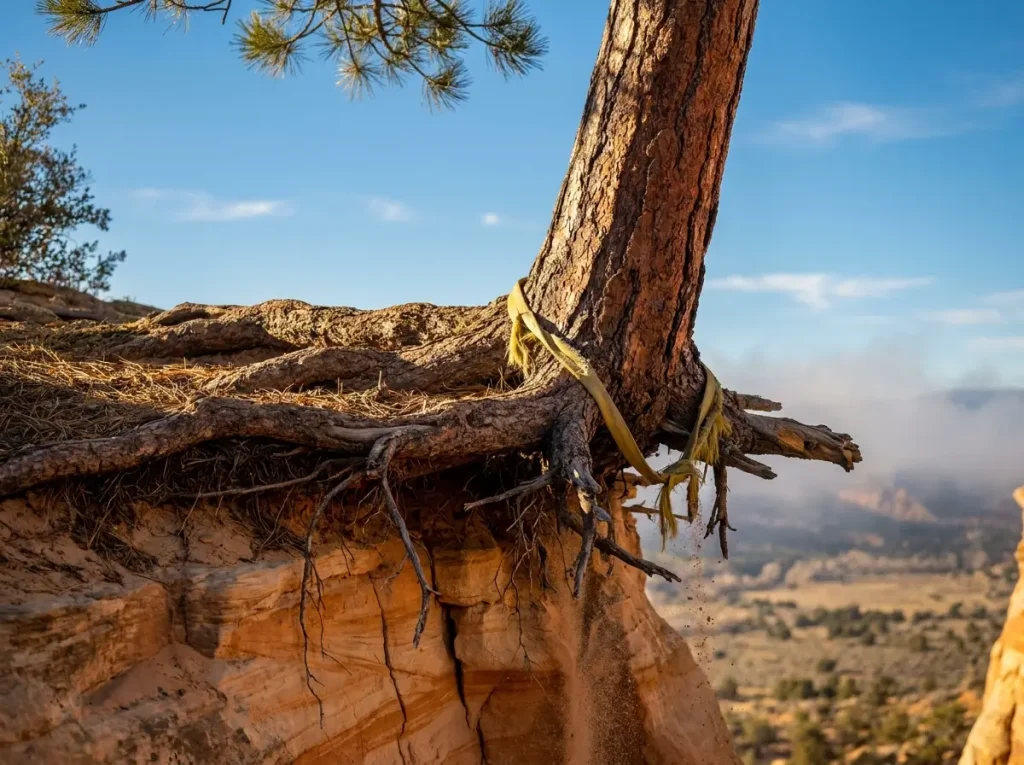
Here’s the thing every anchor article mentions tree diameter but almost none address seriously: the root system matters as much as the trunk. A 12-inch oak anchored in deep soil with roots threaded into bedrock cracks is bomber. That same 12-inch oak growing on a cliff ledge with roots in eight inches of forest duff over bare granite is a trap.
Trees growing on cliffs are notoriously shallow-rooted. The soil layer on many cliff-top environments is thin — sometimes just a pad of organic material over slick rock. Roots spread horizontally through that thin layer instead of anchoring vertically into stone. From above, the tree looks massive and healthy. From the side, you can sometimes see daylight under the roots where erosion has washed away soil.
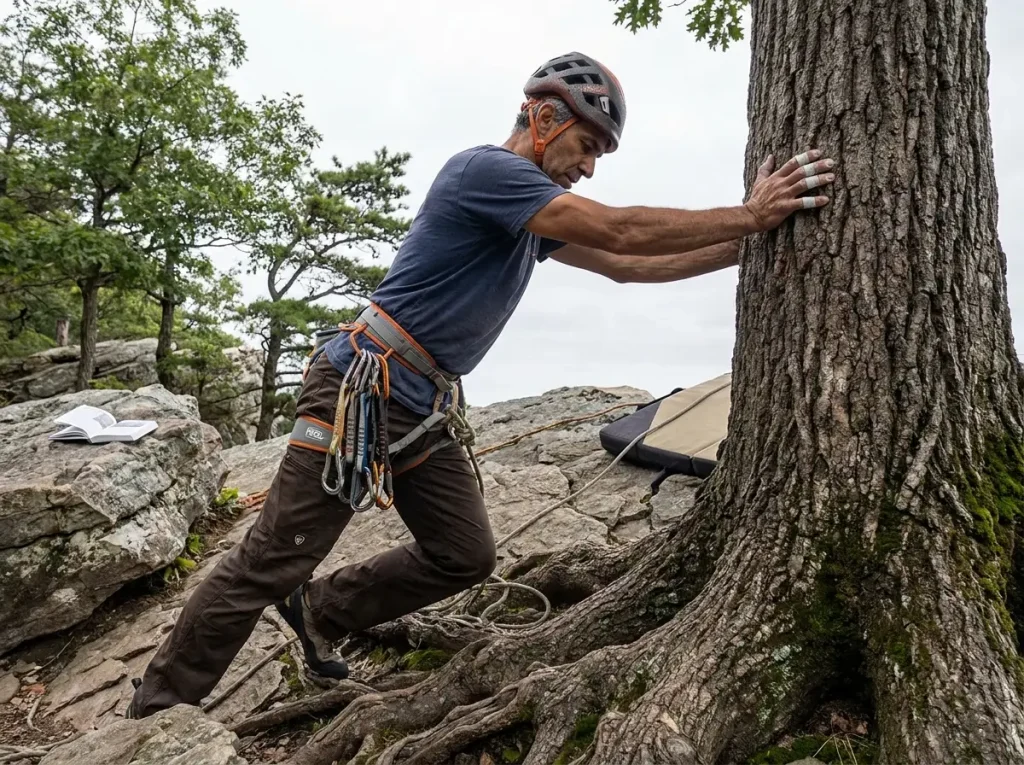
Push the tree. Hard. Lean into it with your foot from the direction the load would pull. If it moves at all — even a little — it’s not your anchor.
Pro tip: At popular top-rope crags, check whether the trees nearest the cliff edge have been used as anchors before. Look for bark abrasion, old sling marks, and compressed soil around the base. Heavily used anchor trees eventually weaken from repeated bark stripping. If the bark around the base looks chewed up, consider a tree farther back from the edge and extend your system.
How to Assess Boulders and Rock Features
The Refrigerator Rule and Why It’s Not Enough
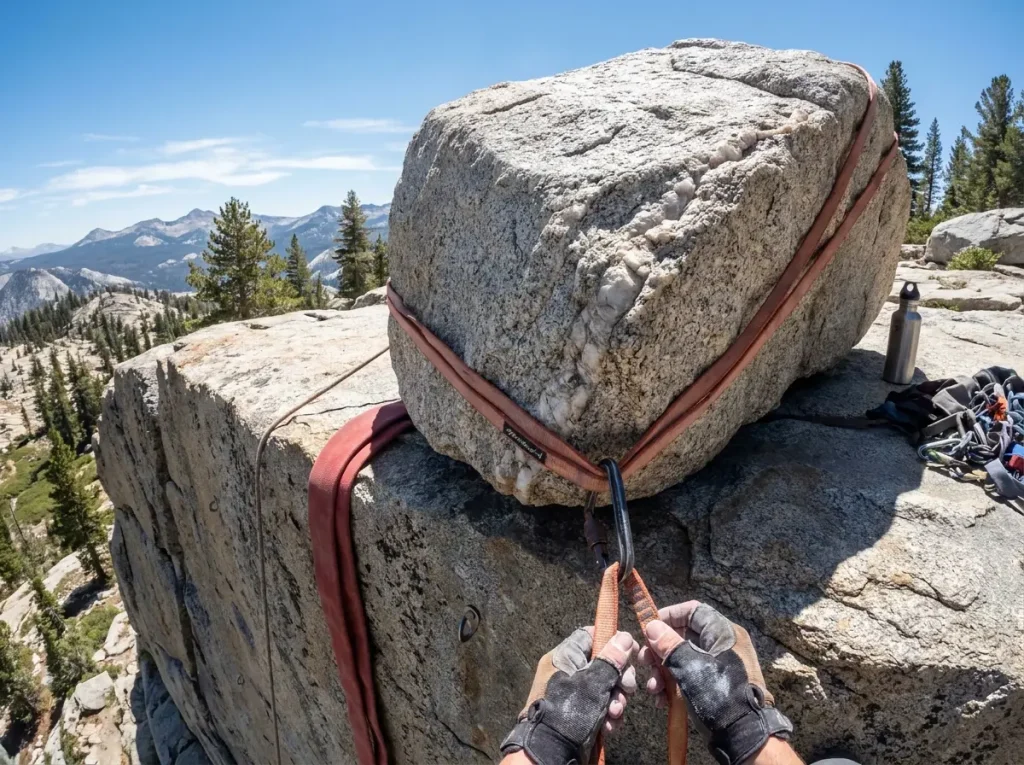
The standard advice is to only sling a boulder if it’s refrigerator-sized or larger. That’s a decent starting point, but size alone doesn’t make a boulder safe. Position matters just as much.
A refrigerator-sized boulder sitting on a flat granite ledge with full ground contact is excellent. That same boulder perched on a sloping surface with sand underneath is a liability. Push it. Pull it. Try to rock it from every direction the load might pull. If it shifts, it’s not your anchor.
Check the contact surface. Boulders sitting on dirt can be undercut by water erosion you can’t see. Boulders on bare rock need enough friction and mass to resist the load — smooth, rounded boulders on smooth rock are less reliable than angular blocks wedged into features.
Horns, Chockstones, and Thread-Throughs
Rock horns — protruding knobs of solid rock — make excellent anchor points when they’re genuinely attached to the wall. The test is the same: push, pull, check for fracture lines. A horn with visible cracks at its base is not an anchor. A solid horn with no separation from the parent rock is often stronger than any cam you could place.
Chockstones — rocks wedged tightly in cracks or chimneys — work when they’re truly jammed and cannot shift in the direction of load. Loop a sling around them and pull in the expected load direction. If the chockstone moves or rotates, find something else.
Thread-throughs are holes in the rock you can pass a sling or cordelette through. They’re bomber when the rock surrounding the hole is thick and solid. Check the edges of the hole for sharp features that could cut webbing under tension. Pad sharp edges with extra webbing or consider running cord instead of flat sling through tight threads.
Pro tip: At crags like Devil’s Lake and Seneca Rocks, natural anchors on quartzite are often the primary protection. Rock type affects everything — quartzite horns tend to be solid and sharp-edged, sandstone horns can be fragile, and granite features are usually bomber but smooth. Know your rock.
Slinging Techniques That Actually Equalize
Cordelette Method — The Standard
A cordelette is a 18-to-20-foot loop of 7mm or 8mm Perlon cord tied with a double fisherman’s knot. It’s the workhorse of natural anchor building because it’s long enough to reach multiple anchor points and creates a clean, equalized master point.
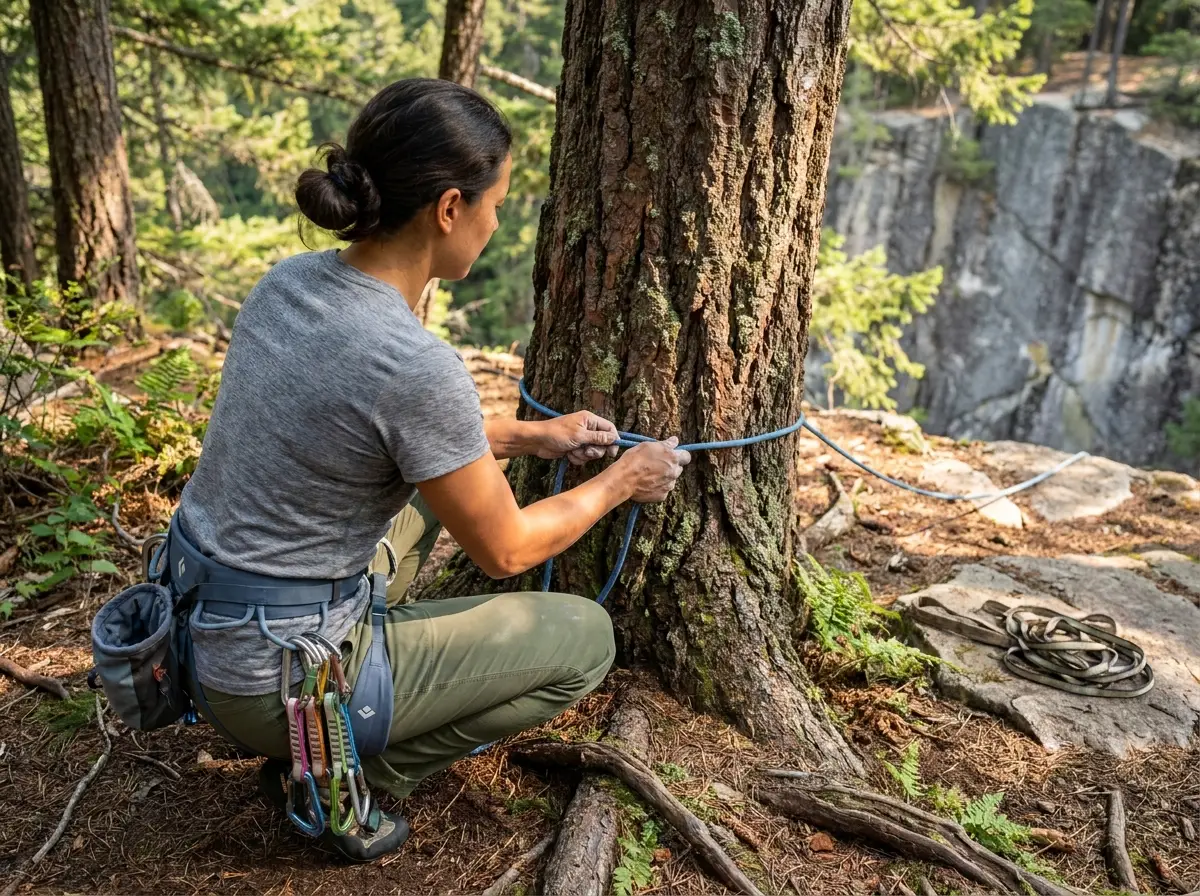
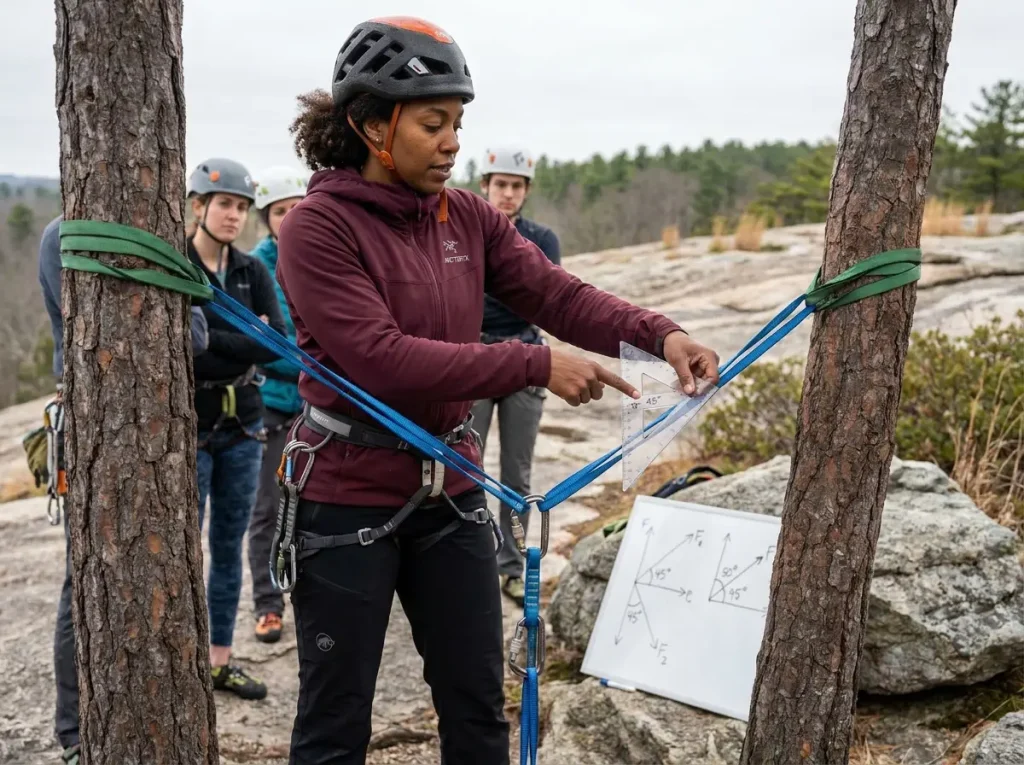
To rig a cordelette on two trees: wrap the cord around each tree at the base, pull down the sections between the trees, bring all strands together at the anticipated direction of pull, and tie a figure-eight on a bight incorporating every strand. The resulting loop is your master point. Clip two locking carabiners through it, gates reversed and opposed.
The key detail most people rush: make sure you clip through each strand of the master point individually. If you clip around the outside of the strands instead of through each one, a single anchor failure could cause the entire system to unravel. This is one of the most common rigging errors in anchor building for top-rope setups.
Position the double fisherman’s knot below your highest anchor point so it stays clear of the master point knot. And always orient your figure-eight so the load pulls on the bight, not across the knot.
Webbing and Runner Methods
For a single bomber tree, a doubled runner or a length of one-inch tubular webbing works fine. Girth hitch the sling around the base of the trunk and clip a locking carabiner to the two ends. For redundancy, use two slings girth-hitched independently — if one fails, the other holds.
When you’re linking two anchor points with runners, a simple method is to clip a sling to each anchor, bring the slings together, and tie an overhand knot to create a master point. This gives you static equalization — it works well when the load direction is predictable and consistent, like a straight-down top-rope pull.
For situations where the load direction might shift — traversing routes, multi-pitch belays where the leader could fall in different directions — consider a sliding X (also called a magic X). This provides self-equalization but sacrifices redundancy unless you add limiting knots to the sling.
Pro tip: If you’re using webbing on trees, wrap the sling as low on the trunk as possible. The base of a tree is where the root system provides the most resistance. Slinging high on the trunk creates a lever arm that multiplies the force on the roots — the same tree that holds a fall when slung at the base might uproot when slung at chest height.
The Force Math Behind Natural Anchors
What the Numbers Actually Mean
A typical lead fall on a well-belayed single-pitch route generates somewhere between 2 and 6 kN of force on the anchor, depending on fall factor, rope type, and belay technique. A factor-2 fall — the worst case — can generate up to 9 kN on the anchor with a modern dynamic rope.
For context: 1 kN equals roughly 225 pounds of force. So a typical lead fall puts 450 to 1,350 pounds of force on whatever you’re anchored to. A worst-case scenario pushes that toward 2,000 pounds.
A healthy tree with a solid root system can hold vastly more than that. The American Mountain Guides Association has pull-tested trees to failure and found values exceeding 17 kN — roughly 3,800 pounds — for relatively modest trees. A large, well-rooted oak or fir is effectively unbreakable for climbing forces.
But here’s where the numbers get interesting. A smaller tree — six inches in diameter, shallow roots, mediocre soil — might only hold 5 to 8 kN before the root system fails. That’s enough for a top-rope scenario where forces stay low, but it’s marginal for a lead fall. This is why redundancy matters. Two mediocre trees equalized together give you a system that’s stronger than either one alone.
Why Angle Matters More Than You Think
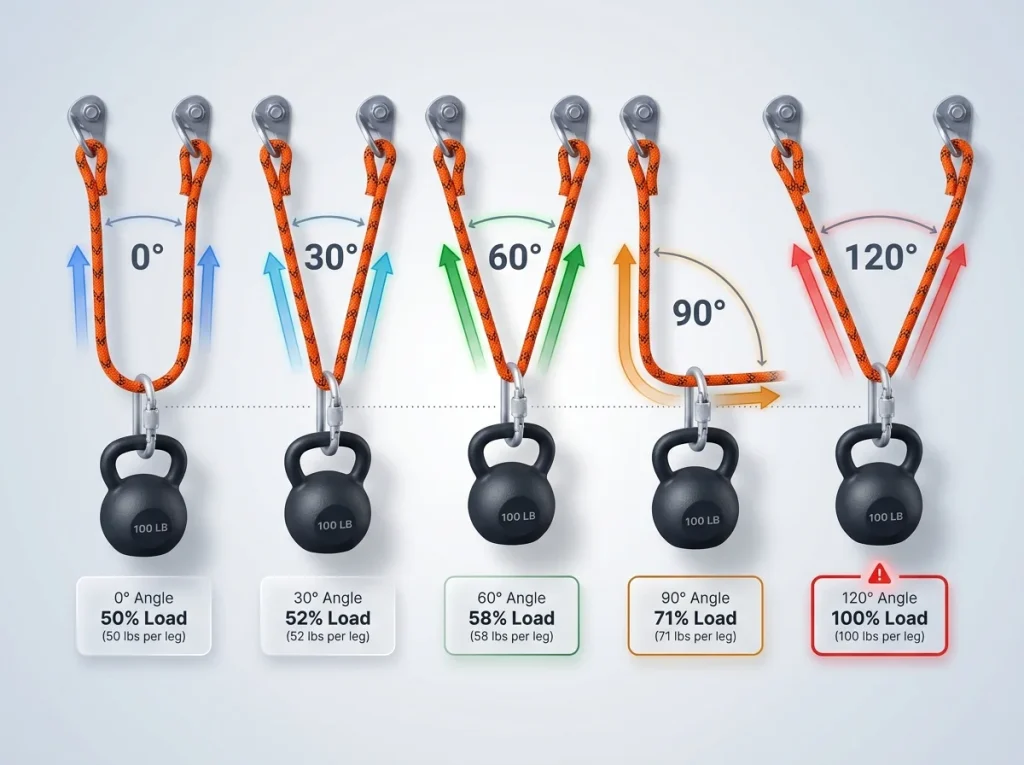
The angle between the legs of your anchor system directly affects the force on each anchor point. At zero degrees (both legs parallel, pulling straight down), each anchor shares the load equally. At 60 degrees, each anchor point sees about 58% of the total load — still manageable. At 120 degrees, each anchor sees 100% of the load — your equalization is doing nothing.
The rule: keep the angle between your anchor legs under 60 degrees. Above that, the force multiplication starts working against you. If your two trees are far apart and the angle is getting wide, use a longer cordelette or extend one anchor to bring the angle down.
This matters most with natural anchors because you can’t move a tree. With cams, you choose your placements to manage geometry. With trees and boulders, the geometry is fixed by nature and you adapt your rigging to it.
When to Walk Away From a Natural Anchor
Red Flags That Should End the Conversation
Some anchor candidates need to be rejected immediately. No amount of equalization or backup fixes a fundamentally weak anchor point. Here’s the short list:
The tree is standing but has no living bark, fungal growth at the base, or sounds hollow when you knock on it. The boulder moves when you push it, even slightly, in any direction. The rock horn has visible fracture lines separating it from the parent wall. The root system is exposed and sitting in less than six inches of soil over bare rock. The feature has old, sun-bleached webbing from previous users that’s been there long enough to UV-degrade — that webbing isn’t a vote of confidence, it’s evidence that the last person didn’t assess carefully either.
If you find yourself rationalizing — “it’s probably fine,” “it’s only top-rope,” “other people have used it” — that’s your signal to step back and find something better. Anchor failures follow predictable patterns, and most of them start with a climber who ignored a gut feeling.
What to Do When Good Natural Anchors Don’t Exist
Sometimes the cliff top just doesn’t have what you need. The trees are too small, the boulders are loose, and there are no horns or threads worth trusting. In that case, you have options.
Build a gear anchor using cams and stoppers placed in cracks. Combine a marginal natural anchor with gear placements for redundancy — a so-so tree backed up by two well-placed cams is a solid system. Or walk away and find a different climb. There’s no route worth a sketchy anchor.
If you’re regularly climbing in areas where natural anchors are the primary protection, learning to place trad gear efficiently gives you backup options when nature doesn’t cooperate. Carrying a few Tricams adds lightweight versatility to a natural anchor rack.
Pro tip: Before you leave the ground, look up at the cliff top from below. You can often spot the trees and boulders you’ll be working with from the base. If nothing looks substantial from fifty feet away, it’s not going to look better up close.
Protecting Trees and Leaving No Trace
Bark Damage Is Real and Cumulative
Every time a sling runs over bark under load, it strips a little bit. On heavily used anchor trees at popular crags, you can see the evidence — bare wood rings around the trunk where hundreds of climbers have slung the same spot. That bark stripping eventually girdles the tree, cutting off nutrient flow and ending up with a standing dead trunk that nobody should be anchoring to.
This isn’t hypothetical. Organizations like the Access Fund have documented anchor tree loss at popular climbing areas across the country. The trees that make the best anchors — large, well-positioned, close to the edge — are exactly the ones that get the most use and the most harm.
How to Minimize Your Impact
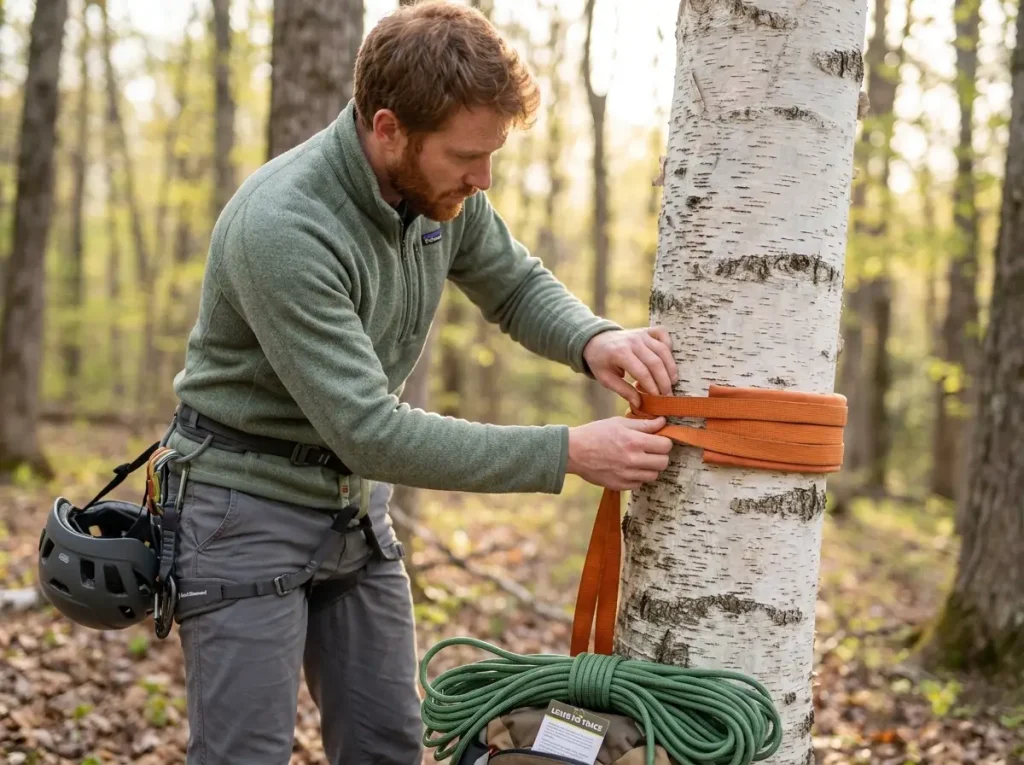
Pad the contact point. Place a folded section of tubular webbing, an old shirt, or purpose-built tree protectors between your sling and the bark before loading the system. This distributes the pressure and prevents the sawing action that strips bark.
Sling at the base, not at chest height. The bark at the base of a tree is typically thicker and more resistant to abrasion than bark higher up the trunk.
Vary your anchor point when multiple trees are available. Spreading the use across several trees prevents any single one from taking all the wear.
Don’t leave webbing on trees. Fixed slings left behind continue to abrade bark every time wind moves them. They also UV-degrade into a false sense of security for the next climber. Pack out what you bring. The same ethic that applies to rappelling safely applies to anchoring: leave the system cleaner than you found it.
Conclusion
Three things determine whether your natural anchor is trustworthy. First, honest assessment — push the tree, test the boulder, check the roots, and reject anything that gives you a reason to doubt. Second, proper rigging — equalize your anchor points, keep the angle under 60 degrees, and clip through every strand of your master point. Third, environmental awareness — protect the bark, vary your anchor trees, and pack out your gear so the next climber finds the same strong features you did.
Take a cordelette, a few slings, and a healthy dose of skepticism to the cliff top. The natural features are there. Your job is figuring out which ones deserve your trust.
Q1 How big does a tree need to be for a climbing anchor?
At least six inches in diameter for top-rope anchors, and it must be alive, well-rooted in solid ground, and stable when you push against it. For lead anchors or any scenario involving higher forces, go bigger — eight inches or more with visible root integration into bedrock.
Q2 Can you use a dead tree as a climbing anchor?
No. Dead trees lose structural integrity quickly as the wood dries and the root system decays. A dead tree that looks solid can snap at the base under loads a healthy tree half its size would handle easily. Always confirm the tree is alive before rigging.
Q3 What is the SERENE method for building climbing anchors?
SERENE stands for Strong, Equalized, Redundant, Efficient, No Extension. It’s a checklist for evaluating whether your anchor system meets the minimum safety requirements. Some instructors add SA (Solid Angle) to emphasize keeping the angle between anchor legs under 60 degrees.
Q4 How do you equalize two natural anchor points?
Wrap a cordelette around both anchor points at the base, pull all strands to the anticipated direction of pull, and tie a figure-eight on a bight to create a master point. Clip two locking carabiners through every strand, gates reversed and opposed. Keep the angle between the legs under 60 degrees.
Q5 What is a cordelette and how do you use it for anchors?
A cordelette is an 18-to-20-foot loop of 7mm or 8mm Perlon accessory cord tied with a double fisherman’s knot. You wrap it around multiple anchor points, gather all strands at the load direction, and tie a figure-eight on a bight to create an equalized master point. It’s the most versatile tool for building natural anchors.
Safety Notice: Rock climbing and mountaineering are inherently high-risk
activities that can involve physical trauma or fatal incidents. The information on Rock Climbing Realms is for
educational and informational purposes only. Techniques and advice presented here are not a substitute
for professional, hands-on instruction. Conditions and risks vary by location. Always seek guidance
from a qualified instructor before attempting new techniques. By using this website, you agree that you
are solely responsible for your own safety. Any reliance you place on this information is strictly
at your own risk, and you assume all liability for your actions. Rock Climbing Realms and its authors
will not be held liable for any harm, damage, or loss sustained in connection with the use of this information.
Affiliate Disclosure: We are a participant in the Amazon Services LLC Associates Program, an
affiliate advertising program designed to provide a means for us to earn advertising fees by advertising and linking
to Amazon.com. As an Amazon Associate, we earn from qualifying purchases. We are also an official affiliate partner
of Black Diamond Equipment via the AvantLink network. If you click on a Black Diamond affiliate link and make a
purchase, we may earn a commission at no additional cost to you. We also participate in other affiliate programs.
Additional terms are found in the terms of service.