
In this article
You send 5.11a in the gym three times a week. Your footwork is clean, your endurance is solid, and you’ve been eyeing that crag 40 minutes from town for months. So you drive out, lace up, and get shut down on a 5.8 that a twelve-year-old just waltzed up.
That’s not a failure. That’s exactly how the gym-to-crag transition works for almost everyone. I’ve watched dozens of strong gym climbers step outside for the first time and discover that plastic holds and color-coded routes gave them strength but not the skills that real rock demands. After years of guiding friends through their first outdoor days — and learning from my own humbling moments on sandstone — here’s the checklist that actually prepares you for the switch.
Quick Answer: Before your first outdoor climb, check these essentials:
- Reset your grade expectations — drop 2 to 3 number grades from your gym level
- Get the gear you don’t own yet — helmet, quickdraws, personal anchor, rope
- Learn anchor cleaning before you leave the ground
- Study route-finding on natural rock without colored tape
- Know the crag etiquette rules that keep climbing areas open
- Prepare for the approach hike — it’s harder than you think
The Grade Reality Check
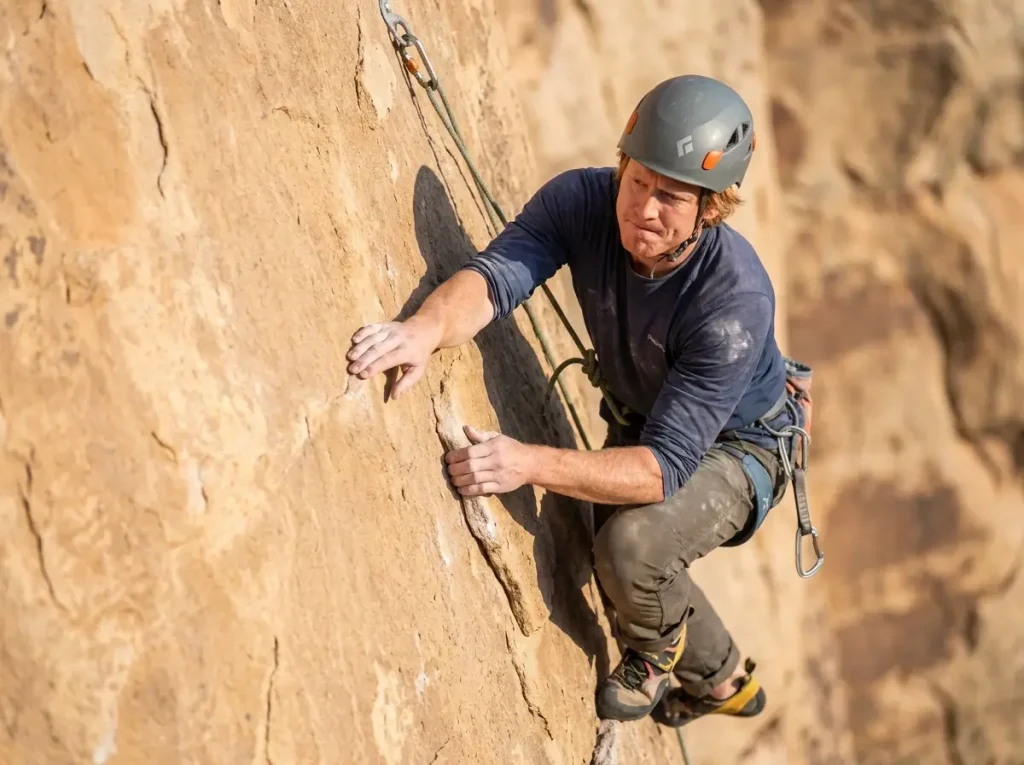
Here’s the number that stings: most gym climbers drop two to three full grades when they step onto real rock for the first time. If you climb 5.11a in the gym, expect to fight on 5.8 or 5.9 outside. That’s not you getting weaker overnight — it’s the difference between curated plastic and millions of years of geology.
Why Outdoor Grades Feel Harder
In the gym, every hold is designed to be grabbed. The route setter color-coded the path, the footholds are positive, and the wall angle is consistent. Outdoors, the rock doesn’t care about your project. Holds are whatever the geology left behind — a rounded nub, a shallow pocket, a friction smear on a slab that looks like nothing until you trust it.
Rock type changes everything. Limestone is the friendliest transition — it’s featured, pocketed, and closest to what gym holds simulate. Granite feels like a different sport entirely. The holds are rounder, the friction is different, and edging on crystals instead of rubber-molded edges takes recalibration. Sandstone sits somewhere in between but punishes bad footwork harder because it’s softer and your shoes don’t stick the same way.
How to Use the Grade Drop
Don’t fight it. Embrace climbing well below your gym max for the first several sessions. Climb 5 to 10 routes per day at a comfortable grade instead of grinding one route at your limit. Volume builds the outdoor movement patterns faster than projecting, and you’ll start reading natural rock features much sooner.
Research from Training for Climbing confirms this: outdoor climbing is skill-dominant, and the biggest limiter for gym transitioners is efficiency, not strength. You already have the power. You need the pattern recognition.
Pro tip: Bring a guidebook or use Mountain Project to find routes rated 2 to 3 grades below your gym max. Look for routes described as “juggy,” “well-bolted,” or “great for beginners.” These are your calibration routes — the ones that teach you outdoor movement without the fear.
The Gear You Actually Need (and What to Leave at the Gym)
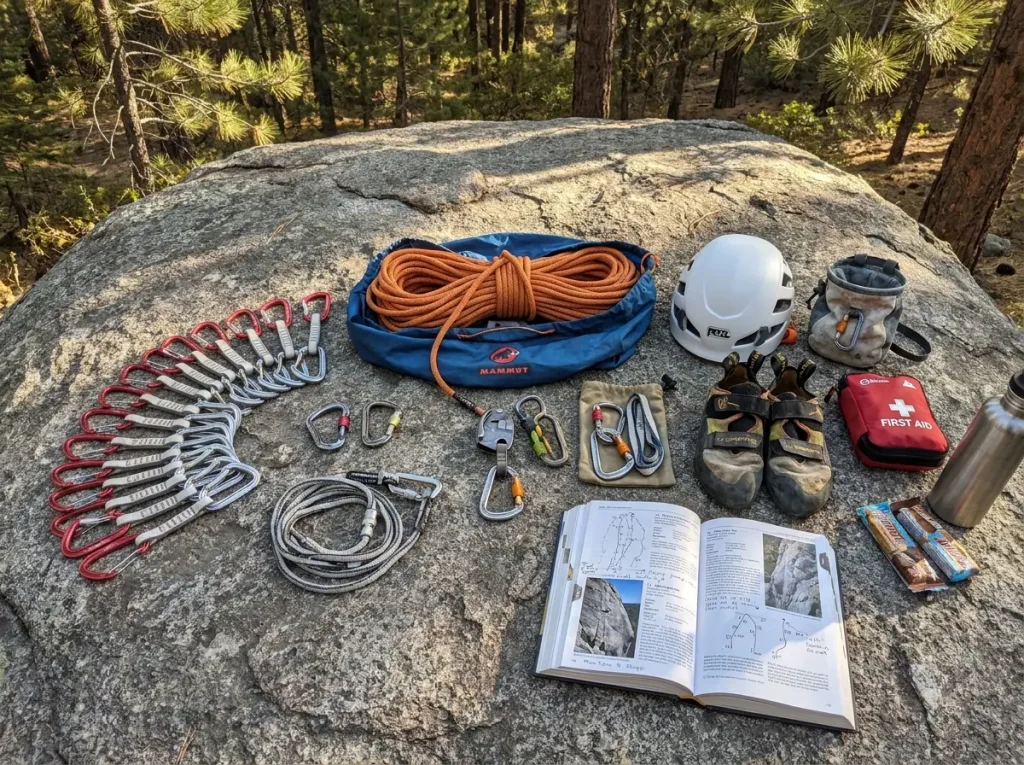
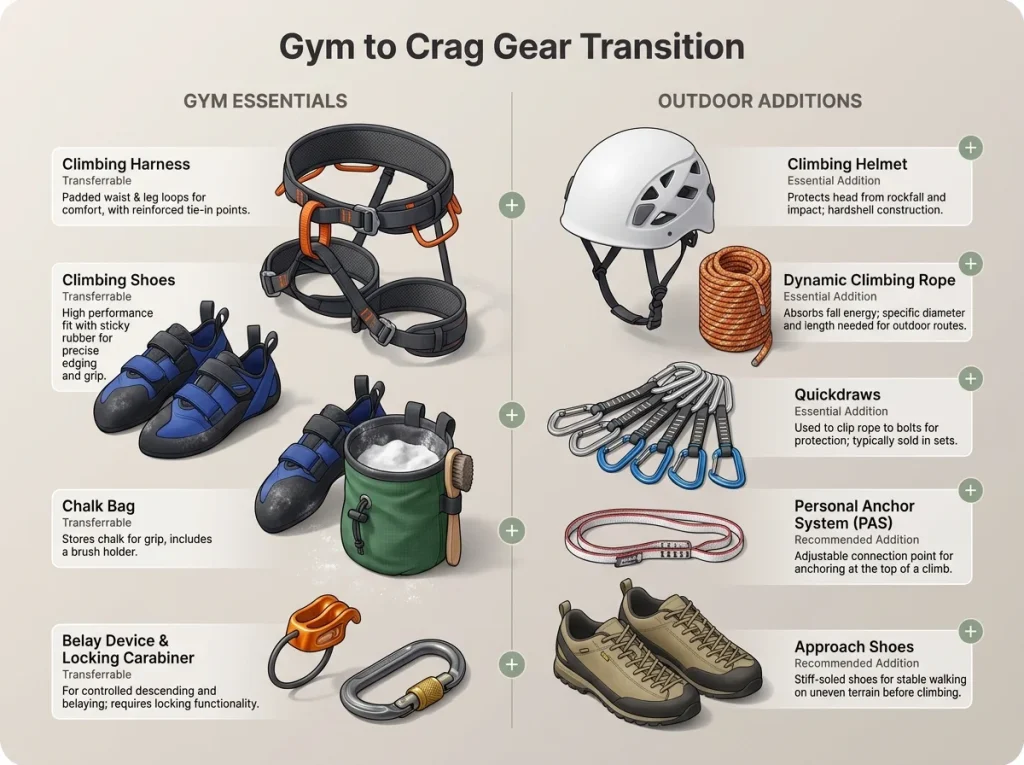
Your gym harness and shoes will work outside. Almost everything else needs to be acquired, borrowed from a trusted source, or rented.
The Outdoor Essentials You Don’t Own Yet
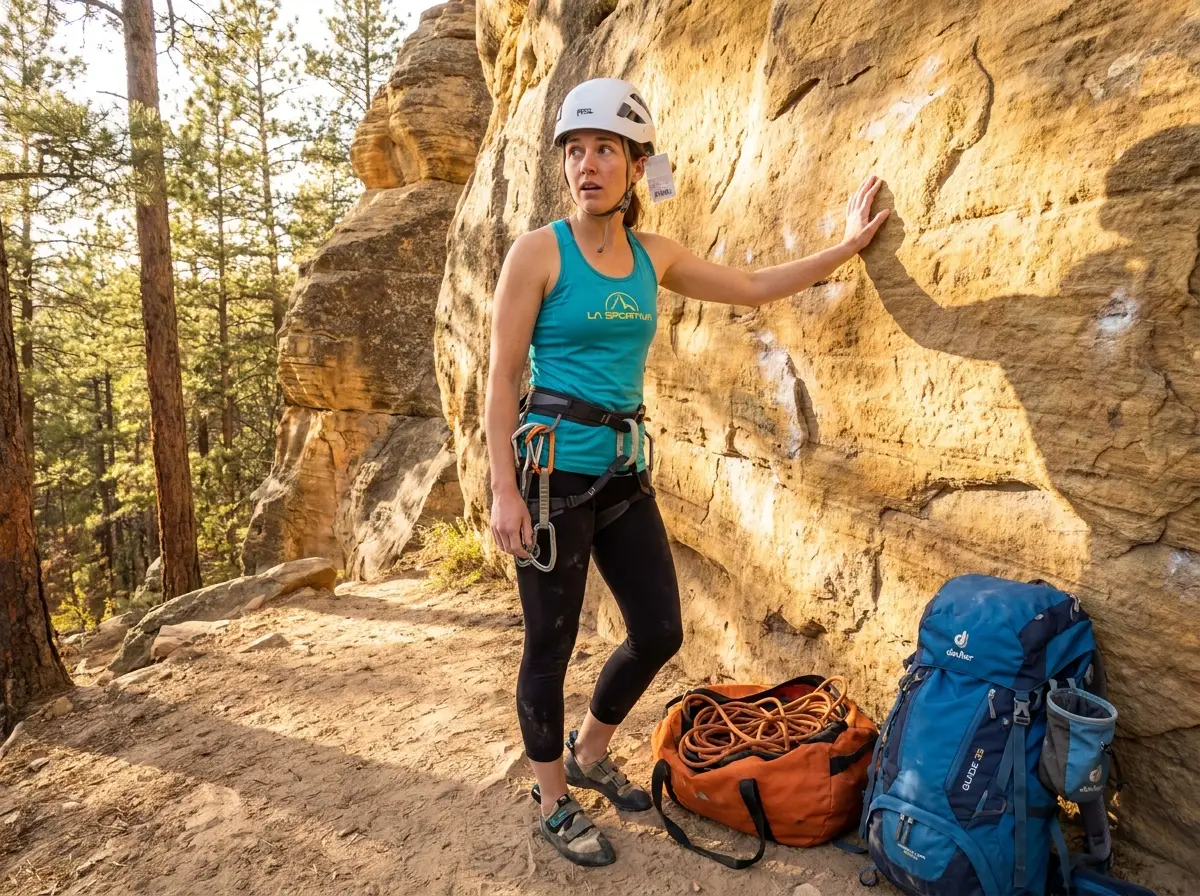
A helmet is non-negotiable. Rockfall, dropped gear, and unexpected slips happen outdoors in ways they never happen in the gym. A hardshell helmet like the Petzl Boreo or Black Diamond Half Dome weighs almost nothing and protects against the one variable you can’t control.
You need a rope — most sport crags require 60 meters, though 70 meters gives you margin for longer routes. A set of quickdraws (10 to 14 for sport climbing) lets you clip bolts as you climb. Two to three locking carabiners and a personal anchor system handle the top-of-route anchor work. And a belay device you’ve practiced with — not one you borrowed in the parking lot.
Check the full breakdown in our climbing gear checklist for specifics on what to buy versus rent.
What to Leave Behind
Skip the gym chalk bucket — a smaller chalk bag clips to your harness and works better when you’re moving on real rock. Leave the bluetooth speaker at home. Crags are shared spaces, often in wilderness or residential areas, and noise is the fastest way to get a climbing area shut down.
Don’t bring gear you haven’t practiced with. A brand-new GriGri you’ve never loaded is a liability, not a safety device.
The Borrowing Trap
REI’s expert guidance puts it plainly: never borrow hardware or safety gear if you don’t know its full history. Carabiners can have microcracks from impact. Nylon slings and ropes degrade from UV exposure, abrasion, and even chemical contact.
The only safe borrowed gear is clothing, shoes, and chalk. A certified guide’s gear is the exception — they’re required to log and inspect every piece.
Pro tip: Before buying a full rack, ask your gym if they offer an outdoor transition class or clinic. Many gyms include gear for the day, and you’ll learn what you actually need before spending money on equipment you might not use.
Anchor Cleaning — The Skill That Separates You From the Gym
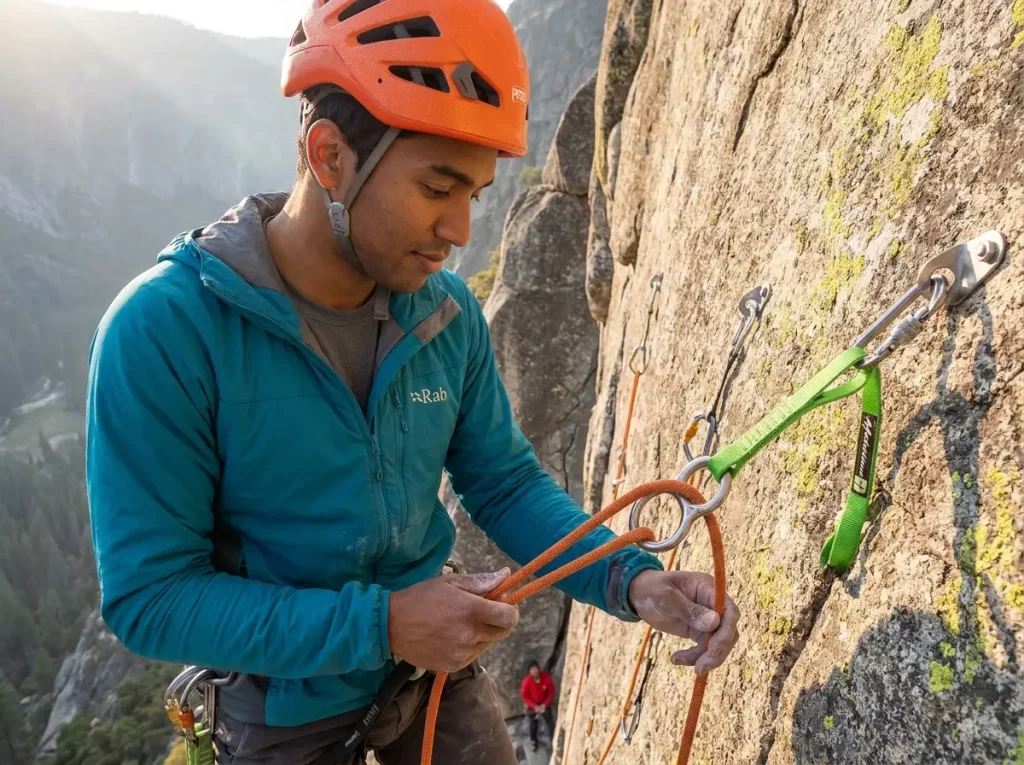
In the gym, you clip into an autobelay or get lowered by your belayer. The anchor is someone else’s problem. Outdoors, cleaning the anchor at the top of a route is your responsibility — and it’s the skill where the most accidents happen to transitioning climbers.
Why This Matters More Than Your Send
The American Alpine Club’s accident reports document multiple incidents of inexperienced climbers making fatal errors while cleaning anchors. The mistakes are almost always the same: unclipping from the system before threading the rope, failing to maintain a backup connection, or misunderstanding the lowering sequence.
The AAC is direct about this: do not attempt to clean a route without proper supervision if you’ve never done it before. This is not a skill you learn from watching a YouTube video in the car on the way to the crag.
The Basics You Need to Practice
Before you go outside, learn these steps in a controlled environment — your gym’s anchor-cleaning clinic or a guided session:
Clip your personal anchor system to the anchor bolts. Thread the rope through the rappel rings or lowering hardware. Weight-test the system before removing your quickdraws.
Communicate clearly with your belayer at every transition. Stay connected to the rope at all times — if you drop the rope at the anchor, you’re stranded.
The details of anchor cleaning fill an entire article. Start with our top-rope anchor building guide for the foundational physics and vocabulary, then practice the specific cleaning sequence with an experienced mentor.
The Communication Problem at the Top
Outdoor cliffs create communication challenges that gym walls never do. Wind, distance, and rock features between you and your belayer can make voice commands inaudible. Before the climber leaves the ground, agree on the cleaning method and the verbal or rope-signal cues you’ll use. The partner check protocol covers the pre-climb communication system.
Pro tip: Practice the anchor-cleaning sequence on a low bolt line — two or three meters off the ground — until it’s muscle memory. Getting flustered at height with gear dangling is how mistakes happen. Build the habit at ground level where the stakes are zero.
Reading Real Rock — Route Finding Without Colored Tape
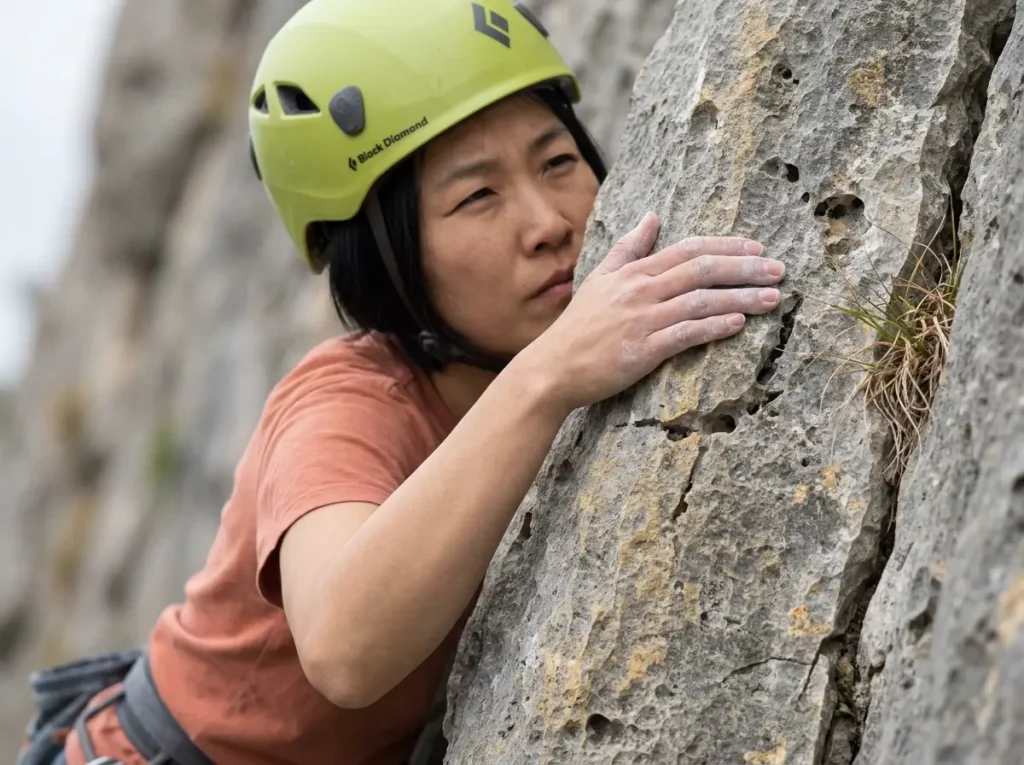
The gym painted every hold neon green and told you exactly where to go. Outside, the rock is one color, the holds aren’t marked, and the route is whatever your hands and feet can figure out.
How to See What the Rock Is Offering
Start by standing back and looking at the entire route from the ground. Identify the obvious features — cracks, ledges, pockets, arêtes. Then look for the bolt line, which traces the intended path up the wall. The bolts aren’t always in a straight line, and the route may wander left or right to follow the best rock features.
Once you’re on the wall, slow down. Feel the rock with your fingertips before committing to a hold. Outdoor holds often feel different than they look — what appears blank might have a positive edge when you touch it from the right angle. What looks like a great jug might be a sloping bump that spits you off.
Footwork Changes Everything
In the gym, footholds are big, positive, and obvious. On real rock, the best foothold might be a crystal the size of a pencil eraser. Smearing — pressing the flat of your shoe rubber against a featureless slab — becomes a real technique instead of a gym exercise.
Watch the experienced climbers at the crag. Notice how slowly they place their feet, how precisely they weight each placement, and how little they readjust. That deliberation is the difference between a gym climber and an outdoor climber.
Chalk Marks and Ethics
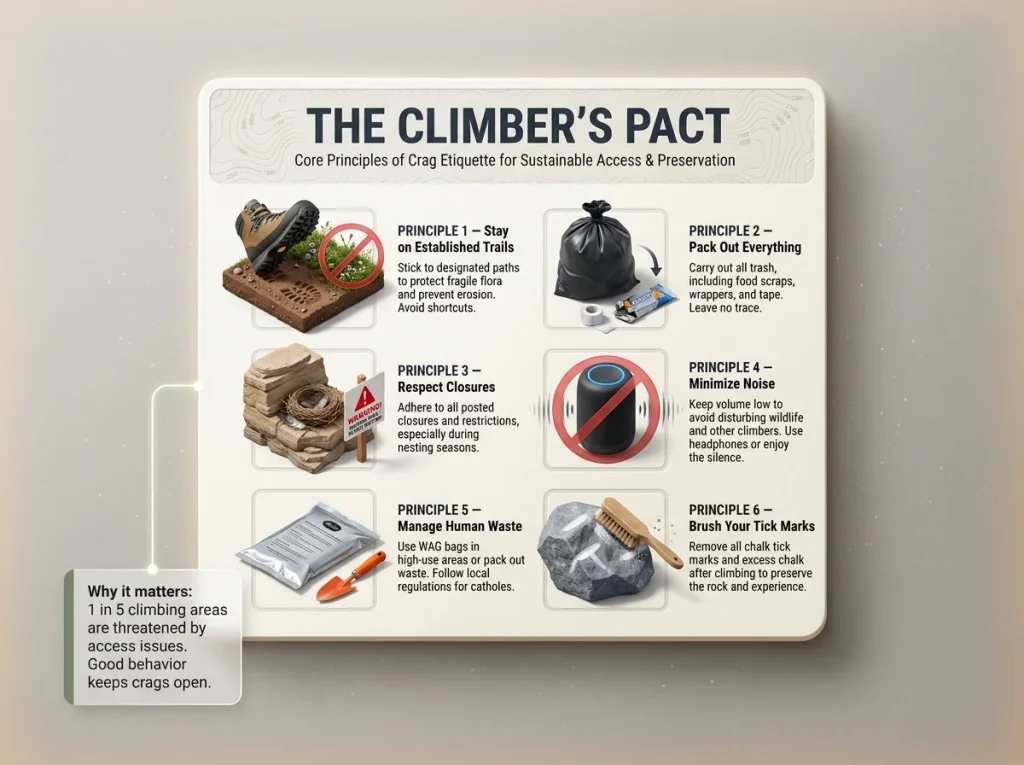
Chalk marks on popular routes can help you find holds, but they’re also a crag etiquette issue. Excessive chalk damages rock and changes its appearance. Brush your holds when you’re done, especially tick marks you placed for route-reading. Pack a brush in your chalk bag — it’s as standard as the chalk itself.
Follow the outdoor bouldering ethics protocol for the full rundown on chalk management, vegetation protection, and access preservation.
Pro tip: On your first outdoor day, ask your mentor to point out three types of holds you’ve never used in the gym: underclings, gastons, and pinches on natural rock. Feeling the difference between plastic and stone versions of these holds recalibrates your grip faster than anything else.
Crag Etiquette — What the Gym Didn’t Teach You
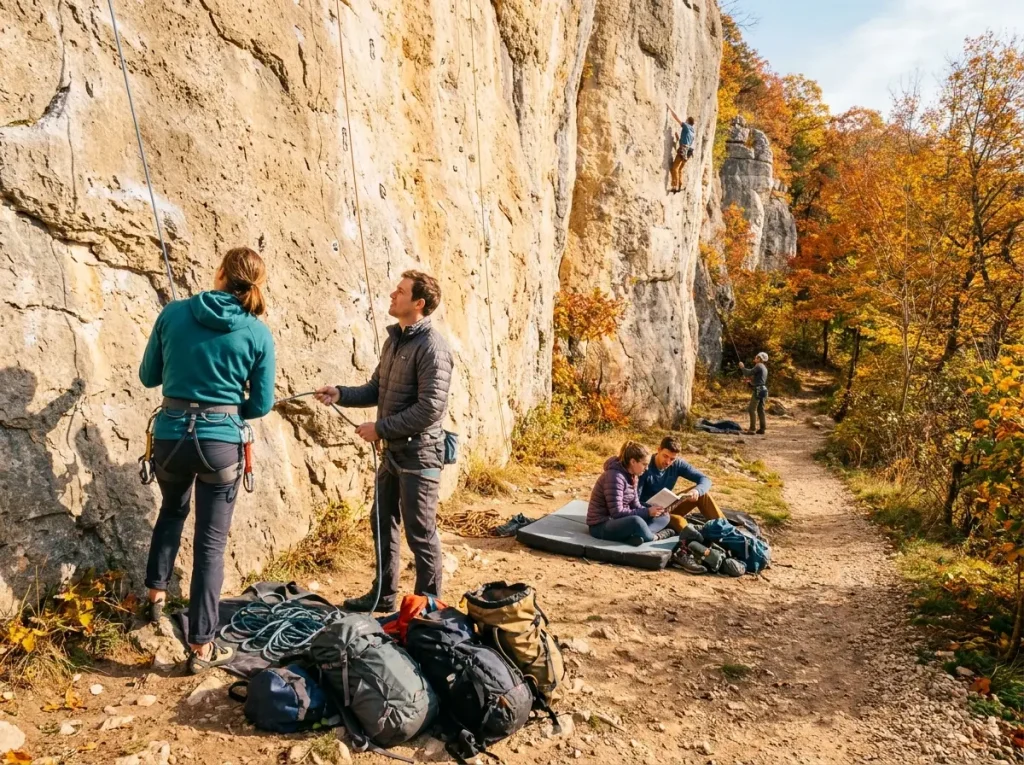
Climbing areas close because of climber behavior. Not because of inherent risk, not because of liability — because people acted like the crag was their private gym. The Access Fund reports that one in five climbing areas have been closed due to perceived liability issues or climbers no longer being welcome. Every climber who steps outside carries the responsibility of keeping areas open.
The Rules That Matter Most
Stay on established trails. The shortcut you take across the hillside becomes a scar when 200 other climbers follow the same path. Park in designated areas — blocking access roads or private property is how climbing bans start.
Pack out everything. Not just your trash — your tape scraps, your food wrappers, your broken chalk ball. If you brought it in, it leaves with you.
Human waste at popular crags requires WAG bags at minimum. The water quality protection guide explains why this matters more than you think.
Sharing the Wall
Crags aren’t gym routes with a queue system. If someone is projecting a route, don’t set up your top-rope on the same line. If the crag is crowded, offer to share anchors or alternate burns. Keep your gear in a tight pile at the base — not sprawled across the approach trail where people need to walk.
Volume down. Screaming beta, blasting music, and loud celebrations might fly in the gym. At the crag, they echo off the walls and announce to every neighboring party that the gym crowd has arrived.
The Access Mindset
Every outdoor climbing day is a vote for or against continued access. Introduce yourself to other parties. Clean up litter that isn’t yours. Report access issues to local climbing organizations.
The gym-to-crag transition isn’t just about skills and gear — it’s about joining a community that relies on collective responsibility to keep climbing outside.
The Approach Hike Nobody Warns You About
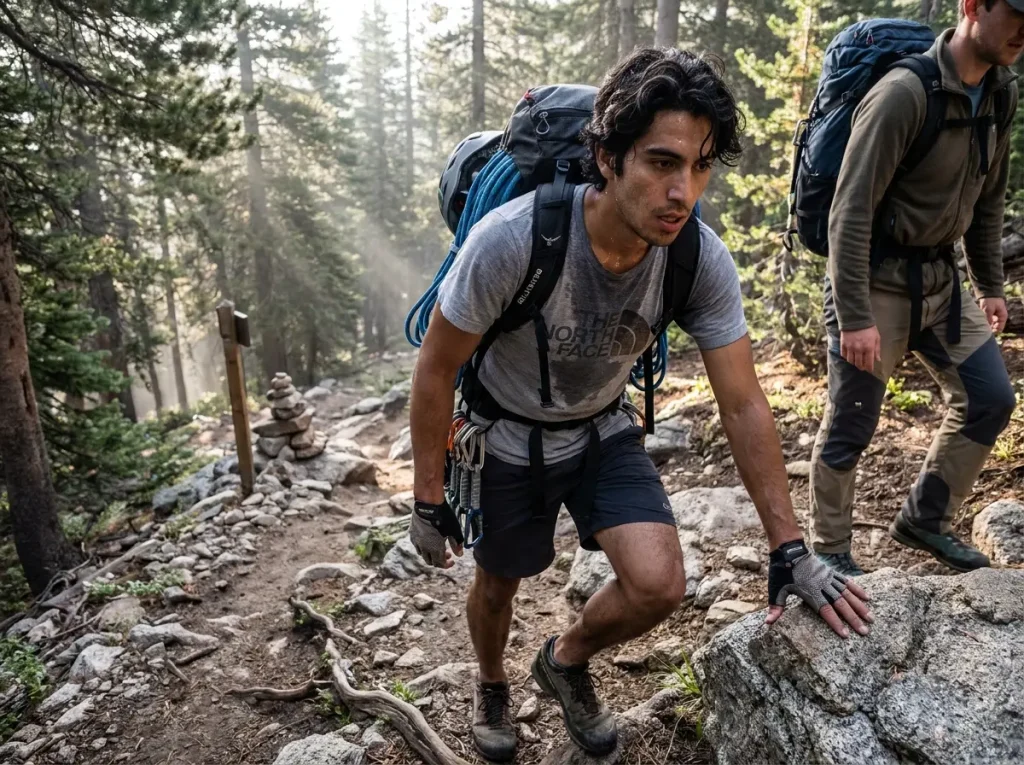
You parked at the trailhead. Now you have to walk uphill for 30 minutes carrying 15 kilograms of climbing gear on your back. In approach shoes. On rocky trail.
Before you even touch rock.
Why This Catches Gym Climbers Off Guard
Gym climbing starts at the parking lot. You walk 30 seconds to the wall and start climbing. Outdoor climbing starts with an approach hike that ranges from a flat 10-minute walk to a steep scramble that feels like a workout on its own. By the time you reach the crag, you’ve already used energy and hydration that gym climbers never account for.
Your cotton gym t-shirt is soaked through. Your feet hurt because you wore your climbing shoes for the hike instead of approach shoes. Your pack is cutting into your shoulders because you loaded it wrong. These are all preventable problems.
How to Prepare
Invest in a proper climbing pack — 30 to 38 liters with a hip belt that transfers weight off your shoulders. Wear dedicated approach shoes with stiff soles and good traction for the hike in. Pack your climbing shoes inside the bag and change at the base.
Bring more food and water than you think you need. A full day at the crag means six to eight hours outside, and the hike back is harder when you’re exhausted.
Two liters of water minimum. Lunch plus snacks. An energy bar for the approach and another for the walk out.
Check the packing list for climbing trips for the complete breakdown of what goes in the bag.
The Warm-Up Problem
After a 30-minute uphill hike with a heavy pack, your legs are tired but your fingers are cold. The crag warm-up routine solves this: start with easy routes two to three grades below your target, focus on movement quality over intensity, and give your tendons time to adapt to pulling on natural rock features.
Pro tip: Do the approach hike once without climbing gear — just to see how long it takes, what the trail is like, and where the crag actually is. Knowing the approach removes one unknown from your first outdoor climbing day and lets you budget your energy.
The Mental Game — Fear, Exposure, and Trusting the Gear
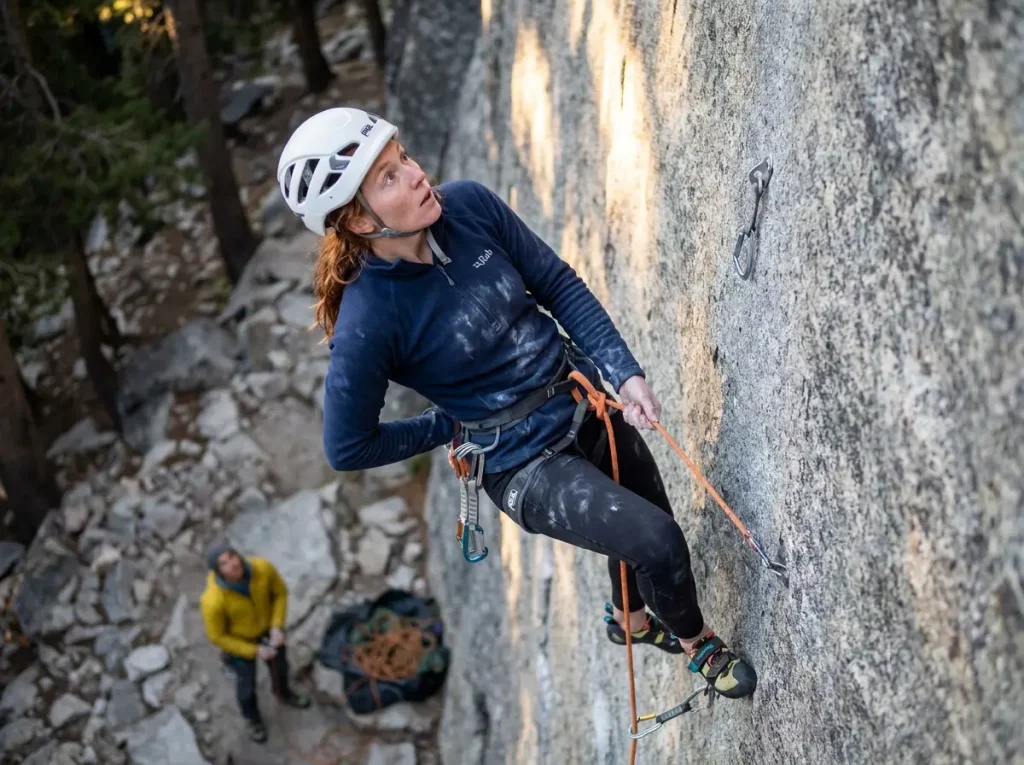
The gym trained your muscles. It didn’t train the part of your brain that freezes when you look down from 15 meters up and see talus instead of foam padding.
Why Outdoor Fear Is Different
In the gym, you fall on padded floors or get caught by a top-rope that’s always above you. The consequences feel low because they are low. Outside, the ground is hard, the heights are real, and your protection is a series of small metal pieces clipped to bolts drilled into rock.
The rational part of your brain knows the system works. The survival part doesn’t care.
Fear of falling outdoors is nearly universal among transitioning climbers, even those who take big gym whippers without flinching. The visual exposure — seeing the real ground far below, with real trees and real rocks — triggers a fear response that gym walls never activate.
How to Build Outdoor Confidence
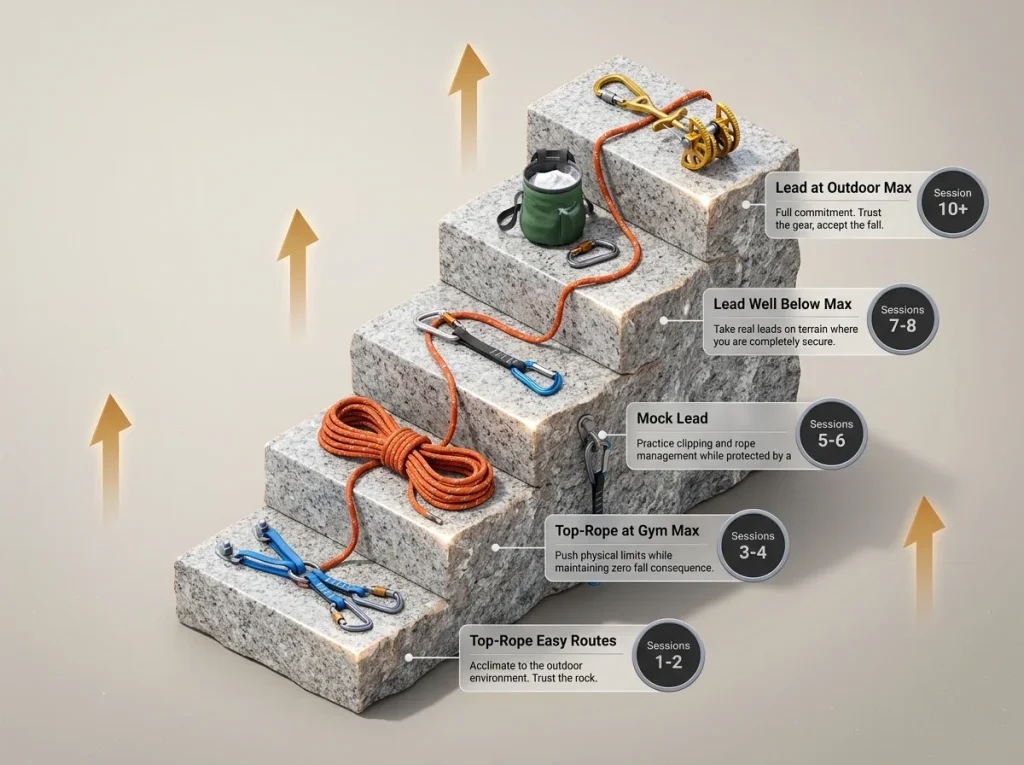
Start on top-rope. Your first several outdoor sessions should involve zero lead climbing. Let someone else set the routes. Your job is to climb, fall safely, and let your nervous system calibrate to the outdoor environment.
When you’re comfortable on top-rope, progress to mock leading — climbing with quickdraws and a lead rope while also protected by a top-rope. This lets you practice clipping bolts and managing rope without the full consequences of a lead fall. The fall practice progression gives you a structured system for building fall comfort.
The Gear Trust Problem
Gym climbers trust gym gear implicitly because they never think about it. Outdoor climbers need to actively build trust in their systems — and that trust comes from understanding, not blind faith.
Learn how your belay device works mechanically. Understand what a bolt holds and why. Know the physics behind your harness and what happens when you fall on each piece of protection.
The fear won’t go away completely. It shouldn’t — healthy respect for the consequences is what keeps outdoor climbers alive. But it will shrink from paralyzing to manageable, and then to something you barely notice on routes well within your ability.
Pro tip: After your first outdoor day, write down three things that scared you and three things that went well. The scared list shows you what to work on. The went-well list reminds you that you’re making progress. Most gym-to-crag transitioners forget the second list.
Conclusion
Your gym grade prepared your muscles for outdoor climbing. It didn’t prepare your eyes for unmarked holds, your lungs for the approach hike, or your ego for the grade reset. That gap closes fast once you accept it — most gym climbers are climbing at their expected outdoor grade within five to ten sessions.
The gear, the anchor skills, and the etiquette are all learnable. Find a guide or experienced mentor for your first day. Climb easy routes at high volume. Bring more food and water than you think you need.
And leave the crag cleaner than you found it.
The outdoor climbing community exists because people before you respected the rock, the access, and the shared responsibility of keeping crags open. You’re joining that community now.
Climb well. Climb respectfully. And don’t worry about the grade — it’ll come back.
Q1 How much harder is outdoor climbing compared to gym climbing?
Most gym climbers drop two to three full letter grades when they first climb outside. A gym 5.11a climber typically starts at 5.8 or 5.9 on real rock. The difference comes from unmarked holds, unfamiliar rock texture, and the mental adjustment to natural features. The gap closes within five to ten outdoor sessions.
Q2 What gear do I need that I don’t already have from the gym?
You’ll need a helmet, a rope (60 to 70 meters), quickdraws (10 to 14), locking carabiners, a personal anchor system, and approach shoes. Your gym harness, climbing shoes, chalk bag, and belay device transfer directly. Borrow or rent before buying if budget is tight.
Q3 Do I need to know how to lead climb before going outside?
No. Start on top-rope set by a guide or experienced friend. Learn anchor cleaning and outdoor movement first. Progress to mock leading when you’re comfortable, then actual lead climbing. Rushing to lead outdoors before mastering the basics is how preventable accidents happen.
Q4 How do I find a good crag for my first outdoor climbing trip?
Use Mountain Project or a local guidebook to find crags rated beginner-friendly with well-bolted sport routes in the 5.5 to 5.9 range. Look for short approaches, good cell service, and multiple easy routes so you can climb volume. Ask your gym community for recommendations specific to your area.
Q5 What is crag etiquette and why does it matter?
Crag etiquette is the code of conduct that keeps climbing areas open. It includes staying on established trails, packing out all trash, minimizing noise, sharing routes respectfully, and brushing chalk marks. The Access Fund reports that one in five climbing areas have been closed due to climber behavior. Every outdoor session is a vote for continued access.
Safety Notice: Rock climbing and mountaineering are inherently high-risk
activities that can involve physical trauma or fatal incidents. The information on Rock Climbing Realms is for
educational and informational purposes only. Techniques and advice presented here are not a substitute
for professional, hands-on instruction. Conditions and risks vary by location. Always seek guidance
from a qualified instructor before attempting new techniques. By using this website, you agree that you
are solely responsible for your own safety. Any reliance you place on this information is strictly
at your own risk, and you assume all liability for your actions. Rock Climbing Realms and its authors
will not be held liable for any harm, damage, or loss sustained in connection with the use of this information.
Affiliate Disclosure: We are a participant in the Amazon Services LLC Associates Program, an
affiliate advertising program designed to provide a means for us to earn advertising fees by advertising and linking
to Amazon.com. As an Amazon Associate, we earn from qualifying purchases. We are also an official affiliate partner
of Black Diamond Equipment via the AvantLink network. If you click on a Black Diamond affiliate link and make a
purchase, we may earn a commission at no additional cost to you. We also participate in other affiliate programs.
Additional terms are found in the terms of service.