
In this article
Halfway up a WI4 pillar in Ouray Ice Park, every swing punched clean through. Dinner plates the size of frisbees kept sheeting off, and I couldn’t get a single solid placement to save my life. The pick looked fine at a glance. But back at the van, I ran a thumb across the bevel and felt it immediately—rounded, soft, useless. Fifteen minutes with a flat file changed everything. Next morning, same route, same ice. First-swing sticks all the way up, zero fracturing, half the effort.
After years of ice climbing across Colorado, Montana, and the Canadian Rockies, I’ve learned that the gap between a frustrating day and a clean send often comes down to one thing most climbers ignore: maintaining a sharp edge on their ice tools and crampons. This guide covers the exact hand-filing method that AMGA instructors, Black Diamond athletes like Will Gadd, and Petzl engineers recommend, including the brand-specific details most tutorials skip.
⚡ Quick Answer: Use a medium-cut flat file ($10-15) and file in one direction only (push strokes). Follow the original factory profile exactly, alternate sides for balance, and never touch a power grinder to your picks. For Petzl picks, maintain a 0.5 mm flat area at the tip center. Replace picks when wear reaches past the first tooth.
Why Sharp Ice Picks Change Everything on the Wall
The Physics of Penetration and Fracture
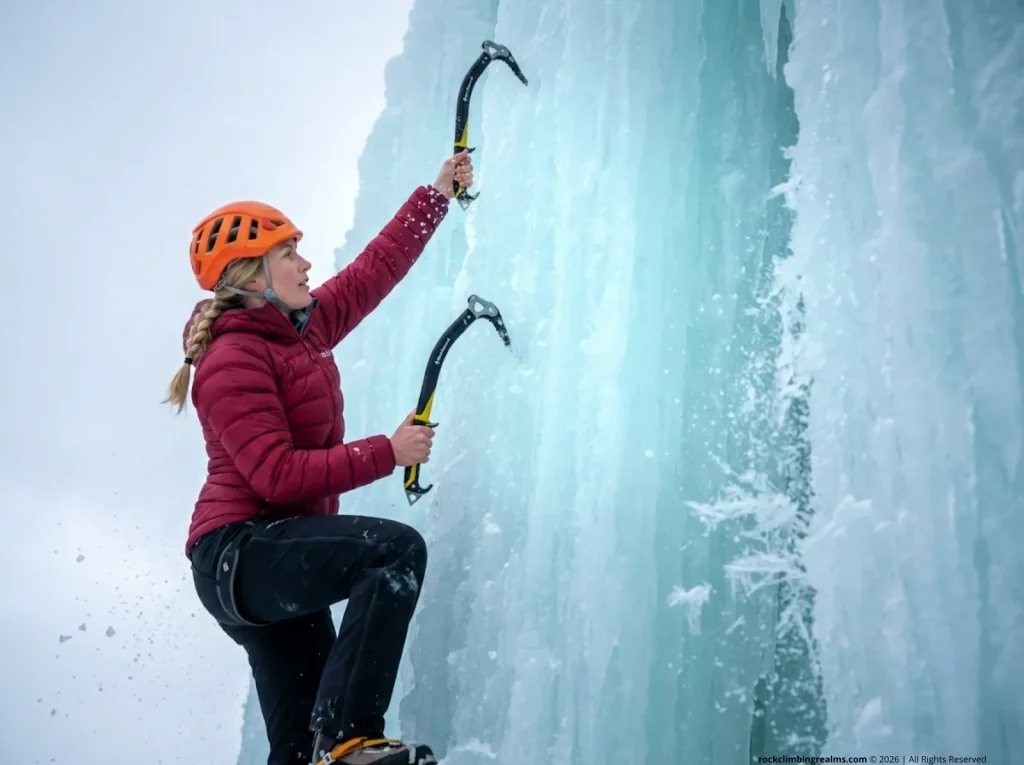
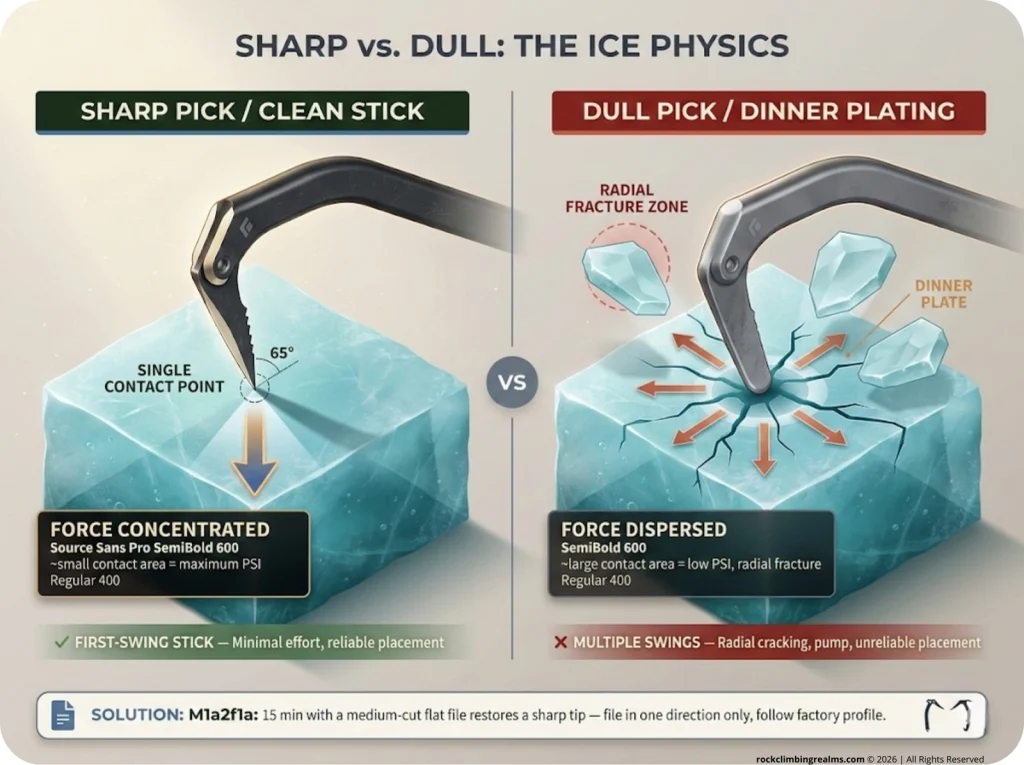
A sharp pick concentrates all your swing force onto a tiny contact point. That means clean penetration with less effort—the tool bites, holds, and stays put. A dull tip does the opposite. It spreads the impact across a rounded surface, and instead of sticking, it kicks off radial cracks that send ice chunks flying. Climbers call it dinner-plating, and it’s the signature of a pick that needs work.
Petzl’s official maintenance guide puts it simply: sharp front points on crampons “cut into ice rather than shatter it.” The same principle applies to your picks. Patrick Ormund from the AMGA demonstrates this in his instructional videos—sharper tools mean fewer swings per placement, less pump in your forearms, and easier removal when you need to move.
The practical difference is enormous. On pure ice, a freshly sharpened pick sticks on the first swing. A dull one might need two or three attempts on the same placement, which compounds fatigue over a full pitch. If you want to understand why cold ice shatters differently, temperature plays a big role in fracture behavior—but edge geometry is the variable you can actually control.
When to Sharpen (and What Causes Damage)
Sharpen after any significant rock contact. Even one stein-pull on mixed climbing terrain can roll a tool tip. Pure ice climbing dulls picks more gradually—usually over 2-3 sessions depending on ice temperature, since colder ice is harder and grinds edges faster.
Two quick field checks tell you when it’s time. The visual check: hold the pick up to light. If the tip reflects light as a flat line instead of a sharp point, it’s dull. The touch check: draw your thumbnail perpendicular across the bevel. A sharp edge catches. A dull one slides right off.
The Tools You Need (and the Ones That’ll Ruin Your Picks)
Your Sharpening Kit Checklist
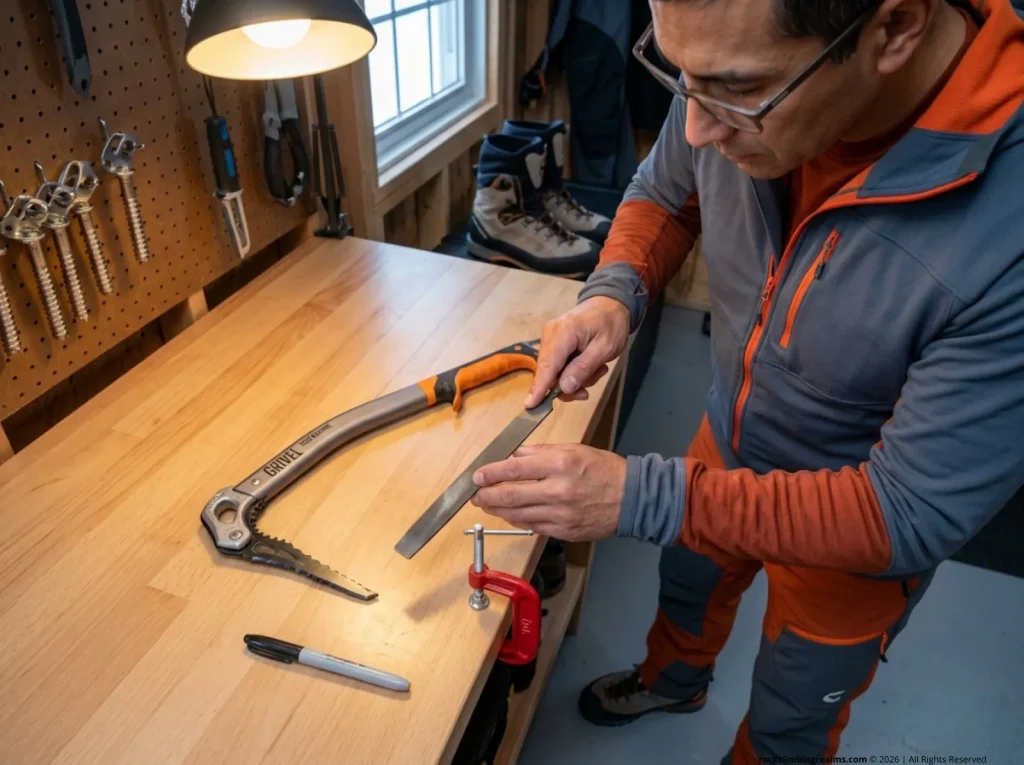
You don’t need much, and you don’t need to spend much. Here’s the full kit:
- Medium-cut flat file (also called a second-cut flat file)—about $10-15 at any hardware store. Not a coarse bastard file, which rips off too much metal too fast. Not a chainsaw file, which has the wrong cross-section.
- Metal vice or C-clamp—the preferred bracing method. If you’re in the field without one, brace the shaft between your thighs with the pick extending over a stable edge.
- Marker pen—trace the factory bevel line before filing so you can see exactly where metal is coming off.
- Fine sandpaper or deburring stone—for finishing passes to clean up the wire edge.
- Clean rag plus light lubricant—Petzl’s guide warns that high-strength steel picks have no rustproof treatment. Wipe them dry and oil them after every sharpening session.
Pro tip: Keep your file in a protective sleeve or wrap. A bare file bouncing around in your tool box or pack dulls its own teeth before you ever use it.
Why Grinders Are a Deal-Breaker
This one deserves its own section because it’s the single fastest way to destroy expensive gear. Power grinders generate heat. Heat destroys the steel’s temper—the specific hardness that lets your pick hold an edge through hundreds of swings. Metallurgist Graham Gedge on UKC specifically warns against this, and both Petzl and REI echo the same message.
A pick that’s been ground isn’t just poorly sharpened. It’s permanently compromised. The softened steel dulls 3-4 times faster, and power tools remove metal unevenly, destroying the teeth geometry that took the factory CNC machines precise tolerances to create. One session with a grinder can turn a $40 pick into scrap.
If you’re thinking about tracking your gear’s service life, this is exactly the kind of damage that makes the difference between picks lasting three seasons and picks lasting three months.
Step-by-Step Pick Sharpening (The AMGA Method)
Step 1: Secure and Inspect
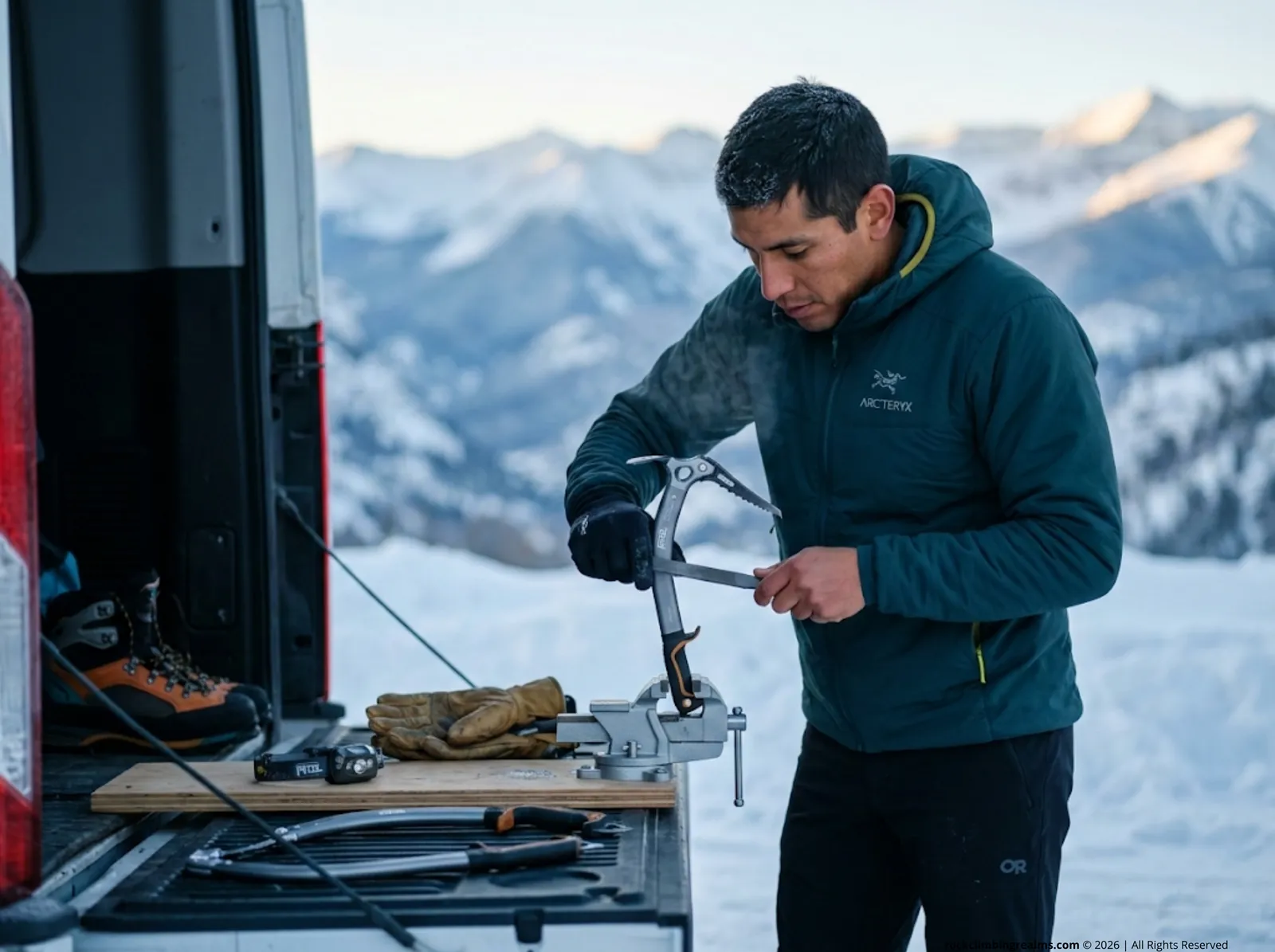
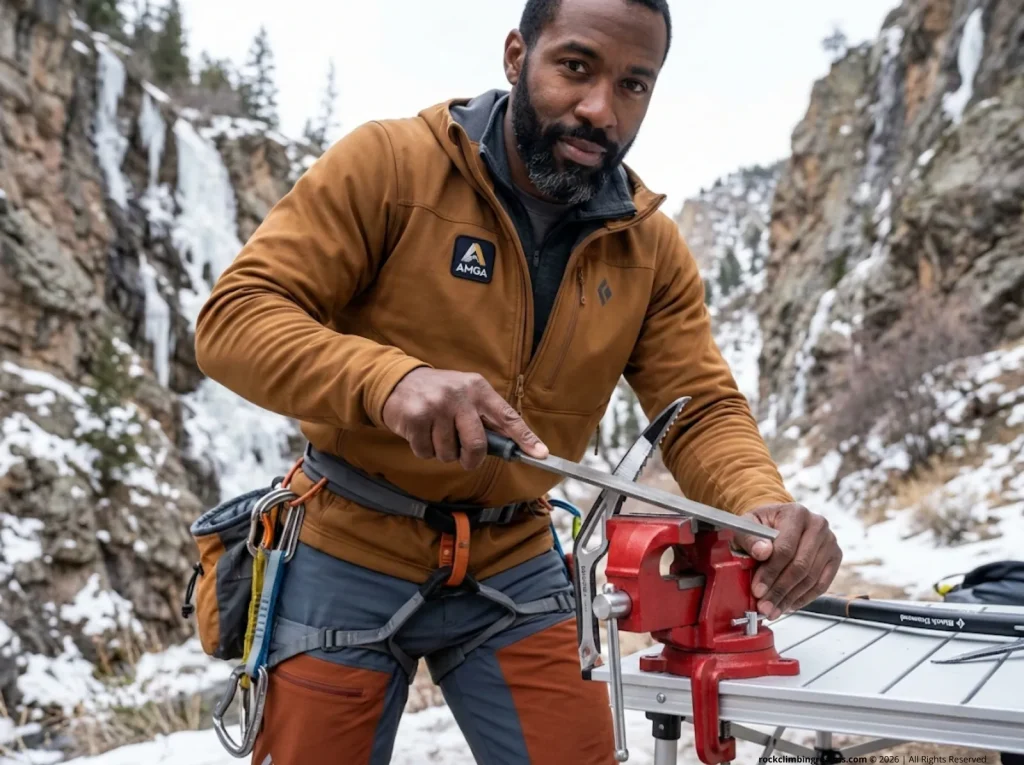
Lock the tool shaft in a vice with the pick exposed, teeth facing you. No vice? Sit on the ground, brace the shaft between your thighs, pick extending over one knee. It’s less ideal, but field climbers have been doing it this way for decades.
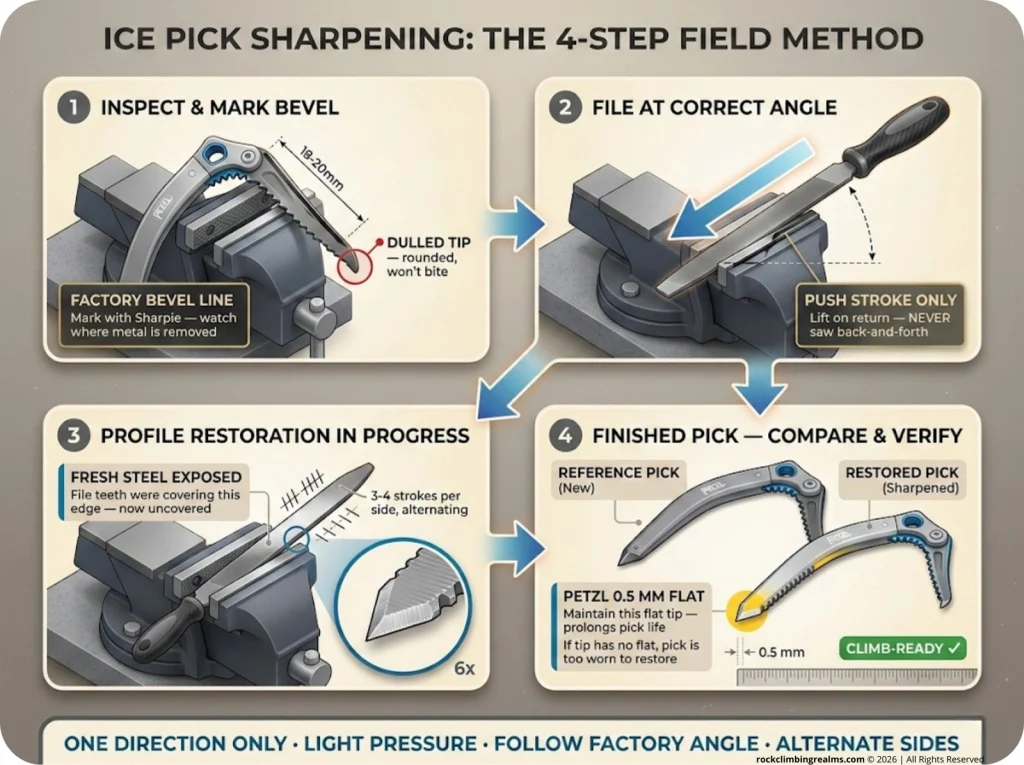
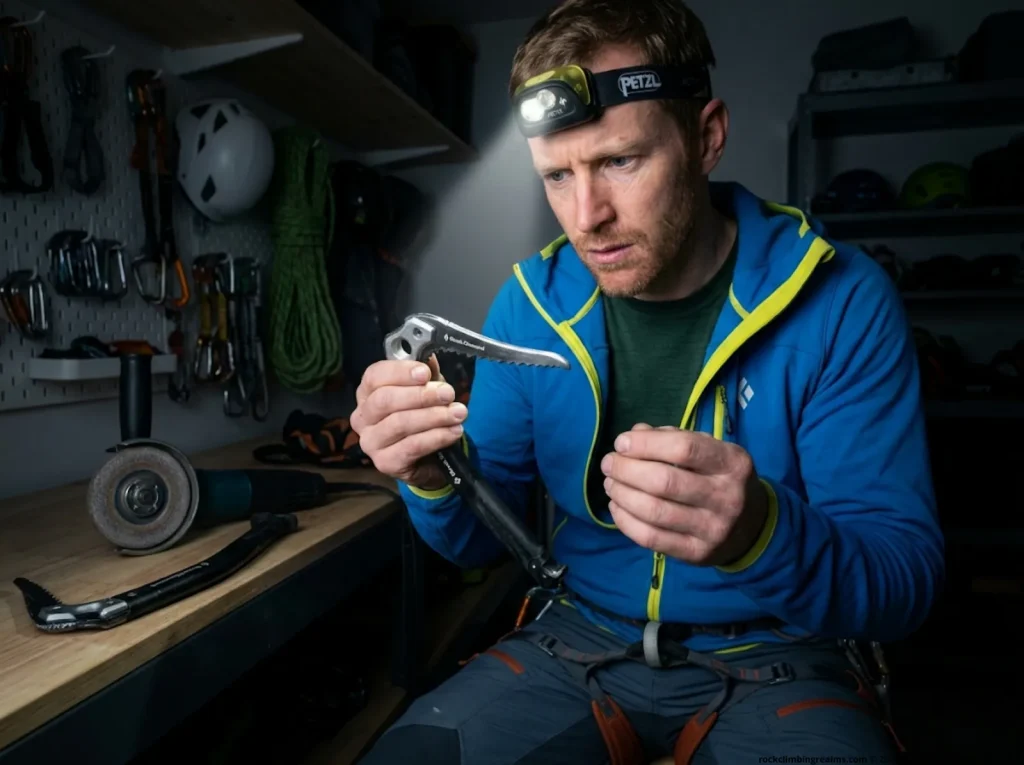
Now compare your worn pick against a brand-new Black Diamond reference pick side by side—Will Gadd specifically recommends this as his first step. Hold both picks next to each other and look at the profiles. You’ll see exactly where your worn pick deviates from factory. Mark the bevel line with a Sharpie so you have a visual target while filing.
Check the serrations. Are the teeth still defined? If the first tooth is barely visible, you’re getting close to pick retirement criteria.
Step 2: File the Profile (Shape First)
Place the flat file against the pick’s profile and push away from you in a single, clean stroke. Lift on the return. Never saw back and forth. One-direction filing strokes are non-negotiable—back-and-forth ruins the file, roughs the surface, and undoes your own work.
The goal here is profile restoration—not creating a new edge but uncovering the one that’s underneath the damage. File each side in alternating passes, three to four strokes per side, to keep the edge centered and balanced. Light pressure only. Let the file do the work. Heavy pressure clogs the file teeth and gouges unevenly.
For Petzl Laser picks specifically: maintain a 0.5 mm flat area in the center of the tool tip after filing. This seems counterintuitive, but Petzl’s engineers designed it this way—the flat spot prolongs pick life without reducing penetration.
Step 3: Restore the Bevel (Edge Last)
Once the profile shape matches factory, shift your attention to the bevel angles on each side of the tip. Match the original angle exactly—this is where your marker line pays off. You’ll need fewer strokes here, typically five to eight per side.
Finish by running fine sandpaper or a deburring stone lightly along the edge to remove the wire edge (the thin burr of metal left from filing). Final check: the edge should catch your thumbnail, and the tip should have that Petzl 0.5 mm flat tip (if Petzl) or come to a controlled point (if BD).
Will Gadd’s tech tips video above walks through this exact process on Black Diamond picks and is worth watching before you file your first stroke.
Pro tip: Compare your sharpened pick to an unworn reference pick every single time. Your eye gets used to a worn profile if you sharpen without a benchmark—and one day you’ll realize you’ve been “restoring” a shape that’s been drifting from factory for two seasons.
Once your picks are dialed, the improvement shows up immediately in your swing efficiency. Properly sharpened tools stick on the first swing with a relaxed wrist flick instead of desperate overhead hammering.
Crampon Sharpening (Different Rules Apply)
Front Points: Edges Only, Never the Flat
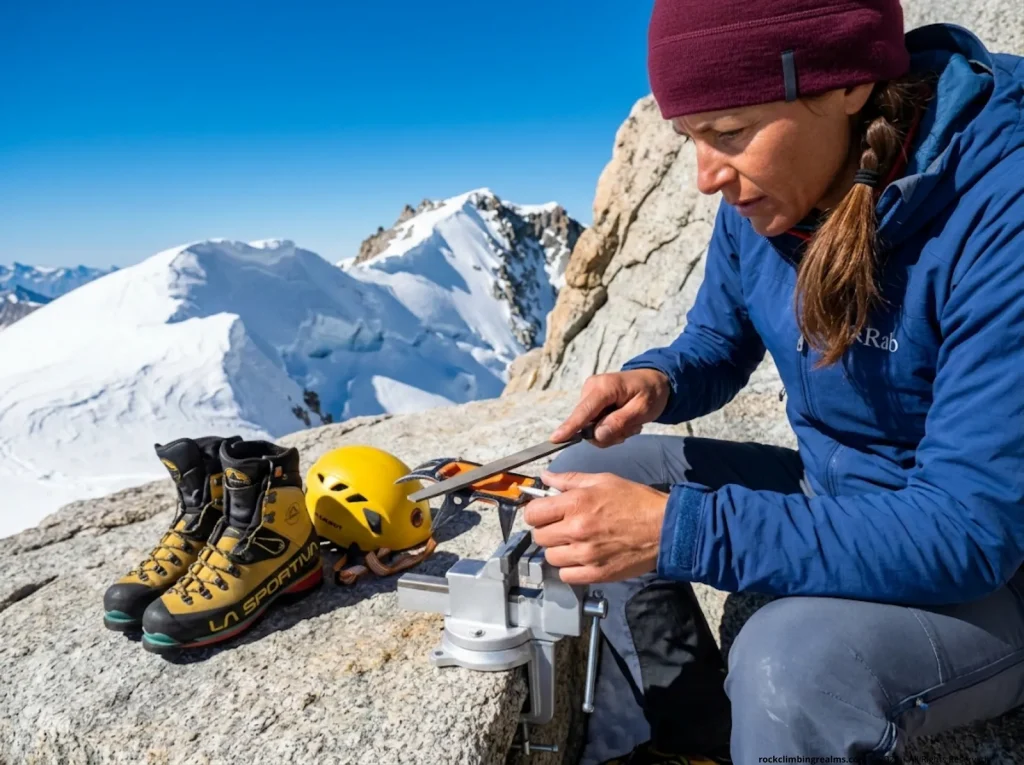
Crampon sharpening follows the same basic rules—same medium-cut flat file, same one-direction strokes, same light pressure. But the geometry is different, and getting it wrong costs you more than a dull edge.
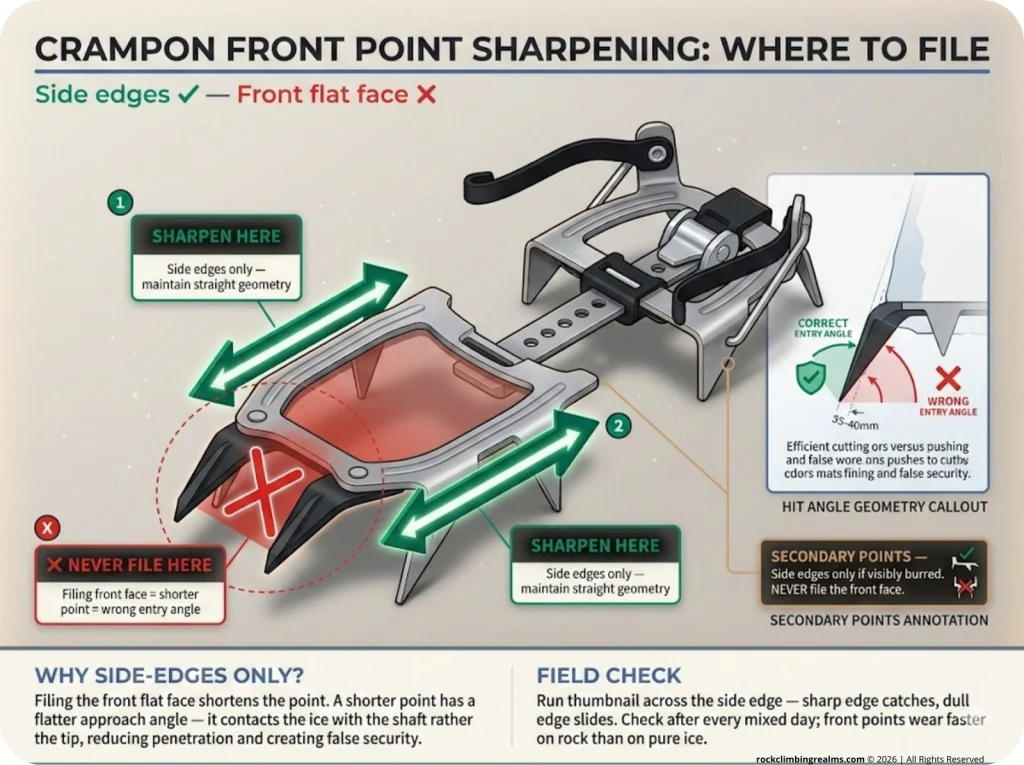
Sharpen the two side edges of each front point only. Maintain the straight-line geometry from the crampon frame to the tip. Don’t round them. Don’t shorten them. You’re restoring the cutting edge, not reshaping the spike.
After rock contact, front points may need resharpening every two to three climbing days on brittle ice. If you’re choosing crampons for ice climbing, keep in mind that different models wear at different rates—Petzl Lynx front points are thinner and wear faster in mixed terrain than Grivel G14 Evo points.
Secondary Points: The Rule Most People Break
Here’s where most climbers go wrong. Never sharpen the front face of secondary points. This is the single most common crampon sharpening mistake, and The Mountaineers’ ice climbing gear notes specifically warn against it.
Filing the front face effectively lengthens the point, pushing it farther from the ice surface and changing the secondary point hit angle. Your foot feels secure, but the crampon isn’t engaging properly. Only sharpen the side edges of secondary points, and only if they’re visibly burred or damaged from rock contact.
When to Retire Your Picks (The Brand-Specific Cheat Sheet)
Black Diamond Retirement Criteria
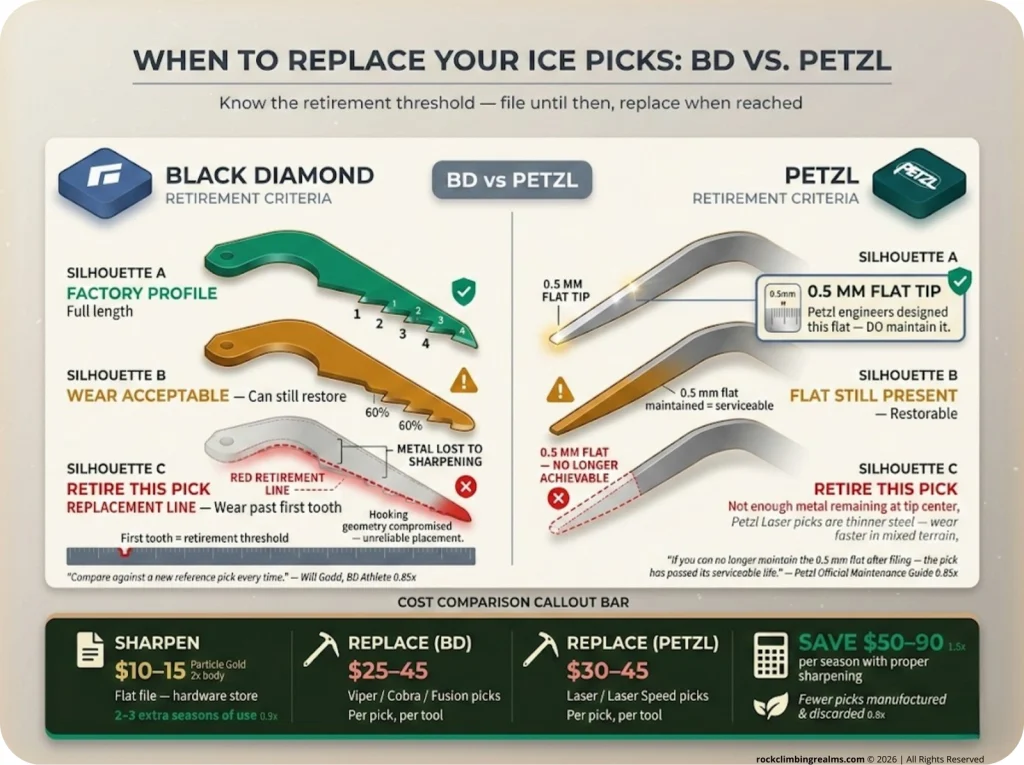
Black Diamond keeps it straightforward. If the wear is past the first tooth, the pick profile is too far gone to restore safely. Will Gadd reinforces this: once roughly three teeth have been filed away through repeated sharpening, the hooking geometry is compromised and the tool won’t hold placements reliably.
BD replacement picks for the Viper, Cobra, and Fusion range from $25-45 depending on model. Compare your worn pick against a BD reference pick—if the shapes no longer match, your money is better spent on new steel than more filing.
Petzl Retirement Criteria
Petzl ties retirement to that 0.5 mm flat tip we’ve been talking about. If you can no longer maintain the flat area at the center of the bevel after filing—because there simply isn’t enough remaining metal—the pick has passed its serviceable life. Petzl Laser picks are thinner steel than BD equivalents, so they wear faster in mixed terrain but tend to hold edges longer on pure ice.
Petzl also sells a dedicated file guide accessory that helps maintain exact factory angles—worth the investment if you sharpen frequently.
The Sustainability Angle (Sharpen vs. Replace)
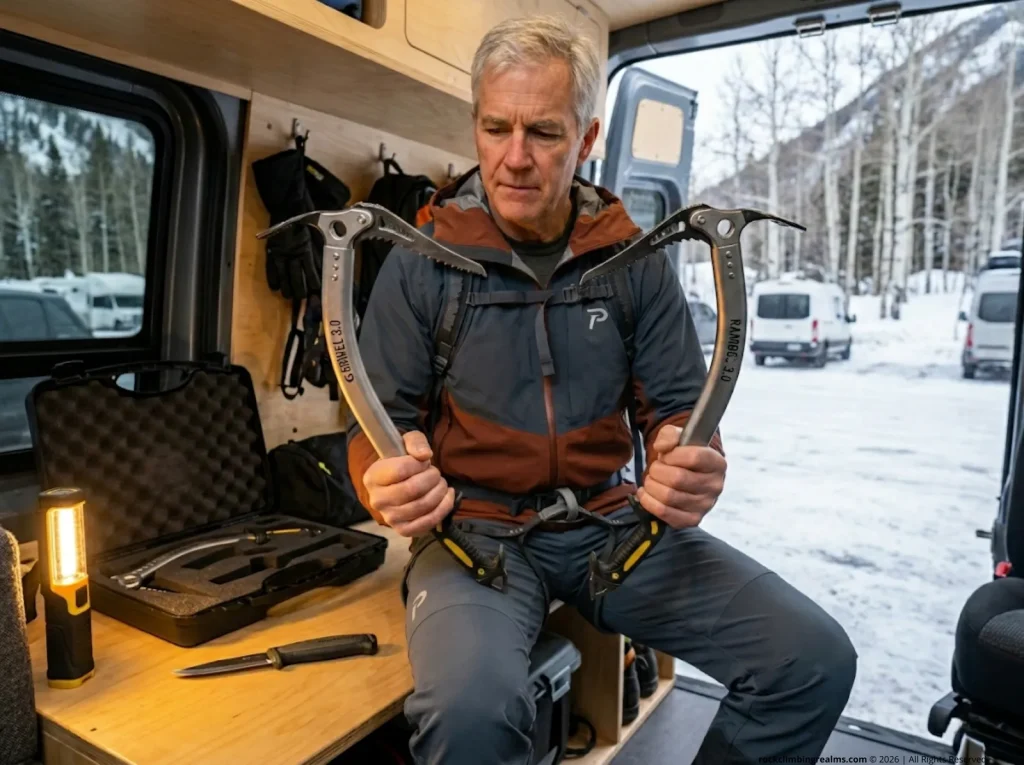
Proper hand-filing extends pick life by two to three additional seasons versus immediate replacement. Run the numbers: a $10-15 file versus $25-45 per new pick times two tools equals $50-90 saved per season. Over several years of regular ice climbing, that adds up.
There’s an environmental angle too. Fewer picks manufactured, shipped, and thrown away. Sustainable gear practices aren’t just a feel-good checkbox—they’re a practical outcome of learning to maintain what you already own. As American Alpine Club equipment guidelines and UIAA ice tool standards both emphasize, regular maintenance extends safe performance and reduces waste.
Pro tip: Touch up your picks every 2-3 climbing days on brittle ice. A five-minute tune-up between routes beats a thirty-minute full resharpening after you’ve let damage accumulate.
5 Sharpening Mistakes That Destroy Ice Picks
Mistakes 1-3: Technique Errors
Mistake 1: Back-and-forth filing. The most common error. Sawing the file in both directions dulls the file itself, roughs the surface, and undoes your own progress. Always lift on the return stroke.
Mistake 2: Heavy pressure. Pushing hard feels productive but it clogs file teeth, gouges the metal unevenly, and removes too much material per pass. The file’s own weight is almost enough. Guide it—don’t force it.
Mistake 3: Ignoring alternating sides. Filing one side more than the other shifts the edge off-center, causing the pick to track sideways on placement. Three to four even strokes per side, alternating, every time. This is where bracing firmly matters—any wobble in your setup translates directly to uneven filing.
On harder ice climbing grades, these mistakes become glaringly obvious. A misaligned edge that sort of works on WI3 fails completely on steep, brittle WI5.
Mistakes 4-5: Equipment Errors
Mistake 4: Using a grinder. Already covered above, but worth repeating. Power grinder risks include permanent temper loss, uneven removal, and potential failure in the field. One session can ruin a $40 pick beyond recovery.
Mistake 5: Using the wrong file type. Coarse bastard files tear through steel too aggressively for the precision work your picks need. Chainsaw round files have the wrong cross-section entirely. A 1/8 inch chainsaw file might seem close, but it won’t match the flat bevel profile. Only a medium-cut flat file gives you the control required.
After sharpening, wipe the pick dry and apply a thin film of lubricant. High-strength steel has no rust treatment. Leaving picks wet overnight accelerates corrosion and undoes your work.
Advanced Modifications for Mixed and Drytooling
Beak Shaping for Mixed Terrain
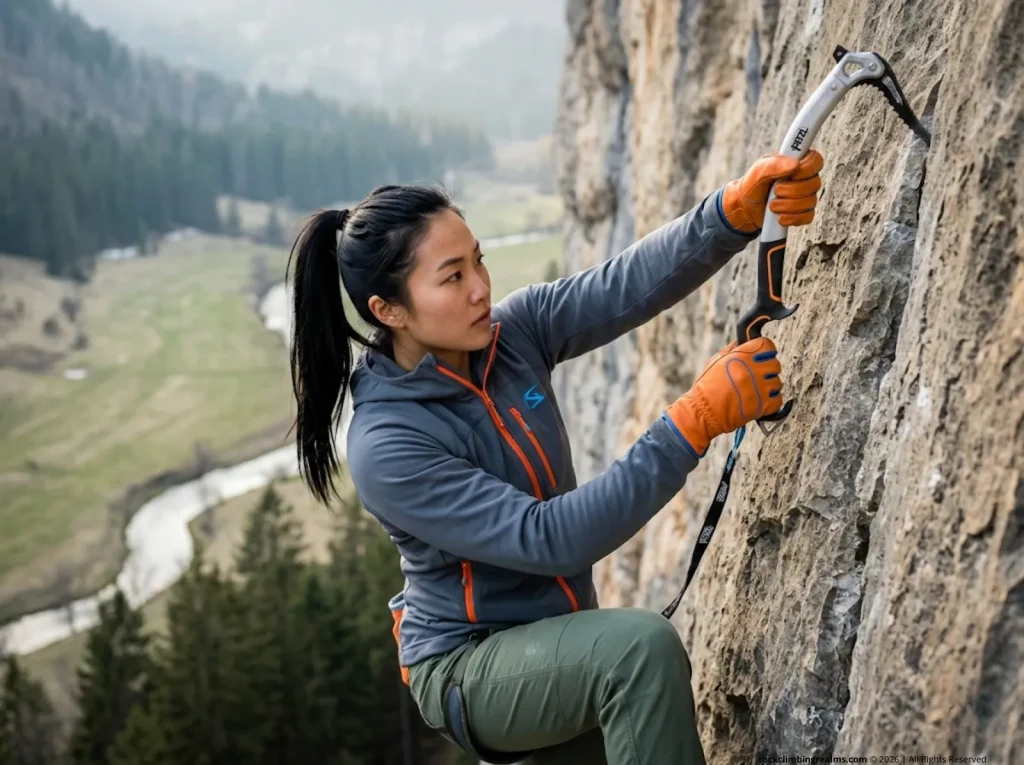
Mixed climbing and competition dry tooling demand a different pick geometry than pure ice. Some experienced drytoolers shape a more aggressive, pronounced beak angle for hooking rock features. A few go further, removing teeth entirely from the pick for cleaner rock placements.
This is expert-only territory. A pick modified for drytooling performs worse on water ice—the teeth that catch awkwardly on rock are the same teeth that grip during ice placement. If you climb both disciplines, consider dedicated picks for each rather than compromising one for the other. For anyone getting started with this style, dry tooling fundamentals should come before any drytooling beak shaping.
Pure Ice vs. Mixed: The Teeth Decision
For pure ice, preserve all serrations. They help the pick bite and grip. For mixed, some climbers file down the first one or two teeth for smoother hooking. For competition drytooling, a fully smooth beak with no teeth is standard—but that’s a specialized tool for a specialized discipline. Any tooth removal is irreversible and voids your warranty.
Conclusion
Three things to carry with you. First: one flat file, one direction, original factory profile. That’s the entire method. A $10 tool and fifteen minutes of focused work restores performance that a $40 pick burned through over hundreds of swings.
Second: picks and crampons play by different rules. Front points get edge work only. Secondary points stay untouched on the front face. Break this rule and your crampons won’t engage properly.
Third: know when to sharpen and when to replace. Past the first tooth limit on Black Diamond picks, or can’t hold the 0.5 mm flat on Petzl? Time for new steel. Everything before that is fixable with a file.
Grab a flat file, pull out your tools, and put this to the test before your next ice season. The difference between dull and sharp on a WI4 pillar isn’t subtle—it’s the difference between pumping out and sending clean.
FAQ
What file should I use to sharpen ice climbing tools?
Use a medium-cut flat file (also called a second-cut), available at any hardware store for about $10-15. Avoid coarse bastard files, chainsaw files, and any power tools. They remove metal too aggressively or damage the steel’s temper through heat.
How sharp should ice climbing picks be?
Sharp enough that the edge catches your thumbnail when drawn perpendicular across it. For Petzl picks, maintain a 0.5 mm flat spot at the center of the tip—it prolongs life without losing penetration. For BD, the tip should match a new reference pick’s profile.
Can you use a grinder to sharpen ice tools?
No. Grinders generate heat that destroys the steel’s temper, making the edge soften and dull much faster. Petzl, REI, and metallurgist Graham Gedge all prohibit power tools on climbing picks. Always hand-file.
How often should I sharpen my ice axe picks?
After any rock contact and every 2-3 pure ice sessions. A quick five-minute touch-up between routes is easier than a full resharpening after letting damage stack up. For crampons, check front points after every day on mixed terrain.
When should I replace instead of sharpen my ice picks?
Replace when sharpening can no longer restore the original factory profile. For Black Diamond, that is when wear reaches past the first tooth. For Petzl, when you cannot maintain the 0.5 mm flat area at the tip. Compare against a new pick as reference—if the shapes no longer match, it is replacement time.
Safety Notice: Rock climbing and mountaineering are inherently high-risk
activities that can involve physical trauma or fatal incidents. The information on Rock Climbing Realms is for
educational and informational purposes only. Techniques and advice presented here are not a substitute
for professional, hands-on instruction. Conditions and risks vary by location. Always seek guidance
from a qualified instructor before attempting new techniques. By using this website, you agree that you
are solely responsible for your own safety. Any reliance you place on this information is strictly
at your own risk, and you assume all liability for your actions. Rock Climbing Realms and its authors
will not be held liable for any harm, damage, or loss sustained in connection with the use of this information.
Affiliate Disclosure: We are a participant in the Amazon Services LLC Associates Program, an
affiliate advertising program designed to provide a means for us to earn advertising fees by advertising and linking
to Amazon.com. As an Amazon Associate, we earn from qualifying purchases. We are also an official affiliate partner
of Black Diamond Equipment via the AvantLink network. If you click on a Black Diamond affiliate link and make a
purchase, we may earn a commission at no additional cost to you. We also participate in other affiliate programs.
Additional terms are found in the terms of service.