
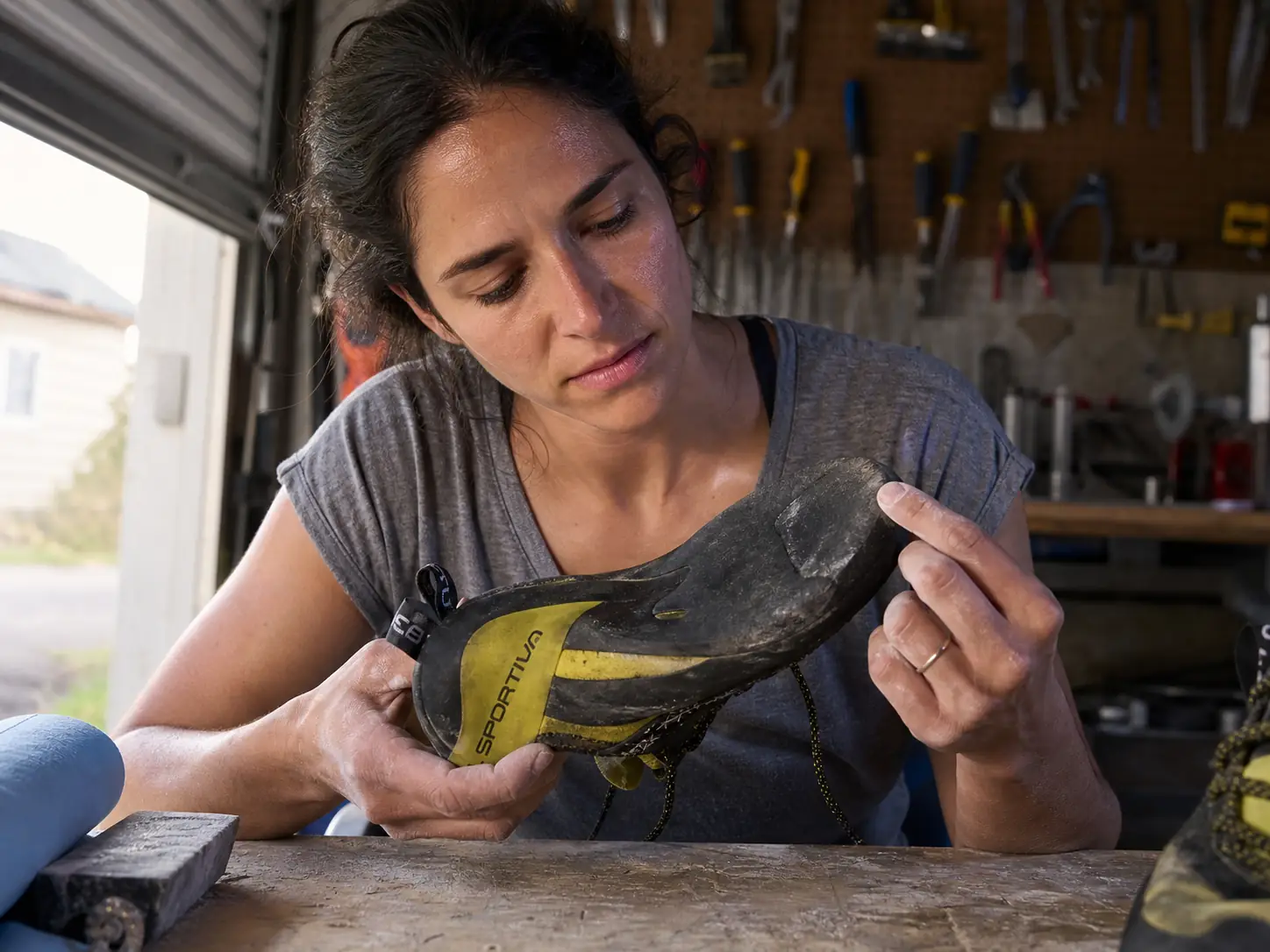
In this article
You glue the new rubber on, clamp it overnight, and it looks great. Three weeks later you’re standing on a small edge and you feel the toe move under you, and when you pull the shoe off there’s daylight between the patch and the sole. That’s not bad luck and it isn’t a talent problem. Home resoles fail for two specific, documented, entirely avoidable reasons, and the climber who wrote the most-cited DIY resole log on the internet only admitted his had peeled in an update tacked onto the bottom of the page weeks later.
This guide puts both failures at the front instead of the back, then walks the whole job: reading the wear, deciding whether your shoe is even a good candidate, the realistic no-woodshop kit, the step-by-step, and the point where mailing them out is flatly the smarter call.
What Wears Out on a Climbing Shoe (and When It’s Time)
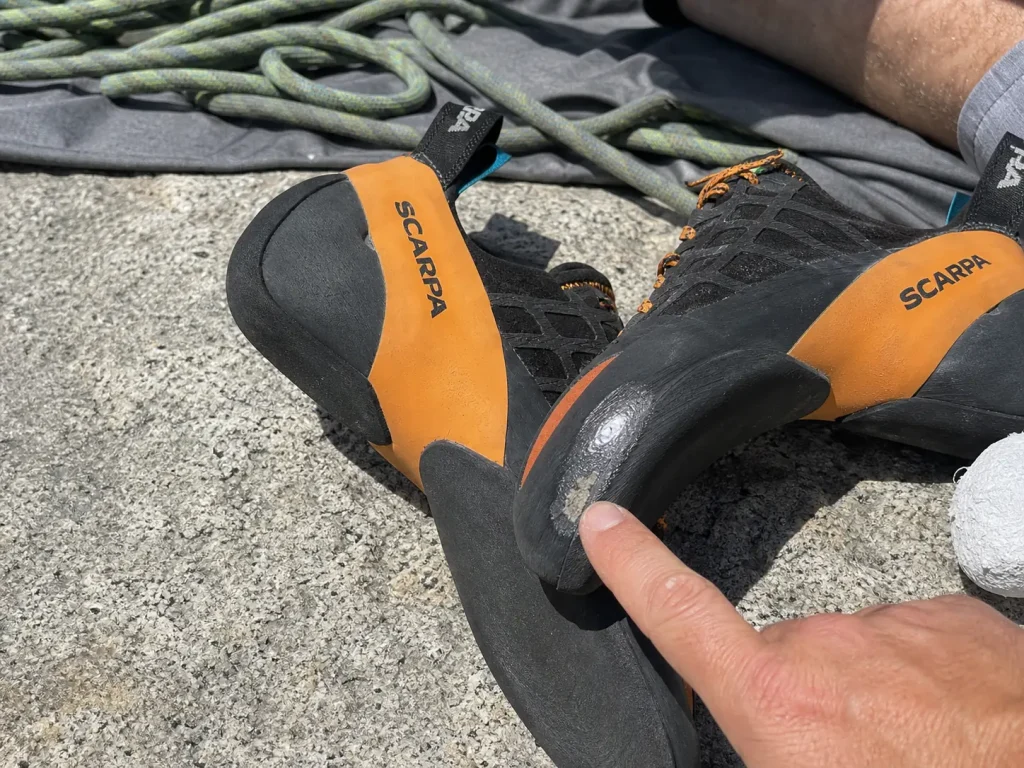
Most climbers flip a shoe over, squint at the toe, and have no real idea whether that shiny patch means next month or last month. The good news is that the answer is visible from the outside, and it comes down to telling two layers apart.
The Sole and the Rand Do Different Jobs
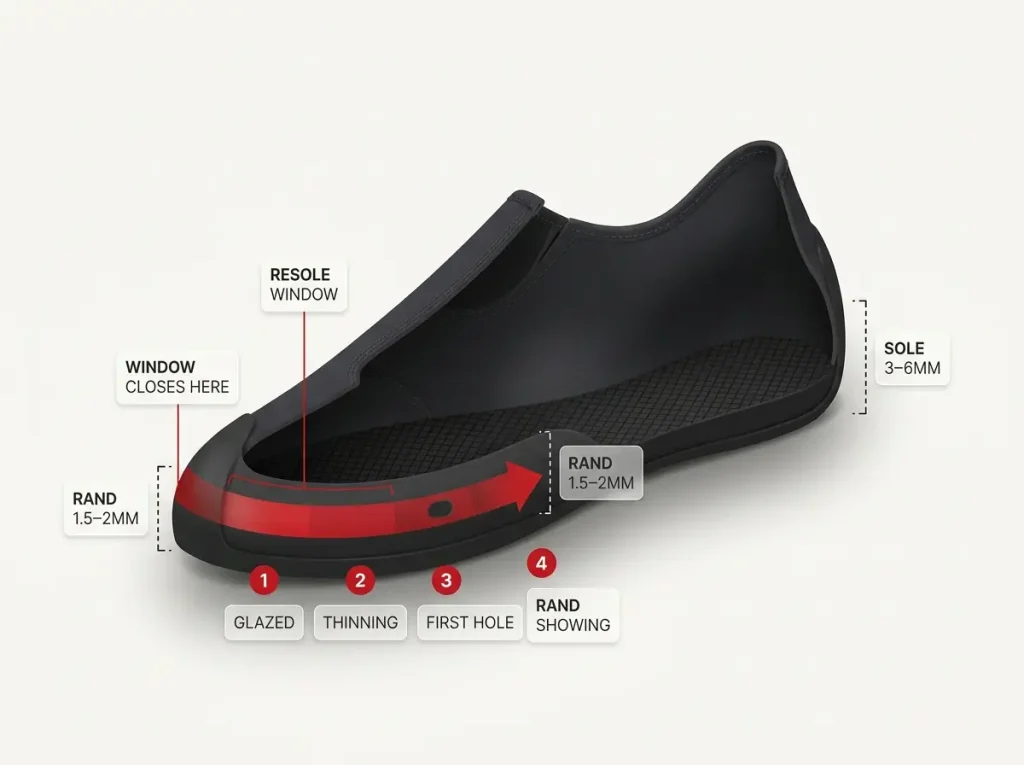
Sole rubber is the flat pad under your foot, and it runs somewhere around 3 to 6mm thick on a typical climbing shoe. The rand is the thin band that wraps up around the toe and sides, and it’s only about 1.5 to 2mm.
That thickness gap tells you everything about how climbing shoes are actually built: the sole is the sacrificial layer, designed to be worn away and replaced, while the rand is structural and holds the shoe’s shape and tension. Understanding how climbing shoes are actually built makes the rest of this decision much easier, because once the rand goes, you’re no longer looking at a resole. You’re looking at a rand repair, which costs more and takes longer.
Reading Your Own Wear, Stage by Stage
Wear moves through a predictable progression.
First the rubber glazes, going smooth and slightly shiny where you edge most. Then it thins visibly at the big-toe point. Then the first hole opens through the sole. Then a strip of rand rubber starts showing through in a slightly different shade. Then the rand itself blows out.
The resole window is open through the first four stages and closed at the fifth. Glazing on its own isn’t a resole trigger at all, since glazed rubber can sometimes be revived without a resole with nothing more than a scuff and a clean. The stage you’re aiming for is the one climbers call the Stage 3 window, where the sole is genuinely thin but nothing has broken through yet.
Why Resoling Early Beats Resoling Late
Here’s the part that runs against instinct. Waiting until your toes poke through doesn’t just make this repair harder. It makes every future repair harder, because each time you climb on exposed rand you’re spending structure you can’t get back.
Climbers on Mountain Project keep landing on the same line independently: if you resole a little early, they’ll last longer than if you resole late. Catching it at Stage 3 buys you more total resoles across the shoe’s whole life than squeezing out one more month now.
How many resoles is a pair actually good for?
Most climbers get about three before the stitching lets go or the shoe stops holding its shape. Some report four or five with careful timing. One climber on that same thread reported thirteen on a single pair of Miura Laces, which is an outlier and not a target. There is no fixed ceiling here. Condition decides, not a number, and a shoe is only truly blown out when the stitching or rand is structurally done.
Should You DIY This, or Send Them Out?
Most DIY guides assume you should try. This one asks a different question first: what shoe are you holding, and how much would it hurt to lose it?
Your Shoe’s Shape Decides This More Than Your Skill Does
Nobody in the search results says this plainly, so here it is. Shoe geometry sets the difficulty of a home resole far more than your hands do.
A flat-lasted shoe with low asymmetry has a long, nearly straight sole line. The bonding surface is close to a plane, the patch you cut is close to a flat shape, and pressure is easy to apply evenly across the whole thing. That is a genuinely approachable first job.
An aggressive downturned shoe is a different animal. The sole curves in two directions at once, the rand wraps continuously around the toe box, and the rubber you’re bonding has to hold under constant tension because the shoe is actively trying to spring back to its shape. A patch that would sit flat and happy on a beginner shoe gets peeled at the edges by that tension every time you weight it.
The practical rule is blunt: don’t practice on your project shoes. Do your first attempt on the beat-up pair you’d shrug off losing.
Half Resole vs Full Resole vs Rand Repair
Scope matters as much as shape. A half resole, meaning the toe area only, is the realistic DIY target and it’s also what most climbers actually need. A full resole replaces the entire sole and roughly doubles the surface you have to prep, cut, and press evenly.
A rand repair or a toe cap rebuild is a different category entirely. You’re rebuilding structure, not replacing a wear surface, and the tolerances are tighter. If the rand is already worn through, stop. A home half-sole glued over a compromised rand will fail regardless of how well you glue it, because the layer underneath your bond is no longer holding tension.
One more honest filter: a resole will not rescue a shoe that never fit right in the first place. If you’ve been fighting the shape since day one, new rubber changes nothing about that.
The Tooling Gap Between Your Kitchen and a Resole Shop
Professional resolers work with commercial heat sources and hydraulic presses that apply consistent, enormous force across the whole sole at once. At home you’re substituting a hobby heat gun and either hand clamps or the improvised bike-tube press that gets passed around climbing forums, which is exactly what it sounds like: bicycle inner tube wrapped under tension around the shoe.
That gap is real, and it’s worth naming so you set the right expectation. A home bond that’s weaker than a shop’s isn’t evidence you did it wrong. It’s a tooling difference, and knowing that up front helps you decide whether the shoe in your hand deserves shop-grade pressure.
What You Actually Need for an At-Home Resole
The deepest DIY walkthrough in this corner of the internet opens by building a custom wooden shoe last with a band saw and a bench vise. That’s a woodworking project with a shoe at the end of it, not a Saturday repair, and it’s the reason most climbers read a DIY guide and quietly decide to mail their shoes somewhere. The simplified version is real and it works for a half resole on a reasonable shoe.
The Four Things You Genuinely Need
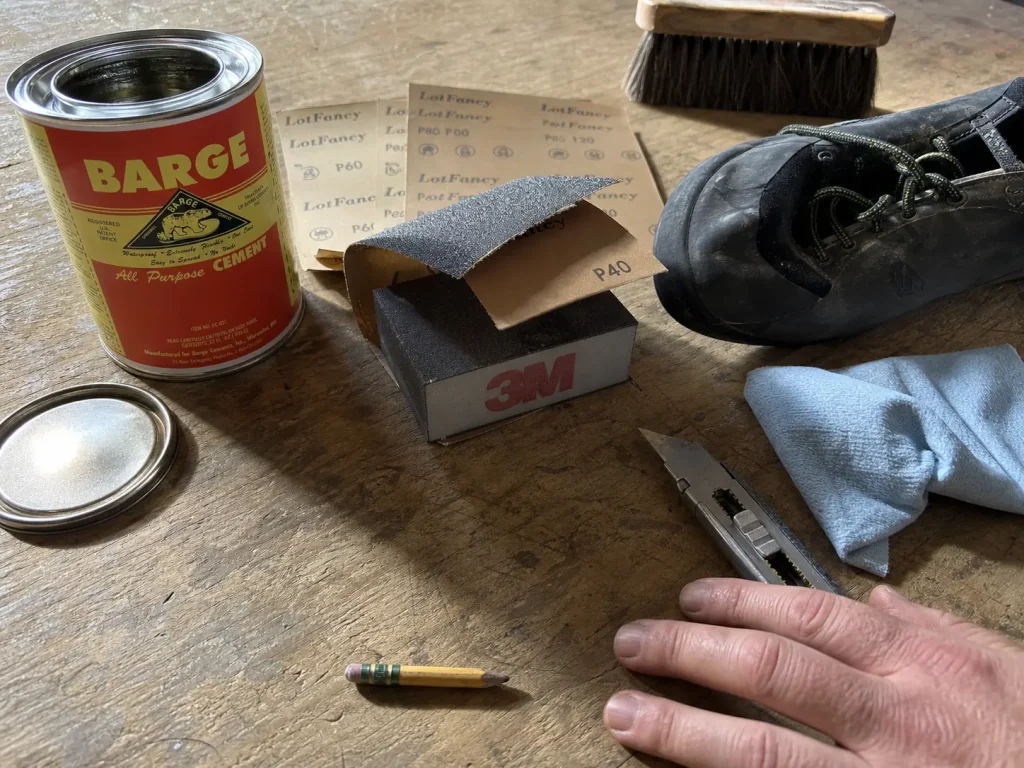
Strip it down and the kit is four categories: an adhesive, a sheet of soling rubber, something abrasive, and a heat source. Everything else on the workbench is convenience.
For adhesive, contact cement is the standard, and the name that shows up across every serious source on this topic is Barge. The Barge All Purpose Cement Quart Original is the quart size, which covers several resoles and is the sane buy if you expect to do this more than once. For a rand touch-up or a single small patch rather than a full half-sole, Shoe GOO Adhesive 3.7 fl oz Black is the smaller-format flexible option, and it’s also the fix that buys a worn toe another few weeks when you’re not ready to commit to the whole job.
Surface Prep Tools (Where Most of the Work Happens)
Ask anyone who has done this and the answer is the same: sanding is most of the job. The DIY resoler whose build log anchors this entire topic called sandpaper the tool he used the most, and specifically named 60 to 80 grit for scuffing the old rubber. A LotFancy Sandpaper Assortment for Palm Sander 60 to 1000 Grit 50 pcs covers the coarse end for stripping and the fine end for cleaning up your finished edge.
Loose sheets are hard to control on a curved sole, which is where a 3M Rubber Sanding Block 2.625×4.75×1.25 inch earns its keep. It turns the paper into a hand tool you can hold even pressure with, and it means you don’t need a belt sander for the at-home version of this work.
Two cheap additions round the prep out. A steel brush clears rubber dust out of the sanded texture faster than blowing on it, and a wood rasp knocks down stubborn high spots that paper just polishes. A little acetone on a rag after sanding lifts the last of the oils and dust, and it’s what separates a surface that looks dull from one that’s actually clean.
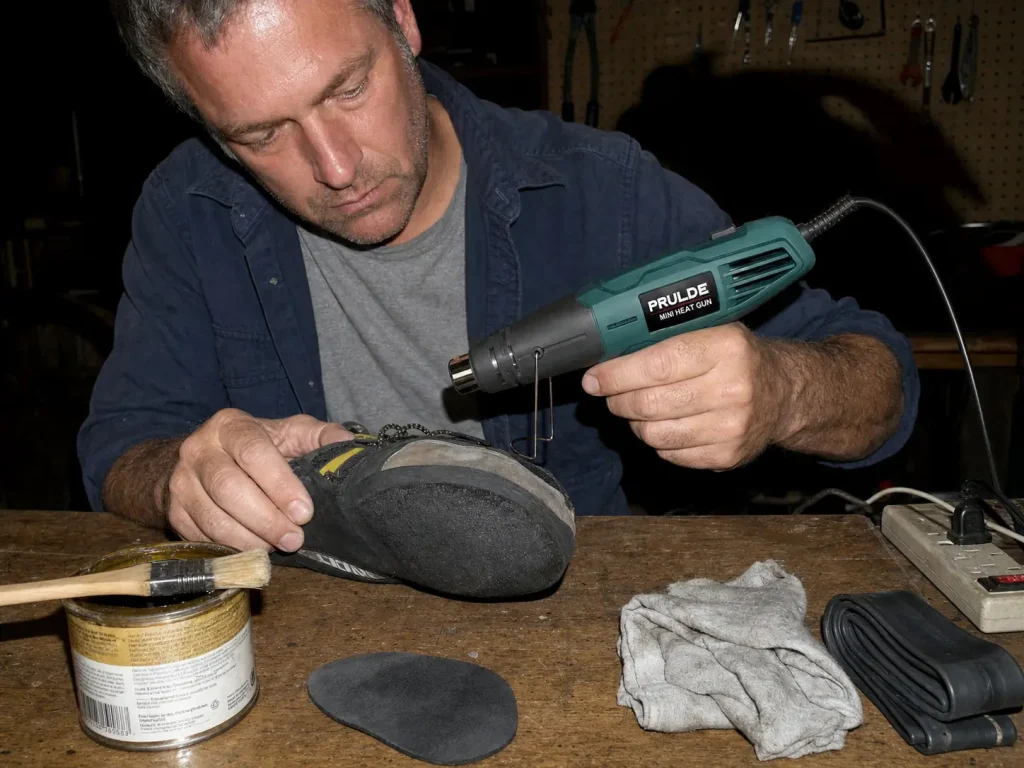
For heat, a PRULDE Mini Heat Gun for Crafting Dual Temp 480-850F handles both jobs a heat source does here: softening old rand rubber so it releases, and tack-activating contact cement before you press. A hobby-sized gun is genuinely the right tool, because a construction heat gun delivers more heat than this job wants and heat is easy to overdo on a climbing shoe, same as it is with any other at-home shoe work.
Improvising a Press Without a Shop
The thing people skip is pressure, and it’s the third leg of the failure tripod. The rig climbers call the poorman’s press is bicycle inner tube wound around the shoe under heavy tension, and the tension pulling it applies wraps force around the curve of the toe in a way flat clamps can’t. Some resolers add hammer bonding, meaning working along the seam with light taps to drive the two faces together before the clamps go on. Whatever you use, you need real force spread across the whole patch and held there.
Round out the bench with a couple of things you probably own: pliers for peeling stubborn old sole off the midsole, and a sharp X-Acto knife with spare blades for cutting the patch and trimming it after cure. A dull blade tears rubber instead of slicing it, and a torn edge is a head start on a peel.
Pressing hard with your hand for thirty seconds is not a bond. Build the press before you open the cement, not after, because contact cement gives you a working window and you don’t want to spend it hunting for clamps in the garage.
One framing worth internalizing before you buy anything: the tools are a one-time cost, not a per-resole cost. That distinction decides whether the DIY route saves you anything, and it’s the whole subject of the cost section further down.
Picking the Right Resole Rubber
The instinct is to buy the stickiest rubber sold and treat it as a free upgrade. That instinct is why people say their resole feels worse than stock.
Thickness Is a Trade, Not an Upgrade
Vibram XS Edge and Stealth C4 are both commonly applied at 4mm, and 4mm is the sane default for a resole on an edging-oriented shoe. Going thicker adds durability and takes away sensitivity, which is a real trade rather than a bonus. Thicker rubber also stiffens the toe box slightly, which changes how the shoe rolls onto a small edge.
Soft Rubber vs Hard Rubber by Terrain
The compound question is where stickier rubber isn’t automatically better rubber becomes concrete. Softer compounds like Vibram XS Grip2 and Stealth C4 do their best work on overhangs and smears, where the hold is taking low load across a broad contact patch. Harder compounds like Vibram XS Edge hold small edges under high point load but underperform on those same low-load overhanging holds.
Beyond the two headline compounds there’s a wider bench: Stealth Onyx sits harder and longer-wearing than C4, and Mad Rock’s TRAX SAS is another soft-to-medium option that shows up in resole conversations. Match the rubber to where you actually climb, not to whichever compound has the biggest reputation. A steep-cave climber and a vertical-limestone climber shouldn’t be buying the same sheet, and route angle should drive the decision the same way it drives which shoe you bought in the first place.
Buying Sheet Stock You Can Actually Cut
Here’s the practical wrinkle: there is no consumer-facing Vibram XS Edge sheet you can just add to a cart. The closest legitimate option for a home resoler is the Vibram Cherry Shoe Repair Soling Sheet Black 4mm 11×35 inch, real Vibram soling rubber at the same 4mm thickness the climbing resole world works in.
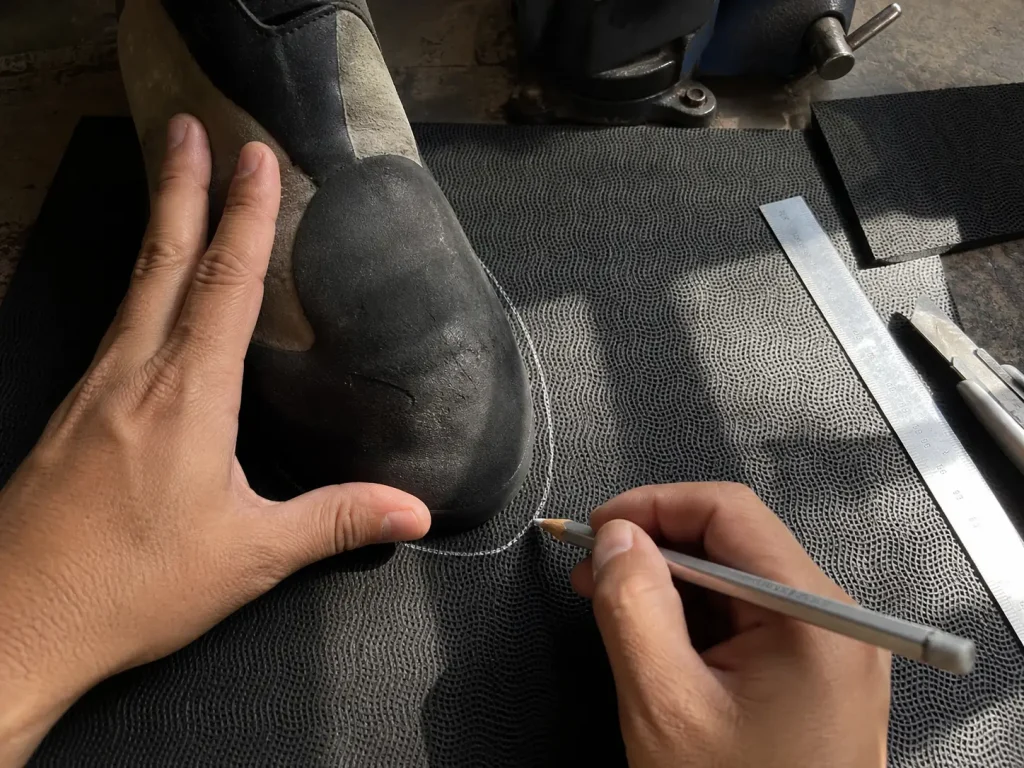
Sheet stock is what you want anyway. The patch has to be cut oversized, and you can’t do that from a pre-shaped piece sized to the sole. Buy more sheet than one shoe needs, because you will cut at least one patch wrong, and a patch cut too small is the single most common reason a home resole peels.
There’s a footnote here that isn’t about performance. La Sportiva now takes production rubber scrap, melts it down, and re-vulcanizes it into FriXion Eco, which means the industry has started treating rubber as something to recover rather than discard. Resoling is the reader-level version of the same idea.
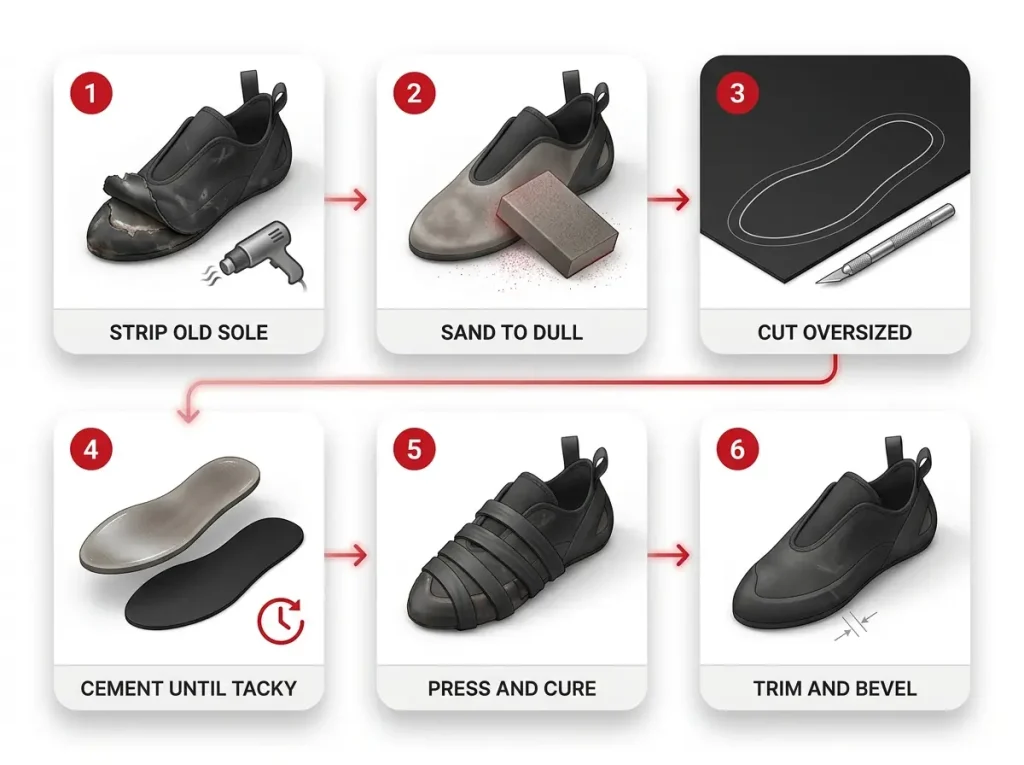
How to Resole Climbing Shoes, Step by Step
This is the part you came for. Read it once through before you start, because the two places this job goes wrong are both timing decisions rather than skill decisions.
Steps 1–2: Stripping and Sanding
Step 1, strip the old sole. Peel or cut the old rubber away back to a clean line. Warm it with the heat gun if it fights you. Take the old adhesive layer off too, because cement bonds to the midsole, not to a film of dead glue.
Step 2, sand to dull. Work the exposed midsole and the rand-side bonding area with 60 to 80 grit until the entire surface is uniformly matte. No shiny spots, anywhere. Every shiny spot left behind is a spot the new cement will not hold, and it will be the spot the peel starts from.
Sand slow and take breaks. Friction heat gums rubber up, and once it goes tacky under the paper you’ve wrecked the surface you were trying to prepare. If it starts smearing instead of dusting, stop and let it cool.
The same caution applies to the heat gun. Sustained heat is what softens and reshapes a downturned shoe, so use it in short passes and keep it moving.
Steps 3–4: Cutting Oversized and Bonding Tacky
Step 3, cut oversized. Trace the shoe onto the rubber sheet, then draw your actual cut line deliberately outside that trace so the finished patch overlaps 3/16 to 3/8 inch onto the rand. This is a specification, not a suggestion, and it’s the single most load-bearing number in this article. A patch cut flush with the sole edge creates a butt seam with nothing holding it laterally, and that seam is where the failure begins.
Step 4, cement both faces and wait. Coat both the sole and the patch, then let both surfaces dry until they’re tacky to the touch, or tack-activate them with the heat gun. Contact cement bonds tacky to tacky. It is not a wet glue, and pressing two wet faces together gives you a bond that looks fine on the bench and separates under load.
While you’re opening the can, it’s worth knowing that solvent-based cement is a genuine inhalation exposure rather than just a smell, which is covered in more detail below and spelled out in current OSHA respiratory protection guidance.
Steps 5–6: Pressing, Curing, and Finishing
Step 5, press and cure. Press hard and evenly across the entire patch and hold that pressure. Then leave it alone.
A full day is a reasonable floor for a flexible shoe adhesive, and humidity and temperature move that number, so a muggy garage cures slower than a dry one. When you’re unsure, give it longer. Climbing on a green bond is how an otherwise good glue-up still fails.
Step 6, trim and bevel. Trim the excess with a fresh blade, then bevel the edge back at roughly 45 degrees so nothing catches on a hold or a crack and starts lifting the patch for you.
Where Home Resoles Actually Go Wrong
The most detailed DIY resole writeup on this subject ends with an update, added weeks after publication, explaining that the author’s own resole came apart. That confession belongs at the front of a how-to guide, not the back. Here are the five ways this job fails, in the order they’re most likely to get you.
Cutting the Patch Too Small
A flush-cut patch makes a butt seam, meaning two edges meeting with nothing overlapping. Under load the sole flexes, the seam opens a fraction of a millimeter, grit works into the gap, and the peel walks itself outward from there. Nothing about your glue can stop it, because the geometry is doing the damage.
The overlap spec exists to solve exactly this. Running 3/16 to 3/8 inch of new rubber up onto the rand gives the joint lateral hold and puts the vulnerable edge somewhere flexing doesn’t concentrate. If you take one thing from this guide, take this one.
Putting the Seam Under the Ball of Your Foot
The second failure compounds the first. In the case that anchors this whole topic, the patch was both undersized and positioned so the seam landed directly under the ball of the foot, which is the highest-load point on a climbing shoe and the place your weight concentrates on every edge and every heel-to-toe rock.
Joint placement is a free variable and almost nobody treats it as one. Plan where the seam falls before you cut, and push it forward toward the toe or back toward the arch, anywhere the shoe isn’t loading hardest. Watch for a seam dip too, the small depression that forms when the patch sits slightly lower than the surrounding rubber. Under a foot that dip becomes a lip, and a lip is something a hold can catch.
Bonding Wet, Pressing Light, Curing Short
The last three failures are one failure wearing different hats, and all three are impatience.
- Bonding wet. Both faces tacky before they touch, or the bond is weak from the first second.
- Pressing light. Sustained clamped force across the whole patch, not a hard squeeze with your thumbs.
- Curing short. A full day minimum, longer in humidity. The bond that failed on a small edge felt solid in the garage.
- Glazed or contaminated surface. Uniform dull across every square millimeter, or don’t bond yet.
None of these are talent problems. Every one is a procedure problem, which means every one is fixed by reading this section before you start rather than discovering it after. And if the peel has already begun, a sole that’s already delaminating is its own repair with its own approach.
The Safety Part Nobody Writes About
Every other guide on this topic treats resoling as a craft-and-cost question. It’s also a safety question, and that gap in the coverage is worth closing.
What a Failed Bond Feels Like on Rock
A bad bond doesn’t fail on the workbench where you can see it. It fails weighted, on a small foothold, at the exact moment you’ve committed to standing up on it and have the least ability to react.
It’s also rarely dramatic. Full delamination mid-move is the loud version. The common version is a partial lift at the edge that quietly changes how the shoe loads the hold, so the placement skates before you register that anything is wrong.
That’s a real problem because precise foot placement on small holds depends on the shoe telling your foot the truth about what it’s standing on. A patch that’s half-attached is a shoe that lies to you.
Testing a Fresh Resole Before You Trust It
Test on flat ground first, weighting the toe hard and rolling onto the edge of the patch with your full weight. Then take them somewhere easy and low. Traverse, downclimb, stand on things you don’t care about.
The first session back on a fresh resole is not the session to project. Give the bond a few hours of ordinary climbing before you ask it for anything.
Ventilation, Fumes, and the Part People Skip
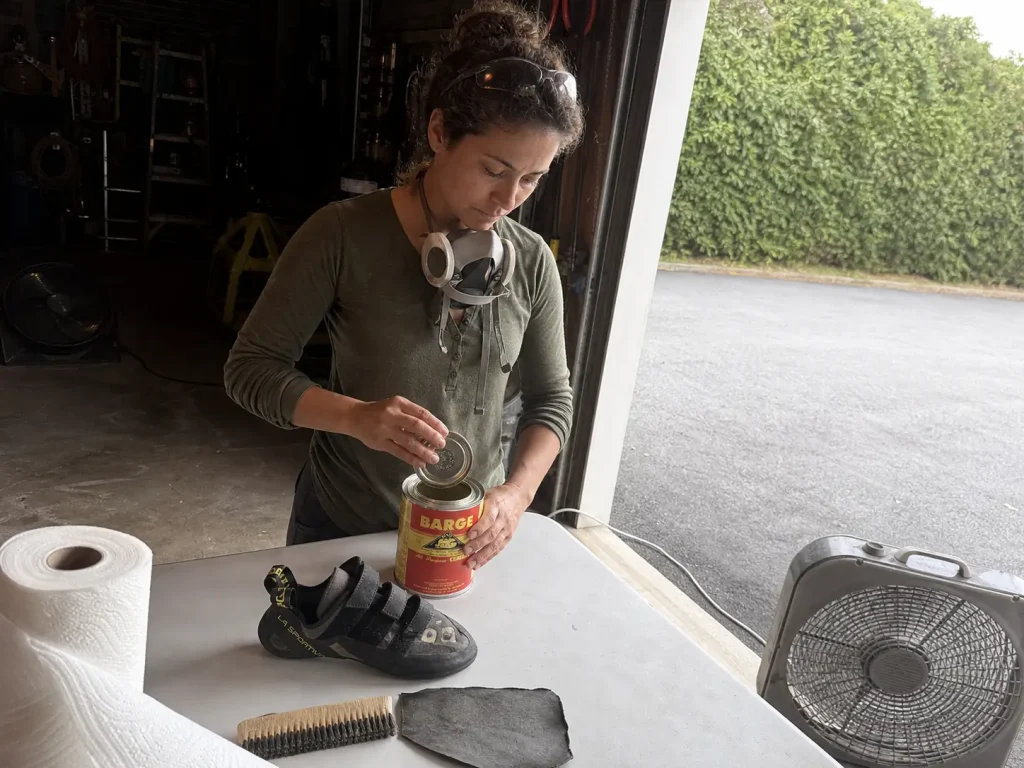
Solvent-based contact cement wants real airflow, on the order of 100 feet per minute where the space is enclosed, and a NIOSH-approved respirator when ventilation isn’t adequate. That’s the standard laid out in OSHA’s respiratory protection standard, and it applies to a garage as much as a factory floor.
Gluing shoes on a kitchen table with the windows shut, leaning over the joint for an hour, is a genuine inhalation exposure and not just an unpleasant smell. Open the door, put a fan in it blowing out, and wear the respirator if you can’t manage real cross-ventilation.
Sanding has its own kit. A dust mask handles the rubber particulate a respirator cartridge isn’t rated for, and safety goggles matter more than they sound like they do, because sanded rubber throws fine grit upward off a curved surface and straight at your face.
Sending Them Out to a Pro
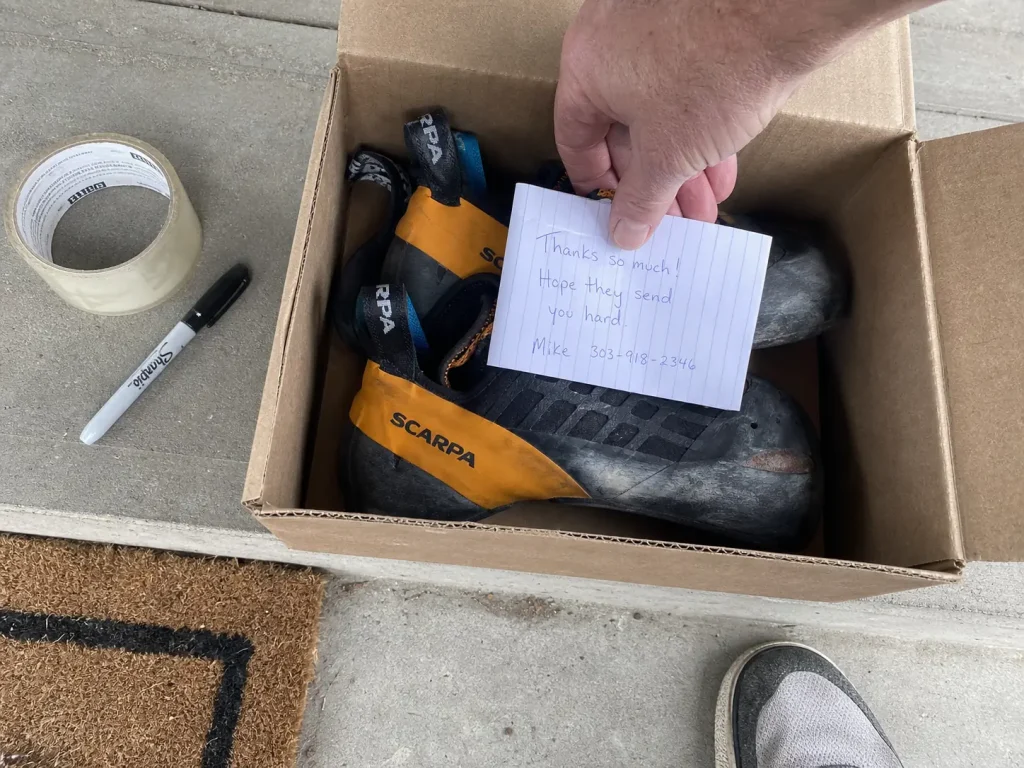
For a lot of readers this is simply the right answer, and this guide isn’t going to pretend otherwise. Mailing shoes to a resoler is boring, reliable, and cheaper than a failed home attempt followed by mailing them anyway.
What a Professional Resole Costs
Rough numbers to plan around: a half resole generally lands in the $30 to $40 range and a full resole in the $40 to $50 range, with rand repair adding roughly $10 to $40 per shoe on top. Add round-trip shipping and most people end up somewhere between $58 and $140 depending on scope and how far the shop is.
Turnaround Time and Seasonality
Turnaround varies by shop and it’s seasonal, because everyone’s shoes wear out at roughly the same time of year. Shops back up when the season peaks. Plan around your calendar instead of mailing shoes out the week before a trip, and if you climb year-round, send them in your off-season.
Questions to Ask Before You Mail Them
Three questions sort the good options from the convenient ones. Which rubber compounds do you stock? Will you do rand work if it turns out to be needed? What’s your actual turnaround right now, not your website’s turnaround?
A cobbler who handles general footwear may answer the first two vaguely, which tells you what you need to know.
A shop that stocks the compound you want is worth more than a shop that’s twenty dollars cheaper. It’s also worth asking about brand-specific construction if you’re sending something complicated, since rand geometry varies a lot between Scarpa’s own model range and La Sportiva’s lineup, and some shops are noticeably better with one than the other.
DIY vs Pro vs New Shoes: Running the Numbers
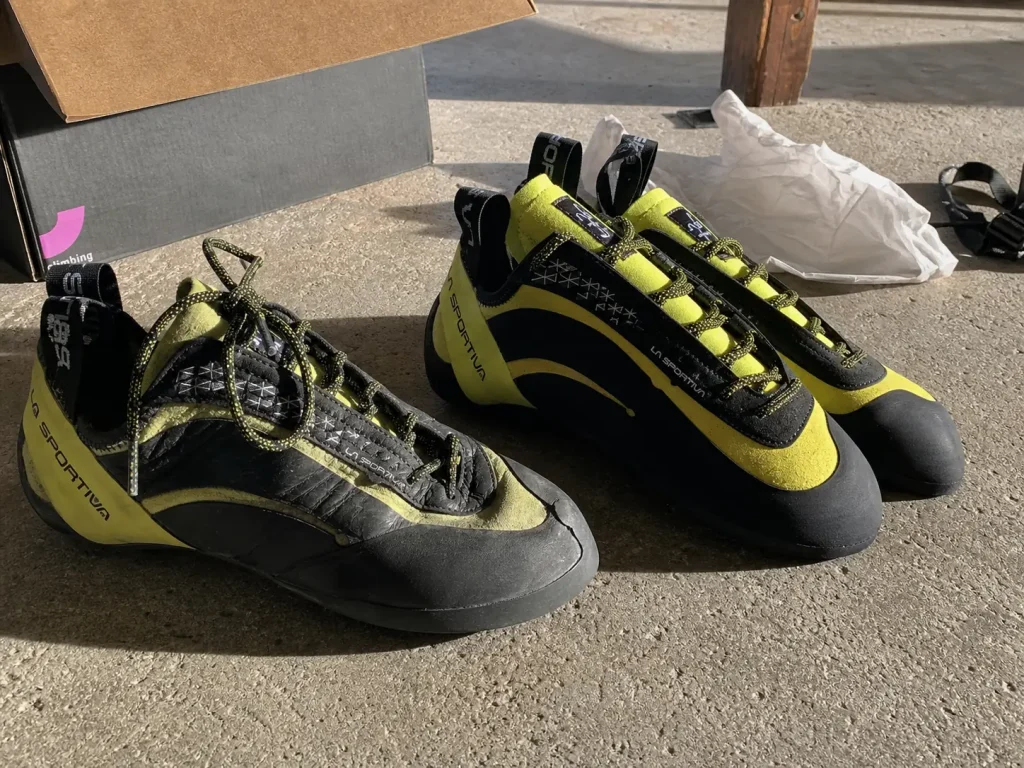
Nobody puts all three routes side by side, which is a shame, because the honest answer isn’t the one most DIY guides imply. The whole thing turns on one question: is this your first resole or your fourth?
The First-Resole Math vs the Fourth-Resole Math
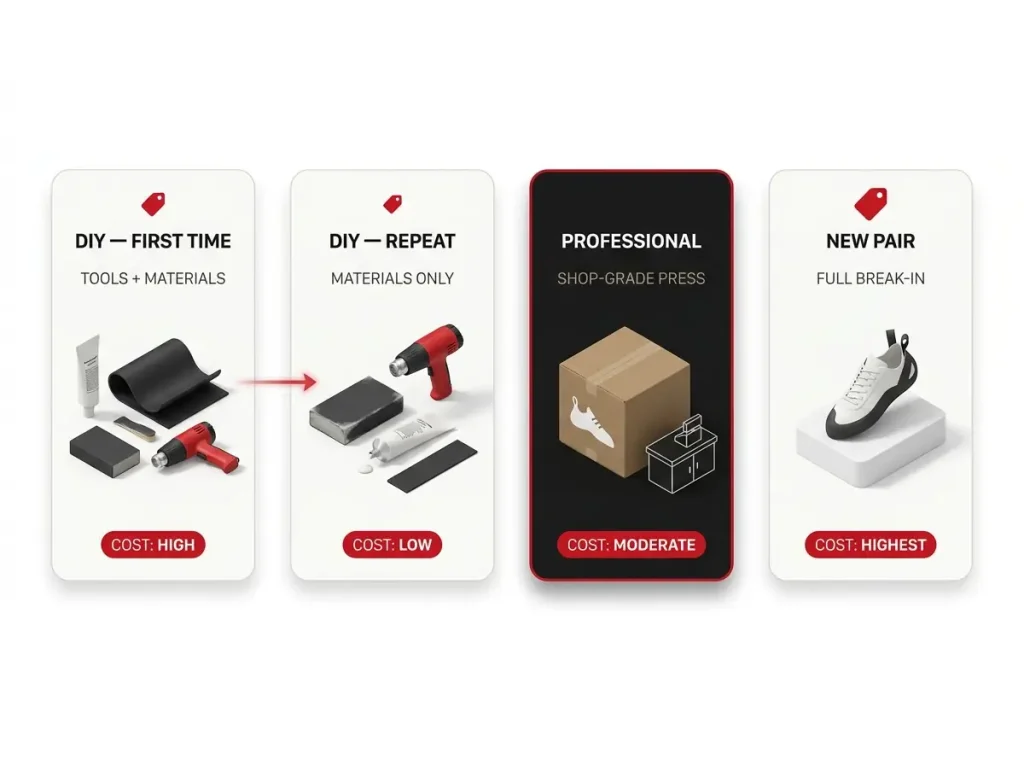
On the first job, DIY means buying cement, a rubber sheet, sandpaper, a block, and a heat gun. Add those up and you land in roughly the same territory as paying a shop for a single half resole. You’ve spent a professional’s fee and you’ve also spent a Saturday, and your bond is coming out of a hand press rather than a hydraulic one.
On the fourth job, the picture inverts completely. The tools are already paid for. Now you’re buying a strip of rubber and using cement you already own, and the per-resole cost drops to a fraction of the shop’s. DIY only wins on cost if you’ll do it more than once with the same tools. Treat the tool spend as a sunk cost and be honest with yourself about whether there’s a second resole in your future.
What You Give Up by Buying New
Replacing instead of repairing runs $150 to $200 or more for a comparable pair, which is the number both other routes are measured against. But you also give up something the price tag doesn’t capture: a broken-in fit you spent months earning. A resoled shoe fits like your shoe. A new one hands you the break-in period all over again, weeks of hot spots and short sessions before the upper molds back to your foot.
That said, the math changes at the entry level. Understanding what a new beginner pair really costs matters here, because if the shoe was inexpensive to begin with and its stitching is already going, replacement starts making sense. This comes up most often with an inexpensive first pair, where the resole fee is a larger fraction of the replacement cost and the upper often gives out around the same time the sole does.
The Case for Resoling That Isn’t About Money
There’s a second argument that has nothing to do with your budget. A resole extends one pair’s usable life several times over, which keeps rubber, leather, and synthetic uppers out of a landfill for years longer than a buy-new-every-season cycle does. Stretching a shoe lifecycle across three or four resoles is real waste reduction, not a gesture: it’s roughly a quarter of the uppers manufactured for the same amount of climbing.
The industry is following, slowly. La Sportiva’s recycled FriXion Eco rubber is one example, and there are brands building longer-lived gear on purpose across the rest of the category. It connects to the same stewardship logic behind Access Fund’s conservation work: the cheapest gear, environmentally speaking, is the gear you already own.
Making a Fresh Resole Last
The habits that chew through rubber fastest aren’t climbing habits. They’re the walk from the car, the drag down the slab, and the shoes left in a hot trunk.
The No-Walk Rule and Why It Matters More After a Resole
The no-walk rule is simple: approach shoes to the base, climbing shoes on at the base, off between burns. Walking on climbing rubber on dirt and gravel wears it faster than climbing does, and on a fresh patch it also grinds directly at the edge you just beveled.
Taking shoes off between burns is easier with some closures than others, and closure style changes how often shoes come off in practice. Velcro and slippers make the habit nearly frictionless. Laces make it a decision, and decisions get skipped.
Rotating Two Pairs
The two-shoe quiver solves the impatience problem structurally instead of relying on willpower. Keep a backup pair so a curing resole never competes with a session you’ve already committed to.
Rotating two pairs does more than protect a curing bond. Rubber recovers a little between sessions, so alternating pairs means neither one is ever climbed on completely spent, and both wear more evenly across the toe instead of burning one spot through.
Footwork is a durability variable too, not just a performance one. Precise placements load the toe evenly. Dragging and scuffing chews one spot until it becomes a hole, which is why climbers with clean footwork consistently get more sessions out of the same rubber.
Heat, Moisture, and Storage
Heat is the fastest way to undo a resole you just paid for. Hot car degradation is the version that gets people: a trunk in summer softens rubber and works on the adhesive passively, for hours, while you’re doing something else entirely.
Get shoes out of the pack when you get home and let them dry fully.
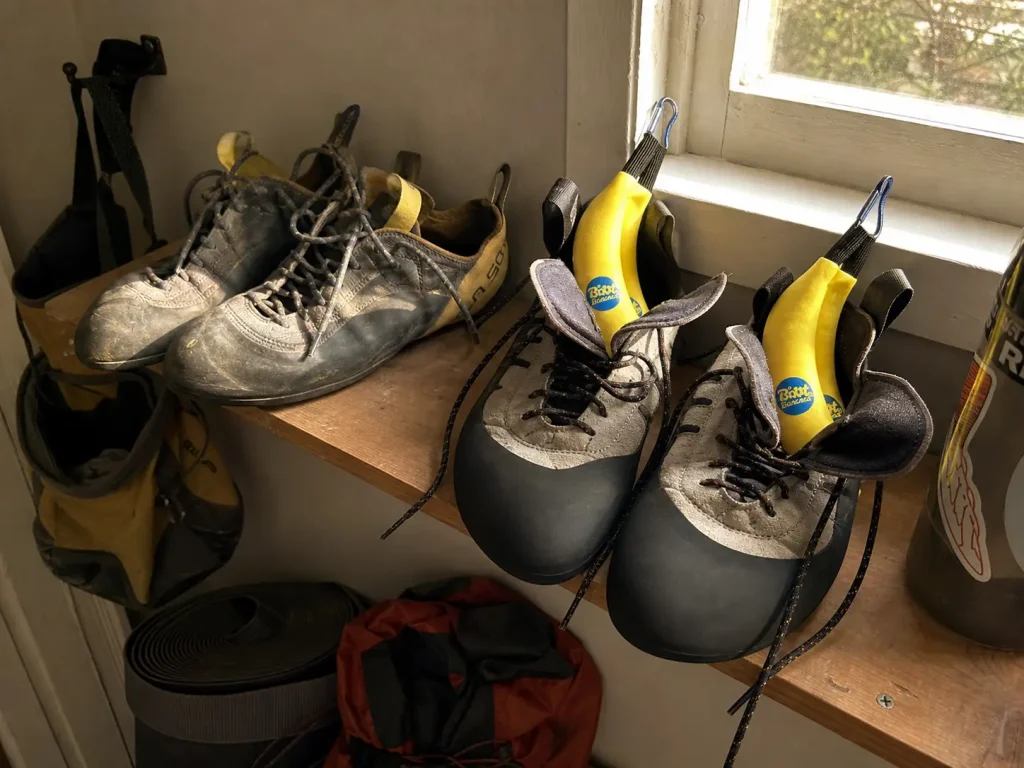
A breathable shoe bag beats sealing them in a plastic sack, which traps the moisture right against the bond line. A Boot Bananas Original Shoe Deodorizer parked in each shoe between sessions targets the moisture and funk that push people toward washing their shoes, and washing is itself hard on bonds and rubber. Finally, wipe the sole before you pull them on. Clean rubber grips better, and a lot of what feels like dead rubber is just a dust film.
Bringing It Together
A home resole is a bonding job, and bonding jobs are won on preparation and timing rather than on skill or equipment. Here’s what actually decides whether yours holds.
- Cut the patch oversized. Overlap 3/16 to 3/8 inch onto the rand, and keep the seam out from under the ball of your foot.
- Let both faces go tacky before they touch. Then press hard, and give it a full day before you climb on it.
- Catch the wear early. Resoling in the Stage 3 window buys you more total resoles than squeezing out one more month.
And take the permission this guide is offering: if the shoe is aggressively downturned, if the rand is compromised, or if it’s a pair you can’t afford to lose, mailing them to a resoler is the smarter call and always was. Either way, the goal is the same. Catch it early, and one pair keeps going for years.
Frequently Asked Questions
01Can I resole climbing shoes myself?
Yes, with two qualifiers. A half resole on a flat-lasted shoe is a realistic home job. An aggressive downturned shoe with a wraparound rand is not a good first attempt, and a worn-through rand is pro territory regardless of your skill.
02How expensive is it to resole climbing shoes?
A half resole runs about $30 to $40 and a full resole about $40 to $50, with rand repair adding roughly $10 to $40 per shoe. With round-trip shipping most climbers land between $58 and $140.
03Does REI resole climbing shoes?
REI does not run its own resole operation. The practical route is a dedicated mail-in resoler or a cobbler who works on climbing shoes specifically, and asking at a local climbing shop is the fastest way to find one climbers in your area trust.
04How many times can you resole climbing shoes?
Most climbers get about three before the stitching blows out or the shoe loses its shape, and four or five is achievable with careful timing. Condition decides, not a fixed count, and resoling early is what buys the extra rounds.
05Is it worth resoling budget climbing shoes?
Usually yes, because a resole still costs a fraction of a new pair and you keep a broken-in fit. The exception is a shoe whose rand or stitching is already failing, where the repair cost climbs toward replacement.
Safety Notice: Rock climbing and mountaineering are inherently high-risk
activities that can involve physical trauma or fatal incidents. The information on Rock Climbing Realms is for
educational and informational purposes only. Techniques and advice presented here are not a substitute
for professional, hands-on instruction. Conditions and risks vary by location. Always seek guidance
from a qualified instructor before attempting new techniques. By using this website, you agree that you
are solely responsible for your own safety. Any reliance you place on this information is strictly
at your own risk, and you assume all liability for your actions. Rock Climbing Realms and its authors
will not be held liable for any harm, damage, or loss sustained in connection with the use of this information.
Affiliate Disclosure: We are a participant in the Amazon Services LLC Associates Program, an
affiliate advertising program designed to provide a means for us to earn advertising fees by advertising and linking
to Amazon.com. As an Amazon Associate, we earn from qualifying purchases. We are also an official affiliate partner
of Black Diamond Equipment via the AvantLink network. If you click on a Black Diamond affiliate link and make a
purchase, we may earn a commission at no additional cost to you. We also participate in other affiliate programs.
Additional terms are found in the terms of service.