
In this article
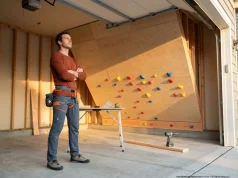
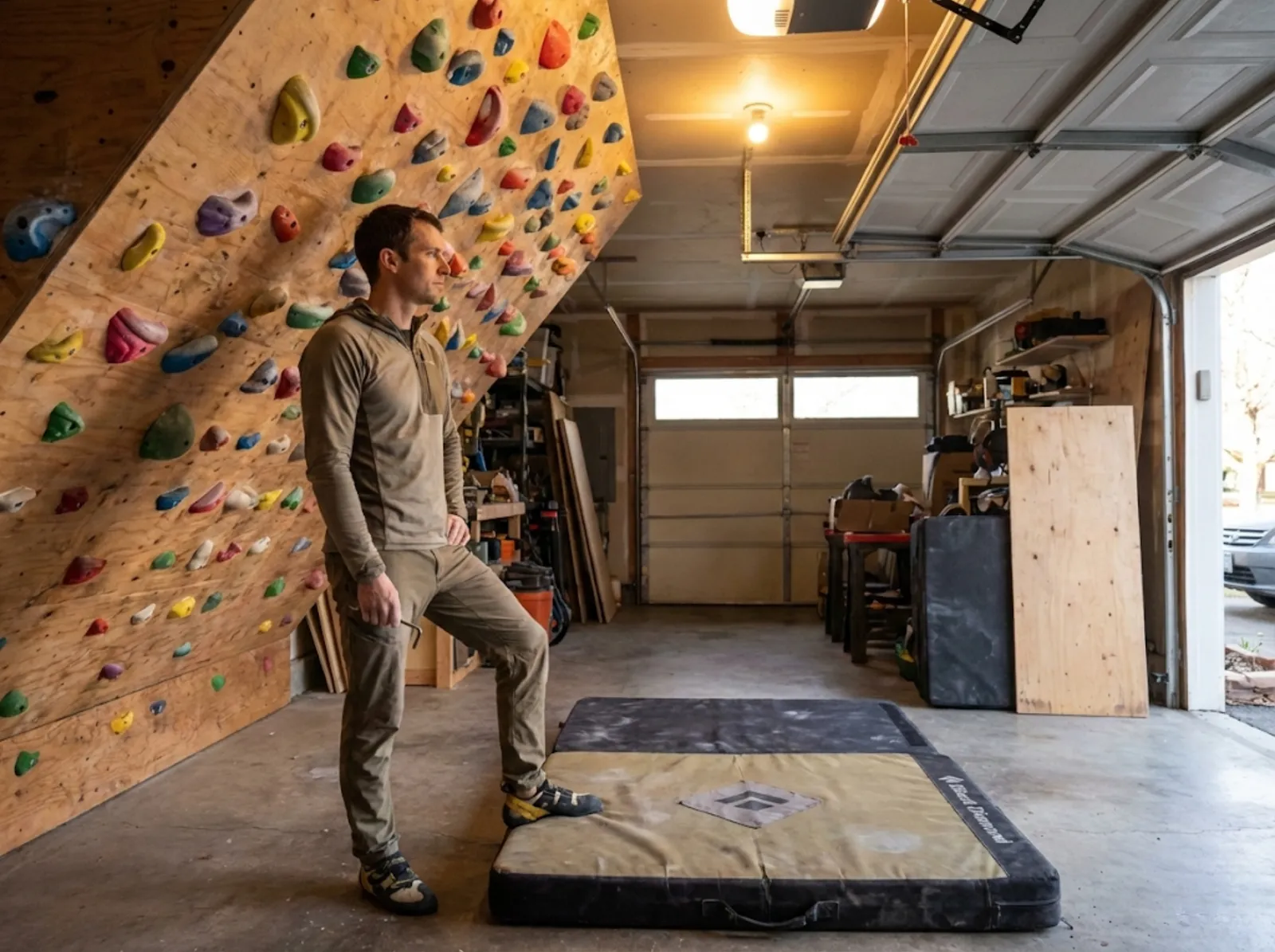
I stared at my garage wall—100 holds bolted on over three frantic weekends—and realized I hadn’t climbed anything intentional in six months. The moves felt random because they were. My “training” had devolved into arm-pumping chaos, and I was getting weaker. After 15 years of setting in commercial gyms, I knew the problem wasn’t the wall. It was that I’d skipped the fundamentals that turn a collection of holds into an actual training tool.
This guide covers everything you need to transform a random scatter of climbing holds into purposeful home wall routes—from the spray wall philosophy to forced movement principles, hardware essentials, and training integration that actually builds strength.
⚡ Quick Answer: To set effective routes on your home wall, choose between a spray wall (dense holds, infinite sequences) or marked routes (color-coded paths). Use standard 3/8-16 hardware for safety, create intentional movement through strategic foothold placement, and integrate training protocols like 4x4s and 30/30 intervals. The key is moving from random climbing to systematic skill development.
The Two Philosophies: Spray Wall vs. Set Routes
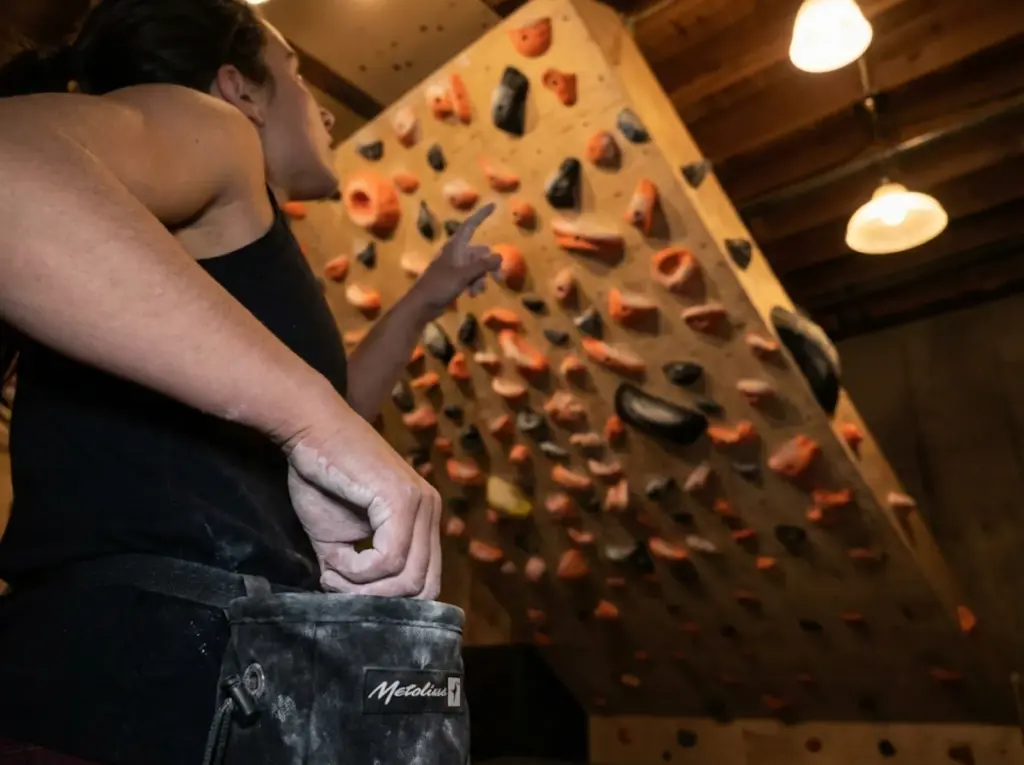
Every home wall owner faces a foundational question: should you cover your surface with holds and create movement on the fly, or mark specific routes like a commercial gym?
Spray Wall Strategy: Maximum Flexibility
A spray wall packs your climbing surface densely—typically 3-4 holds per square foot—so you can create infinite routes without physically resetting anything. Elite climbers favor this approach because it eliminates the “I’ve done everything” plateau. You can always find new sequences.
The ideal spray wall follows a specific ratio: roughly 50% horizontal holds, 30% sidepulls, and 20% underclings. This distribution ensures balanced movement in every direction. Volumes should sit primarily in the middle of the wall; high-profile features at the top block movement and waste vertical space.
Color symmetry matters too. Place one of each hold type—jug, crimp, pinch, sloper—in every grid section. This eliminates “dead zones” where movement stalls because no usable holds exist.
Pro tip: “Couch setting” is a real advantage of dense walls. Analyze photos of your wall while resting and design sequences mentally before your next session. This mental engagement accelerates progression faster than random climbing.
The spray wall approach works best for climbers V4 and above who can self-regulate difficulty through hold selection. If you’re newer or share your wall with beginners, pure spray can feel overwhelming. That’s where set routes come in.
If your home space limits you to choose between a spray wall and standardized training, compare commercial training boards like Kilter, Moonboard, and Tension that follow similar density principles but offer app-based route sharing.
Set Routes: The Gym Experience at Home
Specific routes use color-coded tape or matching hold colors to define a singular path from start to finish. This mirrors the commercial gym experience and works brilliantly for redpoint practice and tracking grade-specific progress.
The limitation is surface area. Most home walls measure 65-128 square feet, which supports only 4-6 distinct routes before crowding becomes a problem. Color-coded grade systems—Green for easy, Yellow for moderate, Red for hard, Blue for project—mirror commercial gym standards and make sharing your wall with partners of varying abilities straightforward.
Even on a set-route wall, leave some holds untagged as “open feet.” This prevents the overly constrained feeling of gym routes where every foot placement is dictated.
Hybrid Approach: The Best of Both
Most experienced home wall owners evolve toward a hybrid: spray-style density with occasional taped “projects.” Digital apps like Stōkt or Crux mark routes without physical tape, solving the aesthetic problem while preserving route data. Photo-based systems like RetroFlash handle the “I forgot what I set” problem that plagues dense walls.
The hybrid approach allows training specificity—a taped circuit for power endurance—within the flexibility of spray climbing.
The Hardware Foundation: Bolts, T-Nuts, and Safety
Hardware is where amateur walls fail. Skip this section at your wall’s peril.
The 3/8-16 Standard: Why It Matters
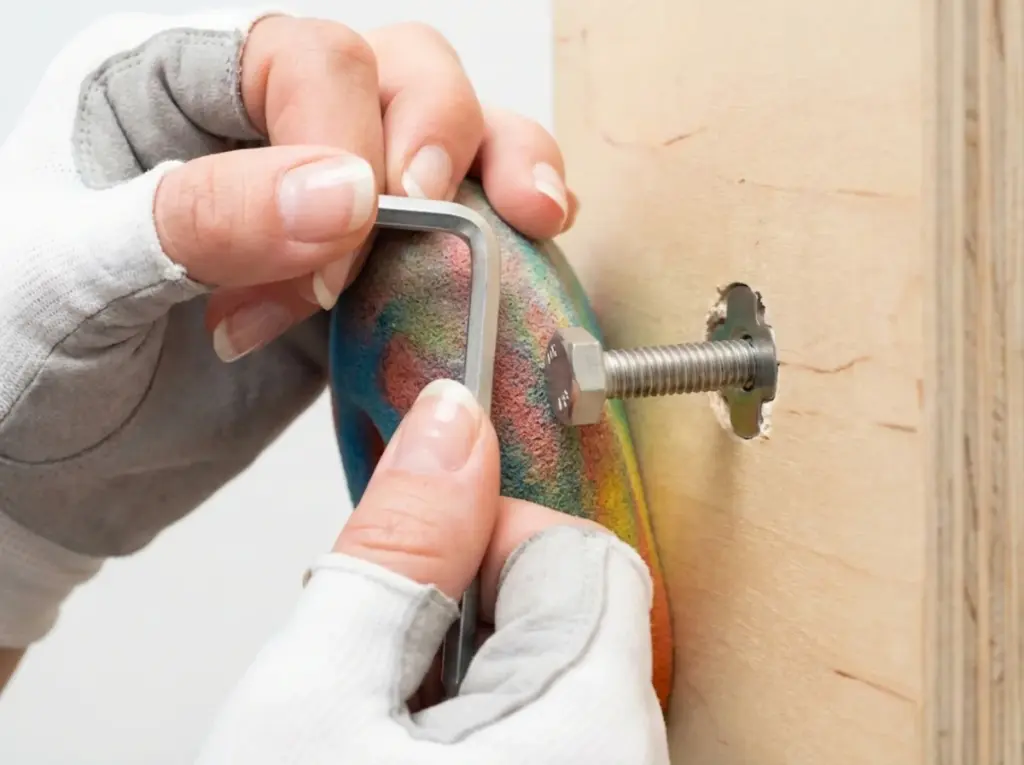
The North American climbing industry standard is the 3/8-16 Allen Head Socket Cap Bolt. This isn’t arbitrary—the 3/8-inch diameter provides the cross-sectional area to resist shear forces during dynamic movements, while the 16 threads per inch ensure sufficient engagement within the T-nut. According to the Climbing Wall Association, proper hardware installation is foundational to climbing wall safety standards.
Buttonhead bolts use a 7/32″ wrench and sit lower profile for cramped setups. Stainless steel resists corrosion on outdoor walls; zinc-plated works fine for indoor-only installations. Never mix metric and imperial hardware—thread engagement fails catastrophically.
High-quality holds feature a “Shoulder Tower” design that keeps the bolt head recessed beneath the grip surface. Your fingers never contact the hardware. Cheap holds expose bolts to your skin—a skin-shredding hazard and a sign to upgrade immediately.
For the complete installation process including proper mounting climbing holds with correct torque and spacing, that guide covers substrate preparation and T-nut patterns.
Calculating Bolt Length
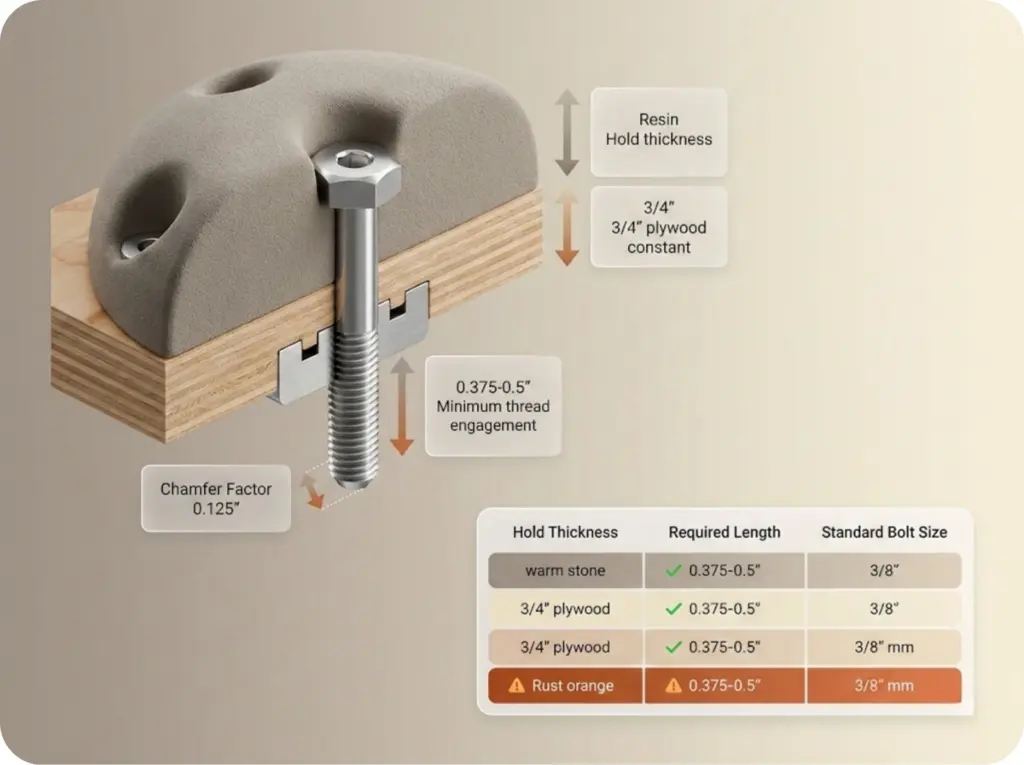
Total required bolt length combines: hold thickness + plywood thickness (standard 3/4″) + minimum thread engagement + chamfer factor.
For 3/8″ bolts, minimum thread engagement runs 0.375 to 0.5 inches—roughly 1.0 to 1.5 times the bolt diameter. The chamfer factor accounts for incomplete threads at the bolt tip—approximately 0.125 inches or two thread pitches. Always round up to the nearest standard length: 1.5″, 2.0″, 2.5″, 3.0″, 3.5″, or 4.0″.
Under-length bolts strip T-nuts under dynamic load. Over-length bolts bottom out and prevent proper seating. Neither situation is safe.
T-Nut Selection: Residential vs. Commercial
Four-prong hammer-in T-nuts work for residential walls with moderate use. Three-screw T-nuts are the commercial standard because they resist spinning under repeated tightening cycles.
Standard T-nut spacing is an 8″ grid. A 6″ grid allows more creative routesetting but increases hardware costs significantly. If T-nuts strip, a 3/8-16 tap restores threads—faster and cheaper than replacement. Always clean debris from T-nuts before inserting bolts to prevent cross-threading.
Hold Selection: Materials, Shapes, and Skin Preservation
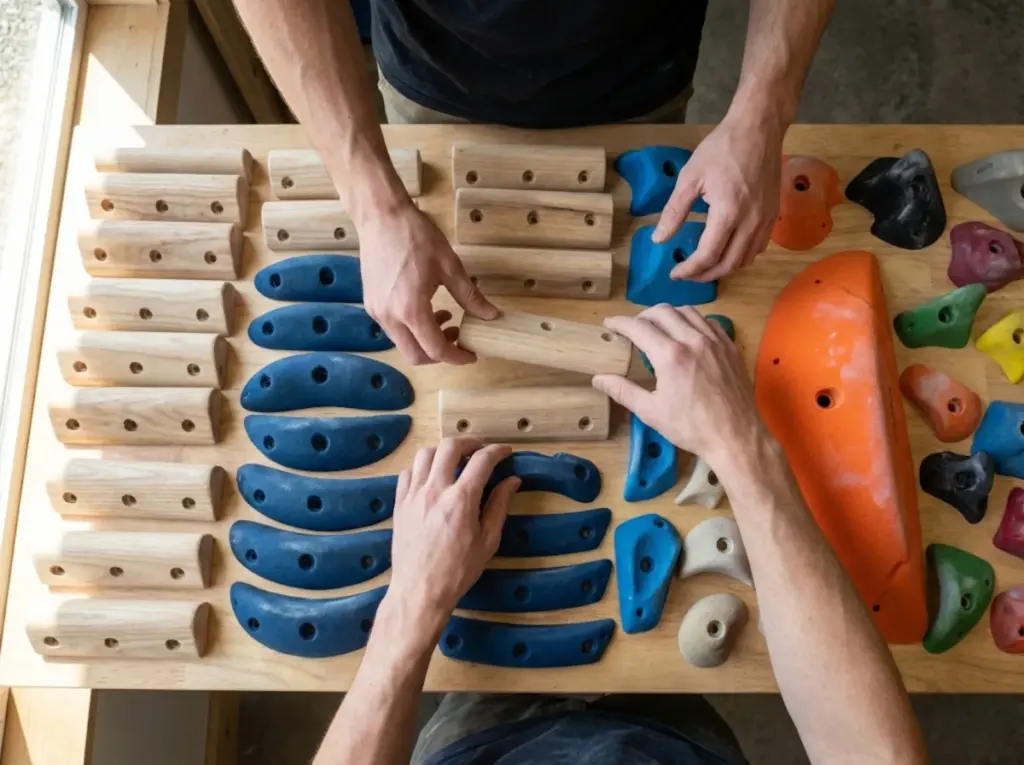
Your hold collection shapes your training. Choose strategically.
Material Comparison: PU vs. PE vs. Wood
Polyurethane (PU) dominates roughly 68% of the professional market because of its impact resistance. Unlike Polyester (PE), which chips when over-tightened or struck, PU absorbs deformations without damage. PE is significantly cheaper and offers texture closer to natural rock—many climbers prefer its feel despite the durability tradeoff.
Wooden holds are essential for high-volume training. Their low-friction surface minimizes skin abrasion, allowing longer sessions without flappers or worn tips. Campus boards use wooden rungs almost exclusively for this reason.
Fiberglass holds offer the highest durability and UV resistance for outdoor walls. Recyclable thermoplastic holds are emerging for sustainability-focused climbers—some manufacturers claim 10+ recycling cycles.
For deeper analysis of grip variations and how they affect finger loading, explore the biomechanics of different climbing hold shapes.
Shape Variety: Building a Complete Rack
Jugs handle warm-ups and confidence building—you can never have too many. Crimps develop finger strength but require 2+ years of tendon adaptation; beginners should limit exposure to prevent injury. Pinches train thumb opposition, critical for outdoor climbing performance. Slopers force body tension and core engagement, especially on steeper angles.
Pockets stress A2 pulleys and should appear sparingly on home walls—never below V4 climber experience level. Volumes create 3D features that replicate outdoor movement better than flat wall holds, forcing spatial awareness and creative footwork.
Wooden Holds for Training Walls
Wooden holds demand higher muscular tension because you can’t rely on aggressive mechanical friction. This “no friction cheating” principle makes them superior training tools.
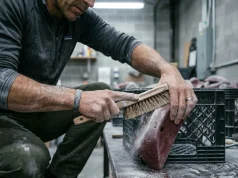
Sand wooden holds with 100-200 grit to restore texture when slick from skin oils. Avoid water soaking—wipe with a damp cloth only. For a training spray wall, mix 20-30% wooden holds with synthetic options.
Setting Fundamentals: Movement, Flow, and Forced Sequences
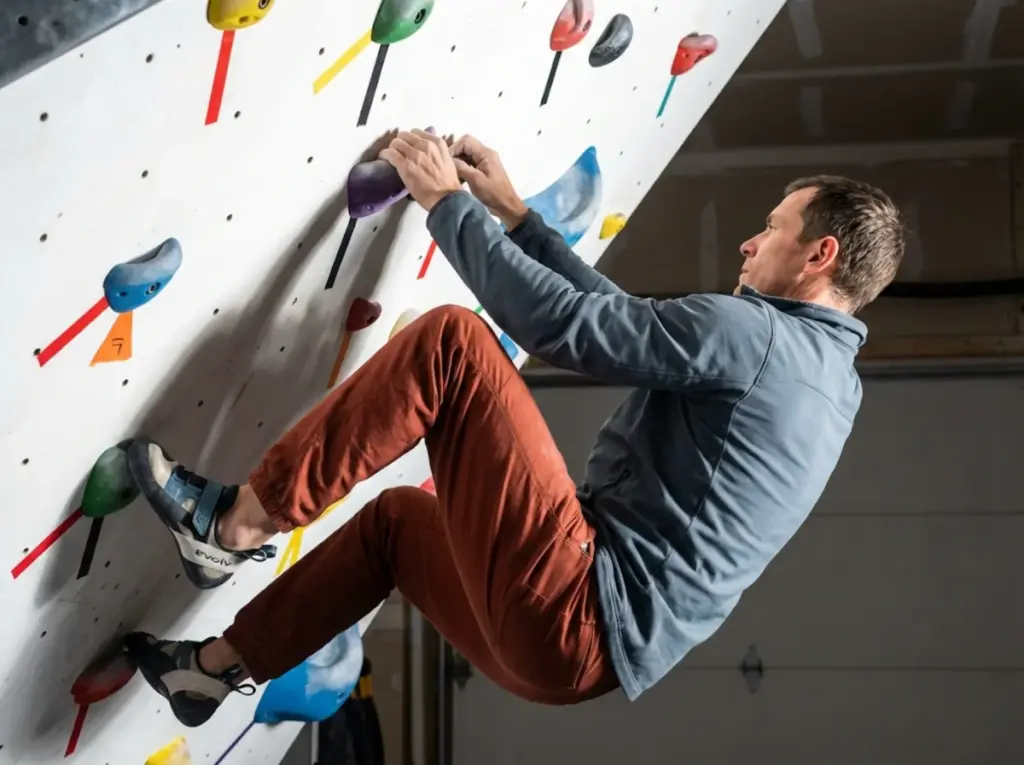
This is where random holds become real routes.
The X-Pattern for Jug Distribution
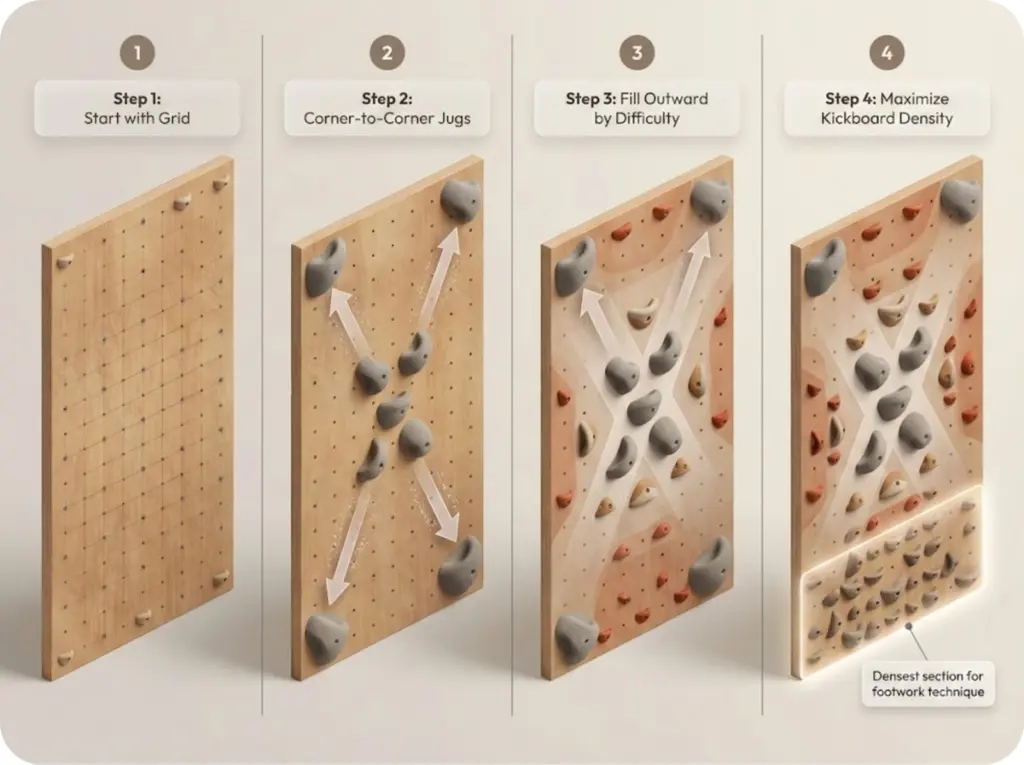
Start by making a large “X” of jugs from the top corners to the bottom corners of your wall. This creates warm-up holds accessible from anywhere on the surface and prevents “jug deserts” that block movement flow.
Fill remaining space with progressive difficulty outward from the X. Your bottom section—the kickboard—should be densest. This is where footholds matter most, and cramped foot options force technique development rather than arm-pulling.
Forced Movement: Controlling the Sequence
Foothold placement controls route intensity more than hand holds do. Limiting feet to specific holds forces precise body positioning that you can’t cheat through. This is the essence of good route setting.
Sidepulls and underclings create directional opposition—the foundation of hard climbing. They force you to push against one hold while pulling another, developing the full-body tension that transfers to outdoor rock.
The critical mindset shift: “Start with a move, not a hold.” Visualize the movement you want—a powerful lockoff, a precise heel hook, a coordinated dyno—then place holds to achieve it. Work backward from the move to the hold placement.
Pro tip: “Forerunning” every route isn’t optional. If you set it and didn’t climb it, you have no idea whether the sequence flows or you’ve accidentally created an unclimbable sandbag. Test every move yourself before considering the route “set.”
Hold orientation determines movement difficulty. Rotating a hold 15-30 degrees transforms a jug into a sloper, a sidepull into an undercling. Experiment with orientation before drilling new T-nut patterns.
Understanding how body position responds to hold placement relates directly to techniques like flagging and drop-knee mechanics helps you set for specific movement patterns.
Consistency and Grade Integrity
Routes should maintain consistent difficulty throughout—no “crux then jug” patterns that let you cruise after one hard move.
Height normalization matters for shared walls. Shorter climbers may need intermediate footholds to reach between moves designed by taller setters. The 60-degree overhang is the most versatile home wall angle—hard enough for serious training, not so steep that every hold must be a jug.
Training Integration: Periodization and Programming
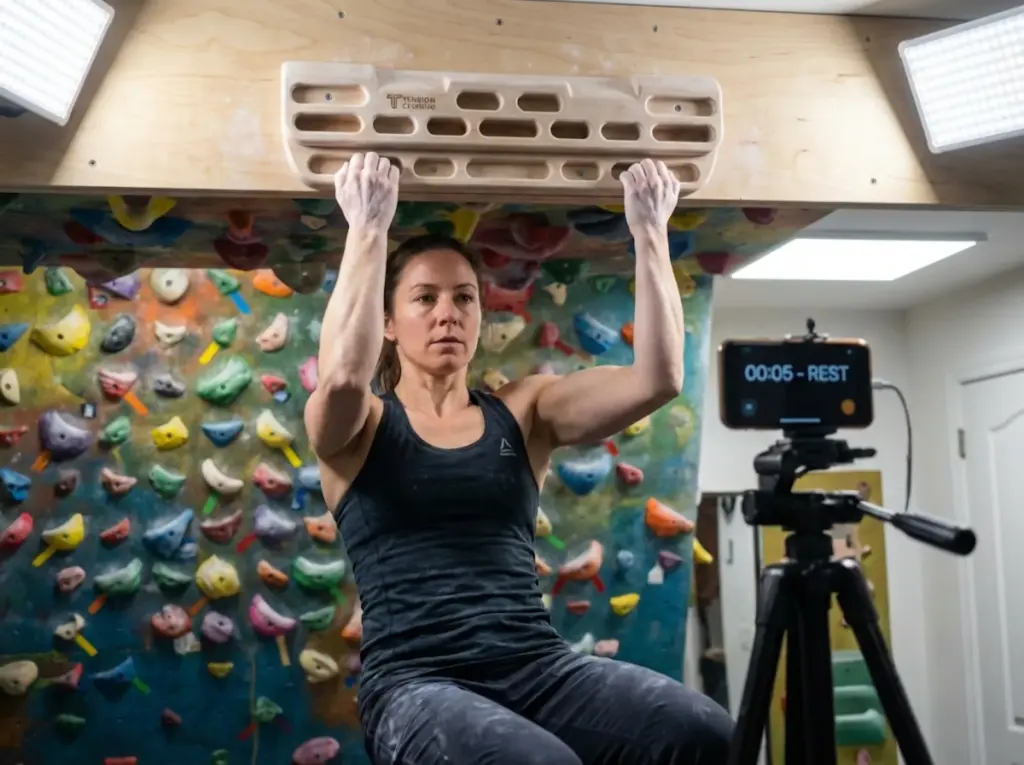
A home wall’s value depends on how you use it, not just that you have it.
Setting for Strength Phase
Crimp ladders and small pinch sequences develop contact strength. Limit bouldering protocols—20 seconds of effort, 3+ minutes rest—maximize neural recruitment without accumulated fatigue.
Wooden hold emphasis works perfectly for strength phase training because grip demand stays high without friction assistance. Reset frequently (weekly if possible) to prevent pattern memorization. Climbing the same moves repeatedly builds familiarity, not transferable strength.
For complementary off-wall training, structured programs focused on building finger strength and lock-off power integrate well with home wall strength phases.
Setting for Power Endurance
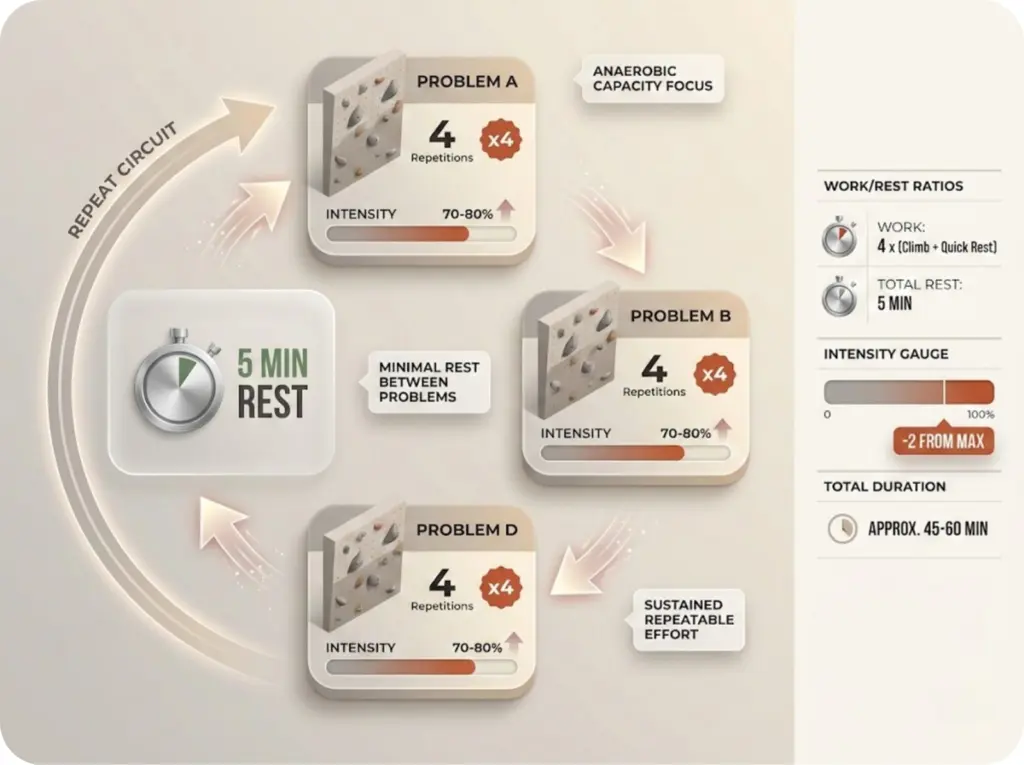
The 4×4 protocol is the backbone of anaerobic capacity training: climb four problems, four times each, with minimal rest between repetitions and five minutes between sets. Routes should sit two grades below your limit for sustained, repeatable effort.
EMOM (Every Minute on the Minute) protocols—start a new problem every minute for 10 minutes—train recovery efficiency. 30/30 intervals—30 seconds max intensity, 30 seconds rest, six intervals—form the backbone of elite spray wall training.
Set circuits that link multiple problems without touching the ground. This forces you to manage pump while problem-solving, mimicking competition conditions.
Setting for Aerobic Capacity (ARCing)
ARC training requires 20-30 minutes of continuous, low-intensity climbing. Set easy traverses along the length of your wall. Open feet rules work best—movement flow matters more than difficulty.
Target intensity: sustainable conversation pace, not pumped forearms. ARCing is ideal for recovery days and builds capillary density in forearm muscles.
Common Mistakes and How to Fix Them
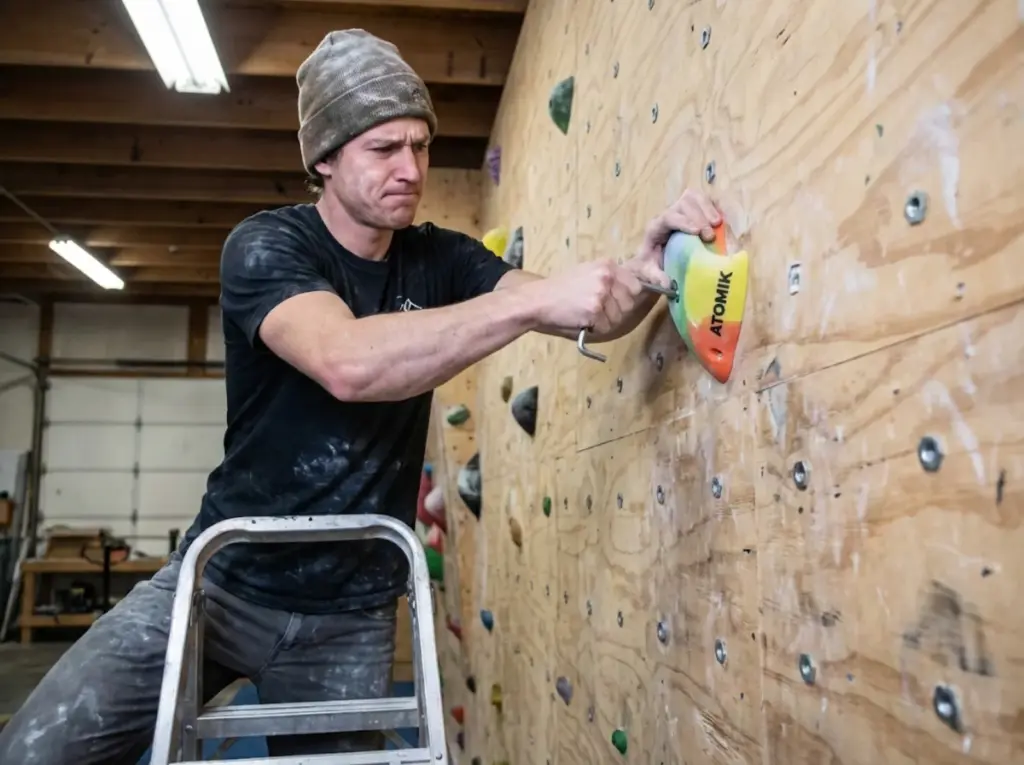
Every home wall owner makes these errors. Fix them before they waste months of training.
Mistake 1: All Difficulty Up Top
Setters naturally place cruxes near the finish—but you fall from height onto tired arms. Distribute difficulty evenly. If anything, hardest moves should sit lower where falls are safer. Top-heavy difficulty breeds frustration without training benefit.
Mistake 2: Ignoring Footwork
Most home walls under-set footholds. Climbers end up campus-climbing everything, which builds pulling power but destroys technique. Jibs—tiny footholds—force footwork precision that transfers directly to outdoor rock.
“All-foot” zones on your kickboard train smearing and edge transitions. If you can campus every route on your wall, you’ve set poorly.
Mistake 3: Never Resetting
Climbing the same problems breeds pattern memory, not transferable skill. Your body learns those moves rather than movement broadly.
Monthly bolt tightening prevents spinners. Quarterly hold washing removes chalk buildup and restores texture. Full resets every 3-6 months minimum combat stagnation. Digital apps solve the “I don’t want to lose good problems” fear—photo and archive before stripping.
Pro tip: “Setting parties” with friends generate fresh beta you’d never see climbing solo. The social aspect isn’t just fun—it’s a hack for exposure to diverse movement styles and problem-solving approaches.
If you’re hitting a plateau beyond setting issues, a systematic data-backed framework for finding and fixing climbing weaknesses can identify whether the problem is strength, technique, or mental.
Conclusion
Transforming your home wall from random holds to real routes requires three things: understanding the spray vs. route philosophy and hybridizing wisely, mastering the engineering fundamentals that keep you safe, and setting with intention—controlling movement through hold orientation, foothold placement, and training-specific protocols.
The goal isn’t mimicking a commercial gym. It’s building a tool that targets your weaknesses, trains your movement gaps, and stays fresh through strategic resets and community setting sessions.
Pick one section of your wall this week and strip it. Reset with a single training goal—power, endurance, or technique. Forerun it until it flows. Then climb it until you’re better.
Now go send something.
FAQ
What is the difference between a spray wall and a route wall?
A spray wall covers the surface densely with holds allowing infinite route combinations, while a route wall uses color-coded or taped sequences defining specific paths. Spray walls maximize flexibility for experienced climbers; route walls mimic gym structure for varied ability levels.
What tools do I need to set climbing routes at home?
Essential tools include a 7/32″ Allen wrench for standard bolts, a 5/16″ Allen wrench for buttonhead bolts, a cordless drill with 7/16″ bit for T-nuts, and gaffer’s tape for route marking. A 3/8-16 tap restores stripped T-nut threads.
How do I make my home wall routes harder or easier?
Adjust foothold availability first—limiting foot options dramatically increases difficulty without changing hand holds. Next, alter hold orientation: rotating a hold 15-30 degrees changes usability entirely. Finally, increase spacing between holds to require longer reaches or dynamic moves.
How often should I change routes on my home wall?
Monthly bolt tightening prevents spinners. Quarterly deep cleaning removes chalk buildup. Full resets every 3-6 months combat pattern memorization. Digital archiving with apps like Stōkt preserves favorites before stripping.
What are the best holds for a beginner home wall?
Prioritize large jugs for warm-ups, medium pinches for developing opposition strength, and slopers for training body tension. Avoid small pockets until at least V4 level—finger pulleys need 2+ years of adaptation before handling high stress.
Safety Notice: Rock climbing and mountaineering are inherently high-risk
activities that can involve physical trauma or fatal incidents. The information on Rock Climbing Realms is for
educational and informational purposes only. Techniques and advice presented here are not a substitute
for professional, hands-on instruction. Conditions and risks vary by location. Always seek guidance
from a qualified instructor before attempting new techniques. By using this website, you agree that you
are solely responsible for your own safety. Any reliance you place on this information is strictly
at your own risk, and you assume all liability for your actions. Rock Climbing Realms and its authors
will not be held liable for any harm, damage, or loss sustained in connection with the use of this information.
Affiliate Disclosure: We are a participant in the Amazon Services LLC Associates Program, an
affiliate advertising program designed to provide a means for us to earn advertising fees by advertising and linking
to Amazon.com. As an Amazon Associate, we earn from qualifying purchases. We are also an official affiliate partner
of Black Diamond Equipment via the AvantLink network. If you click on a Black Diamond affiliate link and make a
purchase, we may earn a commission at no additional cost to you. We also participate in other affiliate programs.
Additional terms are found in the terms of service.