
In this article
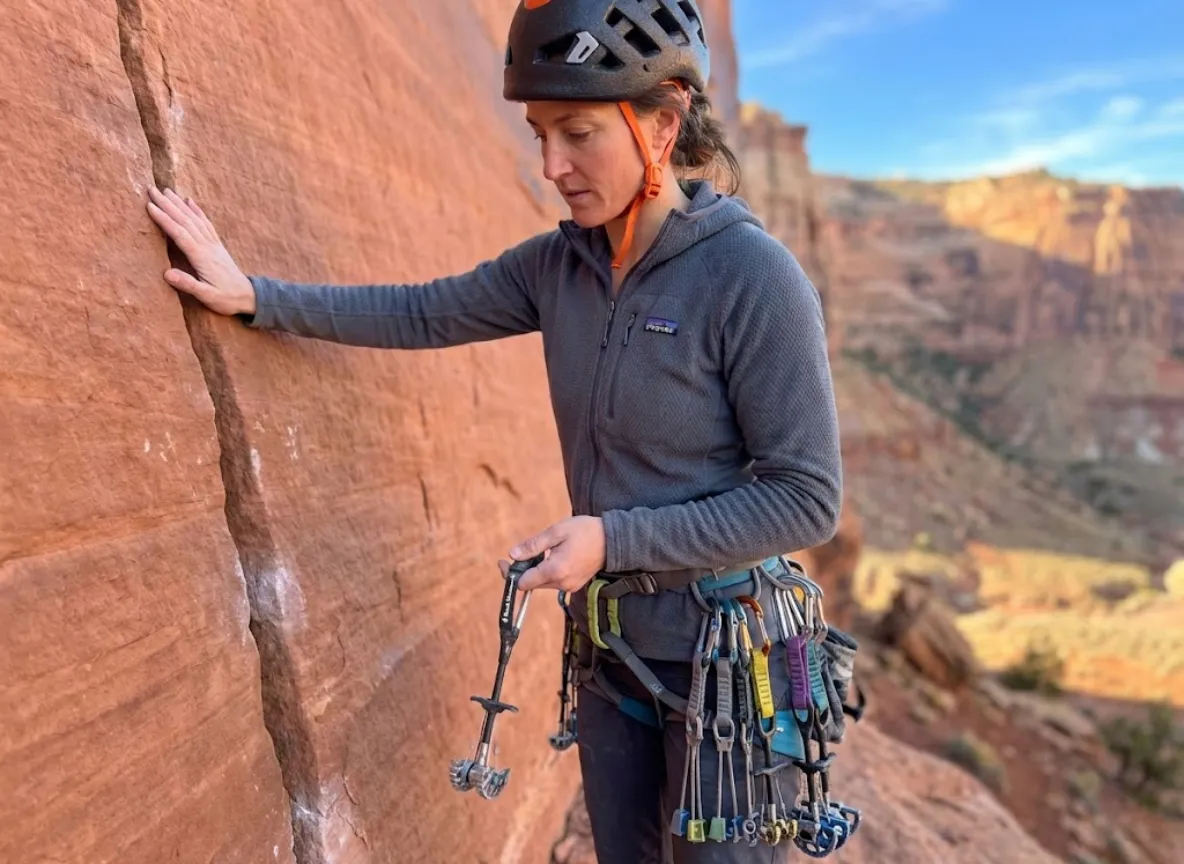
The cam felt solid when I placed it—four lobes snug against the Indian Creek splitter, the reassuring click of the trigger. Eighty feet higher on a soft Navajo sandstone pitch in Zion, an identical placement sheared through the rock like a spoon through wet sugar. Same brand, same size, wildly different outcomes. After fifteen years of traditional climbing across three continents, I’ve learned the difference wasn’t the gear—it was the geology.
This field manual bridges the gap between gear placement and geological fluency—the understanding that every anchor decision starts not with the device in your hand, but with the rock you’re trusting your life to. You’ll learn to read lithology the way you read beta: identifying Rock Classes, understanding why granite forgives sloppy technique while sandstone punishes it, and selecting climbing protection that matches the physics of the substrate.
⚡ Quick Answer: Rock type determines protection reliability. Granite (100-250 MPa compressive strength) handles standard cams and nuts reliably. Porous sandstone (25-40 MPa) requires Fat Cams to distribute pressure and prevent shear failure. Limestone demands Tricams for solution pockets and awareness of bolt corrosion in marine environments. Always tap-test before placing gear—a hollow sound means a hollow promise.
Understanding Rock Classes: The Foundation of Protection Selection
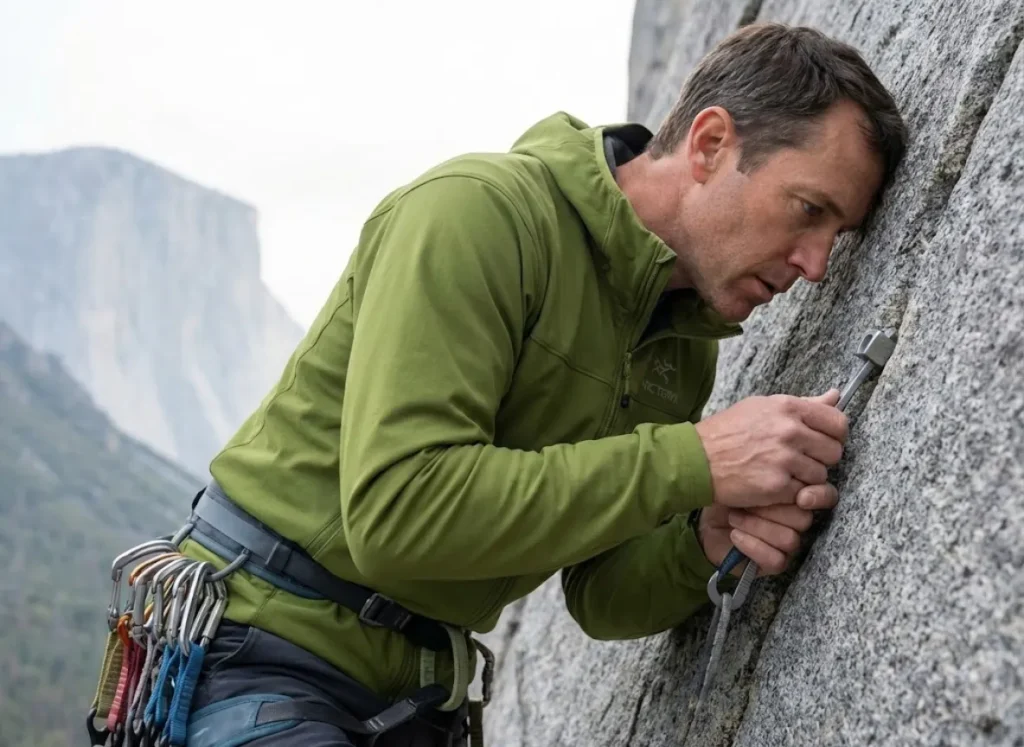
Before you rack a single piece of trad climbing gear, you need to understand what the rock can handle. The compressive strength of stone—how much pressure it takes before the rock crushes—tells you whether your cam will grip or punch through like a fist through drywall.
Why Compressive Strength Matters More Than Crack Width
Here’s the uncomfortable truth: that CE/UIAA rating stamped on your cam means nothing if the rock can’t support the forces. A carabiner rated to 24 kN is irrelevant when clipped to a bolt in gypsum with the structural integrity of sugar cubes.
Granite sits at the top of the strength spectrum. Those interlocking crystals of quartz and feldspar have been holding together since the Cretaceous—they’re not failing for your body weight. But poorly cemented sandstone can be so weak that it falls below the minimum threshold for mechanical expansion bolts to function without crushing the borehole wall.
Understanding traditional climbing protection philosophy starts here. The rock dictates the rack, not the other way around.
The 6-Class Engineering System
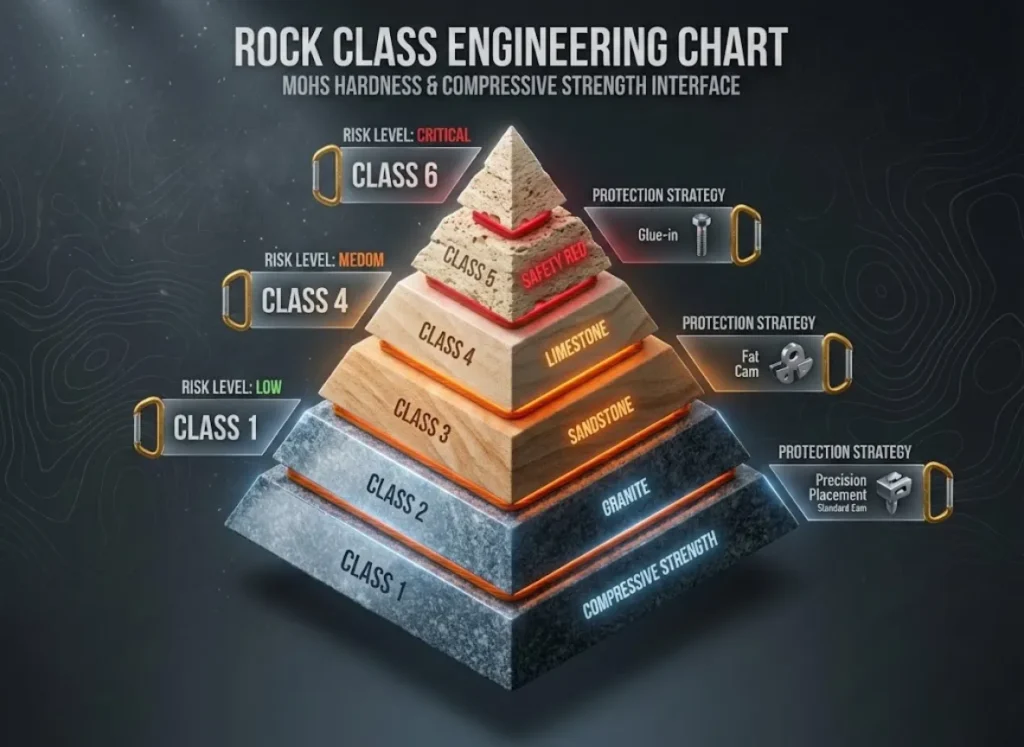
Rock engineers classify stone into six classes based on compressive strength. Memorize this, because it’ll change how you think about every protection placement:
Class 1: Gypsum, shale, soft conglomerate. These are unsafe for expansion bolts—the outward force from the anchor exceeds what the rock can handle. You need glue-in bolts or deeply seated passive pro.
Class 2: Soft limestone, porous sandstone. This is marginal territory. Standard cam lobes can punch through like a thumb into cake frosting. Fat Cams with wide lobes become mandatory to distribute pressure.
Class 3-4: Dolomite, medium sandstone, hard limestone. This is where standard cams and nuts work reliably. Check for surface weathering that might compromise friction, but the substrate can take load.
Class 5-6: Compact granite, basalt, quartzite. The rock is stronger than your gear. Failure happens due to placement geometry—a nut walking out or a cam over-retracted—not because the stone collapsed.
Pro tip: A rack optimized for Class 6 Yosemite granite (micro-nuts, narrow-head cams) is dangerously inadequate for Class 2 sandstone. When you travel between rock types, rebuild your rack for the geology, not habit.
Hardness vs. Strength: The Mohs Scale Interface
Compressive strength tells you about crushing. The Mohs scale of mineral hardness tells you about scratching—and that matters for how your gear grips.
Quartz and feldspar in granite are harder than the aluminum alloys in your cams. On igneous rock like granite, your gear relies on friction and mechanical keying in constrictions. The metal can’t gouge its own seat.
Calcite in limestone is much softer. Your cam teeth physically bite into the rock, creating a shear-resistant interface. That sounds good—until you realize the same softness makes limestone prone to grooving and polishing under repeated traffic.
The Granitic Standard: Why Plutonic Rock Rewards Precision
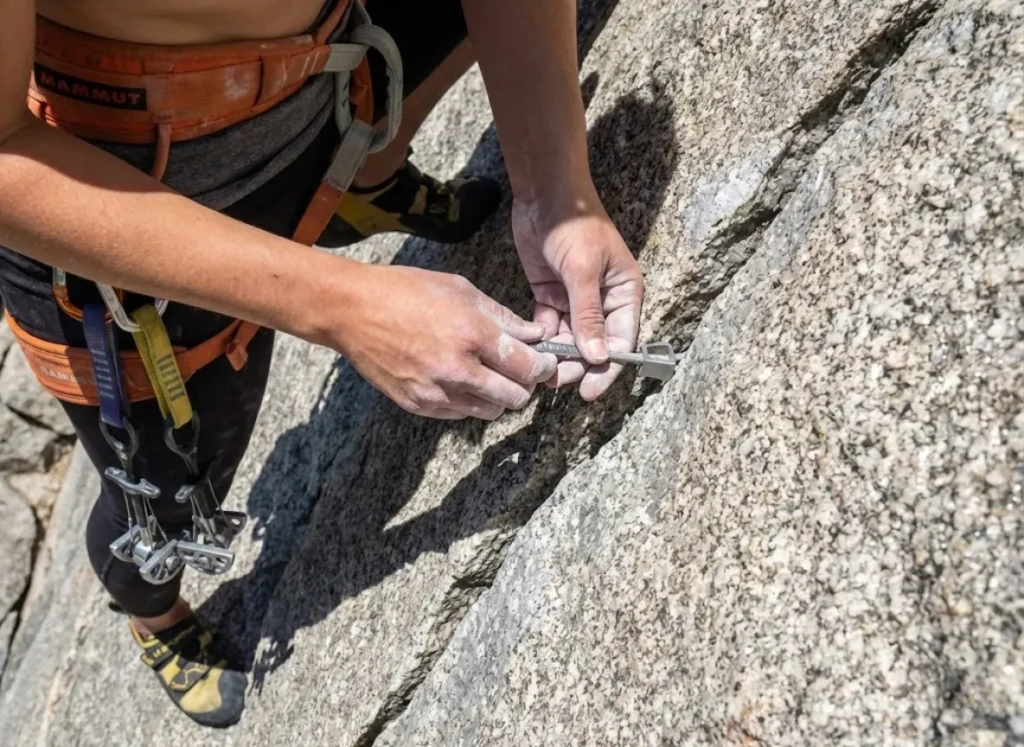
There’s a reason Yosemite granite became the birthplace of modern trad climbing. Plutonic igneous rock—formed from slowly cooling magma deep underground—offers the most predictable substrate for mechanical protection.
Crystalline Interlock: The Physics of Bombproof Placements
Granite isn’t cemented together like sandstone. Those large, visible crystals of quartz, feldspar, and mica grew interlocked during millions of years of cooling. The result is immense shear strength—the rock resists forces trying to slide one part past another.
What does that mean on the wall? A small quartz knob in Yosemite granite formations can support your full body weight. The same feature in limestone might shear clean off. Granite’s density means near-zero porosity—the rock stays mechanically stable whether it’s bone dry or dripping wet.
After a hundred days at Yosemite, I learned to trust the knobs. Those crystals have been interlocked for 85 million years. They’re not letting go for my 180 pounds.
Friction Mechanics on Crystalline Surfaces
The friction on granite is excellent for climbing. Large crystalline structure creates a rough, “knobby” macro-texture. Soft climbing rubber deforms over those crystals, creating mechanical interlock that lets you smear effectively on slabs with no positive edges.
Because quartz and feldspar are harder than rubber, the friction stays consistent. Granite doesn’t polish easily, maintaining its texture over decades of traffic. Compare that to polished limestone in high-traffic sport crags, where the surface becomes glass-smooth and the grip drops dramatically.
Pin Scars: The Legacy of the Iron Age
If you’ve climbed in Yosemite, you’ve encountered pin scars—shallow, flared pods where decades of driving hard steel pitons mechanically deformed the cracks. The repeated hammering pulverized feldspar crystals, creating geometry hostile to standard protection.
Pin scars often flare outward—wider at the face and narrowing toward the back. Standard cams may “track” outward as they expand. Standard nuts pull through because the constriction is inverted.
The solution: Offset nuts like DMM Alloy Offset geometry specifications. These feature asymmetric geometry allowing them to fit the irregular negative space of pin scars where standard gear fails.
Pro tip: In the Valley, I carry DMM Offsets even on routes with “splitter” descriptions. You’ll find the pin scars where the old timers established their aid lines in the 1960s.
The Sandstone Paradigm: Managing Friable, Anisotropic Rock
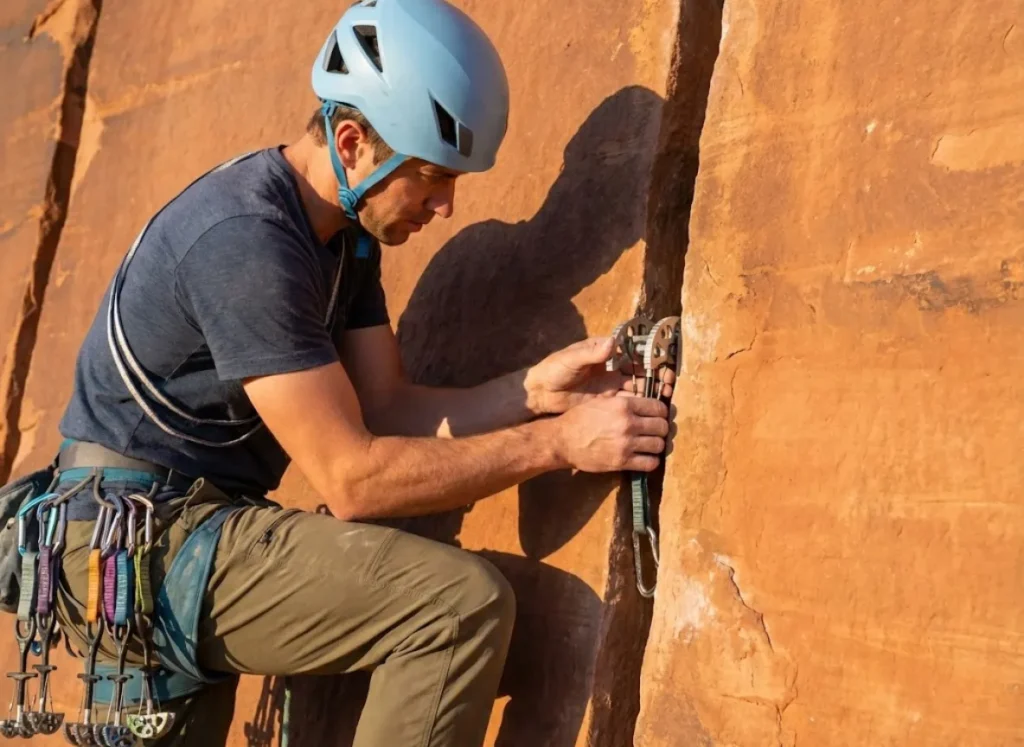
Sandstone climbing is a different game. Unlike the uniform strength of granite, sedimentary rock properties vary wildly based on how the rock was deposited, what’s cementing the grains together, and how much water the stone has absorbed.
Wingate vs. Navajo: Not All Sandstone Is Equal
The iconic splitters of Indian Creek Wingate sandstone and the red walls of Zion National Park aren’t created equal, even when they look similar.
Wingate Sandstone at Indian Creek is strongly cemented and cliff-forming. Those parallel cracks formed from stress-relief joints in massive sandstone sheets—ideal geometry for four-lobe camming devices. Critically, Wingate surfaces develop “desert varnish,” a dark patina of iron and manganese oxides that acts as case-hardening, significantly increasing surface strength.
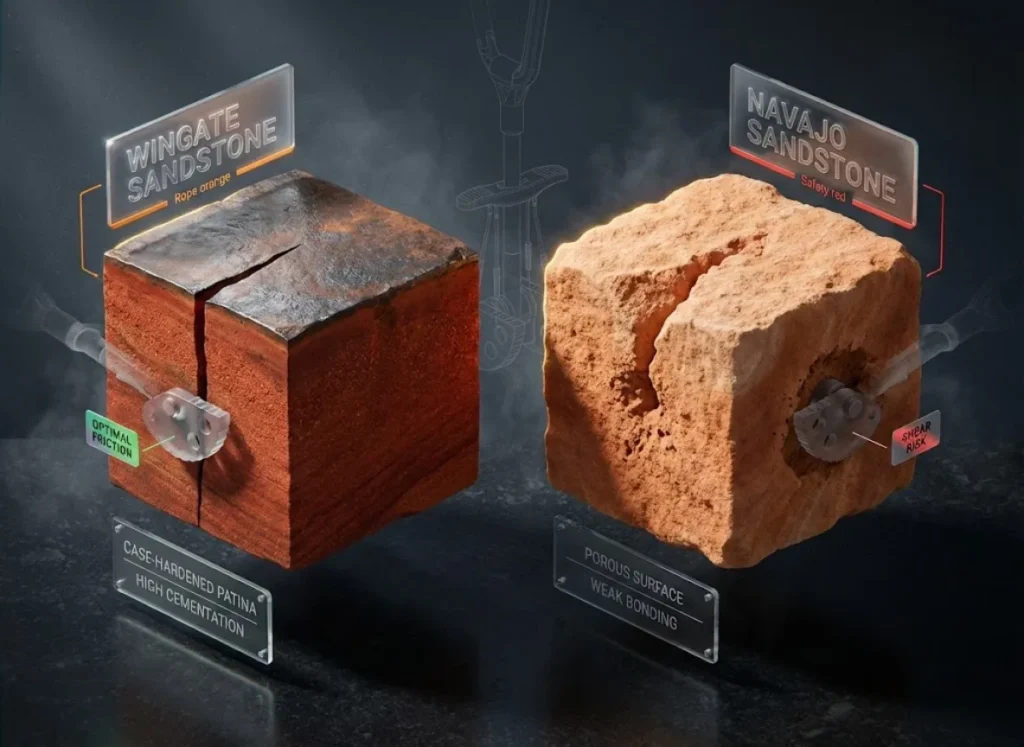
Navajo Sandstone at Navajo sandstone climbing at Zion is younger, more porous, and often weaker due to inferior cementation. Without that thick patina, narrow cam lobes can punch through the surface. I learned this the hard way when what looked like a bomber placement sheared through like I was caming in brown sugar.
The Wet Sandstone Cardinal Rule
Never climb wet sandstone. This isn’t ethics snobbery—it’s physics.
Sandstone with high porosity acts as a sponge. When saturated, several weakening mechanisms activate: ite and clay cements soften or dissolve, water filling pore spaces pushes grains apart, and expansive clays swell and crack.
Research from Berkeley research on sandstone strength mechanics shows wet sandstone strength can drop by half or more. A cam placement that would hold a lead fall on dry rock may shear through the wet matrix. The effect reverses as the stone dries—unless the cement has been permanently damaged.
At Red Rocks, wait 48-72 hours after rain. The surface dries before the interior. Climbing too soon causes permanent damage and compromises rock quality for everyone.
Fat Cams: Engineering for Soft Rock
The failure mode in soft rock is usually the rock crushing under your cam lobes. Standard cams maximize narrowness for fitting pin scars in granite. Metolius Ultralight Fat Cams flip this—lobes significantly wider than standard units, increasing the contact area to spread the load.
The concept is simple: spread the force over more surface area, and you reduce pressure on any single point. In tests, Fat Cams outperform standard cams in soft rock by preventing localized shear failure. Do NOT use narrow-lobe cams in weak sandstone—the concentrated force acts like a hydraulic punch.
I carry both styles now. Advanced cam placement techniques matter less than matching cam design to rock type.
Carbonate Geochemistry: Limestone’s Hidden Hazards
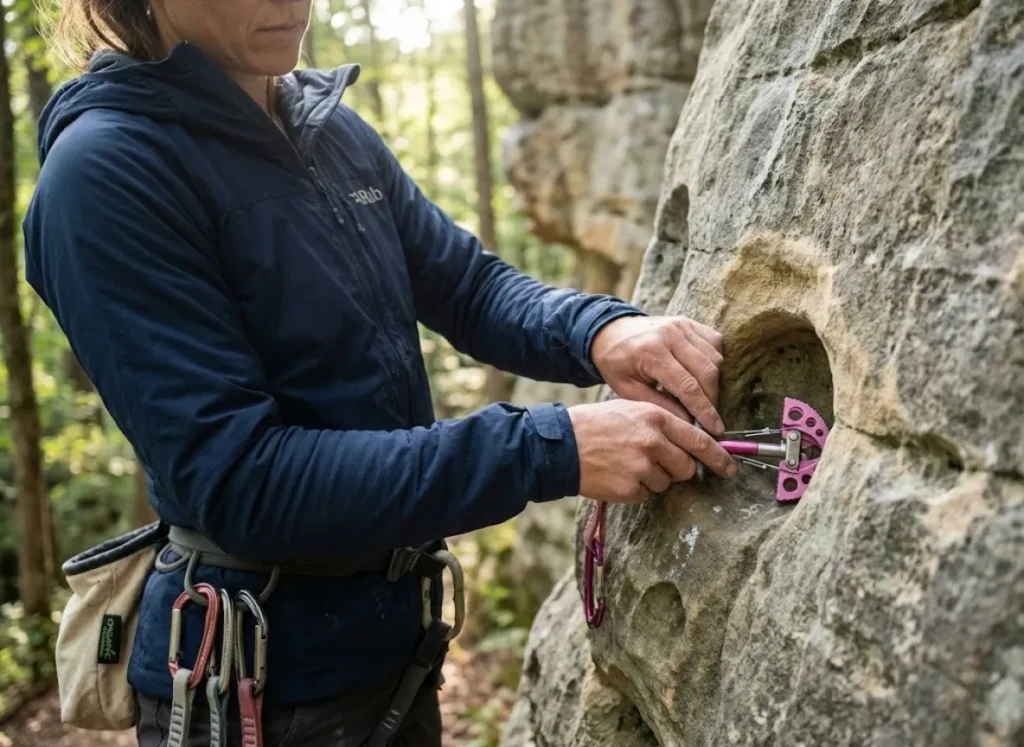
Limestone climbing presents hazards that are invisible until catastrophic. The rock’s chemical origin—calcium carbonate from ancient seas—makes it vulnerable to dissolution and, in marine environments, to insidious metal corrosion.
Solution Pockets and the Tricam Advantage
Unlike stress-relief cracks in granite or sandstone, limestone features form by dissolution. Water chemically eats away the rock, creating round limestone pockets or huecos rather than linear fissures.
Standard four-lobe cams rely on two parallel, opposing walls. In a round pocket, a cam is often unstable—only two lobes may contact the rock, or the device walks into a position where it opens and fails.
Enter the Tricam—a hybrid active/passive device with a pointed fulcrum and camming rail. It requires only a small dimple to seat the point. Under load, the “stinger” drives into the pocket floor while the rails cam against the roof. In soft limestone, the sharp point bites aggressively where smooth-lobed cams would slip.
Tricams fit “shotgun holes”—perfectly round, parallel-sided pockets—where cams are too wide and nuts have no constriction. If you’re headed to Red River Gorge pocketed limestone, carry a full set.
Stress Corrosion Cracking: The Invisible Critical Failure
This is the hazard that keeps me awake at night. Stress Corrosion Cracking affects stainless steel bolts in tropical marine limestone—Thailand, Vietnam, Cayman Brac, coastal Sardinia.
Three factors align for failure: stress from the bolt installation, chloride ions from sea spray and the limestone itself, and susceptible materials (standard stainless steel). The salt attacks the steel from within. Unlike surface rust, these cracks propagate through the metal. A bolt may look shiny and solid while being internally fractured, ready to snap under body weight.
According to UIAA investigation into sea cliff bolt failures, standard stainless steel lasts only 3-5 years in marine limestone. Titanium Grade 2 glue-in bolts last 50+ years. In Thailand or Vietnam, climb ONLY routes with titanium or specialized corrosion-resistant steel. Your life depends on asking.
Protection Physics: SLCDs, Nuts, and Force Dynamics
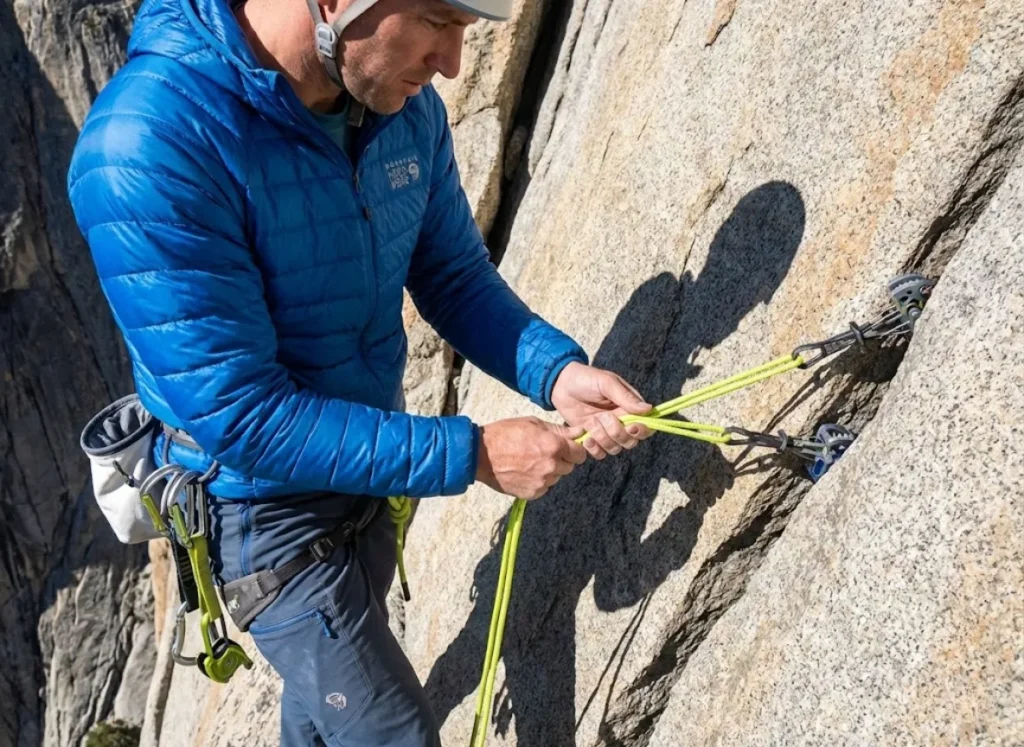
Understanding how your gear translates forces into security helps you select the right tool for each rock type.
The Logarithmic Spiral: Why Cam Angle Matters
Every spring-loaded camming device uses lobes shaped to a specific curve. This geometry ensures the angle between the cam surface and rock remains constant regardless of retraction—critical for consistent holding power.
Here’s what matters: a smaller camming angle (like some Metolius models) generates higher outward force—better grip in slippery rock, but it can blow out soft substrates. A larger angle (like Black Diamond Camalot C4) generates lower outward force—wider range, safer for marginal rock IF friction holds.
In the gorge, I run Black Diamond for the range. At Indian Creek, I’ll take narrower-angle cams—that extra bite on patina matters for active protection.
Passive Protection: The Geometry of the Wedge
Nuts convert downward pull into outward force contained by narrowing crack morphology. Most nuts feature transverse taper plus a curved face that creates stable three-point contact—preventing wobble under upward rope pull.
Material matters in micro-protection. Brass offsets are malleable. Under fall load, the brass head deforms and “smears” into rock texture, locking the piece into marginal seams. The nut may be sacrificed, but it holds. Steel micros are harder—preferred for granite where deformation isn’t needed.
Building a balanced trad rack means matching material properties to rock type, not just matching sizes to crack widths.
Anchor Geometry: The Zipper Effect and Critical Angles
When two anchor points connect to a master point, the angle between them determines force multiplication. At 60° (equilateral triangle), each arm carries about 58% of the total load—the industry standard per the American Alpine Club. At 120°—the critical angle—each piece carries 100% of the load with no advantage.
Above 120°, you enter the “American Danger Triangle” where forces multiply. At 150°, each anchor point sees roughly double the applied load.
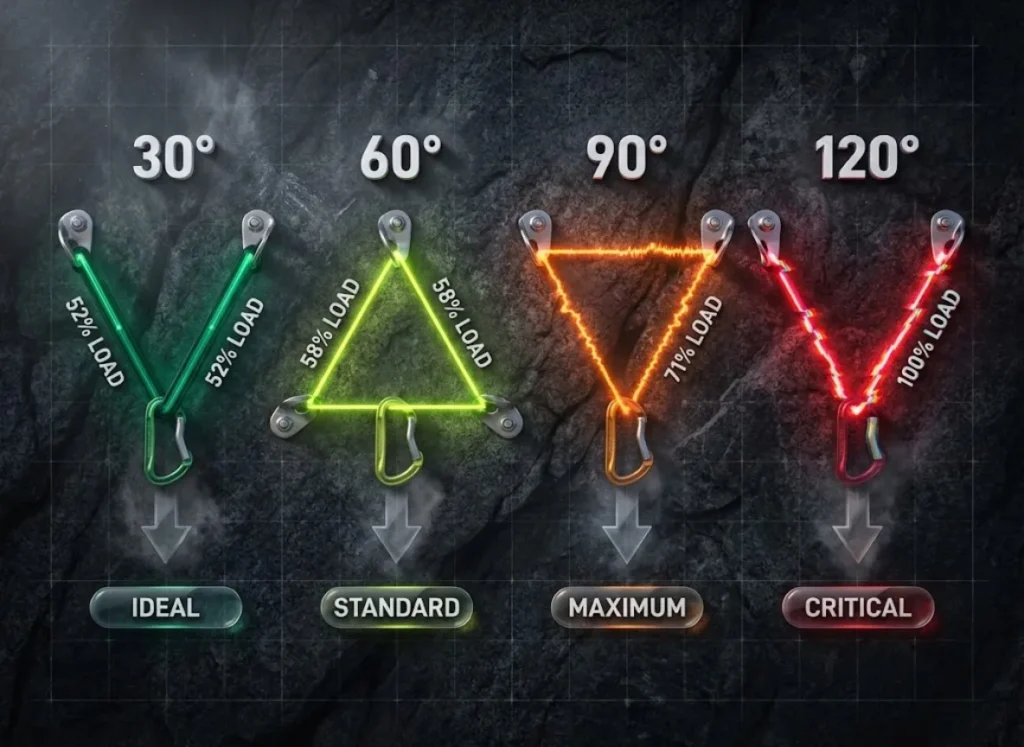
The zippering effect compounds this danger. Rope tension exerts upward and outward pull on bottom protection. If your first piece handles only downward pull, it lifts out. The resulting slack increases shock on the next piece up. If that one zippers too, cascade failure runs up your entire system.
Mitigation: Your first piece—the “Jesus Nut”—must handle multi-directional load analysis. Use a cam or opposed nut arrangement. Per vector analysis in rope rescue systems, never let your anchor angle exceed 90°.
Field Assessment: Reading Rock in Real Time
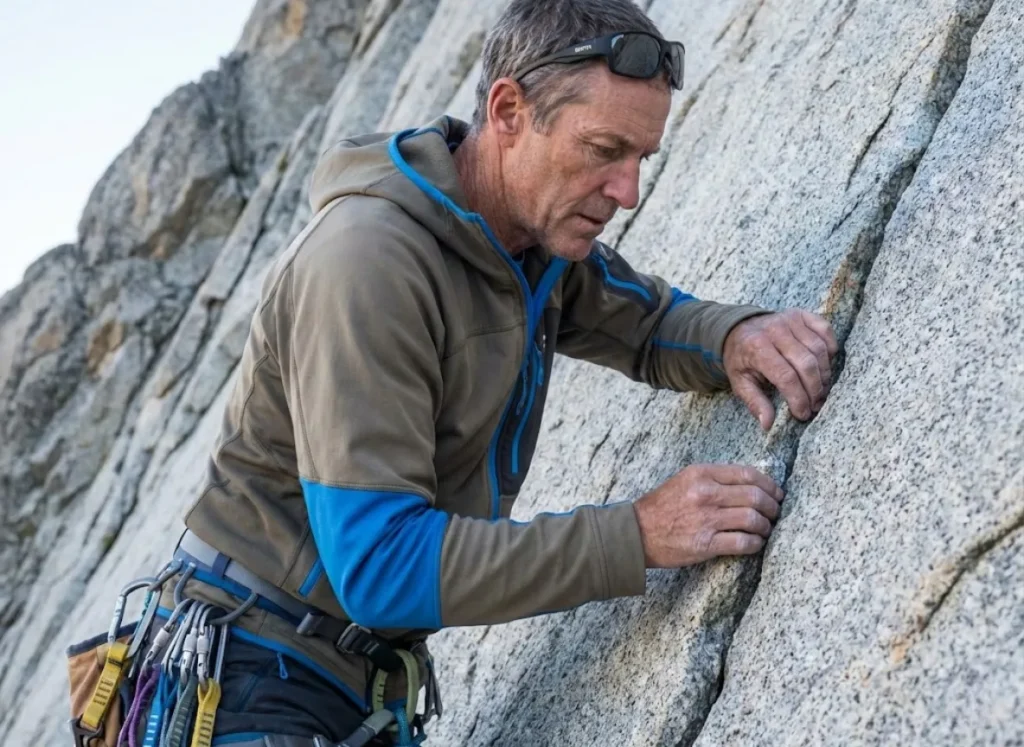
All the theory means nothing if you can’t apply it on the wall under pressure. These protocols turn knowledge into instinct.
The Tap Test Protocol
Before every placement, strike the rock with your knuckle, nut tool, or carabiner. Listen.
A sharp, high-pitched “ring” indicates solid, continuous rock. A low-frequency “thud” indicates a hollow space behind the surface—a detached block or flake.
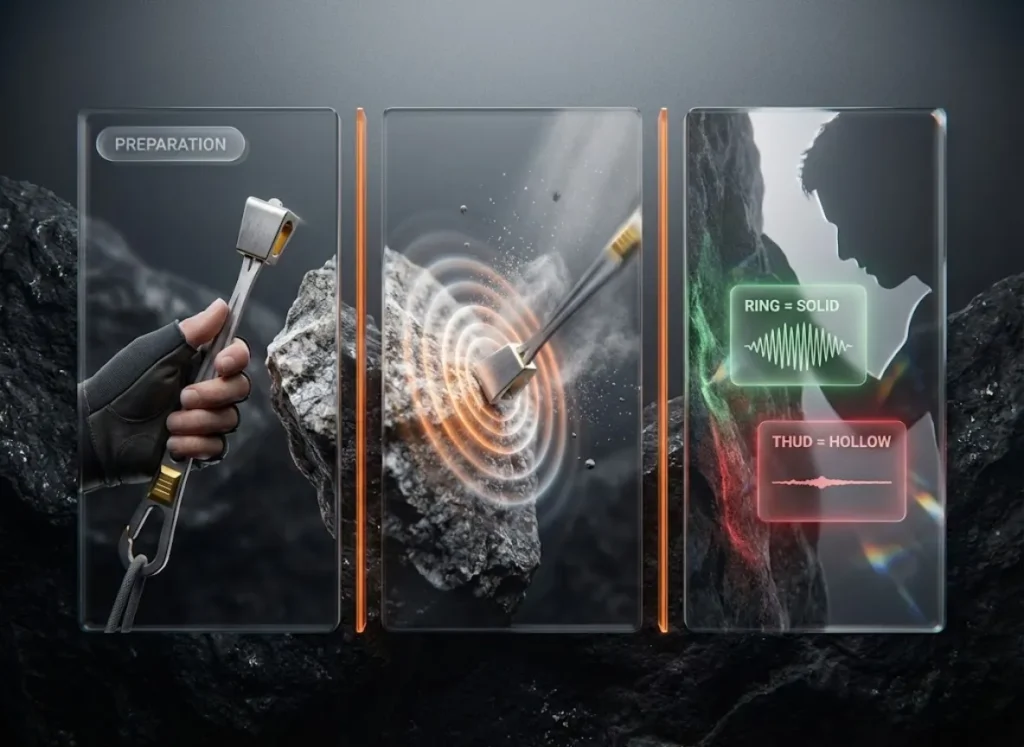
NEVER place cams in hollow-sounding rock. Cam lobe friction against a hollow flake acts like a hydraulic jack—expanding behind it levers the flake off the wall, creating both rockfall and anchor failure.
I tap every placement. It takes two seconds. The one time I skipped it, I pulled off a dinner-plate flake at my feet.
Visual Inspection: Reading Weathering Patterns
Train your eye for warning signs. Hairline fractures radiating from bolt holes indicate stress failure from previous loads. Light patches on red sandstone walls mean fresh breaks where the patina-layer is missing—softer, weaker rock underneath.
Heavy lichen growth obscures fissures. A “solid” crack may be filled with soil, dropping friction coefficients to near zero. Clean placements before trusting. A cam in detritus is a cam in nothing.
In alpine limestone, watch for exfoliation zones—thin layers that separate under load like pages of a book. Check knowledge of rockfall and anchor failure hazards before committing to alpine routes.
The Psychology of Loose Rock
Expert climbers treat loose rock management as a psychological skill. Accept that “solid” is a relative term. In alpine metamorphic rock or chossy sandstone, every hold is suspect until proven otherwise.
Soft movement keeps you alive. Keep your center of gravity directly over your feet. Pull DOWN, not out. Test holds with gradual force increase—let the rock tell you before you’re committed.
Pro tip: On my first alpine route in the Dolomites, I pulled off three handholds before learning to climb like I was diffusing a situation. Now that’s my default mode until the stone proves otherwise.
Conclusion
The gear in your rack is half the equation. The rock geology itself—crystalline structure, compressive strength, surface hardness, weathering state—is the other half.
Three takeaways to carry on every lead:
Know your numbers. Weak sandstone requires Fat Cams for load distribution. Strong granite rewards precision placement geometry. Match the gear to the rock class, not just the crack width.
Read before you rack. Patina color, rock quality tap-test resonance, and fracture patterns tell you what the rock can handle before you commit. Two seconds of assessment beats 200 feet of wondering.
Match the mechanism. Tricams for solution pockets. Offset nuts for pin scars. Brass micros for marginal seams. Using the right tool for the right rock is what separates confident leaders from those who just hope their gear holds.
The difference between hoping and knowing is geological fluency. Build that fluency, and you stop being a passenger on the rock—you become a practitioner of climbing style protection.
Now go send something.
FAQ
Can you use cams in limestone?
Yes, but with caveats. Limestone’s softness allows cam teeth to bite well, but high-traffic routes polish smooth, reducing grip. In slick, polished limestone, passive pro or offset gear often provides more reliable holding power than cams.
How do I know if sandstone is dry enough to climb?
Wait 48-72 hours after significant rain. Press the rock surface—if it darkens or leaves moisture on your hand, it’s still saturated. Wet sandstone can lose half its strength or more, and climbing too soon causes permanent damage.
What are offset nuts used for?
Offset nuts feature asymmetric geometry with tapers in multiple directions. This allows them to fit irregular, flaring placements—especially pin scars in granite—where standard symmetrical nuts would pull through.
Why do climbers use hexes instead of cams?
Hexes are passive protection with no moving parts, making them more reliable in wet or icy conditions where cam lobes might slip. They’re lighter, cheaper, and create a multi-directional anchor when properly seated.
How can I tell if a bolt is compromised by stress corrosion cracking?
You often cannot—the damage is invisible on the surface. In marine limestone environments, assume any standard stainless steel bolt over 3-5 years old is suspect. Rely only on titanium or specialized corrosion-resistant steel, and ask local organizations about recent bolt replacement projects.
Safety Notice: Rock climbing and mountaineering are inherently high-risk
activities that can involve physical trauma or fatal incidents. The information on Rock Climbing Realms is for
educational and informational purposes only. Techniques and advice presented here are not a substitute
for professional, hands-on instruction. Conditions and risks vary by location. Always seek guidance
from a qualified instructor before attempting new techniques. By using this website, you agree that you
are solely responsible for your own safety. Any reliance you place on this information is strictly
at your own risk, and you assume all liability for your actions. Rock Climbing Realms and its authors
will not be held liable for any harm, damage, or loss sustained in connection with the use of this information.
Affiliate Disclosure: We are a participant in the Amazon Services LLC Associates Program, an
affiliate advertising program designed to provide a means for us to earn advertising fees by advertising and linking
to Amazon.com. As an Amazon Associate, we earn from qualifying purchases. We are also an official affiliate partner
of Black Diamond Equipment via the AvantLink network. If you click on a Black Diamond affiliate link and make a
purchase, we may earn a commission at no additional cost to you. We also participate in other affiliate programs.
Additional terms are found in the terms of service.