
In this article
You trust the sheath to hold the fall, but the real threat to your lifeline isn’t the massive whipper—it’s the invisible geology grinding inside the core. A dirty rope is not a cosmetic annoyance; it is a mechanical hazard where microscopic quartz crystals act as internal razors, slowly shearing the load-bearing nylon fibers with every ascent.
As a climbing guide who has retired dozens of cords over the years, I’ve seen firsthand how neglect destroys gear faster than gravity does. This guide shifts outdoor gear maintenance from a chore to a critical safety ritual. We will cover the physics of grit, the chemistry of safe detergents, and the daisy-chain protocol required to extend the life of your most vital piece of life-safety equipment without creating a catastrophic tangle.
Why is Washing Your Rope a Safety Imperative? (The Physics)
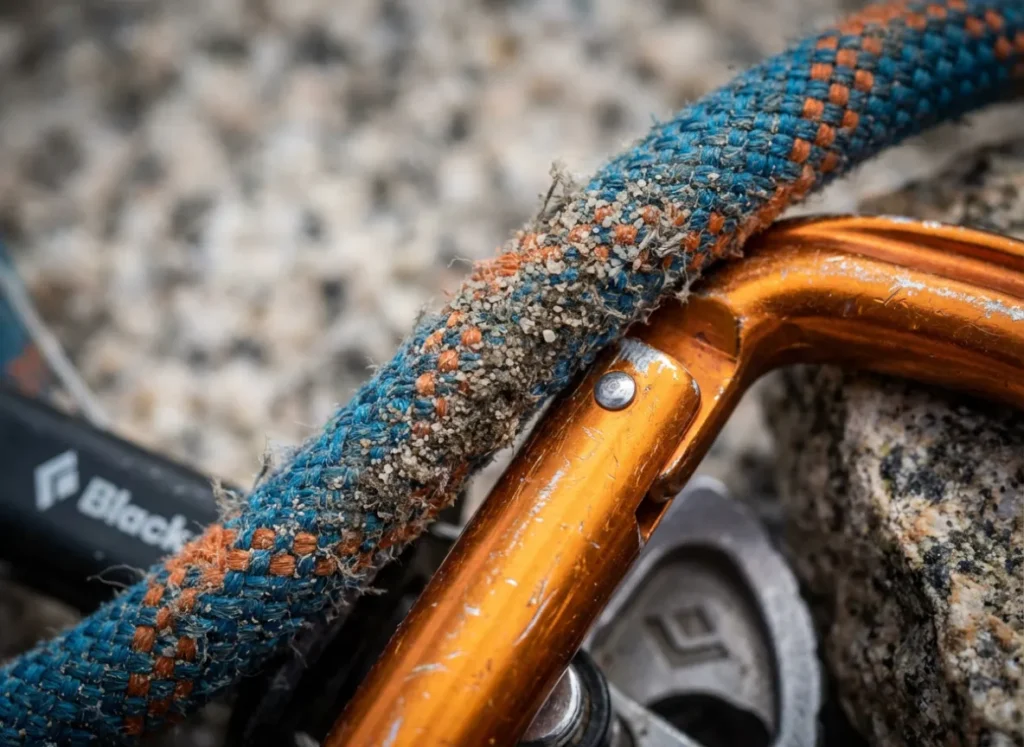
Washing your rope is a safety requirement because accumulated dirt particles migrate through the sheath and physically cut the load-bearing core strands during use. Whether you are dealing with gritty lead ropes or a fuzzy top-rope, the damage mechanism remains the same.
How Does Dirt Actually Damage a Climbing Rope?
The structural vulnerability of the kernmantle rope design involves particle migration. While the braided sheath is designed to take the brunt of rock abrasion, it is porous. Fine particulate matter passes through the braid via capillary action and settles into the twisted core strands. The problem lies in the Mohs Hardness Scale. Polyamide (Nylon) ranks at a soft 2-3, while common grit like Quartz (silica) ranks at a 7.
When these harder particles lodge between filaments, they act as an internal abrasive. Every time the rope is weighted, flexed, or knotted, these internal crystals saw through the polymers. This is why inspecting your rope for core shots is only half the battle; the micro-abrasion is often the most dangerous.
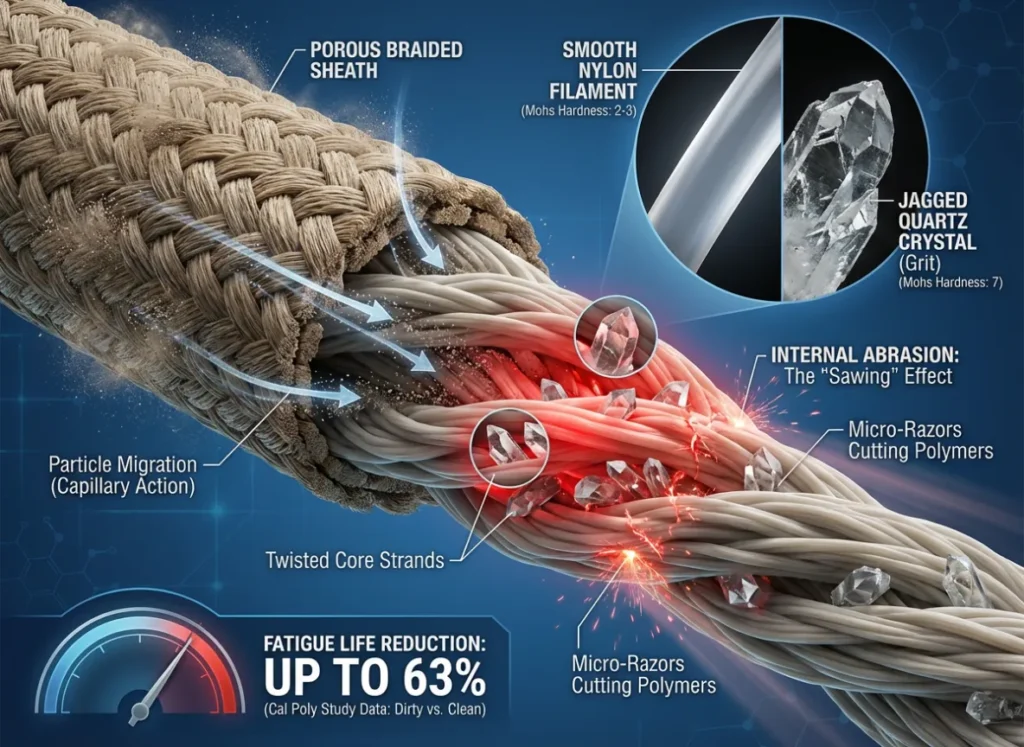
Scientific testing paints a grim picture for the unwashed rope. According to a California Polytechnic State University study on fatigue life, ropes contaminated with dirt suffer a drastic reduction in performance. In simulated environments, dirty ropes showed a drop in fatigue life of up to 63% compared to clean samples.
This damage is insidious because it occurs internally. A rope may look fuzzy on the outside, but the real structural compromise happens where you cannot see it. Washing acts as a mechanical extraction process, flushing these “internal razors” out of the core to restore the rope’s elasticity and energy-absorption capabilities.
What Cleaning Products Are Safe for Nylon? (The Chemistry)
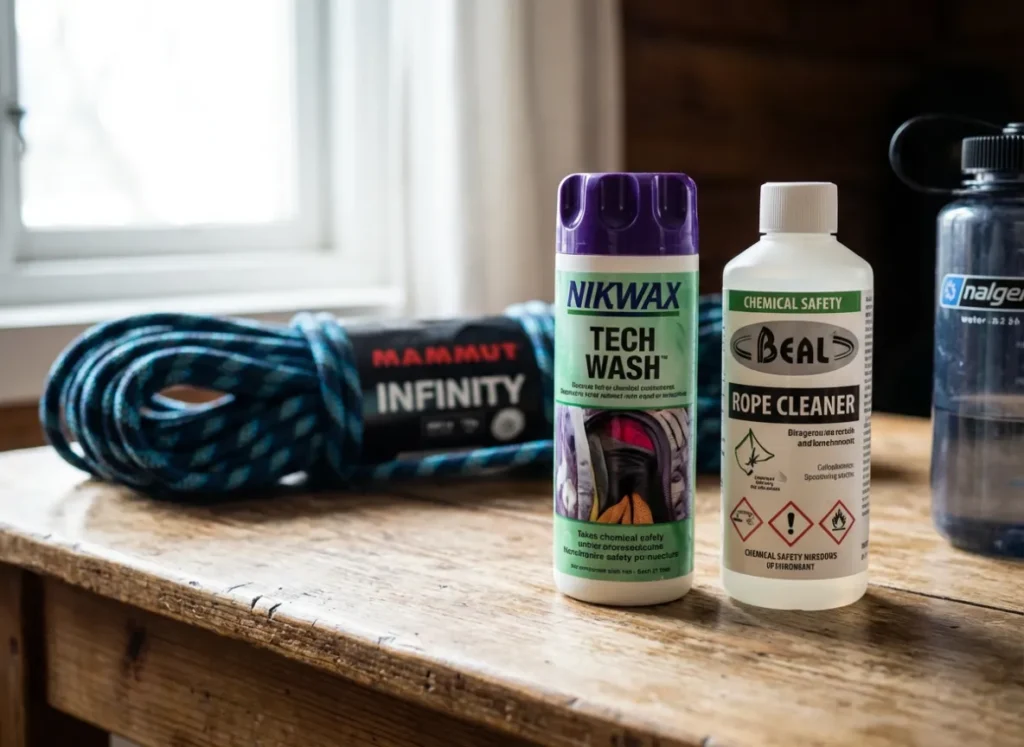 Beal Rope Cleaner sitting next to a coiled Mammut climbing rope on a wooden table.” class=”wp-image-12432″/>
The only safe cleaning products for climbing ropes are pH-neutral (range 5.5-8.5), surfactant-specific cleaners that are free of bleach, acids, and heavy degreasers. Using the wrong chemicals can void a manufacturer warranty from brands like Mammut, Black Diamond, or Petzl.
Safe vs. Unsafe Rope Cleaners
A comprehensive comparison of cleaning agents for climbing and technical ropes based on chemical safety and performance.
pH Profile
Balanced (Neutral) – Formulated to protect synthetic fibers.
Safety & Sustainability
High lubricant safety (for Nylon); High sustainability (Bluesign/Eco).
Residue Risk
Very Low – Rinses clean without affecting dry-treatments.
Sustainability
High – PFAS-free formulations are standard for this category.
Lubricant Safety
Moderate – Dilution is critical to prevent stripping fiber lubricants.
pH Profile
Varies – Essential to check Safety Data Sheets (SDS) before use.
Risk Factors
Alkaline pH and aggressive surfactants reduce rope life and leave hydrophilic residues.
Performance
Strips essential grease/lubricants; high foaming agents make rinsing difficult.
Which Chemicals Must You Strictly Avoid?
Nylon 6 and 6.6 are critically vulnerable to acid hydrolysis. In this chemical process, hydrogen ions attack the amide linkages in the polymer chain, causing rapid chain scission. This leads to catastrophic strength loss that is often invisible to the unaided eye. The UIAA Safety Commission guidelines on chemical exposure confirm that any substance with a pH below 5.5 (acidic) or above 9.0 (highly alkaline) is a danger zone.
This means standard heavy-duty detergents and bleach are absolute prohibitions. Even common household “hacks” involving vinegar or tile cleaners are dangerous due to potential acidic residues. These residues can remain active deep in the core long after the rope dries. This chemical sensitivity is a major factor when tracking the lifespan of your climbing gear.
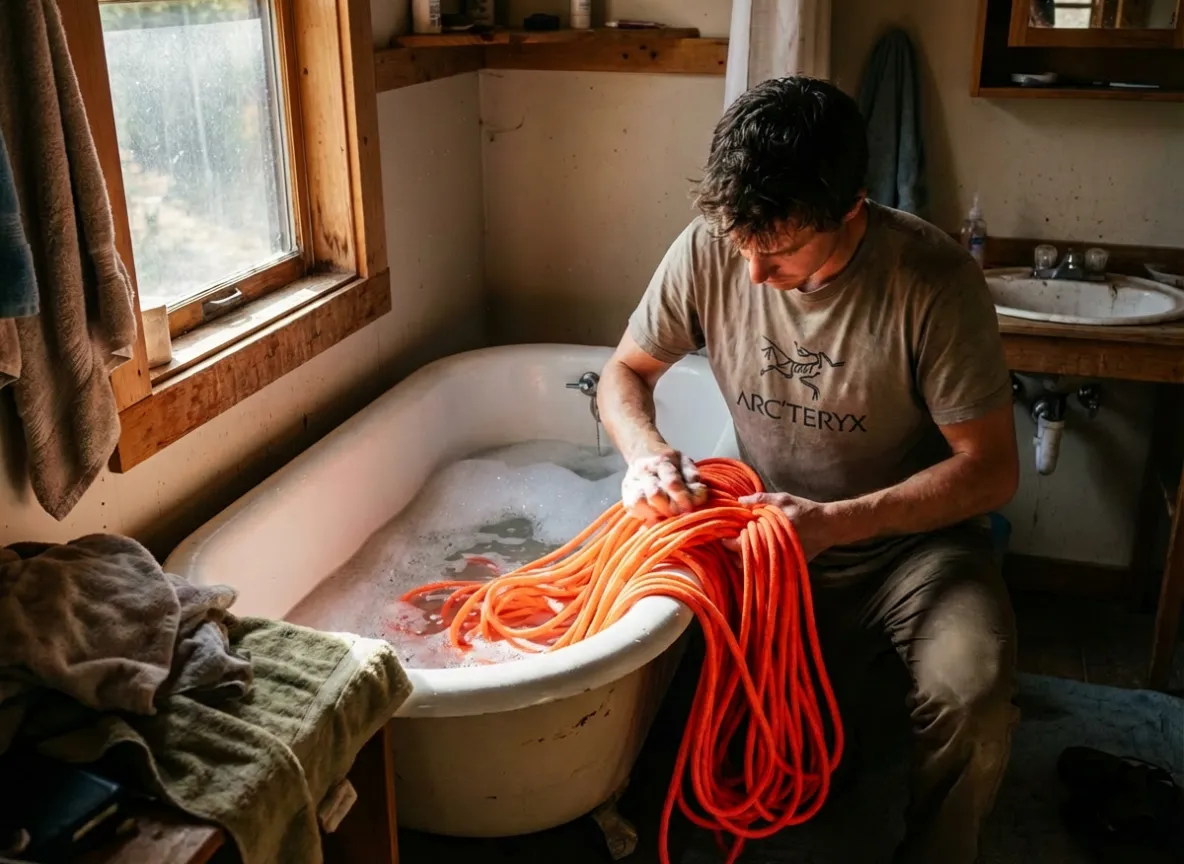
Pro-Tip: The Bathtub Contamination Vector is real. Before soaking your rope, scrub your bathtub thoroughly. Residual bleach or harsh bathroom cleansers from your last cleaning session can silently compromise the rope during the wash.
What Are the Best Eco-Friendly Rope Washes?
The ideal cleaner is a pH-balanced (neutral), oil-safe surfactant designed to lift organic soil and inorganic silica without stripping internal lubricants. Top-tier options include specialized rope washes like Beal Rope Cleaner, Sterling Wicked Good, or Edelweiss Rope Wash. These are formulated to maintain the “hand” or suppleness of the rope, ensuring optimal belay device performance.
For generic alternatives, mild soaps are acceptable only if heavily diluted. Some climbers suggest Woolite or even baby shampoo, but you must ensure they contain no bleach or brighteners. A biodegradable soap like Dr. Bronner’s Sal Suds (diluted significantly) is a common “greener clean” choice. However, avoid dish soaps like Dawn unless absolutely necessary, as they are aggressive degreasers that can strip the chemical finishes that rope makers apply to reduce friction.
You should also be wary of generic enzymatic detergents. Research into the biohydrolysis of nylon 6,6 suggests a theoretical risk where non-specific proteases might interact with technical textiles. While the risk is debated on forums like Climbing.com, using a rope-specific cleaner eliminates this variable.
Residue profile is another critical factor. Technical washes are engineered to rinse out completely. Hydrophilic residues left by standard soaps attract water, which can lead to freezing in alpine conditions. This is critical for maintaining your dry-treated rope, as soap scum can mask the hydrophobic coating, rendering it useless.
How Do You Wash a Rope Without Ruining It? (The Procedure)
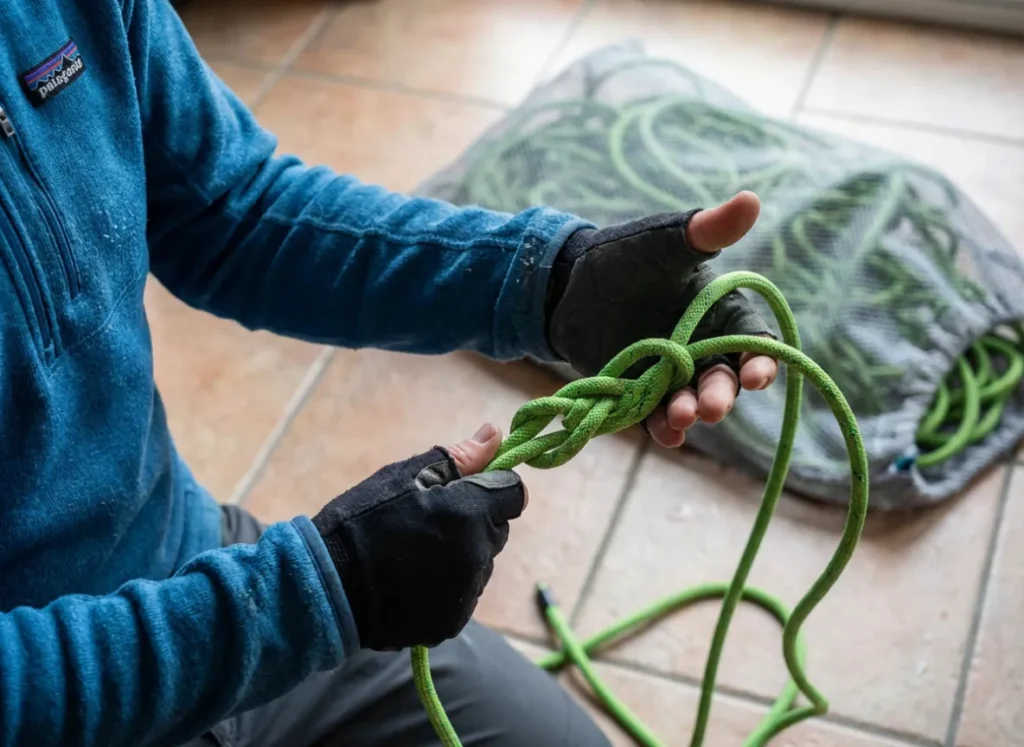
To wash a rope without ruining it, you must daisy chain it to prevent tangling and use water no hotter than 30°C (86°F) to avoid thermal damage to the nylon. This step-by-step tutorial works whether you are in a laundry room or a campground shower.
How Do You Prepare the Rope to Prevent Tangles?
Never wash a loose rope. The turbulence of water in a machine or a tub will cause “knot nucleation,” creating tight tangles that are nearly impossible to undo when wet. The mandatory technique is the Daisy Chain (or Chain Sinnet).
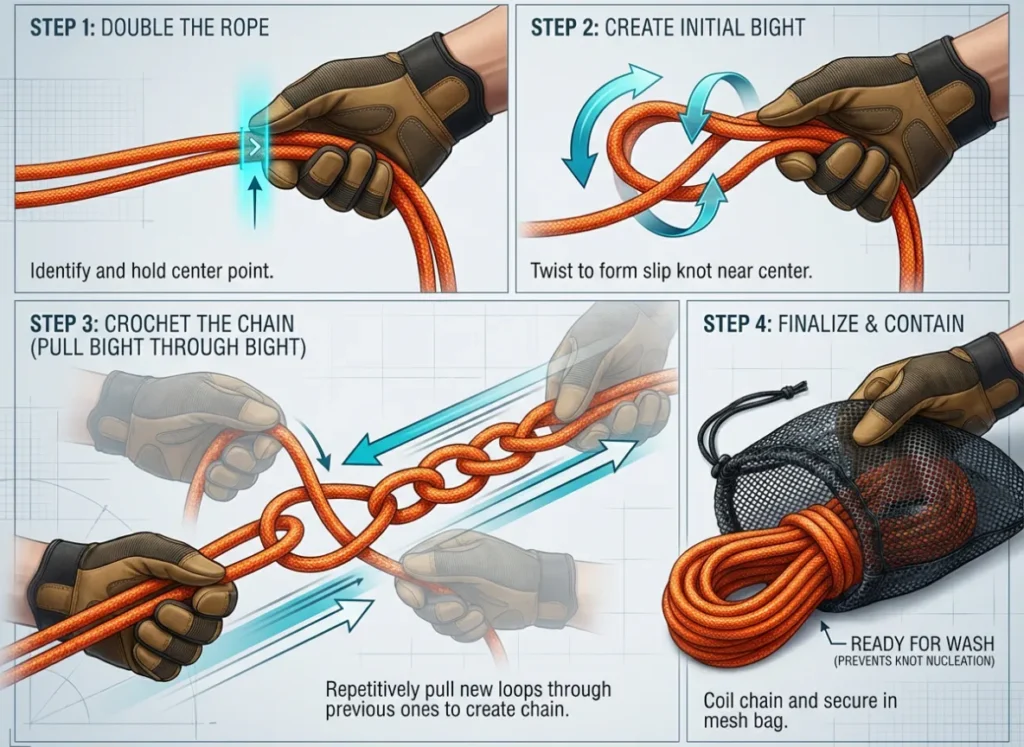
By doubling the rope and crocheting it into a semi-rigid chain, you reduce its degrees of freedom while still allowing water penetration. Placing this daisy-chained rope inside a mesh laundry bag (or an old pillowcase tied with a slip knot) adds a secondary layer of protection against abrasion. This geometry prevents the rope from wrapping around the agitator or getting stuck in the door seal.
Pro-Tip: If you are hand-washing, the daisy chain makes the rope manageable to lift and rinse. It prevents you from dragging the ends across a potentially dirty shower floor.
When the wash is done, the “flake out” process is simplified. The chain naturally undoes itself without kinks when pulled from the end, which aligns with the UIAA Conference on Nylon and Ropes summary regarding the handling of wet nylon.
Machine Wash vs. Hand Wash: Which Method is Superior?
Machine Wash Protocol:
If you choose a machine, use a front-load washing machine on a “Wool” or “Delicate” cycle. This minimizes mechanical agitation. You must eliminate the spin cycle or set it to the absolute minimum. Centrifugal force can herniate the core strands through the sheath if the spin is too aggressive. Simply throw the rope into the washing machine with a mild detergent—but only if it is contained in a mesh bag.
Hand Wash Protocol:
Use a clean bathtub or a deep bucket with lukewarm water. Manually agitate the rope using a swishing motion for 10-15 minutes to work the surfactant into the core. This gives you tactile feedback on the rope’s condition. You can check for flat spots, stiffness, or minor rope damage while you wash.
Temperature Limit:
Regardless of the method, the water must never exceed 30°C (86°F). Higher temperatures push wet nylon closer to its glass transition phase, causing sheath shrinkage and stiffening. This affects the handling characteristics discussed when understanding different climbing rope types.
Rinsing is as important as washing. You must run multiple rinse cycles or fill the tub with clean water repeatedly to remove all surfactant. Residue attracts dirt and water. This mechanical removal of grit is supported by ResearchGate publication on abrasive particles, which highlights the necessity of cleaning to preserve fatigue life.
Finally, managing your wastewater aligns with following the Climber’s Pact. We wash our gear to stay safe, but we do it responsibly to protect the places we play.
The Clean Rope Standard
A dirty rope is a compromised rope. The science is clear: dirt is a mechanical abrasive that drastically reduces gear longevity. By using pH-neutral chemistry and strictly adhering to the daisy-chain protocol, you can remove these “internal razors” without damaging the polymer structure.
For drying, avoid direct sunlight and UV rays. Hang the chain over a shower-curtain rod or lay it on a towel in a cool/dry place for 24-48 hours. Proper rope care, including using a rope tarp or rope bag at the climbing area, extends the life of your gear. If you find frayed ends during inspection, use a heat cutter to seal them, ensuring the mantle doesn’t retract.
Share your own “before and after” washing results or tips for drying ropes in small apartments in the comments below to help the community refine its maintenance protocols.
FAQ – Frequently Asked Questions
How often should I wash my climbing rope?
Wash your rope whenever it becomes visibly dirty or leaves black residue on your hands. For moderate users, this is typically once or twice a season. Frequent climbers may need to wash monthly to prevent grit accumulation from damaging the core.
Can I use vinegar or bleach to clean my rope?
Absolutely not. Vinegar is acidic and bleach is a strong oxidizer; both can chemically degrade the nylon polymer and compromise the rope’s strength. Always use a pH-neutral soap specifically designed for synthetic technical fabrics.
How long does a climbing rope take to dry?
A climbing rope typically takes 24 to 48 hours to dry completely when air-dried in a cool, shaded area. Factors like humidity and air circulation heavily influence this time. Never use heat sources like radiators or direct sunlight to speed up the process.
Will washing my rope wash off the Dry treatment?
Washing with a gentle, non-detergent soap actually improves the performance of Dry treated ropes. It removes the dirt that covers the water-repellent coating. However, the treatment does wear off over time, and re-proofing products (like Nikwax Rope Proof) can be used to restore it.
Safety Notice: Rock climbing and mountaineering are inherently high-risk
activities that can involve physical trauma or fatal incidents. The information on Rock Climbing Realms is for
educational and informational purposes only. Techniques and advice presented here are not a substitute
for professional, hands-on instruction. Conditions and risks vary by location. Always seek guidance
from a qualified instructor before attempting new techniques. By using this website, you agree that you
are solely responsible for your own safety. Any reliance you place on this information is strictly
at your own risk, and you assume all liability for your actions. Rock Climbing Realms and its authors
will not be held liable for any harm, damage, or loss sustained in connection with the use of this information.
Affiliate Disclosure: We are a participant in the Amazon Services LLC Associates Program, an
affiliate advertising program designed to provide a means for us to earn advertising fees by advertising and linking
to Amazon.com. As an Amazon Associate, we earn from qualifying purchases. We are also an official affiliate partner
of Black Diamond Equipment via the AvantLink network. If you click on a Black Diamond affiliate link and make a
purchase, we may earn a commission at no additional cost to you. We also participate in other affiliate programs.
Additional terms are found in the terms of service.