

In this article
Gravity exerts roughly 5 kilonewtons of force on a falling body in mere milliseconds. At that specific moment of impact, your climbing harness ceases to be a fashion accessory and becomes the sole biomechanical interface between survival and catastrophe. A label that says “Medium” offers no guarantee of safety if the geometry does not mechanically interlock with your skeleton.
In my years guiding students from the crag to alpine climbing summits, I have seen that the difference between a comfortable catch and a traumatic injury often lies not in the brand, but in the precision of the fit. We need to move beyond generic harness size charts.
This guide will walk you through the Iliac Anchor, the geometry of Rise, and the Suspension Audit—a proprietary protocol to verify your technical rock climbing gear is ready to catch you, whether you are sport climbing or enduring a punishing mountaineering objective.
Why is the “Finger Test” Insufficient for Safety? (The Biomechanical Foundation)

The “finger test” is a subjective heuristic that fails to account for the violence of a fall. Safety requires objective verification that the harness waist has mechanically interlocked with the pelvic structure to prevent ejection. Relying on a “feeling” of snugness is dangerous when physics dictates that soft tissue compresses and nylon slips under force.
What is the “Iliac Lock” and why is it non-negotiable?
The Iliac Crest is the bony, superior ridge of your pelvis. In the context of fall arrest, this bone acts as the primary “shelf” for your waistbelt. The “Iliac Lock” occurs only when the waistbelt is tightened to a waist circumference smaller than this crest and sits strictly superior to (above) the bone.
This mechanical positioning is the only defense against inversion ejection. If you flip upside down during a fall, gravity attempts to pull you out of the harness. Friction is unreliable here. Under the high-velocity load of a fall (approx. 3,300 lbf), nylon slips easily over synthetic clothing like yoga pants or smooth shell pants.

The two-finger rule is too subjective to trust. The Slide Test—forcibly pushing the buckled belt down over the hipbones—is the only objective pass/fail metric.
Failure to engage the iliac shelf forces the harness to rely on soft tissue compression. This shifts the impact force to the stomach, which can lead to internal abdominal injury.
We must adhere to the UIAA Standard 105 regarding harness construction and testing, which dictates the baseline safety standards and force testing requirements for CE certified and UIAA certified gear. However, a harness that passes the lab test will fail in the field if it isn’t anchored to your skeleton.
How does “Rise” determine whether a harness will hurt you?
Rise is the fixed vertical distance between the inguinal crease (where leg loops sit) and the natural waist (where the waistbelt sits). This distance is dictated by the length of the belay loop and the connector strap (or haul loop connection).
A climber with a “Short Torso” wearing a “Long Rise” harness will suffer immediately. The waistbelt will be forced up into the floating ribs, restricting breathing.
Conversely, a climber with a “Long Torso” wearing a “Short Rise” harness will find the waistbelt pulled down onto the hips, bypassing the Iliac Lock entirely.

The industry labels these geometries as “Men’s” (Short Rise) and “Women’s” (Long Rise), but these are misnomers. Selection must be based on biometric measurement, not gender. A women-specific harness often features a longer rise to accommodate women’s anatomy or curvy hips, but many male climbers with high waists find a better fit here too.
I frequently recommend testing women’s harnesses for fit and comfort for anyone who needs that specific geometry. A unisex harness or models like the Black Diamond Momentum offer a middle ground, but specific harness models like the Arc’teryx AR-395a or Black Diamond Solution cater to specific torso lengths.
Construction style matters as well. Wireframe constructions (like the Petzl Sitta or Edelrid Sendero) typically feature shorter rises compared to Traditional Foam models with thick swami belts.
Current research on harness suspension evaluation and anthropometry corroborates that matching this geometric fit is critical for minimizing suspension trauma.
Pro-Tip: Measure your “crotch-to-navel” distance with a soft tape measure before shopping. Compare this against the harness specifications if available, or bring the tape measure to the shop.
What is “The Suspension Audit” and How Do I Perform It? (The Practical Protocol)

The Suspension Audit is a three-phase testing framework designed to validate the harness’s performance under load. It moves you from a passive consumer to an active risk manager.
How do I execute the “Static Check” and “Slide Test”?
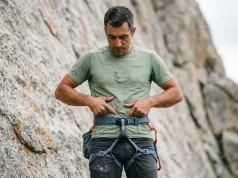
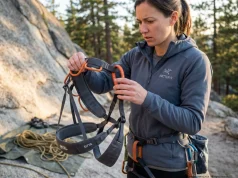
Begin with the Step-In Protocol. Loosen all straps fully before stepping in. Pull up like pants, bringing the waistbelt up to the belly button height before you even touch the leg loops. The primary cinch must happen first to isolate the anchor point.
Verify the buckle is doubled-back if it is a manual thread design. Most modern gear uses auto-locking buckles or speed buckles, but verifying the buckle threading is vital for any harness.
Now, perform the Slide Test. Place your thumbs inside the belt and push downward with significant force. If it slides over your hipbones, the fit is a FAIL.

Follow this with the Flat Hand Rule. A flat hand (roughly 3-5 finger widths) should slide snugly between the abdomen and belt, but you should not be able to make a fist (The Fist Test). This balance ensures the Iliac Lock is engaged without causing abdominal binding.
Medical data on the effect of clothing and binding on inhalation volume validates the risk of over-tightening; you must maintain respiratory efficiency. This static security is foundational to safety protocols for belaying in climbing, where you may be holding a suspended load for extended periods on belay ledges.
Finally, check for Tail Length. Ensure at least 3 inches of webbing extend past the buckle to account for slippage or the addition of winter layers. A harness that fits tight on summer shorts might not close over an alpine kit.
How do I evaluate Hemodynamic Safety while hanging? (The “Dead Hang”)
Static security is mandatory, but climbing is dynamic. You must test the interface while suspended. Perform the Dead Hang by suspending your full body weight for at least 2 minutes. Relax your core completely to test the harness’s “bucket” structure and hanging belay comfort.
During the hang, monitor for Hemodynamic Safety. If you feel tingling in the toes or legs, the leg loops are acting as a tourniquet on the femoral artery. This is a fail.
Simultaneously, perform the Breath Test. Attempt a deep “belly breath.” Restriction here indicates the waistbelt is too high or too tight, compromising oxygen intake.
This test is critical because pathology of suspension trauma and orthostatic intolerance shows that venous pooling can lead to unconsciousness in under 10 minutes.
If you feel a pinch, try loosening the rear adjustment strap or the leg loops slightly. This can lower the pressure point away from the femoral triangle without compromising safety. This simple adjustment is often the key to preventing common climbing dangers associated with hanging belays.
Before you finish, perform a High Step Test or Lunge Test. Ensure the elastic straps and leg loops allow for full range of motion required for high steps on sport routes.
Pro-Tip: Pay attention to material stiffness. WARP technology (like on the Arc’teryx AR-395a) distributes load differently than Foam Laminate (like on the Black Diamond Solution or Petzl Aquila). Thinner materials may “bite” more if the fit is imperfect, requiring a more precise size match.
When Should I Retire My Climbing Harness? (Lifecycle & Integrity)

A perfectly fitted harness is still a consumable good. We must establish a clear retirement protocol based on degradation and fit-to-lifespan ratio, moving beyond simple “age” to “condition.”
How do I identify “Structural Fuzz” versus cosmetic wear?
Inspect the lower tie-in points first. This area endures the “Sawing Effect” of the rope and belay loop friction. Look for significant “furring” or abrasion. Many brands, including Petzl and Mammut, embed a Red Wear Indicator. If you see red thread, the structural integrity is compromised—retire it immediately.
Also, look for Chemical Necrosis. This appears as discoloration or “bubbling” on the straps, often caused by silent exposure to battery acid or bleach. This is an immediate fail.
Regarding lifespan, follow the 10-Year Rule. Polymer degradation occurs via oxidation even in storage. Retire gear 10 years post-manufacture date, regardless of use.
For active climbers or a well-cared-for harness, the timeline is shorter. The safe lifespan of tie-in points is typically 1-3 years due to micro-abrasion from taking a big whipper or repetitive rope climbing. Determining the true lifespan of a climbing harness requires vigilance.
While metal gear suffers micro-fractures, soft goods suffer premature wear and fiber fatigue. If the webbing feels stiff or dried out, it lacks energy-absorbing capacity. Studies on the impact of harness fit on suspension tolerance link the quality of the gear directly to survival times.
Final Verification
A harness is not just a strap; it is a life-support system.
- The Iliac Lock prevents ejection; verify it with the Slide Test (ensure it sits above hipbones).
- Rise Matching ensures the harness fits your torso length, preventing respiratory restriction.
- The Dead Hang validates that you are safe from suspension trauma and verifies hanging belay comfort.
- Retirement is mandatory when Red Wear Indicators appear or the 10-year mark is reached.
Take your current rig to the gym this week. Hang for two minutes. Perform the audit. Verify your interface before your next crux.
FAQ – Frequently Asked Questions about Climbing Harness Fit
How tight should my climbing harness be?
The waistbelt should be tight enough that you cannot push it down over your hipbones (The Slide Test), but loose enough to slide a flat hand underneath. You should not be able to make a fist between the belt and your body; this ensures the anchor is secure without restricting diaphragm movement.
Can I fall out of my climbing harness if I flip upside down?
Yes, if the waistbelt is too loose or positioned below the iliac crest, a violent inversion can cause the harness to slide off. Ensuring the Iliac Lock (waistbelt secured above the hipbones) mechanically prevents the harness from sliding down the torso during an inverted fall.
Why do my leg loops hurt when I hang?
Pain usually indicates the leg loops are positioned too high in the crotch (compressing soft tissue) or are too tight, restricting blood flow. Adjust the rear adjustment strap to lower the leg loops slightly so the wide part of the foam padding supports the thigh muscles rather than the groin crease. Adjustable leg loops (common on the Black Diamond Momentum) offer more flexibility here than fixed leg loops.
How many years does a climbing harness last?
Most manufacturers mandate a maximum lifespan of 10 years from the date of manufacture (not purchase), even if unused. With regular weekly use, the structural tie-in points often wear out in 1 to 3 years; retire immediately if you see the red wear indicator or severe fuzzing.
Safety Notice: Rock climbing and mountaineering are inherently high-risk
activities that can involve physical trauma or fatal incidents. The information on Rock Climbing Realms is for
educational and informational purposes only. Techniques and advice presented here are not a substitute
for professional, hands-on instruction. Conditions and risks vary by location. Always seek guidance
from a qualified instructor before attempting new techniques. By using this website, you agree that you
are solely responsible for your own safety. Any reliance you place on this information is strictly
at your own risk, and you assume all liability for your actions. Rock Climbing Realms and its authors
will not be held liable for any harm, damage, or loss sustained in connection with the use of this information.
Affiliate Disclosure: We are a participant in the Amazon Services LLC Associates Program, an
affiliate advertising program designed to provide a means for us to earn advertising fees by advertising and linking
to Amazon.com. As an Amazon Associate, we earn from qualifying purchases. We are also an official affiliate partner
of Black Diamond Equipment via the AvantLink network. If you click on a Black Diamond affiliate link and make a
purchase, we may earn a commission at no additional cost to you. We also participate in other affiliate programs.
Additional terms are found in the terms of service.