
In this article
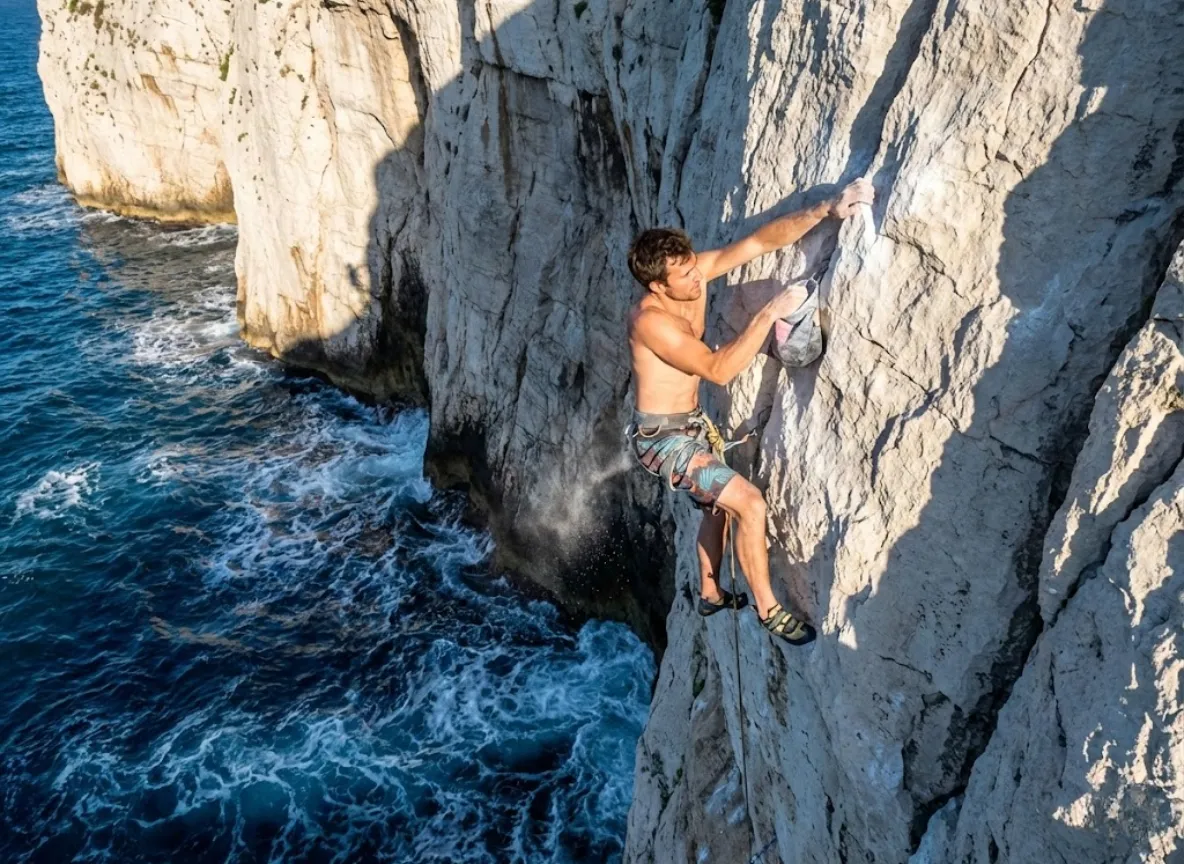
The interface where limestone cliffs meet the restless energy of the sea creates a climbing environment unlike any other. It is governed not by rope drag or bolt spacing, but by the chaotic hydrodynamics of the swell.
I’ve spent years guiding on both granite spires and sea cliffs, and the difference is stark. On a standard crag, the ground doesn’t move. In Deep Water Soloing (DWS), the “ground” is a living, shifting entity that can be a soft pillow one moment and a hydraulic hammer the next.
Damian Cook understood this better than anyone. He didn’t just climb these walls; he codified the language used to interpret them, transforming the wild Dorset coast and the cliffs of Swanage into a navigable athletic arena. Sadly, the ocean tragically claimed him in 2004.
To understand his life is to inherit a vital legacy: the knowledge that in this purest form of climbing, the water is often a greater adversary than the rock. This article examines his contribution to rock climbing history and extracts a rigorous safety framework from the tragedy that ended his life.
Who Was the Real Damian Cook? (Identity & Disambiguation)
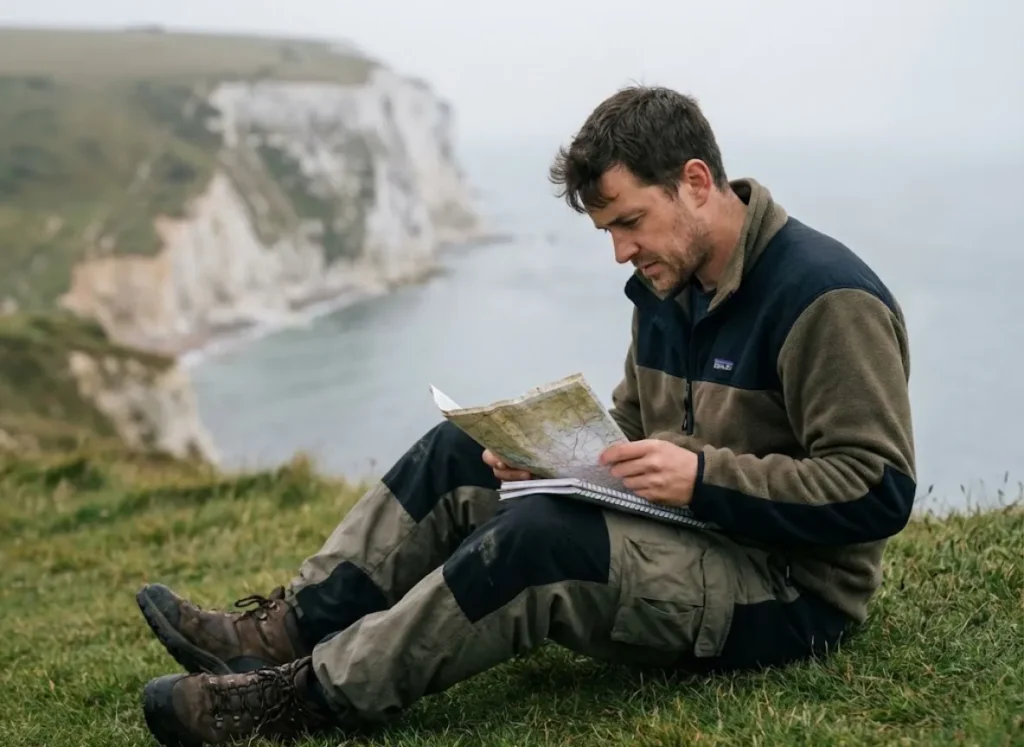
The primary source of confusion regarding this name stems from the prominent digital footprint of Damien Cook (spelled with an ‘e’), the active Australian Rugby League player. It is vital to correct the record immediately.
Damian Cook (with an ‘a’) was a British rock climber and author active in the 1990s and early 2000s. His climbing career and life ended nearly a decade before the rugby player’s professional debut in 2013. Their legacies are entirely separate.
Cook was a computer lecturer at Nescot College in Epsom and later a resident of Boscombe, UK. He was a dedicated father-of-two, a husband to Eszter Cook, and a brother to Joff Cook. Along with his father Bruce Cook, they remain custodians of his memory.
In niche sports like ours, accurate biographical explanation and historical record-keeping are essential. We must ensure the preservation of digital cultural heritage to maintain the contributions of pioneers against the noise of mass-media sports.
How Did Cook Revolutionize Deep Water Soloing? (History & Routes)
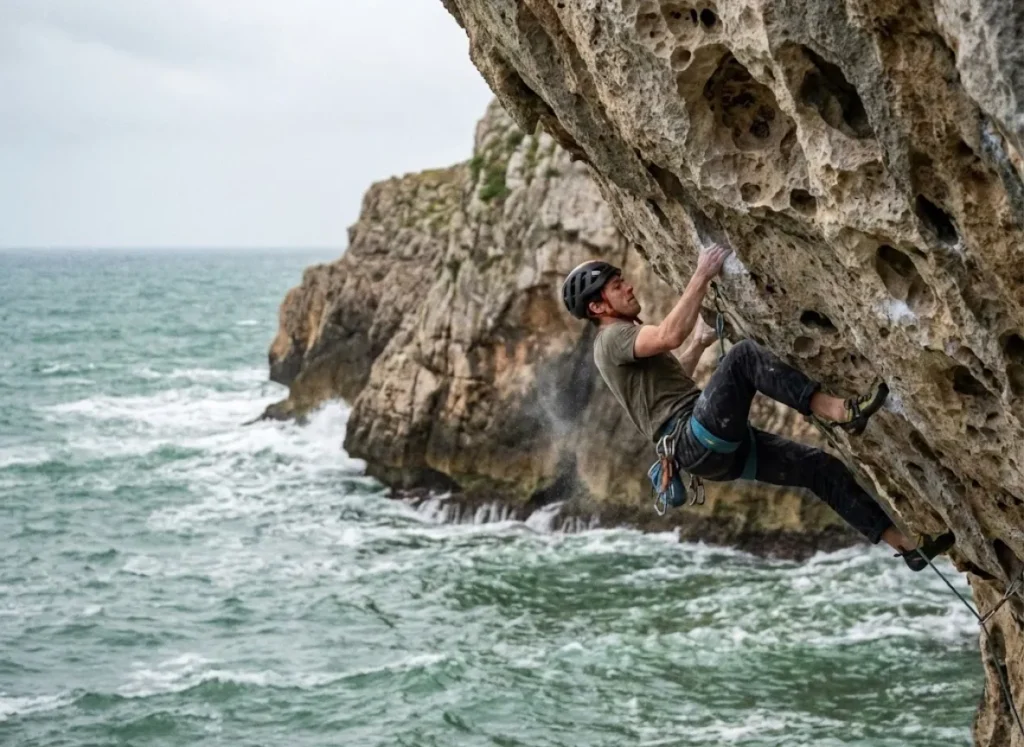
Damian Cook’s most tangible contribution to the British climbing community was the seminal 1996 guidebook Into the Blue, which he co-authored with Ron Pritchard. Before this publication, DWS in the UK was largely an “oral tradition” of secret spots and local hearsay.
Into the Blue legitimized the sport. It democratized the coastline, transforming DWS pioneering from a fringe “daredevil” pursuit into a respected sub-discipline recognized by the Climbers’ Club. It opened up areas like Portland and Wallsend Crag to a new generation.
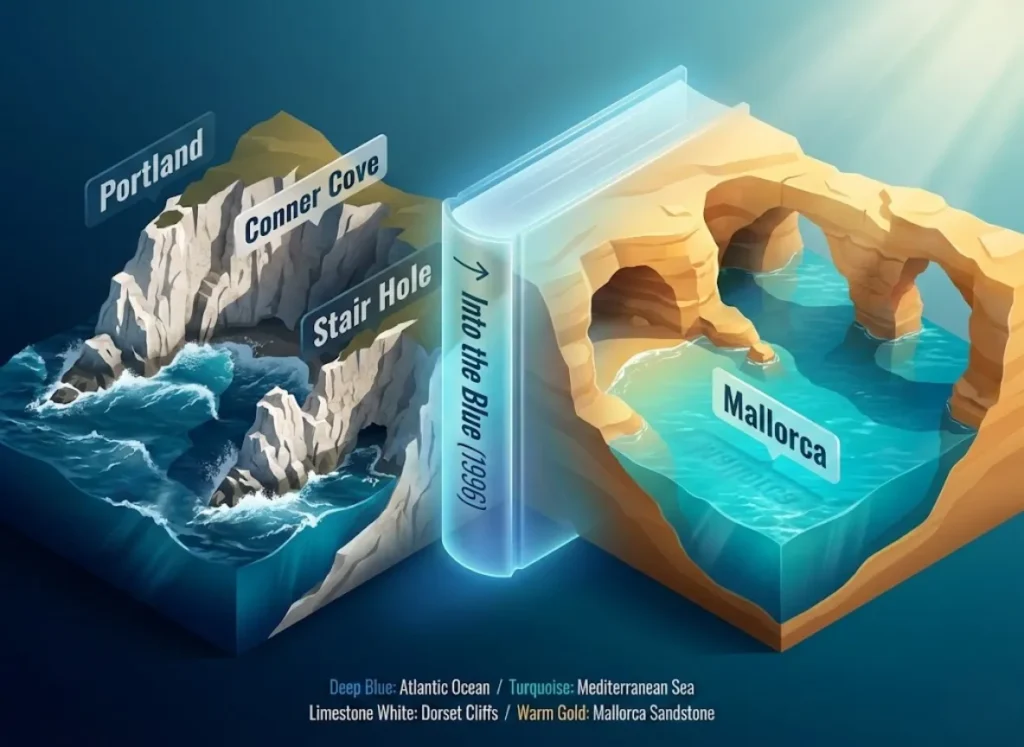
The Invention of the S-Grade
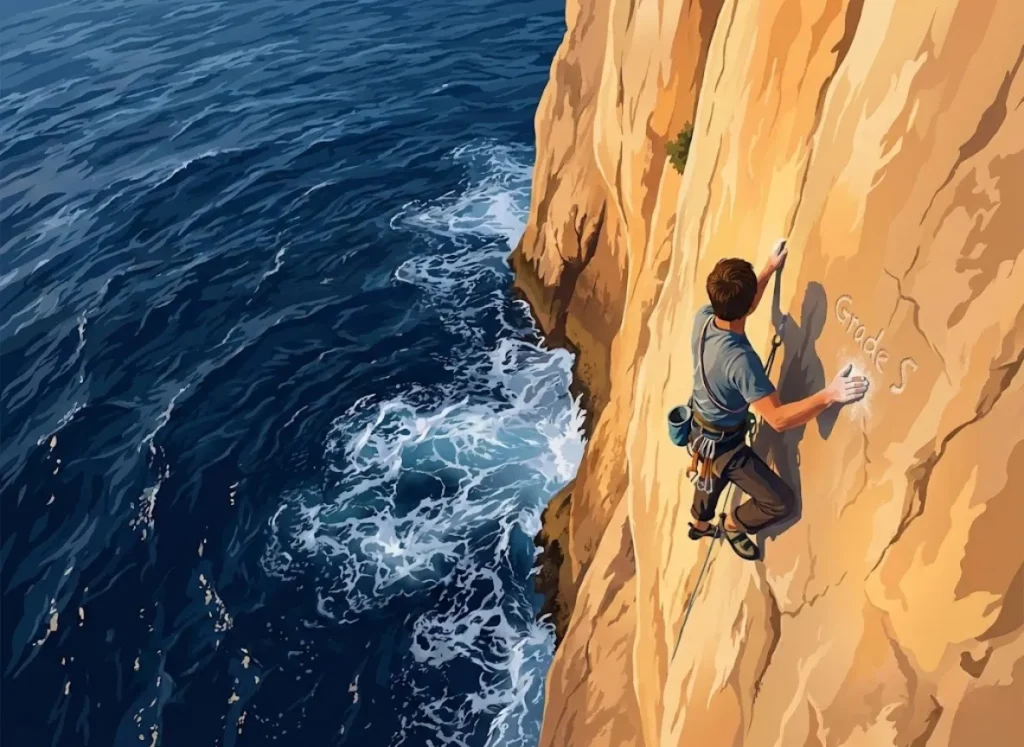
Cook realized that standard British trad climbing grades failed to account for the specific risks of the ocean. He helped formalize the “S-grading” system (S0-S3). This metric quantifies risk based on water depth, fall safety, and tidal windows rather than just technical difficulty.
This allowed climbers to distinguish between a hard route with a safe fall (S0) and an easy route with high consequences (S3). Whether you are a trad and sport climber or a specialist, this distinction is vital.
Pro-Tip: When reading a DWS guide, treat the S-grade with as much respect as the technical grade. An S0 fall is a splash; an S3 fall involves underwater ledges, shallow reefs, or difficult extraction.
Cook adapted the Mallorcan psicobloc style to the colder, more volatile waters of the English Channel. The British Geological Survey regarding Jurassic Coast stability notes the unique, shifting nature of these cliffs.
Cook mastered this terrain on routes like Frazzled (often graded around 7a or 7b depending on conditions) and Freeborn Direct. He also established lines with personal significance, such as To Hungary for Love.
If you are unfamiliar with how to read these difficulty ratings, refer to a climbing guidebook decoder to understand the interplay between technical movement and environmental risk.
| Comparison of Traditional E-Grade and DWS S-Grade | ||
|---|---|---|
| Feature | Traditional E-Grade (Trad) | DWS S-Grade (Deep Water Solo) |
| Primary Risk Factor | Ground fall, hitting ledges | Water hazards, hitting underwater rocks |
| Protection | Mechanical (cams, nuts) | Water depth & sea state |
| Assessment | Visual inspection of cracks | Observation of tides & swell |
| “Safe” Rating | E1 (usually good gear) | S0 (Safe deep water fall) |
What Happened at Porto Cristo? (The Accident Analysis)
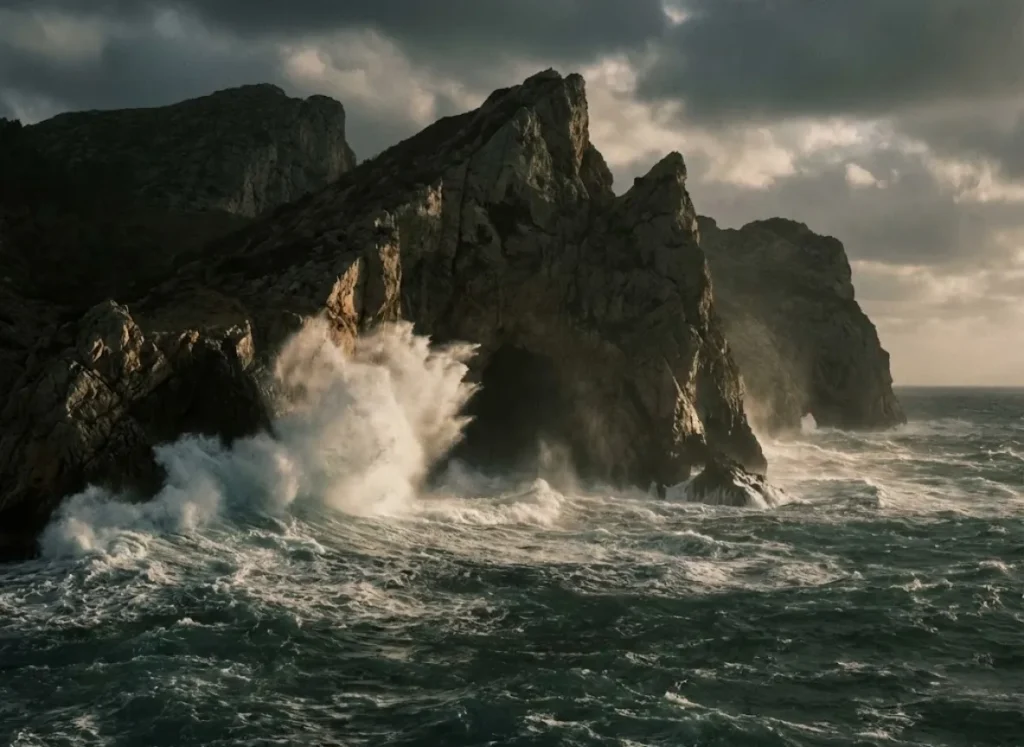
On April 28, 2004, Damian Cook was climbing at the Cova del Diablo near Porto Cristo, Mallorca. His wife, Mrs Cook (Eszter), and family were present. The environmental factors on this day were the critical variables that escalated the risk.
The sea was rough, characterized by heavy swell and what witnesses described as “treacherous currents.” Cook fell into the water—a standard occurrence in solo climbing. The fall itself did not injure him.
However, the National Weather Service guide to wave-current interaction explains how swell hitting a cliff face creates chaotic, aerated water that offers little buoyancy and unpredictable directional force.
The “Exit Gap” Phenomenon
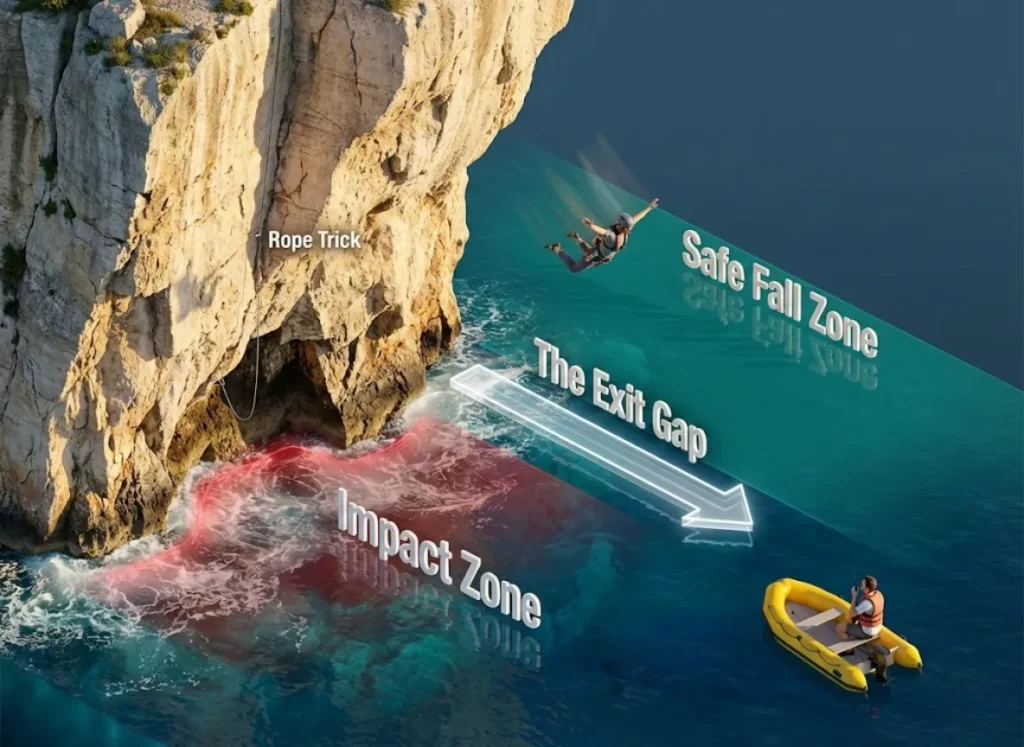
Cook’s tragedy illustrates a concept I call the “Exit Gap.” This is the discrepancy between a safe Fall Zone (deep water) and a lethal Exit Zone (unclimbable, wave-battered cliffs).
For approximately 10 minutes, Cook struggled to exit the water. The heavy swell prevented him from gaining purchase on the rock to climb out.
While his wife had visual contact from the cliff-top, she could not physically assist him. A video recording of the day might show the conditions, but the reality on the water level was far worse. This highlights a terrifying reality of rock climbing in Spain and other coastal destinations: being seen is not the same as being savable.
He was eventually swept away. exhaustion set in, leading to a water-related tragedy, leaving Eszter a single mother and the community bereft of a pivotal climber.
What is the “Cook Protocol” for DWS Safety? (Safety Framework)
To prevent history from repeating itself, we must implement a safety framework derived from Cook’s experience. I call this the “Cook Protocol.” It moves beyond S-grades to real-time decision-making for fellow climbers.
Dynamic Environmental Assessment (DEA)
Climbers must practice Dynamic Environmental Assessment (DEA). Unlike rock, which is static, the sea requires continuous monitoring. You must assess three variables:
- Swell Period: Long-period waves carry more energy and violence than short wind-chop.
- Aeration: White, foamy water is less dense than green water. You sink deeper and float lower, making swimming significantly harder.
- Tidal Windows: A safe exit at high tide might be a barnacle-covered wall at low tide.
Pro-Tip: Enforce the “15-Minute Rule.” Before gearing up, sit and watch the sea for a full 15 minutes. Ocean swell comes in sets; if you only look for two minutes, you might miss the “cleanup set” that hits every quarter-hour.
Sea-Level Support
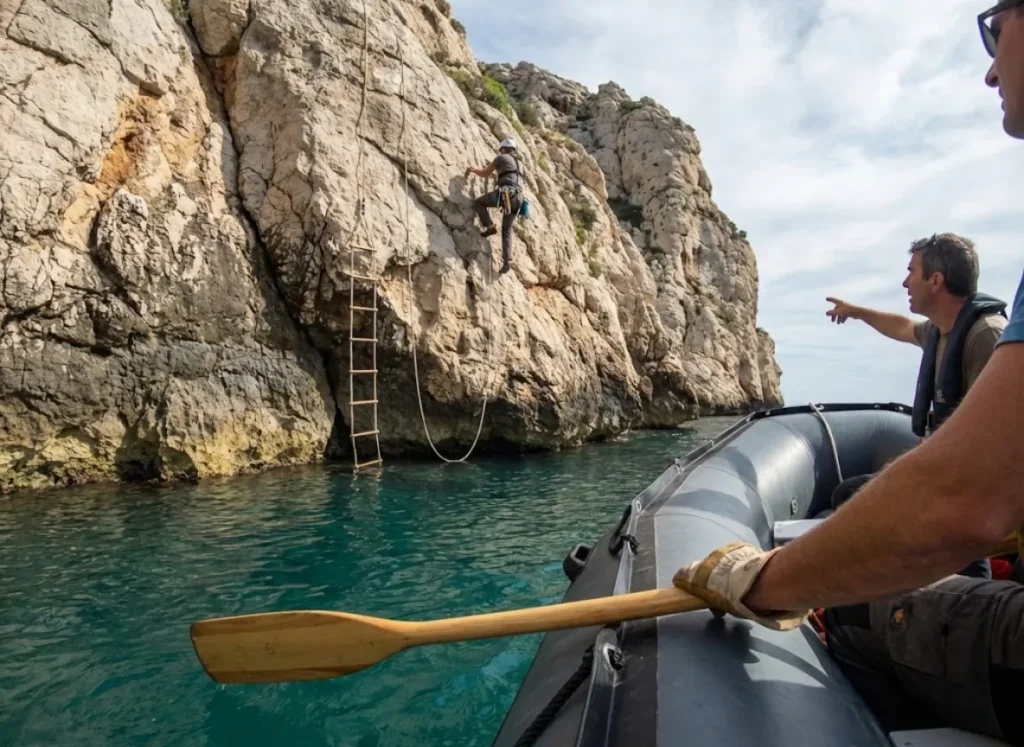
The most critical lesson from Porto Cristo is the necessity of a “Spotter at Sea Level.” A spotter on the cliff is a witness; a spotter in a dinghy or kayak is a rescuer.
If a boat is not available, you must utilize the “Rope Trick.” This involves hanging a static line or caving ladder near the route’s start or crux. This provides an immediate vertical exit strategy from the water, bypassing the slick rock interface.
Never underestimate the physiological response to cold water immersion. Even in the Mediterranean, the initial shock can cause a gasp reflex. In the UK, it can incapacitate a swimmer in minutes.
Understanding these environmental factors is part of managing the top 10 climbing dangers, where water-related incidents remain a distinct outlier compared to trauma-based rock accidents.
How Does Cook’s Legacy Endure? (Impact & Evolution)
The sport has evolved significantly since the publication of Into the Blue. We have moved from Cook’s era of lonely exploration to a professionalized global circuit.
Yet, modern guidebooks, such as those from Rockfax, continue to use and adapt the grading systems Cook helped codify. His intellectual fingerprint is on every topo that uses an “S” grade. Areas in Mallorca, sometimes referred to locally as Damianas boulders or similar tributes, stand as quiet memorials.
The British Mountaineering Council on DWS ethics continues to promote the values Cook embodied: adventure tempered by respect for the environment.
Damian Cook serves as a permanent “warning buoy” for the community. His story reminds us that even elite skill cannot negate the impartial power of the ocean. We must treat the water as a dynamic partner, not a passive crash pad.
Climbing routes like Frazzled today is an act of communion with this history. It aligns with the broader trad ethics of taking responsibility for one’s own safety and leaving no trace—either on the rock or in the memory of the sport.
Conclusion
Damian Cook was a seminal British climber who pioneered DWS in Dorset, distinct from the Australian rugby player who shares his name. His tragic loss in 2004 was caused by a disconnect between a safe fall zone and a dangerous, wave-battered exit zone.
His “S-grade” system remains the standard for measuring risk in deep water soloing. However, modern safety demands we go further by adopting a “Cook Protocol”: dynamic assessment of swell, mandatory sea-level support, and strict adherence to tidal windows.
Explore our deep dive into climbing risk management to further refine your safety instincts on the rock and water.
FAQ – Frequently Asked Questions
Who was the climber Damian Cook and is he related to the rugby player?
Damian Cook (spelled with an ‘a’) was a pioneering British rock climber and author known for Deep Water Soloing, who died in 2004. He is not related to Damien Cook (spelled with an ‘e’), the Australian Rugby League player who began his professional career years later.
What is the S-grade in Deep Water Soloing?
The S-grade is a safety grading system (S0 to S3) co-developed by Damian Cook to classify the danger of falling into the water. S0 indicates a safe fall into deep water, while S3 indicates critical danger due to shallow water or obstructions.
What caused Damian Cook’s accident in Mallorca?
Damian Cook drowned in 2004 near Porto Cristo after entering the water during a climb; while the fall was safe, rough seas and strong currents prevented him from exiting the water onto the cliffs. This tragedy highlighted the critical danger of the Exit Gap in rough sea states.
What safety lessons can climbers learn from Damian Cook’s life?
Climbers should prioritize Dynamic Environmental Assessment, monitoring swell and currents continuously, and ensure they have a viable Exit Strategy (like a hanging rope or support boat) before committing to a route.
Safety Notice: Rock climbing and mountaineering are inherently high-risk
activities that can involve physical trauma or fatal incidents. The information on Rock Climbing Realms is for
educational and informational purposes only. Techniques and advice presented here are not a substitute
for professional, hands-on instruction. Conditions and risks vary by location. Always seek guidance
from a qualified instructor before attempting new techniques. By using this website, you agree that you
are solely responsible for your own safety. Any reliance you place on this information is strictly
at your own risk, and you assume all liability for your actions. Rock Climbing Realms and its authors
will not be held liable for any harm, damage, or loss sustained in connection with the use of this information.
Affiliate Disclosure: We are a participant in the Amazon Services LLC Associates Program, an
affiliate advertising program designed to provide a means for us to earn advertising fees by advertising and linking
to Amazon.com. As an Amazon Associate, we earn from qualifying purchases. We are also an official affiliate partner
of Black Diamond Equipment via the AvantLink network. If you click on a Black Diamond affiliate link and make a
purchase, we may earn a commission at no additional cost to you. We also participate in other affiliate programs.
Additional terms are found in the terms of service.