
In this article
My forearms seized at 40 feet — completely locked, dead, useless. I couldn’t clip. I couldn’t shake out. I could only stare at the blue pillar above me and acknowledge, viscerally, that my rock-climbing fitness meant nothing on ice. I lowered off that pitch more educated than I had been in years: ice climbing doesn’t just demand different gear — it demands a different body.
After two decades guiding on ice and mixed routes, I’ve watched fit, strong rock climbers get shut down on WI3 because they came in with the wrong physiology. The good news is that you can build the right one. This 8-week periodized protocol is built around how the ice tool actually works, what your calves are actually doing, and the specific metabolic failure that creates “the pump that doesn’t clear.” Follow the phases. Don’t skip weeks. Your season will be different.
⚡ Quick Answer: To train for ice climbing, follow an 8-week plan divided into three phases: Foundational Conditioning (Weeks 1–2), Maximum Strength (Weeks 3–5), and Sport-Specific Power Endurance (Weeks 6–8). Prioritize cylinder grip tool hangs over hangboard training, build your calves in stiff B3 boots, and protect your shoulders with the Active Shoulder Protocol on every rep. Start 10–12 weeks before your target ice season for full adaptation.
Why Ice Climbing Fitness Is Different From Rock Climbing Fitness
The first time I tried to clip a draw after 15 pitches of moderate trad, my fingers still worked. After my first ice lead, my hands were so locked I couldn’t untie my knot at the anchor. That’s not a training gap — it’s a physiological one.
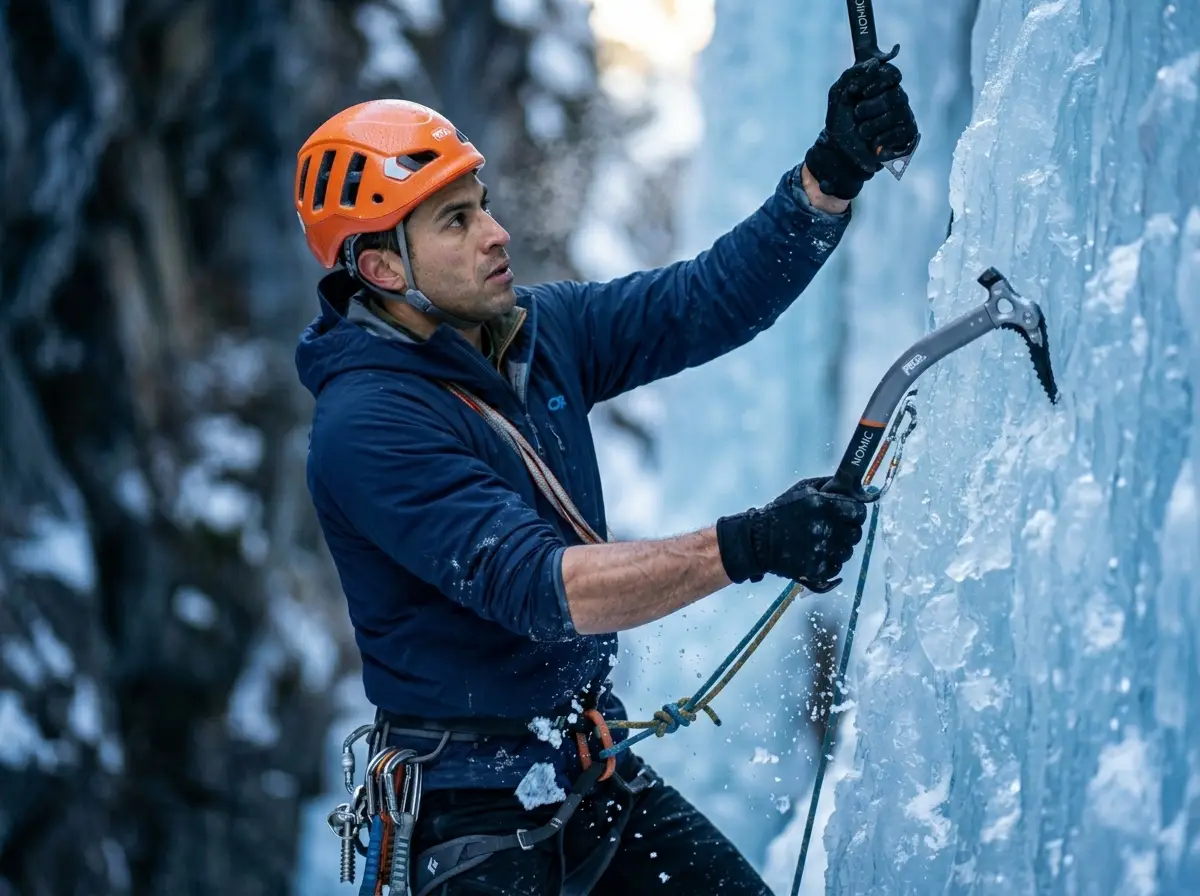
Rock climbing lives in the world of static friction and structural finger-hold engagement. Ice climbing is a different animal entirely. Every placement is a kinetic event: the pick drives into ice through angular momentum, not raw shoulder force. The tool is a lever arm, and speed at impact — not muscle — determines how deep the pick seats. This is why a clean flick of the wrist beats a shoulder-driven hammer strike every time.
The grip is different too. On rock, you’re crimping or open-handing specific features. On ice, you’re using a cylinder grip — palm and all four fingers wrapped around the handle. This grip distributes force across a wider surface area, but it also creates a sustained isometric contraction that drives intramuscular pressure past the point where blood can flow into the forearm. The result is localized ischemia — blood stops getting in. That’s the pump that won’t shake out. Rock climbing doesn’t train the vascular system for this reperfusion cycle. Your gym mileage simply doesn’t carry over.
The physiological profile of elite ice climbers (PLOS ONE) confirms the gap. Elite climbers average 33.17 pull-up reps — higher arm endurance than advanced rock climbers — but notably carry lower calf circumference. The governing rule on ice is efficiency over mass, not raw strength. If you want to understand the full framework before starting phases, Rock Climbing Realms has a solid master training framework for ice climbing that covers ice-specific conditioning from first principles.
I used to think my rock fitness would transfer. It doesn’t. The cylinder grip hits a different forearm system entirely — you feel it in the first ten minutes on steep ice, usually somewhere around the third screw you try to place.
Pro tip: The screaming barfies aren’t a quirk — they’re a metabolic event. Blood rushes back into ischemic hands after a sustained overhead grip. Training Phase 3 is specifically designed to develop the capillarization that reduces the severity of that reperfusion hit. You can’t avoid it; you can train it down.
The Physics of the Ice Tool Swing (And Why You Must Train the Wrist)
Most training programs default to pull-ups. Pull-ups matter, but they miss the mechanism that separates a clean placement from a shattered dinner plate of ice: the wrist extensor flick.
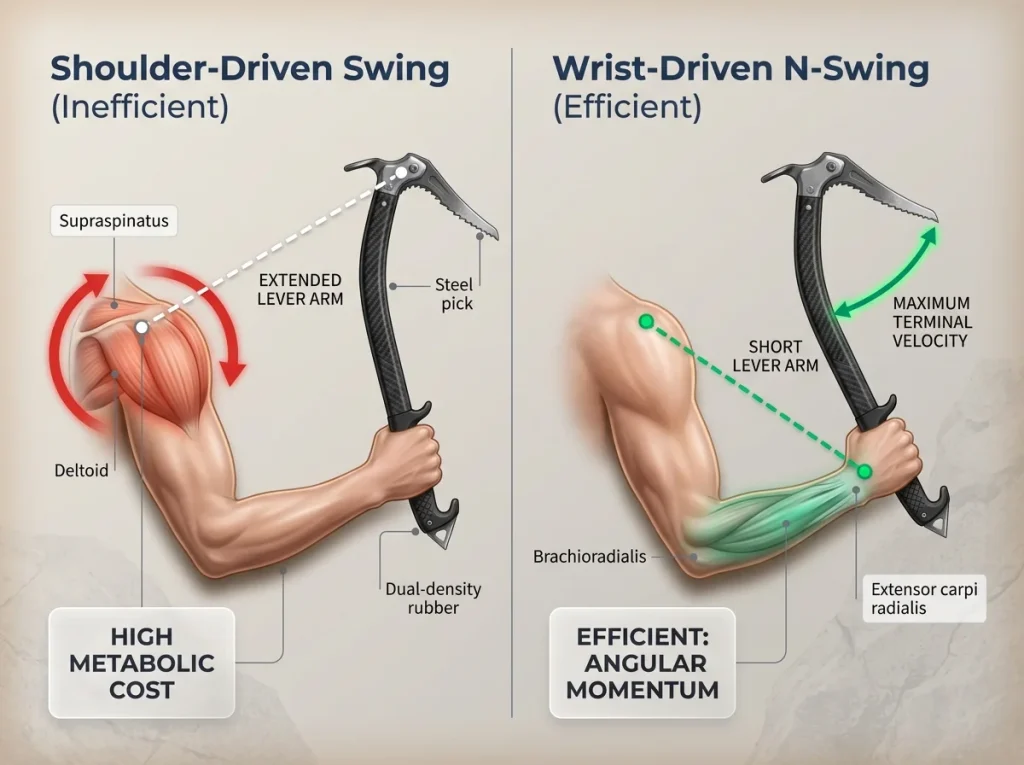
The ice tool works as a lever arm. When you initiate the swing from the wrist — keeping the pivot point at the wrist joint — you keep the lever arm short. The pick travels through roughly 15 degrees of arc with maximum terminal velocity. This is the N-Swing. The brachioradialis and extensor carpi radialis are the primary drivers, not the shoulder. The pick penetrates deep on minimal effort.
When you swing from the shoulder, the lever arm extends to your full arm length. Rotator cuff torque demand climbs steeply. Repeat that across 200+ placements per pitch and you understand why the chronic injury rates in the climbing upper extremity (NIH/PMC) show shoulder and elbow problems accounting for more than a third of all chronic climbing injuries. Shoulder impingement on ice is almost always a mechanics problem, not a structural weakness. Fix the swing first.
To train the wrist-driven movement: hold a light dumbbell horizontally and practice the snap without moving your shoulder. If the shoulder moves, start over. Progress to wrist rollers, reverse wrist curls, and towel hangs for eccentric loading. These aren’t accessory exercises — they’re the mechanism. Once you’ve dialed in the concept, the leashless ice tool swing mechanics guide walks through the full field application.
Phase 1 & 2: Building the Foundation and Maximum Strength (Weeks 1–5)
Weeks 1–2 — Foundational Conditioning: Connective Tissue First
Don’t blow this phase. Every athlete who skips the foundational weeks to chase harder sessions ends up with angry elbows by Week 5. Tendons adapt slower than muscles. The system has to be built before it can be loaded.
Weeks 1 and 2 are about connective tissue preparation, not performance. Climbing volume stays at roughly 60% of your maximum pitch count — 5 pitches in Week 1, 6 to 7 in Week 2 — at least two grades below your current onsight level. Strength sessions run 2 to 3 times per week with no max-intensity efforts. The focus is the “10 Killer Core” block: bird dogs, windshield wipers, L-sits. Core is the link between your tool placements and your crampon points. If the core isn’t solid, the hips sag away from the wall and forearm load goes unsustainable fast.
If your tendons feel crunchy — morning elbow stiffness, a grinding sensation on flexion — back off climbing volume immediately. That’s the system telling you it’s not ready. Listen to it.
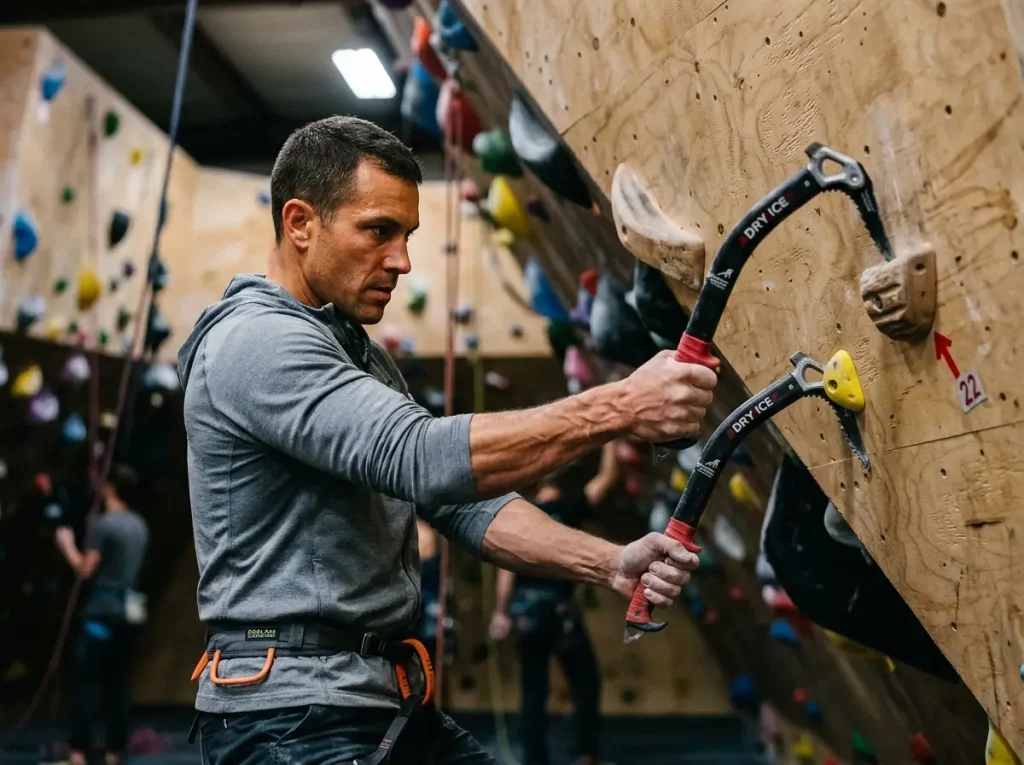
For athletes without ice access during this phase, the Furnace Industries DRY ICE Evolution rubber training tools allow gym-safe drytooling practice with 90% mechanical relevancy for tool geometry. They loop over standard gym holds and keep the movement patterns specific without the metal-spike liability. A good ice-specific periodization framework will help you customize phase lengths if you need more or less time in the foundation before loading up.
Weeks 3–5 — Maximum Strength: The 6×4 Protocol
This is where the real periodization work starts. The 6×4 protocol — 6 sets of 4 reps at 85–90% of your 1-rep max — builds the strength-to-weight ratio reserve that keeps individual moves on the ice from pushing you into anaerobic failure. Each hard placement becomes a smaller fraction of your total capacity. The pump comes later.
Weighted pull-ups at 85–90% 1RM build the pulling power for the upward movement phase. One-arm lock-offs — 6 sets of 6 seconds at maximum effort — simulate ice screw placement. The ability to hang single-tool for 20–30 seconds is non-negotiable for lead ice. Technique note: stay in the 6-second peak output window per rep, not 10. Ten seconds pushes into anaerobic failure, not power. Weighted toe raises at 80% 1RM start building the calf endurance reserve before the sport-specific phase hits.
Turkish Get Ups belong in every strength session. Three sets of 5 per side, every session. The TGU trains scapular stabilizers through a full range of loaded movement — there’s no better single investment for shoulder longevity in overhead athletes.
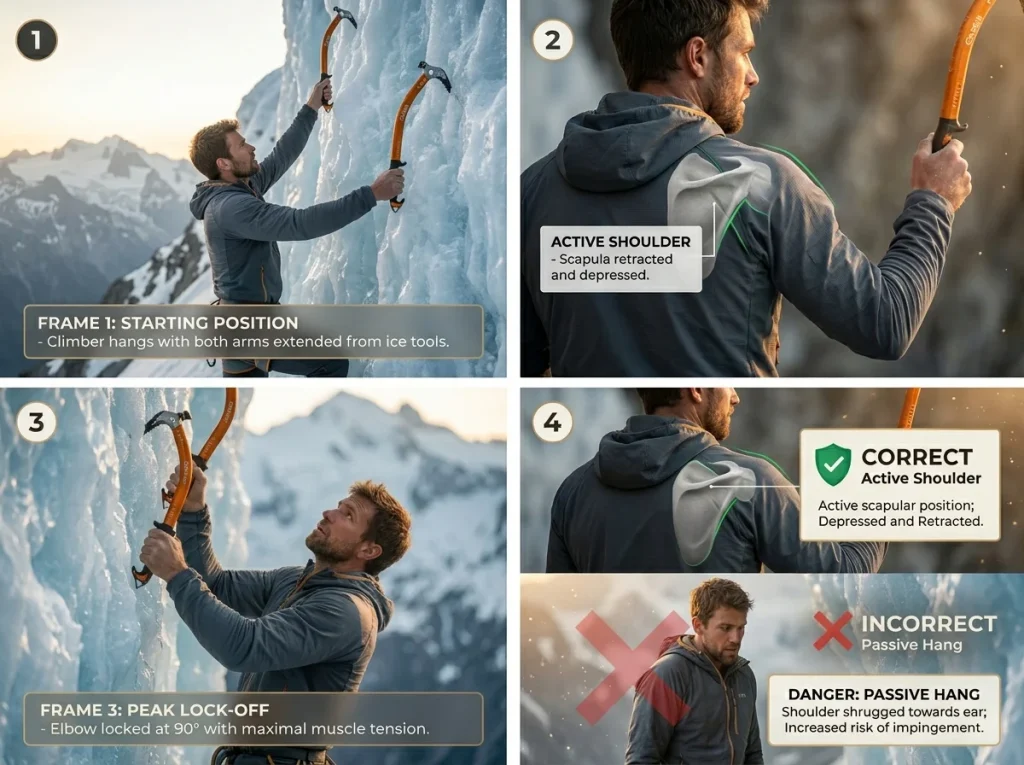
CRITICAL: Never hang passively from tools, rings, or bars with a relaxed shoulder. Scapula retracted and depressed at all times — serratus anterior and rhomboids engaged. Passive hanging with a relaxed joint is how labral tears happen. The lock-off strength technique for ice tool placement guide covers the Active Shoulder cue in full detail.
The sport-specific physiological adaptations in trained athletes (PubMed) research validates the strength reserve concept — high 1RM training ensures each individual move on the ice represents a smaller percentage of total capacity. This is why elite programs run max strength phases before power-endurance. Sequence matters.
Going through Weeks 3–5 correctly sets up everything that follows. If you shortcut the load here, Phase 3 will expose it — not with soreness, but with a pump that won’t clear and placements that feel like gambling.
Phase 3: Sport-Specific Power Endurance (Weeks 6–8)
The “Ice-Beast” Circuit — Simulating Lead Ice
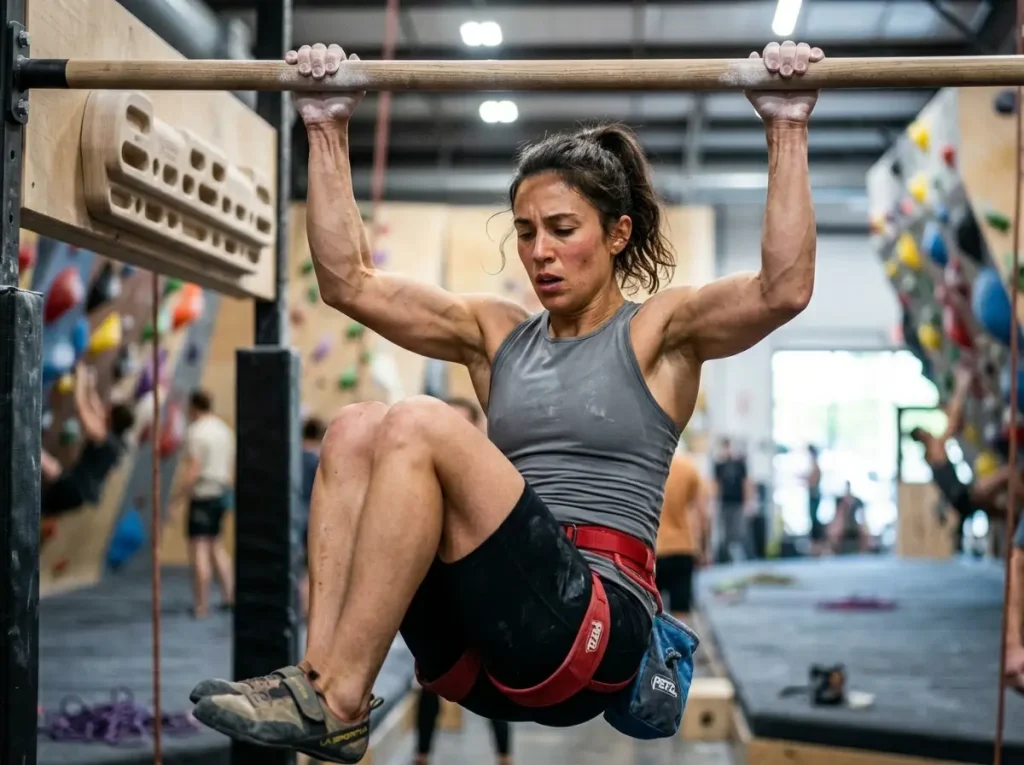
By Week 6, the base is built. Now you convert strength into the ability to sustain output under metabolic stress. The “Ice-Beast” HIIT circuit runs in this order: Hanging Leg Raises to failure → Static Tool Lock-off (60 seconds) → Hanging Windshield Wipers (5 per side) → Pull-ups max reps → Grip Strength Hangs (60 seconds).
Two rounds in Week 6. Five rounds by Week 8. Progress is measured in rounds completed, not load lifted.
This phase induces the pump deliberately — the same metabolic waste-clearance failure that creates screaming barfies on a long column. You’re not building strength reserves here; you’re training capillarization and the speed at which metabolites clear during shake-outs. The pump on ice isn’t fuel depletion — it’s what happens when waste products accumulate faster than your vascular system can flush them. Understanding the metabolic science behind climbing pump explains why this circuit works at the physiological level.
Recovery monitoring is non-negotiable. If you miss more than 2 workouts in a week, repeat that week. Overtraining this phase doesn’t produce adaptation — it produces injury. Physiological adaptation lives in recovery, not in grinding.
Grip Endurance Specifics: Tool Hangs vs. Hangboard
Here’s where rock climbers make the most common training mistake when crossing over to ice: they keep using the hangboard. Hangboard training is crimp-focused. Ice demands the cylinder grip. These are not the same movement pattern, and training one does not transfer to the other in any meaningful way.
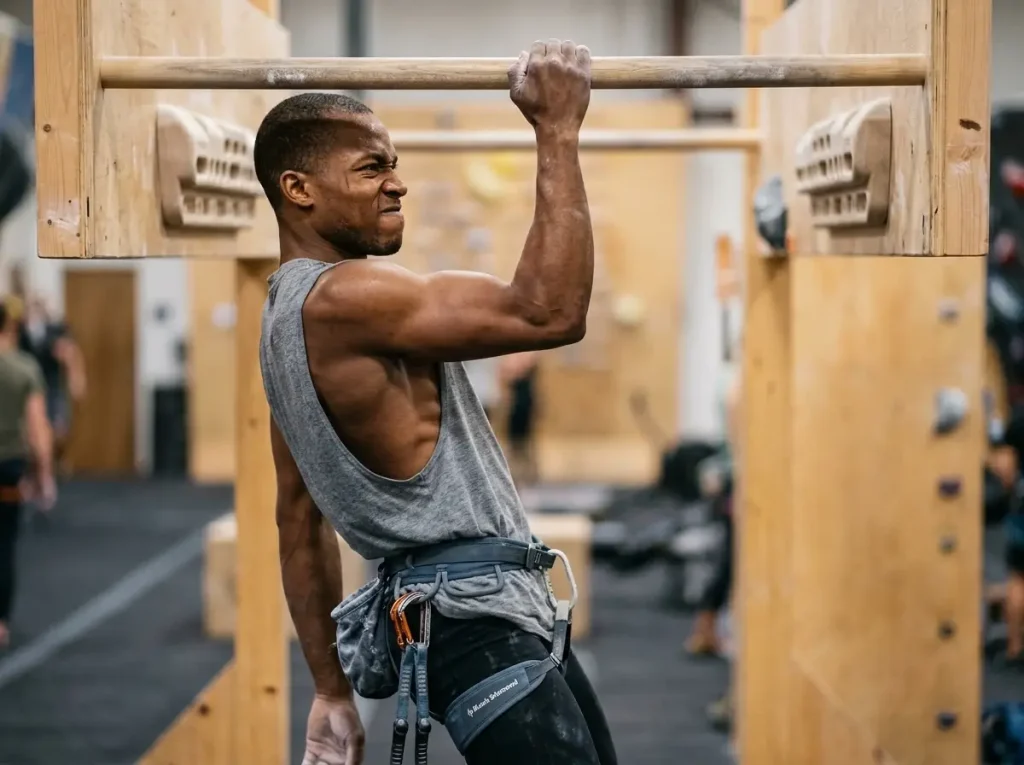
Tool hangs — from actual ice tool handles with the cylinder grip — rate at 100% mechanical relevancy. Hang from whatever your drill goes into: a home wall beam, a pull-up station mounted to plywood, anything solid. The tools don’t need to be sharp. They just need to match real handle geometry.
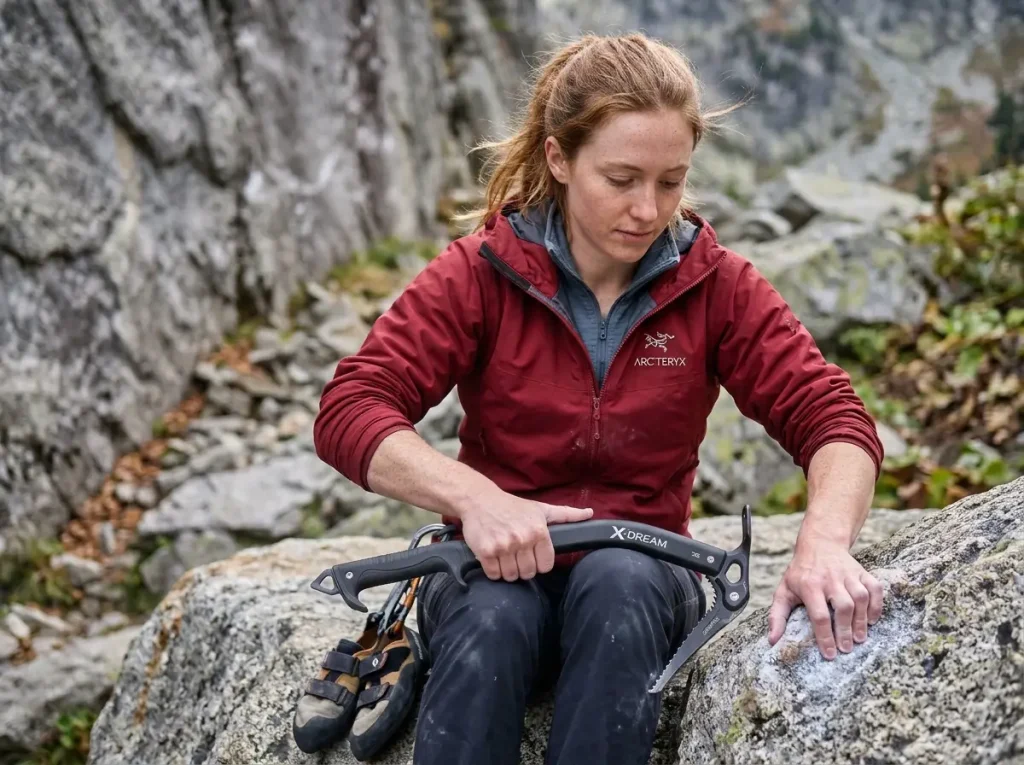
Wooden tools (70% mechanical relevancy) are useful for popping drills and figure-4 precision work, but they shouldn’t replace tool hangs in this phase. Vary grip width on your hangs — narrow, mid, and wide — to simulate the handle diameter differences across tool brands. The Petzl Nomic and Cassin X-Dream have meaningfully different ergonomics. Training a single width leaves gaps.
Target: sustained 60-second hangs by Week 8. That’s the time window required to place an ice screw on a steep pitch. Hangboard training fundamentals remains relevant for finger strength base in the foundational phase — just don’t substitute it for tool hangs in Phase 3.
Sixty seconds sounds short until you’re hanging from a tool at minus ten degrees trying to get your screw rack sorted. Train that exact duration specifically. Your forearms will tell you if you haven’t.
The Calf System: Ice Climbing’s Forgotten Limiting Factor
Every guide, forum post, and training plan focuses on the upper body. Meanwhile, on WI5, it’s the calves that fail first.
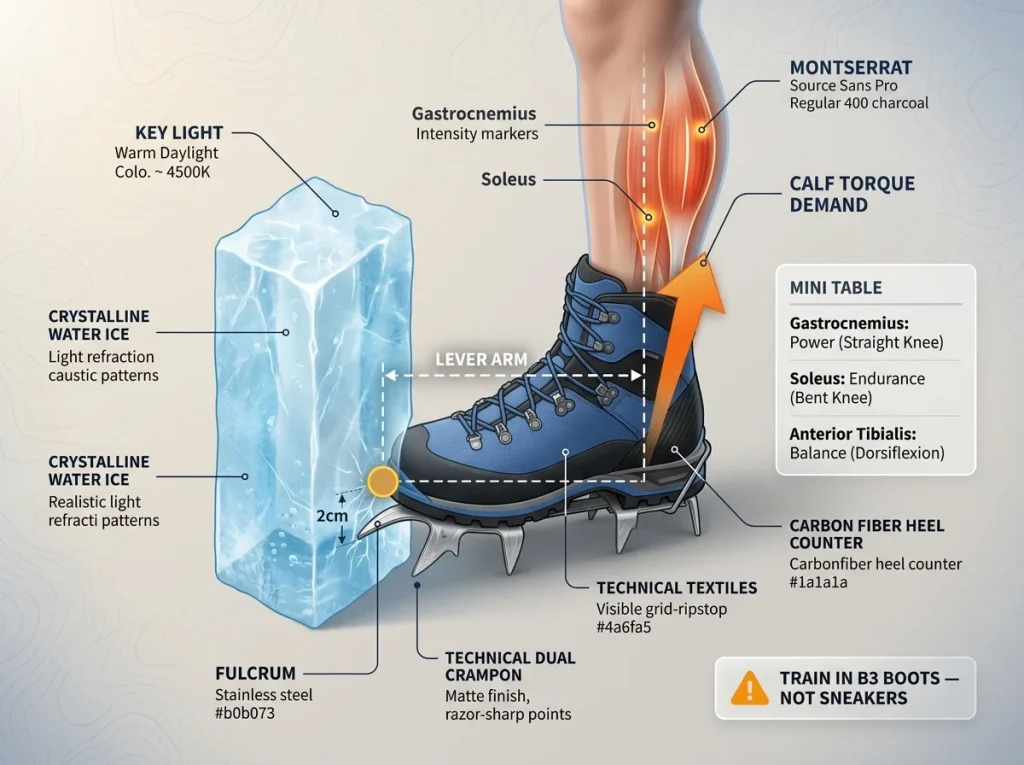
Front-pointing is a lever problem. The distance from your front crampon point to your ankle joint determines how much torque your gastrocnemius has to generate to keep you on the wall. Lock that position for 15 minutes on a sustained column and you understand why calf pump ends pitches that your forearms could have handled.
The research is counterintuitive: elite ice climbers carry lower calf circumference than advanced climbers. The goal isn’t bulk — it’s calf endurance and efficiency. The gastrocnemius (standing calf raises, 10–12 reps with weight, straight knee — pure plantar flexion) handles the big power demand. The soleus (seated calf raises, 15–20 reps, bent knee) handles the sustained low-angle front-pointing endurance. The anterior tibialis (reverse calf raises) prevents the imbalance that leads to Achilles tendonitis.
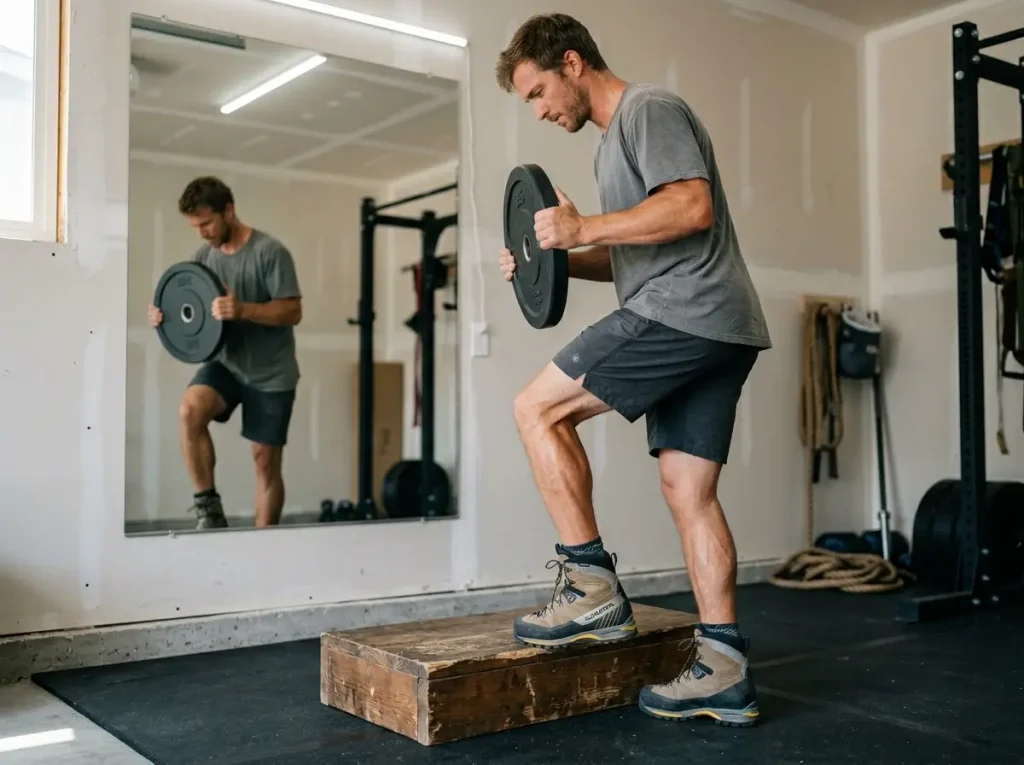
Critical note that almost no one mentions: perform every calf raise in your stiff-soled mountaineering boots (B3-rated), not sneakers. The boot stiffness changes the mechanical advantage and replicates the on-ice condition. Sneaker training does not transfer. The somatic determinants of elite ice climbing performance (PLOS ONE) confirms the lower-calf-circumference finding in elite vs. advanced climbers — train for endurance, not bulk.
Tight calves increase Achilles tendonitis risk. Integrate the downward dog stretch — “dropping the heel” reduces calf tension on steep ice and is a real mechanical efficiency gain. For the full injury prevention picture behind front-pointing stress, climbing injury prevention and Achilles tendonitis risk covers the connective tissue mechanics.
Pro tip: Train calf raises standing on a step with full range — heel below horizontal at the bottom, full plantar flexion at the top. Pause 2 seconds at both ends. Time under tension is the adaptation driver here, not rep speed.
Protecting the Machine: Shoulder and Elbow Injury Prevention
The Shoulder: The Most Complex Joint in Your Kinetic Chain
Shoulders end seasons. 19.5% of chronic climbing injuries are shoulder injuries — and most of them are preventable.
The mechanism is passive hanging. When you let your body weight be supported by ligaments and the labrum rather than musculature, you’re loading structures that aren’t designed for it. Subacromial impingement and labral tears follow. The Active Shoulder Protocol is simple: scapula retracted and depressed at all times during any overhead load. Serratus anterior and rhomboids engaged. No exceptions.
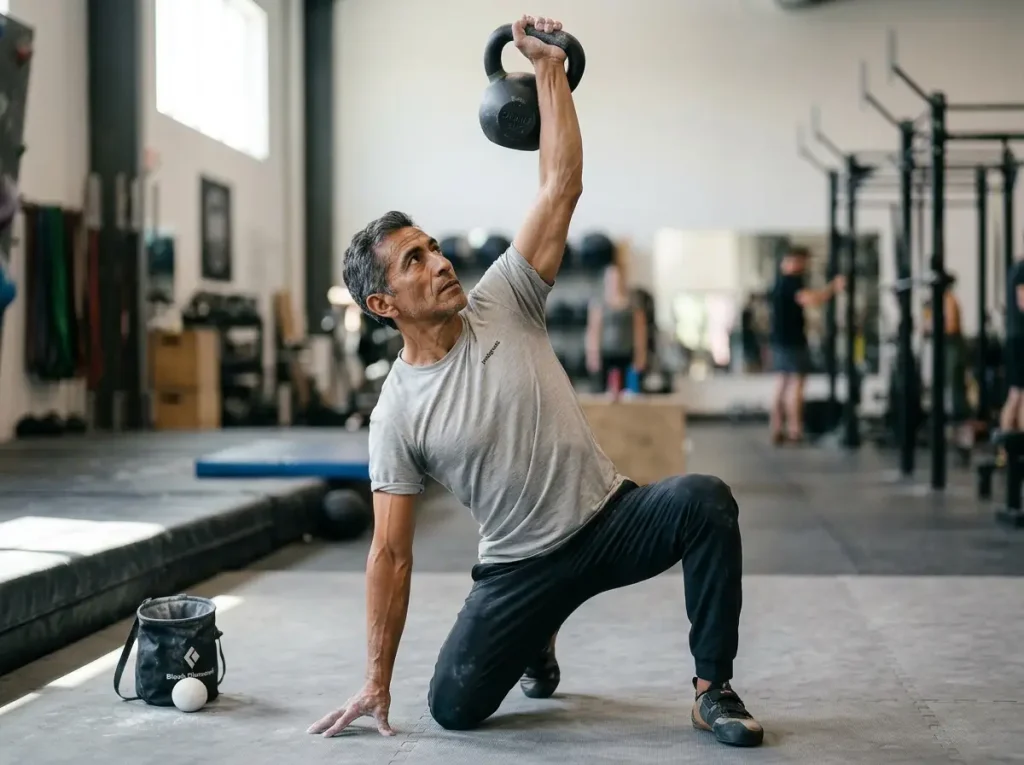
Turkish Get Ups belong in every strength session, every week, for exactly this reason. Three sets of five per side, with a moderate load. The TGU trains scapular stabilizers through a full range of loaded movement and there’s no better single exercise for shoulder stability in overhead athletes. Add scapular pull-ups to your warm-up — retract and depress the scapulae before initiating the pull. This resets the motor pattern before every set.
If you’re experiencing shoulder trouble during the swing cycle, fix the mechanics first. A shoulder-driven swing (not wrist-driven) is almost always the cause. Correcting the swing often resolves the pain without any structural intervention. The physics-based shoulder prehab for climbers guide covers the full scapulohumeral rhythm and rotator cuff sequence.
Elbow Epicondylitis: The Extensor Neglect Problem
Medial epicondylitis — Golfer’s Elbow — hits 17.7% of chronic climbing injuries. It comes from repetitive tool gripping. Lateral epicondylitis (Tennis Elbow) comes from the explosive wrist-flick of the swing. Most climbers train flexors. Almost no one trains the extensors that actually power the ice swing.
The prevention protocol is straightforward: stretch both flexor and extensor forearm musculature after every session. Wrist extensor stretch — straight arm, hand bent downward, held 10–20 seconds. Make it a daily habit throughout the training block. Add 2–3 sets of reverse wrist curls and tricep pushdowns to every upper-body session. These antagonist training moves offset the pulling dominance of ice climbing and are the reason the antagonist training for injury-free climbing framework exists.
Elbow tendonitis almost always begins in sessions where the warm-up was skipped. Pre-warm the extensors before every climbing session — 30 seconds of wrist circles, 30 seconds of reverse wrist curls with a light resistance band. Two minutes of prevention saves you weeks. The full injury prevalence data is in the self-reported chronic injuries in climbing athletes (NIH/PMC) study — worth reading before you decide to skip prehab.
Gear That Supports Your Training (Anti-Sell Analysis)
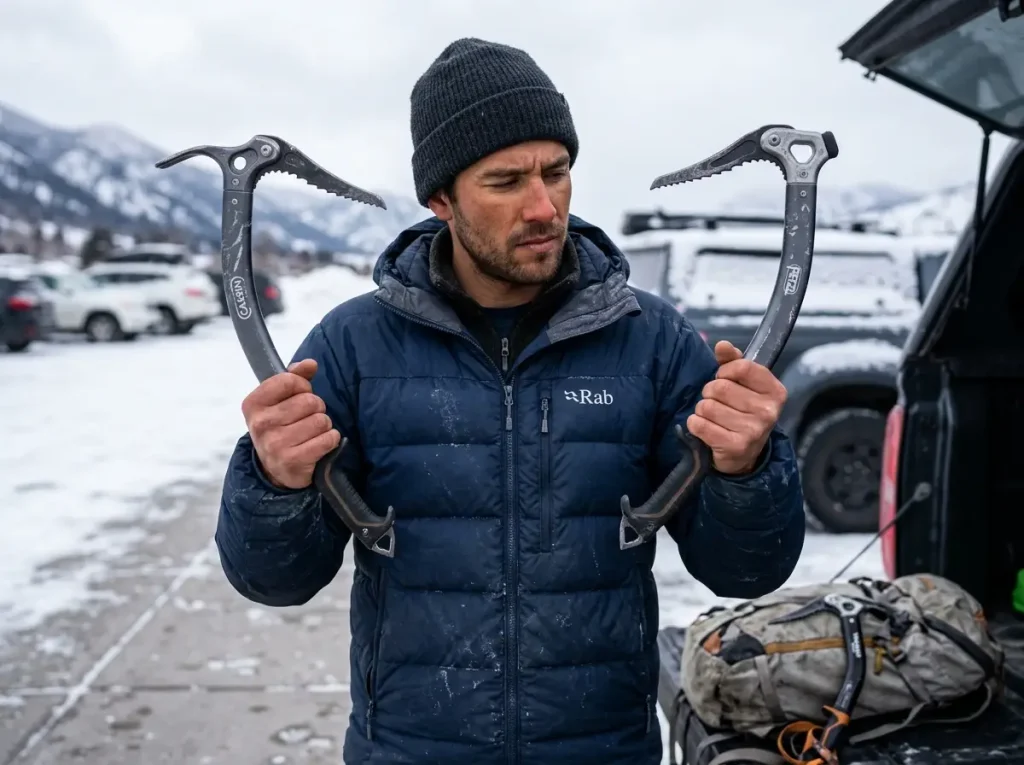
Petzl Nomic vs. Cassin X-Dream: The Honest Assessment
The Petzl Nomic has a balanced head weight that facilitates the N-Swing — genuinely good for pure water ice and alpine objectives. The engineering flaw: the pommel spike and assembly have documented structural weakness under high-torque mixed climbing loads. If you’re swinging on steep mixed lines, that’s a real consideration.
The Cassin X-Dream offers a more aggressive handle geometry for overhanging terrain and figure-4 maneuvers. The wider upper grip rest reduces ulnar nerve compression — pinky-side numbness on long hangs. Engineering flaw: the adjustment bolt mechanism loosens in extreme cold without thread-locking compound maintenance. Budget athletes might look at the Trango Raptor — solid value-to-cost ratio, flaw being pick removal difficulty.
Pick geometry matters more than most people realize. Black Diamond picks designed for Utah’s soft plastic ice often underperform on the harder, more brittle ice of the Alps or the Northeastern US. Petzl Pur’Ice and Cassin picks use a more aggressive beak angle and thinner profile for harder ice. Swapping factory picks for Krukonogi or Sport-Steinle options can provide a real mechanical advantage on bulletproof ice. The complete ice axe and tool selection guide is the right next stop for anyone still selecting their first technical tool.
Training Tools: Rated by Physics, Not Marketing
Any rubber or plastic device claiming to “replicate ice tool training” with a grip pad that doesn’t match real tool geometry is training the wrong neural pattern. Insist on proper handle diameter and angle replication.
Furnace Industries DRY ICE Evolution: 90% mechanical relevancy for tool geometry, gym-safe. Industry standard for year-round indoor preparation. Actual tool hangs with real ice tools: 100% mechanical relevancy — the physical gold standard. Escape Training Picks: 85% relevancy, not gym-safe (real spikes), best for personal home walls. Wooden tools: 70% relevancy, useful for popping drills and figure-4 precision training, not a substitute for full-weight hangs in Phase 3.
Figure-4 and figure-9 drills on an overhanging Kilter Board or plywood wall build the “Tool IQ” needed to recognize unconventional placements in the field. Train them monthly even if you never plan to use them on ice.
Pro tip: Alternate grip width on your tool hangs — narrow, mid, and wide — to simulate the variability of handle diameters across tool brands. The Petzl Nomic and Cassin X-Dream have meaningfully different ergonomics, and you discover that difference mid-pitch, not at the gym.
Conclusion
Three things will change your ice season. Train the wrist, not just the shoulder — the ice tool swing is driven by angular momentum at the wrist, and training wrist extensors and the N-Swing is the single biggest gap between rock climbers and ice climbers. Build your calves in stiff mountaineering boots with full-range time-under-tension work; front-pointing places the entire body’s weight through the calf lever and they’ll fail before your forearms on sustained terrain. And every rep of every hang must involve active scapular engagement — the Active Shoulder Protocol is not optional, it’s what keeps you climbing in February.
Take this plan to your gym this week. Start with the foundational core session and a set of wrist extensor exercises. You don’t need ice to start training for ice. The season will reward the work you do now.
FAQ
How do I train for ice climbing at home?
Tool hangs from a pull-up bar or home wall setup using actual ice tool handles provide the highest carry-over — 100% mechanical relevancy for grip and lock-off training. Add weighted calf raises on a step, windshield wiper core exercises, and wrist extensor stretches with a resistance band for a complete home protocol. No ice required.
Can you train for ice climbing in a gym?
Yes, with the right tools. The Furnace Industries DRY ICE Evolution (rubber strap loops over standard gym holds) allows tool-geometry-specific training without metal picks, making it the standard for commercial gym preparation. Supplement with weighted pull-ups, lock-offs, and calf raises in B3 boots if you can manage it.
How do I get stronger for ice tools specifically?
The cylinder grip used on ice tools (palm plus all four fingers) requires different conditioning than rock climbing’s crimp strength. Prioritize weighted tool hangs, lock-offs at 85–90% max effort, and wrist extensor exercises. Hold off on hangboard work until your foundational ice-specific strength is established.
How long should I train before the ice season?
A minimum of 8 weeks is required — connective tissue preparation in Weeks 1–2, maximum strength in Weeks 3–5, and metabolic power endurance in Weeks 6–8. Starting 10–12 weeks out gives you one buffer week if injury or travel disrupts the block.
What causes screaming barfies and can training reduce them?
The screaming barfies are a vascular reperfusion event — blood rushes back into ischemic hands after holding tools overhead. The isometric contraction restricts blood flow; when you shake out, metabolites flush back through rapidly. Training that develops capillary density — Phase 3 endurance circuits, sustained grip hangs — improves metabolic waste clearance and reduces the severity of the reperfusion response over the course of a season.
Safety Notice: Rock climbing and mountaineering are inherently high-risk
activities that can involve physical trauma or fatal incidents. The information on Rock Climbing Realms is for
educational and informational purposes only. Techniques and advice presented here are not a substitute
for professional, hands-on instruction. Conditions and risks vary by location. Always seek guidance
from a qualified instructor before attempting new techniques. By using this website, you agree that you
are solely responsible for your own safety. Any reliance you place on this information is strictly
at your own risk, and you assume all liability for your actions. Rock Climbing Realms and its authors
will not be held liable for any harm, damage, or loss sustained in connection with the use of this information.
Affiliate Disclosure: We are a participant in the Amazon Services LLC Associates Program, an
affiliate advertising program designed to provide a means for us to earn advertising fees by advertising and linking
to Amazon.com. As an Amazon Associate, we earn from qualifying purchases. We are also an official affiliate partner
of Black Diamond Equipment via the AvantLink network. If you click on a Black Diamond affiliate link and make a
purchase, we may earn a commission at no additional cost to you. We also participate in other affiliate programs.
Additional terms are found in the terms of service.