
In this article
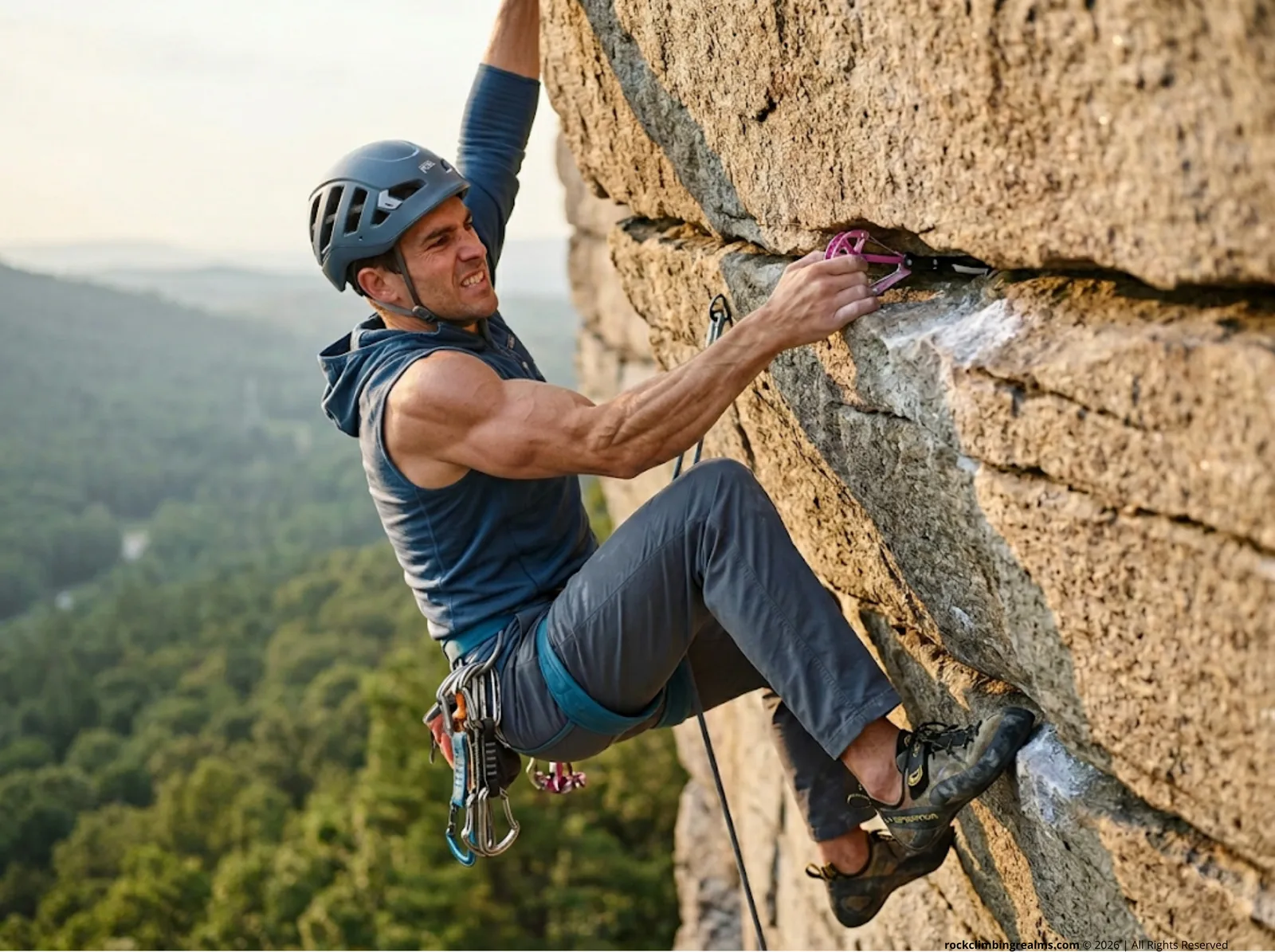
You’re 30 feet off a horizontal crack on damp Shawangunk quartzite. Pumped. The cam you just tried skated on the wet quartzite like it was glass. Your forearms are burning, your feet are smearing on a slick face, and you need a piece — now. Your eye drops to the Pink Tricam hanging at the back of the rack. One pull to cock the sling, a second to seat the stinger in a quartz crystal dimple, a sharp downward jerk, and suddenly you have a piece that trusts the rock instead of fighting it. The rope goes in the biner. You breathe.
That moment is what this article is about.
After years of placing trad gear on routes from the Gunks to the High Sierra, I keep coming back to the Tricam in specific situations where every other piece on my rack fails. Not because the Tricam is magic — it isn’t — but because when the rock gives you horizontal pods, icy fissures, or limestone pockets with no good parallel walls, nothing else works as reliably. By the end of this, you’ll understand why the Tricam stays put (the physics of the tripod contact points), you’ll know how to read rock for placements before the piece ever leaves your rack, and you’ll execute both active mode and passive mode placements without fumbling.
⚡ Quick Answer: A Tricam works by creating a three-point tripod — the pointed fulcrum (stinger) seated in a rock rugosity, and two parallel rails pressed against the opposite wall. To place one in active mode: cock the sling into the cam channel, insert the head with the stinger aimed at a surface irregularity, verify both rails contact the wall (the Tripod Check), then deliver a firm downward jerk to set it. Use a 60 cm runner on all horizontal placements to prevent walking. Never pull on the sling to remove a stuck Tricam — rotate the head backward with a nut tool instead.
Quick Reference
Size range: 0.125–7.0 covering 10mm–140mm cracks
Placement modes: Active (camming) & Passive (nut / broadside Evo)
3-Point Contact Rule: Fulcrum + 2 Rails
Strength range: 3 kN (size 0.125) to 15 kN (sizes 4.0–7.0)
Standards: EN 12270 / UIAA 124/125
The physics behind the tripod — why a Tricam holds
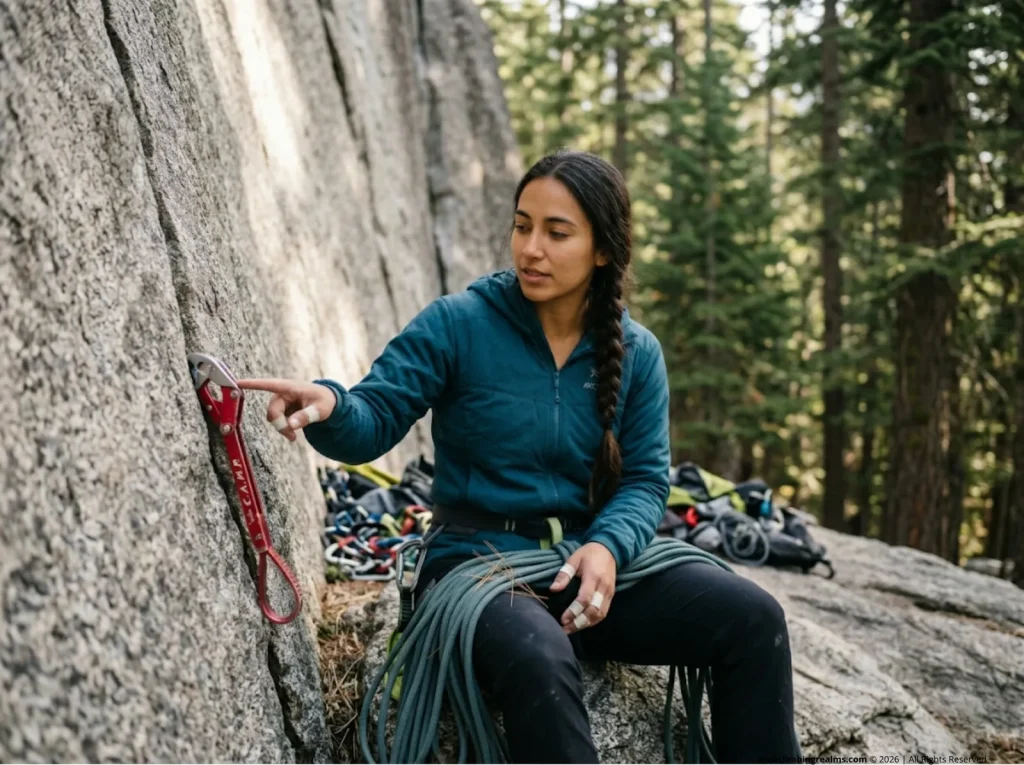
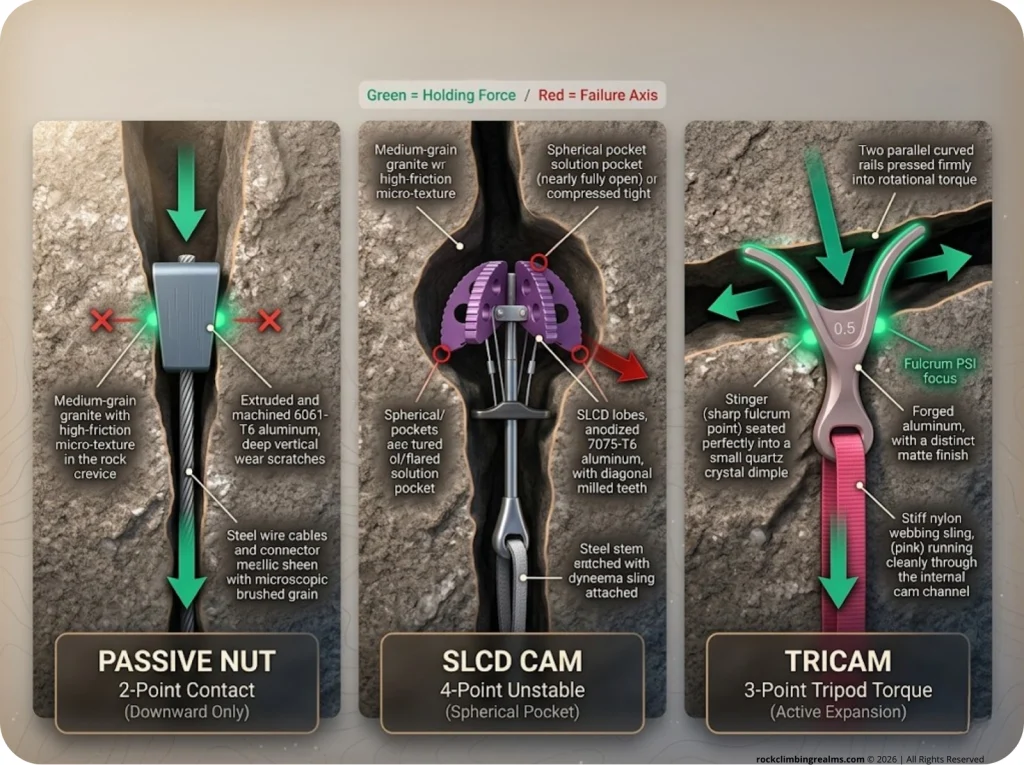
Most climbers describe a Tricam as “half cam, half nut.” That’s not wrong, but it misses the reason the thing works. The Tricam transforms linear force into rotational torque — and that’s a different mechanical story than either a passive nut or a spring-loaded cam.
The head follows a curved profile — the same equiangular shape used in SLCD lobes. What that means in practice: the angle between the fulcrum, the rail contact point, and the rock surface stays constant no matter how far the head rotates into the crack. That constant angle is what prevents catastrophic slip-out under variable loads. The short version: the Tricam is predictable across its entire usable size range, and that’s a feature, not an accident. If you want the underlying geometry, the mathematics of constant-angle cam curves is the original source.
The tripod is what separates it from everything else on your rack. The stinger (fulcrum) and two parallel rails create three contact points. A three-legged stool cannot rock; a four-legged table wobbles. SLCDs have four or more lobe contact points that must reach independent equilibrium. In irregular or spherical pockets, that rarely happens cleanly. The Tricam needs only three points and finds stability in geometries where cams spin and nuts rattle.
The force multiplication is the other piece. When you pull down on the sling, the attachment point is offset from the fulcrum — that offset creates a lever arm. The torque generated at the fulcrum converts your moderate rope tension into outward expansion force against the crack walls. The harder the fall, the harder the piece wedges. That’s also why a heavily weighted Tricam becomes progressively harder to clean. The physics work both ways.
For context on how this compares to standard cam mechanics, how standard SLCD camming angles compare fills in the broader picture. The camming angle physics and friction relationship that governs all passive-rotational protection are covered there in full.
Pro Tip: If you anticipate a directional fall that will heavily weight the piece, go one size smaller than feels comfortable. A Tricam that never reaches maximum rotation is dramatically easier for your second to clean.
Reading rock for Tricam placements — feature identification in the field
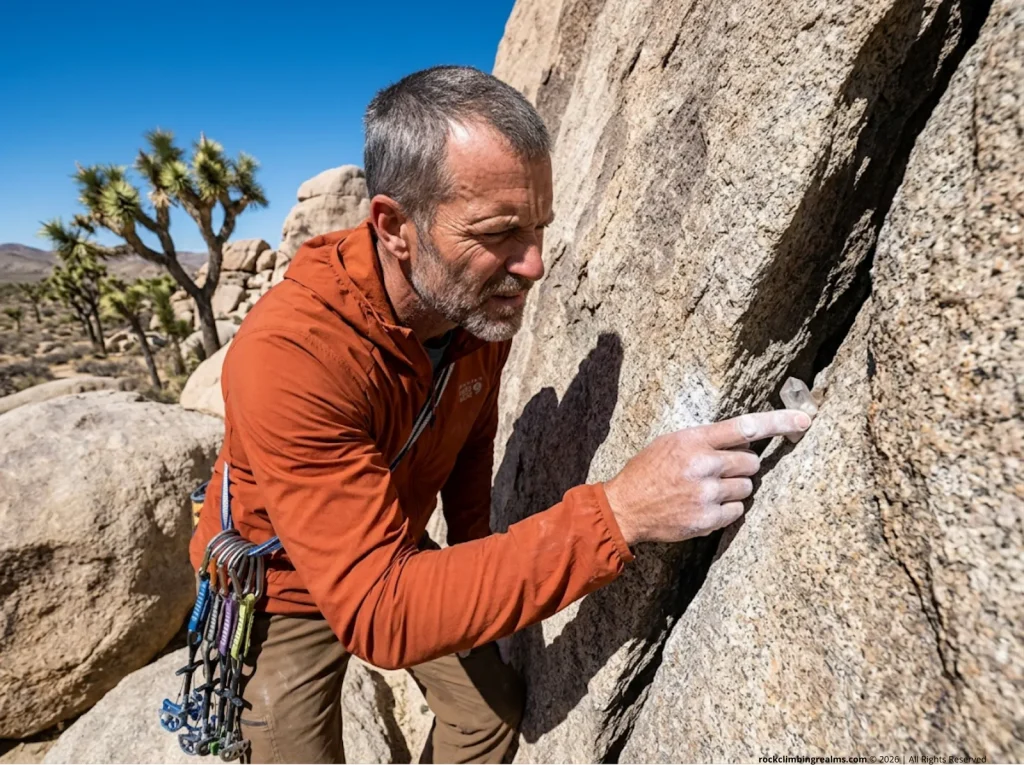
Here’s where everyone goes wrong: they stare at crack width instead of reading the wall geometry. A Tricam placement starts with your eyes, not your hands.
The macro scan comes first. You’re looking for crack sections where the walls run parallel or flare slightly outward toward you. Converging cracks — ones that narrow as they go deeper — are nut territory. Parallel and flared cracks are Tricam territory. When you’re reading crack feature types before rack selection, this distinction drives everything that follows.
Once you’ve found a good parallel section, the micro scan starts. You need a specific irregularity where the fulcrum seated in rugosity can bite — a quartz crystal, a calcite ridge, a solution pocket edge, a piton scar lip. On limestone, solution pockets are the stinger’s natural home. On granite, feldspar crystals serve the function. The stinger doesn’t just rest against the wall; it hooks something. A smooth, glass-polished surface gives you nothing to hook.
Rock type matters. Limestone with solution pockets is the best Tricam environment on the planet — the spherical voids are made for this piece. Shawangunk quartzite horizontal pods are where the Tricam was essentially born. Granite with flared horizontal cracks works well if you can identify a crystal for the stinger. Sandstone is tricky — soft rock means the expanding rails can act as a lever and pry loose flakes, so passive mode is often safer there. Polished basalt is the hardest call; if there’s no rugosity, the stinger will skate, and you should know that before you commit. How rock geology determines protection choice gives you the deeper lithological context.
I’ve pulled Tricams off the rack at the Gunks for almost every horizontal pod because the quartzite there is riddled with solution dimples and piton scars from the old aid-era hardware. At Indian Creek? I leave them on the harness. Parallel splitter cracks in sandstone want cams. Reading the rock is reading the gear.
Use your fingertip before you insert any piece. Run it along the wall where the stinger will sit. If your fingernail catches, the stinger will catch. If it slides, find a different section or switch to passive mode immediately.
Pro Tip: For the size check before committing: insert the piece and observe how much rotation remains. You want 20–40% rotation still available after the rails contact the walls. More rotation = easy to set, easy to clean. Full rotation on insertion means the piece is over-cammed — possibly irretrievably stuck before a single fall.
Step-by-step active mode placement — the cocking, seating, and setting protocol
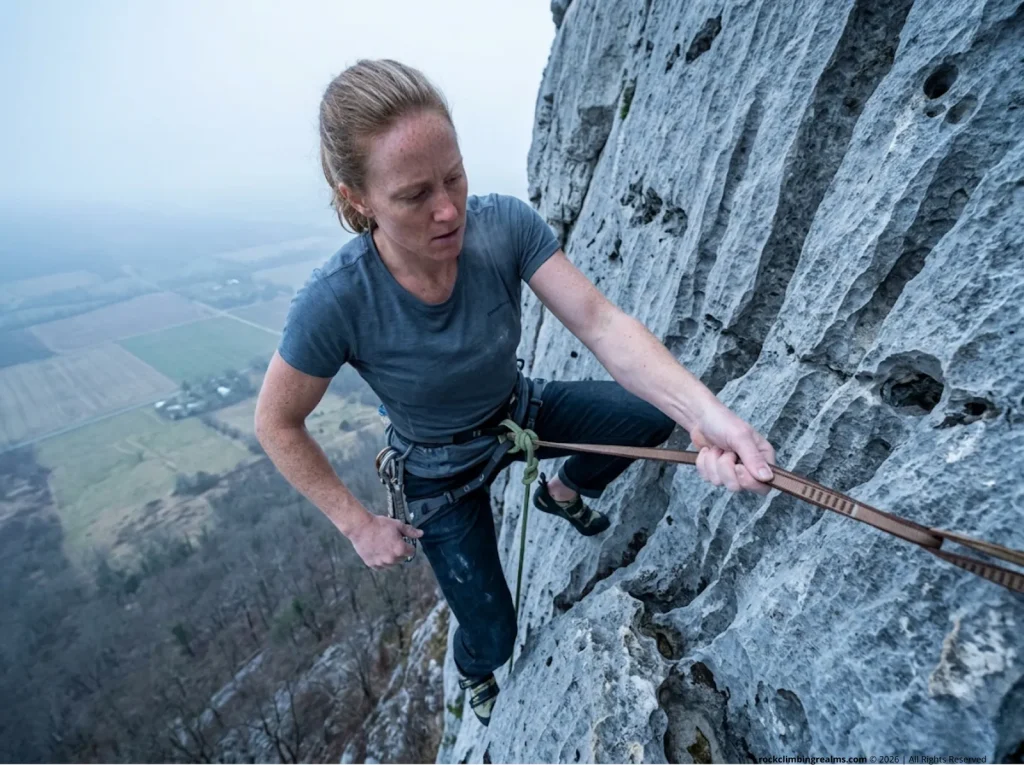
Knowing the mental framework for placing protection under pressure matters here because the Tricam demands a four-beat sequence executed in order. Skip a beat and you haven’t placed protection — you’ve hung a heavy nut with an attitude problem.
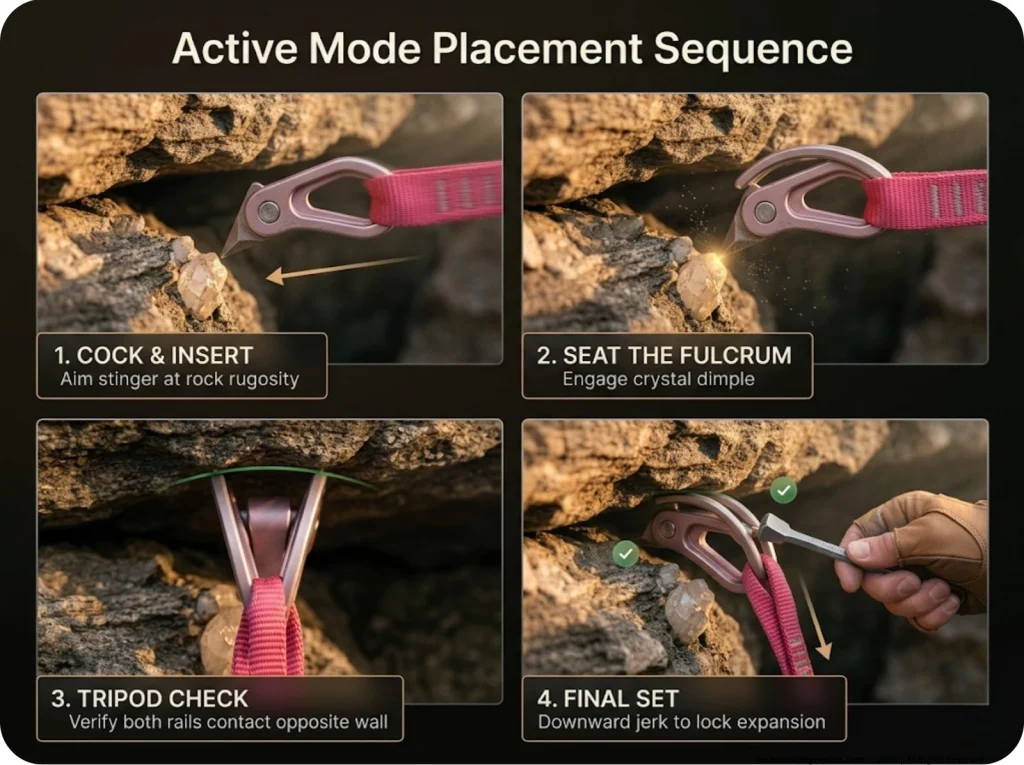
Step 1 — Cock the head. Run the sling all the way into the internal cam channel, positioning it so it exits from the offset position. If the sling exits centered, the lever arm is gone and the head behaves like a passive nut regardless of what you do next. With a modern stiffened sling, thumb-flick the head while holding the webbing 10–15 cm from the head. One hand, moderate pump. With older floppy slings, use both hands and consider a few wraps of athletic tape near the head to maintain stiffness — a field repair that works. Pull the sling gently after cocking; the head should rotate slightly and resist, confirming the lever arm is active.
Step 2 — Insert and scan. Guide the cocked head into the crack with the fulcrum aimed at the load-bearing wall — the wall you’ll be pulling away from. Lead the stinger toward the rugosity you identified in your micro scan and let it drop into position. Don’t force or drag.
Step 3 — Tripod Check. Look at the head from outside the crack. Both rails must visibly contact the opposite wall. If one rail is floating, rotate the head slightly until both engage. A Tricam with only one rail contacting can rotate sideways out of the crack during a fall. That’s the most common active mode failure mode, and it’s invisible once you clip unless you check.
Step 4 — Set. Deliver a firm, short, downward jerk. You should feel a slight “bite” as the stinger seats and the rails compress. Firm enough to seat — not so hard you’ve force-yanked the rails into maximum rotation. A test: can you imagine your second rotating the head backward with a nut tool on steep terrain? If the answer is no, you set it too hard.
For horizontal cracks, orientation matters. Fulcrum-down is preferred when you’re climbing directly above the piece — rope weight reinforces stinger seating. Fulcrum-up works better when you’re traversing away from the piece, since lateral rope drag could unroll a fulcrum-down placement over a long pitch.
Post-set: tug the sling sideways to check directional stability. Clip and use a 60 cm alpine draw on horizontal placements. A short quickdraw transmits rope movement directly to the head, which can jostle the stinger out of its seat across 40 meters of horizontal traversing.
Pro Tip: Use a 60 cm alpine draw on every horizontal Tricam placement. This is not optional on long pitches. Rope vibration from dozens of meters of movement will eventually walk the piece if you’re running a short draw directly to it.
The Evo angle and passive mode — when not to cam
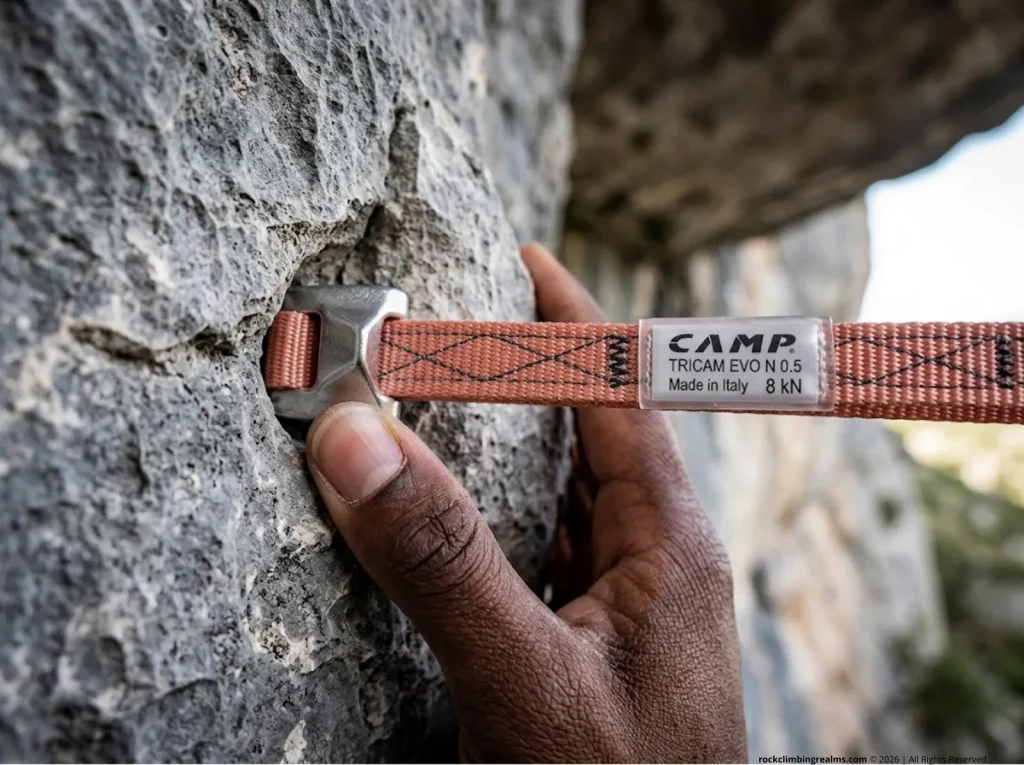
The standard Tricam has two placement modes. The Evo, introduced in 2013, has three. Knowing when to use each is as important as the mechanics of any individual placement.
Standard passive mode flips the sling to the centered position — not cammed — and uses the Tricam as a large, angled nut. This works in vertical, narrowing constrictions where the tapered head wedges along its profile. The Tricam in this configuration resists only downward and outward pull, so it’s directional: a lateral force will unseat it. Use it where pull direction is predictable and geometry is clearly converging. How passive nut geometry compares to hybrid protection gets into the detail on when this is the right call versus a standard nut.
Evo broadside passive mode is the third option. The Evo head has a secondary tapered plane on its broadside face that lets it straddle the entrance of a spherical solution pocket — wedging horizontally across the opening rather than longitudinally. This covers limestone geometry where neither SLCDs nor standard nuts fit: the pocket eats your fingers whole but won’t take a cam lobe cleanly. Orient the Evo so the broadside axis aligns with the pocket opening, slide until the tapered faces contact both edges, and tug to confirm the wedge. Treat it as a supplemental piece unless a long test tug proves bomber.
When to drop to passive and not fight it: soft or friable rock, very shallow pockets where the head can’t rotate, situations where the sling exit direction perfectly aligns with the load. In soft desert sandstone, an active camming ratio can pry loose flakes apart because the rail expansion acts as a wedge against fragile rock. When the rock type signals that risk, passive mode or a different piece entirely is the rational call. The Tricam doesn’t care which mode you use. The rock does.
Environmental performance — where Tricams dominate and where they fail
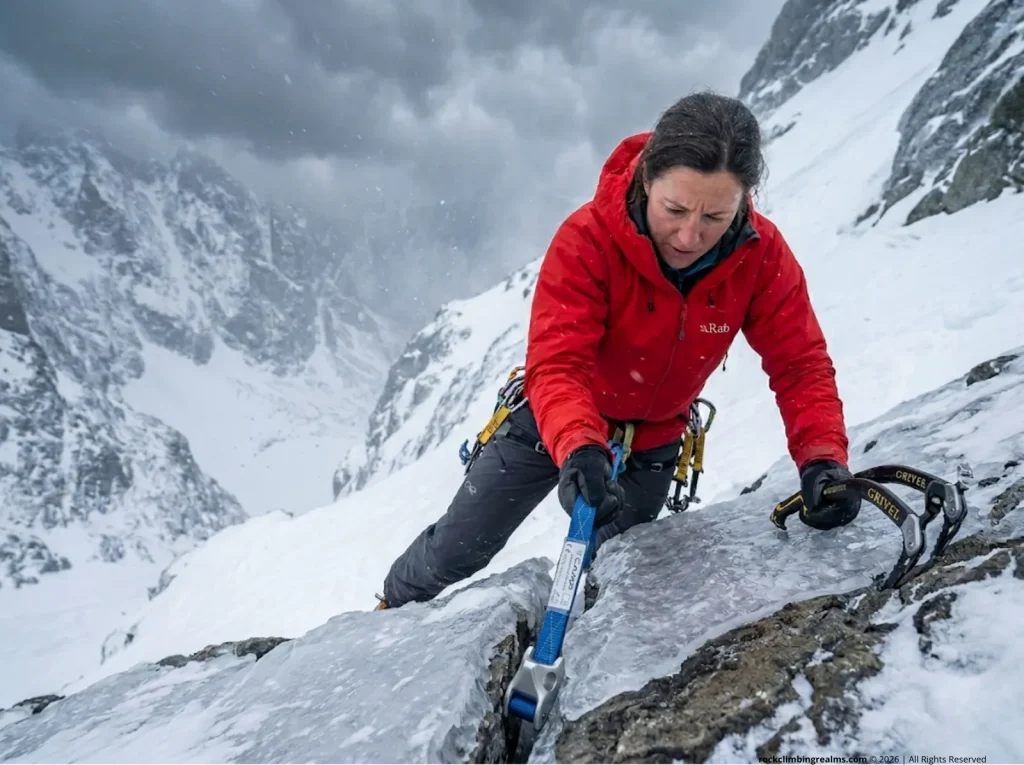
The Tricam earns its space on the rack in three conditions that make every other piece unreliable.
Icy and mixed cracks. When ice lines a crack, SLCD lobes skate because they depend on friction between aluminum and rock — and that interface disappears under ice. The Tricam’s concentrated fulcrum point punches through thin ice veneers the way a pick finds rock in mixed climbing. The stinger creates a pressure-based mechanical engagement, not a friction-based grip. I have a memory of a mixed pitch in October — the crack lined with frozen mud — where three different cams just spun. Pink Tricam, one sharp set, and the stinger found rock under the ice the cam lobes never touched.
One safety warning on pure ice: sustained load at a belay can let the fulcrum slowly melt deeper into the ice, migrating the placement. Do not use a Tricam in pure ice as your bomber primary anchor under long-term strain. Back it up. A nut tool pre-clear of the worst ice from the crack before insertion helps significantly — removing even the top 3–5 mm improves stinger contact with underlying rock.
Horizontal pods and the anti-walking advantage. SLCD lobes ratchet outward under rope vibration on long pitches — each micro-vibration from the rope nudges the lobe into a wider section until the cam has walked out of the placement entirely. The stinger prevents this. Once seated in a rugosity, the stinger creates a mechanical register that requires the entire head to rotate before it can migrate — and the head won’t rotate with both rails loaded. This stability in horizontal pods is the Tricam’s single greatest structural advantage over SLCDs, and it’s why how to build a weight-optimized alpine trad rack includes Tricams as a core component for traversing pitches.
Racking efficiency. The core-four Tricam set — sizes 0.5, 1.0, 1.5, 2.0 (Pink, Red, Brown, Blue) — weighs approximately 166g and covers 18–45mm of crack range. Equivalent SLCD coverage in the same range runs 400g or more. For multi-day alpine objectives where you’re counting every gram, that 240g difference is meaningful.
The anti-sell — placement mistakes and extraction
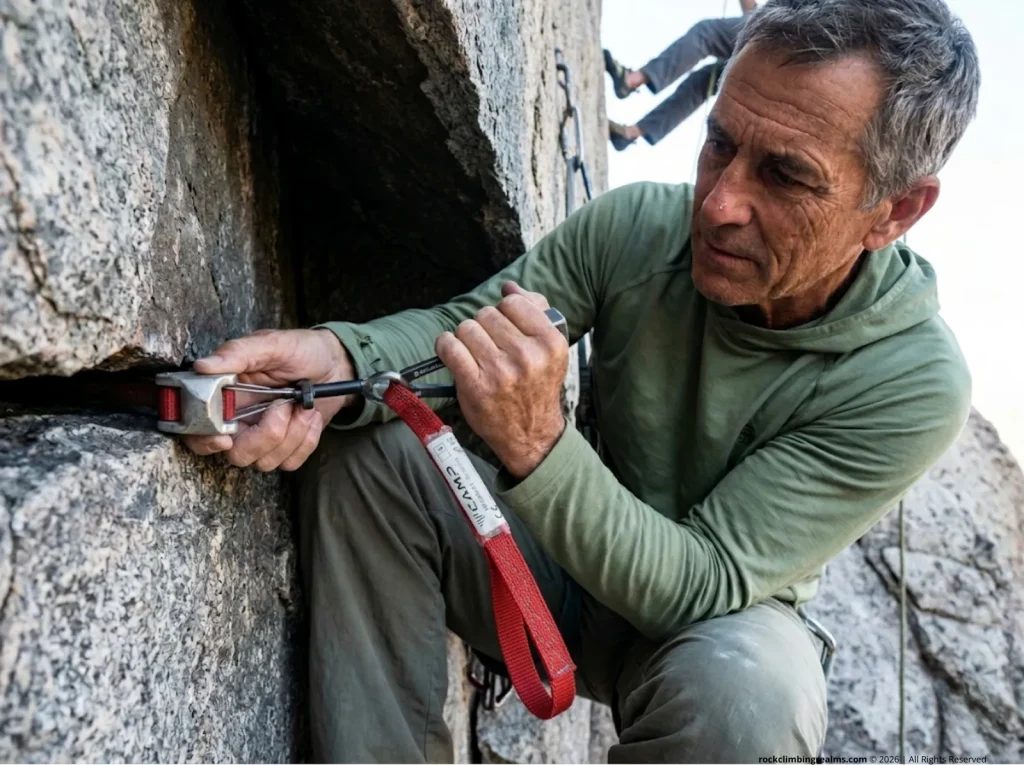
I’ve left exactly one piece on a route in my life. It was a Pink Tricam I yanked-and-sent in a rush because I was pumped and didn’t want to think about it. My second couldn’t touch it. I hiked back the next morning with a cheater stick. The piece is still on that route as far as I know.
Here’s where people go wrong, in order of frequency.
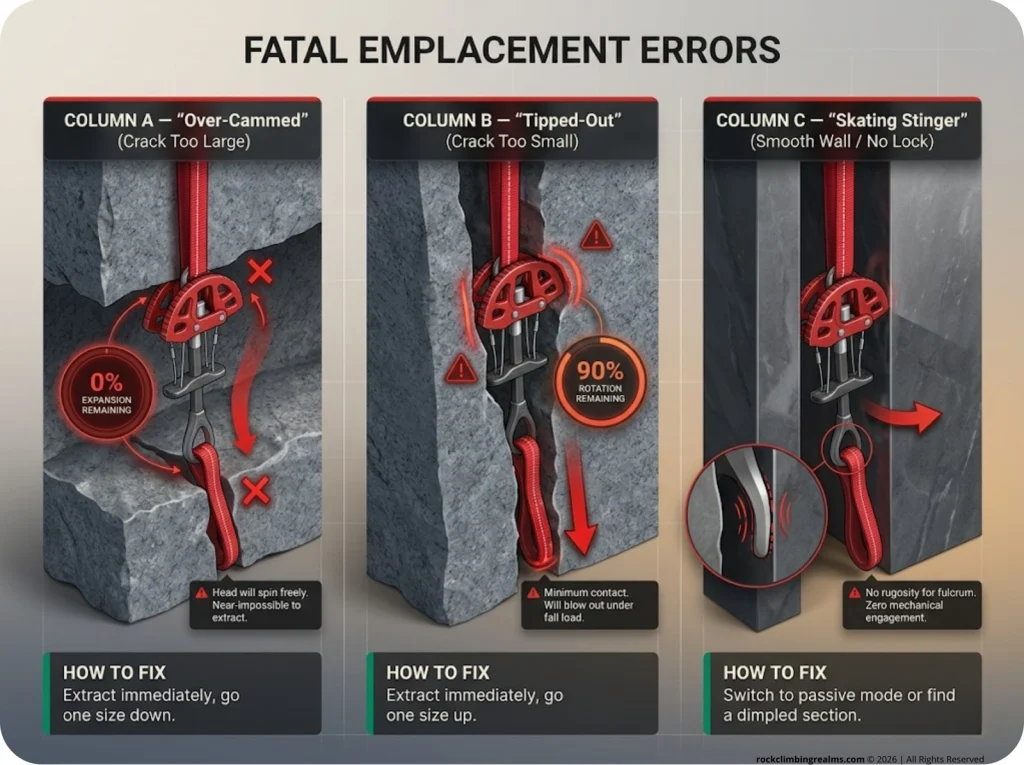
The three fatal placement errors:
The over-cammed Tricam happens when you choose a size too large. The head reaches full rotation before the rails contact the walls, which means zero expansion potential and virtually guaranteed impossible extraction. The tell is a head that spins freely in the crack. Extract immediately and go one size down.
The tipped-out Tricam happens when you go too small. The rails barely contact the walls, and a fall will complete the rotation — the piece will exit the crack. The tell is a head that wobbles laterally and rotates completely when you tug the sling. Go one size up.
The skating stinger happens on smooth rock with no rugosity for the fulcrum. The rails may look engaged, but any lateral movement lets the piece slide along the wall. The tell is a set jerk that produces no bite sensation. Switch to passive mode or move to a different crack section.
Walking and rope drag. Every horizontal Tricam on a traverse needs a 60 cm runner. No exceptions. Rope drag pulling the sling upward and sideways realigns the pull vector away from the camming angle, which partially unseats the piece. Plan your runners before you leave the ground. Replacing mid-pitch protection while pumped costs time and mental bandwidth you don’t have.
The extraction protocol — the art of the clean. When your second hits a stuck Tricam, the instinct is to yank the sling. That’s wrong — every pull on the sling re-cams the device. The exit is reverse rotation, and it works like this: insert a nut tool into the fulcrum channel or hook it behind the stainless retaining cross-pin. Apply steady pressure to rotate the head backward — the exact reverse of the seating motion — while simultaneously pressing the head inward to relieve outward rail pressure. Work slowly. Steady pressure, not jerks. One hand on the sling to add slight slack as the head rotates free, the other operating the tool. On steep terrain your second needs a solid body position before attempting this.
Full trad gear cleaning and maintenance protocol has the complete framework if you want to go deeper on extraction technique for other pieces.
Pro Tip: Always perform the set jerk before clipping the rope. An unseated piece that only “passes” because downward rope pull holds it in place is fool’s protection. Set first. Clip after.
Maintenance, standards, and retirement — making your Tricam last
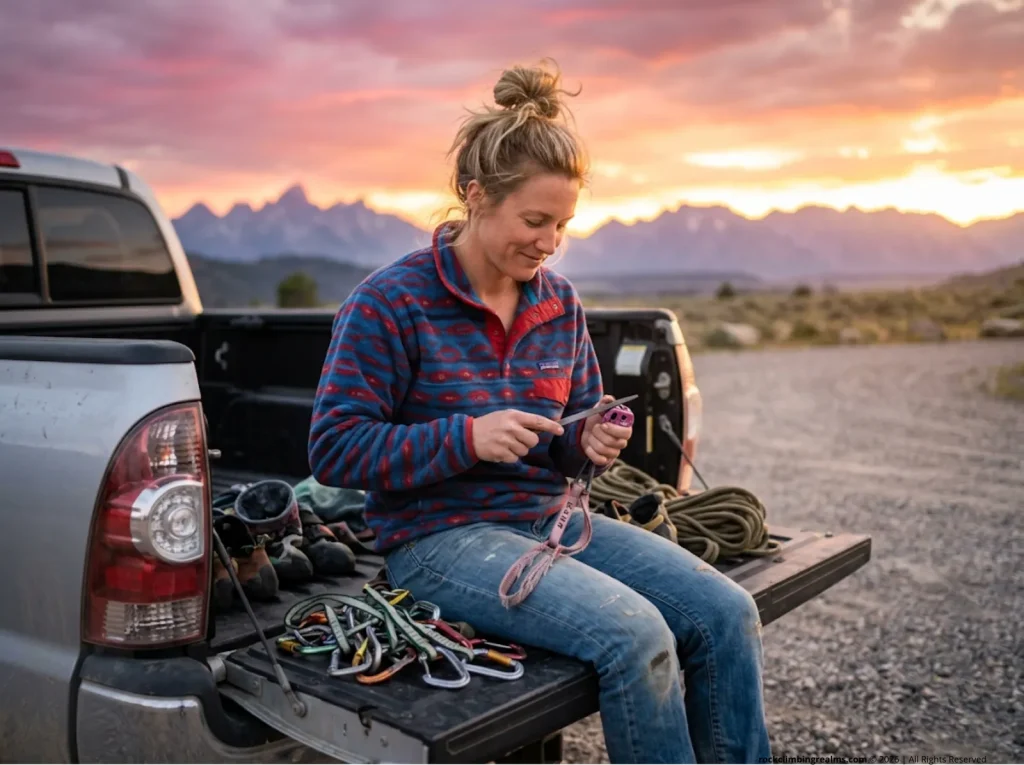
C.A.M.P. Tricams are certified to EN 12270 (Chocks) and UIAA 124/125 (Frictional Anchors). Before purchase, verify the UIAA Safety Label on the sling or head. Counterfeits exist and they do not carry the Label. UIAA guidance on inspecting and retiring climbing protection is the authoritative resource on that.
Run this 60-second protocol before every wall session:
Head: Scan for deep gouges over 1mm, cracks at the pin interface, visible deformation. Any of these means retire immediately.
Pin: Press it from both sides. Any lateral play in the stainless pin indicates galvanic corrosion or aluminum fatigue at the pin socket. Retire the piece.
Sling: Run the webbing through your fingers. Fuzz, discoloration, brittleness, or stiffness from UV damage means replace the sling or retire the piece. A sling stored in sunlight loses significant strength with no visible indicator. Exposure to battery acid, certain cleaning agents, or other chemicals can push a sling below UIAA minimums with zero visual change. If you don’t know what the sling touched, retire it.
Stinger: Press your fingernail against the stinger tip. It should catch on smooth granite. If it slides, file it. A fine-tooth needle file, longitudinal strokes along the stinger axis, maintains the factory edge geometry. Fifteen minutes of filing can save a piece you were about to retire. I filed a Pink Tricam stinger back to a point last season — performs like new.
The nylon vs. Dyneema question. Standard Tricams come with nylon slings, and most field veterans prefer them for a specific reason: nylon is bulkier, which keeps the sling stiffer in the cam channel after cocking. Dyneema is thinner and floppier — the head tends to unroll before you clip in, which is a leading failure mode. Nylon also has a higher melting point and absorbs more energy if the sling drags across a sharp rock edge during a fall. For horizontal placements where sling-edge loading is a real scenario, nylon is the safer call. Track your complete climbing gear lifespan and tracking system with purchase dates and annual inspection results.
Forged heads (sizes 0.125–4.0) have grain-aligned aluminum and superior fatigue resistance. The stamped larger sizes (5.0–7.0) need careful inspection at the head-to-pin interface after heavy use.
Conclusion
Three things carry everything in this article.
First: the Tripod Check is non-negotiable. Without the fulcrum seated and both rails contacting the opposite wall, you are not placing active protection. You’re hanging a heavy, unstable nut. Verify before every clip.
Second: the rock tells you the mode. No rugosity means passive mode. A spherical limestone pocket means broadside Evo. A horizontal pod with a dimple means active camming. Don’t force a geometry that isn’t there.
Third: your second deserves a clean piece. Set with authority, not maximum force. Use long runners on horizontals. Know the reverse-rotation extraction sequence before you need it in the field.
Take your Tricams to a low-angle boulder with horizontal pockets and practice the four-beat sequence until cocking, scanning, and setting is muscle memory. Find one placement per pitch on your regular crag. In a month you’ll see rock differently.
Now go send something.
FAQ
Are Tricams hard to place?
Tricams have a steeper learning curve than SLCDs, but confidence comes fast once you understand the tripod geometry. The hard part is finding the fulcrum seat — the micro-rugosity for the stinger — not executing the mechanics, which is a straightforward four-beat sequence. Most climbers are placing reliable active mode Tricams after 3–5 dedicated practice sessions on low-stakes terrain.
How do you clean a stuck Tricam?
Never pull the sling — it re-cams the device every time. Insert a nut tool into the fulcrum channel or hook it behind the retaining cross-pin and apply steady reverse-rotation pressure while pressing the head inward to relieve outward rail pressure. Work slowly and steadily. Rushing causes the tool to slip and the piece to seat harder.
Can you use Tricams in vertical cracks?
Yes, in passive mode. Orient the sling in the centered (uncocked) position and use the Tricam as a large angled nut in a narrowing vertical constriction. In active mode, vertical cracks are unreliable because gravity and rope movement pull the sling away from the cam channel, uncocking the piece before it loads. Horizontal placements are the Tricam’s primary design environment.
What is the best Tricam size to start with?
Pink (0.5) and Red (1.0) are the most versatile entry point, covering 18–32mm — the range that includes most horizontal pod features on moderate trad routes. The Pink in particular is the legendary Gunks piece; Shawangunk horizontal cracks fall almost universally in that range. If you climb granite or alpine terrain, add the Brown (1.5) for slightly wider horizontals. These three sizes together weigh about 111g.
Tricam vs. small cam — which should I place?
In parallel vertical cracks with no unusual features, place the cam every time — it’s faster and easier to clean. The Tricam earns its rack space in three specific conditions: horizontal pods where cams walk, icy crack performance where cam lobes skate, and limestone solution pockets where cam lobes can’t achieve equilibrium. Carry both, deploy each where it excels, and trust the physics.
Safety Notice: Rock climbing and mountaineering are inherently high-risk
activities that can involve physical trauma or fatal incidents. The information on Rock Climbing Realms is for
educational and informational purposes only. Techniques and advice presented here are not a substitute
for professional, hands-on instruction. Conditions and risks vary by location. Always seek guidance
from a qualified instructor before attempting new techniques. By using this website, you agree that you
are solely responsible for your own safety. Any reliance you place on this information is strictly
at your own risk, and you assume all liability for your actions. Rock Climbing Realms and its authors
will not be held liable for any harm, damage, or loss sustained in connection with the use of this information.
Affiliate Disclosure: We are a participant in the Amazon Services LLC Associates Program, an
affiliate advertising program designed to provide a means for us to earn advertising fees by advertising and linking
to Amazon.com. As an Amazon Associate, we earn from qualifying purchases. We are also an official affiliate partner
of Black Diamond Equipment via the AvantLink network. If you click on a Black Diamond affiliate link and make a
purchase, we may earn a commission at no additional cost to you. We also participate in other affiliate programs.
Additional terms are found in the terms of service.