
In this article
You stand at the base of a V4 that has sent half the people who touched it before you. Chalk dust hangs in the LED light. Somewhere in those holds is the beta that turns this from a pump-out into a flash. You have eight minutes on the clock and thirty moves you haven’t committed to memory. This is where route reading becomes the difference — and reading competition boulder problems teaches you to decode the setter’s puzzle before you pull.
I’ve been coaching climbers through this wall for over a decade. The climbers who consistently send at their limit aren’t the strongest — they’re the ones who decoded what the route setter actually built. This guide teaches you that process. By the end, you’ll know how to map force vectors before you pull, pre-load your motor cortex from the ground, and engineer your recovery so the send becomes a calculation instead of a gamble.
⚡ Quick Answer: Route reading combines visualization (neurological priming from the ground), biomechanical mapping (reading hold vectors), and hemodynamic management (planning recovery). The goal: eliminate mid-route hesitation by solving the puzzle before you’re on the wall. Practice the ground read on every route — even easy ones — and the skill compounds.
The Ground Phase — Cognitive Pre-loading and Visualization
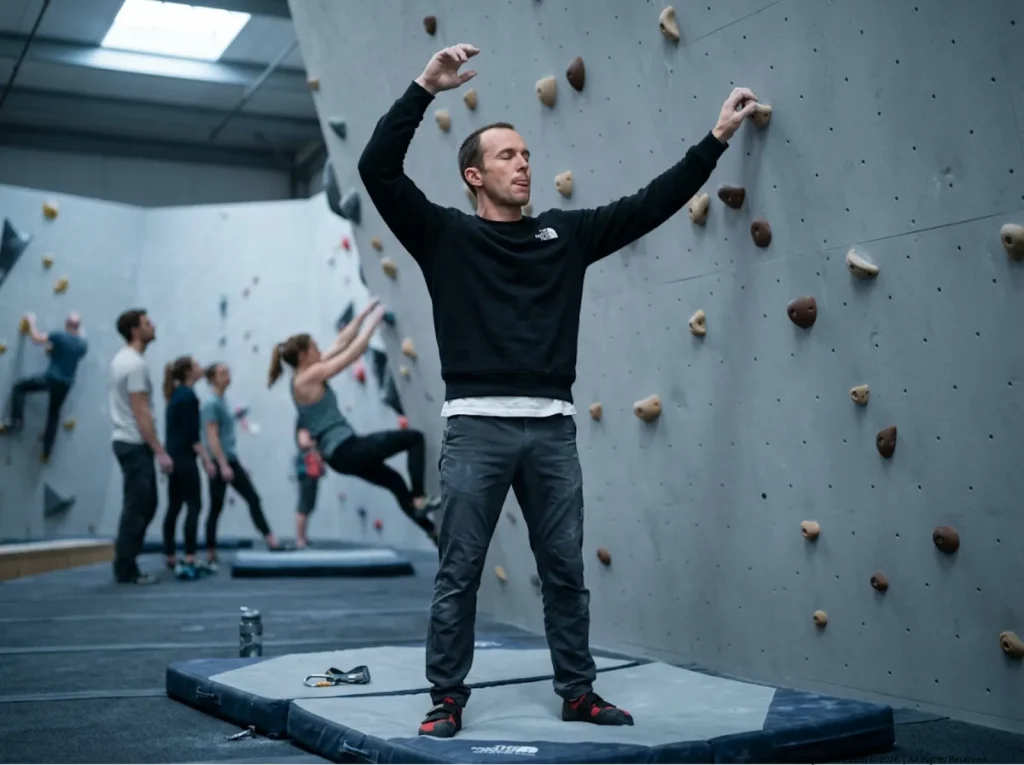
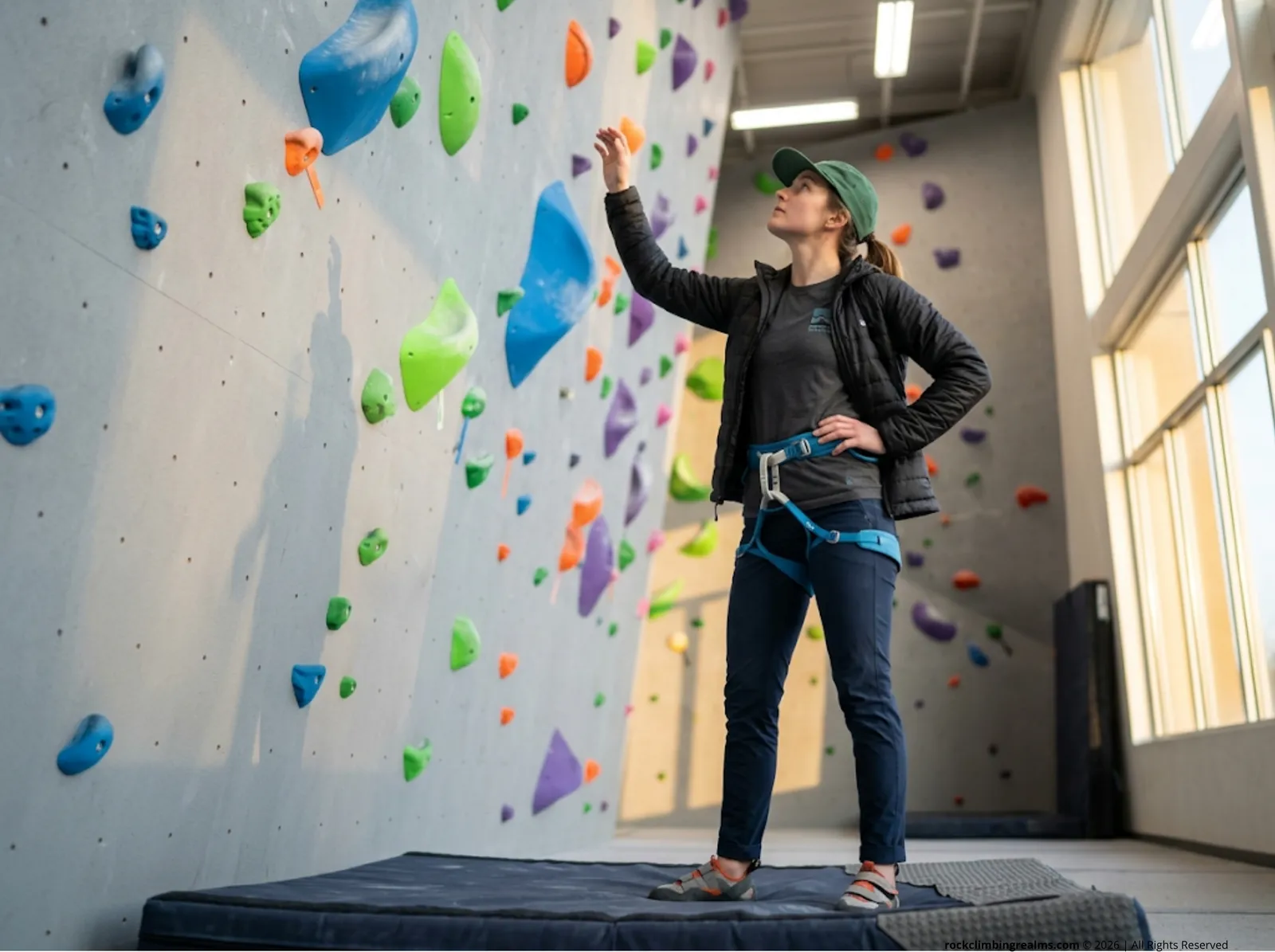
Route reading starts the moment you walk up to the wall, not when you grab the first hold. Standing below the route, you’re building a high-fidelity digital twin of the climb inside your motor cortex — a neurological blueprint you’ll execute when your feet leave the ground.
The research on mental rehearsal is concrete. When you vividly imagine a sequence, your brain activates the cortical sensorimotor areas responsible for actual movement. That mental rehearsal triggers low-level muscle electrical activity, priming target muscles before you physically pull. This is a documented technique with measurable physiological effects, backed by peer-reviewed research on blood flow restriction and motor cortex activation during climbing.
The Neuromechanics of Visualization
For visualization to actually work, it needs to be polysensory. Don’t just see the holds — feel the sharp edge of a dual-texture crimp against your fingertip. Hear your breath. Sense the gym temperature. The more sensory layers you integrate, the stronger the neural pathway. This connects directly to mental training protocols that leverage amygdala control and neuroplasticity.
The Ondra Method — Three Tiers of Rehearsal
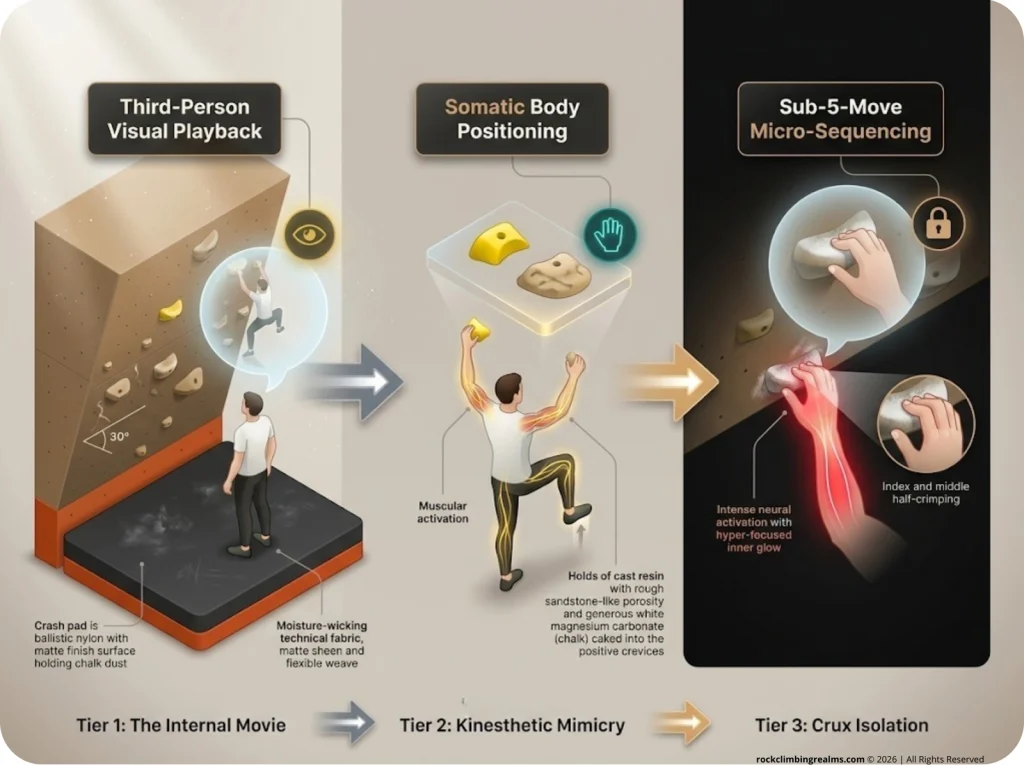
Adam Ondra uses a tiered system that translates directly to gym climbing.
Tier 1 — The Internal Movie: Close your eyes and watch yourself climb from a third-person perspective standing on the ground. Identify the clipping stance, locate the crux, find where you’ll rest. If you can’t see it from the ground, you won’t find it on the wall.
Tier 2 — Kinesthetic Mimicry: Physically act out the hand and foot movements while standing below the route. Your body’s proprioceptive feedback tells you whether the beta you’ve visualized actually works in three dimensions. This is embodied cognition — your body teaches your brain before you commit.
Tier 3 — Crux Isolation: Take the hardest sequence and drill it mentally until it’s automatic. Break it into sub-5-move chunks. If you cannot see the move in your mind before you pull, you will not execute it cleanly when it counts.
Building Your Internal Movie
Start by practicing ground reads on routes you’ve already sent — you’re training your eye without the consequence of failure. Verbally narrate each hold from the ground: “crimp, gaston, high-step, deadpoint.” The verbal process forces precision. Once that feels natural, transition to silent internal playback.
Chunk holds into logical movement units rather than individual placements. You’ll remember sequences faster and execute them more fluidly because you’re not consciously tracking every separate decision.
Pro tip: start your ground read by verbally narrating the sequence out loud — speaking forces your brain to process each hold’s beta rather than glazing over details.
Biomechanical Mapping — The Physics of Hold Vectors
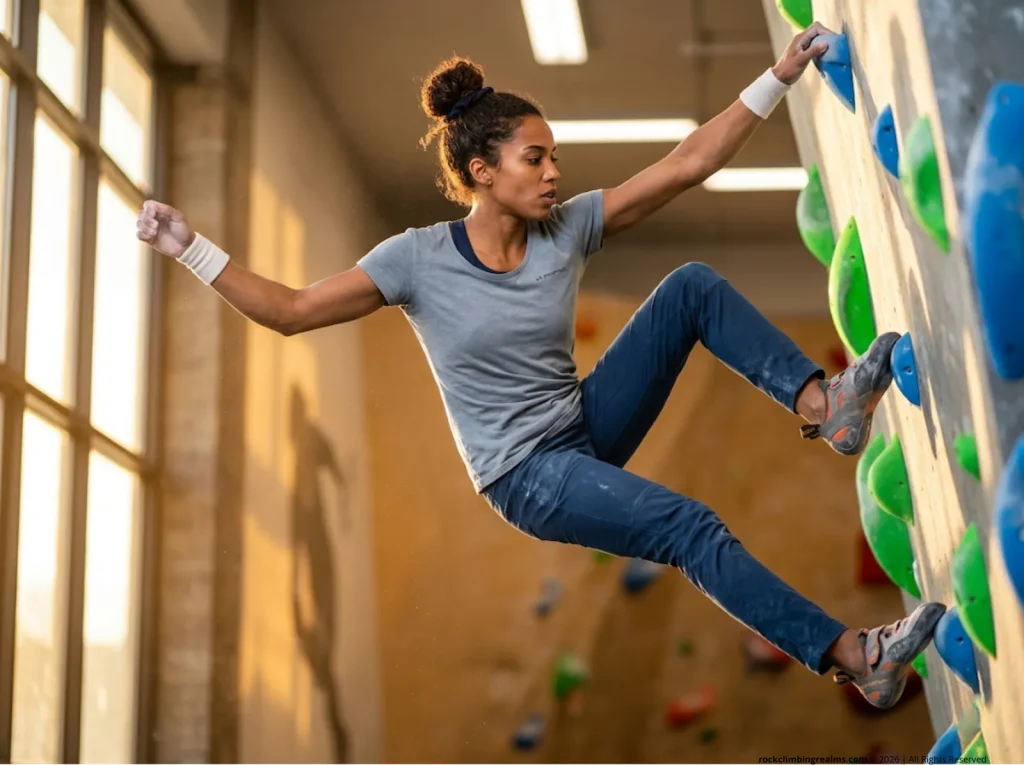
Every hold on a route is a force delivery system — understanding climbing hold shapes and their biomechanics will rewire how you read the wall. Once you start reading holds as vectors instead of shapes, the sequence stops being arbitrary and starts being logical. Research from MDPI’s scientific journal on climbing biomechanics provides peer-reviewed validation of the force vector analysis approach.
Each hold provides a force vector — a specific direction and magnitude your body must counteract to stay on the wall. Your job is to identify the vector, then position your body so your skeletal structure — not your muscles — handles the load.
The Force Vector Matrix
Crimp vectors point perpendicular to the small edge. Keep your body weight directly under the hold to minimize the lever arm on your finger flexors. Pulling a crimp with your body offset to the side is the fastest way to blow a finger joint under load.
Sloper vectors are rounded and rely on friction coefficient. Reading a sloper route means finding the sweet spot on the curve where your hand achieves maximum surface area contact, then keeping your center of gravity low and under the contact point. Pulling away from a sloper peels you off instantly. This connects directly to the biomechanics of body tension and friction optimization.
Side-pull and gaston vectors point horizontally. These require counter-pressure — turning your opposite hip into the wall so your skeleton resists the pull, not your arm. A gaston used with proper hip-to-wall counter-pressure is almost effortless. When a sequence demands you switch between heel hooks and toe hooks, knowing the mechanics of each prevents the barn-door swing that costs sends.
Undercling vectors point downward. High footholds become non-negotiable — you need body tension through your chain to drive into an undercling without barn-dooring.
The Force Triangle and Geometric Stability
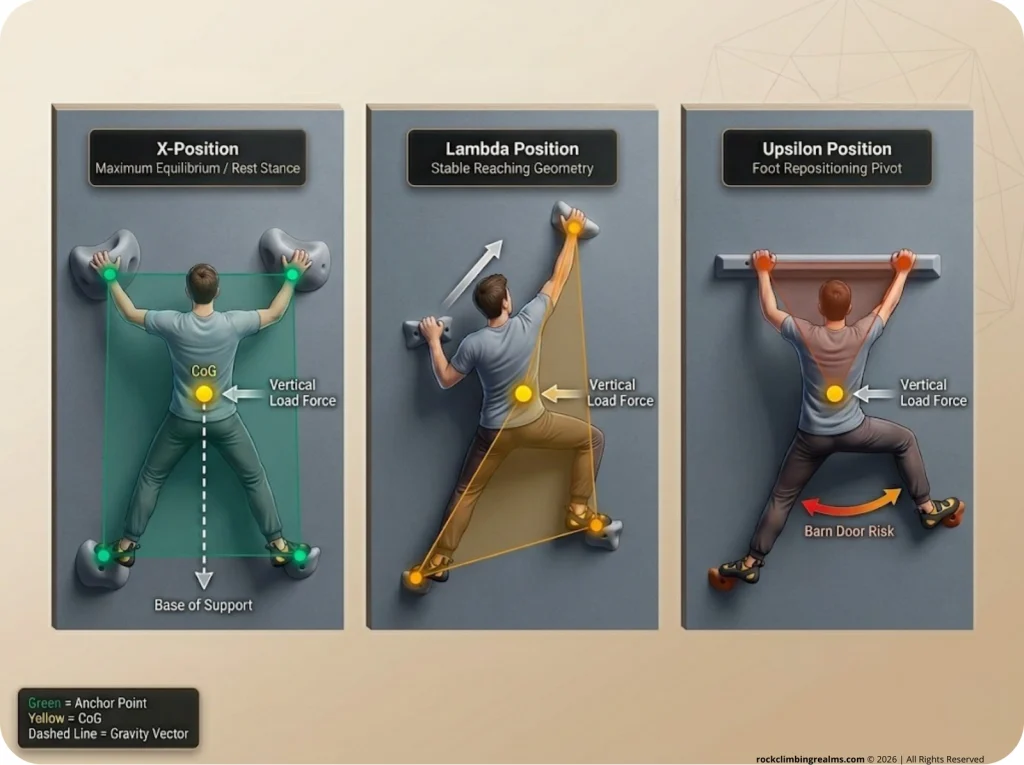
Your hands and feet form a support area. Your center of gravity must act perpendicular to this support area to maintain equilibrium. If your center of gravity drifts outside the support triangle, you rotate — the dreaded barn-door swing that sends people off the wall even with plenty of finger strength left.
Everything on the wall follows basic physics. A stable position is one where all acting forces balance to zero. The route setter designed certain positions where that equilibrium is easy. Reading the route means finding those positions, then working between them.
The X, Lambda, and Upsilon Positions
The three geometric stability positions describe every static moment on a route.
The X-Position uses four points of contact — two hands and two feet — with your center of gravity vertically between the hands. This is your home base for rest stances.
The Lambda Position has three points — one hand and both feet — during a one-hand reach. Both feet and the active hand form a triangular base that maintains equilibrium while your free hand travels.
The Upsilon Position has three points — two hands and one foot — during foot repositioning. Your center of gravity shifts over the planted foot as a pivot point while the other foot searches for the next placement.
Route reading means knowing which position you’re in, then understanding what the next logical position should be based on the hold geometry. Correct beta means you flow through these positions without thinking — and when balance break down, flagging and drop-knee techniques are the tools that close the gap.
Pro tip: if you feel yourself barn-dooring, it’s almost always a center of gravity alignment problem, not a grip strength problem. Your body has drifted outside the support triangle and physics wins that argument every time.
The Physiology of the Send — Hemodynamic Management
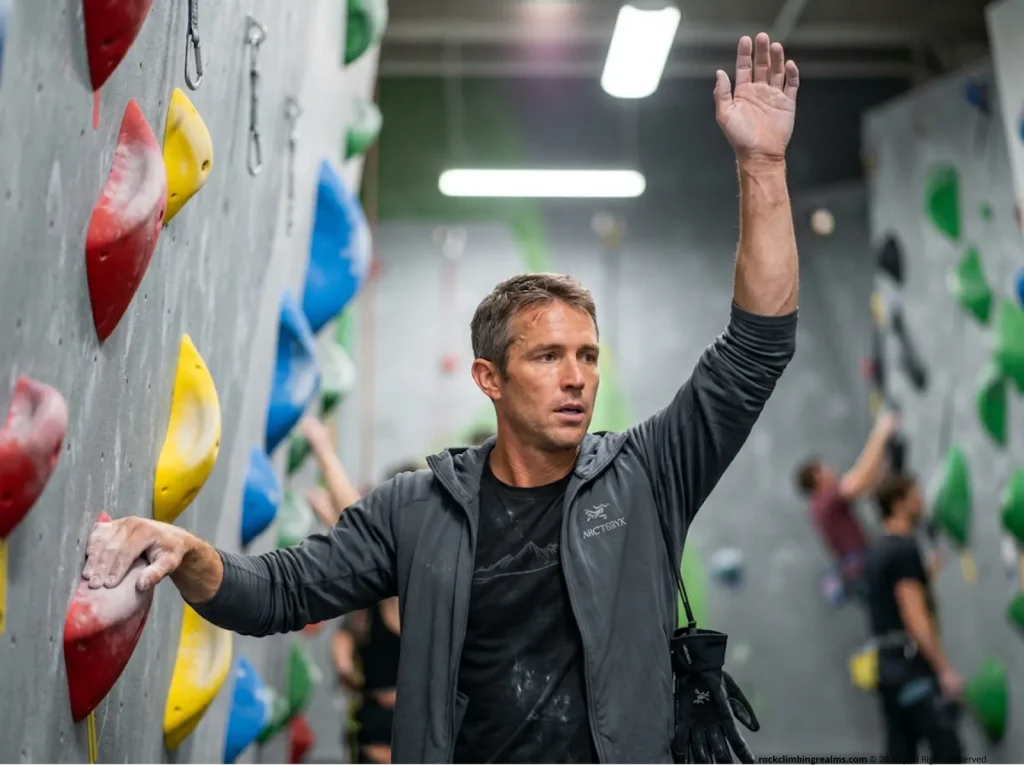
Even perfect beta fails if your forearms are cooked. Forearm fatigue is not primarily a strength problem — it is a circulation problem — and the science of the pump explains exactly why.
Capillary Occlusion and the “Flash Pump”
During intense isometric gripping, your forearm muscles compress the capillaries running through them. At only 20% of maximum grip intensity, circulation to the forearms begins being restricted. At 50%, circulation is often completely cut off — oxygen delivery drops sharply while lactic acid accumulates faster than your body can clear. This is the physiological mechanism behind the pump, and it explains why forearms can feel fine one moment and completely useless the next.
Every second of hesitation on the wall is a withdrawal from your metabolic account. Misread a rest stance and blow through it, and you may arrive at the crux already compromised.
G-Tox — The Gravity-Assisted Detox
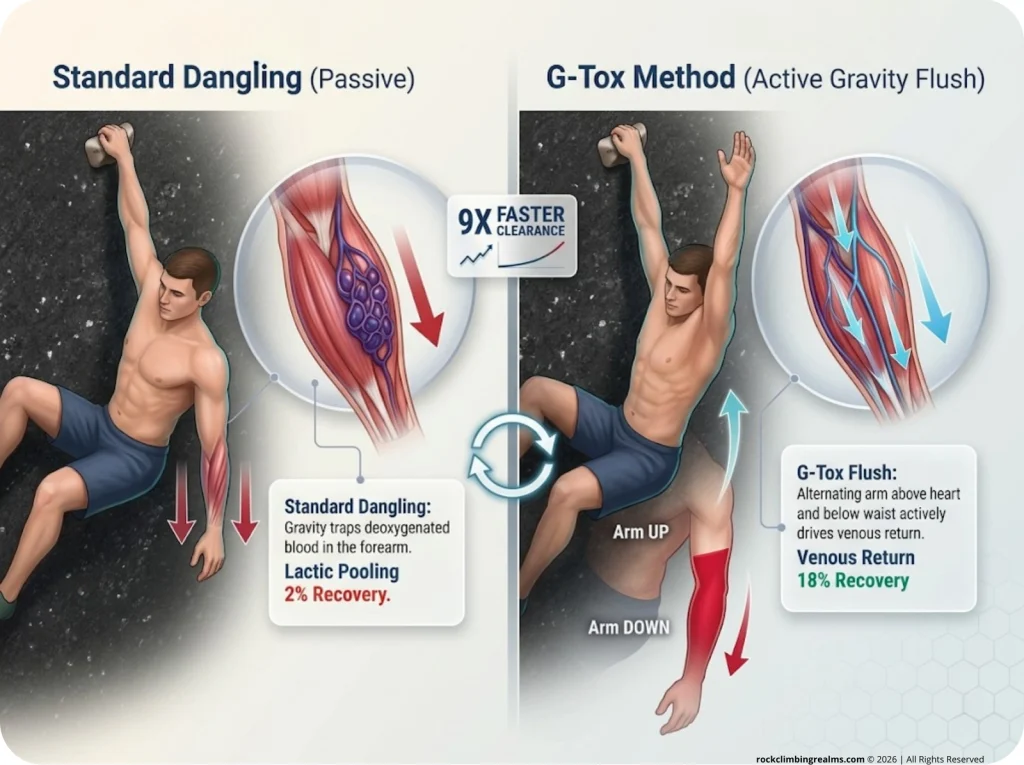
Standard dangling is not doing what you think. Circulation pools in your forearm and venous return becomes sluggish. You’re relying on slow passive diffusion to clear waste.
The G-Tox method uses gravity as an active recovery tool. Alternate your resting arm between a position above your head and below your waist. Above the head, gravity pulls deoxygenated blood out of your forearm. Below waist level, fresh oxygenated blood refills the vessels. Each position change is a mechanical flush.
The data is unambiguous: G-Tox users recover 18% grip strength after 2 minutes versus 2% for standard dangling. Ninefold recovery advantage from a protocol change that takes no additional effort.
Planning Recovery During the Read
Your route read is incomplete without a recovery plan. Identify confirmed rest stances from the ground — positions where the X-position is available for a full G-Tox cycle. On routes with no flat rest, plan active hang positions: clipping stances where you can execute G-Tox while maintaining one hand on the wall. Recovery isn’t just about the send, either — climbing rest day protocols factor into how your body rebuilds after hard efforts.
The climbers who send hard routes consistently planned their recovery windows before they pulled.
Pro tip: start using G-Tox on every rest stance during easy routes now — before you need it on a hard redpoint. Build the habit in training so it fires automatically under pressure.
Thinking Like a Route Setter
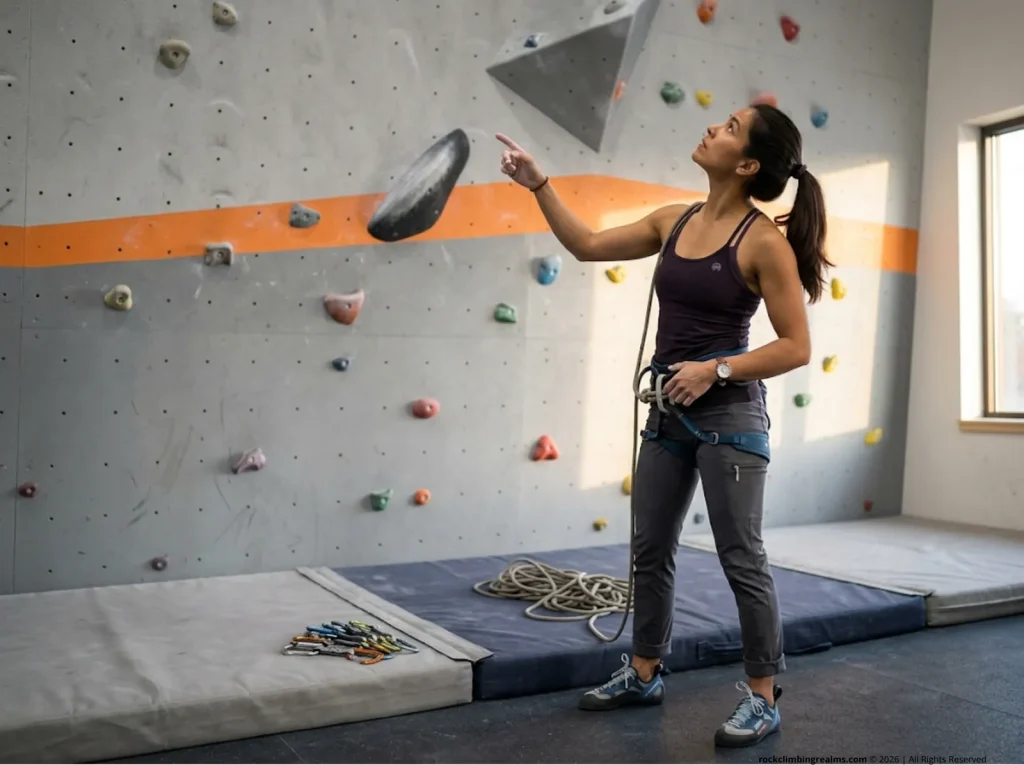
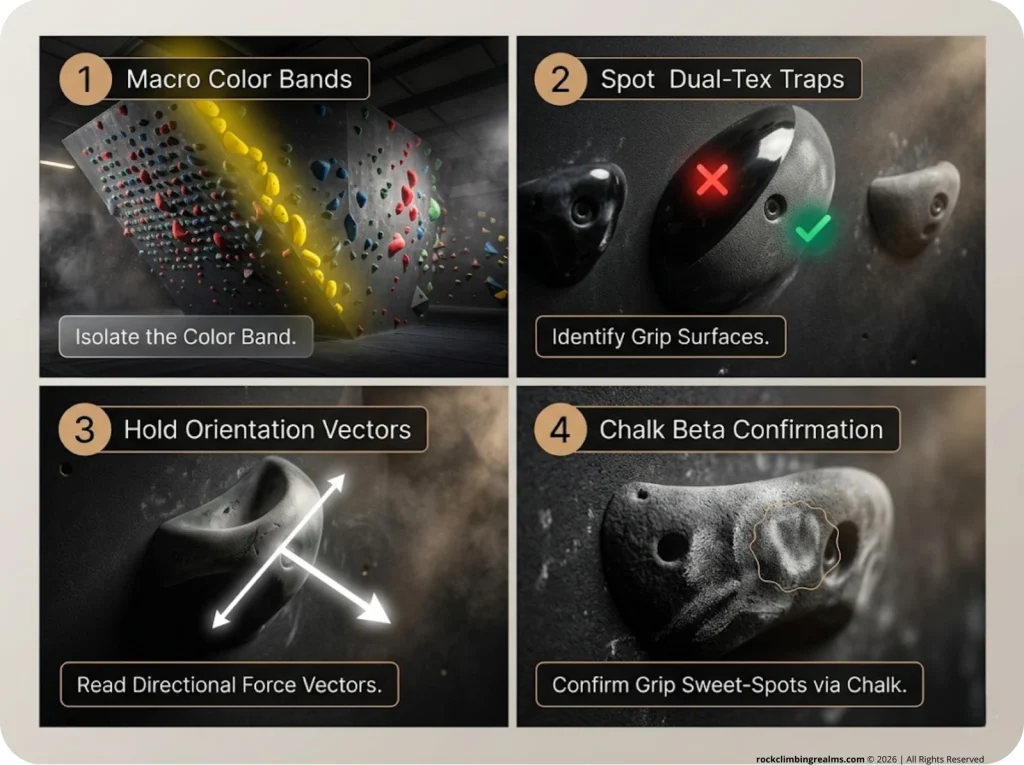
Route setters are puzzle designers. Every orientation, every color change, every dual-texture feature is a deliberate signal. Once you start reading setter intent, the route stops being a mystery.
Clues in the Resin
Hold orientation is the clearest signal on the wall. A hold turned sideways is not a vertical pull — it is a side-pull or a drop-knee. The setter placed it that way on purpose. If you’re reading it as a crimp, you’re already off-sequence.
Chalk marks are beta data from everyone who sent the route before you. Thumb impressions indicate where successful climbers found the vector sweet spot. Use that data.
Dual-texture holds are a biomechanical gatekeeper. A shiny, frictionless section next to a grippy surface tells you exactly where your hand should not go. The setter designed it that way to punish imprecision.
Reactionary Route Reading (RRR)
On long sport routes where you cannot see the top, cognitive load becomes a real limiter. Onsight and redpoint route reading strategies require chunking the route between reset points — clips, rest stances, and directional changes. From each reset point, read only to the next one. Do not try to hold the entire upper half of the route in your head — you’ll fatigue your decision-making before the crux arrives.
Reading the Wall Geometry
Before you read holds, read the macro shape. Overhangs require different vector strategies than slabs. Dihedrals and aretes create natural rest positions. Roof sections demand momentum management; slab sections demand precision footwork and center of gravity control.
If your beta consistently feels harder than the route grade, you’re probably off-sequence. The setter calibrated difficulty around a specific path. Use color bands as a macro-level guide — most gyms use color changes to signal the intended path — then refine with individual hold reads.
Gear and Training — Tools for the Technical Mind
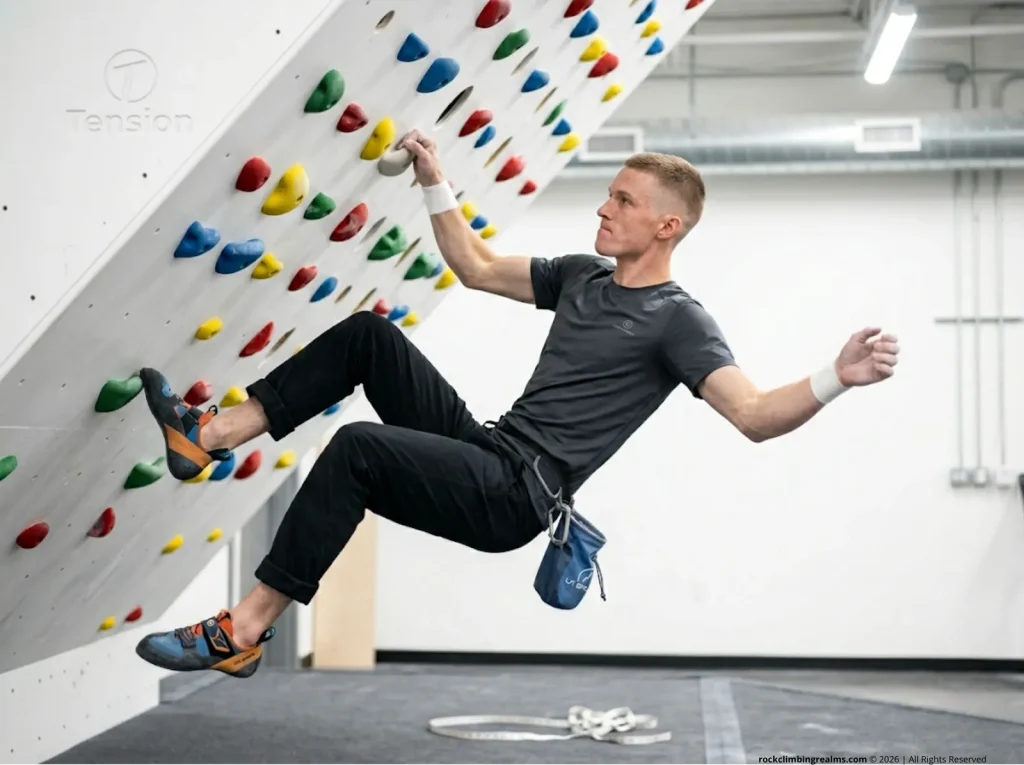
Your gear is an extension of your biomechanics. The right shoe makes the read possible. The right training board makes the skill compound.
Performance Footwear Analysis
For steep routes and overhangs, an aggressive downturned shoe — the Scarpa Drago or La Sportiva Solution Comp — lets you pull with your toes as if they were hands. For technical vertical and slab, a flatter, structurally supportive shoe — the La Sportiva Katana Lace or Scarpa Boostic R — provides the sensitivity needed for dime-edge precision.
Training Boards — The Lab Environment
Training boards are where route reading skill goes from theoretical to measurable. If you’re targeting V5, a structured training framework will accelerate your reading accuracy faster than random gym routing.
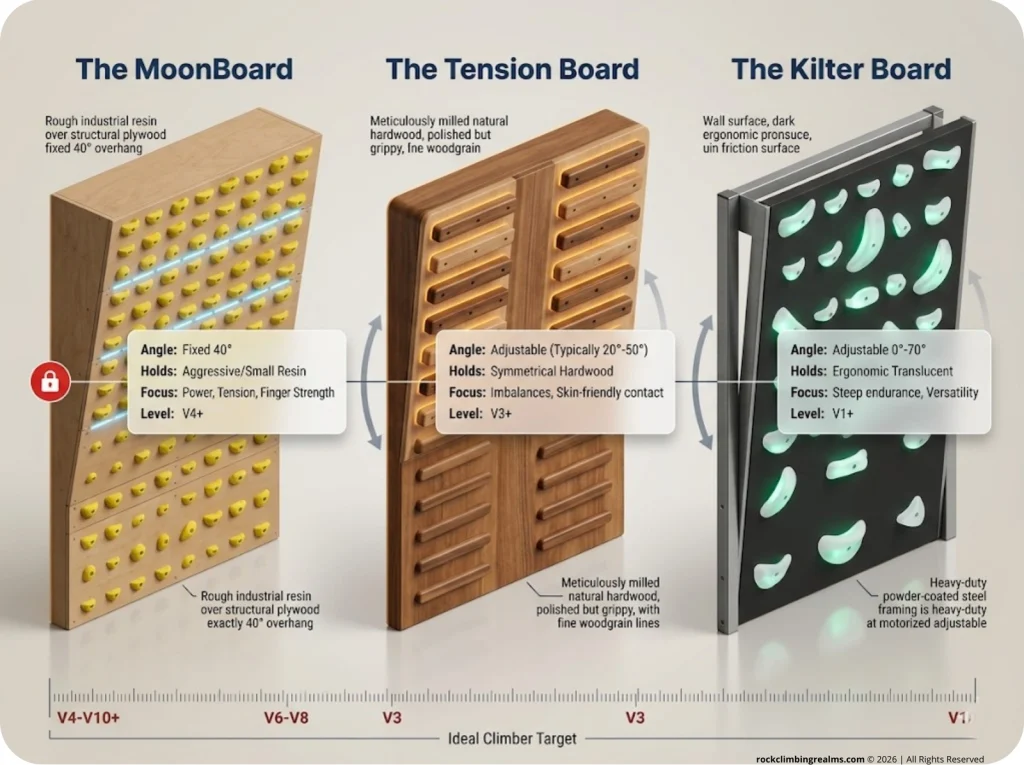
The MoonBoard uses small, aggressive holds on a standardized 40° overhang, forcing outdoor-style reading on incremental edges. The Tension Board eliminates left/right bias with its symmetrical design, exposing dominant-side compensation in reading. The Kilter Board adjustable angles (0–70°) let you practice the same read at multiple intensities, building intuitive steepness progression.
Systematic board protocols produce measurable results. Four to six weeks on a single board configuration builds a Beta Bank of reproducible movement patterns. Data-backed assessment frameworks for identifying and fixing climbing plateaus confirm that structured board repetition produces measurable improvements in route reading speed and sequence prediction accuracy.
Pro tip: spend at least one session per month reading board routes without touching the wall — walk through the sequence on the ground, film it, compare what you read to what you executed. The gap between those two is your reading accuracy score.
The Efficiency Audit — Learning from Failure
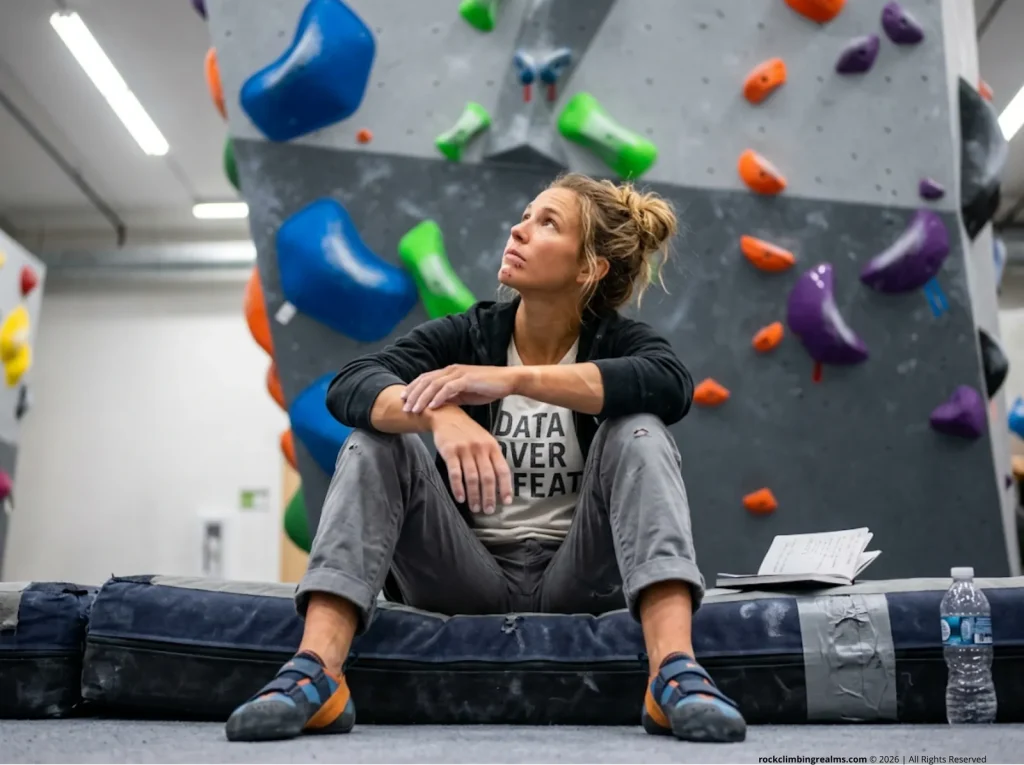
Every fall contains diagnostic data. Climbers who improve fastest extract it before they pull again.
Post-Fall Diagnostic Questions
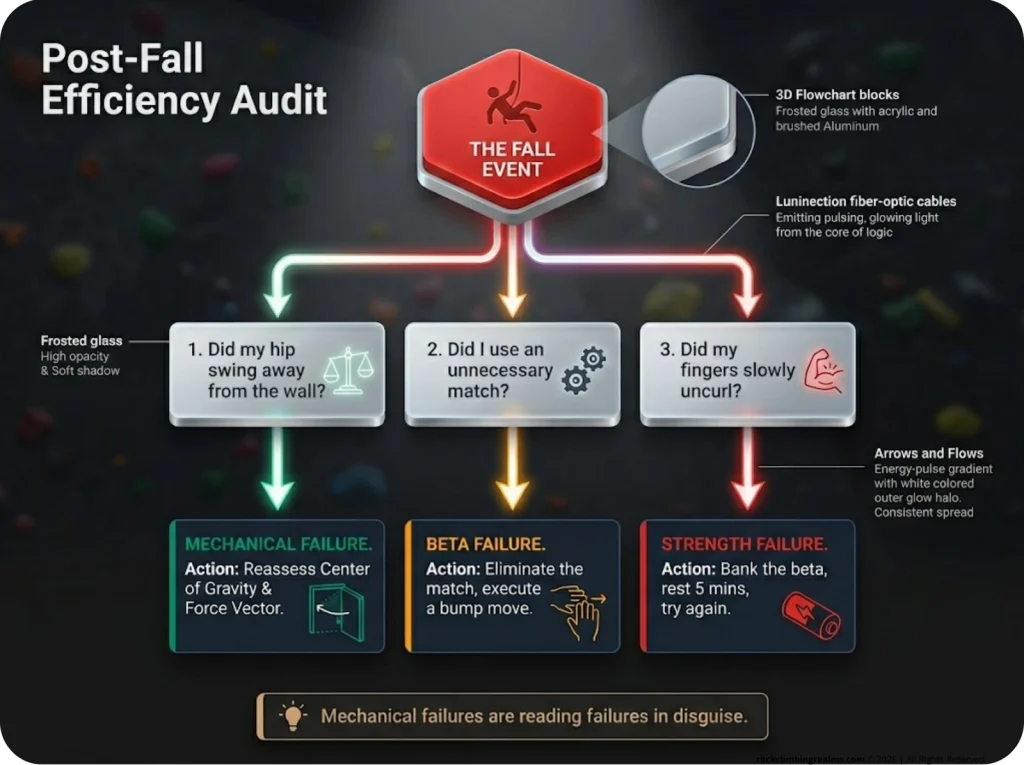
Run this three-question audit before re-attempting anything:
Was it a strength failure or a mechanical failure? Did your fingers open because the muscle was exhausted, or did your hip swing away from the wall — a center of gravity alignment problem? These require different responses. Mechanical failures are reading failures in disguise.
Was the sequence efficient? Did you match on a hold that could have been used in a bump move? Unnecessary matches compound into a pump-out at the crux.
Did you misread the force vector? Were you pulling away from a sloper instead of staying under its contact curve? A misread vector is a beta problem. Treat it as one.
Building Your Beta Bank
Every route you read — successfully or not — deposits data into your Beta Bank: your internal library of hold configurations, body positions, and movement patterns. A diagnosed, filed sloper misread means the next sloper you encounter reads faster.
Boards expose you to specific, reproducible configurations faster than random gym routes. A month of deliberate board reading is more efficient Beta Bank construction than six months of random sends.
Even on successful sends, run the efficiency audit. Hesitations and sub-optimal beta choices are efficiency leaks. Systematic post-mortem analysis of climbing failures works best within 24 hours — mental replay before sleep consolidates motor patterns because sleep-dependent memory retention makes the data stick.
Pro tip: the gap between what you read on the ground and what you executed on the wall is your reading accuracy score. Track that gap over time, not just whether you sent.
Three things to take into your next session: visualization is neurological priming — treat it as a warm-up for your motor cortex; every hold is a force vector your center of gravity must align with; and your recovery windows are planned during the read, not improvised when the pump hits.
The next time you’re staring at a route that has beaten you before — the send is not a gamble. It is a calculation. Now go apply these principles and feel the difference.
Now go send something.
FAQ
How long should I spend reading a route before climbing it?
Spend 5–10 minutes on a ground-level read for routes at your limit. Study the full sequence, identify the crux, locate rest stances, and mentally rehearse the beta. That investment eliminates mid-route hesitation — one of the fastest drains on your metabolic reserves during a redpoint burn.
Does visualization actually improve climbing performance?
Yes. Research on motor cortex activation confirms that vivid mental rehearsal triggers the same neural pathways used during physical execution. Climbers who visualize with polysensory detail show measurable improvements in beta retention and movement fluidity. Passive thinking about climbing does almost nothing — the key word is vivid.
What is the G-Tox method and why is it better than regular shaking out?
G-Tox alternates your resting arm between a position above your head and below your waist, using gravity to actively flush deoxygenated blood out of your forearm. Standard dangling relies on slow passive diffusion. Research shows G-Tox recovers 18% grip strength after 2 minutes versus 2% for standard dangling.
How do I know if I misread a route versus just being too weak for it?
Run the 3-question efficiency audit: (1) Did your body swing away from the wall — a mechanical or reading failure — or did your fingers open from exhaustion? (2) Was your sequence efficient? (3) Was your center of gravity aligned with the hold’s force vector? Mechanical failures are reading failures. If the answer points to position or sequence, the problem is your read, not your finger strength.
How do training boards specifically improve route reading?
Boards provide repeated exposure to standardized configurations, building your Beta Bank faster than random gym routing. Systematic protocols produce measurable improvements in reading speed because your brain files and retrieves patterns faster with repetition.
Safety Notice: Rock climbing and mountaineering are inherently high-risk
activities that can involve physical trauma or fatal incidents. The information on Rock Climbing Realms is for
educational and informational purposes only. Techniques and advice presented here are not a substitute
for professional, hands-on instruction. Conditions and risks vary by location. Always seek guidance
from a qualified instructor before attempting new techniques. By using this website, you agree that you
are solely responsible for your own safety. Any reliance you place on this information is strictly
at your own risk, and you assume all liability for your actions. Rock Climbing Realms and its authors
will not be held liable for any harm, damage, or loss sustained in connection with the use of this information.
Affiliate Disclosure: We are a participant in the Amazon Services LLC Associates Program, an
affiliate advertising program designed to provide a means for us to earn advertising fees by advertising and linking
to Amazon.com. As an Amazon Associate, we earn from qualifying purchases. We are also an official affiliate partner
of Black Diamond Equipment via the AvantLink network. If you click on a Black Diamond affiliate link and make a
purchase, we may earn a commission at no additional cost to you. We also participate in other affiliate programs.
Additional terms are found in the terms of service.