
In this article
The wind on the divide is screaming at 40mph. It’s stripping the heat right through your layers while your partner shivers at the anchor. This is definitely not the time to fight a tangled mess of pigtails caused by a lazy morning coil.
In rock climbing and mountaineering, the hike in is basically the first pitch. How you carry your climbing rope decides if you arrive at the base wrecked and frustrated, or fresh and ready to go.
The butterfly coil isn’t just a way to store gear; it’s a tool to stop wasting time. As a guide, I don’t see rope logistics as a chore. Proper gear management is a critical part of the day. If you understand how your gear works, you can turn a heavy rope into a comfortable system that moves with you, not against you.
This technical field guide explains why the old-school mountaineer’s coil ruins your rope, how the backpack carry saves your back, and how to master coiling speed so you can get moving.
Why Does Your Coil Choice Matter?
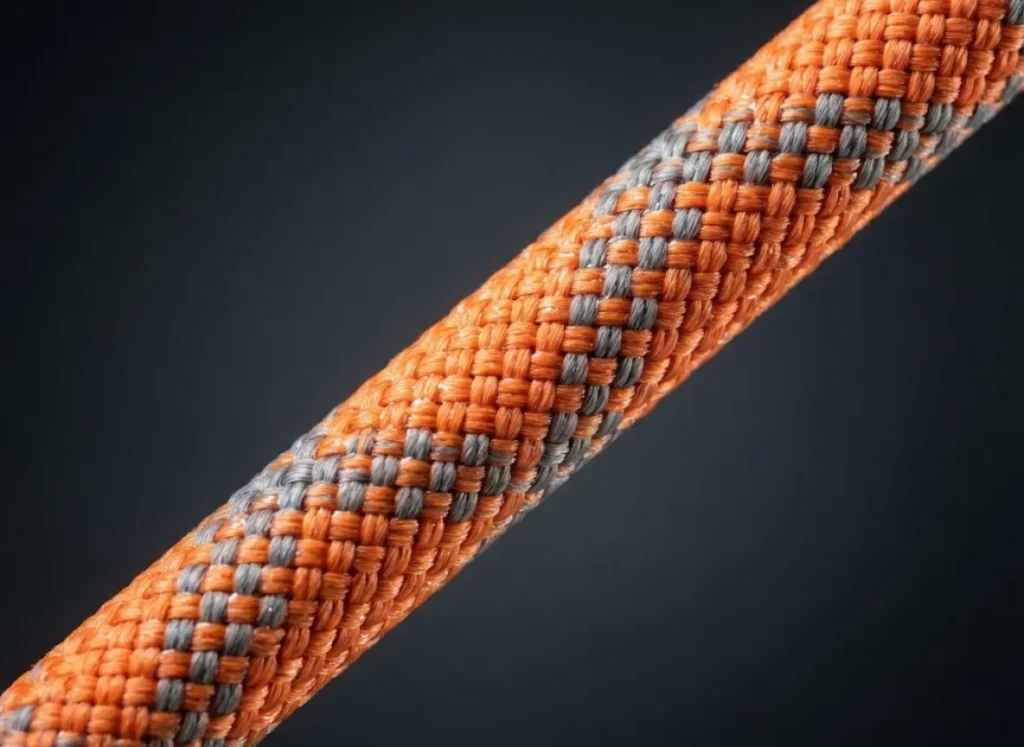
How the rope is made changes how you should coil it.
Rope behaves a certain way because of how it is built, not just because of personal preference. Modern dynamic rope uses a specific understanding dynamic rope construction, which has a twisted core for strength and a woven sheath for protection. Because of this design, the rope has a “grain” to it.
The popular “Mountaineer’s Coil”—sometimes called an alpine coil—fights this design. Mechanically, looping it in a circle forces a full rope twisting effect for every single loop you make. Over a standard 60-meter single rope, you are adding about 60 twists. When you flake the rope later, all that twisted energy turns into a bird’s nest coil of kinks.
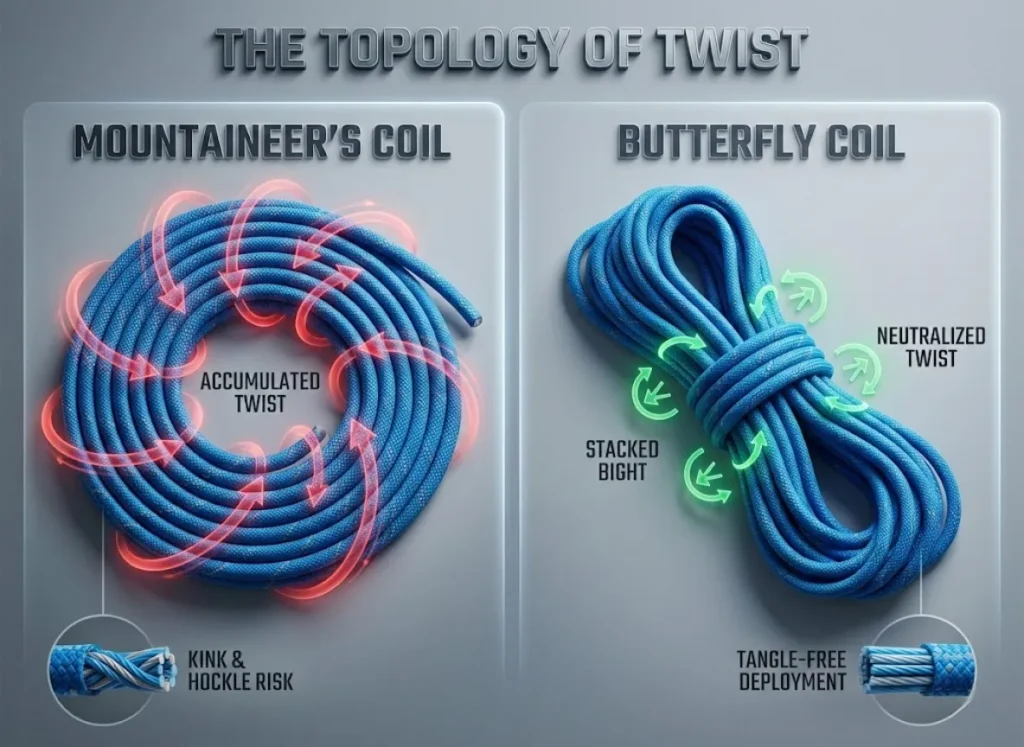
The butterfly coil (also known as the French coil) is different. It uses a back-and-forth folding method. Every time you twist the rope one way, you fold it back the other way. This cancels out the twisting, so the rope stays “relaxed” while it hangs. This is exactly like how the rope lies when you flake it on the ground.
Keeping the sheath and core happy is vital for rope longevity. Constant twisting creates friction between them, which can make the rope feel sloppy and harder to handle over time. Following AMGA-certified sources regarding standards for rope management and technical rescue is the best way to prevent gear issues caused by bad handling.
How does a bad carry hurt your approach?
The way you carry your gear changes how much energy you burn. A standard rope weighs between 7 and 10 pounds. That is a heavy weight if you carry it wrong. If you sling a coil over one shoulder “Courier Style,” you pull your body to the side. This forces your back muscles to work unevenly to keep you upright, which tires you out before you even touch rock.
The butterfly coil climbing rope carry sits the weight high on back. This lines the load up with your spine. When you are scrambling over rocks, balance is everything. A loose coil that swings around can throw you off when you are on exposed terrain, ruining its suitability for scrambling.
Pro-Tip: If your coil is bouncing against your lower back, it’s too loose. The rope should feel like a solid part of your body, moving right along with your hips.
Spreading the weight out helps you walk normally. This helps you know exactly where your feet are placing, which stops you from tripping or rolling an ankle. We know from principles of military load carriage that protecting your body during the hike means you climb better when you get there. This is also why choosing the right approach shoes matters—your feet need to support the load you are carrying.
How Do You Tie the Double-Strand Butterfly Coil?
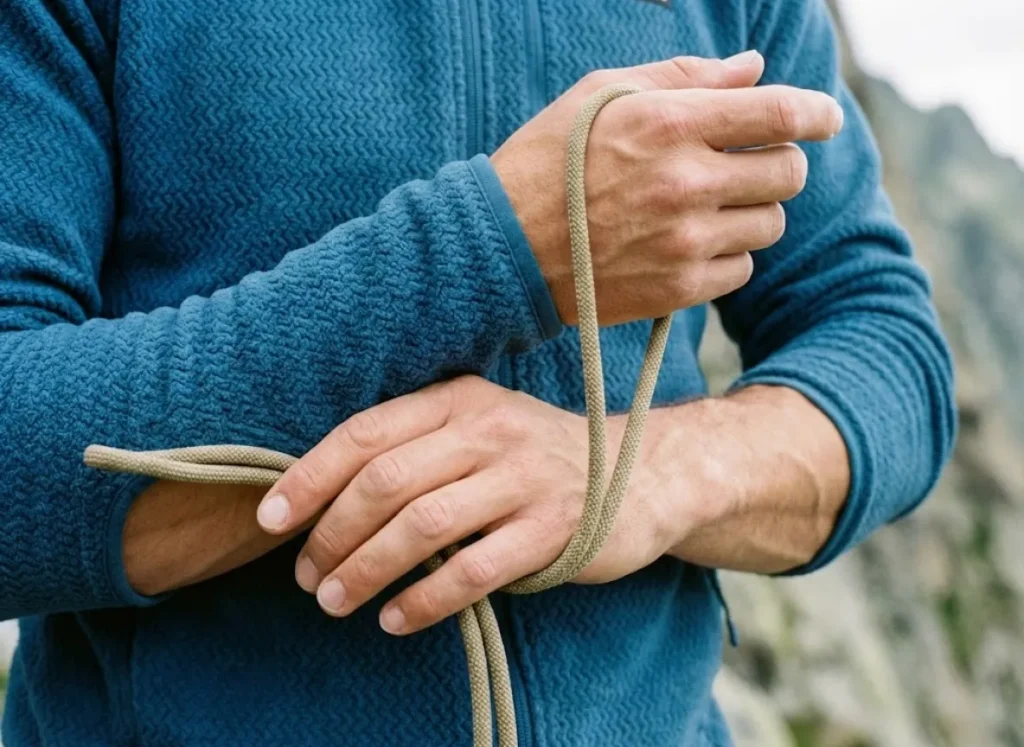
Measuring the tails with your body.
To make a backpack carry work, you have to measure your rope tails (the loose ends) correctly before you start. The most common mistake is reaching the end of the coil and realizing you don’t have enough tail length left to tie it around your waist.
Use your wingspan (arms stretched out wide) to measure. Anthropometric data on human reach shows that arm span is a great way to estimate length in the field. Generally, a climber needs 2.5 to 3 full wingspans of tail before starting the coil.
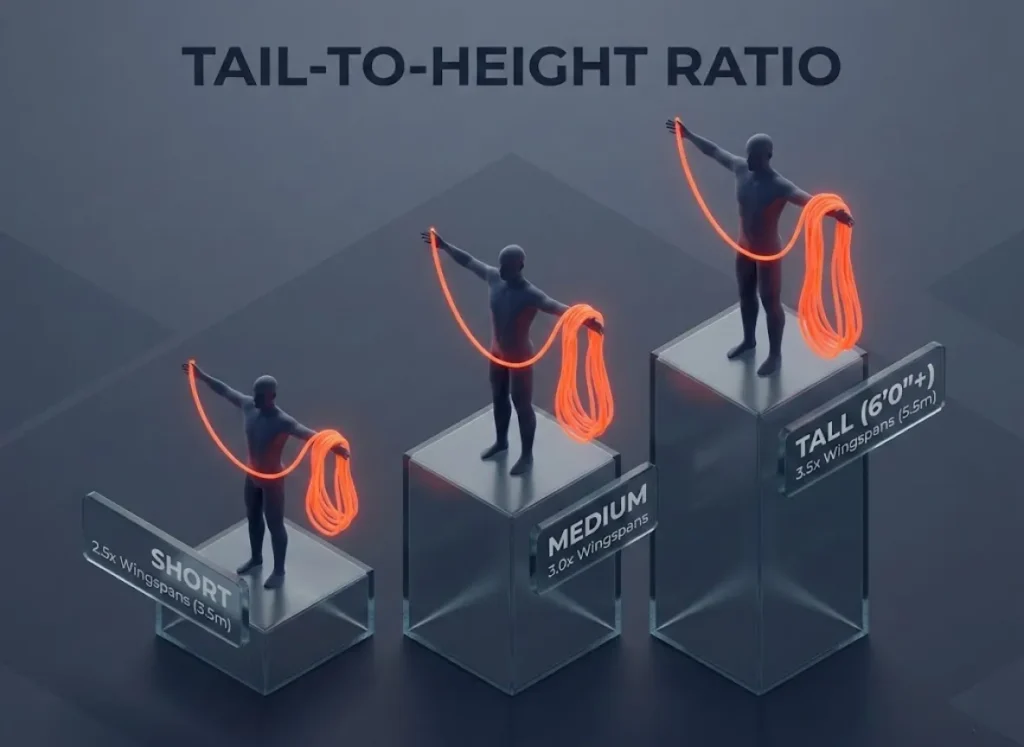
If you are tall (over 6’0″), you need more rope—aim for nearly 5.5 meters. Shorter climbers might only need 3.5 meters. You also need to think about what you are wearing. Winter climbing means big puffy jackets, which make your waist bigger, so you will need a little extra rope length.
It is always better to have too much tail than too little. You can tuck extra rope away easily. If the tail is too short, you have to tie the waist knot too tight, which makes it hard to breathe. A short tail also forces the knot to sit too high on your ribs instead of your hips, which ruins the weight transfer. Knowing your essential climbing knots is a must for securing this system.
The fastest way to coil.
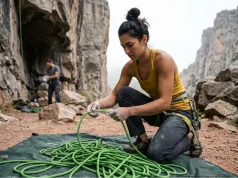
Speed counts when you are starting early in the alpine. The double-strand butterfly is the standard for guides because it processes two meters of rope for every single arm movement. It is significantly faster than the single-strand butterfly method.
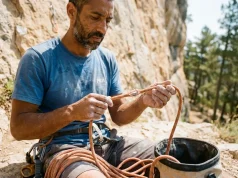
Start by holding the middle of the rope (if using a doubled rope technique) in one hand. Pull both strands at the same time and drape the loops over your neck anchor. You can also use your hand like a saddle if you prefer a shoulder anchor. Make sure the bottom of the loops hangs no lower than your mid-thigh or knee. If the loops touch the ground, they will snag on bushes and rocks while you hike.
Stack the rope slightly back and forth (left-right-left) on your neck. This creates a flatter bundle that sits smooth against your back. This keeps your profile low, which matches military mountaineering course standards for moving through steep terrain.
Pro-Tip: Keep your loops the same size. One long loop hanging down is a tripping hazard and can get caught on your gear or rocks.
The best part is the “Butterfly Drop.” When you get to the climb, you can take this coil off and the rope will feed directly out of it without needing to be flaked again. This flaking ease saves precious minutes and is key to mastering alpine rope management.
How Do You Turn the Coil into a Backpack?
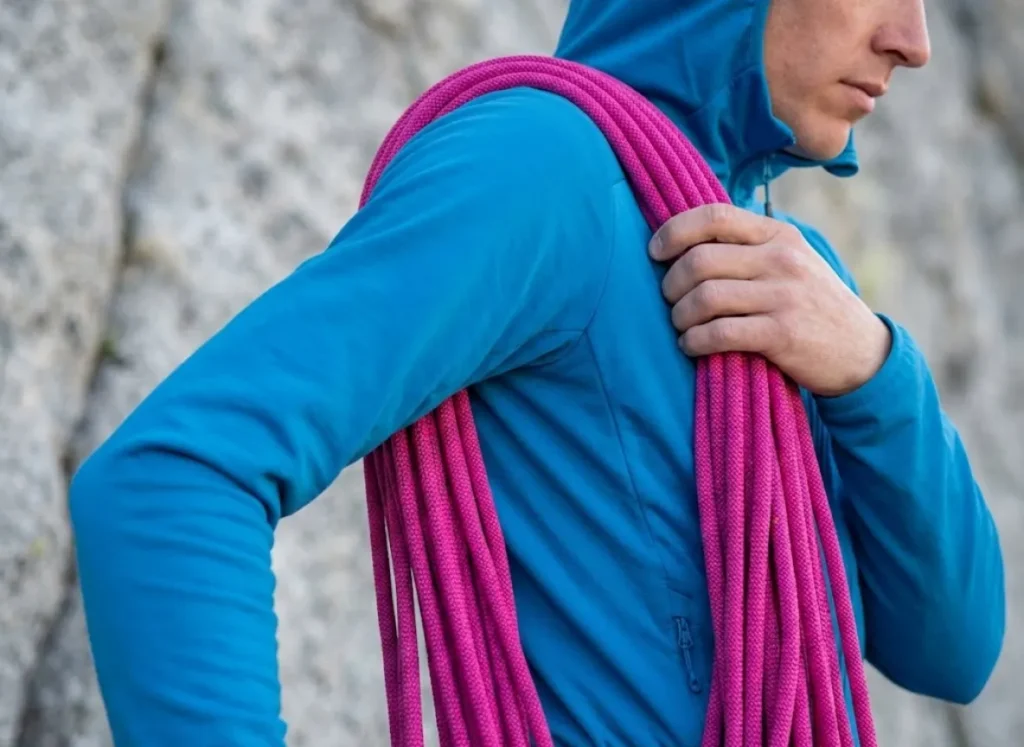
Locking it all together.
The backpack only works if you lock it tight with cinching wraps. Once the rope is coiled, take the tails and wrap them 3 to 4 times around the “neck” of the coil. Pull these wraps as tight as you can.
These wraps squeeze the loops into a solid spine. This stops the coil from getting sloppy and sliding off your shoulders. Make a final bight with the tails, pass it through the top of the coil, and thread the loose ends through to cinch the bight.
You have to make this neat and tight, a process known as dressing the coil. According to rescue systems manual on knot security, a loose lock allows the wraps to come undone, and the whole backpack will fall apart while you walk. The lock should sit near the back of your neck when you wear it. This puts the weight on your strong upper back muscles.
A tight coil acts like the frame of a backpack. It gives you support and airflow. Regular rope safety and inspection should include checking your rope for soft spots, which can make this locking process difficult.
Tying it to your body.
To wear the coil, put the tails over your shoulders and run them straight down under your armpits—just like backpack straps. Do not cross them over your chest. That can make it hard to breathe when you are hiking hard.
Bring the tails behind your back and cross them over the rope coil. Pull tight to cinch the coil against your spine. Bring the tails forward to your waist and tie a firm square knot (Reef Knot) at your belly button. This creates a waist connection that puts the weight on your hips.
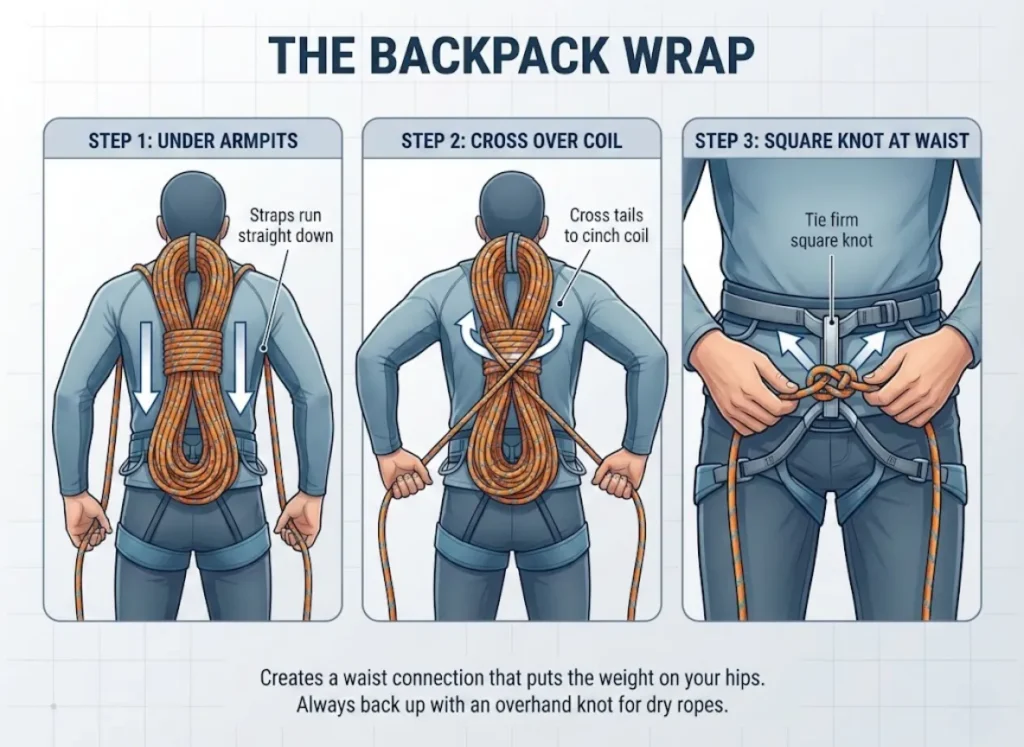
Be careful with different rope types. Dry vs non-dry climbing ropes feel different. Dry-treated ropes are slippery, so the waist knot might come loose. Manufacturer knot limitations and safety warnings remind us that coatings affect how well knots hold. Always back up your square knot with an overhand knot or tuck the ends away securely.
Make sure the loose ends of the knot are tucked into your pockets, or behind your harness. You don’t want them snagging on rocks or interfering with your belay loop.
Wrapping Up
Real skill in the outdoors is about turning what you know into smooth action for ultimate climbing performance.
- The butterfly method is the only way to carry a rope that guarantees no twists when you are ready to climb.
- Measuring with your wingspan is the only reliable way to ensure you have enough tail for a comfortable backpack carry.
- The double-strand butterfly cuts your coiling time in half, improving multipitch efficiency so you can stop messing with gear and start climbing.
Next time you pull your rope, commit to the double-strand butterfly. Practice it in your living room. When the alpine start demands speed, your hands will know exactly what to do.
FAQ – Frequently Asked Questions
Why does my rope twist and kink after I uncoil it?
Rope kinking usually happens because of the Mountaineer’s Coil (loops), which adds a twist with every loop. It can also happen if you uncoil it wrong. The butterfly coil cancels out this twist, so the rope feeds flat and tangle-free.
How much rope tail do I need for a backpack carry?
A good rule of thumb for tail length is 2.5 to 3 full wingspans (about 4 to 5 meters). If you are tall or wearing bulky winter clothes, this tail-to-body-height ratio suggests aiming for 3.5 wingspans to ensure the waist knot can be tied securely.
Can I store my rope in a Butterfly Coil long-term?
Yes. The butterfly coil offers excellent storage suitability because it doesn’t twist the rope fibers. However, storing it loosely in a rope bag is also fine and lets the fibers relax completely.
What is the difference between a Butterfly Coil and a Kiwi Coil?
A butterfly coil is for carrying a stored rope on your back like a backpack. A kiwi coil is used while climbing or walking on a glacier to shorten the distance between you and your partner. Do not confuse either with the alpine butterfly knot, which is a loop tied in the middle of a rope for isolation or clipping.
Safety Notice: Rock climbing and mountaineering are inherently high-risk
activities that can involve physical trauma or fatal incidents. The information on Rock Climbing Realms is for
educational and informational purposes only. Techniques and advice presented here are not a substitute
for professional, hands-on instruction. Conditions and risks vary by location. Always seek guidance
from a qualified instructor before attempting new techniques. By using this website, you agree that you
are solely responsible for your own safety. Any reliance you place on this information is strictly
at your own risk, and you assume all liability for your actions. Rock Climbing Realms and its authors
will not be held liable for any harm, damage, or loss sustained in connection with the use of this information.
Affiliate Disclosure: We are a participant in the Amazon Services LLC Associates Program, an
affiliate advertising program designed to provide a means for us to earn advertising fees by advertising and linking
to Amazon.com. As an Amazon Associate, we earn from qualifying purchases. We are also an official affiliate partner
of Black Diamond Equipment via the AvantLink network. If you click on a Black Diamond affiliate link and make a
purchase, we may earn a commission at no additional cost to you. We also participate in other affiliate programs.
Additional terms are found in the terms of service.