
In this article
You reach for the next climbing hold, and your hand instinctively recoils. The surface is slick, sloping, and offers no positive edge to latch onto. In that split second, your success isn’t determined by raw grip strength alone, but by a rapid calculation of friction dependence, center of gravity positioning, and anatomical preservation.
As a climbing guide, I have watched countless strong rock climbers fail on climbing routes well below their physical limit simply because they misunderstood the geometry of the plastic in front of them. Modern climbing hold shapes are no longer random chunks of resin; they are sophisticated engineering marvels designed to manipulate your biomechanics and force specific movement patterns.
Mastering these basic 5 hold types is not just about memorizing names. It is about understanding the conversation between the route setting function and your body’s physiological limits. This intelligent climber’s guide moves beyond visual identification to explain why a hold feels the way it does and how to grip it without injury.
Why Does Hold Shape Dictate Grip Mechanics?

The geometry of a hold forces the climber to utilize specific levers within the hand and forearm. This interaction directly influences injury prevention and force generation, dictating whether you should hang on your skeleton or engage a high-tension crimp.
How Does the Crimp Grip Affect Tendon Load?
The crimp grip places extreme load on the annular pulley system, specifically the A2 pulley, as the flexor tendons attempt to “bowstring” away from the phalanges during high-force moves.
The “Crimp” is the dominant grip for small incut edges, chips, or rails. It is characterized anatomically by the flexion of the PIP joint (Proximal Interphalangeal) to approximately 90 degrees and the hyperextension of the DIP joint (Distal Interphalangeal). To execute a “Full Crimp” (or closed crimp), you wrap the thumb over the index finger (thumb-wrapping). This locks the grip to maximize the mechanical advantage of the flexor digitorum profundus (FDP) muscle and generates maximal tip-to-tip tension.
However, this mechanical advantage comes at a steep physiological cost. Biomechanical analysis of pulley forces indicates that dynamic loading in a full crimp can exert forces up to three times the load applied at the fingertip. This multiplier effect is the primary mechanism for pulley ruptures on thin edges.

Conversely, the “Half-Crimp” maintains PIP flexion but leaves the thumb passive and the DIP joints neutral. This offers a balance between strength and safety. A vital part of understanding the climber’s hand anatomy is knowing when to switch gears. Strategic climbers utilize the Open Hand grip whenever possible to reduce pulley strain risk, reserving the Full Crimp only for limit-level crux moves where maximum leverage is non-negotiable.
What Is the Quadriga Effect in Pocket Climbing?
The Quadriga Phenomenon occurs because the Flexor Digitorum Profundus (FDP) muscle shares a common muscle belly and interconnected tendon slips for the middle, ring, and little fingers.
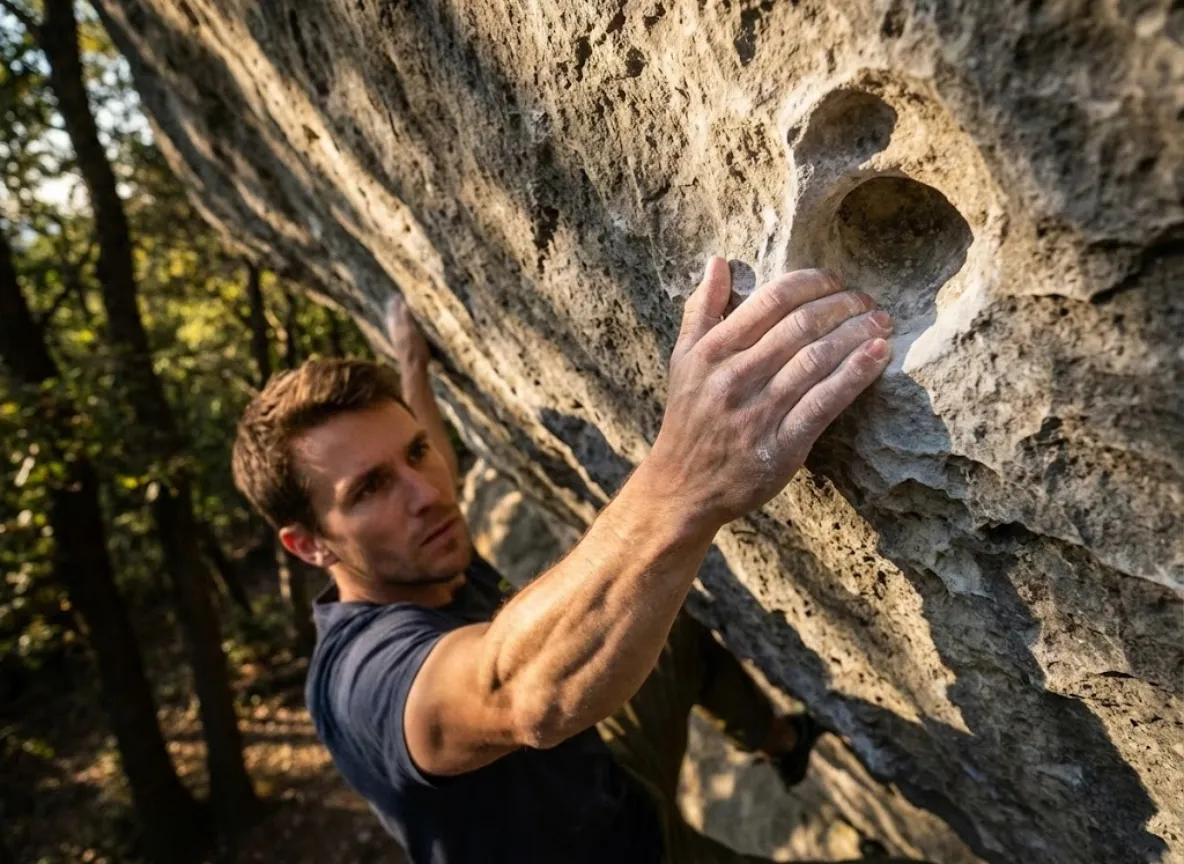
Pockets are concave recesses, often simulating holes in real rock, designed to isolate one (mono), two (bi-fingers / bis), or three fingers (tri-fingers). This shape forces you to bypass the hand’s natural load-sharing mechanism. When you flex specific fingers into a pocket while keeping adjacent fingers extended—such as the common “dropped pinky” technique—the common muscle belly is pulled in opposing directions simultaneously.
This antagonistic tension creates immense shear force. It can reduce maximal force output by up to 48% due to the “tethering” of the inactive tendons. More critically, this shear force is a leading cause of lumbrical muscle tears. The smaller stabilizing muscles are literally torn apart by the divergent pulls of the flexor tendons.
To navigate the flexor tendon pulley system safely on these rounded openings, aim to keep the non-engaged fingers slightly flexed rather than fully extended. This reduces the tension differential across the palm. Additionally, many advanced climbers preemptively utilize methods for taping fingers for pulley support to add external stability to the isolated tendons.
What Are the Fundamental Climbing Hold Types?

We can now categorize the standard hold shapes found in climbing gyms and outdoors. Moving beyond visual identification, we must look at the physics required to utilize these essential building blocks effectively.
How Should You Approach Jugs and Incuts?
The primary technique for jugs and incuts is a relaxed “hook” grip, allowing the climber to hang on the skeletal structure rather than taxing the forearms.
“Jugs” (or buckets) are the most secure positive hold types. They are defined by a deep, positive lip that allows the fingers to hook securely behind the edge. “Incuts” are smaller variations that maintain a positive angle but accommodate less surface area. They often bridge the gap between a jug and a large crimp.

While the standard definition and taxonomy of climbing holds categorizes jugs as “easy” resting holds, they present a hidden risk. The high friction and deep incut can catch callus folds during dynamic moves, leading to painful “flappers” (skin tears).
Setters strategically place jugs on steep overhang climbs or roofs to allow for recovery. They are also staples on beginner-level climbs to ensure security. Experienced climbers use jugs as recovery stations to shake out pumped forearms. However, this is only effective if you hang with straight arms to conserve upper body strength. This hold type is often essential for understanding bouldering grades in the V0-V2 range.
Pro-Tip: On sharp jugs or incuts, avoid over-gripping. Squeeze only as hard as necessary to stay on the wall. Over-squeezing on positive holds is the fastest way to flash-pump your forearms.
What Is the Secret to Holding Slopers?
Success on a sloper depends on maximizing the Normal Force—the force applied perpendicular to the hold’s surface—rather than generating shear force.
Slopers are rounded, bulbous, or flat holds that lack a positive edge, often resembling a large chunk of eroded granite. To stick a sloping hold, you must rely on friction dependence (Amontons’ Law) and body tension. The “Meat Hook” or open-hand palm press is the standard technique. The goal is to cover as much surface area as possible to engage the viscoelastic properties of the skin.
Biomechanically, you must position your Center of Gravity (COG) directly beneath the hold. If your hips drift outward, the force vector shifts to shear, causing a slip. Advanced technique involves the “sag,” where you straighten your arms and sink your hips low to align the gravity vector with the hold’s optimal friction surface.
Research on muscle hemodynamics in sports climbing suggests that body tension is critical here. Because slopers rely on friction, they are highly sensitive to environmental conditions. Using quality climbing chalk enhances grip significantly by removing moisture that acts as a lubricant on the smooth surfaces.
How Do Pinches Challenge the Forearm Extensors?
Pinches require opposition force between the thumb and the fingers, engaging the adductor pollicis muscle and forcing the hand into a squeezing rather than pulling mechanic.
These holds range from narrow “ribs” or tufas that allow for a skeletal lock to wide “blocks” or block-like structures. Unlike crimps or jugs, pinches often require significant involvement of the pectoralis muscles and core. You must generate enough compression force to effectively “clamp” your body to the wall using torque.
Wide pinches place high stress on the Triangular Fibrocartilage Complex (TFCC) in the wrist due to ulnar deviation. Motion analysis of the wrist shows that maintaining a stable wrist position under load is critical for injury prevention.
Training for pinches differs from other holds. It requires strengthening the thumb flexors and the antagonist extensor muscles. Incorporating specific grip strength exercises for climbing that target the thumb and wrist stabilizers is essential for mastering these compression-based moves. This grip is often utilized on gastons (pulling outward with the thumb down) or sidepulls (pulling inward with the thumb up), where thumb-catch engagement is key.
How Have Volumes and Macros Changed Route Setting?

Indoor climbing has evolved toward large-scale features. We must distinguish between structural changes to the wall and standard holds to understand the unique techniques they demand.
What Distinguishes a Volume from a Macro?
“Volumes” are large, structural features (often wood or fiberglass) bolted to the wall to alter its 3D geometry, effectively turning a flat wall into a grabbable wall corner (arete), slab, or overhang. “Macros” are large climbing holds (usually PU or fiberglass) that are significantly bigger than standard handholds but smaller than volumes; they function as distinct holds rather than terrain modifiers.
In competitive and most commercial settings, volumes are considered “part of the wall.” This means climbers can smear, press, or stand on any part of them unless marked otherwise. The introduction of these features has driven the sport toward “Parkour” style movement. This encourages coordination-based actions like running and jumping rather than static pulling on tiny ledges.
Modern manufacturing, such as recyclable thermoplastic macros, allows these massive shapes to be lightweight and durable hollow-backs. Tactically, volumes require “compression” climbing—squeezing the entire feature with the arms and legs. This is a stark departure from the isolated finger strength required for indoor rock climbing for adults on older, crimp-heavy routes.
How Do Dual-Texture Holds Force Precision?
Dual-texture (Dual-tex) holds feature two distinct surfaces on a single unit: a standard textured area for gripping and a polished, glassy area that offers zero friction.
Setters use dual-tex as a tool for “beta forcing.” By orienting the slick side to eliminate specific feet or hand positions, they dictate the exact sequence you must execute. Climbing on dual-tex requires immense precision. Missing the “sweet spot” results in an immediate slip, as the glossy surface provides no purchase for rubber or skin.

This hold type penalizes “sloppy” footwork and smearing. It forces you to place your toe exactly on the textured section and maintain tension. The evolution of climbing holds has moved towards these complex textures to test technical mastery over raw power. Consequently, having a solid climbing shoe rubber guide is helpful, as softer rubbers often deform better onto the small textured patches available on these micro holds and jibs.
Why Do Hold Materials Matter for Your Skin and Setup?

The chemical composition of holds affects friction, durability, and skin friendliness. This knowledge is crucial for both gyms and home wall setup.
What Are the Differences Between PU, PE, and Wood?
Polyester Resin (PE) is the old standard. It is known for a dry, stone-like texture that mimics real rock but is brittle and prone to cracking if overtightened. Polyurethane (PU) is the modern climbing gym standard. It is prized for its ductility and impact resistance. It flexes slightly against the wall rather than cracking, making it ideal for commercial use and bolt-on applications.
Wood is used primarily for training boards (e.g., Tension Board) or cracks. It is skin-friendly and smooth, forcing climbers to rely on active tension rather than skin friction. This saves your fingertips for outdoor climbing days.
From a chemical perspective, the difference between Polyether PU vs Polyester PU properties determines longevity. PE holds tend to be heavier and retain a “crunchy” texture that holds chalk well. PU is lighter but can “polish” or become slick over time in high-traffic gyms.
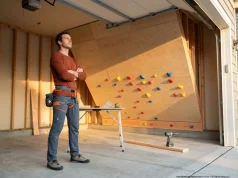
For those looking to buy climbing holds for your home wall, PU is generally preferred for its durability. It reduces the risk of breaking during frequent resetting, despite being more expensive than PE. When installing, ensure you have the correct fixing mechanisms, using t-nuts for bolt-ons and appropriate screws for screw-on jibs.
Pro-Tip: If you are building a home wall, mix your materials. Use wood for training holds to save skin, and PU for feet and large jugs to prevent breakage.
Conclusion
Climbing holds are active variables in the vertical equation. A crimp is a lever that magnifies tendon force, while a sloper is a friction puzzle dependent on body angles. The evolution from simple resin shapes to complex macros and dual-texture volumes has shifted the sport toward coordination and precision, demanding a broader skillset.
Biomechanical safety is proactive. Avoiding full crimps on pockets and maintaining tendon health on jugs prevents the most common climbing injuries. Whether building a home wall or projecting in the gym, knowing the difference between PE brittleness and flexible PU helps you choose the right tools for your training.
Next time you’re at the gym, take a moment to inspect the climbing route before you climb. Identify the hold types, predict the grip they demand, and visualize your body position to challenge gravity.
FAQ – Frequently Asked Questions
What is the hardest climbing hold type to grip?
Most climbers consider the sloper or the mono-pocket the hardest. Slopers require perfect body positioning and friction rather than just strength. Mono-pockets demand extreme isolated tendon strength and carry a high injury risk.
Why do some climbing holds spin or rotate?
Holds spin when the main bolt is not tightened sufficiently or if the hold lacks a secondary set screw (pinner) to lock it in place. Spinning is more common with Polyester (PE) holds which are rigid; Polyurethane (PU) holds flex slightly to grip the wall texture better, reducing spin frequency.
What is the difference between a volume and a macro?
A volume is a large, structural feature (usually wood or fiberglass) that changes the wall’s geometry and is considered on for all limbs unless marked otherwise. A macro is a very large hold (usually PU or fiberglass) that functions as a distinct hand or foothold but is not considered part of the wall structure itself.
How do I clean climbing holds on my home wall?
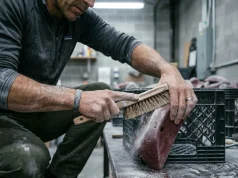
The standard method is to soak them in warm water with a mild detergent (like dish soap) and scrub them with a stiff nylon brush to remove shoe rubber and chalk buildup. Avoid using harsh chemicals or metal wire brushes, as these can damage the texture of the plastic and ruin the hold’s friction properties.
Safety Notice: Rock climbing and mountaineering are inherently high-risk
activities that can involve physical trauma or fatal incidents. The information on Rock Climbing Realms is for
educational and informational purposes only. Techniques and advice presented here are not a substitute
for professional, hands-on instruction. Conditions and risks vary by location. Always seek guidance
from a qualified instructor before attempting new techniques. By using this website, you agree that you
are solely responsible for your own safety. Any reliance you place on this information is strictly
at your own risk, and you assume all liability for your actions. Rock Climbing Realms and its authors
will not be held liable for any harm, damage, or loss sustained in connection with the use of this information.
Affiliate Disclosure: We are a participant in the Amazon Services LLC Associates Program, an
affiliate advertising program designed to provide a means for us to earn advertising fees by advertising and linking
to Amazon.com. As an Amazon Associate, we earn from qualifying purchases. We are also an official affiliate partner
of Black Diamond Equipment via the AvantLink network. If you click on a Black Diamond affiliate link and make a
purchase, we may earn a commission at no additional cost to you. We also participate in other affiliate programs.
Additional terms are found in the terms of service.