In this article
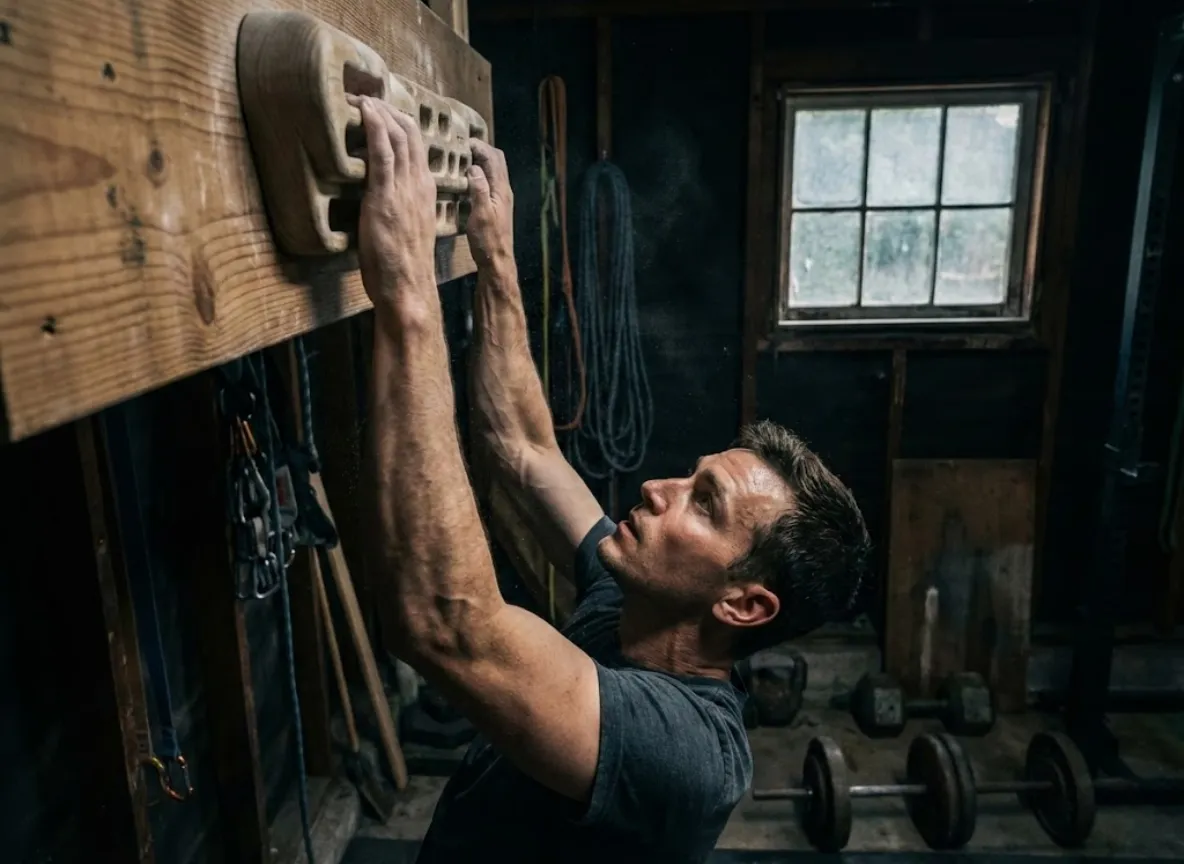
Gravity exposes the weak link instantly. You throw for the hold, latch the edge, and for a split second, you feel secure. Then, your fingers slowly uncurl against your will. It isn’t a failure of technique or desire; it is a failure of structural integrity.
As a climbing guide, I see this moment constantly. For the climber stuck at the 5.10 or V4 plateau, dedicated hangboard training is often the answer, but it is also a loaded weapon. Used correctly, it serves as a tool for connective tissue conditioning, remodeling weak links into steel cables; used recklessly, it snaps pulleys and ends seasons.
This isn’t just a random workout list. It is a physiological blueprint for navigating the dangerous gap between muscular power and tendon adaptation. We are going to treat the hangboard (or fingerboard) not as a test of ego, but as a medical device for structural remodeling.
Is Hangboarding Safe for Beginners? Defining the Entry Gate

Before we talk about protocols, we must define who you are as a climber. There is a massive difference between a “True Novice” and a “Training Novice.”
If you have been climbing for less than six months, you should not be on a hangboard. Your delicate joints are still adapting to the chaotic, multi-directional loading of climbing itself. At this stage, your primary gains come from neural adaptation—learning how to move.
We look for a v-grade prerequisite of consistent V3 (bouldering training) or 5.10 (route) climbing. This usually indicates that “newbie gains” have been exhausted and focused isolation training is now appropriate.
However, specific red flags immediately disqualify you. Do not start if you have active finger pain, recent pulley strains, or an inability to perform basic shoulder engagement tasks like proper pull-ups.
Am I Ready to Start Hangboarding?
Age is another critical factor often ignored in generic training plans. Adolescents are at a uniquely high risk for growth plate (epiphyseal) fractures. Dynamic loading or max hangs can cause permanent damage to skeletal structures that haven’t fused yet.
We also have to dismantle “survivor bias.” You see pros hanging with massive added weight, but you don’t see the years of micro-adaptations that got them there. Copying a pro routine is dangerous for a novice physiology.
You must pass the “Entry Gate” assessment: a pain-free, controlled engagement of the scapular stabilizers before adding finger load. Once you clear this, you need to understand the machinery you are loading, specifically understanding the A2 and A4 pulleys inside your fingers.
Why Do Muscles Grow Faster Than Tendons?
There is a biological trap waiting for every new climber called the “Adaptation Gap.” Muscle tissue is highly vascular; it receives significant blood flow and can adapt to stress in a matter of weeks. Tendons, however, are avascular. They are white, blood-poor tissues that take months or years to strengthen.
Connective tissue acts like a sponge. It requires mechanical loading and unloading to absorb synovial fluid through diffusion, rather than receiving nutrients through direct blood flow. This creates a “Window of Vulnerability” between months 6 and 18 of a climber’s life, where your flexors can generate more force than your pulleys can withstand.
When you crimp, the flexor tendons try to pull away from the bone—a phenomenon known as “Bowstringing.” The A2 pulley is the biological strap that prevents this. A full crimp generates roughly 31.5 times more force on the pulley than an open hand grip.
This is why the goal of beginner hangboard routines is “stiffness” and “density,” not raw power. We are building the chassis before we upgrade the engine, which is essential for breaking through the V5 plateau safely.
What Equipment Do I Need? Wood vs. Resin
Your choice of equipment dictates your skin health, which in turn dictates your training consistency.
Why Choose Wood Over Resin Boards?
Wooden boards (like the Beastmaker 1000 or Tension Simple Board) are hygroscopic, meaning they absorb moisture. This maintains consistent friction. Plastic boards (resin) are non-porous, causing sweat to pool between your skin and the hold, creating a “glassy” slip effect.
When friction is low, you rely on the texture of the hold to keep you on, which shreds skin. Wood demands “Active Compression.” The lower friction forces you to actively squeeze the hold, leading to better grip strength recruitment rather than just hanging on the skin’s surface tension.
Pro-Tip: If your gym only has resin boards (like an older Metolius Simulator), bring a portable wooden block or stick to the largest edges (jugs) available to save your skin for actual climbing.
Ergonomics also play a vital role. Cheap boards often have sharp edges that cut into the skin. High-quality wooden boards feature a specific “Fillet Radius”—a rounded edge that is ergonomic and distributes force evenly.
Be aware of the “20mm standard” anomaly. An edge depth of 20mm on one brand feels different than 20mm on another due to that edge curvature. Beginners should stick to one board for tracking progress when selecting climbing training tools.
The “Safe Strength” Protocols: Actionable Blueprints
We do not hang randomly. We use quantitative recipes. The goal for beginners is “Density hangs“—increasing the structural integrity of the tissue through volume and metabolic stress.
How to Perform the “Density” Repeater Protocol?
The Gold Standard for beginner-friendly hangboard training is the 7/3 rule (often called repeaters).
- The Set: Hang for 7 seconds. Rest for 3 seconds. Repeat this 6 times. This totals one minute of time under tension.
- The Volume: Perform 3 to 5 sets with a 3-minute rest duration between sets.
- The Grip: Use a “Half Crimp” (fingers at 90 degrees). Avoid the Full Crimp entirely.
This protocol targets the glycolytic energy system. The short hang duration paired with incomplete recovery forces metabolic stress. This signals the body to increase capillary density and hypertrophy in the forearms.
Intensity management is critical. The load should be sub-maximal, around 60-70% of your max effort. You should not be fighting for your life on the first rep. This lower peak force reduces rupture risk while conditioning the tissue through rock climbing finger training techniques designed for longevity.
Can I Hangboard if I Can’t Hold Bodyweight? (The No-Hang Method)
If you cannot complete a repeater set at bodyweight, do not cheat. Do not jump to the bar. Instead, use the Bathroom Scale Method, also known as “No-Hang.”
Place a digital scale underneath a hangboard or a portable block. Keep your feet on the scale and pull down on the board until the scale reading drops by a specific amount. For example, if you weigh 70kg and you want to load 50kg, pull until the scale reads 20kg.
This allows for precise progressive overload. You can aim to “lift” 2kg more next week without complex pulley setups.
From a safety perspective, this is superior because your feet on ground posture eliminates the “shock load” if your fingers slip. It bridges the gap for climbers who are physically strong but lack specific connective tissue density. You can also use this for “Recruitment” pulls—short, max-effort 10-second pulls to prime the nervous system safely.
Technical Execution & Injury Prevention
Knowing when to stop is a skill. Most beginners stop when they fall off. That is too late.
When Should I Stop the Set? Technical vs. Muscular Failure
We must distinguish between two types of failure. Muscular Failure is falling off the board because your muscles quit. Technical Failure is when your form breaks.
A form break looks like elbows dropping, shoulders shrugging up toward your ears (turtle shelling), or your grip sliding from a Half Crimp to an Open Hand drag.
The Golden Rule: The set ends at Technical failure.
Continuing past this point transfers load from the muscles (active support) to the ligaments (passive support). When the Flexor Digitorum Profundus (FDP) muscle fatigues, the fingers uncurl. This places extreme shear force on the A2 pulley, often leading to a pop.
Use the “Pain Traffic Light” system:
- Green: Muscle soreness. Good.
- Yellow: Joint ache that warms up and goes away. Caution.
- Red: Sharp, point-tenderness or an audible popping sound. Stop immediately.
If you are entering the danger zone, proper support is vital. Learn about using rock climbing finger tape to provide external support to the pulleys if you suspect minor tweaks.
What Should I Do Between Sets? (Active Rest)
Do not sit on the mat and scroll through your phone. Sitting idly allows blood to pool and tissues to cool, increasing stiffness.
Use your 3-minute rest window for “Antagonist Training” (Active Rest). While the flexors rest, train the extensors. Perform light reverse wrist curls, finger expansions using a rubber band, or scapular wall slides.
Pro-Tip: Keep a rice bucket or a therapy band next to your hangboard. Do 20 reps of extensor work between every hang set.
This promotes blood flow, often called “the pump,” which aids in flushing lactate and delivering nutrients without fatiguing your primary gripping muscles. It also prevents common overuse injuries like Tennis Elbow (Lateral Epicondylitis) by balancing your comprehensive intro strength plan for climbers.
Nutrition & Recovery: Feeding the Tendons
Training provides the stimulus, but biology provides the repair. You can accelerate this process chemically.
Can Nutrition Speed Up Tendon Repair?
Recent research suggests a specific “Collagen Synthesis Window.” Consuming 15g of Hydrolyzed Collagen (or Gelatin) combined with 50mg of Vitamin C approximately 30–60 minutes before your session can improve tendon stiffness.
Think of your tendons as sponges. They absorb fluid when loaded. By pre-loading your blood with glycine and proline (the amino acids in collagen), you ensure these building blocks are sucked into the tissue during the workout.
Note that this is specific to connective tissue, not muscle protein synthesis. Vitamin C is a mandatory co-factor; without it, the synthesis process is impaired. This is a crucial addition to your strategy for hydration for climbers and overall intake.
Final Thoughts: The Long Game
The hangboard is a tool of patience. It rewards consistency over intensity and structure over ego.
Remember the hierarchy:
- Anatomy First: Respect the “Adaptation Gap.” Train for the tortoise (tendons), not the hare (muscles).
- Tools: Use wood for friction and the scale method for precision.
- Precision: Execute the 7/3 Repeater and stop at Technical Failure.
- Recovery: Feed your tendons with collagen and protect them with antagonist work.
You are building the foundation for a lifetime of climbing. Do not rush the process.
FAQ – Frequently Asked Questions
How many times a week should a beginner hangboard?
Beginners should hangboard no more than 2 times per week, with at least 48 to 72 hours of recovery time between sessions. Tendons have poor blood flow and recover much slower than muscles; frequent training accumulates damage faster than it can be repaired.
Is it better to hangboard before or after climbing?
You should hangboard before climbing (after a thorough 10-minute warm up) when your neural system is fresh and you can control your form perfectly. Hanging after climbing, when you are fatigued, significantly increases the risk of injury due to compromised form.
What is the best edge size for beginners?
A 20mm edge is the industry standard. Beginners should look for a board with a comfortable, rounded fillet radius (like the Beastmaker 1000). If 20mm is too difficult, do not use a smaller edge; instead, remove bodyweight using the bathroom scale method.
Should I use a full crimp on the hangboard?
No. Beginners should strictly use the Half Crimp (90-degree elbow) or Open Hand grip to minimize shear force on the A2 pulley. The Full Crimp generates excessive force and provides minimal physiological benefit over the Half Crimp for strength training purposes.
Risk Disclaimer: Rock climbing, mountaineering, and all related activities are inherently dangerous sports that can result in serious injury or death. The information provided on Rock Climbing Realms is for educational and informational purposes only. While we strive for accuracy, the information, techniques, and advice presented on this website are not a substitute for professional, hands-on instruction or your own best judgment. Conditions and risks can vary. Never attempt a new technique based solely on information read here. Always seek guidance from a qualified instructor. By using this website, you agree that you are solely responsible for your own safety. Any reliance you place on this information is therefore strictly at your own risk, and you assume all liability for your actions. Rock Climbing Realms and its authors will not be held liable for any injury, damage, or loss sustained in connection with the use of the information contained herein.
Affiliate Disclosure: We are a participant in the Amazon Services LLC Associates Program, an affiliate advertising program designed to provide a means for us to earn advertising fees by advertising and linking to Amazon.com. As an Amazon Associate, we earn from qualifying purchases. We also participate in other affiliate programs. Additional terms are found in the terms of service.